


Report Overview
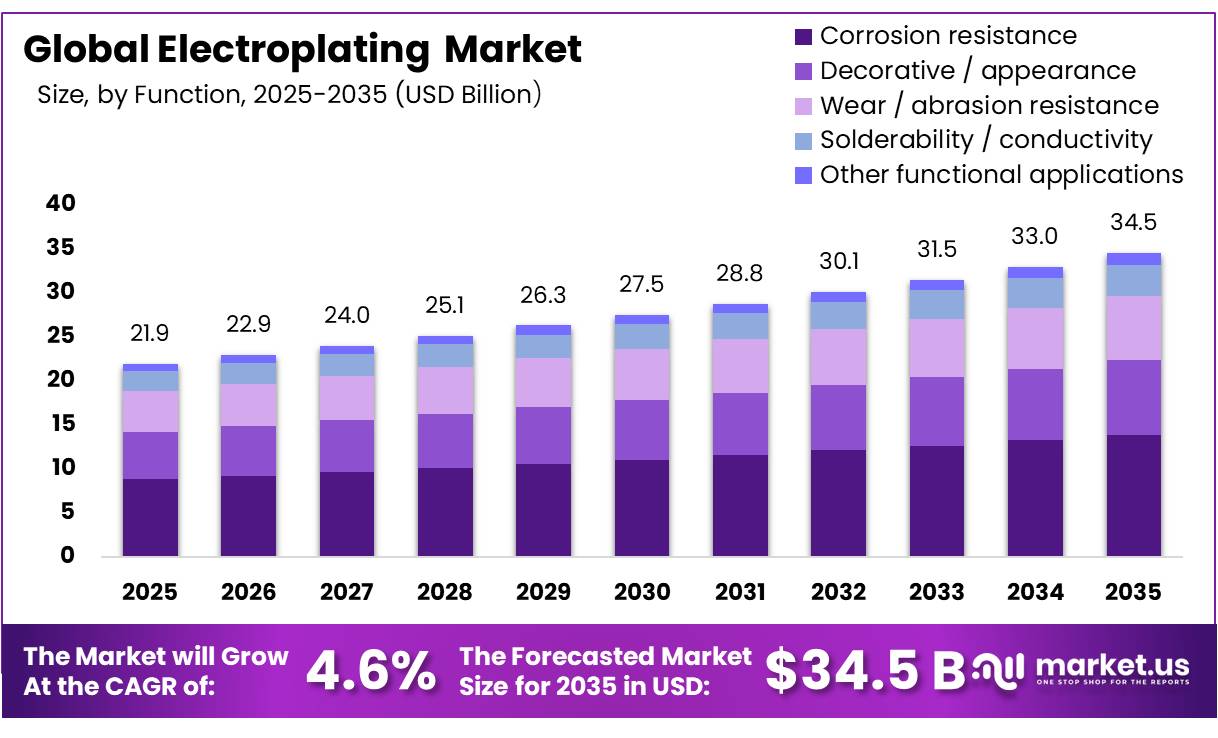
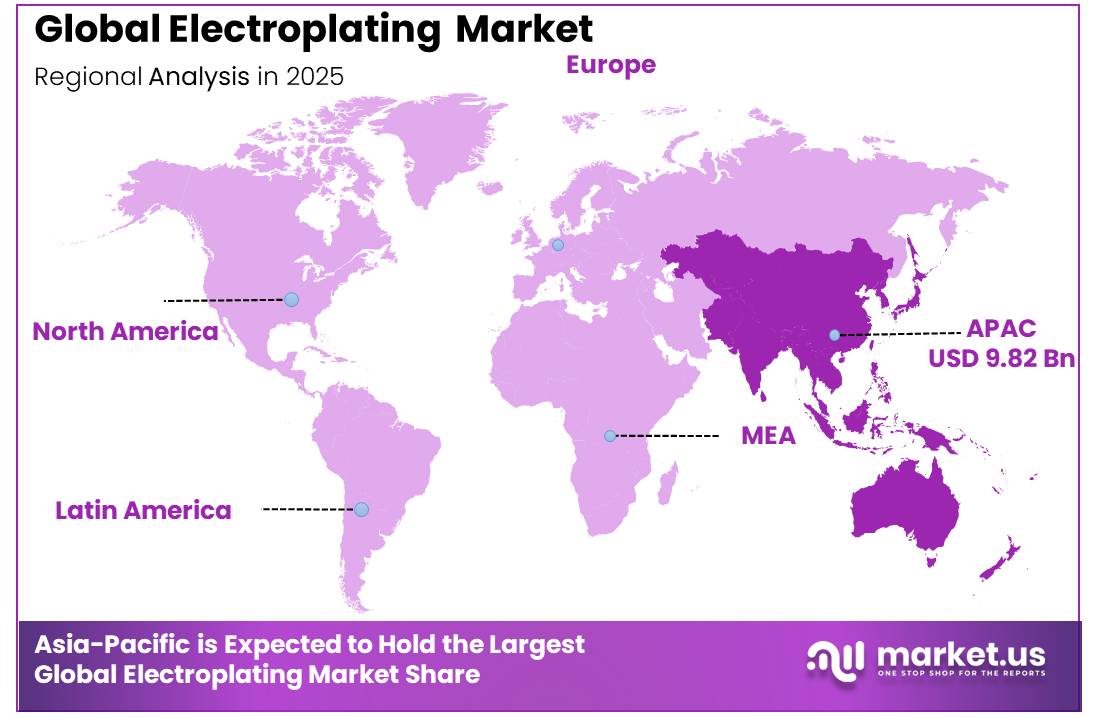
In 2025, the Global Electroplating Market was valued at USD 21.9 billion, and between 2026 and 2035, this market is estimated to register a CAGR of 4.6% reaching about USD 34.5 billion by 2035. Asia Pacific held a dominant market position, capturing more than 44.8% share and generating USD 9.82 billion in revenue.
Electroplating is a manufacturing process that applies a thin layer of metal onto the surface of another material using an electric current, improving the surface’s functional and aesthetic properties. Through electroplating, steel components gain better corrosion resistance, electrical connectors achieve higher conductivity, decorative products obtain a brighter finish and improved durability, and industrial parts become harder and more wear-resistant. Depending on the application, manufacturers commonly use metals such as nickel, zinc, copper, chromium, gold, and silver, with each metal providing specific performance benefits.
- According to the International Energy Agency (IEA), Global EV Outlook 2025, global electric car sales are projected to exceed 20 million units in 2025, representing more than 25% growth compared with 2024. This rapid expansion is increasing demand for electroplated battery terminals, electrical connectors, charging-system components, and other precision metal parts used in electric vehicles.
Key Takeaways
- The global electroplating market was valued at US$ 21.9 billion in 2025.
- The market is projected to grow at a CAGR of 4.6% and is estimated to reach US$ 34.5 billion by 2035.
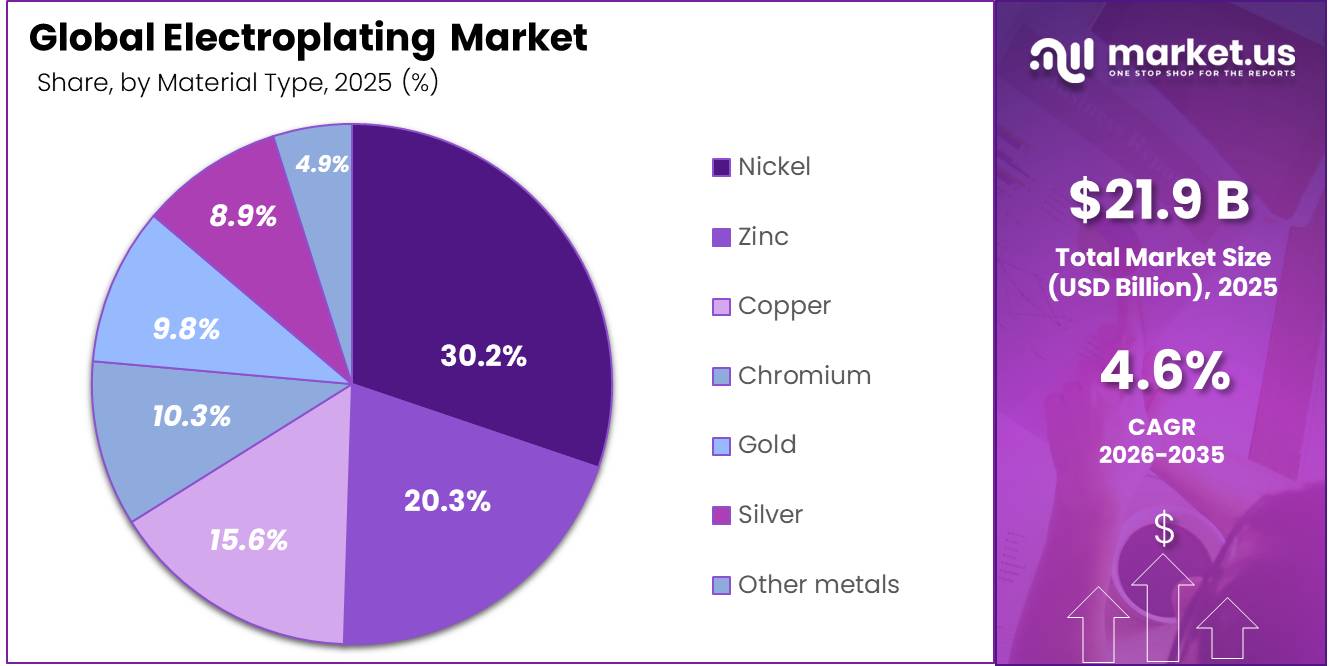
- On the basis of material type, nickel dominated the market, constituting 30.2% of the total market share.
- Based on the function, corrosion resistance dominated the electroplating market, with a substantial market share of around 40.1%.
- Based on the end-use industry, electrical and electronics led the market, comprising 30.1% of the total market.
- In 2025, Asia-Pacific was the most dominant region in the electroplating market, accounting for 44.8% of the total global consumption.
The commercial importance of electroplating lies in its versatility, reliability, and cost-effectiveness. The process can be applied to a wide range of metal substrates and is used across industries including automotive, electronics, aerospace, medical devices, industrial machinery, and consumer goods. Because it enhances product performance while remaining economically viable for large-scale production, electroplating has remained an essential manufacturing technology for nearly two centuries and continues to play a critical role in modern industrial production.
- According to the International Air Transport Association (IATA), 2025, global passenger demand, measured in revenue passenger kilometers (RPK), increased by 5.3% in 2025, while international passenger traffic grew by 7.1% compared with 2024. The continued expansion of air travel is supporting higher aircraft production and maintenance activity, increasing demand for electroplated fasteners, landing gear components, electrical connectors, and engine parts that require enhanced corrosion resistance and durability.
The Global Electroplating Market is driving due to the rapid expansion of high-value manufacturing industries, increasing demand for corrosion-resistant and high-performance components, and continuous advancements in precision engineering. The growing production of consumer electronics, electric vehicles (EVs), semiconductors, aerospace equipment, and medical devices is creating strong demand for electroplated components that offer improved conductivity, wear resistance, and durability.
- According to the Semiconductor Industry Association (SIA), 2025, global semiconductor sales reached a record USD 795.6 billion in 2025, representing a 26.2% increase compared with 2024. This growth is driving higher demand for electroplating materials such as copper, nickel, gold, silver, and palladium, which are widely used in semiconductor chips, printed circuit boards (PCBs), electrical contacts, and advanced packaging components.
In addition, industries are shifting toward environmentally friendly plating chemicals, low-emission processes, and resource-efficient technologies to comply with stricter environmental regulations, creating new opportunities for innovation and capacity expansion. As industrial production becomes more technology-intensive and quality standards continue to rise, electroplating remains a critical process that supports the manufacturing of reliable, high-performance components across multiple end-use sectors, sustaining the market’s long-term growth.
Material Type Analysis
Nickel Represents the Dominant Segment in the Market.
Nickel leads the electroplating material segment with a 30.2% share, and its dominance is built on a combination of performance versatility and broad industrial applicability that no other plating metal can quite match. Nickel plating delivers an exceptional combination of corrosion resistance, hardness, and surface uniformity that makes it the go-to choice across automotive parts, electronic connectors, industrial components, and consumer goods where durability and consistent appearance matter simultaneously.
It also serves as an excellent undercoat beneath other plating metals particularly chromium and gold improving adhesion and extending the overall lifespan of the finished plated component. The automotive and electronics industries the two largest end-use sectors in the entire electroplating market are both heavy consumers of nickel plating, which creates a structural and self-reinforcing demand base that keeps nickel firmly at the top of the material hierarchy.
Zinc is the dominant choice for corrosion protection in automotive and construction applications particularly for steel components exposed to outdoor environments because it offers reliable and cost-effective protection at a price point that makes it commercially viable for high-volume production.
- In February 2026, the U.S. Geological Survey reported that U.S. primary nickel consumption reached 120,000 metric tons in 2025. The agency identified electroplating as one of the country’s leading primary nickel applications, alongside alloys and steels, reflecting continued industrial demand for nickel-based protective and decorative coatings.
Function Analysis
Corrosion Resistance Represents the Dominant Functional Segment in the Market.
Corrosion resistance accounts for 40.1% of total electroplating functional demand the largest segment by a clear margin because protecting metal components from the destructive effects of moisture, oxygen, chemicals, and environmental exposure is the most fundamental and commercially universal need that electroplating addresses. Every industry that uses metal components and that is essentially every manufacturing industry in the world has a corrosion problem that electroplating solves more cost-effectively and reliably than almost any alternative surface treatment.
Automotive components exposed to road salt and weather, marine hardware subjected to seawater, industrial machinery operating in chemically aggressive environments, and electronic connectors exposed to humidity all of these applications depend on corrosion-resistant electroplating as a non-negotiable part of their product specification and long-term performance reliability.
- The Association for Materials Protection and Performance reported in April 2025 that corrosion causes more than USD 2.5 trillion in economic losses globally each year, while established corrosion-control technologies and practices could prevent as much as 35% of these costs.
End-Use Industry Analysis
Electrical & Electronics Represents the Dominant End-Use Segment in the Market.
Electrical and electronics accounts for 30.1% of total electroplating end-use demand the largest segment and its leadership position reflects the extraordinary and growing dependence of modern electronics manufacturing on precision electroplated components. Every smartphone, laptop, tablet, circuit board, semiconductor package, and electronic connector in the world contains electroplated surfaces that are critical to the device’s electrical performance, reliability, and longevity.
The relentless pace of electronics innovation driven by 5G infrastructure rollout, IoT device proliferation, artificial intelligence hardware, and the miniaturisation of consumer electronics is creating an ever-increasing demand for more precise, more reliable, and more functional electroplated components across every layer of the electronics supply chain. India alone accounted for a significant share of global smartphone shipments in 2024 second only to China illustrating the regional scale of electronics manufacturing demand that is pulling electroplating capacity forward across Asia-Pacific.
Aerospace and defence represent the highest-value application segment per unit requiring the most exacting plating specifications, the longest qualification cycles, and the most rigorous quality documentation making it a technically challenging but commercially attractive segment for electroplating providers with the capability and certification to serve it.
- For instance, in 2025, Sharretts Plating Company provided gold and nickel plating for electrical contacts, connectors, printed circuit boards and semiconductor components. The company states that approximately 0.8 micron of hard gold over 1.3 microns of nickel provides sufficient durability for most electronic connector applications, improving conductivity, wear resistance and signal reliability.
Key Market Segments
By Material Type
- Nickel
- Zinc
- Copper
- Chromium
- Gold
- Silver
- Other metals
By Function
- Corrosion resistance
- Decorative / appearance
- Wear / abrasion resistance
- Solderability / conductivity
- Other functional applications
By End-use Industry
- Electrical & electronics
- Automotive
- Industrial machinery
- Jewellery & decorative
- Aerospace & defense
- Medical devices
- Other end uses
Driver Analysis
EV and auto electrification plating load-up
Vehicle electrification is lifting electroplating demand less through total unit count and more through higher plated-value content per vehicle because EV architectures expand use of plated busbars, battery interconnects, connector pins, thermal management parts, fasteners, braking components, and corrosion-resistant lightweight substrates. The EU auto industry’s 2025 production structure showed continued rebalancing in vehicle output and supply sourcing, while large vehicle manufacturing systems in Asia continue to pull coating and finishing demand into regional supplier clusters; at the same time, plating chemistries tied to nickel, copper, zinc, and chromium remain central to corrosion resistance and conductivity requirements.
On the input side, USGS reported estimated global nickel mine production up 5% in 2025 to about 3.9 million tons, with Indonesia up about 13%, easing one major raw-material bottleneck for nickel-bearing plating chains and supporting expansion in APAC-linked component production. Strategically, this shifts business models toward higher-throughput selective plating lines, tighter thickness tolerances, and more captive finishing inside Tier-1 and battery-component ecosystems; that is why the driver adds an estimated +1.3 percentage points to baseline CAGR rather than a larger figure, since EV growth is strong but plating intensity is concentrated in selected subsystems rather than every metal surface.
Drivers Impact Analysis
| Driver | (~) % Impact on CAGR Forecast | Geographic Relevance | Impact Timeline |
|---|---|---|---|
| EV and auto electrification plating load-up | +1.3% | China core, EU, North America, ASEAN spill-over | Medium term (2-4 years) |
| Aerospace and defense surface finishing recovery | +0.9% | North America core, EU, Japan | Short term (≤ 2 years) |
| PFAS and chromium wastewater compliance retrofits | +0.8% | US core, EU selective, developed Asia | Short term (≤ 2 years) |
| Nickel-zinc-copper feedstock availability expansion | +0.7% | Indonesia-to-APAC chain, China, EU importers, US buyers | Medium term (2-4 years) |
| Electronics and connector miniaturization plating intensity | +1.0% | East Asia core, North America design hubs, EU industrial electronics | Medium term (2-4 years) |
| Industrial corrosion-control replacement demand | +0.6% | India, ASEAN, Middle East, South America spill-over | Long term (≥ 4 years) |
Restraint Analysis
Cr(VI) compliance burden
Hexavalent chromium remains the single most commercially disruptive restraint because chrome plating lines face a dual cost stack of worker-exposure control and chemical authorization uncertainty: in the U.S., the OSHA exposure framework centers on a 5 micrograms per cubic meter 8-hour permissible exposure limit and a 2.5 micrograms per cubic meter action level that can trigger periodic monitoring, engineering controls, and medical surveillance, while in Europe the chromium(VI) restriction debate intensified in 2025 with consultation parameters discussing site emission thresholds as low as 0.25 kg/year to air and 1.5 kg/year to water under the tighter option, plus an 18-month transition concept after adoption; the result is that plating operators must either overinvest early in fume suppression, enclosure, scrubbers, and substitution trials or accept delayed customer qualification, lower line utilization, and selective shutdown of decorative hard-chrome capacity, which in practical forecasting terms trims roughly 120 basis points from 2026 baseline growth in EU-heavy and export-certified supply chains because customer onboarding stretches by 6 to 12 months and compliance overhead can absorb 3% to 7% of EBITDA at subscale facilities.
Restraint Impact Analysis
| Restraint | (~) % Impact on CAGR Forecast | Geographic Relevance | Impact Timeline |
|---|---|---|---|
| Cr(VI) compliance burden | -1.2% | EU core, North America core | Short term (≤ 2 years) |
| Wastewater treatment CapEx | -0.9% | North America core, EU, India clusters | Medium term (2-4 years) |
| Energy-intensive plating economics | -0.8% | EU, Northeast Asia, high-tariff grids | Short term (≤ 2 years) |
| Raw material price volatility | -0.7% | Global, APAC corridors, import-reliant markets | Medium term (2-4 years) |
| Skilled labor scarcity | -0.5% | North America core, Western Europe | Medium term (2-4 years) |
| End-market CapEx slowdown | -0.6% | North America, EU industrial belts | Short term (≤ 2 years) |
Opportunity Analysis
Aerospace reshoring finishers
This is an opportunity rather than a driver because aerospace plating remains a narrower certification-heavy niche, and the upside emerges when regional supply-chain reshoring and resilience programs create localized shortages of NADCAP-like, defense-grade, and high-specification surface finishing capacity that incumbent general industrial platers can enter through acquisition or capex.
The value creation case is based on scarcity economics: certified aerospace and defense finishing lines can sustain 15% to 30% price premiums versus general industrial work, long contract lives can lift capacity utilization from sub-70% levels to 80% to 90%, and bolt-on acquisition roll-ups of small specialty finishers can unlock 200 to 400 basis points of margin through shared chemistry procurement, environmental systems, and lab overhead, supporting about +1.3 percentage points of CAGR upside in North America and Europe through the early 2030s.
Opportunity Impact Analysis
| Opportunity | (~) % Potential CAGR Upside | Geographic Relevance | Execution Window |
|---|---|---|---|
| Battery materials plating | +2.4% | APAC core, EU, North America | Medium term (2-4 years) |
| Closed-loop metal recovery | +1.9% | EU, North America, China, India | Short term (≤ 2 years) |
| High-reliability electronics | +1.7% | North America core, EU, Japan, Korea | Medium term (2-4 years) |
| Aerospace reshoring finishers | +1.3% | North America, EU | Medium term (2-4 years) |
| PFAS-free chrome substitution | +1.5% | North America core, EU | Short term (≤ 2 years) |
| Plating-as-a-service parks | +2.1% | India, ASEAN, LatAm, Eastern Europe | Long term (≥ 4 years) |
Challenges Analysis
Skilled operator attrition
Labor scarcity is a persistent execution challenge because electroplating depends on operators who can control bath chemistry, current density, surface preparation, masking, wastewater interfaces, and defect diagnosis simultaneously, yet U.S. labor data show only about 31,970 plating machine setters, operators, and tenders nationwide with a mean annual wage of $42,550, underscoring a relatively small and specialized workforce base inside a broader coating and allied-activities establishment universe.
The friction drag is estimated at 0.9 percentage points because even a 5 to 8 percent vacancy or retirement-driven skills gap in mature plants can cascade into lower line utilization, longer setup-to-release intervals, more scrap from thickness variation or adhesion failure, and training ramps of 6 to 12 months before new operators can independently manage multi-bath lines on aerospace, electronics, or automotive-grade specifications.
The strategic remedy is long-horizon and organizational rather than cyclical: firms need cross-training matrices, automated dosing and inline analytics to reduce dependence on tacit knowledge, wage ladder redesign in a labor pool where the 90th percentile annual wage is only $57,550, and stronger apprenticeship pipelines tied to environmental and safety certification so that workforce renewal improves process stability without compromising compliance.
Challenges Impact Analysis
| Challenge | (~) % CAGR Friction Drag | Geographic Relevance | Mitigation Horizon |
|---|---|---|---|
| PFAS wastewater transition | -0.8% | North America chrome lines; EU export-linked sites | Medium term (2-4 years) |
| Cr(VI) compliance redesign | -1.1% | EU regulatory hubs; North America aerospace-auto plating | Long term (≥ 4 years) |
| Skilled operator attrition | -0.9% | North America core; Western Europe mature plants; Japan/Korea legacy facilities | Long term (≥ 4 years) |
| Energy intensity volatility | -0.7% | EU finishing clusters; import-dependent APAC processors | Medium term (2-4 years) |
| Nickel chemistry price swing | -0.6% | Global nickel-plating chains; APAC procurement corridors pubs. | Short term (≤ 2 years) |
| Small-plant capex dilution | -0.8% | U.S. job shops; EU SME platers | Medium term (2-4 years) |
Geopolitical Impact Analysis
Trade Tariffs and Critical Metal Supply Concentration Are Reshaping the Electroplating Industry’s Cost and Supply Landscape
The electroplating market is significantly more exposed to geopolitical developments than its industrial positioning might suggest because the metals at the heart of the plating process are among the world’s most geopolitically sensitive commodities. Nickel, cobalt, copper, and precious metals like gold and silver are sourced from a concentrated group of countries, and any disruption to those supply relationships through trade restrictions, export controls, or geopolitical instability in key producing regions sends immediate and measurable cost shocks through the entire electroplating value chain.
US tariff measures introduced in 2025 have added direct procurement cost pressure across the electroplating industry with elevated import duties on Chinese-origin metals and chemical inputs forcing manufacturers to diversify sourcing toward higher-cost alternative suppliers while simultaneously managing retail price expectations from customers in highly competitive downstream industries. The Russia-Ukraine conflict has also affected palladium and platinum supply metals used in speciality electronics plating applications adding another layer of supply uncertainty to a market already managing multiple geopolitical risks simultaneously.
For instance: In 2025, US tariff escalation on Chinese-origin metals and chemical inputs directly impacted procurement costs across North American electroplating operations prompting major plating manufacturers to accelerate supplier diversification strategies and invest in domestic chemical supply partnerships to protect their cost competitiveness and production continuity.
Regional Analysis
Asia Pacific Leads the Global Electroplating Market.
In 2025, Asia Pacific dominated the global electroplating market, holding 44.8% of total global consumption a commanding lead built on the region’s position as the world’s undisputed manufacturing powerhouse across electronics, automotive, industrial machinery, and consumer goods. India is the fastest growing electroplating market within Asia-Pacific driven by rapidly expanding smartphone manufacturing, a growing automotive sector, and government-backed industrial development programmes that are pulling significant foreign manufacturing investment into the country.
China is the single largest national electroplating market in the world home to the highest concentration of electronics manufacturing, automotive component production, and general industrial manufacturing activity globally and its sheer production scale generates an electroplating demand base that no other country or region can come close to matching in volume terms. Japan and South Korea contribute significantly through their world-leading semiconductor, automotive, and precision electronics industries both requiring the highest-quality and most technically demanding electroplating solutions across their sophisticated manufacturing supply chains.
Key Regions and Countries Covered
- North America
- The US
- Canada
- Europe
- Germany
- France
- The UK
- Spain
- Italy
- Russia & CIS
- Rest of Europe
- APAC
- China
- Japan
- South Korea
- India
- ASEAN
- Rest of APAC
- Latin America
- Brazil
- Mexico
- Rest of Latin America
- Middle East & Africa
- GCC
- South Africa
- Rest of MEA
Key Players Analysis
The global electroplating market is served by a diverse competitive landscape that spans large multinational chemical and surface finishing technology companies, vertically integrated plating service providers, and specialist equipment and chemistry suppliers all competing across different application segments, geographies, and technical capability levels. The market’s largest revenue share is held by companies that combine proprietary plating chemistry with advanced process technology and broad geographic service coverage giving them the ability to serve multinational manufacturing customers consistently across multiple production sites in different countries.
Specialist and regional electroplating service providers make up the broader competitive field serving local manufacturing clusters with faster turnaround, more flexible service offerings, and deeper application-specific expertise than larger generalist competitors can always deliver. Many of these specialist providers are building strong positions in high-value niche segments precision electronics plating, aerospace-grade surface finishing, medical device coating where technical depth and qualification credentials matter more than geographic scale.
The Major Players in The Industry
- Atotech (MKS Instruments, Inc.)
- MacDermid Enthone Industrial Solutions
- JCU Corporation
- Pioneer Metal Finishing, LLC
- Interplex Holdings Pte. Ltd.
- Kuntz Electroplating Inc.
- Allied Finishing Inc.
- Sharretts Plating Company, Inc.
- Precision Plating Company
- Peninsula Metal Finishing, Inc.
- Roy Metal Finishing Company, Inc.
- Jing‑Mei Industrial Limited
- Toho Zinc Co., Ltd.
- Sheen Electroplaters Pvt. Ltd.
- Cherng Yi Hsing Plastic Plating Factory Co., Ltd.
- Others
Key Development
- In May 2026, JCU Corporation introduced its development roadmap for next-generation acid copper plating, covering the CU-BRITE, TIPHARES, TVP, RDP and BUP series for PCBs, package substrates, TSVs, RDLs, pillars and hybrid bonding used in AI accelerators, CPUs and GPUs.
- In January 2026, Cherng Yi Hsing Plastic Plating Factory shipped 744 kg of chrome-plated axle covers and 1,884 kg of decorative plastic automotive accessories, followed by a further 1,796 kg shipment in March 2026. Overall, the company recorded 3 transactions, 541 reported units, and 4,424 kg of shipment weight in 2026 through March.
Report Scope
| Report Features | Description |
|---|---|
| Market Value (2025) | US$21.9 Bn |
| Forecast Revenue (2035) | US$34.5 Bn |
| CAGR (2026-2035) | 4.6% |
| Base Year for Estimation | 2025 |
| Historic Period | 2020-2024 |
| Forecast Period | 2026-2035 |
| Report Coverage | Revenue Forecast, Market Dynamics, Competitive Landscape, Recent Developments |
| Segments Covered | By Material Type (Nickel, Zinc, Copper, Chromium, Gold, Silver, and Other Metals), By Function (Corrosion Resistance, Decorative/Appearance,Wear/, Solderability/Conductivity, Abrasion Resistance and Other Functional Applications), By End-Use Industry (Electrical & Electronics, Automotive, Industrial Machinery, Jewellery & Decorative, Aerospace & Defense, Medical Devices, and Other End Uses), |
| Regional Analysis | North America – The US & Canada; Europe – Germany, France, The UK, Spain, Italy, Russia & CIS, Rest of Europe; APAC– China, Japan, South Korea, India, ASEAN & Rest of APAC; Latin America– Brazil, Mexico & Rest of Latin America; Middle East & Africa– GCC, South Africa, & Rest of MEA |
| Competitive Landscape | Atotech (MKS Instruments, Inc.) MacDermid Enthone Industrial Solutions JCU CorporationPioneer Metal Finishing, LLC Interplex Holdings Pte. Ltd. Kuntz Electroplating Inc. Allied Finishing Inc., Sharretts Plating Company, Inc. Precision Plating Company, Peninsula Metal Finishing, Inc. Roy Metal Finishing Company, Inc. Jing‑Mei Industrial Limited Toho Zinc Co., Ltd, Sheen Electroplaters Pvt. Ltd.Cherng Yi Hsing Plastic Plating Factory Co., Ltd., Others |
| Customization Scope | Customization for segments, region/country-level will be provided. Moreover, additional customization can be done based on the requirements. |
| Purchase Options | We have three licenses to opt for: Single User License, Multi-User License (Up to 5 Users), Corporate Use License (Unlimited Users and Printable PDF) |





































