Report Overview
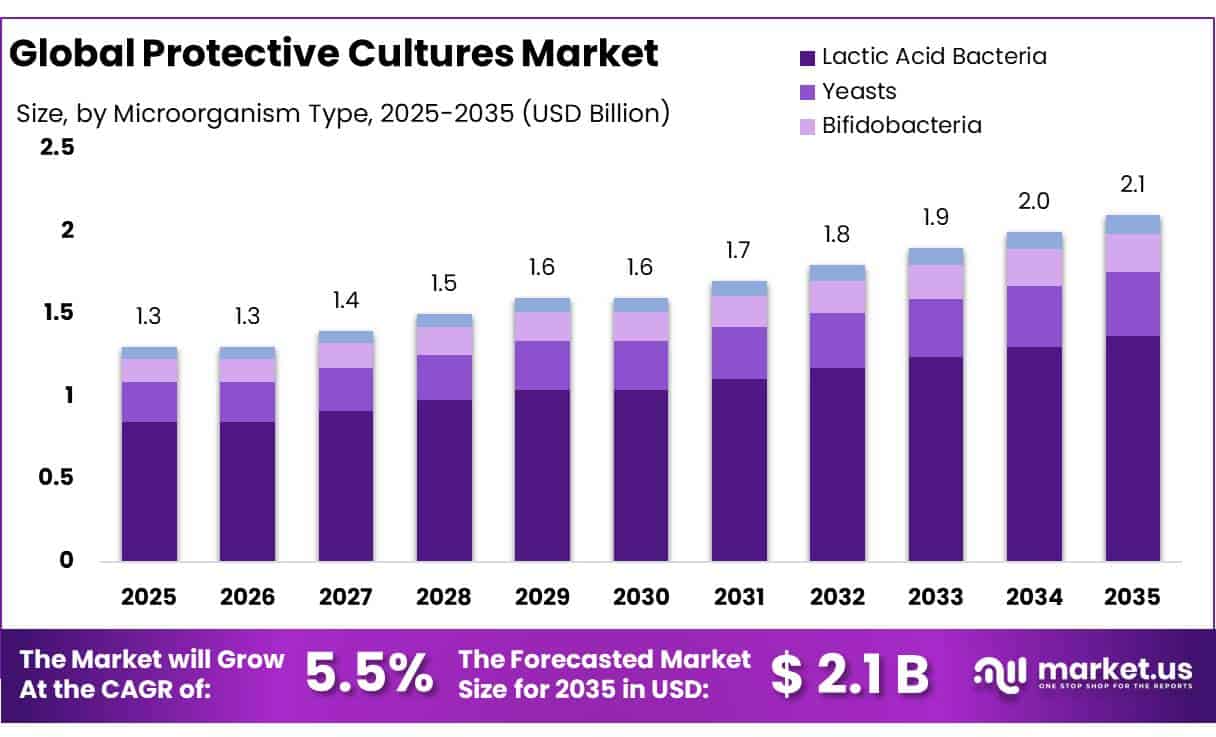
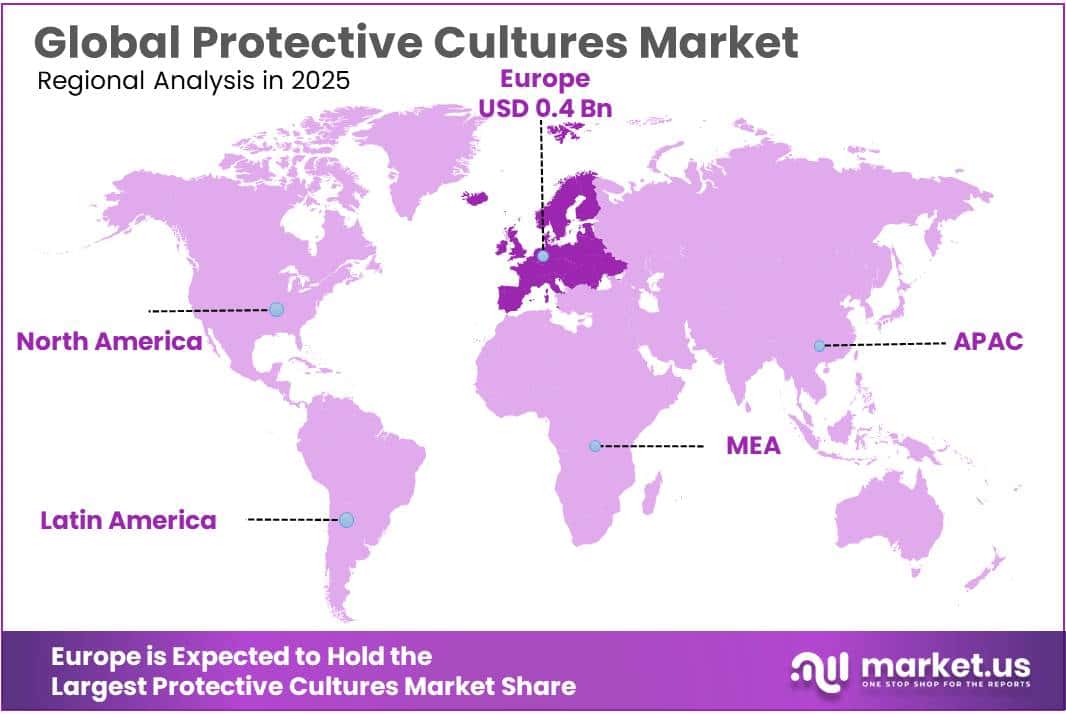
The Global Protective Cultures Market size is expected to be worth around USD 2.1 Billion by 2035, from USD 1.3 Billion in 2025, growing at a CAGR of 5.5% during the forecast period from 2026 to 2035. In 2025, Europe held a dominant market position, capturing more than a 32.00% share, holding USD 0.4 Billion revenue.
Protective cultures are beneficial microorganisms, primarily lactic acid bacteria (LAB), that are intentionally added to food products to improve microbiological safety, maintain quality, and extend shelf life. These cultures inhibit harmful and spoilage microorganisms through natural mechanisms, including organic acid production, bacteriocin formation, hydrogen peroxide release, and competition for nutrients and growth environments.
- The industrial scenario for protective cultures is closely linked to the expansion of food processing, cold-chain infrastructure, and microbiological quality management. The European Union’s food and drink manufacturing industry comprises approximately 290,000 companies and employs around 4.6 million people, demonstrating the scale of the industrial ecosystem in which biological preservation technologies can be applied.
Protective cultures are commercially produced through controlled fermentation processes, with industrial bioreactor capacities ranging from approximately 200 liters to 50,000 liters. Manufacturers use optimized temperature, pH, oxygen levels, and nutrient conditions to achieve high microbial biomass, followed by stabilization and formulation for commercial food applications.
Driving factors for the protective cultures industry include rising food safety requirements, increasing demand for minimally processed foods, and the need to reduce food spoilage across the supply chain. The U.S. Food Safety Modernization Act (FSMA) introduced a preventive approach to food safety, requiring covered food facilities to establish hazard analysis and risk-based preventive controls. This regulatory framework encourages manufacturers to explore additional biological preservation solutions alongside conventional hygiene, refrigeration, and processing measures.
The Food and Agriculture Organization (FAO) reported that approximately 13.2% of food is lost globally after harvest and before retail, highlighting the need for effective preservation technologies. Protective cultures can support these efforts by suppressing spoilage microorganisms, improving product stability, and potentially reducing avoidable food losses.
Future growth opportunities are emerging through the development of specialized microbial strains, multi-strain protective formulations, and advanced delivery technologies. Dairy manufacturers can use protective cultures to control yeast, mold, and unwanted bacterial growth, while meat and seafood processors can adopt selected cultures to manage Listeria monocytogenes and other spoilage organisms. Additional opportunities exist in ready-to-eat salads, fresh-cut vegetables, plant-based foods, and alternative proteins, where maintaining freshness without significantly affecting taste, texture, or appearance is essential.
The European Union’s Horizon Europe FOODGUARD project, running from 2024 to 2026, is investigating bioprotective cultures and natural preservation strategies for perishable foods. Project findings have demonstrated shelf-life improvements of up to 13 days in feta cheese, 1–2 days in ready-to-eat salads, and up to 48 hours in fresh fish, depending on the treatment and storage conditions.
Key Takeaways
- Protective Cultures Market size is expected to be worth around USD 2.1 Billion by 2035, from USD 1.3 Billion in 2025, growing at a CAGR of 5.5%.
- Lactic Acid Bacteria dominate with a 65.00% market share in 2025.
- Freeze-Dried dominates with a 58.00% market share in 2025.
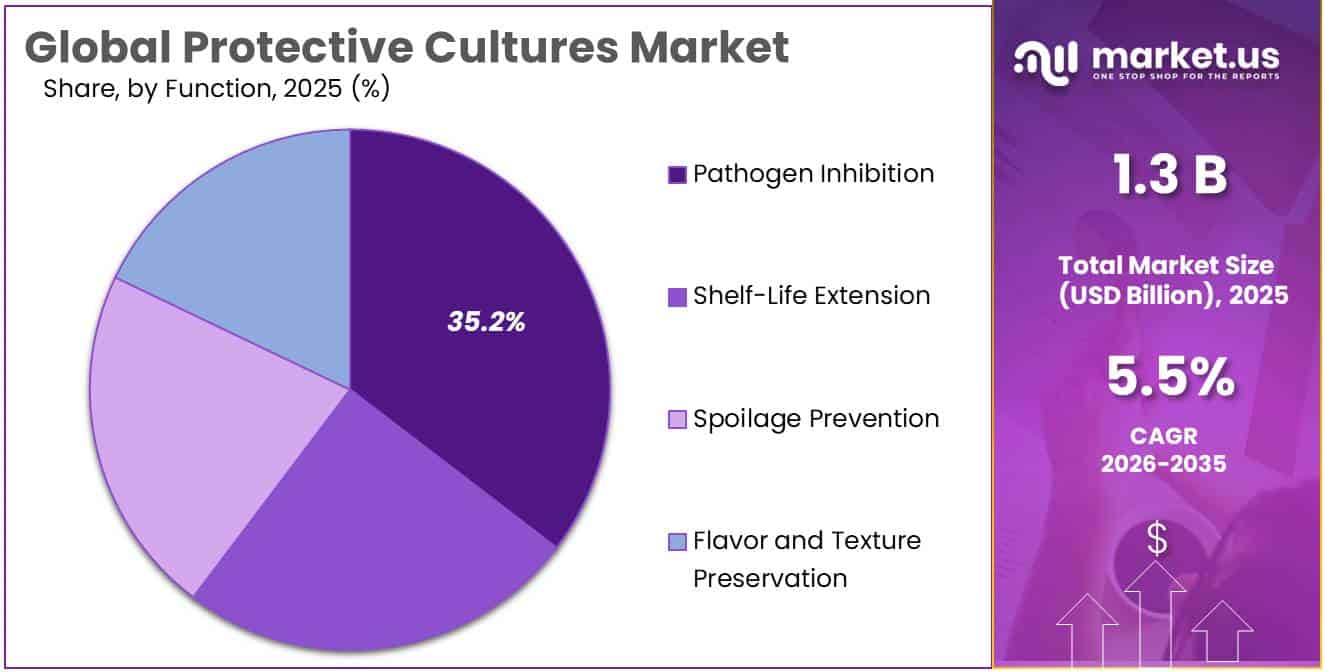
- Pathogen Inhibition dominates with a 35.00% market share in 2025.
- Dairy Products dominate with a 42.00% market share in 2025.
- Europe dominated the Protective Cultures Market, accounting for 32.00% of the market, valued at USD 0.4 billion.
By Microorganism Type Analysis
Protective Cultures Market by Microorganism Type: Lactic Acid Bacteria
Lactic Acid Bacteria dominate with a 65.00% market share in 2025, driven by their widespread use in food preservation, microbiological safety, and shelf-life improvement. In 2025, lactic acid bacteria held a dominant market position, capturing more than a 65.00% share of the protective cultures market. Their ability to produce organic acids and antimicrobial compounds makes them suitable for dairy, meat, seafood, and ready-to-eat food applications. Their established industrial use and compatibility with clean-label food formulations continue to support demand.
Yeasts represent an important microorganism category in the protective cultures market, supported by their ability to contribute to food preservation, fermentation, and microbial control. In 2025, food manufacturers increasingly explored selected beneficial yeast strains to control unwanted molds and spoilage organisms in food products. Protective yeasts offer potential applications in bakery products, dairy, fruits, and fermented foods, where maintaining freshness and product quality is essential. Their natural antimicrobial properties and compatibility with biological preservation methods create opportunities for manufacturers seeking alternatives to conventional preservatives.
By Form Analysis
Protective Cultures Market by Form: Freeze-Dried
Freeze-Dried dominates with a 58.00% market share in 2025, driven by its longer shelf life, convenient storage, and ease of transportation. In 2025, Freeze-Dried held a dominant market position, capturing more than a 58.00% share of the protective cultures market. This form allows beneficial microorganisms to remain stable for extended periods when stored under recommended conditions. Its lightweight nature, reduced moisture content, and suitability for industrial food processing make it a preferred choice among manufacturers.
Frozen protective cultures represent an important product form, offering manufacturers a practical solution for preserving the viability and functionality of beneficial microorganisms. In 2025, frozen cultures continued to serve food processing applications that require microbial stability and reliable performance during manufacturing. Their ability to maintain microbial activity under controlled storage conditions makes them suitable for dairy, meat, and other food applications.
By Function Analysis
Protective Cultures Market by Function: Pathogen Inhibition
Pathogen Inhibition dominates with a 35.00% market share in 2025, supported by increasing attention to food safety and microbial control. In 2025, Pathogen Inhibition held a dominant market position, capturing more than a 35.00% share of the protective cultures market. Protective cultures help food manufacturers control harmful microorganisms through the production of organic acids and antimicrobial compounds. Their application in dairy, meat, seafood, and ready-to-eat products supports food safety while helping maintain product quality.
Shelf-Life Extension remains an important function of protective cultures, as food manufacturers seek to maintain freshness and reduce spoilage during storage and distribution. In 2025, protective cultures continued to gain attention for their ability to suppress spoilage microorganisms and support longer product shelf life. Their application in dairy products, packaged meat, seafood, and ready-to-eat foods helps manufacturers maintain quality while reducing food waste.
By Application Analysis
Protective Cultures Market by Application: Dairy Products
Dairy Products dominate with a 42.00% market share in 2025, supported by their widespread use in cheese, yogurt, fermented milk, and other dairy applications. In 2025, Dairy Products held a dominant market position, capturing more than a 42.00% share of the protective cultures market. Protective cultures help dairy manufacturers control unwanted microorganisms, maintain product quality, and improve shelf life. Their ability to support natural preservation while retaining taste and texture makes them suitable for clean-label dairy products.
Meat and Poultry Products represent an important application segment in the protective cultures market, driven by the need to maintain food safety, freshness, and quality during processing, storage, and distribution. In 2025, food manufacturers increasingly focused on biological preservation methods to manage spoilage and harmful microorganisms in meat and poultry products. Protective cultures can help inhibit microbial growth while supporting product quality and reducing dependence on conventional preservatives.
Key Market Segments
By Microorganism Type
- Lactic Acid Bacteria
- Yeasts
- Bifidobacteria
- Other Microorganisms
By Form
- Freeze-Dried
- Frozen
- Liquid
By Function
- Pathogen Inhibition
- Shelf-Life Extension
- Spoilage Prevention
- Flavor and Texture Preservation
By Application
- Dairy Products
- Meat and Poultry Products
- Seafood Products
- Bakery Products
- Plant-Based Food Products
- Ready-to-Eat Foods
- Other Food Products
Driver Analysis
Food-Waste Reduction Economics
The ability to reduce spoilage-related write-offs gives protective cultures a measurable procurement rationale beyond ingredient substitution, particularly in fresh dairy and other short-life chilled foods. UNEP’s Food Waste Index Report 2024 estimates that 1.05 billion tonnes of food were wasted at household, food-service and retail levels in 2022—approximately 19% of food available to consumers—with 60% occurring in households, 28% in food service and 12% in retail. These figures establish the scale of the problem, not a protective-culture-addressable TAM: much waste arises from purchasing, portioning and other causes that cultures cannot resolve.
Product-level evidence is more commercially relevant: IFF reports an average seven additional days of freshness for two HOLDBAC protective cultures and states that extending yogurt shelf life by one week can reduce waste by up to 30%; these are supplier claims requiring validation in the customer’s recipe, packaging and cold chain, not guaranteed market-wide outcomes. Under an illustrative processor case, 20,000 tonnes of annual output with 3% spoilage-related write-offs represents 600 tonnes at risk; reducing that loss by 20% saves 120 tonnes.
At an assumed recoverable value of $1,500/tonne, gross benefit is $180,000, against $80,000 of annual culture expenditure at an assumed $4/tonne of processed food, leaving $100,000 before testing and implementation costs. The commercial model consequently shifts toward documented loss-reduction trials and repeat production contracts. The +1.0 pp contribution assumes 25% of market revenue grows 4 percentage points faster than the underlying case through waste-reduction adoption in existing products, excluding additional output and distribution programs allocated below.
Drivers Impact Analysis
| Driver | (~) % Impact on CAGR Forecast | Geographic Relevance | Impact Timeline |
|---|---|---|---|
| Food-waste reduction economics | +1.0 pp | EU, UK, US, Canada | Short term (≤ 2 years) |
| Label-friendly preservation conversion | +0.9 pp | North America, EU, UK | Short term (≤ 2 years) |
| RTE safety validation | +0.8 pp | EU core; EU-export suppliers | Short term (≤ 2 years) |
| Dairy processing expansion | +0.7 pp | India, Southeast Asia, EU | Medium term (2–4 years) |
| Extended distribution requirements | +0.6 pp | Europe, North America, APAC | Medium term (2–4 years) |
Restraint Analysis
Unproven Preservation Efficacy
Protective-culture adoption stops when a proposed strain–food combination cannot demonstrate the required inhibition throughout the intended shelf life, regardless of whether the culture performs well in another application. A 2026 review of meat applications identifies performance as strongly dependent on strain, food matrix and storage conditions, including pH, salt, buffering capacity, available carbohydrates and packaging atmosphere; it explicitly positions cultures as targeted preservation hurdles rather than substitutes for hygiene and process control.
This distinction is commercially important because antifungal performance cannot be assumed to establish anti-Listeria efficacy, and suppression of one spoilage organism does not prove control of the complete microbial community. For covered EU ready-to-eat foods supporting Listeria monocytogenes growth, the rules applicable from 1 July 2026 require the relevant safety criterion to be met throughout marketed shelf life; purchasing a protective culture does not itself establish compliance. An illustrative validation program covering three production batches, two storage profiles, four sampling points and three analytical replicates creates 72 measurements before controls.
At an assumed $100 per measurement plus $8,000 for setup and interpretation, the program costs $15,200; failure means those costs do not produce a qualified commercial application. These are budgeting assumptions, not laboratory quotations or a prescribed study design. Suppliers therefore need target-organism evidence and customer-specific validation gates before assigning sales to their pipeline. The −0.5 pp deduction assumes 20% of prospective revenue grows 2.5 percentage points more slowly because efficacy thresholds are not met, excluding routine validation delays where adoption ultimately proceeds.
Restraint Impact Analysis
| Restraint | (~) % Impact on CAGR Forecast | Geographic Relevance | Impact Timeline |
|---|---|---|---|
| Unproven preservation efficacy | −0.5 pp | EU, US, Japan | Short term (≤ 2 years) |
| Unacceptable sensory changes | −0.4 pp | Europe, North America, APAC | Medium term (2–4 years) |
| Weak customer payback | −0.4 pp | India, Southeast Asia, Latin America | Short term (≤ 2 years) |
| Process incompatibility | −0.3 pp | Global processed-food markets | Medium term (2–4 years) |
| Strain qualification barriers | −0.3 pp | EU core; US market entry | Medium term (2–4 years) |
Opportunity Analysis
Plant-Protein Protection Platforms
Application-specific protection for non-dairy plant-protein foods offers a differentiated adjacent market, particularly where manufacturers lack validated combinations of strain, recipe and manufacturing process. This is not an assertion that plant-based protective cultures are absent: IFF already markets cultures for fermented plant-based products, while NovaTaste presented bioprotection for fresh meat analogues at IFFA 2025. The remaining opportunity is therefore narrower—qualifying additional matrices, customers and product formats rather than counting all plant-based food production as untapped demand.
A 2025 industrial-condition study of plant-based fermented dry-cured sausages screened 20 lactic-acid-bacteria strains, advanced five to product trials and identified Latilactobacillus sakei 205 as the strongest candidate, achieving a 2.6-log CFU/g reduction in Listeria monocytogenes without detectable sensory differences from the commercial comparison batch under the study conditions. A 2.6-log reduction corresponds to approximately 99.75% lower counts, not sterilization or a universal safety guarantee.
An illustrative entry program covering 50 manufacturers, each producing 5,000 tonnes annually, with 30% conversion to a qualified protective-culture formulation creates 75,000 tonnes of treated food; at an assumed $12/tonne culture expenditure, annual product revenue is $900,000. These are commercial-screening assumptions, not measured market size or supplier pricing. Suppliers should organize development by substrate and process family, charging for a reproducible protective function rather than ordinary fermentation alone. The +0.30 pp contribution corresponds to approximately 1.85 additional 2031 revenue-index points, excluding plant-based fermented dairy alternatives already in the baseline and existing orders merely transferred from competing suppliers.
Opportunity Impact Analysis
| Opportunity | (~) % Potential CAGR Upside | Geographic Relevance | Execution Window |
|---|---|---|---|
| Plant-protein protection platforms | +0.30 pp | EU, UK, US | Medium term (2–4 years) |
| Specialized seafood cultures | +0.25 pp | Norway, EU, UK, Canada | Medium term (2–4 years) |
| Post-harvest produce cultures | +0.25 pp | EU core; US expansion | Long term (≥ 4 years) |
| Small-processor deployment hubs | +0.20 pp | India, Southeast Asia, Latin America | Short term (≤ 2 years) |
| Outcome-linked supply contracts | +0.20 pp | EU, UK, US, Canada | Short term (≤ 2 years) |
Challenges Analysis
Viable Potency Preservation
Protective-culture manufacturers must maintain viable-cell delivery and functional activity through concentration, drying, storage, distribution and rehydration; equivalent powder weight does not necessarily deliver equivalent biological performance. A December 2025 study of five sourdough-derived lactic-acid-bacteria strains compared overnight pre-freezing at −20°C with two hours at −80°C and found strongly strain-dependent outcomes: Lactiplantibacillus plantarum maintained more than 95% viability, while sensitive strains recorded viability as low as 54.45% and 73.89%, alongside altered metabolic profiles. These are experimental food-culture results, not measured survival rates for commercial protective-culture products, but they demonstrate why preservation protocols cannot be transferred indiscriminately between strains.
Companies cannot safely substitute routine over-dosing for validated storage controls because dosage can also affect product quality. The strategic response is strain-specific stabilization, packaging qualification, validated shipping conditions and potency specifications that distinguish release values from end-of-life guarantees. The −0.30 pp friction estimate assumes 15% of addressable revenue grows 2 percentage points more slowly because additional stability testing, conservative inventory policies and potency adjustment constrain commercial throughput; irreversible process incompatibility is excluded as a separate restraint.
Challenges Impact Analysis
| Challenge | (~) % CAGR Friction Drag | Geographic Relevance | Mitigation Horizon |
|---|---|---|---|
| Viable potency preservation | −0.30 pp | EU, US; APAC distribution | Medium term (2–4 years) |
| Fermentation scale-up consistency | −0.25 pp | EU, US, India, China | Medium term (2–4 years) |
| Microbial ecosystem compatibility | −0.25 pp | Europe, North America, APAC | Long term (≥ 4 years) |
| Shelf-life validation transfer | −0.25 pp | EU, UK, US, Japan | Medium term (2–4 years) |
| Strain-data lifecycle management | −0.20 pp | EU core; global suppliers | Medium term (2–4 years) |
Geopolitical Impact Analysis
Geopolitical Impact of Ongoing Wars on the Protective Cultures Market
The ongoing Russia-Ukraine war and escalating conflict in the Middle East are influencing the Protective Cultures Market in 2026 through higher transportation costs, supply chain uncertainty, energy price fluctuations, and disruptions in international trade. Protective culture manufacturers depend on raw materials, fermentation nutrients, energy, packaging materials, and temperature-controlled transportation. Rising operational expenses may increase production costs and create pricing pressure for food ingredient suppliers and food processing companies. The conflict around the Strait of Hormuz has further intensified supply chain concerns, affecting the movement of essential industrial inputs.
According to UN Trade and Development (UNCTAD), shipping transits through the Strait of Hormuz declined by more than 95% following the escalation of conflict in March 2026. Additionally, freight rates for oil tankers increased by more than 90%, creating additional pressure on global transportation and logistics expenses.
The impact on protective cultures is particularly significant for manufacturers serving dairy, meat, poultry, and ready-to-eat food industries. Higher energy costs can affect fermentation, freeze-drying, refrigeration, and storage operations. Disruptions in international shipping may also delay the delivery of microbial ingredients and increase inventory requirements. According to the Food and Agriculture Organization (FAO), the Food Price Index reached 133.3 points in August 2026, increasing by 2.5% year-on-year, reflecting supply concerns and geopolitical tensions.
Regional Insights
Dominating Region: Europe (32.00% Market Share, USD 0.4 Billion)
In 2025, Europe dominated the Protective Cultures Market, accounting for 32.00% of the market, valued at USD 0.4 billion. The region’s strong position is supported by its established dairy processing industry, increasing focus on food safety, and rising demand for natural food preservation solutions. According to the European Commission, the European Union produces approximately 155 million tonnes of milk annually, creating a substantial industrial base for protective cultures used in cheese, yogurt, and fermented dairy products.
Germany, France, Poland, the Netherlands, Italy, and Ireland collectively contribute more than 70% of EU milk production. Furthermore, Eurostat reported that the European Union produced 161.8 million tonnes of raw milk in 2024, highlighting the scale of dairy production and processing. Strict food safety regulations and growing demand for clean-label products further support regional adoption.
Asia Pacific is expected to experience strong growth in the protective cultures market, supported by expanding food processing industries, increasing consumption of dairy and fermented products, and rising awareness of food safety. Growing urban populations and changing dietary preferences are encouraging manufacturers to improve product quality, freshness, and shelf life. The region is also witnessing increased investment in cold-chain infrastructure, packaged food production, and modern food preservation technologies.
According to the Food and Agriculture Organization, Asia accounted for approximately 46% of global milk production in 2023, demonstrating its substantial contribution to the global dairy industry. Expanding demand for processed meat, dairy products, and ready-to-eat foods is creating further opportunities for protective culture manufacturers. Investments in fermentation technology, microbial research, and food safety management are expected to support the region’s continued expansion.
Key Regions and Countries Insights
- North America
- US
- Canada
- Europe
- Germany
- France
- The UK
- Spain
- Italy
- Rest of Europe
- Asia Pacific
- China
- Japan
- South Korea
- India
- Australia
- Rest of APAC
- Latin America
- Brazil
- Mexico
- Rest of Latin America
- Middle East & Africa
- GCC
- South Africa
- Rest of MEA
Key Players Analysis
Novonesis is a leading biotechnology company with a strong presence in food cultures, enzymes, and microbial solutions. The company supports food manufacturers through protective cultures designed to improve food safety, product quality, and shelf life. In 2025, Novonesis reported 7% organic sales growth and an adjusted EBITDA margin of 37.1%. Its Food & Health Biosolutions business contributed 45% of total sales, reflecting the importance of food and health applications in its business operations. The company continues to strengthen its biosolutions portfolio through research, innovation, and industrial partnerships.
DSM-Firmenich AG is a global supplier of nutritional, health, and food ingredient solutions, with capabilities in food cultures, fermentation, and biotechnology. In 2025, the company reported €9.034 billion in sales from continuing operations and €1.772 billion in adjusted EBITDA. Its Taste, Texture & Health business generated €3.146 billion in sales, reflecting its focus on food-related solutions. The company also invested more than €600 million in research and development during 2025, supporting innovation in nutritional ingredients, food applications, and sustainable technologies.
International Flavors & Fragrances Inc. (IFF) operates in food ingredients, health and biosciences, and specialty solutions, including microbial cultures and fermentation-based ingredients. In 2025, IFF reported USD 10.89 billion in consolidated sales and USD 2.086 billion in adjusted operating EBITDA. Its Health & Biosciences segment generated USD 2.28 billion in annual sales, with 3% comparable currency-neutral growth. The company continued investing in research, commercial capabilities, and capacity expansion to strengthen its innovation pipeline and support food bioscience applications.
Top Key Players Outlook
- Novonesis
- DSM-Firmenich AG
- International Flavors & Fragrances Inc. (IFF)
- Lallemand Inc.
- Sacco System
- Kerry Group plc
- BIOPROX Ingredients
- Biochem S.r.l.
- THT S.A.
- Meat Cracks Technologie GmbH
- Dalton Biotecnologie S.r.l.
- CSK Food Enrichment B.V.
- SOYUZSNAB Group
- ALCE S.r.l.
- LB Bulgaricum
Recent Developments
- April 2026 – Kerry opened its expanded biotechnology manufacturing facility in Carrigaline, County Cork, Ireland, increasing industrial-scale lactase enzyme production capacity. The facility supports more than 200 customers across 80 countries, while its enzymes are used to process over 2 million tonnes of milk annually, reaching approximately 28 million consumers worldwide.
- BIOPROX Ingredients, now operating under the name Bioprox Cultures, is a French biotechnology company specializing in lactic acid bacteria, freeze-dried cultures, and natural food preservation solutions. The company has more than 50 years of experience, serves over 800 customers, exports to more than 40 countries, and employs more than 120 professionals. Its research and development activities focus on microbial strain selection, fermentation, food protection, and shelf-life improvement.
Report Scope
| Report Features | Description |
|---|---|
| Market Value (2025) | USD 1.3 Bn |
| Forecast Revenue (2035) | USD 2.1 Bn |
| CAGR (2026-2035) | 5.5% |
| Base Year for Estimation | 2025 |
| Historic Period | 2020-2024 |
| Forecast Period | 2026-2035 |
| Report Coverage | Revenue Forecast, Market Dynamics, Competitive Landscape, Recent Developments |
| Segments Covered | By Microorganism Type (Lactic Acid Bacteria, Yeasts, Bifidobacteria, Other Microorganisms), By Form (Freeze-Dried, Frozen, Liquid), By Function (Pathogen Inhibition, Shelf-Life Extension, Spoilage Prevention, Flavor and Texture Preservation), By Application (Dairy Products, Meat and Poultry Products, Seafood Products, Bakery Products, Plant-Based Food Products, Ready-to-Eat Foods, Other Food Products) |
| Regional Analysis | North America – US, Canada; Europe – Germany, France, The UK, Spain, Italy, Rest of Europe; Asia Pacific – China, Japan, South Korea, India, Australia, Singapore, Rest of APAC; Latin America – Brazil, Mexico, Rest of Latin America; Middle East & Africa – GCC, South Africa, Rest of MEA |
| Competitive Landscape | Novonesis, DSM-Firmenich AG, International Flavors & Fragrances Inc. (IFF), Lallemand Inc., Sacco System, Kerry Group plc, BIOPROX Ingredients, Biochem S.r.l., THT S.A., Meat Cracks Technologie GmbH, Dalton Biotecnologie S.r.l., CSK Food Enrichment B.V., SOYUZSNAB Group, ALCE S.r.l., LB Bulgaricum |
| Customization Scope | Customization for segments, region/country-level will be provided. Moreover, additional customization can be done based on the requirements. |
| Purchase Options | We have three licenses to opt for: Single User License, Multi-User License (Up to 5 Users), Corporate Use License (Unlimited User and Printable PDF) |