Report Overview
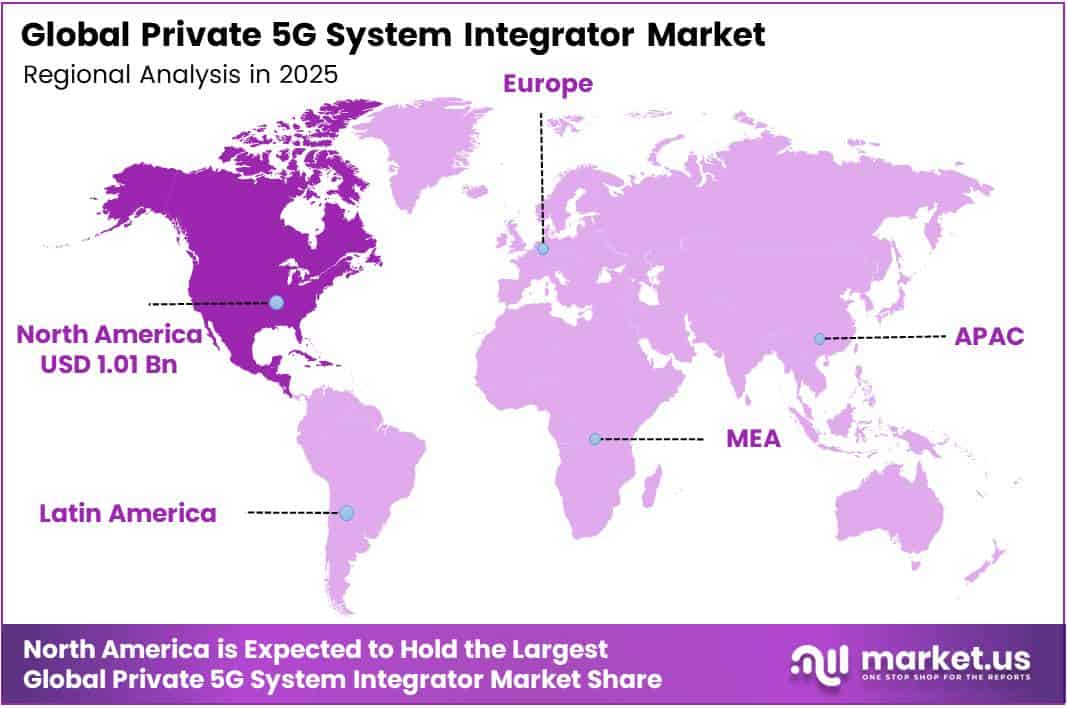
In 2025, the Global Private 5G System Integrator Market was valued at USD 2.2 billion. The market is projected to grow at a CAGR of 21.0% during 2026–2035, reaching approximately USD 14.8 billion by 2035. North America dominated the global market in 2025, accounting for more than 45.8% of the total market share and generating approximately USD 1.01 billion in revenue.
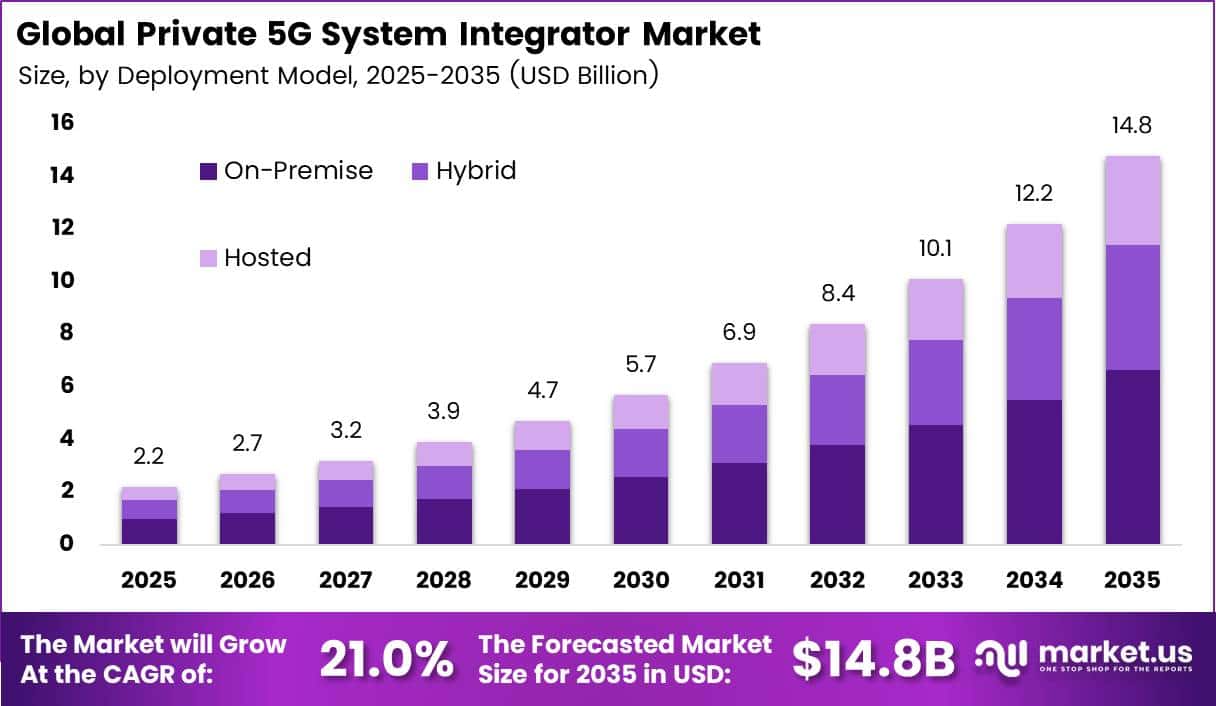
Enterprise demand for private networks drives this growth. The Global Mobile Suppliers Association (GSA) logged 1,846 private mobile network customers in 80 countries by August 2025, up 7.7% from 1,714 in 2024. GSA counted 1,953 customers in 84 countries by the end of 2025. By 2026, it logged 2,031 customer references across 88 countries.
GSA also reports a 34% compound growth rate in cumulative customers from 2020 to 2025, with 241 new customers added in 2025. Each new site needs design, radio planning, core setup, and device onboarding. That work flows straight to system integrators.
The North America region leads because its enterprises spend early on connected industrial systems. US buyers imported USD 48.1 billion of semiconductors in 2025, which made up 1.4% of all US imports. That spending shows a large base of chip-heavy industrial and network projects. The White House lists the communications sector as one of 16 critical infrastructure sectors that depend on chips for broadband and telecom networks.
Key Takeaways
- The Private 5G System Integrator Market reached USD 2.2 billion in 2025 and should hit USD 14.8 billion by 2035. grow at a CAGR of 21.0% from 2026 to 2035.
- Installation and Integration Services lead the Offering segment with a 47.6% share.
- On-Premise leads the Deployment Model segment with a 45.1% share.
- Licensed Spectrum leads Spectrum Allocation with a 48.6% share and is also the fastest-growing sub-segment.
- Low Band leads the Frequency Band segment with a 61.0% share.
- Standalone leads the Network Architecture segment with a 56.2% share.
- Large Enterprises lead the Enterprise Size segment with a 62.3% share.
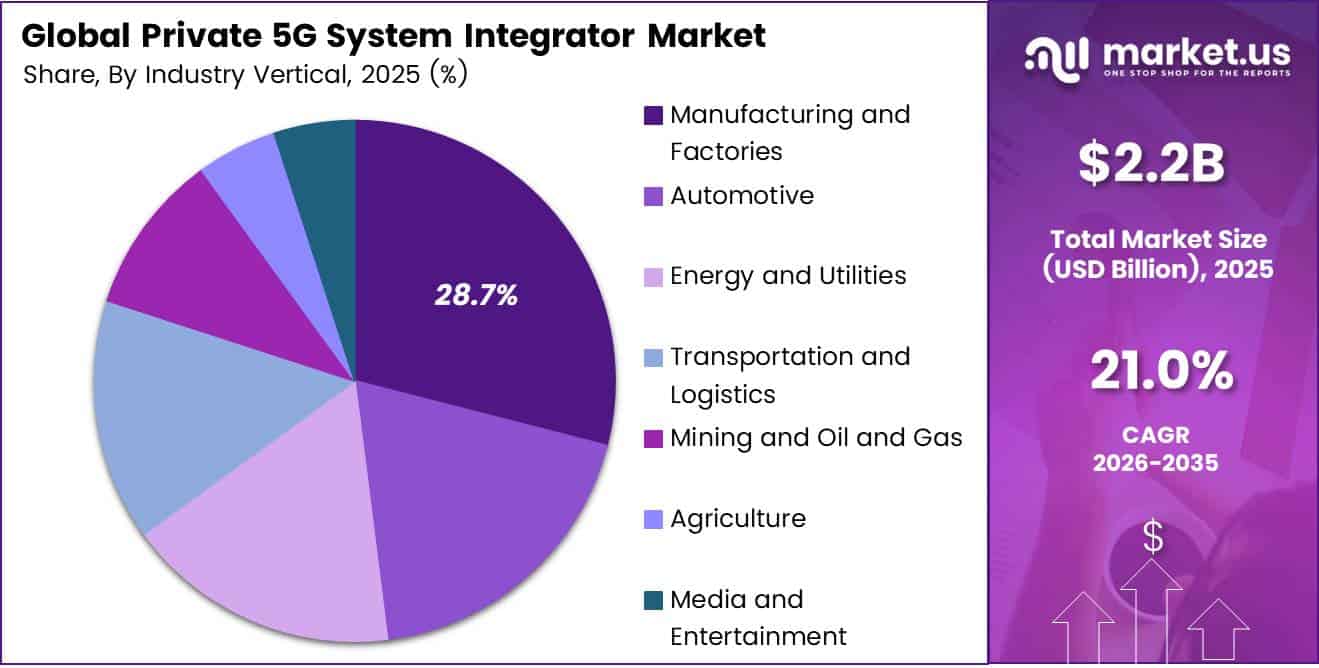
- Manufacturing and Factories lead the Industry Vertical segment with a 28.7% share.
- North America leads with a 45.8% share and USD 1.01 billion in revenue.
By Offering
Installation and Integration Services dominate with 47.6% due to complex multi-vendor network setup needs.
Installation and Integration Services hold the largest share because every private 5G project starts with site surveys, radio planning, core setup, and links to existing factory systems. The Global Mobile Suppliers Association (GSA) counted 1,846 organisations running private LTE or 5G networks across 80 countries by mid-2025, and each one needed a partner to build and connect its network.
New builds keep this work flowing. GSA logged 74 new customer references in the second quarter of 2025, up from 62 a year earlier. Each new customer usually means a fresh integration contract with radio, core, and device testing.
Managed Services is the fastest-growing offering because live networks need daily care after go-live. GSA research shows a typical customer runs 2 to 3 networks, and some large users run hundreds of separate sites. Monitoring, patching, and security across that many sites cost too much to handle in-house, so buyers move to multi-year managed contracts.
By Deployment Model
On-Premise dominates with 45.1% due to strict local data control requirements.
On-Premise leads because plants, ports, and mines want their core network and data to stay inside their own walls. Keeping traffic local cuts delays for machine control and helps firms meet data rules. GSA reports that 2,031 organisations in 88 countries now run at least one private network worth more than €100,000, and most of these sites host their core equipment locally.
Hybrid is growing fastest because it mixes a local core for critical traffic with cloud tools for analytics and remote management. GSA found that 19.0% of customers already run a mixed LTE and 5G setup, which shows a clear demand for layered designs. In 2026, 86% of new references used 5G or a 5G and LTE blend. Buyers making that move want cloud flexibility without giving up local control, so they turn to integrators that can link both environments.
By Spectrum Allocation
Licensed Spectrum dominates with 48.6% due to guaranteed interference-free industrial radio performance.
Licensed Spectrum leads because factories and utilities cannot accept radio interference on safety or control links. Regulators now give enterprises direct access to dedicated bands. Germany’s Federal Network Agency set aside 100 MHz in the 3.7–3.8 GHz range for local industrial licences, and many large firms in the country now hold their own spectrum.
Licensed Spectrum is also the fastest-growing allocation, as more countries open local licence schemes for enterprises. In the United States, the Federal Communications Commission manages 150 MHz of spectrum in the CBRS band, where companies can win priority licences on top of shared access. LTE now runs in 1,385 customer deployments worldwide, and those users are moving to 5G on licensed channels.
By Frequency Band
Low Band dominates with 61.0% due to wide coverage through walls.
Low Band leads because its signals travel far and pass through concrete, steel, and terrain with little loss. Mines, farms, rail lines, and large plants need wide coverage with fewer radio sites, and that keeps hardware and installation costs low. Ericsson reported that about 240 service providers had launched commercial 5G, and many used low-band layers to give broad coverage first.
High Band is growing fastest because some jobs need very high capacity and very low delay over short distances. Automated guided vehicles, machine vision, and AR-guided maintenance in dense factory halls all benefit from millimetre-wave speed. Ericsson expected 5G subscriptions to reach 1.5 billion by the end of 2023, and that scale lowered the cost of high-band chipsets and radios.
By Network Architecture
Standalone dominates with 56.2% due to a dedicated 5G core enabling slicing.
Standalone leads because private networks gain the most from a full 5G core. It supports network slicing, very low delay, and exact device control, all of which industrial automation needs. GSA data shows that 28.5% of private network customers use 5G-only systems, and these usually run on standalone cores built for the enterprise.
Non-Standalone is growing fastest because it lets existing LTE users add 5G radios without replacing their core right away. That lowers upfront cost and risk for budget-conscious buyers. GSA found that 876 customers were deploying 5G, equal to 47% of tracked references, and many of them built on existing LTE assets. For these firms, non-standalone works as a fast bridge.
By Enterprise Size
Large Enterprises dominate with 62.3% due to bigger capital budgets for automation.
Large Enterprises lead because they run big plants, ports, and campuses that need reliable wireless links for thousands of machines. They also have the capital and IT staff to fund multi-site programs. The International Federation of Robotics (IFR) reports that the global stock of factory robots reached 5 million units in 2025, up 9%, and most of these units sit in large-firm plants that depend on stable connectivity.
Small and Medium Enterprises are growing fastest because packaged, subscription-based private 5G offers now remove the high upfront cost. The World Bank estimates that SMEs make up about 90% of businesses and more than 50% of jobs worldwide, which makes them a huge untapped customer base. Integrators now sell compact kits with a small core, a few radios, and managed support for a monthly fee.
By Industry Vertical
Manufacturing and Factories dominate with 28.7% due to heavy robot and sensor connectivity.
Manufacturing and Factories lead because production lines need fast, reliable links for robots, sensors, and quality cameras. Wi-Fi often struggles with mobility and interference on busy shop floors. IFR data shows that the United States installed almost 38,500 industrial robots in 2025, up 12%, while India installed nearly 10,500 units.
Energy and Utilities is the fastest-growing vertical because power grids are adding solar, wind, storage, and smart meters at record pace. Utilities need secure, wide-area links for substations, grid sensors, and field crews. The International Energy Agency estimates that global grid investment reached about USD 400 billion in 2024, and a growing share of that money goes to digital monitoring and control.
Key Market Segments
By Offering
- Installation and Integration Services
- Professional Services
- Managed Services
By Deployment Model
- On-Premise
- Hybrid
- Hosted
By Spectrum Allocation
- Licensed Spectrum
- Shared Spectrum
- Unlicensed Spectrum
By Frequency Band
- Low Band
- Mid Band
- High Band
By Network Architecture
- Standalone
- Non-Standalone
By Enterprise Size
- Large Enterprises
- Small and Medium Enterprises
By Industry Vertical
- Manufacturing and Factories
- Automotive
- Energy and Utilities
- Transportation and Logistics
- Mining and Oil and Gas
- Agriculture
- Media and Entertainment
- IT and Telecommunications
- Other
Geopolitical Impact Analysis
US trade policy now raises the cost of core network hardware. In January 2026, the White House set a 25% duty on certain advanced computing chips and derivative products, effective January 15, 2026. Private 5G cores, edge servers, and radio units all use these chips. The order also warns of broader chip tariffs in a second phase. Integrators must now price that risk into multi-year fixed bids.
Metal costs add more pressure. In August 2025, the US placed 50% tariffs on semi-finished copper products and some copper derivatives. Copper goes into cabling, power systems, grounding, and antenna feeds at every factory or port site. Integrators that buy these parts locally face higher bill-of-materials costs on each deployment.
Red Sea shipping risks slow hardware delivery from Asia to Europe. UNCTAD found that container tonnage through the Suez Canal fell by 82% by early 2024, while tonnage around the Cape of Good Hope rose by 60%. UNCTAD also showed that an India-to-Europe round trip can stretch from 56 to 63 days, which needs one extra vessel. The World Bank estimated that rerouting added 10 or more days to delivery times.
These delays still affect trade flows. IMF PortWatch data shows that Cape container transits more than tripled over three years, while Suez crossings fell by more than half. For integrators, this means longer lead times on radios and gateways. Many now hold more stock in the region and add buffer weeks to project schedules.
Regional Analysis
North America dominates the Private 5G System Integrator Market, holding a 45.8% share and generating USD 1.01 billion in revenue. The US drives most of this demand. Large factories, utilities, ports, and defense sites in the US buy private networks for secure, low-delay links. These buyers rarely build networks on their own.
Asia Pacific is the fastest-growing region in the Private 5G System Integrator Market. China, Japan, South Korea, and India lead factory and port 5G projects. Japan shows strong momentum: Nokia and SoftBank agreed in October 2026 to run a commercial AI-RAN field trial in Japan. In Indonesia, Nokia became Indosat Ooredoo Hutchison’s 5G modernization partner in June 2026.
Europe holds a strong second position, led by Germany, the UK, and France. German factories use local spectrum licenses for campus networks. In the UK, Virgin Media O2 spent about £1.4 billion on mobile network upgrades over two years and added a £700 million tranche in 2026. Nokia also won a multi-year deal to power Telefonica AI edge data centres across Spain.
Key Regions and Countries
North America
- US
- Canada
Europe
- Germany
- France
- The UK
- Spain
- Italy
- Rest of Europe
Asia Pacific
- China
- Japan
- South Korea
- India
- Australia
- Rest of APAC
Latin America
- Brazil
- Mexico
- Rest of Latin America
Middle East and Africa
- GCC
- South Africa
- Rest of MEA
Market Dynamics
Drivers
| Driver | (~) % Impact on CAGR Forecast | Geographic Relevance | Impact Timeline |
|---|---|---|---|
| Industry 4.0 Manufacturing Automation Rollouts | +2.4% | Europe, North America, Japan, South Korea | Short term (2 years or less) |
| Dedicated Enterprise Spectrum Allocation | +1.8% | US, Germany, UK, Japan, France | Short term (2 years or less) |
| Vendor Exit Shifting Integration Demand | +1.2% | Global | Short term (2 years or less) |
| Mining and Energy Site Digitization | +1.0% | Australia, Canada, Latin America, Africa | Medium term (2 to 4 years) |
| Defense and Public Safety Networks | +0.8% | US, NATO Europe, Middle East | Medium term (2 to 4 years) |
| LTE-to-5G Standalone Migration Cycles | +0.7% | North America, Europe | Medium term (2 to 4 years) |
Industry 4.0 Manufacturing Automation Rollouts
Manufacturing is the main source of integration demand. Per Global Mobile Suppliers Association (GSA) deployment tracking, it was the largest vertical with 359 identified deployments by 2Q25, and that rose to 387 companies by September 2026. Overall, GSA counted 2,031 organisations across 88 countries running private networks worth more than €100,000.
Nokia’s Form 20-F filings show its private wireless customer base growing from more than 560 in 2022 to more than 1,000 in 2025. When a customer adds sites, the integrator’s cost of winning that business falls by an estimated 30-40% compared with signing a new logo.
As a result, business models are moving from one-off hardware resale toward recurring managed-network contracts. Recurring services take an estimated 35-45% of contract value, and blended gross margins rise by about 500-800 basis points. National manufacturing association capital spending data supports a mid-term contribution of about +2.4% to the baseline 21.0% CAGR.
Market Dynamics
Restraints
| Restraint | (~) % Impact on CAGR Forecast | Geographic Relevance | Impact Timeline |
|---|---|---|---|
| High Upfront Deployment CapEx | -1.6% | Global, acute in SME segments | Short term (2 years or less) |
| Absent Enterprise Spectrum Regimes | -1.1% | India, Southeast Asia, Africa, Latin America | Medium term (2 to 4 years) |
| Elevated Corporate Borrowing Costs | -0.7% | North America, Europe | Short term (2 years or less) |
| High-Risk Vendor Equipment Bans | -0.5% | US, EU, UK, Australia | Short term (2 years or less) |
| Weak Industrial 5G Device Availability | -0.4% | Global | Short term (2 years or less) |
High Upfront Deployment CapEx
The root cause is how costs are structured. A single-site private 5G build bundles radios, an on-premises core, edge compute, spectrum, and integration labor. Enterprise disclosures and procurement records put typical project values between about $250,000 and $1.2 million. Per GSA’s counting rules, most tracked deployments clear the €100,000 threshold, and only 178 references fall in the €50,000-€100,000 band.
That cost creates a hard barrier. Per OECD SME finance indicators, mid-sized manufacturers usually cap discretionary IT spending at about 2-4% of revenue, so a single-site project eats one to two years of budget. Wi-Fi 6/7 alternatives cost an estimated 40-60% less per square meter covered, which leads many buyers to stall or downsize procurement.
For integrators, this stretches sales cycles to about 9-15 months. Pilot-to-production conversion stays below roughly 50%, and gross margin on hardware-led contracts is squeezed by about 300-500 basis points. Delayed customer spending accounts for an estimated -1.6% drag on the CAGR.
Challenges
| Challenge | (~) % CAGR Friction Drag | Geographic Relevance | Mitigation Horizon |
|---|---|---|---|
| Converged IT-OT-RF Talent Shortage | -1.3% | Global | Long term (4 years or more) |
| Legacy OT System Interoperability | -0.9% | Europe, North America, Japan | Medium term (2 to 4 years) |
| Vendor Ecosystem Consolidation Risk | -0.7% | Global | Short term (2 years or less) |
| OT Cybersecurity Compliance Burden | -0.5% | EU, US | Medium term (2 to 4 years) |
| Unproven Multisite ROI Benchmarks | -0.4% | Global | Medium term (2 to 4 years) |
Converged IT-OT-RF Talent Shortage
The weak point is that private 5G integration needs one team to cover radio planning, 3GPP core engineering, cloud-native orchestration, and industrial OT protocols, and few engineers have all four skill sets. Per GSA, 5G deployments make up just under half of tracked references, while LTE still holds about 51% of the installed base. That means integrators must keep expertise in both technologies.
The friction shows up in numbers. Per ITU and national labor statistics, a certified RF/5G core engineer takes an estimated 18-24 months to train. Salary premiums run about 20-30% above general network roles, and project staffing lead times stretch to roughly 3-6 months. Per GSA, the shift toward multisite projects increases the number of engineers each customer needs.
Integrators will need to make long-term changes. These include in-house academies, blueprint-based automated deployment tooling that cuts field engineering hours by an estimated 25-35%, and partnerships with vocational institutes. Together, these factors put a ceiling drag of about -1.3% on the CAGR.
Opportunities
| Opportunity | (~) % Potential CAGR Upside | Geographic Relevance | Execution Window |
|---|---|---|---|
| Network-as-a-Service Subscription Models | +1.9% | Global, SME-focused | Short term (2 years or less) |
| Edge AI Application Layer Bundling | +1.4% | North America, Europe, East Asia | Medium term (2 to 4 years) |
| Regional Integrator M&A Roll-Ups | +0.9% | North America, Europe | Short term (2 years or less) |
| Emerging Market Spectrum Liberalization | +0.8% | India, Brazil, Southeast Asia | Long term (4 years or more) |
| Ports and Logistics Hub Coverage | +0.6% | Middle East, Asia Pacific, Europe | Medium term (2 to 4 years) |
Network-as-a-Service Subscription Models
This is still unclaimed territory rather than a current driver. Subscription private 5G remains a small share of contracts, and per GSA counting, references are still dominated by deals above €100,000. Hyperscalers have also pulled back: Microsoft retired Azure Private 5G Core on 30 September 2025, and Nokia classified its Enterprise Campus Edge unit as discontinued operations on 23 July 2026.
The unit economics change considerably. Turning an upfront cost of $250,000-$1.2 million into monthly fees of about $5,000-$25,000 lowers the entry barrier for SMEs by an estimated 70-80%. Pooled multi-tenant cores, consistent with telco annual report disclosures, cut per-site core cost by about 40-50%.
Integrators that capture this shift could lift EBITDA margins from about 10-12% to 18-22%, with recurring revenue reaching more than 50% of the mix. Per OECD SME demographics data, this would open a sizable untapped segment of mid-sized enterprises, adding about +1.9% on top of the baseline 21.0% CAGR.
Key Players Analysis
Tier 1 leaders include Ericsson, Nokia, Huawei, Cisco, and HPE. These firms own radio, core, and networking stacks, and they also run large integration teams. Ericsson posted full-year 2025 net sales of SEK 236.7 billion and adjusted EBITA of SEK 42.9 billion. It ended 2025 with net cash of SEK 61.2 billion, which gives it room to invest in enterprise 5G.
In October 2026, Ericsson moved private 5G into its Business Area Networks unit to share R&D. Nokia leads by customer count. It had 960 private 4G and 5G customers by September 2025, about 50% of the market by GSA counts. Its mission-critical private wireless business earned about EUR 1.4 billion in FY2024.
Nokia agreed in October 2026 to sell its Enterprise Campus Edge unit to Aurelius. That unit served 900 customers and earned EUR 170 million a year. NVIDIA put USD 1 billion into Nokia at USD 6.01 per share to speed AI-RAN work. This shifts Nokia’s 5G and 6G software onto GPU platforms, which creates new integration needs for edge AI.
Tier 2 challengers include Accenture, IBM, Kyndryl, Samsung, ZTE, NEC, Fujitsu, and Siemens. These firms win through industry depth, consulting reach, or strong regional positions. Ericsson rolled out AI link adaptation across about 60,000 base stations, which raised spectral efficiency by about 10%. Gains like this push service integrators to pair with Tier 1 vendors.
Top Key Players in the Market
- Accenture plc
- Cisco Systems, Inc.
- Hewlett Packard Enterprise Company
- International Business Machines Corporation
- Kyndryl Holdings, Inc.
- Nokia Corporation
- Telefonaktiebolaget LM Ericsson
- Huawei Technologies Co., Ltd.
- Samsung Electronics Co., Ltd.
- ZTE Corporation
- NEC Corporation
- Fujitsu Limited
- Siemens AG
Recent Developments
- In July 2025, Hewlett Packard Enterprise Company completed its USD 14 billion acquisition of Juniper Networks after a June 2025 settlement with the US Department of Justice.
- In October 2025, NVIDIA agreed to invest USD 1 billion in Nokia Corporation at USD 6.01 per share to build AI-RAN products for 5G and 6G, and the deal closed in November 2025.
- In October 2026, Nokia Corporation agreed to sell its Enterprise Campus Edge private network unit, which earns EUR 170 million a year and serves 900 customers, to Aurelius, with closing expected in the first half of 2027.
Report Scope
| Report Features | Description |
|---|---|
| Market Value (2025) | USD 2.2 Billion |
| Forecast Revenue (2035) | USD 14.8 Billion |
| CAGR (2026-2035) | 21.0% |
| Base Year for Estimation | 2025 |
| Historic Period | 2020-2024 |
| Forecast Period | 2026-2035 |
| Report Coverage | Revenue Forecast, Market Dynamics, Competitive Landscape, Recent Developments |
| Segments Covered | By Offering (Installation and Integration Services, Professional Services, Managed Services); By Deployment Model (On-Premise, Hybrid, Hosted); By Spectrum Allocation (Licensed Spectrum, Shared Spectrum, Unlicensed Spectrum); By Frequency Band (Low Band, Mid Band, High Band); By Network Architecture (Standalone, Non-Standalone); By Enterprise Size (Large Enterprises, Small and Medium Enterprises); By Industry Vertical (Manufacturing and Factories, Automotive, Energy and Utilities, Transportation and Logistics, Mining and Oil and Gas, Agriculture, Media and Entertainment, IT and Telecommunications, Other) |
| Regional Analysis | North America – US, Canada; Europe – Germany, France, The UK, Spain, Italy, Rest of Europe; Asia Pacific – China, Japan, South Korea, India, Australia, Singapore, Rest of APAC; Latin America – Brazil, Mexico, Rest of Latin America; Middle East & Africa – GCC, South Africa, Rest of MEA |
| Competitive Landscape | Accenture plc, Cisco Systems, Inc., Hewlett Packard Enterprise Company, International Business Machines Corporation, Kyndryl Holdings, Inc., Nokia Corporation, Telefonaktiebolaget LM Ericsson, Huawei Technologies Co., Ltd., Samsung Electronics Co., Ltd., ZTE Corporation, NEC Corporation, Fujitsu Limited, Siemens AG |
| Customization Scope | Customization for segments and region/country-level will be provided. Moreover, additional customization can be done based on the requirements. |
| Purchase Options | We have three licenses to opt for: Single User License, Multi-User License (Up to 5 Users), Corporate Use License (Unlimited Users and Printable PDF) |