


Global Poster Design Market Size, Share, Growth Analysis By Product Type (Digital Posters, Printed Posters, 3D Posters, Interactive Posters, Others), By Application (Advertising, Events & Exhibitions, Education, Home Decor, Others), By End-User (Corporates, Educational Institutions, Individuals, Entertainment Industry, Others), By Distribution Channel (Online Platforms, Offline Stores), By Region and Companies - Industry Segment Outlook, Market Assessment, Competition Scenario, Statistics, Trends and Forecast 2026-2035
- Published date: Mar 2026
- Report ID: 180422
- Number of Pages: 315
- Format:
-
keyboard_arrow_up
Quick Navigation
Report Overview
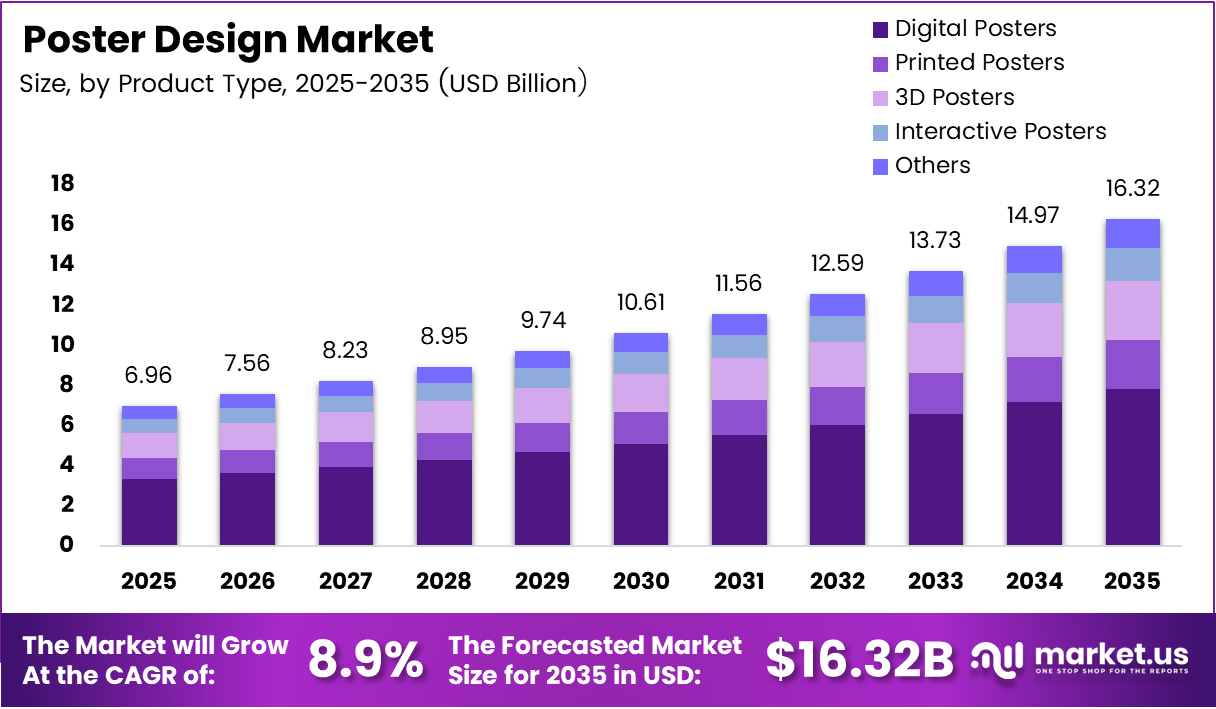
Global Poster Design Market size is expected to be worth around USD 16.32 Billion by 2035 from USD 6.96 Billion in 2025, growing at a CAGR of 8.9% during the forecast period 2026 to 2035.
The poster design market covers the creation, production, and distribution of visual communication materials across digital and print formats. These materials serve advertising, event promotion, retail branding, education, and home decor. The market spans both professional design services and self-service platforms that businesses and individuals use to produce visual content.
Digital transformation in marketing has shifted poster design from print shops to cloud platforms. Businesses now require faster turnaround, more format options, and lower production costs. This structural shift benefits platform-based design providers over traditional print-only operators, compressing margins for legacy vendors while expanding addressable markets for digital-first players.
Corporate buyers represent the largest demand source, with companies allocating design budgets toward brand promotion, event marketing, and retail signage. Small businesses and startups have entered the market as cost-effective digital tools lower the barrier to professional-quality output. This broadening buyer base signals a market that is widening at the bottom while deepening at the enterprise level.
Government and institutional investment in public awareness campaigns, education materials, and cultural events continues to generate steady poster design demand outside the commercial sector. Educational institutions and public-sector organizations commission large volumes of print and digital posters annually, creating durable procurement flows that are less sensitive to economic cycles than advertising budgets.
In January 2025, T-Mobile acquired Vistar Media, a digital out-of-home advertising platform, for $600 million, signaling how major telecoms see digital signage and poster advertising as a high-value distribution channel. In April 2025, Canva launched Visual Suite 2.0 at Canva Create 2025, introducing AI-enhanced productivity tools that accelerate poster and visual design workflows for millions of users.
According to NoGood, AI tools in graphic design workflows achieve a 67% reduction in overall production time for visual assets. This compression of design timelines fundamentally changes cost structures — buyers expect faster delivery at lower prices, which pressures traditional studios while rewarding platforms that have integrated AI into their core workflows.
According to RRD, 72% of recipients regularly read or engage with print advertisements, including posters. This figure challenges the assumption that physical print is declining — it confirms that tactile poster formats retain strong audience engagement, giving multi-format poster design providers a defendable value proposition alongside digital alternatives.
Key Takeaways
- The Global Poster Design Market was valued at USD 6.96 Billion in 2025 and is forecast to reach USD 16.32 Billion by 2035.
- The market grows at a CAGR of 8.9% during the forecast period 2026 to 2035.
- By Product Type, Digital Posters dominate with a 47.60% share in 2025.
- By Application, Advertising leads with a 35.30% share, reflecting strong corporate marketing spend on visual media.
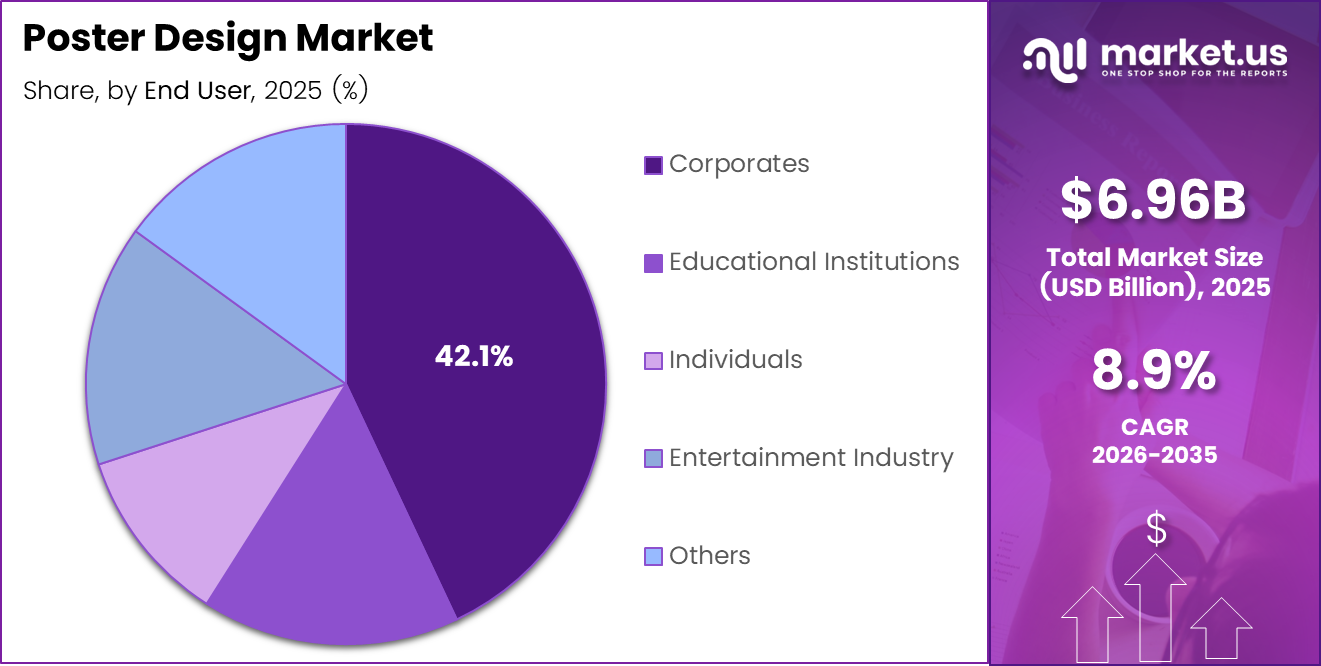
- By End-User, Corporates hold the largest share at 42.18%, driven by consistent branding and promotional needs.
- By Distribution Channel, Online Platforms command 66.49% share, reflecting the dominance of cloud-based design and fulfillment services.
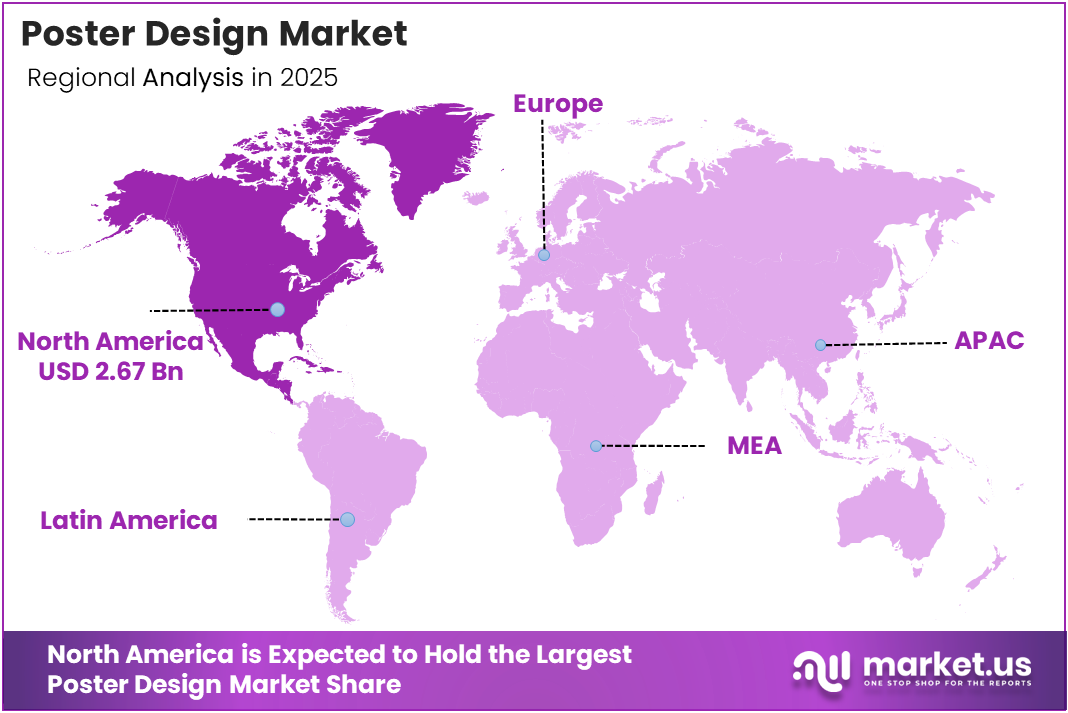
- North America dominates regionally with a 38.40% share, valued at USD 2.67 Billion in 2025.
Product Analysis
Digital Posters dominate with 47.60% due to low production cost and instant scalability.
In 2025, Digital Posters held a dominant market position in the By Product Type segment of the Poster Design Market, with a 47.60% share. Advertisers and event organizers prefer digital formats because they eliminate print lead times and allow real-time content updates. In early 2024, Recraft raised $12 million in funding as an AI image and graphic design platform, validating investor confidence in digital poster generation at scale.
Printed Posters retain relevance in retail, hospitality, and institutional environments where physical presence drives audience engagement. According to RRD, 72% of recipients engage with print advertisements, confirming that physical poster formats maintain genuine audience reach. However, rising paper costs — averaging 3.15% in 2025 — pressure print-focused operators on margins.
3D Posters differentiate through dimensional visual impact, appealing to premium retail brands and entertainment marketers seeking standout displays. In October 2025, Canva introduced its Creative Operating System with a new 3D Content Generator, bringing three-dimensional design capabilities to a mass-market audience and accelerating adoption outside specialist studios.
Interactive Posters carry the highest engagement potential within the product segment, embedding QR codes, NFC triggers, and AR layers to bridge physical and digital experiences. This format appeals to event organizers and retail brands running measurable campaigns. However, higher production complexity and cost currently limit adoption to well-funded marketing teams.
Others in the product category include specialty formats such as fabric posters, backlit displays, and oversized banners used in trade events and architectural applications. These sub-formats serve niche but high-value clients. Wasserman’s acquisition of bluemedia in March 2025 reflects how event branding specialists are consolidating around large-format and specialty print capabilities.
Application Analysis
Advertising dominates with 35.30% due to consistent corporate marketing budget allocation.
In 2025, Advertising held a dominant market position in the By Application segment of the Poster Design Market, with a 35.30% share. Brands allocate recurring budgets to visual promotional materials across out-of-home, retail, and digital channels. This predictable spend makes advertising the most commercially durable application segment for poster design providers.
Events and Exhibitions serve as the highest-volume per-project application, with conferences, trade shows, and concerts commissioning extensive poster suites across both print and digital formats. The post-pandemic recovery of live events has restored and expanded this segment. Moreover, hybrid events now require coordinated digital and physical poster campaigns, increasing design complexity and project value.
Education generates consistent institutional demand for informational posters, classroom displays, and campus communication materials. Schools, universities, and training organizations commission poster content at regular intervals throughout the academic calendar. However, education budgets tend to prioritize cost over design quality, making this a volume-driven rather than margin-rich segment.
Home Decor represents the fastest-evolving application within the market, with consumers purchasing custom art prints, typographic posters, and personalized photo designs for residential interiors. E-commerce platforms have significantly expanded distribution reach for this segment. Additionally, gifting use cases have introduced new purchase occasions outside traditional decor buying cycles.
Others in the application segment include political campaigns, public health communication, non-profit awareness drives, and government information programs. These applications generate irregular but meaningful demand volumes. Their non-commercial nature means procurement is project-driven, creating spikes in design activity around election cycles, public health events, and policy launches.
End-User Analysis
Corporates dominate with 42.18% due to high-frequency branding and promotional requirements.
In 2025, Corporates held a dominant market position in the By End-User segment of the Poster Design Market, with a 42.18% share. Enterprise buyers commission poster design across product launches, internal communications, retail displays, and trade events. This breadth of use cases makes corporate clients the highest lifetime-value buyers in the market, sustaining consistent design platform and agency revenue.
Educational Institutions generate stable, recurring demand for instructional posters, event announcements, and campus branding materials. Universities and schools operate on academic calendars that create predictable procurement windows. Consequently, design platforms that offer institutional pricing and template libraries specifically for educational use cases hold a structural advantage in capturing this segment.
Individuals represent the highest-volume but lowest-average-transaction buyer group, using self-service platforms to create personal event invitations, home decor prints, and social media visuals. This segment expanded significantly as cloud-based tools lowered design skill requirements. However, free-tier platform competition and template availability suppress monetization rates per user.
Entertainment Industry buyers — including film studios, music labels, gaming companies, and streaming platforms — require poster design for promotional campaigns, release announcements, and merchandise. This segment commands premium pricing due to high creative standards and tight launch timelines. Therefore, specialized agencies and platform tiers serving entertainment clients typically generate above-market margins.
Others in the end-user segment include healthcare organizations, government bodies, sports franchises, and non-profit entities that commission poster design for specific communication objectives. These buyers operate outside standard commercial cycles but generate meaningful contract volumes. Design firms with diverse sector experience hold a competitive advantage in serving this fragmented buyer group.
Distribution Channel Analysis
Online Platforms dominate with 66.49% due to accessibility, speed, and self-service scalability.
In 2025, Online Platforms held a dominant market position in the By Distribution Channel segment of the Poster Design Market, with a 66.49% share. Cloud-based platforms allow buyers to design, customize, and order poster production from a single interface without engaging print brokers or agencies. This end-to-end convenience compresses the buyer journey and drives repeat purchasing behavior.
Offline Stores retain relevance for buyers who require physical consultation, material sampling, or large-format specialty production that digital platforms cannot fully service remotely. Print shops and design studios serving local business clients maintain a relationship-driven sales model. However, their share continues to erode as online platforms improve print quality assurance and delivery reliability.
Key Market Segments
By Product Type
- Digital Posters
- Printed Posters
- 3D Posters
- Interactive Posters
- Others
By Application
- Advertising
- Events & Exhibitions
- Education
- Home Decor
- Others
By End-User
- Corporates
- Educational Institutions
- Individuals
- Entertainment Industry
- Others
By Distribution Channel
- Online Platforms
- Offline Stores
Drivers
Digital Marketing Expansion and Social Media Advertising Drive Consistent Poster Design Demand
Corporate marketing budgets increasingly flow toward visual content across digital and physical channels. Businesses running social media campaigns, retail promotions, and event activations require professionally designed posters at higher frequency and shorter turnaround. This demand pattern structurally benefits platforms and agencies that deliver rapid iteration at competitive price points.
Small businesses and startups now invest in branded visual materials earlier in their growth cycles than previous generations did. Accessible design platforms have lowered entry costs, but professional-quality output still drives purchasing decisions among brand-conscious buyers. In March 2024, Canva acquired Affinity — a professional creative software suite — to serve higher-skill designers seeking advanced poster and visual design capabilities alongside its core mass-market audience.
According to Rausr, AI assistance in poster design accelerates the process by approximately 35% through faster concept generation and iteration cycles. For buyers commissioning frequent campaign materials, this speed advantage translates directly into lower agency fees and faster time-to-market. Consequently, design providers integrating AI tools into workflows hold a measurable productivity advantage over manual-only competitors.
Restraints
Free Template Platforms and Price Sensitivity Cap Revenue Growth Among Small Business Buyers
The proliferation of free online design tools — offering pre-built templates, drag-and-drop editors, and basic print services — actively reduces the addressable market for professional poster design services. Small business buyers who previously hired designers now self-serve using free-tier platforms. This substitution effect directly compresses revenue potential at the lower end of the market.
Price sensitivity among small and mid-size business buyers limits willingness to pay for custom poster design beyond template-based alternatives. When buyers perceive minimal quality difference between a custom design and an edited template, professional pricing becomes difficult to justify. According to Printing.org, operating cost inflation across the printing industry averaged 2.9% in 2025, squeezing margins for providers already competing on price.
Average price increases for printing services reached 2.4% in 2025 to offset rising input costs, according to Printing.org. This creates a pricing tension: providers must raise prices to protect margins, but doing so pushes cost-sensitive small business clients further toward free self-service tools. Design firms and print platforms caught in this margin squeeze face structural pressure to either automate or reposition toward premium buyer segments.
Growth Factors
AI Tools, E-Commerce Expansion, and Freelance Marketplaces Unlock New Revenue Streams
AI-powered graphic design tools now allow smaller design providers to deliver enterprise-quality output at significantly lower labor cost. In March 2025, Wasserman acquired bluemedia — a specialist in large-format printing and architectural graphics — to strengthen event branding and poster production capabilities, reflecting how established players are consolidating around premium large-format demand.
E-commerce platforms selling custom and printable poster designs have opened a global retail channel for independent designers and small studios. Buyers in home decor, gifting, and personal branding segments now purchase poster designs through marketplace platforms without requiring local print relationships. According to Medium, AI-driven image generation for posters yields 50-85% time savings compared to traditional methods, making scalable custom poster production commercially viable for the first time.
Freelance design marketplaces connect global clients with independent poster designers, expanding the supply side of the market and giving buyers access to international creative talent at competitive rates. This structural shift benefits buyers through lower costs and greater style variety. Moreover, it creates new revenue opportunities for designers in emerging markets who can now access global clients through platform intermediaries.
Emerging Trends
Minimalist Aesthetics, Motion Posters, and AR Integration Reshape Poster Design Expectations
Minimalist and typography-focused design styles have become the visual language of modern brand communication. Brands across fashion, technology, and food service adopt clean layouts with bold typefaces because they translate effectively across both print and digital formats. This aesthetic standardization benefits design platforms with strong typography libraries and template ecosystems built around minimalist principles.
Digital and animated motion posters now serve as primary assets in online advertising campaigns across social media, streaming platforms, and digital signage networks. Static poster design skills alone no longer satisfy the full brief for digital campaign buyers. In March 2025, Impact XM acquired Touch Associates to enhance experiential marketing with advanced event branding and graphics, reflecting market appetite for dynamic and interactive visual formats.
Augmented reality integration in poster advertising allows brands to embed interactive digital layers into physical poster formats, creating measurable engagement experiences. According to WhatTheyThink, 75% of clients using the Dotti campaign management platform report reductions in inventory and material waste — demonstrating that technology-integrated print management simultaneously drives sustainability outcomes and cost efficiency for poster campaign buyers.
Regional Analysis
North America Dominates the Poster Design Market with a Market Share of 38.40%, Valued at USD 2.67 Billion
North America leads the Poster Design Market with a 38.40% share, valued at USD 2.67 Billion in 2025. The region benefits from a mature digital marketing ecosystem, high corporate advertising spend, and early platform adoption among both enterprise and SMB buyers. The concentration of major design platform headquarters in North America further reinforces its supply-side and demand-side leadership simultaneously.
Europe Poster Design Market Trends
Europe represents the second-largest regional market, supported by strong event culture, retail advertising investment, and institutional demand from educational and government bodies. Germany, the UK, and France anchor regional spending. Additionally, European sustainability regulations are accelerating the shift toward eco-friendly poster substrates, creating a compliance-driven procurement driver that North America has not yet replicated at scale.
Asia Pacific Poster Design Market Trends
Asia Pacific operates as the market’s fastest-expanding regional segment, with China, India, and Southeast Asian economies investing in commercial advertising infrastructure and digital marketing platforms. Rising e-commerce activity in the region generates consistent demand for promotional poster content. Moreover, the rapid adoption of mobile-first design platforms among SMBs positions Asia Pacific as the primary volume growth engine for the next forecast period.
Middle East and Africa Poster Design Market Trends
The Middle East and Africa market benefits from large-scale event infrastructure investment — particularly in the Gulf Cooperation Council states — which generates substantial poster and signage demand for sports, tourism, and cultural events. South Africa anchors the African sub-region with a relatively mature print and advertising sector. However, fragmented market structure and infrastructure gaps limit pan-regional platform deployment.
Latin America Poster Design Market Trends
Latin America presents a developing but commercially meaningful market, with Brazil and Mexico generating the majority of regional poster design activity. Growing retail sectors and expanding digital advertising budgets drive demand for affordable design services. Price sensitivity remains high across the region, which favors low-cost platform-based design tools over full-service agency engagement for most buyer categories.
Key Regions and Countries
North America
- US
- Canada
Europe
- Germany
- France
- The UK
- Spain
- Italy
- Rest of Europe
Asia Pacific
- China
- Japan
- South Korea
- India
- Australia
- Rest of APAC
Latin America
- Brazil
- Mexico
- Rest of Latin America
Middle East & Africa
- GCC
- South Africa
- Rest of MEA
Key Company Insights
Canva has built the dominant mass-market position in poster design by combining an accessible drag-and-drop interface with an expanding professional-grade toolkit. Its acquisition of Affinity in March 2024 signals a deliberate move upmarket toward professional designers — a segment that previously viewed Canva as a consumer tool. This dual positioning across amateur and professional tiers gives Canva broader addressable market coverage than any single-tier competitor.
Vistaprint occupies a distinct position as the primary bridge between digital design and physical print fulfillment for small business buyers. Its integrated design-to-print workflow removes the friction of managing separate design and production vendors. In a market where small businesses represent a large volume segment, Vistaprint’s end-to-end model creates strong customer retention through operational convenience rather than design differentiation alone.
PosterMyWall targets event organizers, educators, and small businesses with template-heavy design tools priced for high-frequency, low-budget users. Its strategic positioning in verticals where design volume matters more than creative sophistication gives it a defensible niche against premium platforms. However, the free-template substitution risk is highest in this segment, requiring continuous feature expansion to maintain paid conversion rates among its core user base.
Fiverr operates as a marketplace intermediary rather than a design tool, connecting buyers with independent poster designers globally. In Q2 2025, Xerox finalized its acquisition of Lexmark, merging print and graphic design technologies — illustrating how adjacent players are integrating design and production capabilities. Fiverr’s model benefits from the freelance marketplace trend but faces margin pressure as design platforms build AI tools that reduce the need for human design labor on standard poster briefs.
Key Players
- Canva
- Vistaprint
- PosterMyWall
- Fiverr
- 99designs
- DesignCrowd
- Adobe Spark
- Zazzle
- UPrinting
- Shutterstock
- Designhill
- Minted
- Snapfish
- Redbubble
- Society6
- VistaCreate
- Over (now GoDaddy Studio)
- Pixartprinting
- Printful
- Others
Recent Developments
- Early 2024 — FE International acquired DotYeti.com, a subscription-based graphic design platform, to accelerate innovation in digital graphic design services including poster creation and visual content delivery for global clients.
- Q2 2024 — Design Manager acquired DesignSpec and Lojik Design Systems, software companies specializing in contract and hospitality design, to enhance platforms for commercial poster and visual design workflows.
- January 2025 — XSYS completed the acquisition of MGS, expanding its offerings in graphic design and printing technologies to strengthen poster production capabilities across large-format and commercial print markets.
- Q1 2025 — Lawson Screen & Digital and Workhorse Products announced a strategic merger, combining expertise in screen printing and digital graphic design solutions to serve poster and visual media production clients.
- Q2 2025 — Durst Group acquired callas software, improving graphic design and production software for the printing industry with enhanced preflight and PDF processing tools for poster and large-format output.
- Q2 2025 — GroupeSTAHL announced the strategic acquisition of TKO Sales, Inc., strengthening its position in the graphic design and printing market for visual media and branded merchandise production.
- Early 2024 — Gotiva secured €1.11 million in seed funding to develop its platform for monetizing AI-generated images, including poster designs used in advertising and branding applications.
- July 2025 — Canva released new AI features including videos powered by Veo 3 and LinkedIn Ads integration, streamlining poster design workflows for social media and integrated print-digital campaigns.
- October 2025 — Figma acquired Weavy, an AI-based video- and image-generation company, to enhance graphic design tools for poster creation and expand AI-driven visual asset generation within its design platform.
Report Scope
Report Features Description Market Value (2025) USD 6.96 Billion Forecast Revenue (2035) USD 16.32 Billion CAGR (2026-2035) 8.9% Base Year for Estimation 2025 Historic Period 2020-2024 Forecast Period 2026-2035 Report Coverage Revenue Forecast, Market Dynamics, Competitive Landscape, Recent Developments Segments Covered By Product Type (Digital Posters, Printed Posters, 3D Posters, Interactive Posters, Others), By Application (Advertising, Events & Exhibitions, Education, Home Decor, Others), By End-User (Corporates, Educational Institutions, Individuals, Entertainment Industry, Others), By Distribution Channel (Online Platforms, Offline Stores) Regional Analysis North America (US and Canada), Europe (Germany, France, The UK, Spain, Italy, and Rest of Europe), Asia Pacific (China, Japan, South Korea, India, Australia, and Rest of APAC), Latin America (Brazil, Mexico, and Rest of Latin America), Middle East & Africa (GCC, South Africa, and Rest of MEA) Competitive Landscape Canva, Vistaprint, PosterMyWall, Fiverr, 99designs, DesignCrowd, Adobe Spark, Zazzle, UPrinting, Shutterstock, Designhill, Minted, Snapfish, Redbubble, Society6, VistaCreate, Over (now GoDaddy Studio), Pixartprinting, Printful, Others Customization Scope Customization for segments, region/country-level will be provided. Moreover, additional customization can be done based on the requirements. Purchase Options We have three licenses to opt for: Single User License, Multi-User License (Up to 5 Users), Corporate Use License (Unlimited User and Printable PDF) 
-
-
- Canva
- Vistaprint
- PosterMyWall
- Fiverr
- 99designs
- DesignCrowd
- Adobe Spark
- Zazzle
- UPrinting
- Shutterstock
- Designhill
- Minted
- Snapfish
- Redbubble
- Society6
- VistaCreate
- Over (now GoDaddy Studio)
- Pixartprinting
- Printful
- Others
Our Clients

- 180422
- Mar 2026






