Report Overview
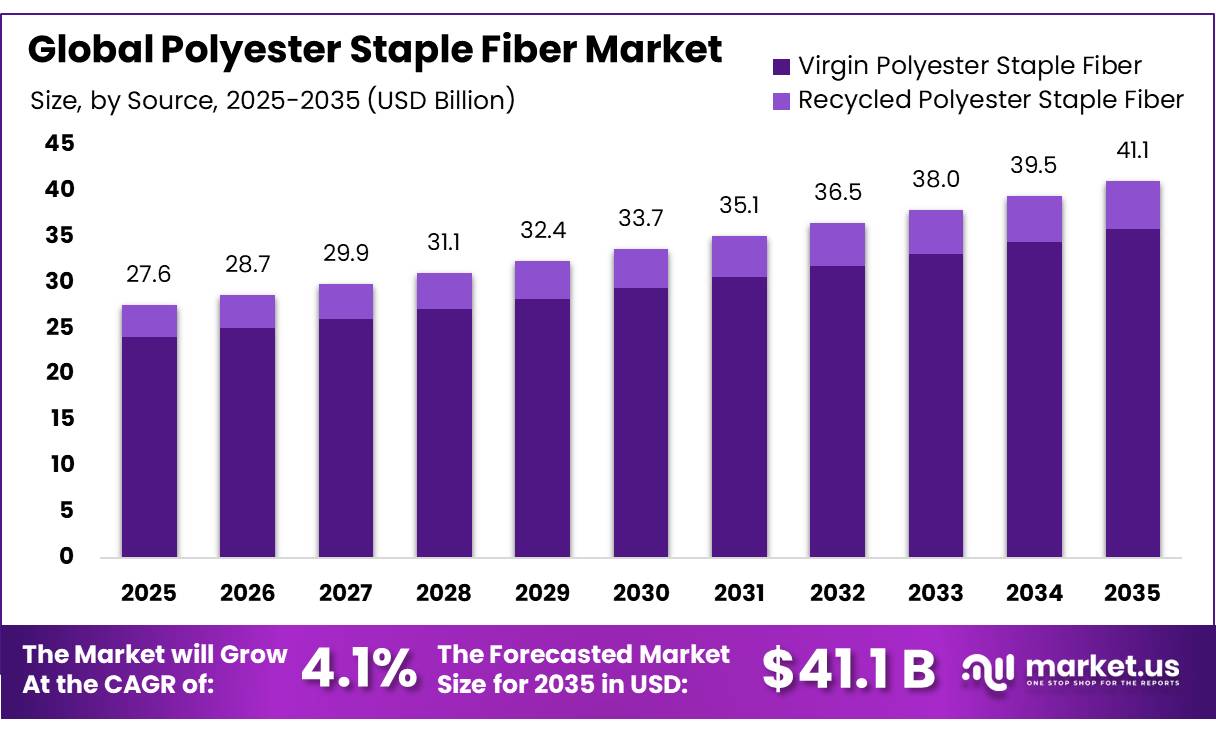
The Global Polyester Staple Fiber Market size is expected to be worth around USD 41.1 Billion by 2035, from USD 27.6 Billion in 2025, growing at a CAGR of 4.1% during the forecast period from 2026 to 2035. In 2025, Asia-Pacific held a dominant market position, capturing more than a 53.45% share, holding USD 14.7 Billion revenue.
Polyester Staple Fiber (PSF) is a synthetic man-made fiber produced from purified terephthalic acid (PTA) and monoethylene glycol (MEG), primarily derived from petroleum-based raw materials. It is manufactured in short, discontinuous fiber lengths that can be spun into yarn or blended with natural fibers such as cotton, wool, and viscose. PSF is widely used in apparel, home furnishings, automotive textiles, carpets, industrial fabrics, and nonwoven products.
The global polyester industry has experienced consistent production growth, supported by increasing textile consumption and the expanding use of synthetic materials across industrial applications. According to Textile Exchange, global fiber production reached approximately 132 million tonnes in 2024, compared with around 125 million tonnes in 2023. Polyester accounted for approximately 59% of global fiber production in 2024, with total production increasing from approximately 71 million tonnes in 2023 to 78 million tonnes in 2024.
- Furthermore, Far Eastern New Century Corporation reported that global polyester staple fiber production reached 18.49 million tonnes in 2024, representing a 3% year-on-year increase. These figures demonstrate the importance of polyester staple fiber within the wider synthetic textile manufacturing industry.
The industrial scenario is increasingly influenced by demand from apparel manufacturers, textile processors, furniture producers, and automotive suppliers. Polyester staple fiber offers a practical alternative to natural fibers because of its consistent quality, strength, dimensional stability, and relatively low maintenance requirements. Its applications in cushions, mattresses, pillows, insulation materials, carpets, and automotive interiors further strengthen industrial demand.
- According to the European Environment Agency, synthetic fibers accounted for 57% of the fibers and yarns used by EU industry in 2024, equivalent to approximately 2.6 million tonnes. This reflects the continued industrial importance of synthetic textile materials across manufacturing applications.
Sustainability and recycling are becoming important areas of industrial development. Manufacturers are increasingly investing in recycled polyester staple fiber produced from post-consumer plastic bottles and textile waste. Textile Exchange reported that recycled polyester production increased from approximately 8.9 million tonnes in 2023 to 9.3 million tonnes in 2024. However, recycled polyester represented approximately 12% of total polyester production in 2024, highlighting the considerable scope for further adoption.
Government regulations are also encouraging investment in recycling infrastructure and sustainable textile manufacturing. The European Union’s Sustainable and Circular Textiles Strategy aims to make textile products more durable, repairable, and recyclable by 2030. Additionally, separate textile waste collection requirements introduced from 2025 are expected to improve the availability of recyclable textile materials. According to the European Commission, approximately 5 million tonnes of clothing are discarded annually across the European Union, highlighting the need for improved textile recovery and recycling systems.
Key Takeaways
- Polyester Staple Fiber Market size is expected to be worth around USD 41.1 Billion by 2035, from USD 27.6 Billion in 2025, growing at a CAGR of 4.1%.
- Virgin Polyester Staple Fiber held a dominant market position, capturing more than a 87.30% share.
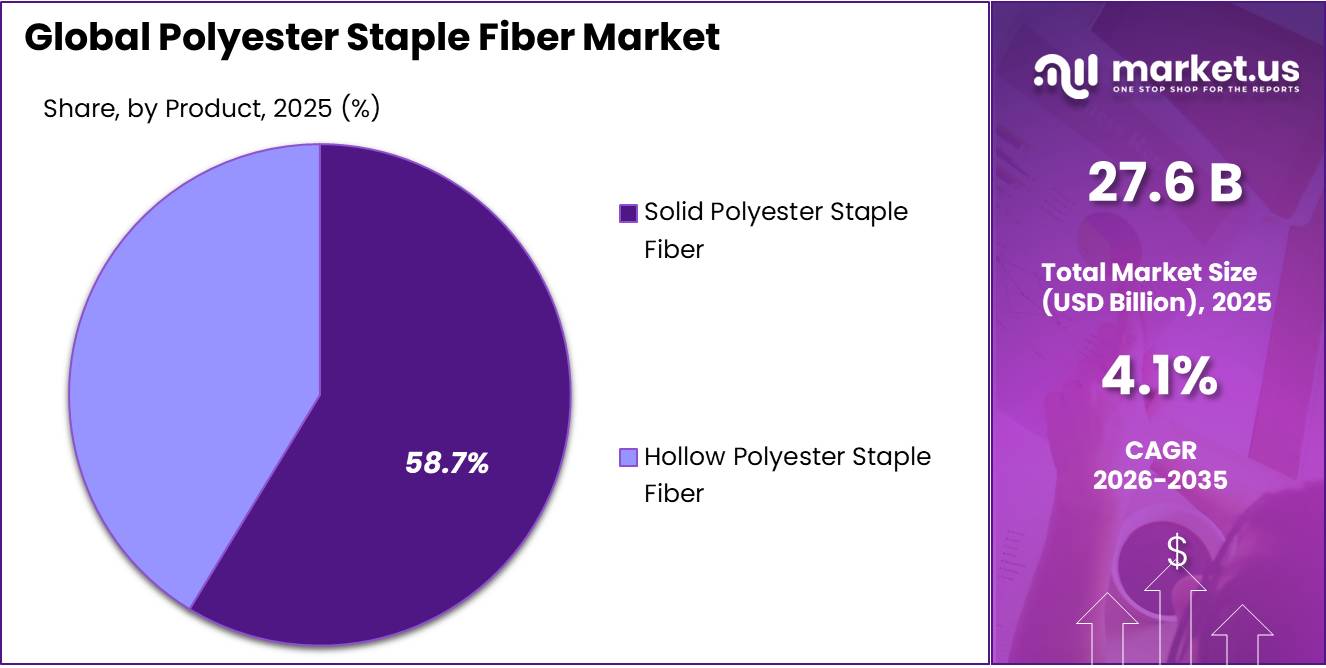
- Solid Polyester Staple Fiber held a dominant market position, capturing more than a 58.67% share.
- Home Textiles held a dominant market position, capturing more than a 31.89% share.
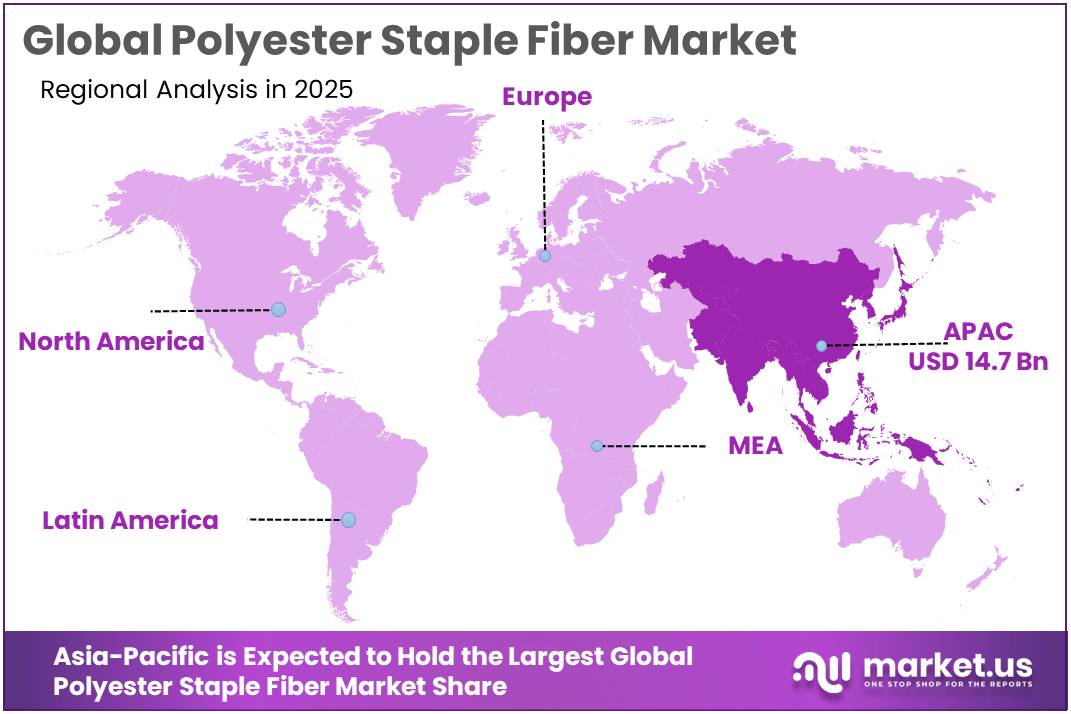
- Asia-Pacific dominated the global Polyester Staple Fiber market in 2025, accounting for a 53.45% market share and generating approximately USD 14.7 billion.
By Source Analysis
Virgin Polyester Staple Fiber dominates the market due to its consistent quality, high durability, and widespread use in textile manufacturing.
In 2025, “Virgin Polyester Staple Fiber” held a dominant market position, capturing more than a 87.30% share. Its leading position was supported by strong demand from apparel, home furnishing, automotive textiles, and industrial fabric manufacturers. Virgin polyester staple fiber offers consistent fiber strength, uniform quality, good dimensional stability, and reliable processing performance, making it suitable for large-scale textile production.
Recycled Polyester Staple Fiber is gaining attention as manufacturers increasingly adopt recycled raw materials to reduce dependence on virgin polyester and improve resource efficiency. Its production generally involves recovering polyester from discarded plastic bottles, post-consumer textiles, and manufacturing waste. The European Environment Agency reported that the European Union generated approximately 6.94 million tonnes of textile waste in 2022, representing a significant opportunity for textile recovery and recycling.
In 2025, the implementation of separate textile waste collection requirements across European Union member states supported the development of a more organized recycling ecosystem. Growing sustainability requirements and investments in textile recycling technologies are expected to strengthen demand for recycled polyester staple fiber in apparel, home furnishings, automotive interiors, and nonwoven applications.
By Product Analysis
Solid Polyester Staple Fiber dominates the market due to its versatility, durability, and wide application across textile and industrial products.
In 2025, “Solid Polyester Staple Fiber” held a dominant market position, capturing more than a 58.67% share. Its leading position was supported by its widespread use in apparel, home textiles, upholstery, carpets, and nonwoven manufacturing. Solid polyester staple fiber offers good tensile strength, dimensional stability, uniform structure, and resistance to regular wear, making it suitable for products that require durability and consistent performance.
Hollow Polyester Staple Fiber is increasingly used in applications where lightweight construction, softness, resilience, and insulation are important. Its hollow internal structure helps trap air, making it suitable for pillows, cushions, mattresses, quilts, sleeping bags, and automotive seating. The fiber also provides good bulkiness and recovery after compression, supporting its use in filling and cushioning applications.
The U.S. Environmental Protection Agency reported that approximately 17 million tonnes of textiles were generated as municipal solid waste in the United States in 2018. This highlights the importance of improving textile material efficiency, product durability, and recycling across the textile value chain. Although this statistic does not directly measure hollow polyester staple fiber consumption, it provides useful background on the scale of the textile industry and its material management requirements.
By Application Analysis
Home Textiles dominates the market due to rising demand for durable, affordable, and easy-to-maintain furnishing materials.
In 2025, “Home Textiles” held a dominant market position, capturing more than a 31.89% share. Its leading position was supported by the extensive use of polyester staple fiber in pillows, cushions, mattresses, blankets, carpets, curtains, upholstery, and other household furnishing products. The fiber offers softness, durability, wrinkle resistance, and good shape retention, making it suitable for products that require regular use and long service life.
Automotive is an important application area for polyester staple fiber because of its use in vehicle seats, carpets, headliners, door panels, trunk liners, and interior insulation materials. Its lightweight structure, durability, abrasion resistance, and sound absorption properties make it suitable for different automotive interior components. Manufacturers also use polyester staple fiber in nonwoven fabrics and cushioning materials to improve passenger comfort and product performance.
In 2025, global motor vehicle production reached approximately 96.4 million units, compared with 92.7 million units in 2024, representing an increase of 3.9%. This expansion in vehicle manufacturing supports opportunities for polyester-based interior textiles and nonwoven materials. Growing demand for lightweight vehicle components and improved cabin comfort is expected to create further opportunities for polyester staple fiber suppliers.
Key Market Segments
By Source
- Virgin Polyester Staple Fiber
- Recycled Polyester Staple Fiber
By Product
- Solid Polyester Staple Fiber
- Hollow Polyester Staple Fiber
By Application
- Automotive
- Home Textiles
- Construction
- Filtration
- Apparel & Nonwoven Textiles
- Others
Driver Analysis
MMF textile investment
The estimated +0.9 pp contribution reflects policy-supported downstream manufacturing that creates additional procurement demand for PSF-based yarns and fabrics, rather than assuming every man-made-fiber investment benefits staple polyester. India’s textile production-linked incentive programme carries an approved outlay of INR 10,683 crore and targets specified MMF apparel, fabrics, and technical textiles.
Amendments notified on October 9, 2025, reduced the minimum additional annual turnover requirement from 25% to 10% after the first performance year, effective from FY2025–26, and added eligible fabric descriptions explicitly covering polyester-staple blends and fabrics containing at least 85% polyester staple fiber.
These changes lower the incremental growth hurdle for qualifying downstream participants; they do not constitute a direct subsidy for all PSF output. Illustratively, a participant with INR 100 crore of preceding-year turnover would face a minimum incremental threshold of INR 10 crore rather than INR 25 crore—a reduction of INR 15 crore, subject to the remaining scheme conditions.
The transmission mechanism is additional spinning, weaving, and finishing activity translating into recurring fiber orders and stronger incentives for consistent length, fineness, dyeability, and contamination control. Suppliers can secure value through mill-linked qualification and scheduled supply contracts, but the +0.9 pp estimate discounts filament-based products, other polymers, and investments that do not generate incremental PSF consumption.
Drivers Impact Analysis
| Driver | (~) % Impact on CAGR Forecast | Geographic Relevance | Impact Timeline |
|---|---|---|---|
| MMF textile investment | +0.9 pp | India; Asian yarn and fabric supply chains | Medium term (2–4 years) |
| Traceable recycled-fiber sourcing | +0.8 pp | U.S., EU; China, India, ASEAN suppliers | Short term (≤ 2 years) |
| Hollow-fiber filling adoption | +0.6 pp | EU, U.S., China; Indian furnishing hubs | Short term (≤ 2 years) |
| Filtration-grade nonwovens | +0.5 pp | EU, U.S., China, Japan | Medium term (2–4 years) |
| Flame-retardant textile specification | +0.4 pp | Germany, France, U.K., U.S. | Medium term (2–4 years) |
Restraint Analysis
Excess-capacity price pressure
The estimated −0.8 pp deduction reflects selling-price compression and production rationalization where competitively supplied polyester products exceed commercially remunerative demand. In November 2025, a major integrated producer described record chemical-industry overcapacity and subdued demand; its November 2026 update reported the exit or restructuring of 10 uncompetitive sites since 2023, removing approximately 3.5 million tonnes of capacity, mainly in Europe across combined-PET and fibers operations. These are group-portfolio figures—not a PSF-specific capacity reduction—and cannot establish global PSF utilization.
Nevertheless, the company’s first-nine-month 2026 results illustrate the distinction between profitability recovery and market expansion: EBITDA increased 63% while sales volumes declined 5%, partly reflecting rationalization and production discipline. An illustrative 100,000-tonne PSF plant producing 75,000 tonnes spreads an assumed USD 12 million annual fixed-cost base over USD 160/tonne, compared with USD 133/tonne at 90,000 tonnes; lower utilization therefore adds approximately USD 27/tonne before variable costs.
Suppliers may defend cash flow through shutdowns, grade specialization, and footprint consolidation, but those actions do not automatically expand market revenue. The −0.8 pp weighting is largest because sustained price competition can suppress nominal revenue even when physical demand increases; illustratively, 3% volume growth combined with a 4% price decline produces approximately 1.1% lower sales value.
Restraint Impact Analysis
| Restraint | (~) % Impact on CAGR Forecast | Geographic Relevance | Impact Timeline |
|---|---|---|---|
| Excess-capacity price pressure | −0.8 pp | China, India, ASEAN; European producers | Medium term (2–4 years) |
| Weak downstream orders | −0.6 pp | EU, U.S.; Asian textile exporters | Short term (≤ 2 years) |
| Bottle-feedstock competition | −0.5 pp | EU; bottle-dependent recycling hubs | Medium term (2–4 years) |
| Trade-remedy duties | −0.4 pp | India, China, South Korea, Taiwan–U.S. | Medium term (2–4 years) |
| Recycled-grade price premiums | −0.4 pp | U.S., EU; Asian sourcing networks | Short term (≤ 2 years) |
Opportunity Analysis
Closed-loop offtake contracts
The estimated +0.7 pp upside comes from contracting customer-controlled textile waste into customer-specific PSF supply, rather than counting general recycled-fiber purchasing as a new opportunity. The EU adopted revised textile-waste rules in September 2025, introducing harmonized extended producer responsibility; the legislative framework provides 20 months for national transposition and 30 months to establish relevant producer-responsibility schemes after entry into force, but does not guarantee feedstock ownership, recycling subsidies, or PSF purchase commitments.
Industrial feasibility is supported by the November 2025 Indorama–Jiaren announcement targeting access to up to 100,000 tonnes annually of textile-recycled PET spinning capacity; that figure includes broader spinning applications and must not be represented as committed PSF output.
The untapped strategic model combines waste-quality specifications, recovery-yield accountability, indexed conversion pricing, and minimum fiber offtake within one commercial arrangement. Illustratively, 10,000 tonnes of contracted textile waste yielding 75% saleable PSF generates 7,500 tonnes; an assumed USD 100/tonne realized product premium creates USD 750,000 of additional gross sales value before sorting, recycling, qualification, and logistics costs.
Suppliers should secure feedstock and fiber offtake together rather than finance processing capacity against non-binding sustainability intentions. Incremental market upside arises from additional qualified recycled grades and new paid conversion value—not from counting waste input and resulting fiber as two separate sales volumes.
Opportunity Impact Analysis
| Opportunity | (~) % Potential CAGR Upside | Geographic Relevance | Execution Window |
|---|---|---|---|
| Closed-loop offtake contracts | +0.7 pp | EU; China, India, ASEAN textile hubs | Medium term (2–4 years) |
| Mixed-color waste valorization | +0.5 pp | Germany, India, Türkiye, China | Short term (≤ 2 years) |
| Foam-replacement comfort systems | +0.5 pp | EU, U.S., Japan | Medium term (2–4 years) |
| Qualified acoustic-fiber platforms | +0.4 pp | Germany, France, U.S., Nordics | Medium term (2–4 years) |
| Recyclable flooring fiber systems | +0.3 pp | Germany, Netherlands, U.S., Japan | Medium term (2–4 years) |
Challenges Analysis
Recycled-feedstock quality variability
The estimated −0.6 pp drag reflects the recurring task of converting heterogeneous recycled inputs into a stable spinning melt, rather than an immediate shortage of affordable PET waste. At SaigonTex 2025, equipment suppliers emphasized melt homogenization, filtration, residence-time control, and intrinsic-viscosity adjustment when processing bottle flakes, film waste, and textile-production waste; their staple-fiber guidance separately confirms that recycled inputs need not match every characteristic of virgin polyester to remain processable.
This demonstrates technical manageability, not automatic equivalence between feedstock streams or between filament and staple applications. In an illustrative material-balance sensitivity, a plant targeting 30,000 tonnes of saleable PSF requires 31,579 tonnes of input at 95% yield but 33,333 tonnes at 90% yield—an additional 1,754 tonnes before considering energy, filter consumption, or disposal. At an assumed USD 500/tonne input cost, that difference represents approximately USD 877,000 annually.
These are scenario assumptions, not observed industry yields. Producers therefore need source-specific acceptance criteria, incoming-lot testing, blending rules, and feedback between melt quality and spinning performance. The growth friction arises when recurrent input variation reduces qualified throughput or delays higher-value customer approvals; it does not imply that recycled PSF production stops or that all collected polyester waste can enter an unchanged process.
Challenges Impact Analysis
| Challenge | (~) % CAGR Friction Drag | Geographic Relevance | Mitigation Horizon |
|---|---|---|---|
| Recycled-feedstock quality variability | −0.6 pp | China, India, ASEAN, Türkiye, EU | Medium term (2–4 years) |
| Fiber performance consistency | −0.5 pp | China, India, South Korea; EU converters | Medium term (2–4 years) |
| Specialty-grade changeover losses | −0.4 pp | China, India, Türkiye, Germany, U.S. | Medium term (2–4 years) |
| Recycled-content traceability assurance | −0.4 pp | EU, U.S.; Asian sourcing networks | Medium term (2–4 years) |
| Energy–water process integration | −0.3 pp | India, China, Türkiye; EU plants | Long term (≥ 4 years) |
| Microfiber performance verification | −0.3 pp | EU; China, India, ASEAN exporters | Long term (≥ 4 years) |
Geopolitical Impact Analysis
Geopolitical Impact of the Middle East War and Russia-Ukraine Conflict on the Polyester Staple Fiber Market
The ongoing Middle East conflict and Russia-Ukraine war are creating supply chain challenges for the global Polyester Staple Fiber market. Disruptions around the Strait of Hormuz have affected crude oil, natural gas, and petrochemical feedstock supplies, increasing uncertainty for polyester manufacturers. Since polyester production depends on petroleum-based raw materials, fluctuations in crude oil, purified terephthalic acid (PTA), and monoethylene glycol (MEG) prices directly affect manufacturing costs.
- According to the International Energy Agency (IEA), the 2026 Middle East crisis caused cumulative losses of approximately 2.8 billion barrels of oil supply and 60 billion cubic metres of natural gas supply as of November 2026.
The conflict has also increased shipping costs, insurance premiums, and delivery uncertainties for chemical manufacturers. The U.S. Energy Information Administration reported that global refinery inputs declined by 4.8 million barrels per day in the second quarter of 2026, reflecting the impact of the conflict. EIA – Global Refinery Inputs 2026. These conditions are putting pressure on polyester production margins and textile manufacturers. However, opportunities are emerging for producers investing in recycled polyester, alternative feedstock sourcing, regional supply networks, and energy-efficient manufacturing to reduce dependence on disrupted supply routes.
Regional Insights
Asia-Pacific – Dominating Region
Asia-Pacific dominated the global Polyester Staple Fiber market in 2025, accounting for a 53.45% market share and generating approximately USD 14.7 billion in revenue. The region’s leadership is supported by its strong polyester manufacturing base, established chemical supply chains, large textile processing industry, and growing demand for affordable fabrics and home furnishing products. China remains a major production center, supported by large-scale fiber manufacturing and integrated petrochemical facilities.
According to China’s National Bureau of Statistics, chemical fiber production reached 87.01 million tonnes in 2025, registering a 4.9% increase over 2024. Furthermore, Far Eastern New Century reported that China produced 12.15 million tonnes of polyester staple fiber in 2025, accounting for approximately 61% of global production. Strong textile manufacturing capabilities and increasing investments in recycled polyester are expected to maintain the region’s leading position.
Asia-Pacific is also positioned to remain a major growth engine for polyester staple fiber during the coming years. Expanding textile manufacturing, increasing demand for synthetic fabrics, and investments in advanced fiber production are supporting regional opportunities. Southeast Asian manufacturing centers are attracting textile production as companies diversify sourcing and manufacturing locations. Growing consumption of bedding, upholstery, automotive interiors, and nonwoven products is creating additional demand for different polyester staple fiber grades.
Investment in recycled polyester processing, improved manufacturing efficiency, and sustainable raw material sourcing is further strengthening the region’s industrial outlook. China’s textile industry recorded 3.0% growth in value added during 2025, while manufacturing of raw chemical materials and chemical products increased by 7.8%, according to official government statistics. These developments indicate continued industrial expansion and provide a supportive environment for polyester staple fiber demand.
Key Regions and Countries Insights
- North America
- US
- Canada
- Europe
- Germany
- France
- The UK
- Spain
- Italy
- Rest of Europe
- Asia Pacific
- China
- Japan
- South Korea
- India
- Australia
- Rest of APAC
- Latin America
- Brazil
- Mexico
- Rest of Latin America
- Middle East & Africa
- GCC
- South Africa
- Rest of MEA
Key Players Analysis
Xin Feng Ming Group is a major Chinese polyester manufacturer with operations covering PTA and polyester fiber production. Founded in 2000, the company operates 5 production bases and 31 subsidiaries. In 2025, its total output reached 18.3347 million tonnes, registering 27.93% year-on-year growth, while revenue reached RMB 151.494 billion, increasing 15.63%. Its integrated manufacturing structure supports raw material supply, production efficiency, and expansion across polyester fiber applications.
Sinopec Yizheng Chemical Fibre is a leading Chinese manufacturer of polyester staple fiber, polyester chips, and filament yarn. Its manufacturing operations include an annual polyester staple fiber production capacity of approximately 1.33 million tonnes, following the commissioning of a 230,000-tonne intelligent direct-melt spinning project in 2023. The company operates 34 specialized production lines and offers nearly 100 product specifications across virgin, recycled, and functional fiber categories. In 2025, its recycled fiber product sales exceeded 10,000 tonnes.
Indorama Corporation is an established manufacturer of polyester staple fiber and polyester filament yarn, serving apparel, home textiles, blended fabrics, and nonwoven applications. Its Purwakarta manufacturing facility in Indonesia produces more than 200,000 tonnes of polyester annually. The company supplies polyester materials to international textile manufacturers and focuses on product quality, manufacturing efficiency, and export development. Its hollow polyester fibers are also used in pillows and comforters, strengthening its presence in home furnishing applications.
Top Key Players Outlook
- Xin Feng Ming Group
- Sinopec Yizheng
- Indorama Corporation
- Reliance Industries Limited
- Toray Industries, Inc.
- Unifi, Inc.
- Far Eastern New Century Corporation
- TEIJIN FRONTIER
- Other Key Players
Recent Developments
- In March 2026, Toray reported a combined annual polyester staple fiber capacity of 327,212 tonnes, across Japan, Indonesia, Malaysia, and South Korea. South Korea accounted for 167,880 tonnes, Indonesia for 71,600 tonnes, Japan for 48,732 tonnes, and Malaysia for 39,000 tonnes.
- In August 2026, Unifi also announced an agreement to sell two non-strategic real estate assets in North Carolina for approximately USD 60 million, covering around 120 acres of land and 500,000 square feet of warehouse space.
Report Scope
| Report Features | Description |
|---|---|
| Market Value (2025) | USD 27.6 Bn |
| Forecast Revenue (2035) | USD 41.1 Bn |
| CAGR (2026-2035) | 4.1% |
| Base Year for Estimation | 2025 |
| Historic Period | 2020-2024 |
| Forecast Period | 2026-2035 |
| Report Coverage | Revenue Forecast, Market Dynamics, Competitive Landscape, Recent Developments |
| Segments Covered | By Source (Virgin Polyester Staple Fiber, Recycled Polyester Staple Fiber), By Product (Solid Polyester Staple Fiber, Hollow Polyester Staple Fiber), By Application (Automotive, Home Textiles, Construction, Filtration, Apparel & Nonwoven Textiles, Others) |
| Regional Analysis | North America – US, Canada; Europe – Germany, France, The UK, Spain, Italy, Rest of Europe; Asia Pacific – China, Japan, South Korea, India, Australia, Singapore, Rest of APAC; Latin America – Brazil, Mexico, Rest of Latin America; Middle East & Africa – GCC, South Africa, Rest of MEA |
| Competitive Landscape | Xin Feng Ming Group, Sinopec Yizheng, Indorama Corporation, Reliance Industries Limited, Toray Industries, Inc., Unifi, Inc., Far Eastern New Century Corporation, TEIJIN FRONTIER, Other Key Players |
| Customization Scope | Customization for segments, region/country-level will be provided. Moreover, additional customization can be done based on the requirements. |
| Purchase Options | We have three licenses to opt for: Single User License, Multi-User License (Up to 5 Users), Corporate Use License (Unlimited User and Printable PDF) |