


Report Overview
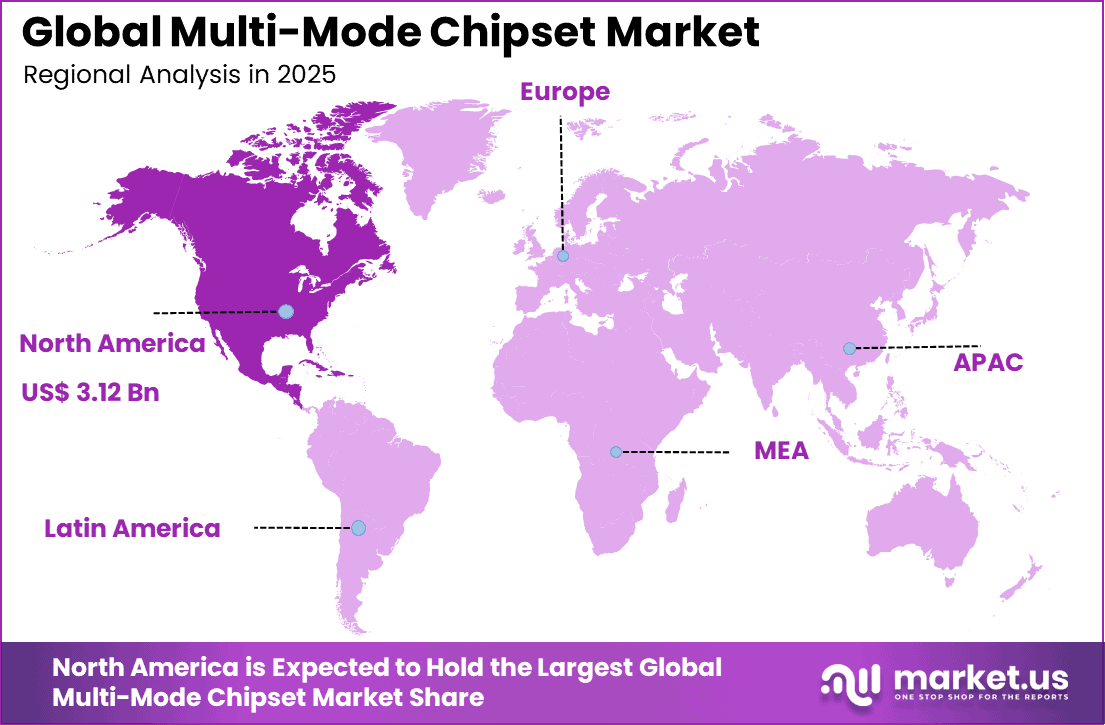
The Global Multi-Mode Chipset Market size is expected to be worth around USD 25.81 billion by 2035, from USD 8.31 billion in 2025, growing at a CAGR of 12.0% during the forecast period from 2025 to 2035. North America held a dominant market position, capturing more than a 37.6% share, holding USD 3.12 billion in revenue.
The multi-mode chipset market refers to integrated semiconductor solutions that support multiple communication technologies within a single chip. These chipsets enable devices to operate across different wireless standards such as cellular networks, Wi-Fi, Bluetooth, and GPS without requiring separate hardware components.
This integration improves device flexibility and connectivity, allowing seamless switching between networks based on availability and performance requirements. Such chipsets are widely used in smartphones, IoT devices, automotive systems, and industrial communication equipment, where uninterrupted connectivity is essential.
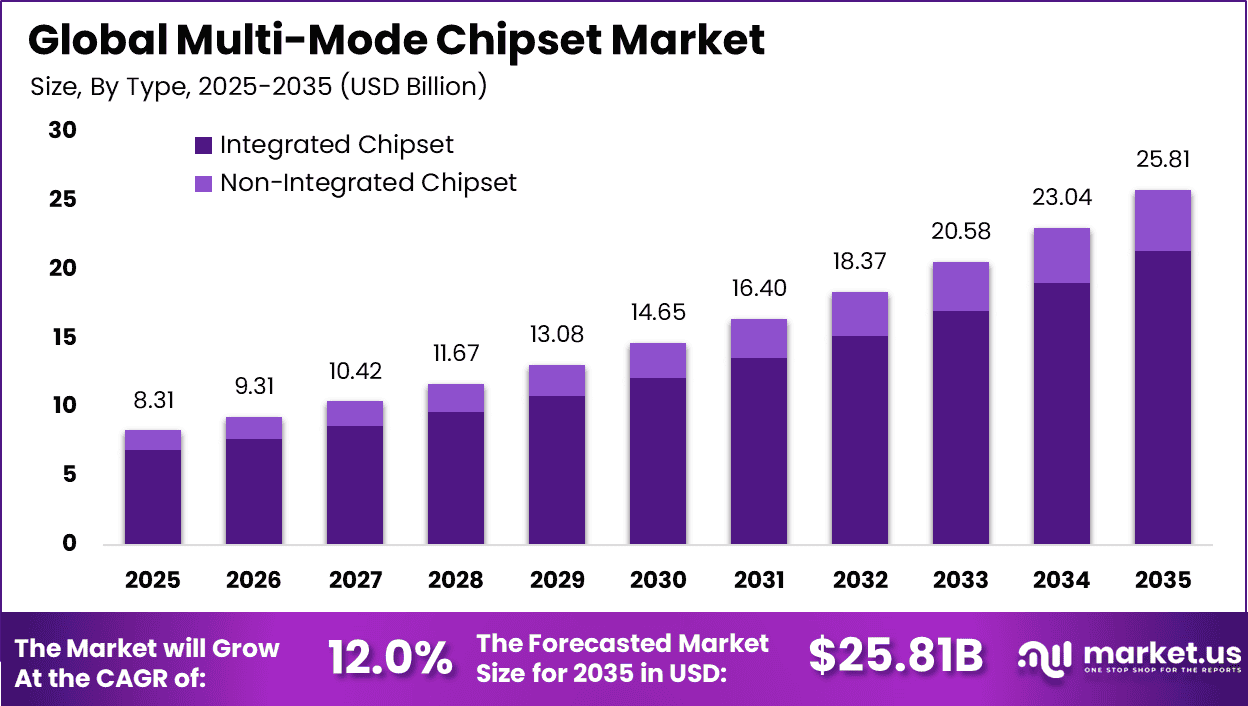
Top driving factors for this market are strongly associated with the rapid evolution of wireless communication technologies and increasing demand for high speed connectivity. The expansion of 5G networks is a major driver, as modern devices are required to support both legacy and next generation networks simultaneously. In addition, the growing number of connected devices has increased the need for chipsets that can handle multiple communication modes efficiently.
Demand analysis indicates strong adoption across consumer electronics, telecommunications, automotive, and industrial sectors. Smartphones remain a key demand contributor due to the need for continuous connectivity across multiple networks. At the same time, demand is increasing in automotive and industrial applications where reliable communication is required for connected systems and automation. The rising deployment of IoT devices has further strengthened demand, as these devices must operate across diverse network environments to function effectively
For instance, in April 2026, Broadcom Corporation acquired a key RF startup to bolster its multi-mode chipset portfolio, announcing the BCM6790 with integrated satellite NB-IoT connectivity. This chipset supports 7 different wireless protocols simultaneously, dominating smart city infrastructure projects with 50% lower deployment costs.
Key Takeaway
- In the multi-mode chipset market, integrated chipsets held a dominant share of 82.7%, reflecting strong demand for compact and efficient communication solutions.
- Smartphones accounted for 60.6%, driven by high global penetration and continuous device upgrades.
- Fifth generation communication technology represented 54.3%, supported by expanding 5G network deployment.
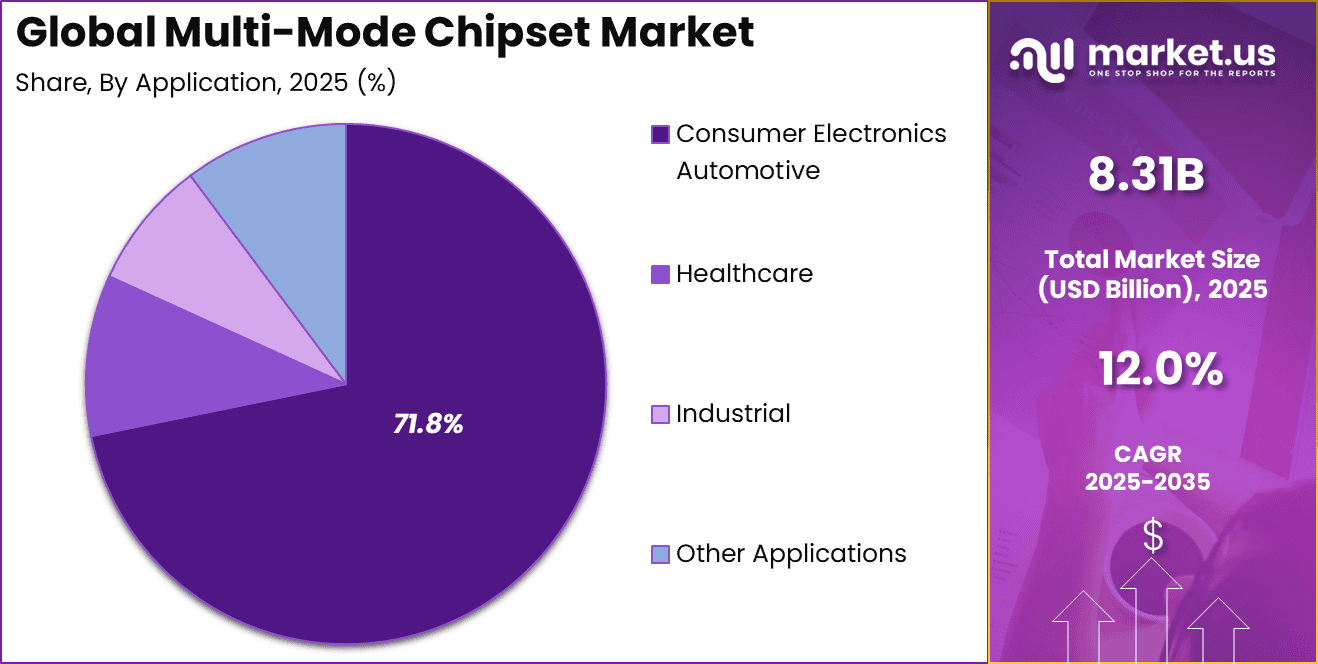
- Consumer electronics captured 71.8%, highlighting widespread use across connected devices.
- North America held a leading market share of 37.6%, supported by advanced telecom infrastructure.
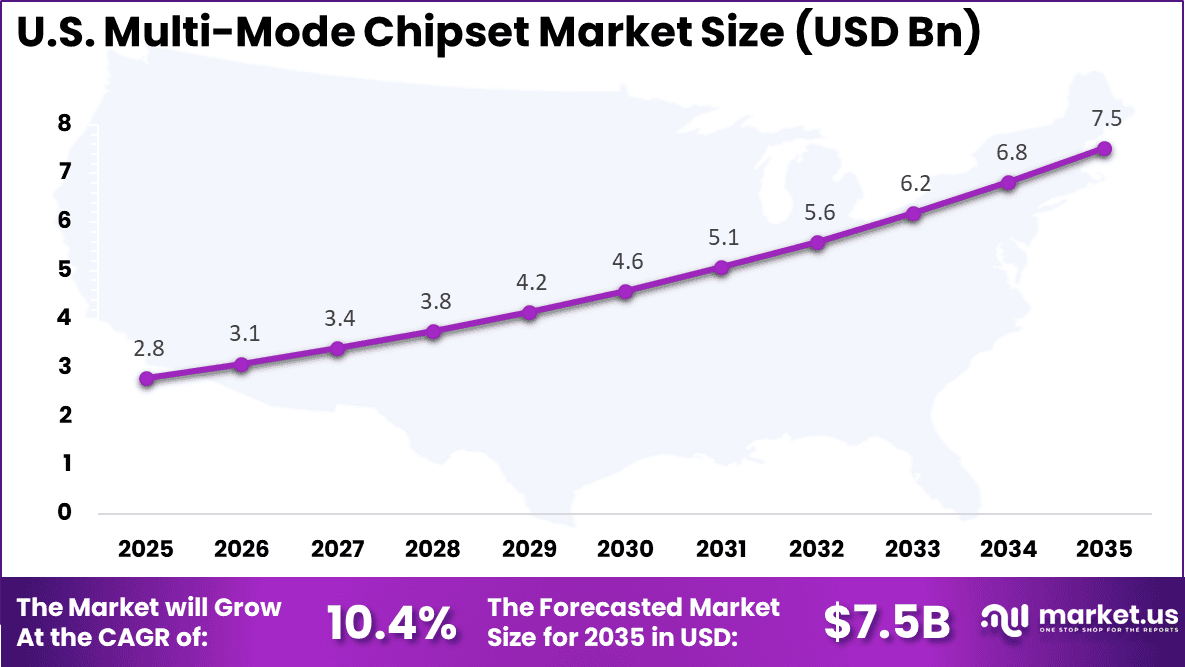
- The U.S. market was valued at USD 2.8 billion and is projected to grow at a CAGR of 10.4%.
Type Analysis
In 2025, The Integrated Chipset segment held a dominant market position, capturing a 82.7% share of the Global Multi-Mode Chipset Market. This dominance is due to a strong preference for integrated designs that combine multiple functions within a single chipset. Such designs simplify device architecture and reduce space requirements. They also support better energy efficiency, making them suitable for modern compact electronics that require consistent and reliable connectivity across different network environments.
Integrated chipsets also help improve performance by enabling smoother communication between internal components. This reduces latency and enhances overall system stability. Manufacturers benefit from lower production complexity, while users experience improved device reliability. These advantages make integrated solutions a preferred choice in evolving communication and connectivity applications.
For Instance, in April 2026, Samsung has been refining its Exynos‑based multi‑mode chipsets to fold 5G modems, RF transceivers, and power‑management blocks into a single, compact solution for smartphones and connected devices. This push toward highly integrated designs helps OEMs reduce board space and complexity while keeping performance and battery life in line with premium‑tier expectations.
Device Analysis
In 2025, the Smartphones segment held a dominant market position, capturing a 60.6% share of the Global Multi-Mode Chipset Market. This dominance is due to the widespread use of smartphones as primary connected devices across global markets. These devices require seamless connectivity across different network generations, which makes multi mode chipsets essential. Their ability to support high speed data and stable connections supports daily communication, entertainment, and digital services.
Smartphones continue to drive innovation in connectivity as users expect faster speeds and better network coverage. The need for uninterrupted service across various environments increases reliance on advanced chipsets. As mobile usage grows, smartphones remain a key driver of demand for flexible and efficient connectivity solutions.
For instance, in January 2026, at CES 2026, Qualcomm unveiled a new Snapdragon platform that combines 5G multi‑mode modems with advanced AI and display engines inside flagship smartphones. The chipset is designed to handle multiple bands and carrier configurations while supporting richer on‑device AI features, which smartphone manufacturers are using to differentiate their latest models in a saturated market.
Communication Analysis
In 2025, The Fifth Generation (5G) segment held a dominant market position, capturing a 54.3% share of the Global Multi-Mode Chipset Market. This dominance is due to the increasing adoption of advanced wireless networks that require flexible and high performance chipsets. Multi mode chipsets allow devices to operate across different network layers, ensuring smooth connectivity. This supports a better user experience, especially in environments where network conditions change frequently.
The shift toward faster and more reliable communication systems is pushing demand for adaptable chip technologies. These chipsets help maintain consistent performance by managing multiple frequencies efficiently. As communication standards evolve, the need for seamless transitions between networks continues to strengthen the importance of multimodal solutions.
For Instance, in March 2026, Huawei showcased new 5G‑ and 5G‑Advanced‑ready chipsets and radio solutions at MWC 2026, aimed at U6 GHz and full‑scenario 5G‑A deployments. These platforms are built to support higher‑order carrier aggregation, ultra‑low latency control, and enhanced coverage, helping network operators and device makers move beyond basic 5G toward more advanced, use‑case‑specific services.
Application Analysis
In 2025, The Consumer Electronics Automotive held a dominant market position, capturing a 71.8% share of the Global Multi-Mode Chipset Market. This dominance is due to the high usage of connected consumer devices that depend on stable and efficient communication systems. Products such as personal electronics and smart home devices rely on multi mode chipsets for smooth operation. This ensures a better user experience through consistent connectivity and improved device performance.
The growing adoption of smart technologies in everyday life is increasing the need for reliable connectivity solutions. Consumer devices must handle multiple tasks while maintaining stable network access. Multi mode chipsets support this requirement by enabling devices to operate efficiently across different communication standards and usage conditions.
For Instance, in April 2026, Texas Instruments is broadening its portfolio of RF‑front‑end and mixed‑signal ICs tailored for consumer electronics such as smart speakers, wearables, and home automation systems. By offering multi‑mode radio building blocks that can be paired with different host controllers, the company helps equipment makers add seamless Wi‑Fi, Bluetooth, and sub‑GHz connectivity across a wide range of price segments.
U.S. Multi-Mode Chipset Market Size
The market for Multi-Mode Chipset within the U.S. is growing tremendously and is currently valued at USD 2.8 billion; the market has a projected CAGR of 10.4%. The market is growing due to strong demand for faster wireless communication, rising 5G deployment, and wider use of connected devices across homes, factories, and healthcare systems.
Growth is also supported by cloud infrastructure expansion and higher adoption of smart technologies. In addition, U.S. companies continue to invest in advanced semiconductor design, which helps improve chipset performance, efficiency, and compatibility across multiple network standards.
For instance, in March 2025, Intel solidified U.S. leadership in multi-mode chipsets by unveiling its latest 5G/4G/3G integrated platform at MWC, powering next-gen smartphones and IoT devices with superior power efficiency. This innovation strengthens North America’s dominance through advanced R&D and rapid 5G deployment across key markets.
In 2025, North America held a dominant market position in the Global Multi-Mode Chipset Market, capturing more than a 37.6% share, holding USD 3.12 billion in revenue. This dominance is because the region has strong telecom infrastructure, early adoption of 5G, and high demand for advanced connected devices.
The presence of major semiconductor and technology companies also supports steady innovation. Growth in cloud services, smart factories, automotive electronics, and IoT applications continues to strengthen regional demand, helping North America maintain its dominant market share in this industry.
For instance, in February 2026, Broadcom strengthened North American dominance by securing major hyperscaler contracts for its Jericho3-AI multi-mode networking chipsets. Supporting 800G Ethernet, InfiniBand, and PCIe Gen6, these solutions power U.S. data centers, fueling AI and cloud computing revolutions.
Emerging Trends Analysis
The multi-mode chipset market is progressing toward highly integrated system-on-chip designs that support multiple communication standards within a single component. Devices today are expected to operate seamlessly across 4G, 5G, Wi-Fi, Bluetooth, and GNSS networks, which has increased the demand for chipsets capable of handling diverse connectivity requirements. This trend is leading to compact, power-efficient chip architectures that reduce hardware complexity while improving overall device performance.
Another key trend is the adoption of advanced semiconductor technologies and smaller process nodes. These innovations are enabling higher data processing speeds, improved energy efficiency, and enhanced thermal management. At the same time, the rise of edge computing and real-time data processing is pushing chipset developers to optimize performance for low-latency applications, especially in smartphones, wearables, and connected devices.
Key Market Segments
By Type
- Integrated Chipset
- Single-Chip Solution
- Multi-Chip Module (MCM)
- Non-Integrated Chipset
- Discrete Chipset
- Modular Chipset
By Device
- Smartphones
- Tablets
- Wearable Devices
- Internet Of Things
By Communication
- Second-Generation
- Third Generation
- Fourth Generation
- Fifth Generation
By Application
- Consumer Electronics Automotive
- Healthcare
- Industrial
- Other Applications
Key Regions and Countries
North America
- US
- Canada
Europe
- Germany
- France
- The UK
- Spain
- Italy
- Russia
- Netherlands
- Rest of Europe
Asia Pacific
- China
- Japan
- South Korea
- India
- Australia
- Singapore
- Thailand
- Vietnam
- Rest of APAC
Latin America
- Brazil
- Mexico
- Rest of Latin America
Middle East & Africa
- South Africa
- Saudi Arabia
- UAE
- Rest of MEA
Drivers
Growing Demand for Seamless Wireless Connectivity
The market is gaining strength because users now expect uninterrupted wireless performance across devices and networks. Multi mode chipsets help support this need by allowing devices to switch smoothly between communication standards. This makes them important for smartphones, wearables, connected vehicles, and many other digital applications.
As digital services expand, reliable connectivity has become a basic requirement for both consumers and businesses. Multi mode chipsets improve signal continuity and device flexibility in changing network conditions. Their role is becoming more important as industries depend on stable wireless communication for daily operations and user experience.
For instance, in March 2025, Samsung rolled out new multi-mode modems that blend 5G and Wi-Fi signals for smoother handoffs in crowded areas. Users on the go now enjoy steady streaming and calls as devices switch networks without a pause, meeting the push for always-on links in daily life. This move helps their phones stand out in a connected world.
Restraint
High Development Costs
The market faces a restraint in the form of high development costs linked to advanced chipset design and testing. Creating multi mode chipsets requires skilled engineering, complex validation, and deep integration across different communication standards. This raises the cost burden for manufacturers working in a highly competitive environment.
These high costs can slow product development and limit entry for smaller players. Investment is needed not only for design but also for software support, compliance, and production readiness. As technology becomes more advanced, cost control remains a major concern for companies trying to maintain both quality and profitability.
For instance, in January 2025, Intel shared details on its pricey push into multi-core designs for mixed signals, noting the heavy spend on labs and tests to blend modes. These costs slow smaller projects as they juggle budgets for complex builds that support various wireless types. It highlights the cash drain in chasing full coverage.
Opportunities
Growth in Edge Computing
A strong opportunity is emerging from the rise of edge computing across connected devices and smart systems. Multi mode chipsets are well suited for this shift because they support reliable local communication without depending fully on centralized cloud systems. This helps improve speed, responsiveness, and operational efficiency in real time settings.
Edge environments require devices to process and share data quickly across different network types. Multi mode chipsets make this possible by offering flexible connectivity in compact systems. As edge adoption expands in industrial, healthcare, and consumer applications, new demand is likely to open for advanced chipset solutions.
For instance, in April 2025, Qualcomm teamed up for edge AI chips that process data right at the source using multi-mode links. This cuts lag for factory sensors and smart cams, fitting the shift to local computing power. It positions them well as industries seek quick, on-site smarts over cloud reliance.
Challenges
Navigating Fragmented Standards
A major challenge in this market is the fragmented nature of wireless standards across regions, devices, and applications. Multi mode chipsets must support different frequencies, protocols, and network requirements, which makes the design more complex. Ensuring broad compatibility while maintaining performance can become difficult as communication ecosystems continue to evolve.
This issue also affects product planning and time to market. Developers must build solutions that work across varied regulatory and technical conditions without creating excessive design overhead. As standards continue to change, chipset makers face ongoing pressure to remain adaptable while still delivering reliable and efficient connectivity solutions.
For instance, in June 2025, Nokia faced pushback on adapting chipsets to clashing regional Wi-Fi rules, delaying some network gear. They reworked designs multiple times to fit local specs, risking product mismatches abroad. It underscores the headache of global rollouts amid mismatched guidelines.
Key Players Analysis
The Multi-Mode Chipset Market is led by major semiconductor and mobile technology companies with strong expertise in wireless communication. Qualcomm Technologies Inc., MediaTek Inc., and Samsung Electronics Co. Ltd. dominate with advanced chipset solutions supporting multiple network standards. Intel Corporation and Huawei Technologies Co. Ltd. enhance connectivity through integrated processing technologies.
A significant contribution is observed from diversified semiconductor and communication solution providers. Broadcom Corporation, NXP Semiconductors N.V., STMicroelectronics N.V., and Infineon Technologies AG deliver integrated chipset components. Analog Devices Inc. and Texas Instruments Incorporated focus on signal processing and power efficiency.
Emerging and specialized players contribute to innovation in RF components and connectivity solutions. Skyworks Solutions Inc., Qorvo Inc., Renesas Electronics Corporation, and Marvell Technology Group Ltd. focus on advanced communication technologies. Rockchip Electronics Co. Ltd., GCT Semiconductor Inc., and Spreadtrum Communications support cost-effective chipset solutions. Other key players continue to expand capabilities.
Top Key Players in the Market
- Samsung Electronics Co. Ltd.
- Huawei Technologies Co. Ltd.
- Intel Corporation
- Qualcomm Technologies Inc.
- Broadcom Corporation
- Fujitsu Limited
- Telefonaktiebolaget LM Ericsson
- Nokia Corporation
- MediaTek Inc.
- STMicroelectronics N.V.
- Infineon Technologies AG
- NXP Semiconductors N.V.
- Analog Devices Inc.
- Renesas Electronics Corporation
- Marvell Technology Group Ltd.
- Skyworks Solutions Inc.
- Texas Instruments Incorporated
- Qorvo Inc.
- Maxim Integrated Products Inc.
- Integrated Device Technology Inc.
- Sierra Wireless Inc.
- Spreadtrum Communications (Shanghai) Co., Ltd.
- Rockchip Electronics Co., Ltd.
- GCT Semiconductor Inc.
- Others
Recent Developments
- In January 2026, Qualcomm Technologies Inc. just rolled out its latest Snapdragon X80 multi-mode chipset with groundbreaking 5G-Advanced support and integrated Wi-Fi 7. This powerhouse delivers 40% better power efficiency while handling seamless transitions across 5G, 4G, and satellite networks. Telecom operators worldwide are snapping it up for next-gen devices.
- In February 2026, Samsung Electronics Co. Ltd. launched the Exynos M6, its most advanced multi-mode chipset yet, packing integrated 6G modem capabilities alongside mmWave 5G. With 3x faster sub-6GHz processing, Samsung solidified its lead in premium smartphones and IoT deployments across North America and Europe.
Report Scope
| Report Features | Description |
|---|---|
| Market Value (2024) | USD 8.3 Bn |
| Forecast Revenue (2034) | USD 25.8 Bn |
| CAGR(2025-2034) | 12% |
| Base Year for Estimation | 2024 |
| Historic Period | 2020-2023 |
| Forecast Period | 2025-2034 |
| Report Coverage | Revenue forecast, AI impact on Market trends, Share Insights, Company ranking, competitive landscape, Recent Developments, Market Dynamics and Emerging Trends |
| Segments Covered | By Type (Integrated Chipset, Non-Integrated Chipset), By Device (Smartphones, Tablets, Wearable Devices, Internet Of Things), By Communication (Second-Generation, Third Generation, Fourth Generation, Fifth Generation), By Application (Consumer Electronics Automotive, Healthcare, Industrial, Other Applications) |
| Regional Analysis | North America – US, Canada; Europe – Germany, France, The UK, Spain, Italy, Russia, Netherlands, Rest of Europe; Asia Pacific – China, Japan, South Korea, India, New Zealand, Singapore, Thailand, Vietnam, Rest of Latin America; Latin America – Brazil, Mexico, Rest of Latin America; Middle East & Africa – South Africa, Saudi Arabia, UAE, Rest of MEA |
| Competitive Landscape | Samsung Electronics Co. Ltd., Huawei Technologies Co. Ltd., Intel Corporation, Qualcomm Technologies Inc., Broadcom Corporation, Fujitsu Limited, Telefonaktiebolaget LM Ericsson, Nokia Corporation, MediaTek Inc., STMicroelectronics N.V., Infineon Technologies AG, NXP Semiconductors N.V., Analog Devices Inc., Renesas Electronics Corporation, Marvell Technology Group Ltd., Skyworks Solutions Inc., Texas Instruments Incorporated, Qorvo Inc., Maxim Integrated Products Inc., Integrated Device Technology Inc., Sierra Wireless Inc., Spreadtrum Communications (Shanghai) Co. Ltd., Rockchip Electronics Co. Ltd., GCT Semiconductor Inc., Others |
| Customization Scope | Customization for segments, region/country-level will be provided. Moreover, additional customization can be done based on the requirements. |
| Purchase Options | We have three license to opt for: Single User License, Multi-User License (Up to 5 Users), Corporate Use License (Unlimited User and Printable PDF) |





































