


Report Overview
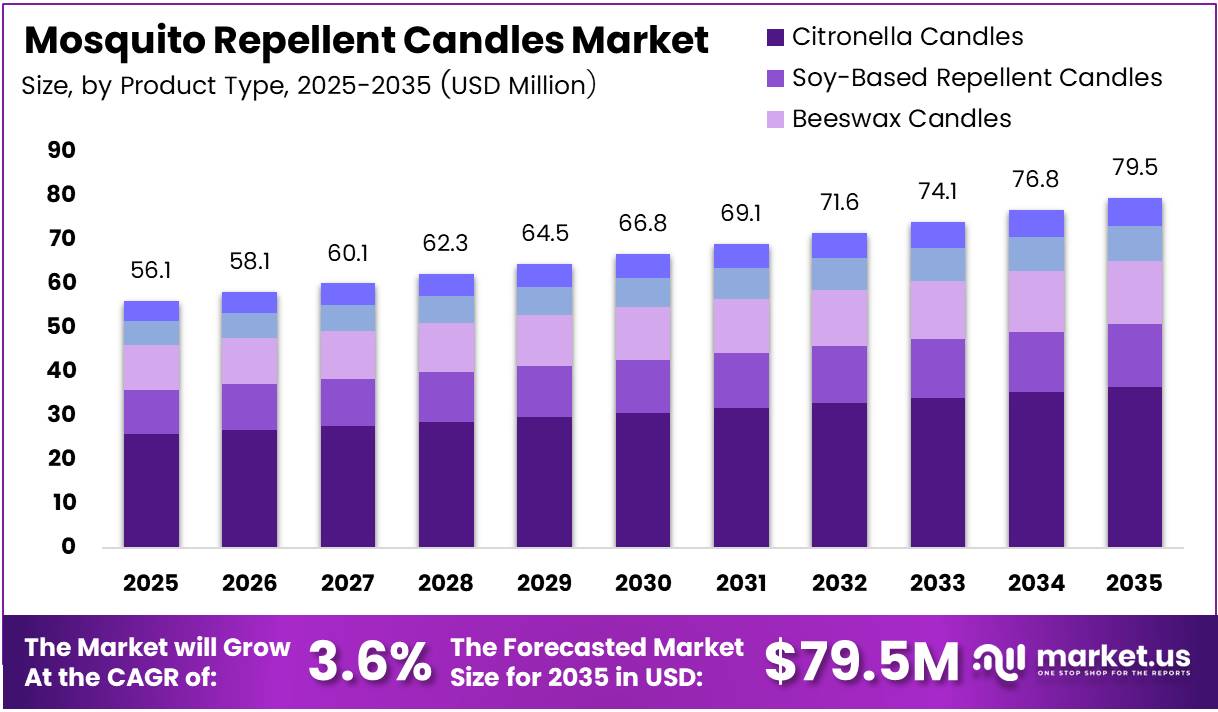
Global Mosquito Repellent Candles Market size is expected to be worth around USD 79.5 Million by 2035 from USD 56.1 Million in 2025, growing at a CAGR of 3.6% during the forecast period 2026 to 2035.
The mosquito repellent candles market covers wax-based products formulated with active botanical compounds — primarily citronella, lemongrass, and other essential oils — designed to deter mosquitoes in residential, commercial, and outdoor settings. These products sit at the intersection of household pest control and lifestyle, appealing to consumers who want functional protection without chemical sprays.
Consumer behavior in this market reflects a clear shift away from synthetic repellents toward plant-based alternatives. Buyers associate candle-format repellents with ambient ambiance, low toxicity, and ease of use — particularly during outdoor dining, garden gatherings, and recreational camping. This dual utility as both repellent and décor item broadens the addressable audience well beyond traditional pest control buyers.
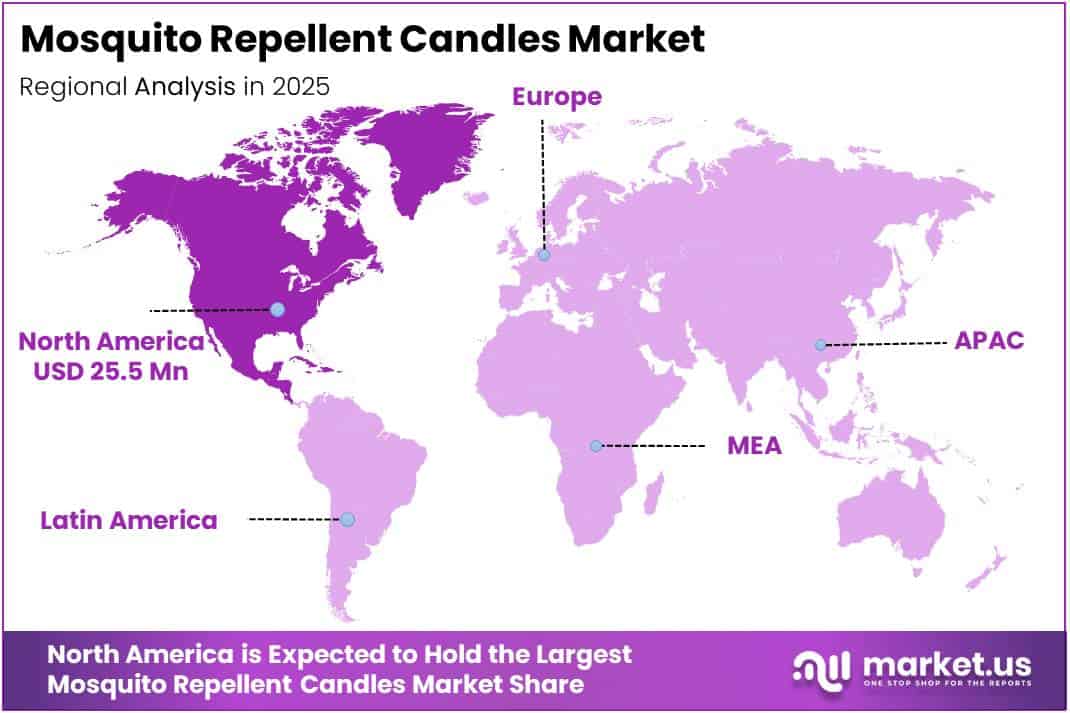
North America anchors the market with a 45.7% share, valued at approximately USD 25.5 Million. This dominance reflects a combination of high outdoor recreation participation, strong retail penetration through supermarkets and hypermarkets, and an established consumer preference for non-DEET alternatives. These structural conditions are not easily replicated overnight in emerging markets, giving North American suppliers a durable home-base advantage.
The residential segment drives 56.2% of end-use demand, which signals that households — not commercial establishments — remain the primary purchase decision-makers. This buyer profile means product marketing must focus on ease of use, scent appeal, and perceived safety rather than technical efficacy metrics, which shapes how brands must position and package their products.
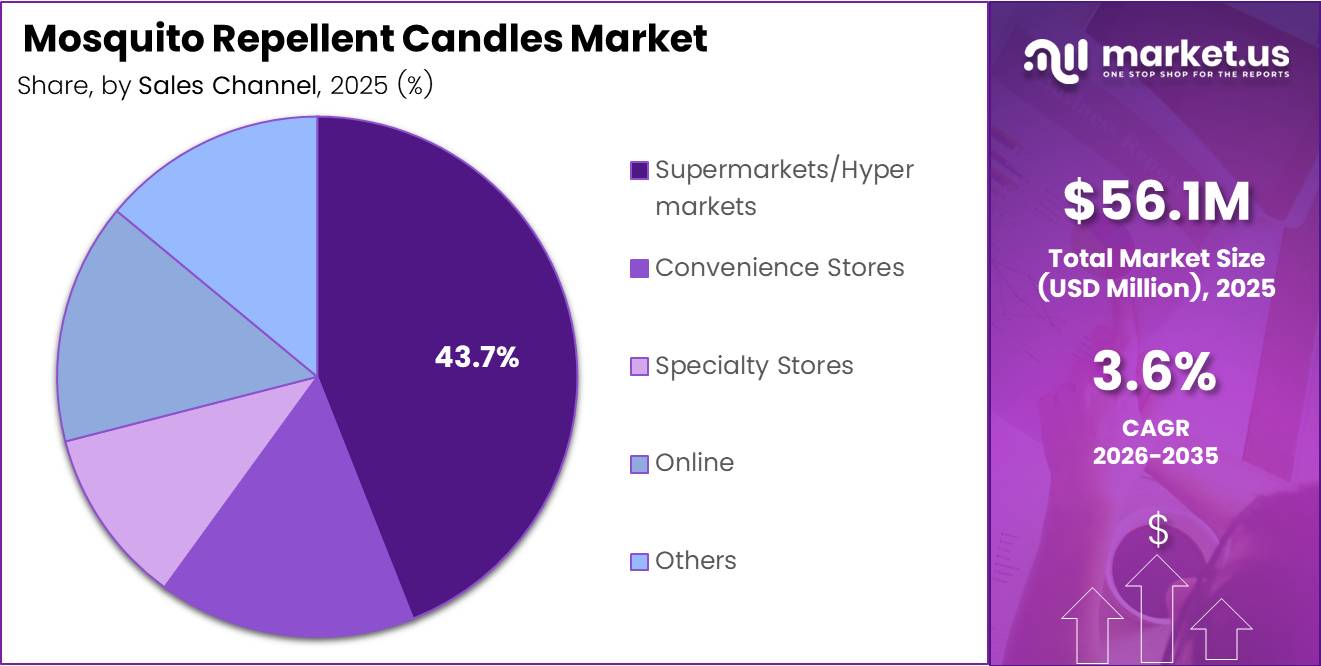
Supermarkets and hypermarkets command 43.7% of sales channel distribution. This concentration in mass retail confirms that mosquito repellent candles remain a convenience purchase rather than a considered one — meaning shelf placement, price point, and packaging visibility outweigh brand loyalty in driving conversion. Vendors not present in major retail chains face a structural disadvantage regardless of product quality.
According to the U.S. EPA, candle lead emission rates range from 0.52 to 327 micrograms per hour, producing indoor air concentrations from 0.02 to 13.1 micrograms per cubic meter in test rooms. This data highlights a key tension in the market: products marketed as natural alternatives carry their own emission risks, creating both a regulatory watchpoint and a product differentiation opportunity for clean-burning formulations.
Research published in PMC found that citronella candles produced secondary organic aerosol emission rates of 3,300 to 11,500 micrograms per gram of candle burned. For the market, this science matters because it gives regulators and informed consumers reason to scrutinize ingredient lists — a pressure that will ultimately reward manufacturers investing in smoke-free and clean-burning candle technologies ahead of potential standards tightening.
Key Takeaways
- The global Mosquito Repellent Candles Market was valued at USD 56.1 Million in 2025 and is forecast to reach USD 79.5 Million by 2035.
- The market grows at a CAGR of 3.6% during the forecast period 2026 to 2035.
- By Product Type, Citronella Candles dominate with a 45.8% share in 2025.
- By End-Use, the Residential segment leads with a 56.2% share.
- By Sales Channel, Supermarkets/Hypermarkets account for 43.7% of total sales.
- North America holds the largest regional share at 45.7%, valued at approximately USD 25.5 Million.
Product Analysis
Citronella Candles dominate with 45.8% due to broad retail availability and established consumer recognition.
In 2025, Citronella Candles held a dominant market position in the By Product Type segment of the Mosquito Repellent Candles Market, with a 45.8% share. Citronella’s recognition as a natural mosquito deterrent drives consistent consumer pull across mass retail channels. Moreover, its established scent profile reinforces repurchase behavior, making it the default category anchor for new buyers.
Soy-Based Repellent Candles serve as the premium entry point for eco-conscious consumers seeking cleaner burn characteristics. Soy wax supports longer burn times and lower soot emissions than paraffin, which appeals to buyers prioritizing indoor air quality. Consequently, soy-based products carry higher price points and attract retail shelf space in specialty and organic-focused stores.
Beeswax Candles carry the highest per-unit cost within the repellent candle segment, positioning them as a niche premium product. Beeswax burns cleanly and naturally repels moisture, making it attractive for outdoor garden and patio settings. However, limited raw material availability constrains volume growth, keeping this sub-segment concentrated among artisan and specialty producers.
Essential Oil Infused Candles differentiate through multi-sensory appeal, combining mosquito deterrence with aromatherapy benefits. Formulations typically blend lemongrass, eucalyptus, or lavender with base wax, creating products that function as household wellness items alongside pest control. This dual positioning enables vendors to command shelf space in wellness and home décor retail alongside conventional pest control aisles.
Others in the product type segment include hybrid formulations and experimental blends that have not yet achieved standardized market classification. These products typically originate from smaller or direct-to-consumer brands testing scent combinations or wax blends. Their share remains fragmented, but this sub-segment functions as an indicator of where consumer preference and formulation innovation are heading.
End-Use Analysis
Residential dominates with 56.2% due to direct household purchase decisions and backyard use occasions.
In 2025, Residential held a dominant market position in the By End-Use segment of the Mosquito Repellent Candles Market, with a 56.2% share. Homeowners and renters purchase repellent candles primarily for patios, balconies, and garden gatherings where mosquito presence disrupts outdoor living. Additionally, the format aligns with home décor preferences, enabling repeat purchases driven by lifestyle rather than crisis response.
Commercial buyers encompass restaurants, hotels, and outdoor hospitality venues seeking ambient pest control without the visible intrusiveness of traps or electronic devices. These buyers require higher burn time, aesthetic consistency, and branded packaging that complements venue ambiance. Therefore, commercial purchasing decisions depend more on formulation longevity and visual design than on price sensitivity alone.
Camping & Outdoor Enthusiasts represent a high-frequency, seasonally concentrated buyer group that prioritizes portability and functional efficacy over aesthetics. This segment drives demand for compact, travel-format candles with reliable repellent performance across variable weather conditions. Moreover, this buyer group actively influences product reviews and community recommendations, making them a disproportionately important audience for brand credibility.
Sale Channel Analysis
Supermarkets/Hypermarkets dominate with 43.7% due to mass consumer reach and high-footfall purchase occasions.
In 2025, Supermarkets/Hypermarkets held a dominant market position in the By Sales Channel segment of the Mosquito Repellent Candles Market, with a 43.7% share. Mass retail channels capture impulse and seasonal purchases driven by promotional placement during peak mosquito season. Consequently, brands without strong retailer relationships face a structural barrier to reaching the majority of active buyers.
Convenience Stores capture last-minute and emergency purchases from consumers who need immediate solutions without planning. Products distributed through convenience retail must prioritize single-unit pricing, compact packaging, and shelf-ready formats. This channel suits established brands with broad SKU distribution rather than premium or artisan producers with limited supply infrastructure.
Specialty Stores serve as the primary channel for premium, natural, and eco-certified repellent candle products. Buyers in this channel actively seek product information and ingredient transparency, making them more receptive to higher price points. However, specialty retail exposure limits volume potential, meaning brands relying solely on this channel accept constrained revenue ceilings in exchange for margin and positioning advantages.
Online channels enable direct-to-consumer sales that bypass traditional retail margin structures and allow brands to communicate detailed product narratives. E-commerce platforms also support subscription models and bundled purchasing, which increase average order value for established players. Moreover, online channels open access to geographies where physical retail distribution of specialty pest control products remains underdeveloped.
Others in the sales channel category include farm markets, pop-up retail, and direct brand outlets that serve hyper-local buyer communities. These channels typically serve artisan and small-batch producers whose production volumes do not qualify for major retail distribution agreements. While commercially marginal at scale, these channels function as product testing grounds and early-adopter feedback mechanisms.
Key Market Segments
By Product Type
- Citronella Candles
- Soy-Based Repellent Candles
- Beeswax Candles
- Essential Oil Infused Candles
- Others
By End-Use
- Residential
- Commercial
- Camping & Outdoor Enthusiasts
By Sales Channel
- Supermarkets/Hypermarkets
- Convenience Stores
- Specialty Stores
- Online
- Others
Drivers
Mosquito-Borne Disease Incidence and Consumer Shift to Plant-Based Protection Products Expand Market Demand
Rising incidence of dengue, malaria, and Zika virus across tropical and subtropical regions raises household awareness of mosquito-linked health risks. This awareness converts previously indifferent consumers into active buyers of mosquito control products. The candle format benefits directly because it satisfies both protective intent and the consumer preference for non-chemical household environments.
Consumer preference for chemical-free and plant-based repellent products shifts purchasing decisions away from synthetic sprays and DEET-based solutions. Citronella, lemongrass, and essential oil formulations meet this demand at accessible price points available in mass retail. Therefore, manufacturers who position clearly around botanical ingredients gain a buyer trust advantage that synthetic product lines cannot easily replicate.
Growth in outdoor recreational activities — including camping, backyard dining, and garden gatherings — creates a consistent seasonal demand cycle for portable and ambient repellent solutions. Additionally, the simultaneous rise of aromatherapy interest among home consumers repositions repellent candles as dual-purpose household items. This expands the addressable buyer pool beyond pest control purchasers into the broader home fragrance and wellness category.
Restraints
Functional Limitations in Large Outdoor Spaces and Strong Alternatives Restrict Candle Repellent Adoption
Mosquito repellent candles face a fundamental efficacy constraint: their protection radius is limited to the immediate surrounding area, making them inadequate for large outdoor spaces such as open yards, parks, or event venues. According to PMC research, citronella candle experiments recorded particle number concentrations rising from 2,000 to 420,000 particles per cubic centimeter within approximately 7 minutes after ozone exposure, highlighting combustion byproduct concerns that reduce their appeal in enclosed or semi-enclosed settings.
Electronic repellents, sprays, and creams deliver measurable, broader-area protection that candles cannot match under wind or open-air conditions. Buyers with larger outdoor spaces or frequent high-exposure scenarios choose these alternatives based on practical effectiveness rather than aesthetic preference. Consequently, repellent candles occupy a functional ceiling that limits their penetration into high-risk or professional pest control contexts.
The availability of multiple competing formats — including electric vaporizers, topical creams, and ultrasonic devices — fragments consumer spending across pest control categories. This competitive fragmentation makes it difficult for candle manufacturers to claim sole-category loyalty from buyers. Moreover, expanding e-commerce shelves expose consumers to a wider repellent option set than traditional retail channels previously allowed, intensifying cross-format competition.
Growth Factors
Long-Lasting Formulations, Hospitality Sector Expansion, and E-Commerce Growth Open New Revenue Streams
Development of long-lasting essential oil-based formulations directly addresses the efficacy concern that currently limits candle repellent adoption. Products with extended burn times and higher active ingredient concentration offer buyers more time-per-dollar value, shifting purchase decisions from entry-level to mid-to-premium SKUs. This formulation advancement creates a tangible product differentiation lever for manufacturers investing in R&D.
The hospitality sector represents an under-penetrated commercial channel for decorative and multi-purpose repellent candles. Hotels, outdoor restaurants, and resort properties need pest control solutions that complement rather than disrupt ambient aesthetics. According to PMC research on smart mosquito-repellent systems, a TinyML-controlled device reduced energy consumption by factors up to 1/227 compared to conventional vaporizers — illustrating that the broader pest control sector is actively evaluating efficiency-led formats, creating space for premium candle solutions in sustainability-oriented hospitality procurement.
E-commerce channel growth allows manufacturers to bypass traditional retail gatekeepers and reach consumers in geographies where physical pest control distribution is limited. Online platforms support richer product storytelling around botanical credentials, sustainability, and scent profiles — attributes that drive purchase decisions among premium buyers. Additionally, expansion of eco-friendly and biodegradable candle packaging solutions strengthens brand positioning in retail and online environments where environmental credentials increasingly influence shelf selection decisions.
Emerging Trends
Clean-Burning Innovation and Aromatherapy Convergence Reshape Mosquito Repellent Candle Product Development
Citronella remains the dominant active ingredient in repellent candles, but consumer sophistication is pushing formulators toward blended essential oil profiles that combine mosquito deterrence with aromatherapy benefits. Lavender, eucalyptus, and lemongrass combinations now appear in premium product lines targeting the wellness-oriented home consumer. This convergence shifts the product category from functional utility toward lifestyle purchase.
Innovation in smoke-free and clean-burning candle technologies directly responds to growing regulatory and consumer scrutiny of combustion byproducts. According to PMC research on smart mosquito-repellent systems, the sensing electronics for a TinyML-controlled detection system drew only 5.4 mA at 3.3 V — roughly two orders of magnitude lower power than a commercial vaporizer’s 804 mA at 5 V. This technological efficiency gap signals that buyers are becoming more informed about product performance trade-offs, raising standards for what qualifies as a credible repellent solution.
Premium outdoor-specific products for garden, patio, and terrace use are gaining distinct shelf positioning separate from general household candles. Manufacturers are differentiating through larger jar formats, higher active ingredient loads, and weather-resistant packaging designed for outdoor placement. Consequently, the premium outdoor sub-segment commands higher retail margins and attracts buyers who previously purchased electronic repellent devices for the same outdoor occasions.
Regional Analysis
North America Dominates the Mosquito Repellent Candles Market with a Market Share of 45.7%, Valued at USD 25.5 Million
North America holds a 45.7% share of the global mosquito repellent candles market, valued at USD 25.5 Million in 2025. High outdoor recreation participation, strong supermarket and hypermarket penetration, and established consumer preference for botanical pest control products create durable structural demand. Moreover, seasonal peaks around summer months drive reliable, repeatable purchase cycles across mass retail channels.
Europe Mosquito Repellent Candles Market Trends
Europe benefits from a strong regulatory preference for non-synthetic household products, which channels consumer spending toward plant-based repellent formats. Outdoor café culture and garden living in Western Europe sustain year-round demand for ambient pest control solutions. Additionally, eco-labeling requirements in key markets such as Germany and France create compliance-driven differentiation opportunities for biodegradable candle packaging producers.
Asia Pacific Mosquito Repellent Candles Market Trends
Asia Pacific holds significant growth potential given its high mosquito-borne disease burden across South and Southeast Asia. Rising urban middle-class populations in India and China are increasing spending on home comfort and wellness products, including plant-based pest deterrents. However, price sensitivity and widespread availability of low-cost chemical alternatives constrain premiumization in this region’s current purchase cycle.
Middle East and Africa Mosquito Repellent Candles Market Trends
The Middle East and Africa region faces a persistent mosquito-borne disease challenge across sub-Saharan and tropical zones, creating structural demand for accessible repellent formats. Candle-based solutions appeal in areas with inconsistent electricity supply, where electronic vaporizers face usage barriers. Fragmented retail infrastructure, however, limits distribution reach for international candle brands outside major urban centers.
Latin America Mosquito Repellent Candles Market Trends
Latin America presents a market where public health urgency around dengue and Zika translates into household-level pest control spending. Brazil and Mexico anchor regional demand through large urban populations with documented mosquito exposure risk. Nevertheless, distributor fragmentation and reliance on informal retail channels remain structural barriers for branded candle manufacturers seeking consistent shelf presence across the region.
Key Regions and Countries
North America
- US
- Canada
Europe
- Germany
- France
- The UK
- Spain
- Italy
- Rest of Europe
Asia Pacific
- China
- Japan
- South Korea
- India
- Australia
- Rest of APAC
Latin America
- Brazil
- Mexico
- Rest of Latin America
Middle East & Africa
- GCC
- South Africa
- Rest of MEA
Key Company Insights
Murphy’s Naturals, Inc. has built its competitive position around transparent botanical ingredient sourcing and eco-conscious branding, targeting the premium end of the plant-based repellent candle market. This strategy captures the growing segment of wellness-oriented consumers who treat mosquito protection as an extension of their household product philosophy. Their direct-to-consumer and specialty retail presence reinforces brand credibility in channels where ingredient transparency commands price premiums.
Spectrum Brands, Inc. operates with a broad portfolio advantage, leveraging cross-category household product distribution to place repellent candles in mass retail channels at scale. This infrastructure gives Spectrum a structural reach that smaller botanical brands cannot replicate without significant distribution investment. However, portfolio breadth also means repellent candles compete internally for marketing attention, potentially limiting the brand-specific investment needed to compete against focused specialist players.
The Coleman Company, Inc. benefits from deep brand equity in outdoor recreational equipment, which transfers consumer trust directly into its mosquito repellent candle products. Camping and outdoor enthusiast buyers who already purchase Coleman tents, coolers, and lighting view Coleman candles as a natural product extension. This embedded brand loyalty reduces acquisition costs and supports higher conversion rates compared to newcomers entering the outdoor pest control category.
La Jolie Muse differentiates through premium aesthetics and fragrance-forward product design, positioning its repellent candles as lifestyle and home décor items rather than functional pest control tools. This positioning allows access to home fragrance and gifting retail channels that traditional repellent brands do not serve. Consequently, La Jolie Muse competes on design credentials and scent quality, insulating the brand partially from direct price competition in the functional repellent segment.
Key Players
- Murphy’s Naturals, Inc.
- Spectrum Brands, Inc.
- The Coleman Company, Inc.
- La Jolie Muse
- Just Makes Scents Candles & Gifts
- UCOgear.com
- Llovefevertree
- Changrin Valley Soap & Salve
- Focus Technology Co. Ltd
Recent Developments
- June 2024 — Off! introduced the Essentials Mosquito Control 3-Wick Metal Tabletop Citronella Candle, featuring a claimed burn time of up to 50 hours for outdoor mosquito reduction. This product launch signals intensified competition in the high-burn-time segment, as established repellent brands move to counter specialty candle manufacturers on durability and outdoor performance credentials.
Report Scope
| Report Features | Description |
|---|---|
| Market Value (2025) | USD 56.1 Million |
| Forecast Revenue (2035) | USD 79.5 Million |
| CAGR (2026-2035) | 3.6% |
| Base Year for Estimation | 2025 |
| Historic Period | 2020-2024 |
| Forecast Period | 2026-2035 |
| Report Coverage | Revenue Forecast, Market Dynamics, Competitive Landscape, Recent Developments |
| Segments Covered | By Product Type (Citronella Candles, Soy-Based Repellent Candles, Beeswax Candles, Essential Oil Infused Candles, Others), By End-Use (Residential, Commercial, Camping & Outdoor Enthusiasts), By Sales Channel (Supermarkets/Hypermarkets, Convenience Stores, Specialty Stores, Online, Others) |
| Regional Analysis | North America (US and Canada), Europe (Germany, France, The UK, Spain, Italy, and Rest of Europe), Asia Pacific (China, Japan, South Korea, India, Australia, and Rest of APAC), Latin America (Brazil, Mexico, and Rest of Latin America), Middle East & Africa (GCC, South Africa, and Rest of MEA) |
| Competitive Landscape | Murphy’s Naturals, Inc., Spectrum Brands, Inc., The Coleman Company, Inc., La Jolie Muse, Just Makes Scents Candles & Gifts, UCOgear.com, Llovefevertree, Changrin Valley Soap & Salve, Focus Technology Co. Ltd |
| Customization Scope | Customization for segments, region/country-level will be provided. Moreover, additional customization can be done based on the requirements. |
| Purchase Options | We have three licenses to opt for: Single User License, Multi-User License (Up to 5 Users), Corporate Use License (Unlimited User and Printable PDF) |





































