Mobile Video Optimization Market By Component (Solutions (Transcoding/Transrating, Transcaching/Pre-fetching, Protocol Optimization, Others), Services (Professional Services, Managed Services)), By Deployment Mode (On-Premises, Cloud-based), By Optimization Technique (Passive Optimization, Active Optimization), By End-User (Mobile Network Operators, Content & Application Providers, Enterprises), By Regional Analysis, Global Trends and Opportunity, Future Outlook By 2025-2035
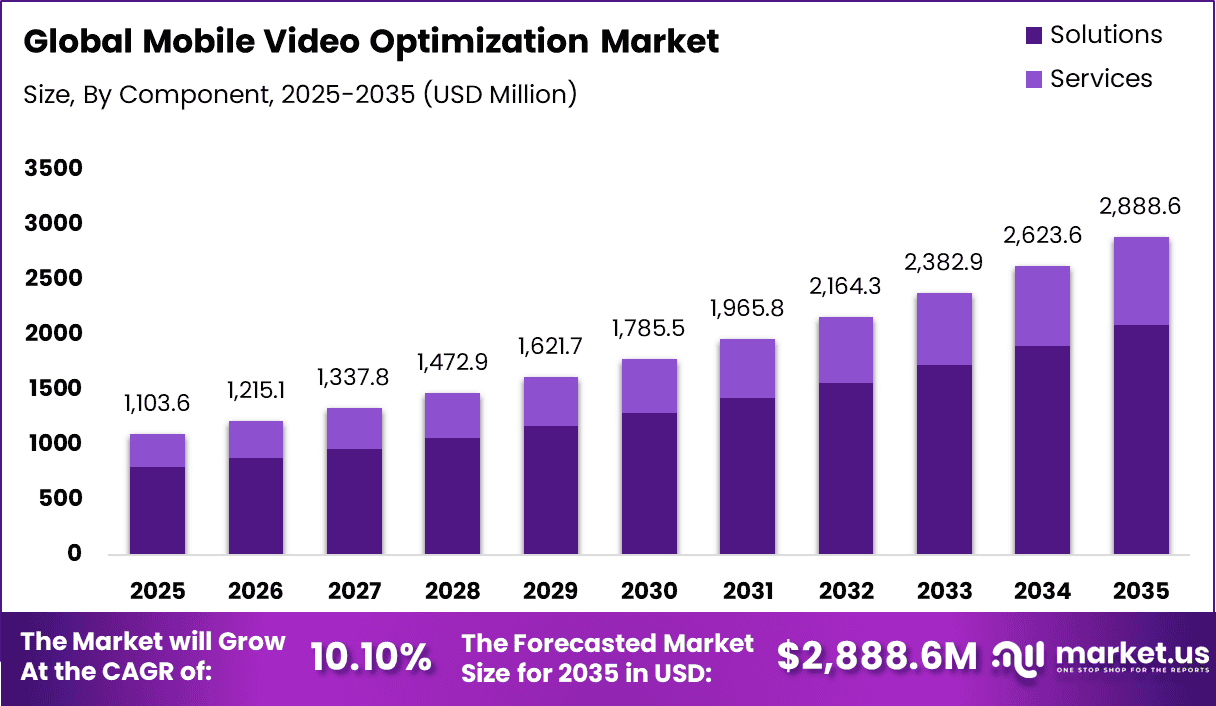
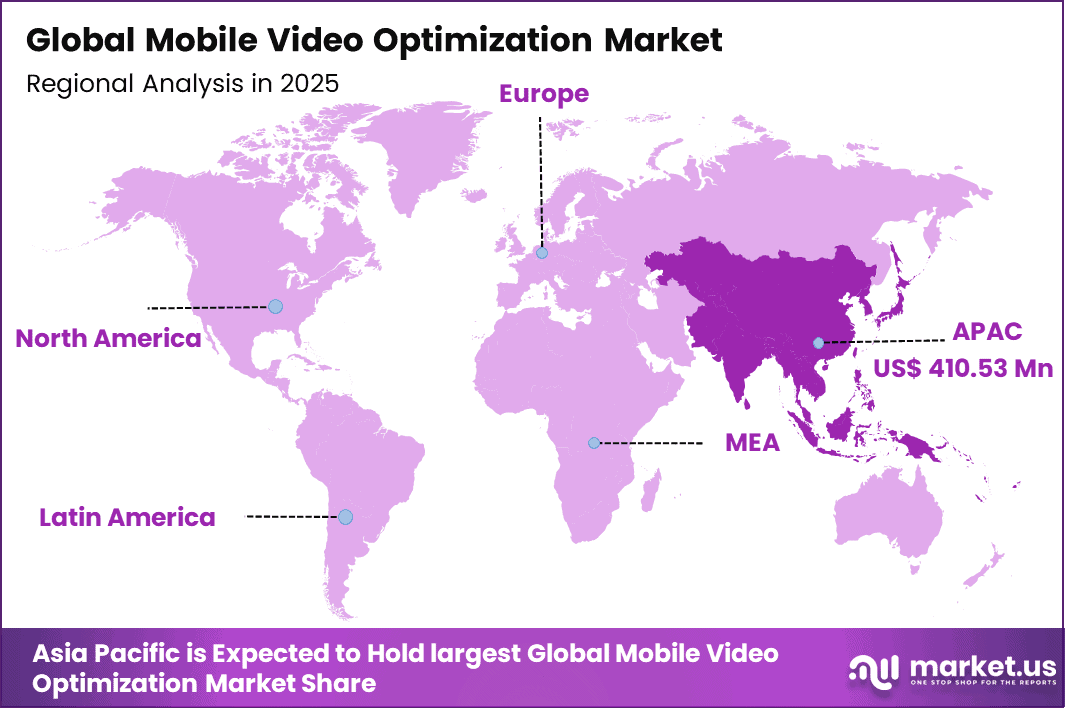
The Global Mobile Video Optimization Market generated USD 1,103.6 million in 2025 and is predicted to register growth from USD 1,215.1 million in 2026 to about USD 2,888.6 million by 2035, recording a CAGR of 10.10% throughout the forecast span. In 2025, Asia Pacific held a dominant market position, capturing more than a 37.2% share, holding USD 410.53 Million revenue.
Top Market Takeaways
Component Solutions account for 72.4% of the mobile video optimization market, as most customers prefer complete software and platform offerings rather than standalone services.
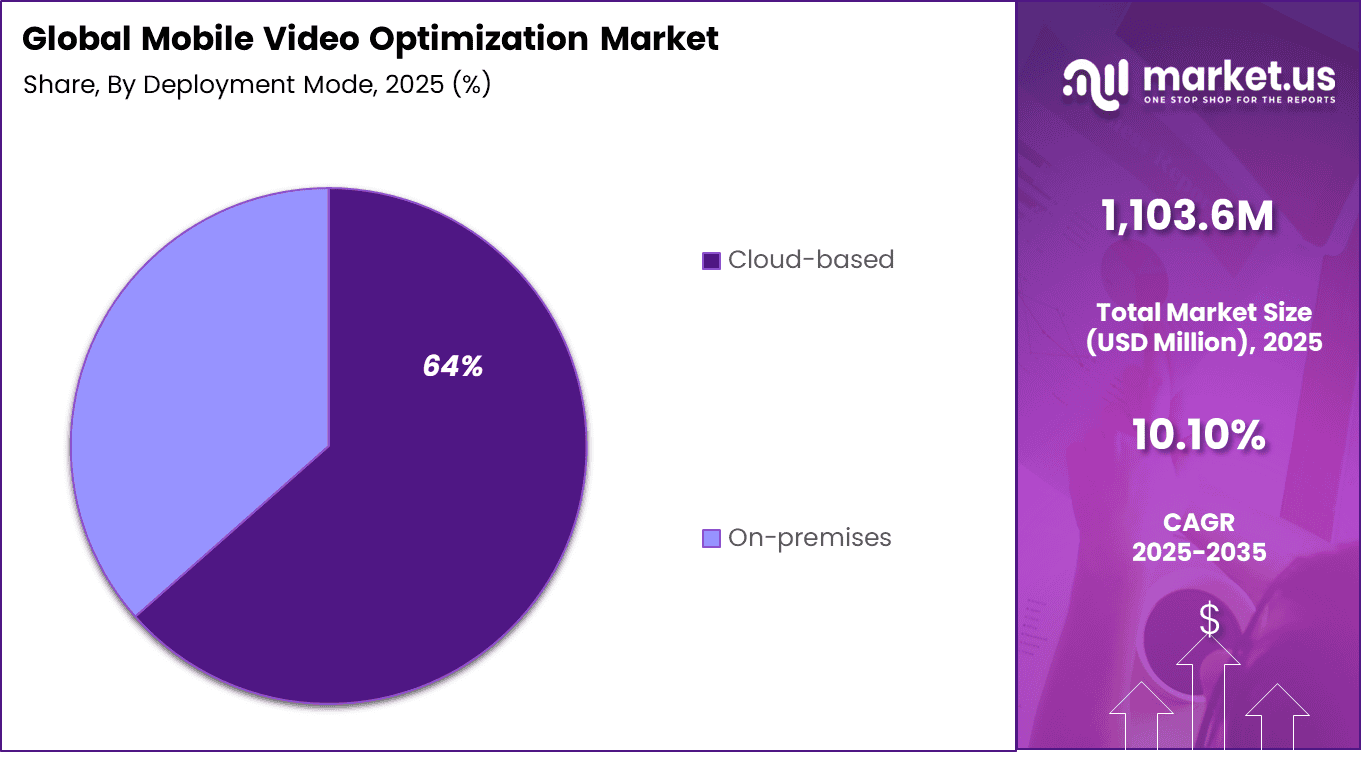
Deployment Mode Cloud-based deployment holds 63.5% because operators and enterprises want scalable, flexible, and easier-to-manage optimization solutions.
Optimization Technique Active optimization leads with 74.9%, since it can adjust video quality and traffic in real time to improve user experience and reduce network congestion.
End-User Mobile network operators make up 81.7% of demand, as they need to handle heavy video traffic on their networks and ensure smooth streaming for subscribers.
Region Asia-Pacific represents 37.2% of the market, supported by rapid growth in mobile data usage and video streaming in the region.
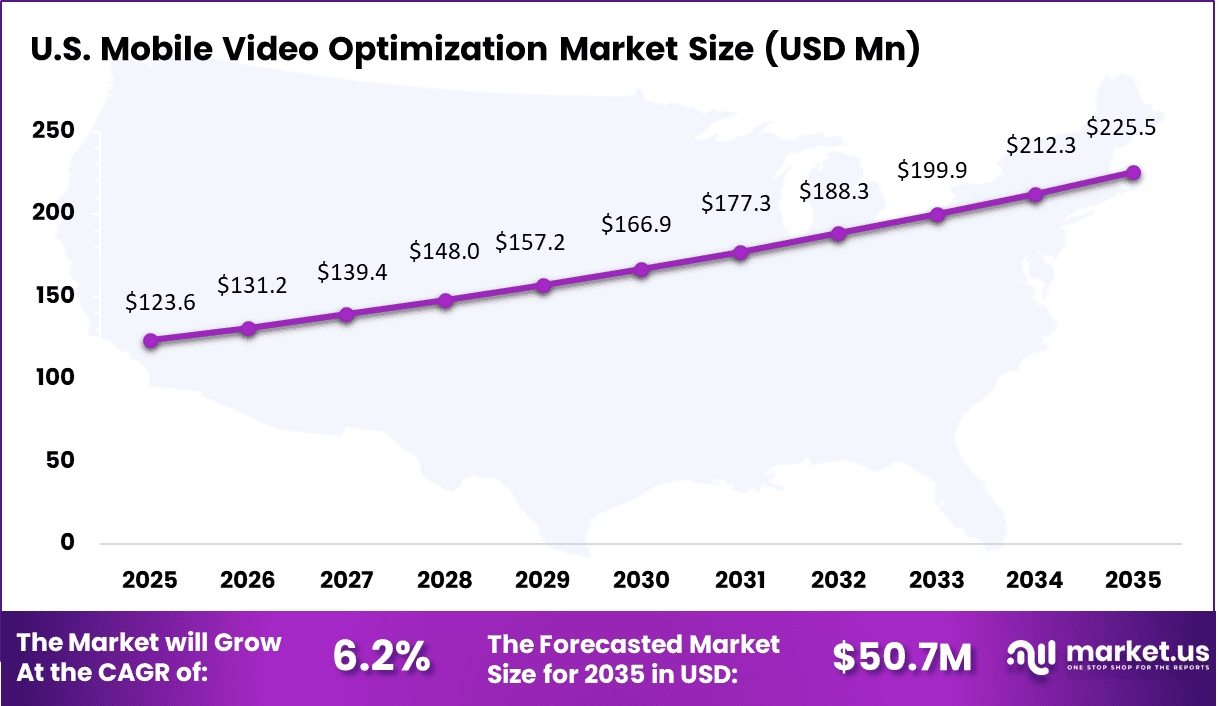
Country China’s market is valued at 123.57 million and is expected to grow at a CAGR of 6.2%, driven by a large mobile subscriber base and strong video consumption trends.
Mobile video optimization is used to improve the delivery, quality, and performance of video content on smartphones and tablets across different network conditions. It includes technologies that compress data, adapt video resolution, reduce buffering, and manage traffic efficiently so users receive a smoother viewing experience.
As mobile devices become the primary screen for entertainment, social media, education, and communication, optimized video delivery has become increasingly important. Businesses and service providers are focusing on solutions that help maintain quality while controlling bandwidth use and device limitations.
One of the main driving factors is the rapid growth of mobile video consumption across streaming platforms, short form content apps, live broadcasts, and digital advertising. Users expect fast loading and uninterrupted playback, even on congested networks or while moving between coverage areas.
In addition, telecom operators are looking for ways to manage rising video traffic without reducing user experience. The expansion of advanced mobile networks is also supporting higher quality video formats, which increases the need for smart optimization tools. Growth in mobile commerce and video based customer engagement is further encouraging investment in better video performance solutions.
Demand for mobile video optimization solutions is rising as content providers and network operators seek stronger user retention and efficient traffic management. There is a strong preference for systems that offer real time adaptation, analytics, low latency streaming, and compatibility across devices and operating systems.
Businesses are also looking for tools that can improve ad delivery, live event streaming, and personalized viewing experiences. The demand is particularly strong among media platforms, telecom providers, gaming services, and digital marketers that depend on mobile audiences. As mobile viewing continues to expand, the need for reliable and intelligent video optimization solutions is expected to grow steadily.
Drivers Impact Analysis
Key Driver
Impact on CAGR Forecast (~%)
Geographic Relevance
Impact Timeline
Additional Insight
Rising mobile video streaming consumption
+3.2%
Asia Pacific, North America, Europe
Short to medium term
Streaming demand increases optimization needs
Expansion of 4G and 5G mobile networks
+2.9%
Global
Medium term
Faster networks support better video delivery
Growing smartphone penetration and screen time
+2.6%
Asia Pacific, Latin America, Africa
Medium to long term
More users watch video on mobile devices
Increasing use of mobile video advertising
+2.3%
North America, Europe, Asia Pacific
Medium term
Advertisers need smooth playback quality
Demand for improved user experience and lower buffering
+2.0%
Global
Medium to long term
Better quality drives platform adoption
Restraints Impact Analysis
Key Restraint
Impact on CAGR Forecast (~%)
Geographic Relevance
Impact Timeline
Additional Insight
High deployment and infrastructure costs
-2.4%
Emerging markets
Short to medium term
Costs limit technology upgrades
Network congestion during peak usage hours
-2.1%
Global
Medium term
Congestion reduces video quality
Fragmented device ecosystem and screen formats
-1.8%
Global
Medium term
Device diversity complicates optimization
Data privacy and user tracking regulations
-1.5%
Europe, North America
Medium to long term
Regulations affect personalization tools
Dependence on telecom operator partnerships
-1.3%
Global
Long term
Partnership gaps slow rollout
By Component Analysis
The solutions segment accounted for 72.4% of the market share, reflecting its central role in improving video delivery quality, bandwidth efficiency, and user experience across mobile networks. This dominance is supported by the growing demand for platforms that can compress video traffic, manage streaming performance, and reduce buffering issues. Organizations are increasingly adopting dedicated solutions to handle rising mobile video consumption efficiently.
Another factor driving this segment is the need for real-time traffic management and network resource optimization. Solution-based platforms help service providers monitor usage patterns, prioritize content delivery, and maintain consistent viewing quality. Their ability to integrate with existing network systems further strengthens adoption across the market.
By Deployment Mode Analysis
The cloud-based segment held 64% share, driven by the increasing preference for scalable and flexible deployment environments. Cloud deployment allows operators to roll out optimization tools faster, manage workloads remotely, and expand capacity based on traffic demand. This approach reduces infrastructure burden and supports more efficient service management.
In addition, cloud platforms enable rapid updates and easier integration with analytics and monitoring tools. Businesses benefit from centralized control and lower maintenance requirements, making cloud-based deployment highly attractive for dynamic mobile video environments.
By Optimization Technique Analysis
The active optimization segment captured 74.9% of the market, reflecting strong demand for technologies that adjust video streams in real time based on network conditions. Active optimization helps improve playback quality by dynamically managing bitrate, compression, and traffic flow. This is essential for maintaining smooth viewing experiences on congested or variable mobile networks.
Furthermore, the rapid growth of high-definition and data-intensive video content has increased the need for intelligent optimization methods. Active techniques help reduce latency and buffering while maximizing network efficiency. These advantages continue to support the segment’s leading position.
By End-User Analysis
The mobile network operators segment accounted for 81.7% of the market share, driven by their responsibility to deliver reliable video services across expanding subscriber bases. Operators rely on optimization platforms to manage rising traffic volumes, improve customer satisfaction, and control network costs. Video remains one of the largest sources of mobile data demand, making optimization a strategic priority.
Moreover, increasing competition in telecom markets has encouraged operators to enhance service quality and user retention. Mobile video optimization tools help ensure smoother streaming experiences and better resource utilization. This has reinforced strong adoption among mobile network operators.
Investor Type Impact Analysis
Investor Type
Growth Sensitivity
Risk Exposure
Geographic Focus
Investment Outlook
Venture capital firms
Moderate to high
High
Asia Pacific, US
Investing in mobile media tech startups
Private equity firms
Moderate
Moderate
North America and Asia Pacific
Scaling digital delivery platforms
Corporate investors
High
Moderate
Global
Strategic investments in telecom and media ecosystems
Institutional investors
Moderate
Low to moderate
Developed markets
Prefer stable digital infrastructure firms
Government and public funding bodies
Moderate
Low
Asia Pacific, Europe
Supporting broadband and digital access programs
Technology Enablement Analysis
Technology
Impact on CAGR Forecast (~%)
Geographic Relevance
Impact Timeline
Additional Insight
AI-driven video compression algorithms
+3.4%
Asia Pacific, US, Europe
Medium to long term
Reduces bandwidth use
Adaptive bitrate streaming technology
+3.0%
Global
Short to medium term
Improves playback quality
Edge computing and CDN integration
+2.7%
Global
Medium term
Lowers latency and buffering
5G network slicing for media delivery
+2.4%
Asia Pacific, North America
Medium to long term
Enhances streaming performance
Cloud-based video optimization platforms
+2.1%
Global
Medium term
Enables scalable deployment
Key Challenges
High data usage can increase costs for users and providers.
Network speed differences affect video quality and streaming performance.
Compatibility issues across different devices and screen sizes.
High cost of advanced optimization tools and infrastructure.
Latency and buffering problems reduce user experience.
Integration challenges with existing apps and content platforms.
Rapid changes in video formats and mobile technologies.
Data privacy concerns related to user behavior tracking.
Limited performance in areas with weak mobile connectivity.
Need for continuous updates to maintain video quality and efficiency.
Emerging Trends
The mobile video optimization market is evolving toward more intelligent streaming technologies that improve viewing quality while reducing bandwidth pressure. One of the key emerging trends is the use of AI driven optimization engines that adjust bitrate, resolution, and buffering behavior in real time based on network conditions and device capability. This helps deliver smoother playback across varying mobile connections.
Another important trend is the growing adoption of edge delivery architecture, where video content is processed closer to end users to lower latency and improve load times. There is also increasing focus on adaptive formats designed for short form, vertical, and social media video experiences. In addition, analytics tools are becoming more advanced, allowing content providers to track viewer behavior, drop off points, and quality issues for better optimization decisions. Energy efficient playback optimization is also gaining attention as users expect longer battery life during heavy video consumption.
Growth Factors
The growth of this market is driven by the rising consumption of mobile video across entertainment, education, gaming, and social platforms. As smartphones become the primary screen for many users, service providers are investing in technologies that ensure stable and high quality video delivery. The expansion of faster mobile networks is also supporting demand, as improved connectivity encourages higher resolution streaming and longer viewing sessions.
Another major factor is the increase in live video, short clips, and user generated content, which requires efficient processing and fast delivery at scale. Businesses are also using mobile video more actively for marketing, training, and customer engagement, further strengthening demand for optimization tools. Additionally, growing user expectations for instant playback and uninterrupted viewing are pushing platforms to adopt smarter video optimization solutions that improve experience while controlling network costs.
Key Market Segments
By Component
Solutions
Transcoding/Transrating
Transcaching/Pre-fetching
Protocol Optimization
Others
Services
Professional Services
Managed Services
By Deployment Mode
On-Premises
Cloud-based
By Optimization Technique
Passive Optimization
Active Optimization
By End-User
Mobile Network Operators
Content & Application Providers
Enterprises
Regional Analysis
Asia Pacific accounted for 37.2% of the Mobile Video Optimization market, supported by rapid smartphone adoption, expanding mobile internet access, and rising consumption of digital video content. The region has a large mobile-first population that actively uses streaming platforms, social media, and short-form video applications, creating strong demand for technologies that improve video delivery quality.
Telecom operators and content providers are increasingly adopting optimization solutions to reduce buffering, manage bandwidth efficiently, and enhance user experience across different network conditions. In addition, ongoing expansion of high-speed mobile networks is strengthening market growth across the region.
China market reached USD 123.57 Million and is projected to grow at a CAGR of 6.2%, driven by its massive base of mobile internet users and strong demand for video streaming services. Consumers are increasingly watching entertainment, live commerce, gaming, and educational content on mobile devices, which is encouraging service providers to invest in better video performance solutions.
The rollout of advanced mobile networks and continuous improvement in digital infrastructure are also supporting adoption. In addition, rising competition among platforms to deliver smoother and higher-quality viewing experiences is expected to sustain steady growth in China over the coming years.
Key Regions and Countries
North America
US
Canada
Europe
Germany
France
The UK
Spain
Italy
Russia
Netherlands
Rest of Europe
Asia Pacific
China
Japan
South Korea
India
Australia
Singapore
Thailand
Vietnam
Rest of APAC
Latin America
Brazil
Mexico
Rest of Latin America
Middle East & Africa
South Africa
Saudi Arabia
UAE
Rest of MEA
Competitive Analysis
The competitive landscape of the Mobile Video Optimization Market is driven by a mix of telecom network vendors, content delivery providers, and traffic management specialists. Companies such as Akamai Technologies, Cisco systems Inc., Nokia Corporation, Huawei, Telefonaktiebolaget LM Ericsson, Ericsson (MediaKind), and NEC Corporation focus on large-scale mobile video delivery and network optimization solutions. These players help telecom operators improve video streaming quality, reduce latency, and manage growing mobile data traffic. Their strong infrastructure expertise and global telecom relationships help them maintain a leading position in the market.
At the same time, companies such as Citrix Systems Inc., Flash Networks Ltd., Openwave Mobility, Qwilt, Vantrix Corporation., Virtual Graffiti Inc., Net Scout, Allot Communications, Allot Ltd., Opera, MediaKind, Enea Openwave, and National Positions compete by offering specialized solutions for video compression, caching, analytics, and traffic shaping.
These players focus on improving user experience, lowering bandwidth costs, and supporting multiple video formats across mobile networks. Competition in this market is driven by streaming quality, network efficiency, real-time analytics, and the ability to support rising demand for mobile video consumption.
The future outlook for the Mobile Video Optimization Market looks strong as mobile video consumption continues to rise across streaming, social media, gaming, and digital learning platforms. The market is expected to grow with increasing demand for smooth playback, faster loading times, and better video quality on smartphones and tablets. Service providers and content platforms are anticipated to invest more in optimization tools to reduce buffering and manage network traffic efficiently. In the coming years, advancements in AI, 5G networks, and adaptive streaming technologies are expected to improve user experience and support wider market growth.
Recent Developments
March, 2026 – Akamai rolls out new mobile‑focused optimizations on its CDN edge platform, combining device‑aware encoding and AI‑driven bitrate selection to cut rebuffering on 5G and 4G networks. Operators and OTT apps use Akamai’s edge compute to transcode and cache popular clips closer to users, reducing backbone traffic and latency.
February, 2026 – Cisco enhances its mobile video optimization and service‑provider networking portfolio, integrating AI analytics from its video probes with traffic‑shaping on 5G cores. This lets carriers prioritize real‑time video, apply congestion‑aware throttling, and protect QoE for premium streaming subscribers.
Report Scope
Report Features
Description
Market Value (2025)
USD 1,103.6 Million
Forecast Revenue (2035)
USD 2,888.6 Million
CAGR(2025-2035)
10.10%
Base Year for Estimation
2024
Historic Period
2020-2024
Forecast Period
2025-2035
Report Coverage
Revenue forecast, AI impact on Market trends, Share Insights, Company ranking, competitive landscape, Recent Developments, Market Dynamics and Emerging Trends
Segments Covered
By Component (Solutions (Transcoding/Transrating, Transcaching/Pre-fetching, Protocol Optimization, Others), Services (Professional Services, Managed Services)), By Deployment Mode (On-Premises, Cloud-based), By Optimization Technique (Passive Optimization, Active Optimization), By End-User (Mobile Network Operators, Content & Application Providers, Enterprises)
Regional Analysis
North America – US, Canada; Europe – Germany, France, The UK, Spain, Italy, Russia, Netherlands, Rest of Europe; Asia Pacific – China, Japan, South Korea, India, New Zealand, Singapore, Thailand, Vietnam, Rest of Latin America; Latin America – Brazil, Mexico, Rest of Latin America; Middle East & Africa – South Africa, Saudi Arabia, UAE, Rest of MEA
Competitive Landscape
Akamai Technologies, Cisco systems Inc., Citrix Systems Inc., Ericsson (MediaKind), Flash Networks Ltd., Nokia Corporation, Openwave Mobility, Qwilt, Vantrix Corporation., Virtual Graffiti Inc., Net Scout, Allot Communications, Opera, NEC Corporation, Huawei, Telefonaktiebolaget LM Ericsson, MediaKind, Allot Ltd., Enea Openwave, National Positions, Others
Customization Scope
Customization for segments, region/country-level will be provided. Moreover, additional customization can be done based on the requirements.
Purchase Options
We have three license to opt for: Single User License, Multi-User License (Up to 5 Users), Corporate Use License (Unlimited User and Printable PDF)