


Report Overview
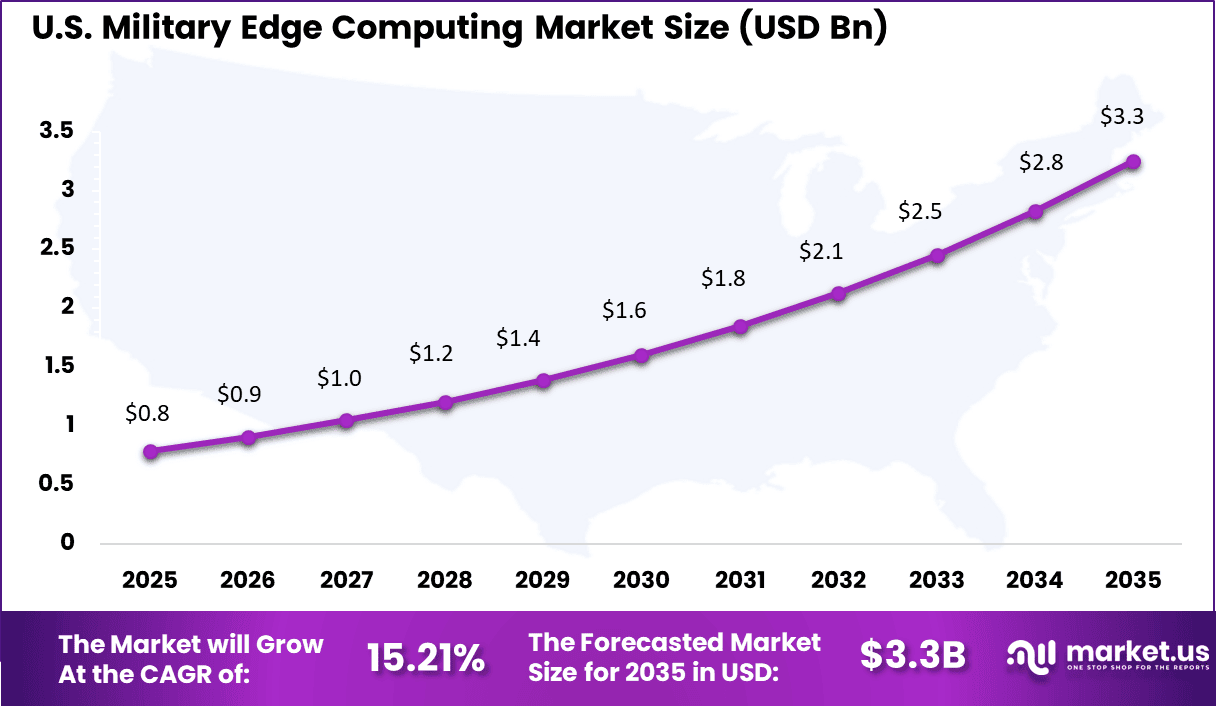
The Global Military Edge Computing Market generated USD 2.1 billion in 2025 and is predicted to register growth from USD 2.5 billion in 2026 to about USD 10.1 billion by 2035, recording a CAGR of 16.8% throughout the forecast span. In 2025, North America held a dominant market position, capturing more than a 41.6% share, with USD 0.89 billion in revenue.
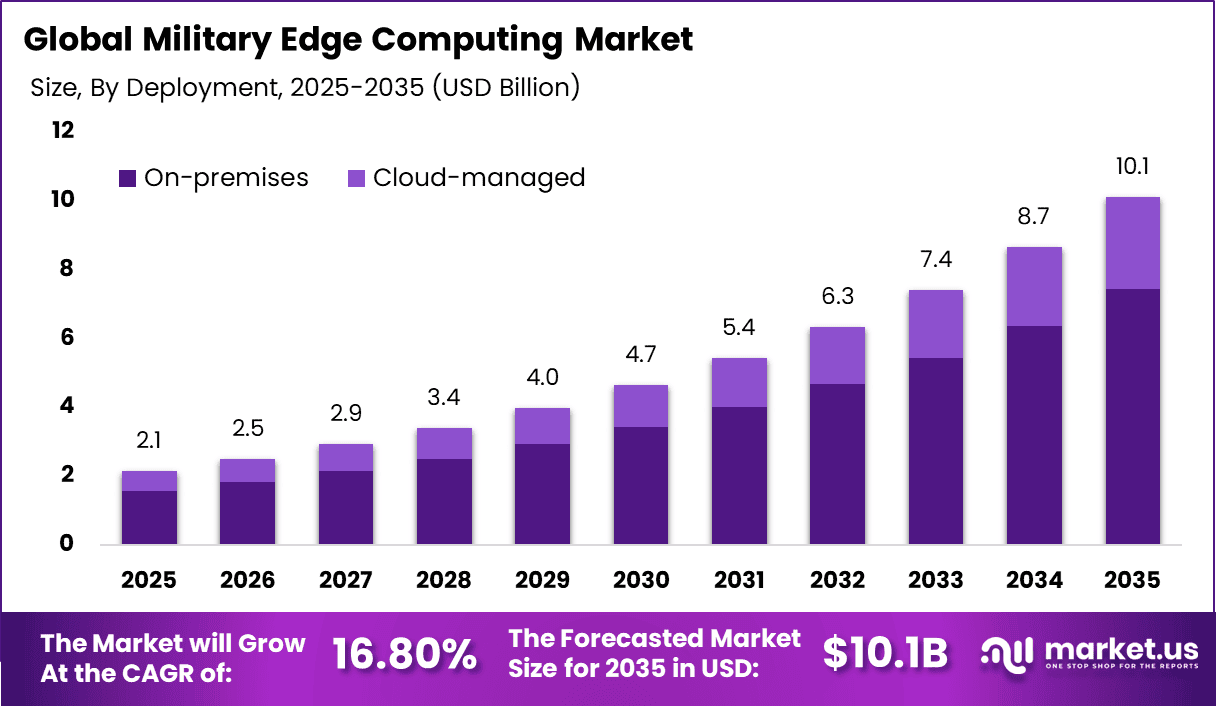
The military edge computing market refers to hardware and software technologies that process data close to the point where it is generated in defence operations, rather than relying on distant central data centres. Edge computing systems in military settings include ruggedised servers, local analytics devices, and specialised software that enable real-time processing of sensor data, mission information, and battlefield intelligence.
The main driving factors for the military edge computing market are the increasing demand for rapid decision-making and the rise of data-intensive defence systems. Modern military platforms generate large volumes of data from sensors, drones, vehicles, and communication networks. Transmitting this data to remote locations for processing can introduce delays and increase vulnerability to communication disruptions.
Top Market Takeaways
- By component, hardware dominated the military edge computing market with a 61.8% share, supplying rugged devices for battlefield data processing.
- By deployment, on-premises systems captured 73.5%, preferred for secure, low-latency operations in disconnected environments.
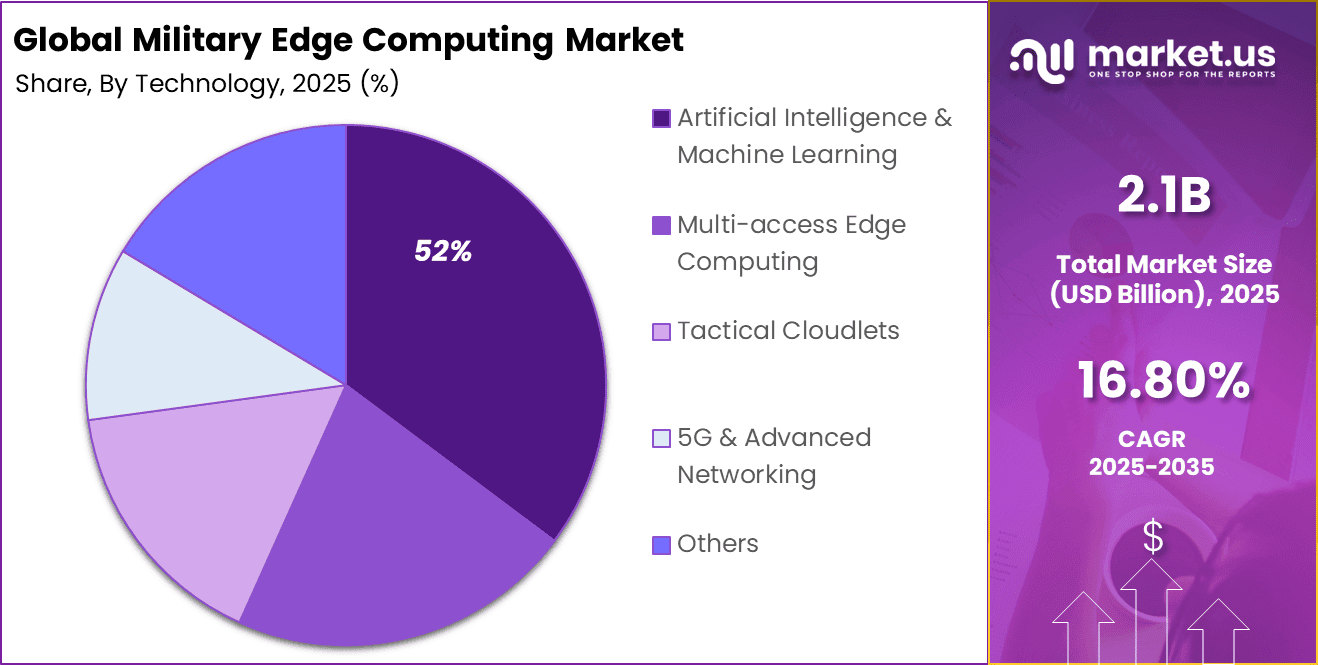
- By technology, artificial intelligence and machine learning led at 52.4%, enabling real-time analytics on sensor data.
- By application, intelligence, surveillance, and reconnaissance held 38.7%, using edge computing for instant threat detection.
- By end-user, the army accounted for 41.5%, deploying solutions for ground troop communications and command.
- North America held 41.6% of the global market, with the U.S. valued at USD 0.79 billion and a CAGR of 15.21%.
Component Analysis
Hardware accounts for 61.8% of the Military Edge Computing market, reflecting the critical role of physical computing infrastructure in defense environments. Edge hardware includes rugged servers, processors, sensors, and communication modules designed to operate in harsh and remote conditions. These systems process data locally at or near the source, reducing reliance on centralized data centers.
From an operational standpoint, edge hardware supports faster decision-making by enabling real-time data processing. It reduces latency and ensures mission continuity even when network access is restricted. The strong share of hardware highlights the military’s focus on resilient and secure computing systems that can function independently in tactical and battlefield scenarios.
Deployment Analysis
On-premises deployment holds 73.5% of the market, showing strong preference for localized and controlled computing environments. Military organizations deploy edge computing systems directly within bases, vehicles, and field units to maintain full control over data and operations. This approach minimizes exposure to external networks and reduces cybersecurity risks.
On-premises deployment also ensures consistent performance in disconnected or contested environments. Local processing supports uninterrupted operations during missions. The dominance of this segment reflects the importance of data sovereignty, security, and reliability in military computing strategies.
Technology Analysis
Artificial intelligence and machine learning technologies account for 52% of the technology segment, making them central to military edge computing. These technologies analyze large volumes of data from sensors, drones, and surveillance systems in real time. AI and ML models help identify patterns, detect threats, and support rapid decision-making at the edge.
The use of AI at the edge reduces the need to transmit raw data to centralized systems. This improves response speed and operational efficiency. The strong share of this segment reflects growing reliance on intelligent automation to enhance situational awareness and mission effectiveness.
Application Analysis
Intelligence, surveillance, and reconnaissance account for 38.7% of application demand, making it the largest use case in the market. Edge computing enables real-time analysis of video, imagery, and sensor data collected during ISR missions. This allows military units to act quickly on critical information.
Edge processing supports faster threat detection and improved mission planning. It reduces delays associated with data transmission and analysis. The strong presence of this application reflects the importance of timely and accurate intelligence in modern military operations.
End-User Analysis
The Army represents 41.5% of end-user adoption, making it the largest branch using military edge computing solutions. Army operations involve extensive use of mobile units, vehicles, and field systems that generate large volumes of data. Edge computing helps process this data locally to support tactical decisions.
The Army also operates in diverse and challenging environments where connectivity is unreliable. Edge systems ensure continuity of operations and support command and control functions. The strong share of this segment reflects the army’s focus on agility, resilience, and real-time situational awareness.
Key Market Segments
By Component
- Hardware
- Ruggedized Edge Servers & Nodes
- Tactical Gateways & Routers
- Sensors & IoT Devices
- Others
- Software
- Edge Analytics & AI Platforms
- Device Management & Orchestration
- Security & Compliance Software
- Others
- Services
- Integration & Deployment
- Training & Support
- Managed Services
- Others
By Deployment
- On-premises
- Cloud-managed
By Technology
- Artificial Intelligence & Machine Learning
- Multi-access Edge Computing
- Tactical Cloudlets
- 5G & Advanced Networking
- Others
By Application
- Intelligence, Surveillance, and Reconnaissance
- Command & Control
- Autonomous Systems & Robotics
- Predictive Maintenance
- Cybersecurity
- Others
By End-User
- Army
- Navy
- Air Force
- Space Force
- Defense Agencies
- Others
Regional Analysis
North America accounted for a 41.6% share, supported by strong defense modernization programs and increasing focus on real-time data processing at the tactical edge. Military organizations in the region have adopted edge computing to enable faster decision-making, reduced data transmission delays, and improved situational awareness in contested environments.
Demand has been driven by growth in sensor-based systems, unmanned platforms, and battlefield connectivity, where centralized cloud processing is not always feasible. The region’s advanced defense infrastructure and sustained investment in digital warfare capabilities have reinforced steady adoption.
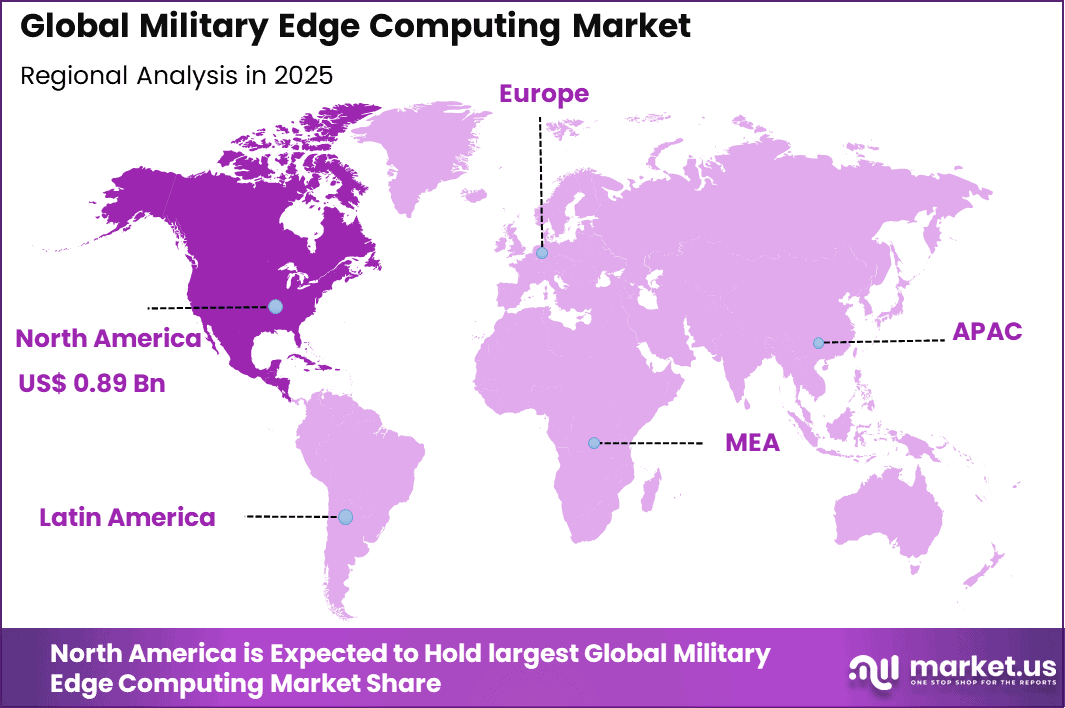
The U.S. market reached USD 0.79 Bn and is projected to grow at a 15.21% CAGR, reflecting rising investment in advanced battlefield technologies and distributed computing architectures. Adoption has been particularly strong across land, air, and naval forces, where edge computing supports real-time analytics, mission planning, and threat detection. These solutions have helped reduce response times and improve operational effectiveness in complex and dynamic environments.
Key Regions and Countries
- North America
- US
- Canada
- Europe
- Germany
- France
- The UK
- Spain
- Italy
- Russia
- Netherlands
- Rest of Europe
- Asia Pacific
- China
- Japan
- South Korea
- India
- Australia
- Singapore
- Thailand
- Vietnam
- Rest of APAC
- Latin America
- Brazil
- Mexico
- Rest of Latin America
- Middle East & Africa
- South Africa
- Saudi Arabia
- UAE
- Rest of MEA
Key Reasons for Adoption
- Real-time data processing is required in combat and field operations
- Dependence on centralized data centers is reduced in remote and hostile environments
- Faster decision-making is needed for mission-critical situations
- Network connectivity limitations require local computing capabilities
- Operational resilience is prioritized during communication disruptions
Benefits
- Response time is improved through on-site data analysis
- Mission effectiveness is enhanced with real-time intelligence processing
- Bandwidth usage is reduced by processing data closer to the source
- System reliability is strengthened during network or satellite outages
- Data security is improved by limiting external data transmission
Usage
- Used in battlefield operations for real-time situational awareness
- Applied in unmanned systems for local data processing and control
- Deployed in command units to support tactical decision-making
- Utilized in surveillance systems for rapid threat identification
- Integrated into mobile defense platforms for autonomous operations
Emerging Trends
| Key Trend | Description |
|---|---|
| AI/ML real-time analytics | Integration of artificial intelligence for battlefield decision-making. |
| Ruggedized hardware solutions | Durable devices designed for extreme military environments. |
| Edge-to-cloud architectures | Hybrid models enabling scalable and flexible data processing. |
| 5G low-latency connectivity | Supports faster unmanned systems and secure communications. |
| Enhanced cybersecurity protocols | Protection of edge networks against advanced cyber threats. |
Growth Factors
| Key Factors | Description |
|---|---|
| Proliferation of unmanned systems | Drones and autonomous robots require localized data processing. |
| Real-time decision-making needs | Reduced latency supports tactical and operational responsiveness. |
| Rising cyberwarfare threats | Decentralized computing improves network resilience and security. |
| Military modernization programs | Defense investments focus on advanced computing infrastructure. |
| Data volume explosion | Edge systems efficiently handle IoT sensor and surveillance data. |
Opportunities & Threats
The Military Edge Computing market shows strong opportunities as defense forces require faster data processing closer to the battlefield. Edge computing allows data from sensors, drones, vehicles, and communication systems to be analyzed locally without relying on distant data centers.
This supports real-time decision-making and reduces dependence on unstable network connections. Growth in autonomous systems, surveillance, and modern command and control operations is increasing demand for edge-based computing solutions.
The market faces threats related to high cost and strict procurement processes. Military-grade edge systems require rugged hardware, advanced security, and long testing cycles, which increase development and deployment costs. Budget constraints and shifting defense priorities can delay procurement. Long approval timelines may also slow adoption of new technologies.
Competitive Analysis
The competitive landscape of the military edge computing market is shaped by a combination of global cloud providers, enterprise IT companies, and major defense contractors. Microsoft Corporation, Amazon Web Services, IBM, Dell Technologies, Hewlett Packard Enterprise, and Cisco Systems hold strong positions by delivering ruggedized edge hardware, secure cloud-to-edge architectures, and data management platforms tailored for defense environments.
At the same time, defense-focused players such as Raytheon Technologies, Lockheed Martin, Northrop Grumman, General Dynamics, L3Harris Technologies, Honeywell International, Sierra Nevada Corporation, Viasat, and Curtiss-Wright strengthen competition through mission-specific systems, secure communications, and embedded computing solutions designed for harsh battlefield conditions.
Top Key Players in the Market
- Microsoft Corporation
- Amazon Web Services, Inc.
- International Business Machines Corporation
- Dell Technologies, Inc.
- Hewlett Packard Enterprise Company
- Cisco Systems, Inc.
- Raytheon Technologies Corporation
- Lockheed Martin Corporation
- Northrop Grumman Corporation
- General Dynamics Corporation
- L3Harris Technologies, Inc.
- Honeywell International Inc.
- Sierra Nevada Corporation
- Viasat, Inc.
- Curtiss-Wright Corporation
- Others
Future Outlook
Growth in the Military Edge Computing market is expected to remain strong as defense forces require faster data processing in field operations. Edge computing allows data to be analyzed closer to sensors, vehicles, and command units, which reduces delay and reliance on central networks.
Increasing use of drones, surveillance systems, and connected battlefield equipment is supporting adoption. Over time, better rugged hardware, secure architectures, and integration with command systems are likely to improve mission awareness and decision speed.
Recent Developments
- In January 2025, Microsoft Corporation partnered with Anduril Industries to transfer management of the Integrated Visual Augmentation System project to Anduril, aiming to refine the hardware and software for battlefield use.
- In January 2025, Amazon Web Services, Inc. was selected as part of the Joint Warfighting Cloud Capability initiative by the Pentagon to expand in-theater data processing and provide advanced computing near operational units.
Report Scope
| Report Features | Description |
|---|---|
| Market Value (2025) | USD 2.1 Bn |
| Forecast Revenue (2035) | USD 10.1 Bn |
| CAGR(2025-2035) | 16.8% |
| Base Year for Estimation | 2025 |
| Historic Period | 2020-2024 |
| Forecast Period | 2025-2035 |
| Report Coverage | Revenue forecast, AI impact on Market trends, Share Insights, Company ranking, competitive landscape, Recent Developments, Market Dynamics and Emerging Trends |
| Segments Covered | By Component (Hardware (Ruggedized Edge Servers and Nodes, Tactical Gateways and Routers, Others), Software (Edge Analytics and AI Platforms, Device Management and Orchestration, Others), Services (Integration and Deployment, Training and Support, Others)), By Deployment (On-premises, Cloud-managed), By Technology (Artificial Intelligence and Machine Learning, Multi-access Edge Computing, Others), By Application (Intelligence, Surveillance, and Reconnaissance, Command and Control, Others) |
| Regional Analysis | North America – US, Canada; Europe – Germany, France, The UK, Spain, Italy, Russia, Netherlands, Rest of Europe; Asia Pacific – China, Japan, South Korea, India, New Zealand, Singapore, Thailand, Vietnam, Rest of Latin America; Latin America – Brazil, Mexico, Rest of Latin America; Middle East & Africa – South Africa, Saudi Arabia, UAE, Rest of MEA |
| Competitive Landscape | Microsoft Corporation, Amazon Web Services, Inc., International Business Machines Corporation, Dell Technologies, Inc., Hewlett Packard Enterprise Company, Cisco Systems, Inc., Raytheon Technologies Corporation, Lockheed Martin Corporation, Northrop Grumman Corporation, General Dynamics Corporation, L3Harris Technologies, Inc., Honeywell International Inc., Sierra Nevada Corporation, Viasat, Inc., Curtiss-Wright Corporation, Others |
| Customization Scope | Customization for segments, region/country-level will be provided. Moreover, additional customization can be done based on the requirements. |
| Purchase Options | We have three licenses to opt for: Single User License, Multi-User License (Up to 5 Users), Corporate Use License (Unlimited Users and Printable PDF) |





































