


Report Overview
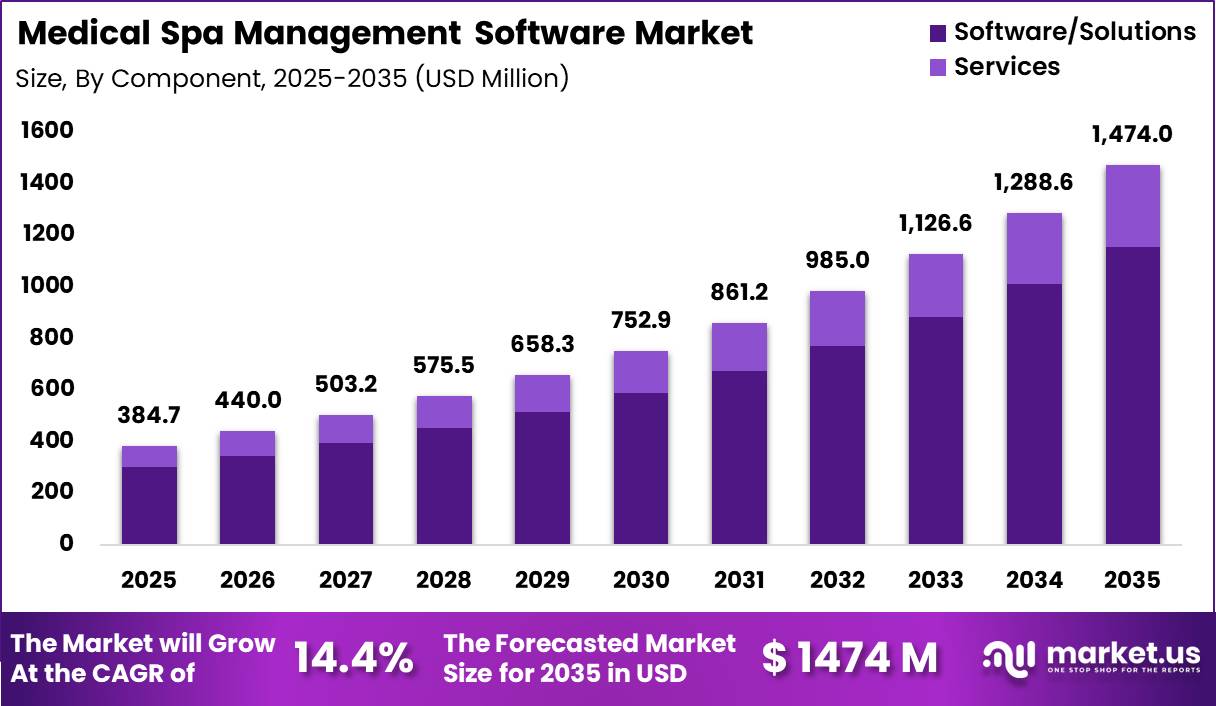
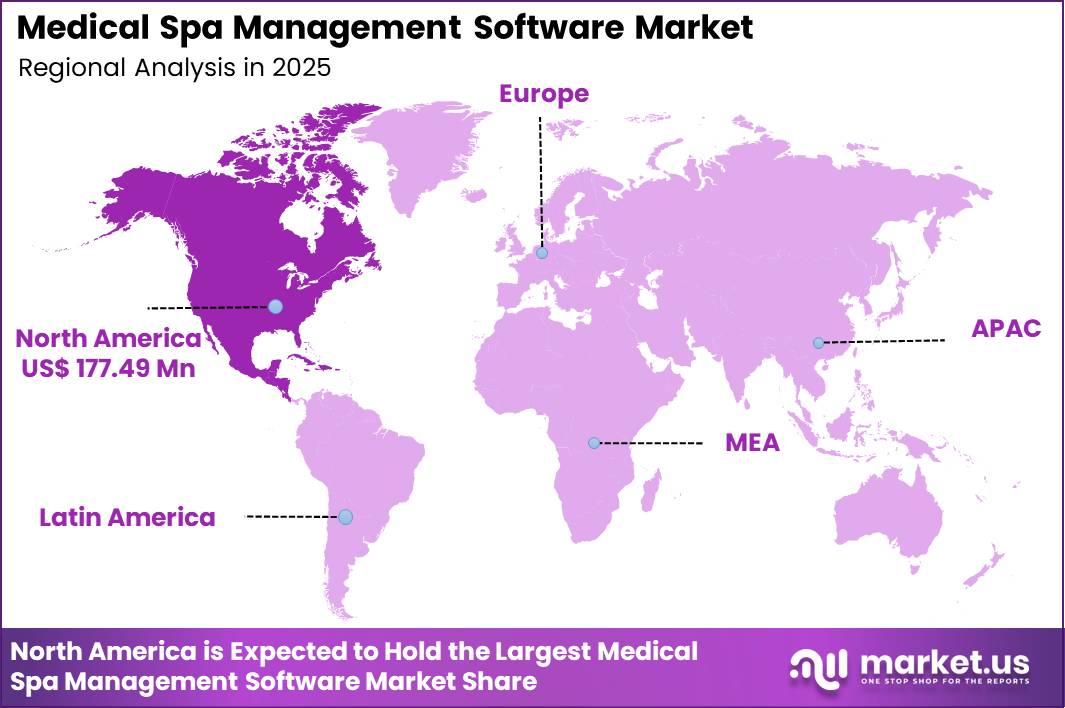
Global Medical Spa Management Software Market size is expected to be worth around US$ 1474.0 Million by 2035 from US$ 384.7 Million in 2025, growing at a CAGR of 14.4% during the forecast period from 2026 to 2035. In 2025, North America led the market, achieving over 46.15% share with a revenue of US$ 177.49 Million.
Medical Spa Management Software refers to integrated digital platforms designed to manage both clinical and business operations of medical spas, aesthetic clinics, and wellness centers. These systems combine features of Electronic Medical Records (EMR), practice management, and customer relationship management (CRM) into a unified solution.
From a functional perspective, the software enables appointment scheduling, billing, inventory tracking, marketing automation, and patient data management. Clinical modules typically include EMR capabilities, which store patient histories, treatment records, medications, and diagnostic data in a secure digital format.
Such systems improve care coordination, as patient information can be accessed and updated in real time across providers. Compliance with data protection standards such as HIPAA is a critical requirement, given the sensitive nature of healthcare data.
Adoption of digital health systems has been increasing globally. According to the Office of the National Coordinator for Health Information Technology, approximately 96% of non-federal acute care hospitals in the United States had adopted certified electronic health record systems by 2021, reflecting the broader shift toward digitization in healthcare environments. This trend has extended into specialized segments such as medical spas.
From a healthcare perspective, increasing demand for non-invasive aesthetic procedures has been a key growth driver. According to global health and wellness data, the spa industry includes more than 181,000 facilities worldwide, generating over USD 105 billion in revenue, highlighting a substantial service base requiring digital management solutions.
Additionally, digital health adoption encouraged by healthcare system modernization initiatives and regulatory emphasis on electronic records has accelerated software integration in outpatient and cosmetic care settings.
Key Takeaways
- Market Size: Global Medical Spa Management Software Market size is expected to be worth around US$ 1474.0 Million by 2035 from US$ 384.7 Million in 2025.
- Market Share: The market growing at a CAGR of 14.4% during the forecast period from 2026 to 2035.
- Component Analysis: In 2025, the software/solutions segment is estimated to dominate the market, accounting for approximately 78.4% of total revenue.
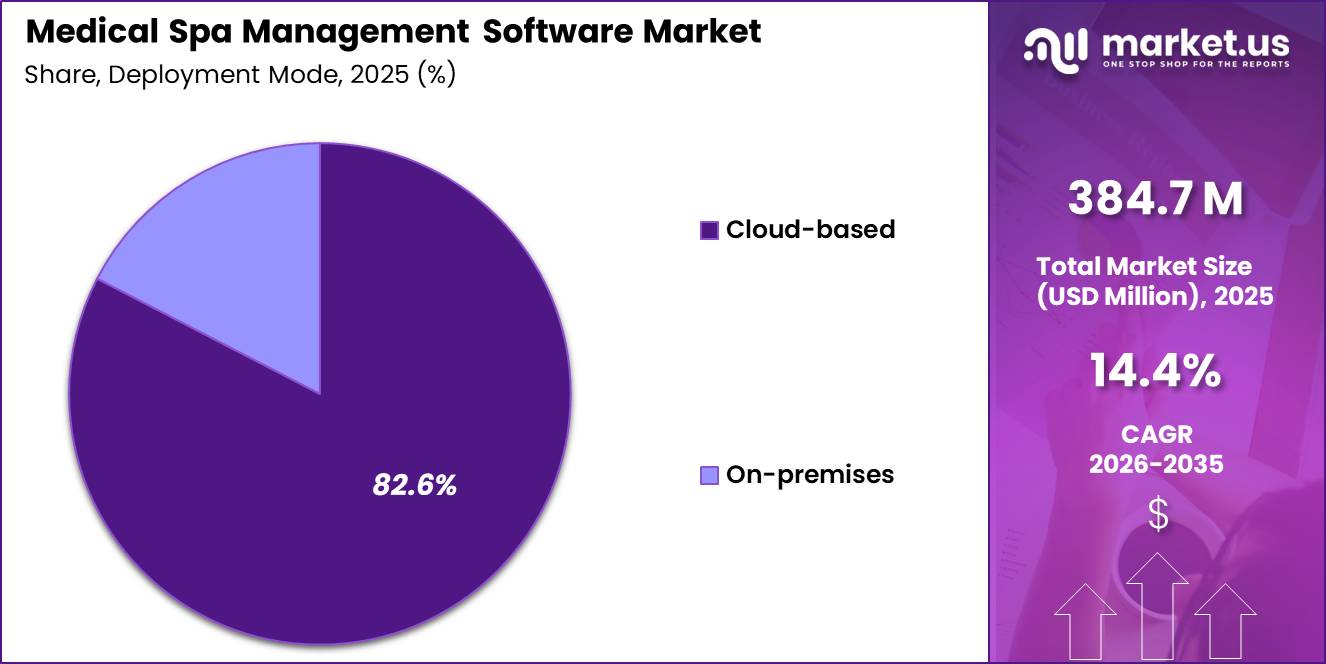
- Deployment Mode Analysis: Cloud-based platforms are projected to dominate the market, accounting for approximately 82.6% of the total share in 2025.
- Organization Size Analysis: Large medical spas and chains are expected to hold a dominant market share of 67.2%.
- Application Analysis: Appointment scheduling and calendar management is anticipated to dominate the segment with a market share of 42.7% in 2025.
- End User Analysis: Medical spas are expected to dominate the market with a share of 58.9%.
- Pricing Model Analysis: Subscription-based pricing is projected to lead the market with a share of 62.0% in 2025.
- Regional Analysis : In 2025, North America led the market, achieving over 46.15% share with a revenue of US$ 177.49 Million.
Component Analysis
The component segmentation of the medical spa management software market is primarily categorized into software/solutions and services, reflecting the structure of value delivery across the ecosystem. In 2025, the software/solutions segment is estimated to dominate the market, accounting for approximately 78.4% of total revenue.
This dominance is attributed to the increasing adoption of integrated digital platforms that enable appointment scheduling, customer relationship management, billing, inventory tracking, and analytics within a unified interface. The growing preference for cloud-based systems, which offer scalability, remote accessibility, and cost efficiency, has further accelerated the adoption of software solutions across medical spas.
Additionally, continuous technological advancements such as AI-enabled analytics, mobile applications, and automated marketing tools have strengthened the value proposition of software platforms, making them essential for operational efficiency and enhanced customer experience.
The services segment, although smaller in share, plays a critical supporting role in market expansion. This segment includes implementation, training, consulting, maintenance, and support services.
Growth in this segment is driven by the increasing need for customization, system integration, and ongoing technical support, particularly among small and medium-sized medical spas with limited in-house IT capabilities.
As digital transformation intensifies, demand for managed and professional services is expected to witness steady growth, complementing the expansion of core software solutions.
Deployment Mode Analysis
The deployment mode segmentation of the Medical Spa Management Software Market is primarily categorized into cloud-based and on-premises solutions. Cloud-based platforms are projected to dominate the market, accounting for approximately 82.6% of the total share in 2025. This dominance is attributed to scalability, lower upfront costs, and seamless remote accessibility, which are critical for multi-location medical spa operations.
The adoption of cloud infrastructure has been further accelerated by the increasing need for real-time data synchronization, automated updates, and integration with third-party applications. Additionally, enhanced data security protocols and compliance with healthcare regulations have strengthened confidence in cloud deployments.
In contrast, on-premises solutions continue to maintain relevance among organizations prioritizing data control and customization. These systems are typically preferred by established facilities with in-house IT capabilities and stringent data governance policies. However, higher maintenance costs and limited flexibility are expected to restrain their growth.
Overall, the transition toward cloud-based deployment is anticipated to remain strong, driven by digital transformation initiatives and the need for operational efficiency across medical spa businesses.
Organization Size Analysis
Based on organization size, the Medical Spa Management Software Market is segmented into large medical spas and chains, and small and medium-sized medical spas. Large medical spas and chains are expected to hold a dominant market share of 67.2% in 2025. This leadership position is driven by their higher financial capacity, greater patient volumes, and the need for centralized management systems across multiple locations.
Advanced software solutions enable these organizations to streamline appointment scheduling, staff management, and revenue tracking, thereby improving operational efficiency and customer experience. Furthermore, large chains are more inclined toward adopting integrated platforms with advanced analytics and CRM capabilities to enhance decision-making and client retention strategies.
On the other hand, small and medium-sized medical spas are witnessing steady adoption due to increasing awareness of digital tools and competitive pressures. Cost-effective and scalable software offerings, particularly cloud-based solutions, are enabling smaller establishments to modernize operations.
Although budget constraints may limit full-scale implementation, the segment is expected to grow steadily as vendors introduce flexible pricing and modular solutions tailored to smaller businesses.
Application Analysis
The application-based segmentation of the Medical Spa Management Software Market includes appointment scheduling and calendar management, client management and CRM, billing and payment processing, inventory management, marketing and email automation, reporting and analytics, and others. Appointment scheduling and calendar management is anticipated to dominate the segment with a market share of 42.7% in 2025.
The prominence of this segment is driven by the need to optimize booking efficiency, reduce no-shows, and enhance client convenience through automated reminders and real-time availability tracking. Efficient scheduling systems contribute significantly to revenue optimization and resource utilization in medical spas.
Client management and CRM solutions also represent a substantial share, enabling personalized service delivery and improved customer retention. Billing and payment processing systems are gaining traction due to the demand for seamless and secure transactions.
Additionally, marketing and email automation tools are increasingly being adopted to drive customer engagement and loyalty programs. Inventory management and reporting and analytics further support operational efficiency by providing insights into product usage and business performance. Collectively, these applications are contributing to a comprehensive digital ecosystem within medical spa operations.
End User Analysis
The end user segmentation of the Medical Spa Management Software Market comprises medical spas, dermatology clinics, cosmetic surgery centers, and wellness centers. Medical spas are expected to dominate the market with a share of 58.9% in 2025. This dominance is attributed to the rapid expansion of aesthetic services, increasing consumer demand for non-invasive treatments, and the growing need for integrated management solutions tailored to spa-specific operations.
These facilities require comprehensive software to manage appointments, client records, treatment histories, and inventory, thereby driving adoption. Dermatology clinics represent a significant segment due to their overlap with aesthetic procedures and the need for specialized patient management systems. Cosmetic surgery centers are also adopting advanced software solutions to streamline pre- and post-operative workflows, billing, and patient engagement.
Meanwhile, wellness centers are gradually integrating management software to enhance service delivery and operational efficiency. Although smaller in comparison, these segments are expected to witness steady growth, supported by increasing digitalization and the convergence of healthcare and wellness services.
Pricing Model Analysis
The pricing model segmentation of the Medical Spa Management Software Market includes subscription-based (monthly/annual), one-time license, and transaction-based models. Subscription-based pricing is projected to lead the market with a share of 62.0% in 2025.
This model is favored due to its affordability, predictable cost structure, and ease of scalability, making it particularly attractive for both large chains and smaller medical spas. Regular updates, maintenance, and customer support are typically included, enhancing value for users and ensuring system reliability. The growing preference for cloud-based solutions has further reinforced the adoption of subscription models.
In contrast, one-time license models are preferred by organizations seeking long-term cost savings and greater control over software infrastructure. However, the need for significant upfront investment and ongoing maintenance may limit widespread adoption. Transaction-based pricing is emerging as a flexible alternative, particularly for businesses with fluctuating service volumes.
This model allows users to pay based on usage, aligning costs with revenue generation. Overall, subscription-based models are expected to maintain their dominance, supported by evolving business needs and digital transformation trends.
Key Market Segments
By Component
- Software/Solutions
- Services
By Deployment Mode
- Cloud-based
- On-premises
By Organization Size
- Large Medical Spas and Chains
- Small and Medium-sized Medical Spas
By Application
- Appointment Scheduling and Calendar Management
- Client Management and CRM
- Billing and Payment Processing
- Inventory Management
- Marketing and Email Automation
- Reporting and Analytics
- Others
By End User
- Medical Spas
- Dermatology Clinics
- Cosmetic Surgery Centers
- Wellness Centers
By Pricing Model
- Subscription-based (Monthly/Annual)
- One-time License
- Transaction-based
Driving Factors
Increasing adoption of digital health systems and electronic records
The expansion of the medical spa management software market is being strongly driven by the broader adoption of digital health technologies across outpatient and wellness settings. Governments and public health agencies have actively promoted digitization to improve efficiency, patient safety, and care coordination.
For instance, the World Health Organization has highlighted that digital health solutions can significantly enhance service delivery and reduce administrative inefficiencies. Similarly, the Office of the National Coordinator for Health Information Technology reported that more than 88% of office-based physicians in the United States were using electronic health record (EHR) systems in recent years, indicating widespread digital adoption in outpatient care.
Medical spas, which operate at the intersection of healthcare and wellness, are increasingly aligning with these digital standards. The need for automated appointment scheduling, billing, and client record management is rising with increasing service volumes.
In addition, national digital health initiatives such as India’s National Digital Health Mission are encouraging clinics to adopt interoperable digital systems. These developments are creating a favorable environment for software adoption, as providers seek integrated platforms to streamline operations and improve patient engagement in a competitive service landscape.
Trending Factors
Growing shift toward cloud-based platforms and AI integration
A prominent trend in the medical spa management software market is the transition toward cloud-based deployment models combined with artificial intelligence (AI) capabilities.
Public healthcare authorities, including the Centers for Disease Control and Prevention, have documented increasing reliance on electronic and digital systems in outpatient care, with EHR adoption exceeding 85% among physicians. This widespread digital ecosystem is influencing adjacent sectors such as medical spas, encouraging adoption of scalable and interoperable software platforms.
Cloud-based solutions provide operational flexibility by enabling remote access, real-time data synchronization, and multi-location management. These benefits are particularly relevant for expanding medical spa chains and wellness clinics. In parallel, AI integration is gaining traction, supporting features such as predictive appointment scheduling, personalized treatment recommendations, and automated customer engagement.
According to the National Institutes of Health, AI applications in healthcare are increasingly being utilized to improve decision-making and patient outcomes, a trend that extends to aesthetic and wellness services.
The convergence of cloud computing, mobile accessibility, and AI-driven analytics is reshaping how medical spa operations are managed. This technological evolution is expected to remain a defining characteristic of the market, improving efficiency while enhancing customer experience and retention rates.
Restraining Factors
Data privacy concerns and regulatory compliance requirements
One of the primary restraints affecting the medical spa management software market is the increasing complexity of data privacy regulations and compliance requirements.
Medical spas handle sensitive patient information, including treatment histories and personal identification data, making them subject to healthcare data protection laws. Regulatory frameworks such as the Health Insurance Portability and Accountability Act impose strict requirements on how patient data is stored, processed, and shared.
According to the U.S. Department of Health and Human Services, healthcare data breaches have affected millions of individuals annually, with reported breaches impacting over 50 million individuals in certain years.
These risks create significant concerns among medical spa operators regarding cybersecurity and compliance costs. Implementing secure software systems requires investment in encryption, access control, and regular audits, which can be financially burdensome for smaller providers.
In addition, regulatory environments vary across regions, requiring software vendors to customize solutions for compliance with local laws. This increases development complexity and slows market penetration in emerging economies.
The fear of penalties, reputational damage, and legal consequences associated with data breaches continues to limit rapid adoption, particularly among small and medium-sized medical spa businesses with limited technical expertise.
Opportunity
Rising demand for wellness services and preventive healthcare
The medical spa management software market presents significant opportunities due to the growing demand for wellness services and preventive healthcare. Governments and international organizations are increasingly emphasizing preventive care to reduce long-term healthcare costs.
The World Health Organization has reported that noncommunicable diseases account for nearly 74% of global deaths, driving demand for lifestyle-oriented and preventive health solutions, including wellness and aesthetic services.
This shift is supporting the expansion of medical spas offering non-invasive treatments such as skin rejuvenation, laser therapies, and anti-aging procedures. In India, initiatives led by the Ministry of AYUSH are promoting wellness and holistic healthcare, contributing to increased establishment of spa and wellness centers. The rising middle-class population and increasing disposable income further support this trend.
As service volumes grow, the need for efficient management systems becomes more critical. Software solutions that integrate appointment scheduling, customer relationship management, and compliance tracking are becoming essential for operational scalability.
Additionally, the expansion of wellness tourism supported by government tourism policies creates further demand for advanced digital tools. These factors collectively present a strong opportunity for sustained adoption of medical spa management software globally.
Regional Analysis
In 2025, North America emerged as the dominant regional market for medical spa management software, accounting for over 46.15% of the global share and generating revenue of approximately US$ 177.49 million. This leadership position can be attributed to the high concentration of advanced medical spa facilities, widespread adoption of digital healthcare solutions, and strong presence of key software providers across the United States and Canada.
The region has demonstrated a higher inclination toward integrating cloud-based platforms, automation tools, and data-driven customer management systems, which has significantly enhanced operational efficiency and client engagement.
Furthermore, favorable regulatory frameworks, coupled with increasing consumer demand for aesthetic treatments, have supported sustained market expansion. The availability of skilled professionals and early adoption of innovative technologies have also contributed to the region’s growth trajectory.
In contrast, Europe has shown steady growth driven by rising awareness of aesthetic procedures and increasing investments in healthcare IT infrastructure. The Asia-Pacific region is anticipated to witness the fastest growth rate due to expanding medical tourism, improving healthcare facilities, and growing disposable incomes.
Meanwhile, Latin America and the Middle East & Africa are gradually adopting these solutions, supported by evolving healthcare ecosystems and increasing demand for wellness services.
Key Regions and Countries
North America
- The US
- Canada
Europe
- Germany
- France
- The U.K.
- Italy
- Spain
- Russia & CIS
- Rest of Europe
Asia Pacific
- China
- India
- Japan
- South Korea
- ASEAN
- Australia & New Zealand
- Rest of Asia Pacific
Middle East & Africa
- GCC
- South Africa
- Rest of Middle East & Africa
Latin America
- Brazil
- Mexico
- Rest of Latin America
Key Players Analysis
The competitive landscape of medical spa management software is characterized by a mix of comprehensive enterprise platforms and niche-focused solutions. Key players such as MINDBODY, Inc. and Zenoti dominate the market with all-in-one platforms integrating scheduling, CRM, marketing, and payment systems. Zenoti, in particular, differentiates itself through AI-enabled automation, HIPAA-compliant workflows, and analytics-driven patient engagement, which has been shown to improve retention and operational efficiency significantly.
Mid-tier providers including Vagaro, Inc. and Reservio focus on affordability and ease of use, making them suitable for small to mid-sized medspas. These platforms emphasize online booking, POS integration, and basic marketing tools, addressing the operational needs of cost-sensitive businesses.
Specialized vendors such as PatientNow and SimpleSpa by Lasyk Networks, Inc. offer industry-specific functionalities including EMR integration, compliance management, and treatment documentation, catering to medically regulated environments. Meanwhile, Miosalon (Waffor Inc.) targets emerging markets with cloud-based, mobile-first solutions.
Overall, the market is moderately fragmented, with competition driven by feature depth, regulatory compliance, scalability, and pricing strategies. Increasing adoption of AI, automation, and data analytics is expected to intensify competition and support market growth.
Market Key Players
- Acuity Scheduling – A Squarespace Company
- AestheticsPro
- Book4Time Inc.
- GlamPlus
- Meditab
- Milano
- Millennium Systems International
- MINDBODY, Inc.
- Miosalon (Waffor Inc.)
- PatientNow
- Reservio
- SimpleSpa by Lasyk Networks, Inc.
- Vagaro, Inc.
- Zenoti
- Others
Recent Developments
- Vagaro, Inc.: In November 2025, Vagaro launched an E-Prescribe integration aimed specifically at medspas and similar providers, through a partnership with ScriptSure, to streamline prescription management, cut down on fax and phone-based workflows, and improve prescription accuracy and patient safety inside its existing practice management platform. CEO Fred Helou emphasized that bringing scheduling, payments, client management, and prescriptions into one system strengthens Vagaro’s role as a long-term technology partner for medical spa operators seeking tighter clinical-commercial integration.
- Mindbody, Inc.: In September 2025, Mindbody released its “2025 State of the Industry” report, highlighting how fitness, beauty, and wellness businesses, including medspas and hybrid spa-wellness concepts, are embracing AI, diversifying revenue streams, and intensifying loyalty strategies. The report positions Mindbody’s platform as a vehicle to operationalize these trends, especially for operators that combine spa services with wellness programming and content.
- Book4Time Inc.: In November 2025, Agilysys Book4Time won the 2025 American Spa Professional’s Choice Award for Favorite Spa Software Technology, reflecting broad recognition from spa professionals of its capabilities in online booking, capacity management, revenue optimization, and integrated POS. The award underscores Book4Time’s position as a trusted platform for spa and medical spa operators in hospitality environments who are prioritizing higher revenue per treatment room and lower manual admin load.
- AestheticsPro: In December 2025, AestheticsPro was actively promoting offers to “lock in 2025 prices” going into 2026, signalling an effort to capture budget-sensitive medspa clients before potential price adjustments, while highlighting its all-in-one practice management capabilities for the aesthetics segment. This pricing and promotion strategy aligns with a market where many independent medical spas are still in their first few years of operation and remain extremely cost conscious even as they digitize.
Report Scope
| Report Features | Description |
|---|---|
| Market Value (2025) | US$ 384.7 Million |
| Forecast Revenue (2035) | US$ 1474.0 Million |
| CAGR (2026-2035) | 14.4% |
| Base Year for Estimation | 2025 |
| Historic Period | 2020-2024 |
| Forecast Period | 2026-2035 |
| Report Coverage | Revenue Forecast, Market Dynamics, Competitive Landscape, Recent Developments |
| Segments Covered | By Component(Software/Solutions, Services) By Deployment Mode,(Cloud-based, On-premises) By Organization Size (Large Medical Spas and Chains, Small and Medium-sized Medical Spas) By Application (Appointment Scheduling and Calendar Management, Client Management and CRM, Billing and Payment Processing, Inventory Management, Marketing and Email Automation, Reporting and Analytics, Others) By End User(Medical Spas, Dermatology Clinics, Cosmetic Surgery Centers, Wellness Centers), By Pricing Model (Subscription-based (Monthly/Annual), One-time License, Transaction-based) |
| Regional Analysis | North America – The US, Canada; Europe – Germany, France, U.K., Italy, Spain, Russia & CIS, Rest of Europe; Asia Pacific – China, India, Japan, South Korea, ASEAN, Australia & New Zealand, Rest of Asia Pacific; Middle East & Africa – GCC, South Africa, Rest of Middle East & Africa; Latin America – Brazil, Mexico, Rest of Latin America |
| Competitive Landscape | Acuity Scheduling – A Squarespace Company, AestheticsPro, Book4Time Inc., GlamPlus, Meditab, Milano, Millennium Systems International, MINDBODY, Inc., Miosalon (Waffor Inc.), PatientNow, Reservio, SimpleSpa by Lasyk Networks, Inc., Vagaro, Inc., Zenoti, Others |
| Customization Scope | Customization for segments, region/country-level will be provided. Moreover, additional customization can be done based on the requirements. |
| Purchase Options | We have three licenses to opt for: Single User License, Multi-User License (Up to 5 Users), Corporate Use License (Unlimited User and Printable PDF) |





































