Market Overview
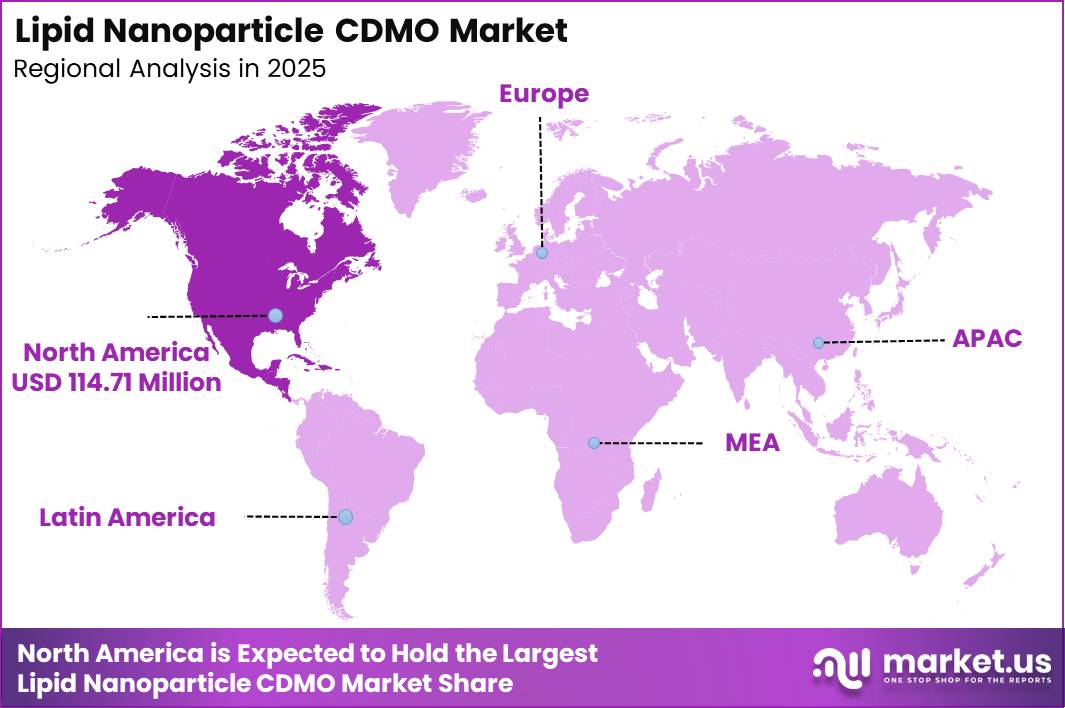
Global Lipid Nanoparticle CDMO Market size is expected to be worth around US$ 1046.3 Million by 2035 from US$ 245.1 Million in 2025, growing at a CAGR of 15.62% during the forecast period from 2026 to 2035. In 2025, North America led the market, achieving over 46.80% share with a revenue of US$ 114.71 Million.
The Lipid Nanoparticle (LNP) Contract Development and Manufacturing Organization (CDMO) industry is expanding as RNA-based therapeutics, gene therapies, and advanced vaccines move from research into clinical and commercial production.
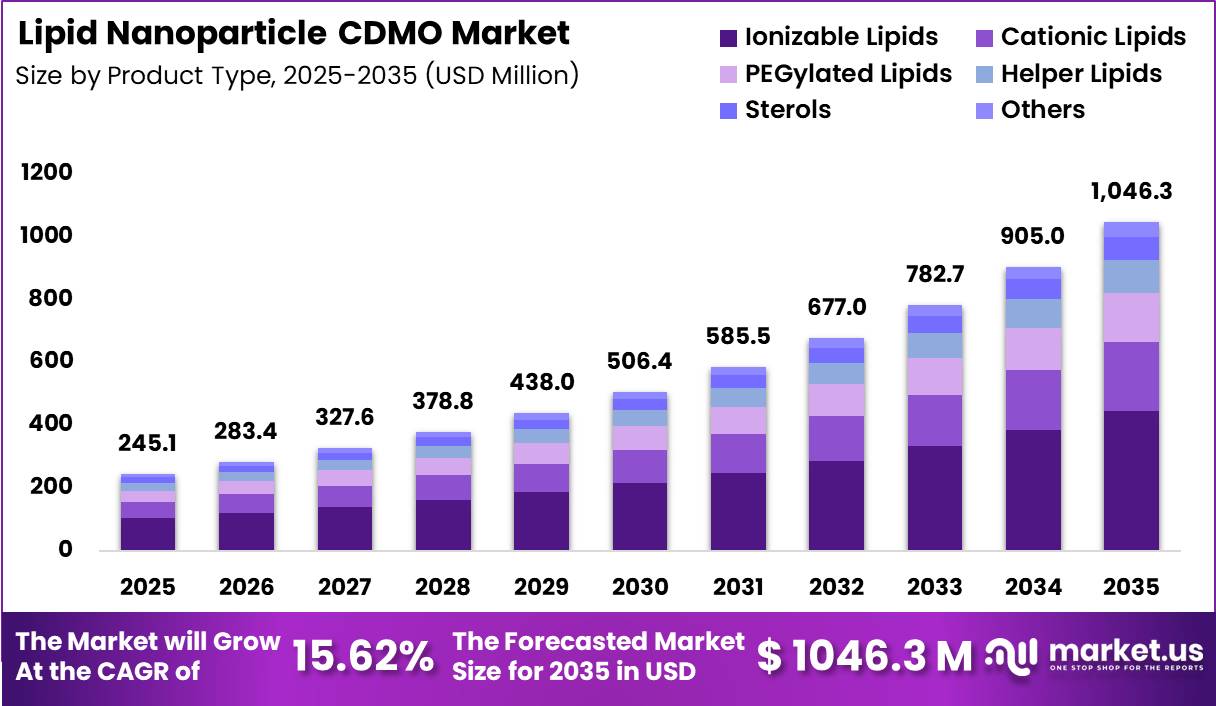
Lipid nanoparticles have become the leading non-viral delivery platform for messenger RNA (mRNA) and small interfering RNA (siRNA), protecting genetic material and enabling efficient delivery into target cells. Their successful use in mRNA vaccines has accelerated demand for specialized manufacturing, formulation development, and analytical testing services.
The U.S. Food and Drug Administration (FDA) identifies lipid nanoparticles as an emerging drug delivery technology supporting vaccines, cancer therapies, antifungal medicines, immune therapies, and nucleic acid therapeutics. The agency is also advancing research into continuous manufacturing processes that improve production efficiency, product quality, scalability, and manufacturing robustness for complex LNP formulations.
Government-supported research continues to demonstrate the growing clinical potential of LNP-enabled medicines. According to the U.S. National Institutes of Health (NIH), more than 800,000 people experience heart attacks annually in the United States, and recent NIH-funded research showed that an RNA therapy delivered through lipid nanoparticles promoted heart repair in preclinical studies, highlighting opportunities beyond infectious diseases.
Growing investment in RNA medicines, personalized therapies, and gene-editing technologies is expected to increase demand for GMP-compliant LNP formulation, process development, technology transfer, and commercial manufacturing. CDMOs with expertise in scalable nanoparticle production, quality control, and regulatory compliance are expected to play a vital role in supporting the next generation of precision medicines and RNA therapeutics.
Key Takeaways
- Market Size : Lipid Nanoparticle CDMO Market size is expected to be worth around US$ 1046.3 Million by 2035 from US$ 245.1 Million in 2025.
- Market Share : The market is growing at a CAGR of 15.62% during the forecast period from 2026 to 2035.
- Product Type Analysis : The Ionizable Lipids segment dominated the Lipid Nanoparticle CDMO market in 2025, accounting for 42.5% of the total market share.
- Application Analysis : The mRNA Vaccines segment held the largest share of the Lipid Nanoparticle CDMO market in 2025, representing 52.8% of total revenue.
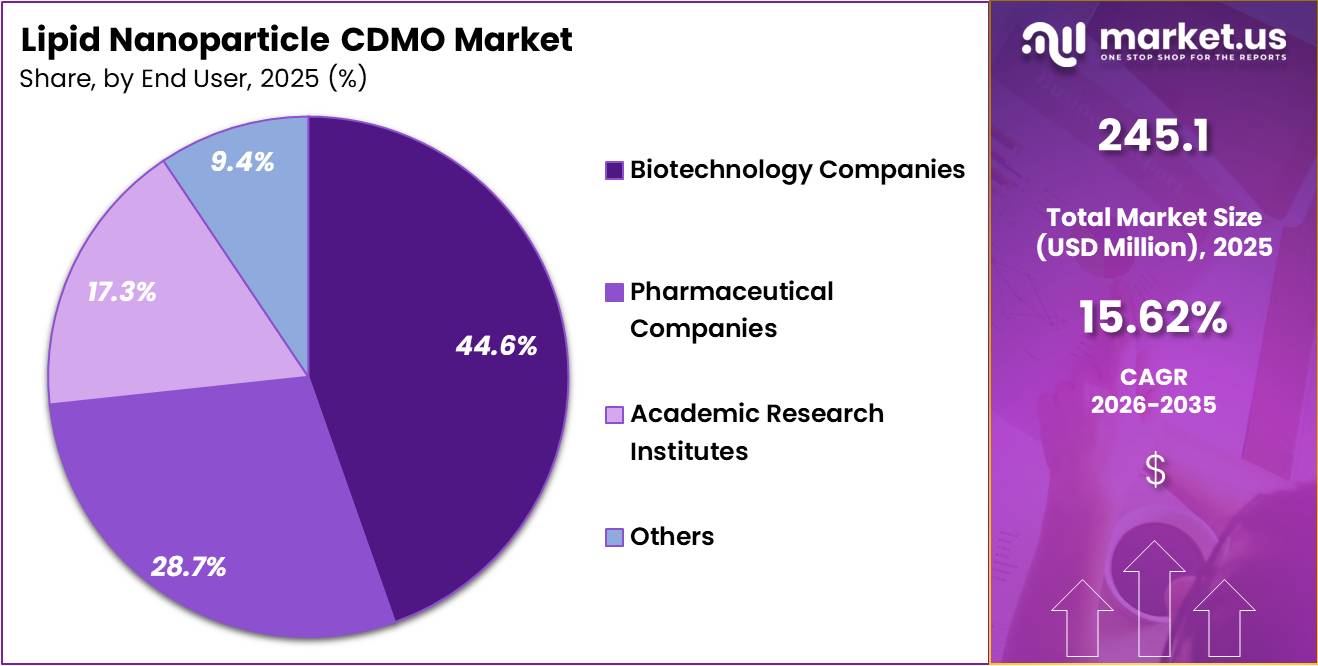
- End User Analysis : The Biotechnology Companies segment dominated the Lipid Nanoparticle CDMO market in 2025, accounting for 44.6% of the global market.
- Regional Analysis : In 2025, North America led the market, achieving over 46.80% share with a revenue of US$ 114.71 Million.
Product Type Analysis
The Ionizable Lipids segment dominated the Lipid Nanoparticle CDMO market in 2025, accounting for 42.5% of the total market share. This leadership is driven by the essential role of ionizable lipids in encapsulating nucleic acids and enabling efficient intracellular delivery. Unlike permanently charged lipids, ionizable lipids remain neutral at physiological pH and become positively charged in acidic endosomal conditions, improving cellular uptake while reducing toxicity.
Their widespread use in mRNA vaccines, siRNA therapeutics, and gene-editing platforms has significantly increased manufacturing demand. Continuous innovation in ionizable lipid chemistry is also improving delivery efficiency and tissue targeting, making them the preferred component in modern LNP formulations.
The Cationic Lipids segment continues to serve niche applications where strong nucleic acid binding is required, although concerns regarding toxicity have shifted much of the market toward ionizable alternatives. PEGylated Lipids remain critical for enhancing nanoparticle stability, extending circulation time, and reducing immune recognition.
Helper Lipids contribute to membrane fusion, particle stability, and improved endosomal escape, making them indispensable in LNP formulations. Sterols, primarily cholesterol, provide structural integrity and improve nanoparticle durability throughout manufacturing and delivery.
The Others segment includes specialty phospholipids and emerging lipid excipients designed for targeted delivery and next-generation RNA therapeutics. Growing research into optimized lipid compositions is expected to support innovation across all product categories.
Application Analysis
The mRNA Vaccines segment held the largest share of the Lipid Nanoparticle CDMO market in 2025, representing 52.8% of total revenue. The segment’s dominance is supported by the proven success of lipid nanoparticles as delivery vehicles for mRNA vaccines, enabling protection of fragile RNA molecules and efficient delivery into cells.
Continued research into infectious diseases, oncology vaccines, and personalized immunotherapies is sustaining demand for commercial-scale LNP manufacturing. The expansion of clinical pipelines beyond COVID-19 has further strengthened investment in mRNA production and specialized CDMO services.
The Gene Therapies segment is expanding as developers increasingly adopt lipid nanoparticles as non-viral delivery systems for genetic medicines. Small Molecule Drugs represent an emerging application where lipid formulations improve drug solubility and targeted delivery. siRNA and RNAi Therapeutics continue to gain momentum following the successful commercialization of RNA interference medicines that rely on LNP technology for efficient delivery.
CRISPR-Cas9 Delivery is another rapidly developing segment, as researchers investigate lipid nanoparticles for safe, transient gene-editing applications without viral vectors. The Others category includes protein replacement therapies, DNA therapeutics, and experimental nucleic acid medicines, all contributing to broader adoption of lipid nanoparticle manufacturing services.
End User Analysis
The Biotechnology Companies segment dominated the Lipid Nanoparticle CDMO market in 2025, accounting for 44.6% of the global market. Biotechnology firms are leading the development of mRNA vaccines, RNA therapeutics, gene-editing technologies, and precision medicines, creating strong demand for specialized CDMO partners.
Since many biotechnology companies operate with limited in-house manufacturing capacity, they increasingly outsource formulation development, process optimization, analytical testing, and GMP production to experienced LNP manufacturers, enabling faster clinical and commercial development.
Pharmaceutical Companies represent another major end-user group as they expand investments in nucleic acid therapeutics and partner with CDMOs to accelerate product development and large-scale manufacturing. Academic Research Institutes continue to contribute through early-stage research, preclinical studies, and technology innovation, often collaborating with industry to advance novel lipid formulations and delivery systems.
The Others segment includes government research organizations, contract research organizations (CROs), and emerging biotechnology startups that increasingly utilize CDMO services for specialized formulation expertise and manufacturing support.
As RNA-based medicines continue to advance through clinical development, demand from all end-user categories is expected to increase, supporting sustained growth across the Lipid Nanoparticle CDMO market.
Market Segmentations
By Product Type
- Ionizable Lipids
- Cationic Lipids
- PEGylated Lipids
- Helper Lipids
- Sterols
- Others
By Application
- mRNA Vaccines
- Gene Therapies
- Small Molecule Drugs
- siRNA and RNAi Therapeutics
- CRISPR-Cas9 Delivery
- Others
By End User
- Pharmaceutical Companies
- Biotechnology Companies
- Academic Research Institutes
- Others
Driver
Microfluidic and high-throughput LNP manufacturing technology adoption
Technological advances in LNP manufacturing particularly microfluidic mixing (including innovations like impinging jet mixing) and advanced T-junction continuous systems have fundamentally improved the scalability, reproducibility, and unit economics of LNP production, which directly reshapes CDMO capacity metrics and cost-per-dose economics for mRNA and RNA-based products.
Experimental and industrial literature from 2021–2025 shows that optimized T-junction and microfluidic systems can produce highly uniform nanoparticles with controllable size distributions while reducing labor intensity compared to conventional macro-mixing methods, and in scaled operations can support high flow rates and continuous processing, lifting throughput per line by multiples versus early-batch systems.
For CDMOs, this translates into higher kilograms of LNP output per square meter of cleanroom space and per FTE, with some microfluidic systems enabling relatively small equipment footprints to support tens of liters per hour mixing capacity, which materially improves project economics particularly when combined with inline analytics for critical quality attributes like particle size, encapsulation efficiency, and residual solvent levels.
Over 2026–2030, the adoption curve of such technologies in North America, the EU, and advanced APAC hubs is expected to raise effective capacity and support entry into more price-sensitive indications and geographies, contributing an estimated 1.8 % point uplift to CAGR by enabling CDMOs to bid competitively for both high-margin specialized programs and more standardized vaccine contracts while maintaining acceptable margins.
| Driver | (~) % Impact on CAGR Forecast | Geographic Relevance | Impact Timeline |
|---|---|---|---|
| Expansion of mRNA and RNA therapeutics pipelines using LNP delivery | +3.0% | North America core, EU, APAC corridors | Medium term (2–4 years) |
| Regionalization of vaccine and pandemic preparedness manufacturing capacity | +2.2% | APAC corridors, EU, Africa & LATAM spill-over | Long term (≥ 4 years) |
| Microfluidic and high-throughput LNP manufacturing technology adoption | +1.8% | North America core, EU, Japan & South Korea | Medium term (2–4 years) |
| Stricter quality and nanomaterial regulatory frameworks for LNP-based products | +1.5% | North America core, EU, selected APAC regulatory hubs | Short–Medium term (≤ 4 years) |
| Emergence of proprietary LNP platforms and long-term CDMO partnerships | +2.0% | North America core, EU, APAC bioclusters | Medium–Long term (≥ 3 years) |
| Diversification beyond vaccines into oncology, rare disease and gene-modulation indications | +2.3% | North America core, EU, China & APAC corridors | Long term (≥ 4 years) |
Challenge
LNP Talent Shortage Constraining mRNA Manufacturing Expansion
The surge in LNP‑enabled mRNA, siRNA, and gene‑editing programs since 2020 has outpaced the availability of senior formulation scientists, analytical development specialists, and manufacturing engineers with deep LNP experience, leaving an estimated global shortfall of 800–1,200 practitioners who can independently lead complex LNP CMC programs.
Many CDMOs operate with only 2–4 true LNP subject‑matter experts per site, each supporting portfolios of 8–12 active programs, which creates bandwidth bottlenecks that extend tech transfer timelines by 3–5 months and stretch method development and validation cycles for key assays from 6–9 months to 9–12 months.
As a result, overall CMC readiness lags clinical demand, with 10–20% of promising pipeline assets constrained by analytical or formulation resourcing rather than clinical strategy, while internal training efforts only add 30–50 LNP‑capable staff per year at leading CDMOs, insufficient to close the talent gap before 2030.
This human‑capital friction lowers practical portfolio onboarding capacity by 15–25%, translating into 0.8 % points of CAGR drag as CDMOs defer or stagger projects and prioritize larger accounts, thereby leaving some emerging biotechs underserved.
Strategically, companies are accelerating cross‑training of biologics and liposome experts into LNP platforms, building rotational programs that move staff through formulation, analytics, and GMP operations in 18–24 month cycles, and deepening partnerships with academic centers to create 100–200 LNP‑focused graduates per year, but resolving this gap remains a ≥4‑year horizon given typical PhD/postdoc cycles and the need to build multi‑disciplinary competence across chemistry, process engineering, and immunology.
| Challenge | (~) % CAGR Friction Drag | Geographic Relevance | Mitigation Horizon |
|---|---|---|---|
| LNP scale-up yield volatility | -1.3% | North America, EU, Japan | Medium term (2-4 years) |
| Ionizable lipid & PEG supply tightness | -1.1% | EU, North America, APAC hubs | Medium term (2-4 years) |
| Ultra-stringent cold-chain logistics | -0.9% | Global high-income markets | Long term (≥ 4 years) |
| Advanced LNP formulation talent gap | -0.8% | Global, acute in APAC & EU | Long term (≥ 4 years) |
| Regulatory CMC & analytics complexity | -0.7% | US, EU, Japan, UK | Medium term (2-4 years) |
| Platform integration & CAPEX misalignment | -0.6% | Global CDMO clusters | Long term (≥ 4 years) |
Restraints
Nanomaterial Regulatory Complexity Slowing LNP CDMO Growth
Nanomaterial regulatory drag reflects how emerging guidance on drug products containing nanomaterials and LNP-based modalities elongates development timelines and constrains CDMO utilization, as agencies tighten expectations around characterization, CMC controls, and clinical risk management for nanoscale carriers.
Since 2022, FDA guidance on nanomaterials has prompted sponsors to expand preclinical safety and immunogenicity packages, often adding 6–12 months and several million dollars per program to generate additional biodistribution, immunotoxicity, and device–drug interaction data, and similar trends are visible in EU and Japan guidances on nanomedicine and advanced therapies.
For LNP CDMOs, this translates into a structurally higher share of capacity devoted to non‑commercial batches (engineering, comparability, bridging) that can consume 20–30 % of available suites, depressing effective revenue‑generating utilization and delaying tech transfer to commercial‑scale runs.
The impact is most pronounced in the US, EU, and Japan, where stringent dossiers on critical quality attributes such as particle size distribution below 100 nm, encapsulation efficiency above 90 %, and surface charge control must be demonstrated across multiple lots, driving up analytical workloads and batch failure risk.
Strategically, this drag pushes smaller sponsors to defer or cancel LNP programs as regulatory uncertainty doubles the cost of late‑stage development, narrows internal hurdle rates, and shifts capital to modalities with better defined regulatory pathways, collectively clipping 2.0 % points off what would otherwise be a mid‑teens LNP CDMO CAGR in 2026–2030.
| Restraint | (~) % Impact on CAGR Forecast | Geographic Relevance | Impact Timeline |
|---|---|---|---|
| Nanomaterial regulatory drag | -2.0% | US, EU, Japan | Medium term (2-4 years) |
| GMP scale-up & capex load | -2.3% | North America, EU, APAC hubs | Long term (≥ 4 years) |
| Specialty lipid input volatility | -1.5% | Global, especially EU, APAC | Short term (≤ 2 years) |
| QA/QC and analytics bottlenecks | -1.2% | US, EU | Medium term (2-4 years) |
| Skilled workforce scarcity | -0.8% | US, EU, select APAC | Long term (≥ 4 years) |
| Biotech funding and pipeline risk | -1.0% | US, EU, global biotech hubs | Medium term (2-4 years) |
Opportunity
Organ-Selective LNP Libraries Creating Scalable CDMO Opportunities
A second white‑space is the creation of organ‑ and cell‑selective LNP libraries offered as a recurring service, rather than one‑off formulation projects, leveraging the increasing body of NIH‑reported work on organ‑targeted delivery and endosomal escape optimization.
Current baseline demand assumes that each biotech builds its own bespoke hepatotropic or myotropic LNP through iterative preclinical work, but reviews indicate that many optimized LNP designs share common structural themes and could be offered as pre‑characterized libraries with known biodistribution profiles, particle sizes in the 50–100 nm range, and validated physicochemical parameters.
A CDMO that invests in 50–100 such “ready‑to‑go” formulations, each with extensive in vivo data packages, can sell annual subscription access (for example, low‑ to mid‑seven‑figure fees per client) plus downstream manufacturing revenues, effectively turning LNP know‑how into a scalable, high‑margin software‑like revenue stream layered on top of traditional batch fees.
If such models capture even 10–15 % of the roughly several hundred early‑stage RNA programs expected globally over the coming decade, the incremental high‑margin service revenues could add on the order of 2 % points to industry CAGR, with disproportionate gains accruing to early movers in North America and Europe who can then expand into APAC emerging biotech hubs.
| Opportunity | (~) % Potential CAGR Upside | Geographic Relevance | Execution Window |
|---|---|---|---|
| Multi-modality RNA LNP platforms | +2.5% | North America, EU, APAC developed | Medium term (2-4 years) |
| Organ-targeted LNP libraries as a service | +2.0% | North America, EU, APAC emerging | Medium term (2-4 years) |
| Integrated cold-chain & fill-finish hubs | +1.8% | North America core, EU, APAC | Short term (≤ 2 years) |
| LNP IP licensing & royalty models | +1.5% | Global, esp. US/EU originators | Long term (≥ 4 years) |
| Non-vaccine chronic disease RNA programs | +2.2% | North America, EU, Japan | Long term (≥ 4 years) |
| Regulatory accelerator & CMC advisory | +1.0% | US, EU, selective APAC | Short term (≤ 2 years) |
Regional Analysis
In 2025, North America accounted for the largest share of the Lipid Nanoparticle (LNP) CDMO market, capturing 46.80% of global revenue. The region’s leadership is supported by its mature biopharmaceutical manufacturing ecosystem, strong regulatory framework, and extensive investment in RNA therapeutics.
The U.S. Food and Drug Administration (FDA) recognizes lipid nanoparticles as a key delivery technology for RNA-based medicines and continues to support regulatory science for nanomaterial-containing drug products. FDA research programs also focus on improving manufacturing quality, scalability, and regulatory standards for nanotechnology-enabled therapeutics.
Europe remains the second-largest regional market, driven by strong pharmaceutical manufacturing capabilities, active research collaborations, and increasing investment in advanced therapies. Countries including Germany, Switzerland, Belgium, and the United Kingdom have established biopharmaceutical hubs supporting the development and commercial manufacturing of mRNA vaccines, gene therapies, and nucleic acid medicines.
Continued collaboration between regulatory agencies, academic institutions, and biotechnology companies is accelerating innovation in lipid nanoparticle technologies.
The Asia-Pacific region is expected to witness the fastest growth over the coming years due to expanding biopharmaceutical manufacturing capacity, government support for biotechnology, and increasing investments in genomic medicine and vaccine production.
Countries such as China, Japan, South Korea, and Singapore are strengthening domestic capabilities in RNA therapeutics and nanoparticle formulation through public-private partnerships and research initiatives.
Meanwhile, Latin America and the Middle East & Africa represent emerging markets, supported by improving healthcare infrastructure, expanding vaccine manufacturing initiatives, and growing participation in clinical research.
Although these regions currently account for a smaller market share, increasing investments in biologics manufacturing and technology transfer are expected to create new opportunities for LNP CDMO service providers over the forecast period.
Key Regions and Countries
North America
- The US
- Canada
Europe
- Germany
- France
- The U.K.
- Italy
- Spain
- Russia & CIS
- Rest of Europe
Asia Pacific
- China
- India
- Japan
- South Korea
- ASEAN
- Australia & New Zealand
- Rest of Asia Pacific
Middle East & Africa
- GCC
- South Africa
- Rest of Middle East & Africa
Latin America
- Brazil
- Mexico
- Rest of Latin America
Key Player Analysis
The Lipid Nanoparticle (LNP) CDMO market is characterized by the presence of established global contract manufacturers and specialized lipid technology companies that support the development and commercialization of RNA-based therapeutics.
Competition is driven by expertise in formulation development, scalable manufacturing, analytical testing, regulatory compliance, and proprietary lipid delivery technologies. Companies are increasingly investing in advanced manufacturing capabilities to meet the growing demand for mRNA vaccines, gene therapies, and gene-editing products.
Catalent Inc. has strengthened its position by providing integrated CDMO services, including plasmid production, mRNA manufacturing, lipid nanoparticle (LNP) formulation, fill-finish, and commercial supply for advanced therapeutics.
Lonza Group AG is a global CDMO leader offering end-to-end manufacturing solutions across biologics, mRNA, cell and gene therapies, supported by a broad international manufacturing network. Evonik Industries AG focuses on advanced drug delivery systems and lipid nanoparticle formulation, helping pharmaceutical companies scale RNA-based medicines from development to commercial production.
Thermo Fisher Scientific Inc. provides comprehensive CDMO services, including process development, analytical testing, clinical manufacturing, and commercial manufacturing for biologics and nucleic acid therapeutics.
Merck KGaA supports the industry through process solutions, pharmaceutical raw materials, and manufacturing technologies used in LNP production. Meanwhile, Precision NanoSystems Inc. is recognized for its microfluidic technology that enables reproducible LNP formulation, while GenVoy (Ionis Pharmaceuticals) develops proprietary lipid delivery technologies for RNA medicines.
Polymun Scientific Immunbiologische Forschung GmbH specializes in liposome and LNP development and GMP manufacturing. Acuitas Therapeutics Inc. is known for its proprietary LNP delivery platform used in several mRNA applications, and Avanti Polar Lipids Inc. supplies high-purity research lipids and specialized materials essential for lipid nanoparticle formulation and manufacturing.
Top Key Players
- Catalent Inc.
- Lonza Group AG
- Evonik Industries AG
- Thermo Fisher Scientific Inc.
- Merck KGaA
- Precision NanoSystems Inc.
- GenVoy (Ionis Pharmaceuticals)
- Polymun Scientific Immunbiologische Forschung GmbH
- Acuitas Therapeutics Inc.
- Avanti Polar Lipids Inc.
- Nippon Fine Chemical Co. Ltd.
- CordenPharma International
- Genevant Sciences GmbH
- Arbutus Biopharma Corporation
- Fujifilm Corporation
- Others
Recent Developments
- In June 2026, Lonza Group AG announced the expansion of its High Potency API (HPAPI) manufacturing capacity in Visp, Switzerland. The investment enhances payload-linker manufacturing capabilities used in advanced therapeutics and strengthens Lonza’s global CDMO platform.
- In September 2025, Evonik Industries AG entered a strategic partnership with Ethris GmbH to develop and commercialize the SNaP LNP® platform for nucleic acid delivery. The collaboration expands Evonik’s CDMO services by combining Ethris’ proprietary LNP technology with Evonik’s formulation development, process development, and clinical manufacturing capabilities.
- In July 20 25, Catalent announced a US$45 million expansion of its Madison, Wisconsin facility. The investment increases biologics manufacturing capacity and strengthens the company’s CDMO network supporting advanced biologics and next-generation therapeutics.
- In April 2025, Catalent Inc. partnered with Silexion Therapeutics to support advanced siRNA formulation development and clinical manufacturing activities. The collaboration leverages Catalent’s expertise in complex formulation and manufacturing for RNA-based therapeutics, including lipid nanoparticle-enabled medicines.
Report Scope
| Report Features | Description |
|---|---|
| Market Value (2025) | US$ 245.1 Million |
| Forecast Revenue (2035) | US$ 1046.3 Million |
| CAGR (2026-2035) | 15.62% |
| Base Year for Estimation | 2025 |
| Historic Period | 2020-2024 |
| Forecast Period | 2026-2035 |
| Report Coverage | Revenue Forecast, Market Dynamics, Competitive Landscape, Recent Developments |
| Segments Covered | By Product Type (Ionizable Lipids, Cationic Lipids, PEGylated Lipids, Helper Lipids, Sterols, Others), By Application (mRNA Vaccines, Gene Therapies, Small Molecule Drugs, siRNA and RNAi Therapeutics, CRISPR-Cas9 Delivery, Others), By End User (Pharmaceutical Companies, Biotechnology Companies, Academic Research Institutes, Others) |
| Regional Analysis | North America – The US, Canada; Europe – Germany, France, U.K., Italy, Spain, Russia & CIS, Rest of Europe; Asia Pacific – China, India, Japan, South Korea, ASEAN, Australia & New Zealand, Rest of Asia Pacific; Middle East & Africa – GCC, South Africa, Rest of Middle East & Africa; Latin America – Brazil, Mexico, Rest of Latin America |
| Competitive Landscape | Catalent Inc., Lonza Group AG, Evonik Industries AG, Thermo Fisher Scientific Inc., Merck KGaA, Precision NanoSystems Inc., GenVoy (Ionis Pharmaceuticals), Polymun Scientific Immunbiologische Forschung GmbH, Acuitas Therapeutics Inc., Avanti Polar Lipids Inc., Nippon Fine Chemical Co. Ltd., CordenPharma International, Genevant Sciences GmbH, Arbutus Biopharma Corporation, Fujifilm Corporation, Others |
| Customization Scope | Customization for segments, region/country-level will be provided. Moreover, additional customization can be done based on the requirements. |
| Purchase Options | We have three licenses to opt for: Single User License, Multi-User License (Up to 5 Users), Corporate Use License (Unlimited User and Printable PDF) |