


Report Overview
The Global Laser Triangulation Sensor Market size is expected to be worth around USD 3,623.4 million by 2035, from USD 1,462.1 million in 2025, growing at a CAGR of 9.5% during the forecast period from 2025 to 2035. Asia Pacific held a dominant market position, capturing more than 42.5% share and generating USD 621.3 million in revenue.
A laser triangulation sensor refers to a non-contact measurement device that uses a laser beam and an optical detector to measure distance, height, thickness, gap, and surface profile. It is widely used in automated inspection, robotics, electronics, and precision manufacturing, where fast, accurate, and repeatable measurement is required without touching the product.
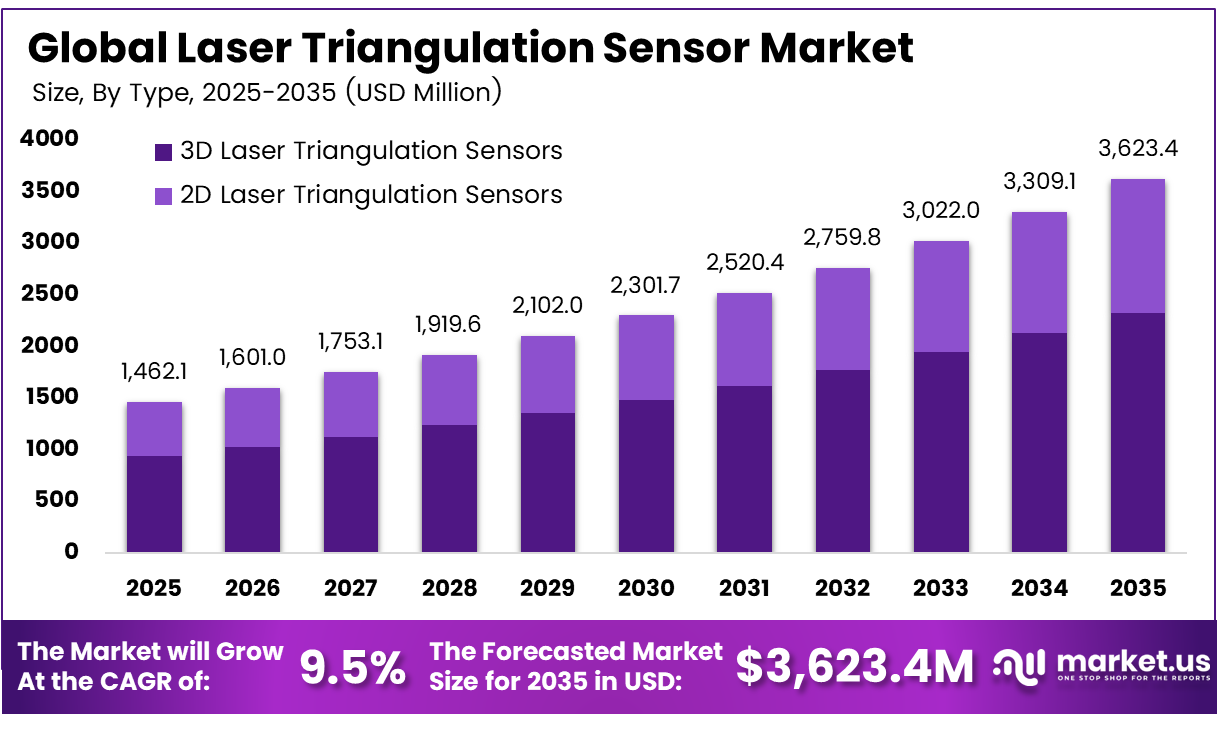
Top driving factors include rising automation in automotive, electronics, and general manufacturing, where over 60% of installations are linked to inline quality checks, robot guidance, and dimensional inspection of complex parts. Demand is also supported by medical devices, machine tools, and mining, where reliable, high-speed, non-contact measurements are needed over traditional gauges.
The market for Laser Triangulation Sensors is driven by rising demand for accurate, non-contact measurement in automated production lines. These sensors help manufacturers inspect distance, thickness, gap, height, and surface profile with high speed and repeatability. Growing use in robotics, electronics, automotive, and precision manufacturing is further supporting adoption as factories focus on better quality control and lower rework.
Demand is strengthened by quality regulations that require factories to monitor every critical dimension with higher accuracy. In many operations, hundreds of points are checked per component in a single shift, which supports the use of high-speed optical sensors. Laser triangulation units also help cut scrap rates by several percentage points and reduce manual inspection time.
For instance, in November 2025, Cognex introduced its first Solutions Experience (SLX) product line featuring AI-powered, application-specific sensors designed for logistics automation. These easy-deployment systems combine reliable barcode reading with AI-driven item detection, representing Cognex’s strategic expansion into vertically integrated sensor solutions that complement laser triangulation technologies for package sorting and warehouse automation.
Key Takeaway
- In 2025, the 3D Laser Triangulation Sensors segment held a dominant market position, capturing a 64.3% share of the Global Laser Triangulation Sensor Market.
- In 2025, the Short Range segment held a dominant market position, capturing a 42.7% share of the Global Laser Triangulation Sensor Market.
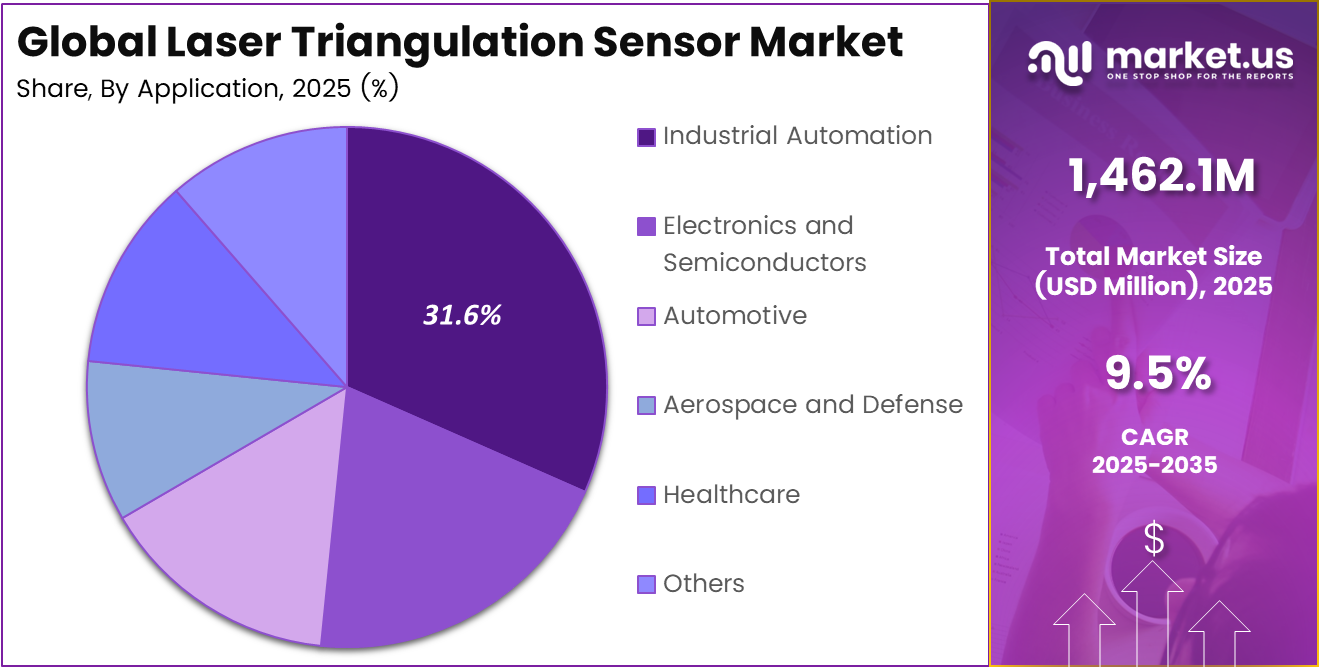
- In 2025, the Industrial Automation segment held a dominant market position, capturing a 31.6% share of the Global Laser Triangulation Sensor Market.
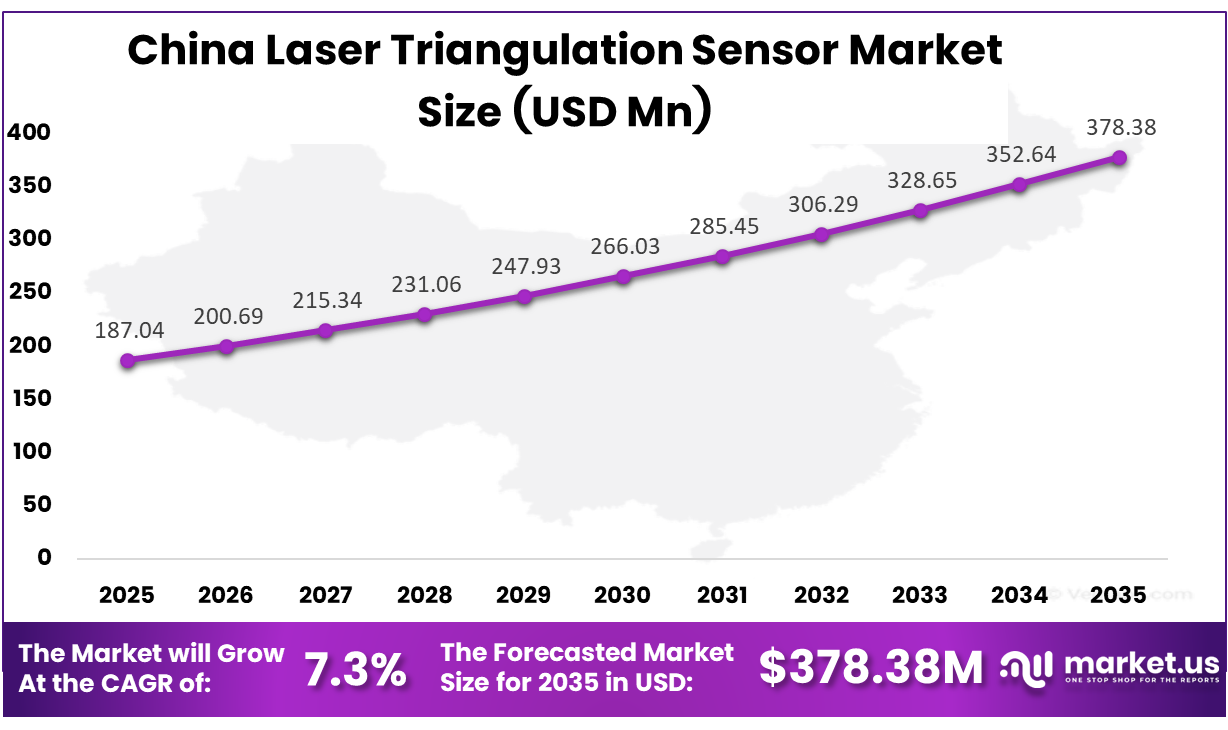
- The China Laser Triangulation Sensor Market was valued at USD 187.04 Million in 2025, with a robust CAGR of 7.3%.
- In 2025, the Asia Pacific held a dominant market position in the Global Laser Triangulation Sensor Market, capturing more than a 42.5% share.
Role of Generative AI
Generative AI is being added over triangulation sensor data streams to turn raw displacement values into quality judgments, anomaly alerts, and process correction suggestions. In industrial surveys, more than 60% of early AI adopters in manufacturing use generative models for code generation, workflow automation, or data interpretation.
At the engineering level, generative AI supports faster sensor design, calibration planning, and synthetic data creation for reflective, dark, or textured surfaces. Large industrial AI programs also report that around 30 to 40% of use cases involve vision and measurement tasks, making triangulation sensors important data sources.
Investment and Business Benefits
Investment opportunities are growing in compact, multi-axis, and 3D triangulation systems used for profile measurement, surface inspection, and robot vision. These solutions are strongly linked with expanding automation in Asia and other industrial regions. Specialized systems that combine laser triangulation with thermal, vibration, or process data can also support predictive maintenance in factories and infrastructure.
Business benefits include fewer defects, shorter inspection cycles, and better traceability, as each measurement can be logged and connected to a part ID in manufacturing systems. Over time, companies often see measurable reductions in rework and material waste. Stable throughput is also supported when sensors detect process drift before it becomes a larger quality issue.
Regional Analysis
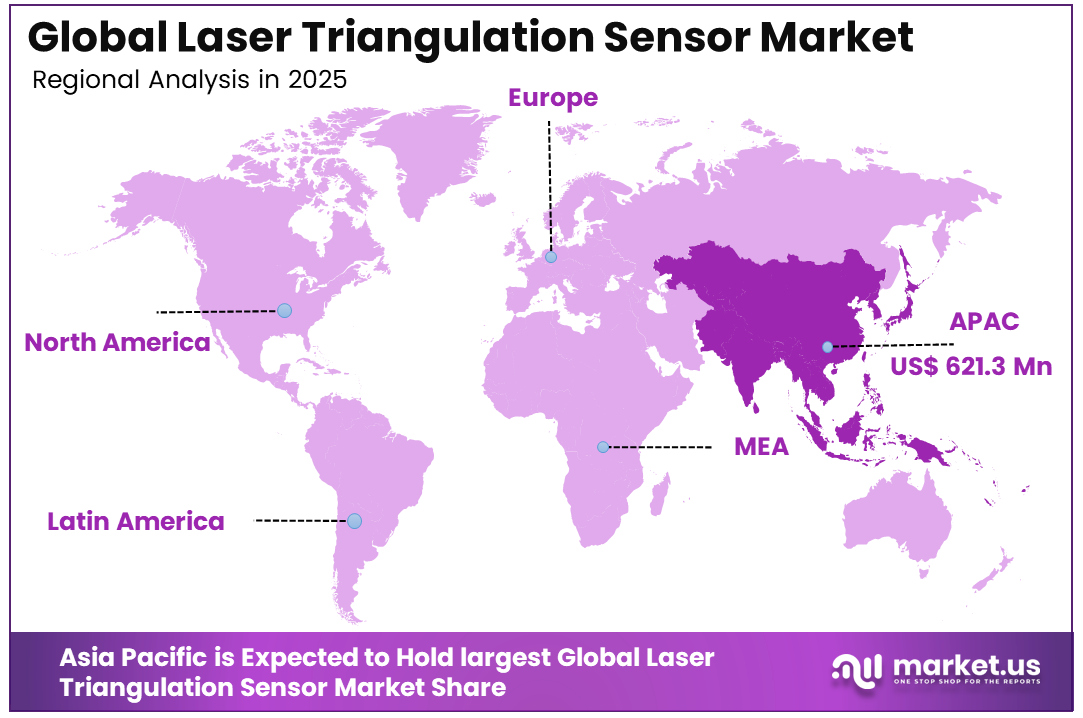
In 2025, the Asia Pacific held a dominant market position in the Global Laser Triangulation Sensor Market, capturing more than 42.5% share and generating USD 621.3 million in revenue. This dominance is due to the Asia Pacific’s large manufacturing base across electronics, automotive, semiconductors, batteries, and precision machinery. The region has a strong demand for high-speed, non-contact measurement tools as factories increase automation and inline quality inspection. Countries such as China, Japan, South Korea, and India are adopting laser triangulation sensors to improve accuracy, reduce defects, and support stable production in fast-moving industrial environments.
For instance, in March 2026, Keyence Corporation launched the advanced 2D/3D Laser Profiler LJ-X8000 Series, reinforcing its leadership position in the Asia Pacific laser triangulation sensor market. This new profiler delivers enhanced measurement precision and speed for industrial automation applications.
China Laser Triangulation Sensor Market Size
The market for Laser Triangulation Sensors within China is growing tremendously and is currently valued at USD 187.04 million; the market has a projected CAGR of 7.3%. This dominance is due to China’s strong manufacturing base across automotive, electronics, machinery, batteries, and precision engineering. The market is growing due to rising factory automation, stricter quality control, and wider use of non-contact inspection on high-speed production lines. Laser triangulation sensors help Chinese manufacturers measure gaps, thickness, height, profiles, and surface defects quickly, which supports lower rework, better consistency, and improved production efficiency.
For instance, in April 2026, KEYENCE expanded its laser triangulation displacement sensor portfolio in China by launching higher-speed CMOS-based models optimized for inline inspection in electronics and automotive component lines, reinforcing its strong share in high-precision measurement applications across coastal manufacturing hubs and deepening localization support through Chinese-language configuration tools and technical service teams.
Key Regions and Countries
North America
- US
- Canada
Europe
- Germany
- France
- The UK
- Spain
- Italy
- Russia
- Netherlands
- Rest of Europe
Asia Pacific
- China
- Japan
- South Korea
- India
- Australia
- Singapore
- Thailand
- Vietnam
- Rest of APAC
Latin America
- Brazil
- Mexico
- Rest of Latin America
Middle East & Africa
- South Africa
- Saudi Arabia
- UAE
- Rest of MEA
Type Analysis
In 2025, the 3D Laser Triangulation Sensors segment held a dominant market position, capturing a 64.3% share of the Global Laser Triangulation Sensor Market. This dominance is due to the strong need for accurate three-dimensional inspection across automated production lines. These sensors help factories measure shape, height, profile, and surface defects without touching the product. Their use is higher where parts are complex and traditional gauges cannot provide fast and repeatable results.
They are also preferred in robot vision, profile scanning, and inline quality control. Manufacturers use them to improve inspection speed and reduce human error. As factories move toward connected and automated measurement systems, 3D laser triangulation sensors continue to gain wider acceptance across precision manufacturing operations.
For instance, in March 2025, Keyence highlighted a new 3D triangulation platform aimed at inline profile inspection in electronics and automotive lines. The system focuses on faster integration with robots and PLCs, so plants can capture full surface geometry in one pass. This reflects growing customer interest in richer 3D data for stable, repeatable quality control on complex parts.
Range Analysis
In 2025, the Short Range segment held a dominant market position, capturing a 42.7% share of the Global Laser Triangulation Sensor Market. This dominance is due to the strong use of short-range sensors in close distance measurement tasks that need high accuracy. These sensors are suitable for checking small parts, gaps, thickness, height, and surface variation. Their role is important in electronics, medical devices, machine tools, and precision assembly.
Short-range laser triangulation sensors are valued because they provide stable readings in compact production spaces. They also support faster inspection without damaging delicate surfaces. As manufacturing parts become smaller and more detailed, demand for close-range, non-contact measurement systems remains strong across high-volume production lines.
For instance, in July 2025, Banner updated its short-range laser triangulation lineup with models offering flexible analog and IO-Link outputs. These sensors are promoted for quick setup in packaging and assembly cells, where maintenance teams want easy parameter changes without stopping production for long periods. The focus on plug-and-play integration shows how short-range devices support fast adoption on existing lines.
Application Analysis
In 2025, the Industrial Automation segment held a dominant market position, capturing a 31.6% share of the Global Laser Triangulation Sensor Market. This dominance is due to the wider use of laser triangulation sensors in automated inspection, robotic positioning, and process control. These sensors help production lines verify part placement, surface quality, and dimensions in real time. Their non-contact nature makes them useful for fast-moving and sensitive components.
Industrial automation also depends on reliable measurement data to reduce defects and improve production consistency. Laser triangulation sensors support this need by replacing many manual checks with inline inspection. Their adoption is supported by factories that are adding robots, smart machines, and connected quality systems.
For instance, in September 2025, SICK expanded its broader sensor portfolio with additional digital models designed to slot into automated production cells. While covering several technologies, the announcements highlighted how triangulation sensors now ship with better connectivity to industrial networks and cloud tools. This supports users who want measurement data to feed directly into monitoring dashboards and improvement projects across multiple sites.
Key Market Segments
By Type
- 2D Laser Triangulation Sensors
- 3D Laser Triangulation Sensors
By Range
- Short Range
- Medium Range
- Long Range
By Application
- Industrial Automation
- Electronics and Semiconductors
- Automotive
- Aerospace and Defense
- Healthcare
- Others
Emerging Trends
A key trend is the move toward higher-speed and higher-resolution sensors for compact production lines and 3D inspection. Better CMOS detectors and improved signal processing are supporting this shift. Blue-laser triangulation is also gaining use in shiny metals and reflective plastics due to better surface stability.
Triangulation sensors are also moving from standalone gauges to networked devices connected with EtherCAT or Ethernet systems. Reports on Industry 4.0 adoption suggest that more than 70% of new smart-factory projects include advanced optical sensing for real-time quality control, keeping triangulation sensors widely relevant.
Growth Factors
Industrial automation remains the main growth factor, as robot cells, flexible assembly lines, and smart inspection stations need high-speed non-contact gauges for position, gap, and thickness measurement. In automotive, aerospace, and battery manufacturing, internal quality teams report double-digit defect reduction after replacing manual gauges with inline triangulation checks.
Miniaturization in electronics is also pushing demand, as components measured in tens of microns need sensors with sub-micron repeatability. Laser triangulation supports this requirement while maintaining cycle times suitable for mass production. This makes it useful for electronics, precision assembly, semiconductor tools, and other high-volume manufacturing environments.
Market Dynamics
Drivers - Rising Need for High Precision in Automated Production
The market for laser triangulation sensors is driven by the rising need for high precision in automated production. These sensors help factories measure distance, thickness, height, gap, and surface profile without touching the product. This makes them useful for fast production lines where manual inspection is slow and less consistent.
Their adoption is also supported by the growing use of robots, smart machines, and inline inspection systems. Manufacturers are using these sensors to detect small defects earlier and maintain stable product quality. As production becomes more automated, accurate non-contact measurement is becoming a key requirement.
For instance, in July 2025, SICK launched the OD200 optical displacement sensor, built on a new triangulation measurement core that stabilises readings even on shiny metals and dark plastics. It supports high process speeds and very fine repeatability, allowing users to maintain precise part positioning and dimensional checks on fast, complex production processes.
Restraint - High Upfront Cost
High upfront cost remains a restraint for many small and mid-sized manufacturers. Advanced laser triangulation systems often require quality optics, controllers, mounting hardware, software, and integration support. This can make adoption difficult for plants that have limited budgets or only need basic measurement functions.
The cost pressure increases when factories need multiple sensors across different lines. Additional spending may also be required for calibration, operator training, and maintenance. For some users, the return on investment takes time to prove, especially when existing manual gauges or simpler sensors are still considered acceptable.
For instance, in February 2024, the W10 laser triangulation sensor adds a touchscreen interface and multiple operating modes, which simplifies setup but increases product complexity. When users factor in this advanced hardware, rugged housing, and digital connectivity, the initial purchase can be challenging for budget-constrained lines that currently rely on basic photoelectric devices.
Opportunities - Growth in Electronics Semiconductor Lines
Growth in electronics and semiconductor production creates strong opportunities for laser triangulation sensors. These industries need accurate, non-contact measurement for small components, wafers, connectors, boards, and precision assemblies. The sensors support quality checks without damaging sensitive surfaces or slowing production flow.
As electronic parts become thinner, smaller, and more densely packed, inspection systems need better control over height, gap, thickness, and surface variation. Laser triangulation sensors fit this need by supporting fast, inline measurement. This creates room for compact, stable, and easy-to-integrate sensor solutions.
For instance, in April 2023, Keyence highlighted new ultra-compact laser sensors tailored to electronics and semiconductor environments, where space and precision are both critical. These products are suitable for thickness and position checks on boards and small parts, aligning well with the move toward more measurement points in dense production lines.
Challenges - Competition from Alternative Sensing Technologies
Competition from alternative sensing technologies is a key challenge for the market. Vision systems, confocal sensors, ultrasonic sensors, capacitive sensors, and contact probes can be preferred in certain applications. Buyers often compare accuracy, cost, surface compatibility, speed, and ease of use before selecting a solution.
Laser triangulation sensors must prove clear value in each use case. Some users may choose other technologies when surfaces are highly reflective, transparent, dusty, or difficult to position. Suppliers, therefore, need stronger application support, simpler setup, and reliable performance to maintain adoption across industries.
For instance, in December 2024, Omron’s ZP-L displacement sensors compete not only with other triangulation products but also with camera-based systems and capacitive or inductive gauges. In certain applications, users may select those alternatives for reasons such as cost, tolerance to surface conditions, or existing familiarity.
Key Players Analysis
One of the leading players in April 2026, SICK strengthened its strategic robotics partnership with Innok Robotics at LogiMAT 2026, transitioning from sensor supplier to customer by deploying the INDUROS transport robot equipped with advanced laser scanning technology, including the outdoorScan3 laser scanner. This collaboration demonstrates SICK’s commitment to integrating its laser triangulation sensors into next-generation autonomous systems for supply chain automation.
Top Key Players in the Market
- Keyence Corporation
- SICK AG
- Banner Engineering Corp.
- Micro-Epsilon
- Baumer Group
- LMI Technologies
- Cognex Corporation
- Omron Corporation
- Panasonic Corporation
- Pepperl+Fuchs
- MTI Instruments
- STMicroelectronics
- Optex FA Co., Ltd.
- Leuze electronic GmbH + Co. KG
- Turck Inc.
- Z-Laser GmbH
- Acuity Laser
- ifm electronic GmbH
- Wenglor Sensoric GmbH
- DIMETIX AG
- Others
Recent Developments
- In September 2025, Baumer strengthened its force and strain measurement capabilities by acquiring Swiss sensor specialist X-Sensors AG. This strategic acquisition expands Baumer’s portfolio in precision measurement technology, complementing its existing laser triangulation sensor offerings and positioning the company for enhanced market penetration in industrial automation and metrology applications.
- In April 2026, Micro-Epsilon expanded its optoNCDT 5500 laser triangulation sensor series with significant performance enhancements, including a speed boost to 150 kHz and new industrial Ethernet fieldbus variants. These improvements enable faster, more accurate displacement measurements for demanding applications in semiconductor manufacturing, automotive quality control, and precision robotics.
Report Scope
| Report Features | Description |
|---|---|
| Market Value (2025) | USD 1,462.1 Million |
| Forecast Revenue (2035) | USD 3,623.4 Million |
| CAGR (2026-2035) | 9.5% |
| Base Year for Estimation | 2025 |
| Historic Period | 2020-2024 |
| Forecast Period | 2026-2035 |
| Report Coverage | Revenue Forecast, Market Dynamics, Competitive Landscape, Recent Developments |
| Segments Covered | By Type (2D Laser Triangulation Sensors, 3D Laser Triangulation Sensors), By Range (Short Range, Medium Range, Long Range), By Application (Industrial Automation, Electronics and Semiconductors, Automotive, Aerospace and Defense, Healthcare, Others) |
| Regional Analysis | North America (US and Canada), Europe (Germany, France, The UK, Spain, Italy, and Rest of Europe), Asia Pacific (China, Japan, South Korea, India, Australia, and Rest of APAC), Latin America (Brazil, Mexico, and Rest of Latin America), Middle East & Africa (GCC, South Africa, and Rest of MEA) |
| Competitive Landscape | Keyence Corporation, SICK AG, Banner Engineering Corp., Micro-Epsilon, Baumer Group, LMI Technologies, Cognex Corporation, Omron Corporation, Panasonic Corporation, Pepperl+Fuchs, MTI Instruments, STMicroelectronics, Optex FA Co., Ltd., Leuze electronic GmbH + Co. KG, Turck Inc., Z-Laser GmbH, Acuity Laser, ifm electronic GmbH, Wenglor Sensoric GmbH, DIMETIX AG, Others |
| Customization Scope | Customization at the segment and region/country levels will be provided. Moreover, customization can be tailored to the requirements. |
| Purchase Options | We have three licenses to opt for: Single User License, Multi-User License (Up to 5 Users), Corporate Use License (Unlimited Users and Printable PDF) |





































