Report Overview
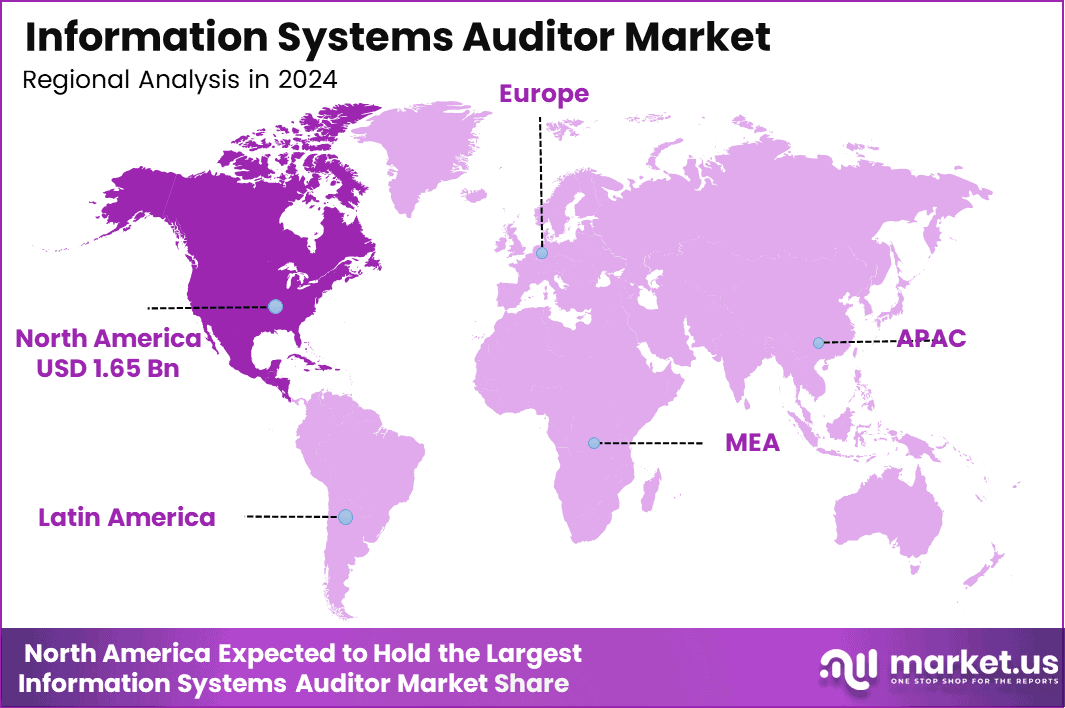
The Global Information Systems Auditor Market reached USD 4.2 billion in 2024 and is forecast to reach USD 7.8 billion by 2034, growing at a 6.4% CAGR from 2025 to 2034. North America led the market with a 39.2% share and USD 1.6 billion in revenue during 2025.
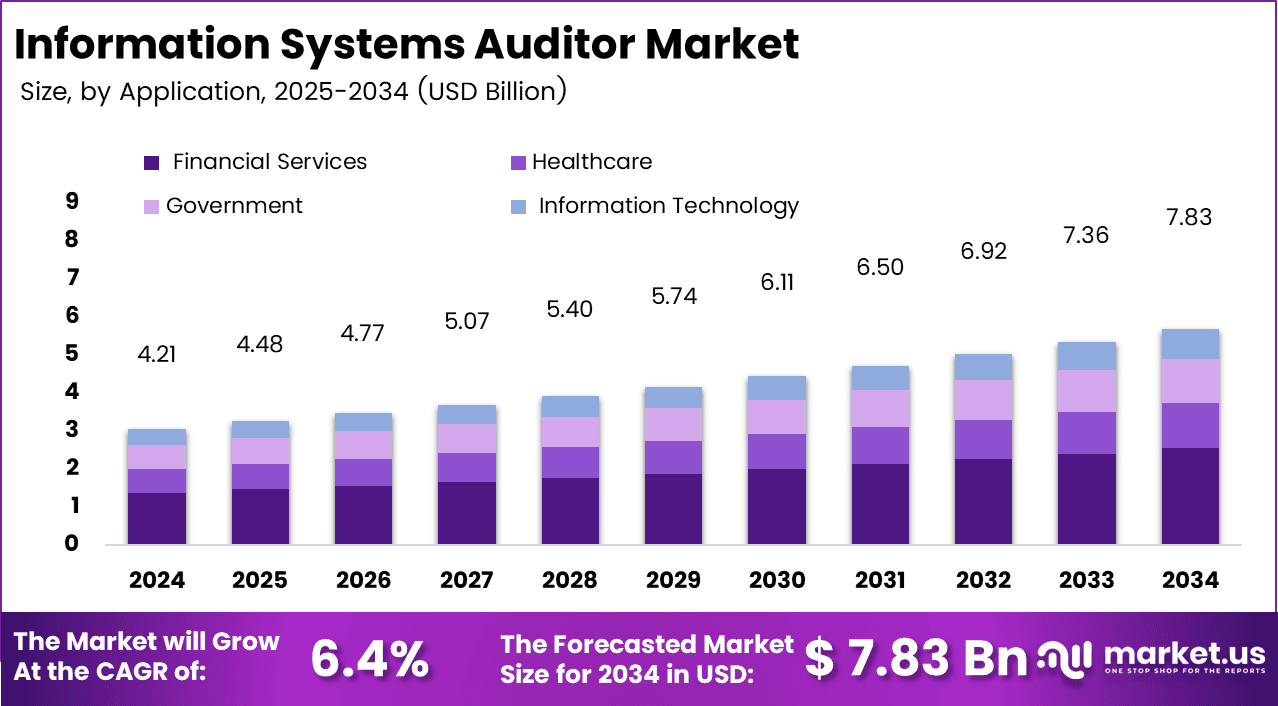
Rising cyber losses, cloud use, artificial intelligence, and digital payment activity increase the need for independent system controls. The FBI received 859,532 internet crime complaints in 2024, with reported losses above USD 16.6 billion, an increase of 33% from 2023. These losses push financial institutions, healthcare providers, public agencies, and technology companies to test access controls, data protection, incident response, and third-party risks.
The North America region combines a large digital economy with strict disclosure duties and high financial exposure to cybercrime. The World Bank reports that the United States supplies 87% of global cloud computing and data storage service exports. This concentration creates a large base of cloud platforms, data centers, software vendors, and connected enterprises that require recurring audits.
Key Takeaways
- The market generated USD 4.2 billion in 2024 and is forecast to reach USD 7.8 billion by 2034. The market is projected to grow at a 6.4% CAGR from 2025 to 2034.
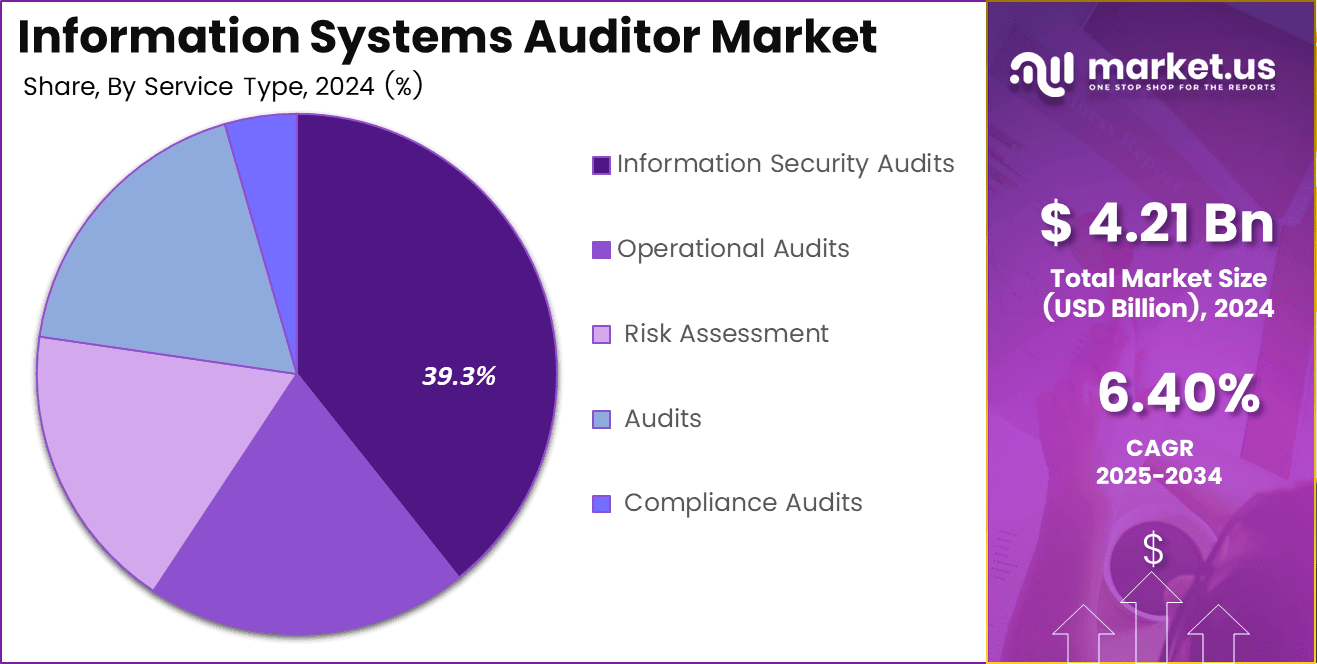
- Information Security Audits led the Service Type segment with a 39.3% share.
- Financial Services led the Application segment with a 32.6% share.
- On-Premise led the Deployment Type segment with a 61.8% share.
- Large Enterprises led the End Use segment with a 58.3% share.
- North America led the market with a 39.2% share and USD 1.6 billion in revenue.
By Service Type
Information Security Audits dominate with 39.3% due to constant cyber threats demanding focused control testing.
Information Security Audits hold the largest share because companies need regular checks on access controls, networks, software, data storage, and incident response plans. Digital operations now connect more employees, customers, devices, and outside suppliers, which creates many entry points for attackers.
The FBI received 859,532 internet crime complaints during 2024 and recorded losses above $16 billion, up 33% from 2023. These losses encourage boards, insurers, regulators, and customers to demand clear proof that security controls work. Information security auditors meet this need by testing systems, finding weak controls, and guiding quick fixes before attackers cause major damage.
By Application
Financial Services dominates with 32.6% due to strict financial rules requiring regular system checks.
Financial Services leads because banks, insurers, payment companies, and investment firms manage valuable funds and large volumes of private customer data. These organizations also depend on connected systems that process transactions every second, so one control failure can interrupt payments, damage trust, or create major losses.
The IMF found that financial firms faced nearly one-fifth of reported cyber incidents during the past 20 years. It also reported almost $12 billion in direct financial-sector cyber losses since 2004. Regulators therefore expect strong access controls, recovery plans, supplier reviews, and proof that managers track technology risks.
Auditors help financial companies test these controls and meet frequent reporting duties. Healthcare ranks as the fastest-growing application because hospitals, health plans, laboratories, and service partners now face a sharp rise in attacks on digital patient records. HHS reported that large healthcare breaches increased 102% from 2018 through 2023, while the number of affected people jumped 1,002%.
By Deployment Type
On-Premise dominates with 61.8% due to direct infrastructure control supporting data governance.
On-Premise deployment leads because many audited organizations want direct control over sensitive files, audit records, user access, and system settings. Banks, government departments, hospitals, and large companies often operate older platforms that connect closely with internal databases and security tools.
Local deployment lets their teams set access rules, control software changes, keep evidence within company facilities, and match audit systems with existing procedures. It also helps organizations manage data location requirements and reduce dependence on outside hosting providers. UK data also showed that 69% of firms used cloud-based computing systems and applications in 2023.
Cloud-Based deployment, however, records the fastest growth as companies move business applications and stored data to flexible online platforms. Eurostat found that 52.7% of EU enterprises bought cloud services in 2025, representing a 7.4 percentage-point increase from 2023. Among cloud users, 85.2% used these services for email, which shows how deeply remote platforms now support daily operations.
By End Use
Large Enterprises dominate with 58.3% due to complex operations requiring broad independent control reviews.
Large Enterprises lead because they operate many systems, offices, business units, and supplier links across several legal markets. Their audit teams must review thousands of users, complex access rights, major data stores, and controls that support finance, sales, production, and customer service. Large companies also face stronger board oversight and greater financial and reputation risks when systems fail.
A 2026 UK government survey found that 69% of large businesses experienced a cyber breach or attack during the prior 12 months, compared with 65% of medium businesses. These exposure levels support regular internal audits, outside reviews, and specialist testing. Small Enterprises form the fastest-growing end-use group because digital tools now connect even very small firms to online payments, cloud software, customer databases, and remote work.
The U.S. Small Business Administration counted 36.2 million small businesses in 2026, equal to 99.9% of all U.S. businesses and 45.9% of private-sector workers. Yet OECD research found that only around 16% of SMEs in the Western Balkans and Türkiye showed strong digital security. This gap creates room for affordable audit packages, automated checks, and subscription services.
Key Market Segments
By Service Type
- Information Security Audits
- Compliance Audits
- Operational Audits
- Risk Assessment Audits
By Application
- Financial Services
- Healthcare
- Government
- Information Technology
By Deployment Type
- On-Premise
- Cloud-Based
By End Use
- Large Enterprises
- Small Enterprises
- Medium Enterprises
Geopolitical Impact Analysis
Trade disputes affect the hardware, cloud infrastructure, and secure network equipment that information systems auditors inspect. New US measures placed tariffs as high as 50% on steel, aluminum, and copper products, while some semiconductor exports faced a 25% tariff from January 2026. Copper forms an important input for data center power systems, server wiring, network cables, and cooling equipment.
The World Bank estimated that copper prices increased 6% in 2025. Higher equipment and installation costs can delay technology upgrades, extend the use of older systems, and increase control weaknesses. Auditors must then review more legacy applications, mixed cloud environments, and hardware from several vendors.
Energy costs can partly offset this pressure. The World Bank projected a 12% fall in its energy price index during 2025 and another 10% decline in 2026, which can lower data center and travel costs. Shipping disruption also affects audit schedules and technology deployments.
UNCTAD reported that maritime trade growth slowed from 2.2% in 2024 to 0.5% in 2025. Red Sea diversions increased global ton-miles by about 6%, while tonnage through the Suez Canal remained 70% below its 2023 level in May 2025. Routes around the Cape of Good Hope can add 10 days or more to deliveries of servers, storage devices, networking equipment, and security appliances.
Regional Analysis
North America dominates the Information Systems Auditor Market, holding a 39.2% share and generating USD 1.6 billion in revenue. The United States supports demand through its large banking system, public capital markets, cloud industry, healthcare networks, and federal contractor base. SEC rules require public companies to explain their cybersecurity governance, risk management processes, and material incidents.
The data input does not identify Asia Pacific as the fastest-growing region. However, the region presents strong expansion potential because China, India, Japan, South Korea, and Australia continue to digitize payments, manufacturing, government services, and supply chains. Large populations and growing cloud use increase the number of systems that organizations must monitor.
Europe holds an important position because banks, manufacturers, public bodies, and digital service providers must manage extensive privacy and cybersecurity duties. The European Union continues to pursue measurable targets for connectivity, digital business, skills, and public services. Its 2025 assessment found that only 55.6% of Europeans had basic digital skills.
US Market Size
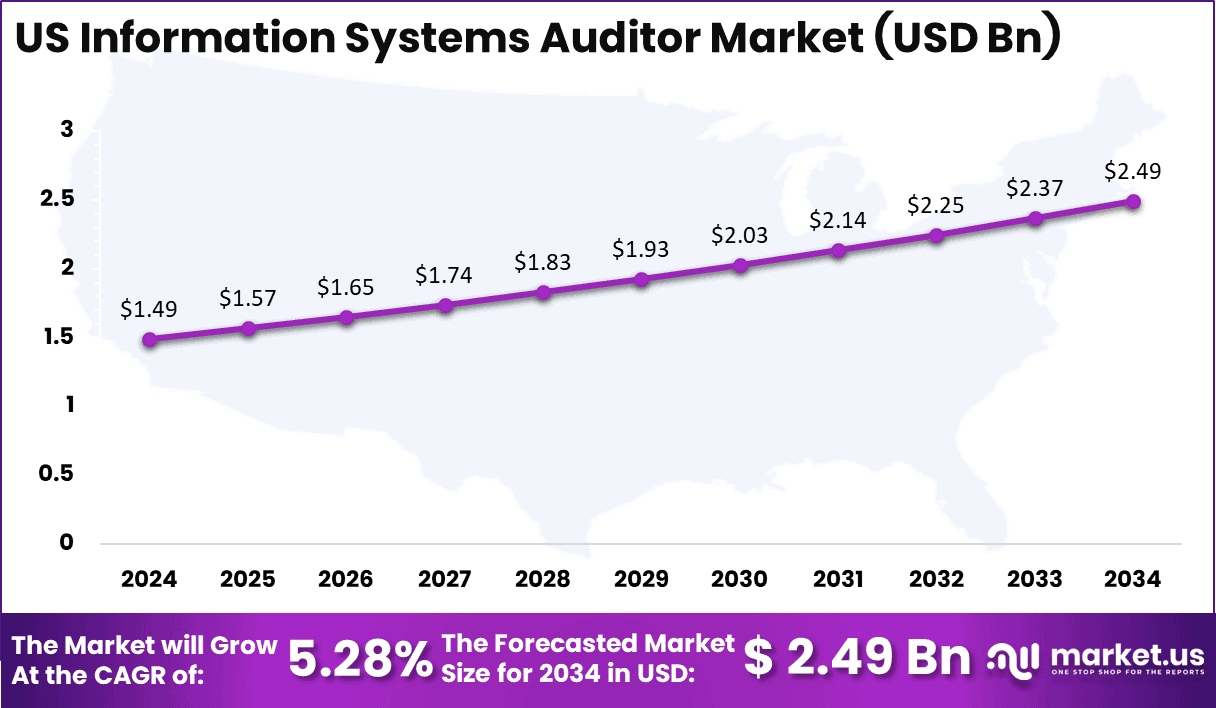
The US Information Systems Auditor Market is valued at USD 1.49 billion in 2024 and is projected to reach USD 2.49 billion by 2034, expanding at a CAGR of 5.28%. This steady growth is driven by rising cybersecurity threats, stricter data protection laws, and expanding adoption of digital auditing tools across enterprises. Increased regulatory scrutiny from bodies such as the SEC and FTC is also strengthening demand for independent IT and financial system audits.
Key Regions and Countries
North America
- US
- Canada
Europe
- Germany
- France
- The UK
- Spain
- Italy
- Rest of Europe
Asia Pacific
- China
- Japan
- South Korea
- India
- Australia
- Rest of APAC
Latin America
- Brazil
- Mexico
- Rest of Latin America
Middle East and Africa
- GCC
- South Africa
- Rest of MEA
Market Dynamics
Drivers
| Driver | (~) % Impact on CAGR Forecast | Geographic Relevance | Impact Timeline |
|---|---|---|---|
| Cyber-resilience audit mandates | +0.90% | European Union, United Kingdom, North America, Asia-Pacific | Short term (2 years or less) |
| Cloud control assurance demand | +0.60% | Global, led by North America and Western Europe | Short term (2 years or less) |
| Corporate cyber disclosure accountability | +0.50% | United States and cross-listed issuers | Short term (2 years or less) |
| AI governance implementation | +0.40% | European Union and multinational enterprises | Medium term (2 to 4 years) |
| Identity architecture complexity | +0.25% | Global digital enterprises | Medium term (2 to 4 years) |
| Public-sector digital modernization | +0.15% | Asia-Pacific, Middle East, Europe, North America | Medium term (2 to 4 years) |
Cyber-resilience audit mandates
Regulatory requirements are turning cybersecurity assurance from a discretionary activity into an ongoing compliance need. The EU set 17 October 2024 as the NIS2 transposition deadline, while infringement procedures were opened against 23 member states in November 2024. DORA became applicable on 17 January 2025 across 21 categories of financial entities.
In the US, the SEC reiterated in 2024 that material cyber incidents generally require Form 8-K disclosure within 4 business days of determining materiality. These requirements are expected to support recurring demand for readiness reviews, ICT-register validation, control testing, and remediation services.
A forecast sensitivity assigns approximately +0.90 percentage points to the market’s 6.40% baseline CAGR as providers shift from annual audits toward continuous compliance engagements, while also investing in jurisdiction-specific testing frameworks and regulatory expertise.
Restraints
| Restraint | (~) % Impact on CAGR Forecast | Geographic Relevance | Impact Timeline |
|---|---|---|---|
| Internal audit budget compression | -0.70% | North America, Europe, public sector and mid-market enterprises | Short term (2 years or less) |
| Lengthy procurement approval cycles | -0.45% | Global regulated enterprises and government agencies | Short term (2 years or less) |
| Data-localization service barriers | -0.35% | China, India, Middle East, European Union | Medium term (2 to 4 years) |
| Fragmented credential recognition | -0.25% | Cross-border and emerging markets | Medium term (2 to 4 years) |
| Professional liability cost escalation | -0.20% | North America, United Kingdom, Australia | Medium term (2 to 4 years) |
| Approved-vendor panel consolidation | -0.15% | Large global enterprises | Short term (2 years or less) |
Internal audit budget compression
Audit demand is rising faster than available budgets. The Institute of Internal Auditors reported that functions facing budget cuts increased from 11% in 2024 to 19% in 2025, while those receiving budget increases declined from 34% to 23%.
Cybersecurity and IT already account for around 20% of audit effort, limiting capacity for additional specialist reviews. This pressure was reinforced by restrictive financing conditions and global growth of only 2.70% in 2025, with similarly weak growth expected in 2026.
These conditions could delay around 8% to 12% of discretionary information-systems audits by at least 2 planning quarters, creating an estimated -0.70 percentage-point drag on market CAGR. Providers may also face longer sales cycles, greater pricing pressure, and slower investment in hiring and professional certifications as clients defer non-critical audit engagements.
Challenges
| Challenge | (~) % CAGR Friction Drag | Geographic Relevance | Mitigation Horizon |
|---|---|---|---|
| Specialized auditor talent shortage | -0.65% | Global, acute in North America, Europe, and Asia-Pacific | Long term (4 years or more) |
| Evidence schema fragmentation | -0.40% | Global cloud and platform ecosystems | Medium term (2 to 4 years) |
| Legacy-hybrid control mapping | -0.35% | Banking, government, healthcare and manufacturing | Long term (4 years or more) |
| Rapid threat-pattern change | -0.25% | Global digital enterprises | Long term (4 years or more) |
| Cross-jurisdiction quality consistency | -0.20% | Multinational audit networks and regional partnerships | Medium term (2 to 4 years) |
| Audit-trail data quality | -0.15% | Global, especially decentralized enterprises | Medium term (2 to 4 years) |
Specialized auditor talent shortage
A limited pool of professionals with audit, cybersecurity, cloud, and regulatory expertise remains a key challenge. ISC2 estimated a global cybersecurity workforce of 5.50 million in 2024, alongside a 4.80 million workforce gap that widened by 19% year over year, while the active workforce grew only 0.10%.
ISACA also found that 55% of cybersecurity teams were understaffed, 65% had unfilled roles, and 59% reported major soft-skill gaps. The Institute of Internal Auditors reported that nearly 70% of chief audit executives recruited for new or vacant roles during 2024, while cybersecurity and IT represented about 17% of audit-plan effort.
These shortages can delay project starts by around 4 to 8 weeks and raise specialist labor costs by 8% to 12%, creating an estimated -0.65 percentage-point drag unless firms expand training pipelines and shared delivery centers over a 4-year-or-longer period.
Opportunities
| Opportunity | (~) % Potential CAGR Upside | Geographic Relevance | Execution Window |
|---|---|---|---|
| Continuous assurance subscriptions | +0.60% | Global cloud-native and regulated enterprises | Medium term (2 to 4 years) |
| Operational technology assurance | +0.40% | North America, Europe, Middle East, industrial Asia | Medium term (2 to 4 years) |
| Post-quantum readiness audits | +0.35% | Government, finance, telecom and critical infrastructure | Long term (4 years or more) |
| Sustainability data-control assurance | +0.30% | European Union and multinational supply chains | Medium term (2 to 4 years) |
| Regional boutique roll-ups | +0.20% | Fragmented emerging and mid-market regions | Medium term (2 to 4 years) |
| Cyber-insurance control attestations | +0.15% | North America, United Kingdom, Europe, Australia | Short term (2 years or less) |
Continuous assurance subscriptions
Continuous auditing remains a future opportunity because most information-systems audits are still delivered as periodic projects. ISACA highlights automated evidence collection as a way to improve audit speed and reduce preparation costs.
The Institute of Internal Auditors reports that 60% of audit functions use outsourcing or co-sourcing, but only 32% of the smallest functions do so, while more than half of audit functions operate with fewer than 10 full-time employees.
SOC 2 examinations also cover up to 5 trust-services categories, creating repeatable areas suitable for continuous assurance. Automating evidence collection for around 30% to 50% of repeatable controls could reduce labor hours per control test by approximately 20% to 35%.
Subscription-based delivery could also improve provider gross margins by around 5 to 8 percentage points after integration costs are recovered, supporting potential CAGR upside of approximately +0.60 percentage points as firms invest in secure integrations, exception management, and human-reviewed assurance workflows.
Key Players Analysis
Tier 1 market leaders include Accenture, Deloitte, IBM, Capgemini, KPMG, Ernst and Young, Hewlett Packard Enterprise, and Cognizant. Their global delivery networks let them combine information system audits with cloud, cyber, data, and managed services. Accenture generated USD 69.7 billion in fiscal 2025 revenue, while its cybersecurity business reached USD 10 billion.
Deloitte reported USD 70.5 billion in fiscal 2025 global revenue, up 4.9% in US dollar terms. KPMG generated USD 39.8 billion, with audit revenue increasing 6.0%. These firms use large technology teams and industry practices to serve global banks, healthcare groups, governments, and listed companies.
IBM provides technology and assurance support through its consulting, software, and infrastructure operations. IBM generated USD 21.1 billion in 2025 consulting revenue and invested USD 8.3 billion in research and development, an increase of 11.2%. Capgemini generated EUR 22.5 billion in 2025 revenue and deployed nearly EUR 4.6 billion of capital. It allocated EUR 3.8 billion to acquisitions, led by WNS.
Tier 2 challengers include BDO International, Crowe, McKinsey and Company, RSM International, Grant Thornton, and Protiviti. These firms compete through regional relationships, internal audit outsourcing, risk consulting, and specialist compliance services. Grant Thornton, BDO, Crowe, and RSM focus strongly on mid-market organizations that need recognized audit methods without the scale of a Tier 1 engagement.
Top Key Players in the Market
- Capgemini
- Accenture
- IBM
- KPMG
- BDO International
- Crowe
- Hewlett Packard Enterprise
- McKinsey and Company
- Ernst and Young
- Deloitte
- RSM International
- Grant Thornton
- Protiviti
- Cognizant
Recent Developments
- In February 2025, IBM completed its USD 6.4 billion acquisition of HashiCorp, adding infrastructure automation, security, and multi-cloud lifecycle management capabilities.
- In July 2025, Hewlett Packard Enterprise completed its USD 14 billion acquisition of Juniper Networks and formed a larger AI-native networking business.
- In October 2025, Capgemini completed its USD 3.3 billion cash acquisition of WNS after pricing EUR 4.0 billion in bonds to finance the transaction and other corporate needs.
- In December 2025, IBM agreed to acquire Confluent for USD 31 per share in cash, representing an enterprise value of USD 11 billion.
- In June 2026, Accenture agreed to acquire a majority stake in Dragos and 100% of runZero and NetRise at a combined enterprise value of about USD 4.175 billion.
Report Scope
| Report Features | Description |
|---|---|
| Market Value (2024) | USD 4.2 billion |
| Forecast Revenue (2034) | USD 7.8 billion |
| CAGR (2025-2034) | 6.4% |
| Base Year for Estimation | 2024 |
| Historic Period | 2020-2023 |
| Forecast Period | 2025-2034 |
| Report Coverage | Revenue Forecast, Market Dynamics, Competitive Landscape, Recent Developments |
| Segments Covered | By Service Type (Information Security Audits, Compliance Audits, Operational Audits, Risk Assessment Audits); By Application (Financial Services, Healthcare, Government, Information Technology); By Deployment Type (On-Premise, Cloud-Based); By End Use (Large Enterprises, Small Enterprises, Medium Enterprises) |
| Regional Analysis | North America – US, Canada; Europe – Germany, France, The UK, Spain, Italy, Rest of Europe; Asia Pacific – China, Japan, South Korea, India, Australia, Singapore, Rest of APAC; Latin America – Brazil, Mexico, Rest of Latin America; Middle East & Africa – GCC, South Africa, Rest of MEA |
| Competitive Landscape | Capgemini, Accenture, IBM, KPMG, BDO International, Crowe, Hewlett Packard Enterprise, McKinsey and Company, Ernst and Young, Deloitte, RSM International, Grant Thornton, Protiviti, Cognizant |
| Customization Scope | Customization for segments, region/country-level will be provided. Moreover, additional customization can be done based on the requirements. |
| Purchase Options | We have three licenses to opt for: Single User License, Multi-User License (Up to 5 Users), Corporate Use License (Unlimited Users and Printable PDF) |