Report Overview
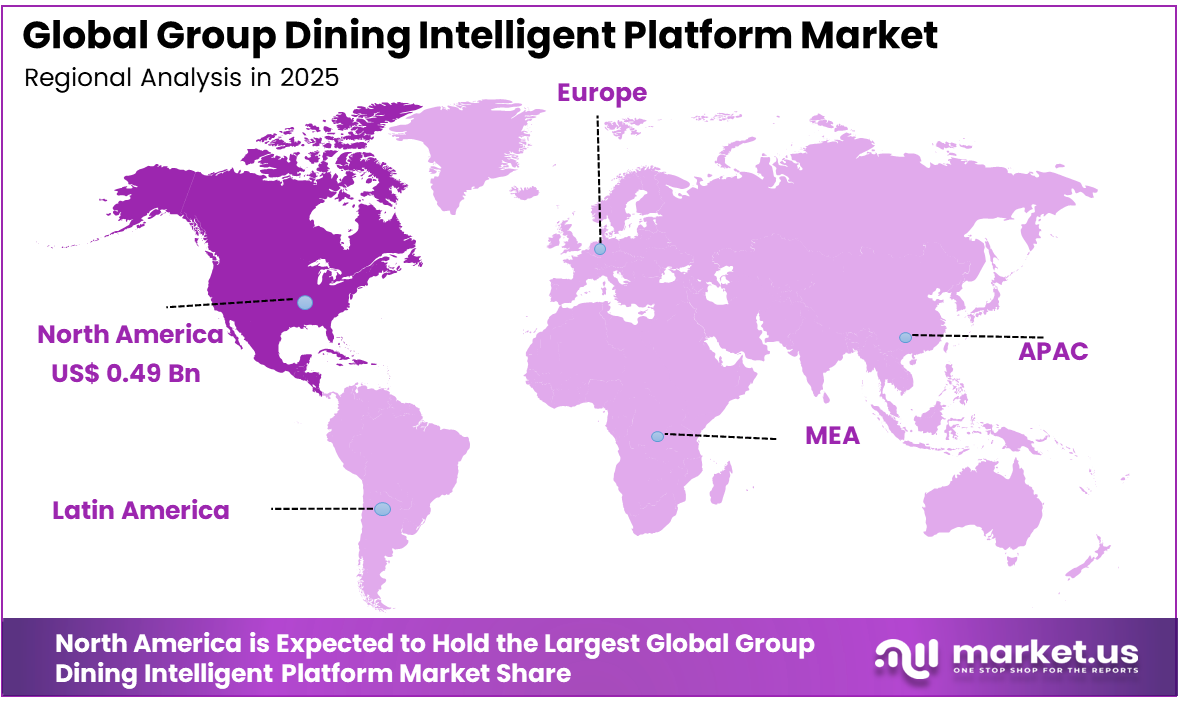
The Global Group Dining Intelligent Platform Market size is expected to be worth around USD 9.13 billion by 2035, from USD 1.25 billion in 2025, growing at a CAGR of 22.0% during the forecast period from 2025 to 2035. North America held a dominant market position, capturing more than a 39.3% share, holding USD 0.49 billion in revenue.
Group Dining Intelligent Platform refers to a digital system that helps manage food ordering, reservations, and payments for groups in a coordinated way. It connects diners and service providers through one interface, allowing smoother planning, faster service, and better control over large orders, events, and shared dining experiences across workplaces and venues.
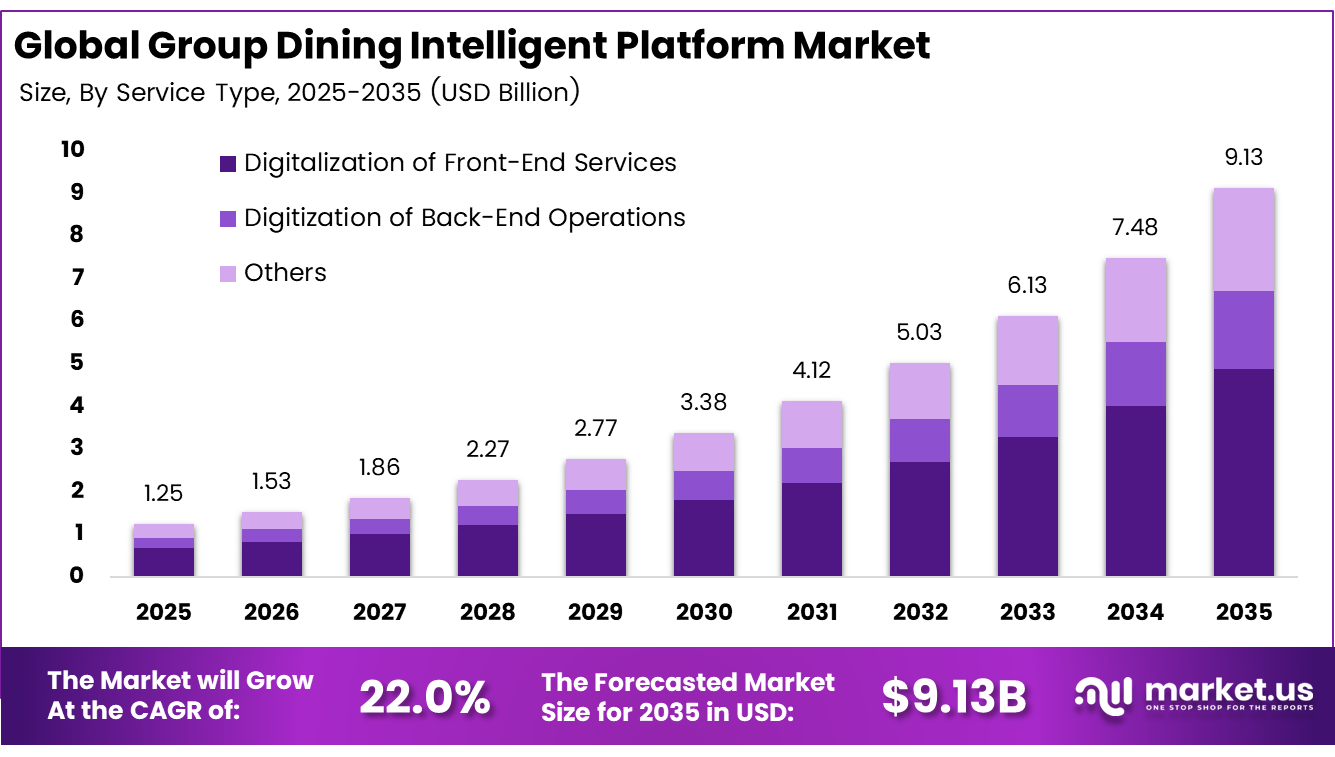
The growth of group dining platforms is supported by rising demand for quick service, as workplaces require faster meal coordination during meetings and events. Around 77% of food service providers now depend on digital tools to manage orders efficiently. Hybrid work culture further supports adoption, allowing both remote and office teams to participate in shared dining experiences seamlessly.
The market for Group Dining Intelligent Platform is driven by the need for faster and more organized meal coordination in workplaces, events, and social gatherings. Businesses and venues are adopting digital tools to simplify group ordering, reduce waiting time, and improve service accuracy. Growing use of mobile apps, digital payments, and data-based planning is further supporting adoption across modern dining environments.
Demand is primarily driven by corporate teams and event planners managing 10-50 person gatherings with minimal complexity. Users increasingly expect features such as real-time seat tracking and smooth payment systems. With only 13% of restaurants offering complete digital group solutions, a clear gap exists, encouraging the adoption of platforms that can anticipate user needs through booking data.
For instance, in October 2025, Beijing DBN Technology Group launched an enterprise-grade group dining solution for factory canteens, serving 300,000 daily meals. Partnering with manufacturing giants, they reduced operational costs by 22% through automated inventory and shift-based meal planning.
Key Takeaway
- In 2025, the Digitalization of Front-End Services segment held a dominant market position, capturing a 53.6% share of the Global Group Dining Intelligent Platform Market.
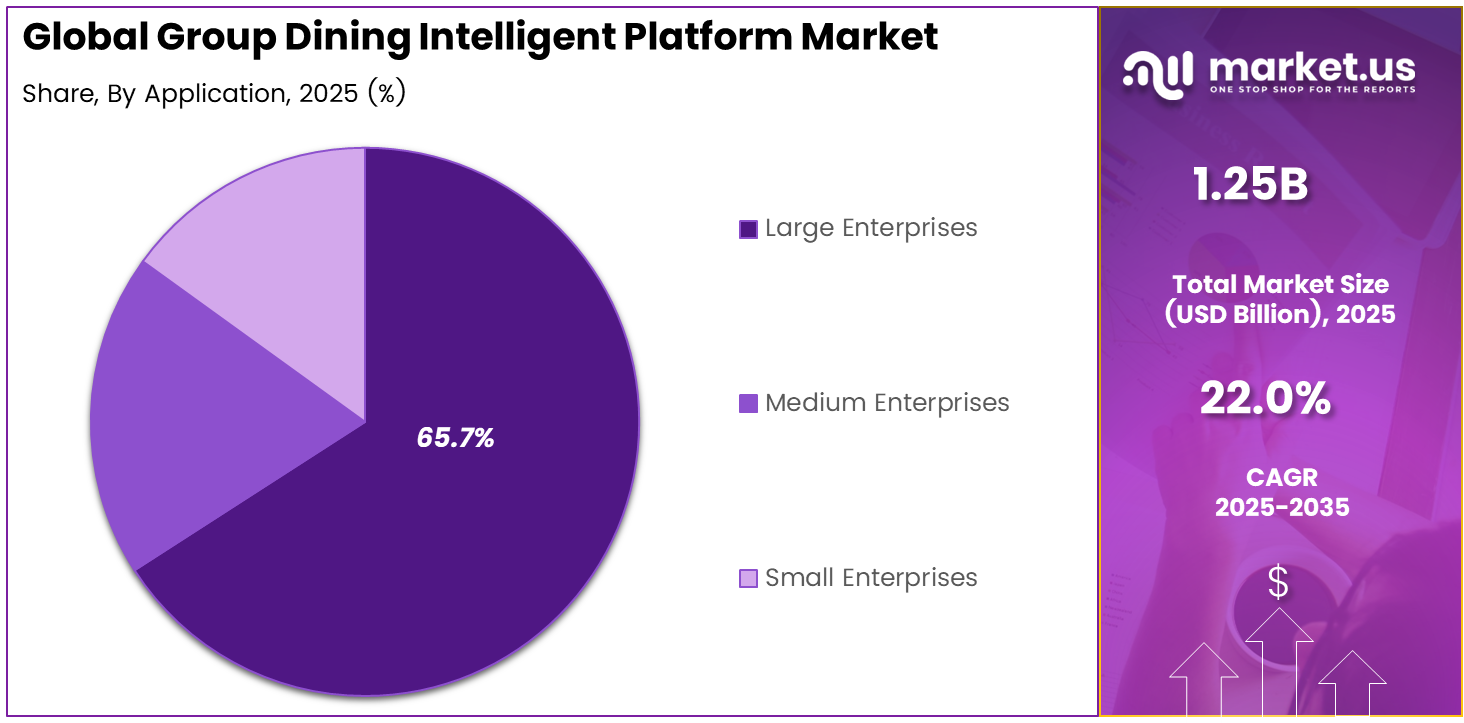
- In 2025, the Large Enterprises segment held a dominant market position, capturing a 65.7% share of the Global Group Dining Intelligent Platform Market.
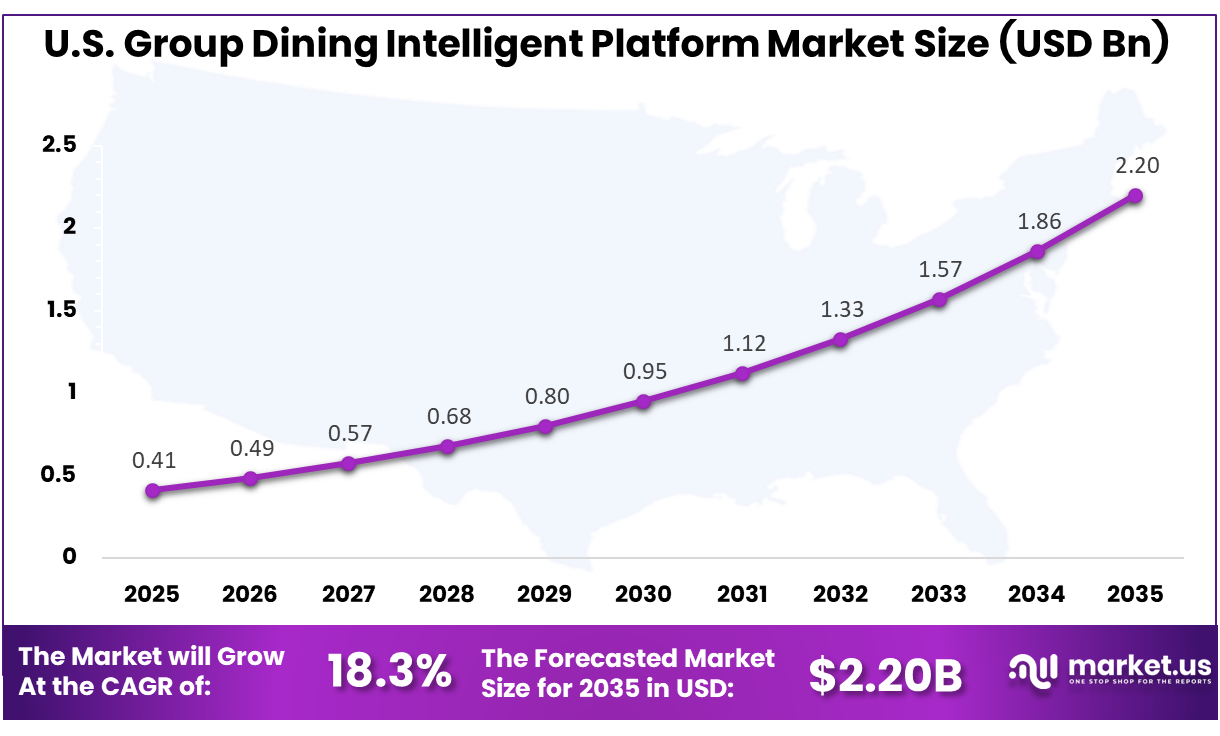
- The U.S. Group Dining Intelligent Platform Market was valued at USD 0.41 Billion in 2025, with a robust CAGR of 18.3%.
- In 2025, North America held a dominant market position in the Global Group Dining Intelligent Platform Market, capturing more than a 39.3% share.
Role of Generative AI
Generative AI supports group dining platforms by creating menus tailored to shared preferences. It studies past orders and suggests suitable dishes, improving satisfaction. Around 65% of diners prefer venues offering personalized choices, showing how data-driven recommendations are becoming essential for enhancing group dining experiences and decision-making.
The technology also improves operational planning by predicting demand and aligning inventory. It evaluates ordering patterns to reduce excess preparation and improve efficiency. Nearly 70% of restaurants now use such systems to refine food selection processes, allowing better cost control while maintaining service quality and minimizing unnecessary waste across operations.
Investment and Business Benefits
Investment interest is focused on platforms integrating AI-driven personalization, such as meal suggestions based on dietary preferences. Growth potential is strong in the travel and event sectors, especially where MICE activities generate hundreds of bookings each year. Strategic partnerships with payment providers also create recurring revenue streams through transaction-based models and service integration.
Operational efficiency improves significantly as these platforms enable accurate portion planning, reducing food waste by 30% or more. Customer satisfaction increases due to smoother service and personalized dining experiences. Over time, collected data helps businesses understand user behavior, allowing better planning for repeat events and strengthening long-term customer engagement and retention.
Regional Analysis
In 2025, North America held a dominant market position in the Global Group Dining Intelligent Platform Market, capturing more than a 39.3% share, holding USD 0.49 billion in revenue. This dominance is due to the strong presence of digitally advanced foodservice networks, high adoption of workplace meal technology, and rising demand for organized group dining across offices, events, and institutions. North America also benefits from better payment infrastructure, wider use of mobile ordering, and faster adoption of AI-based service tools. These factors help dining operators improve speed, reduce manual effort, and deliver more reliable group dining experiences across the region.
For instance, in February 2025, ChowNow from Los Angeles, California, enhanced North American group dining leadership with new AI-driven menu personalization tools for corporate clients. These features optimize catering orders by predicting group preferences, reducing waste by 15%, and boosting order accuracy. ChowNow’s direct restaurant focus solidifies its position in efficient B2B food service.
U.S. Group Dining Intelligent Platform Market Size
The market for Group Dining Intelligent Platform within the U.S. is growing tremendously and is currently valued at USD 0.41 billion; the market has a projected CAGR of 18.3%. The market is growing strongly due to rising demand for faster workplace meal coordination, digital ordering convenience, and smoother event dining management. Businesses are adopting these platforms to reduce manual effort, improve service accuracy, and support group bookings across offices and venues. Growth is also supported by wider use of mobile payments, self-service tools, and data-based planning that helps dining operators serve groups more efficiently.
For instance, in March 2025, ezCater, based in Boston, Massachusetts, strengthened U.S. dominance in group dining platforms by partnering with Dave’s Hot Chicken to launch their first catering program across 200+ locations. This move expanded ezCater’s restaurant network, making spicy Nashville-style chicken accessible for corporate events nationwide. The platform’s seamless ordering tech continues to lead workplace catering innovation.
Key Regions and Countries
North America
- US
- Canada
Europe
- Germany
- France
- The UK
- Spain
- Italy
- Russia
- Netherlands
- Rest of Europe
Asia Pacific
- China
- Japan
- South Korea
- India
- Australia
- Singapore
- Thailand
- Vietnam
- Rest of APAC
Latin America
- Brazil
- Mexico
- Rest of Latin America
Middle East & Africa
- South Africa
- Saudi Arabia
- UAE
- Rest of MEA
Service Type Analysis
In 2025, the Digitalization of Front-End Services segment held a dominant market position, capturing a 53.6% share of the Global Group Dining Intelligent Platform Market. This dominance is due to the growing use of digital tools that simplify customer interaction at the front end. Features like mobile ordering, self-service kiosks, and online reservations improve speed and reduce errors. These systems help restaurants manage large group requests more smoothly and deliver consistent service experiences.
Digital front-end solutions also improve customer engagement by offering easy navigation and faster ordering options. They reduce dependency on manual processes and allow staff to focus on service quality. Over time, this leads to better operational flow, improved customer satisfaction, and stronger repeat usage across group dining environments.
For instance, in March 2025, ChowNow enhanced its business-facing tablet app with a refreshed interface, faster sold-out item management, and improved order notifications for restaurants. These updates streamline how individual venues handle group orders and delivery requests, helping them keep up with digital demand while reducing friction in the front-end ordering flow for corporate and office-based customers.
Application Analysis
In 2025, the Large Enterprises segment held a dominant market position, capturing a 65.7% share of the Global Group Dining Intelligent Platform Market. This dominance is due to the high volume of group dining needs within large organizations, where managing meals for teams and events requires structured systems. Enterprises prefer platforms that can handle bulk orders, scheduling, and centralized payments, ensuring smooth coordination across departments and multiple office locations.
Large enterprises also benefit from better data tracking and integration with internal systems. These platforms help manage recurring bookings, employee preferences, and event planning with ease. As operations scale, such tools support efficiency, reduce manual effort, and improve overall dining management across corporate environments.
For instance, in September 2025, Compass Group stepped up its digital transformation by embedding AI-driven planning and analytics tools into its foodservice operations for large clients. The focus is on tailoring menu experiences and optimizing order flows for big employers and institutions, which helps these organizations manage complex group dining needs while improving user satisfaction and operational efficiency.
Key Market Segments
By Service Type
- Digitalization of Front-End Services
- Digitization of Back-End Operations
- Others
By Application
- Large Enterprises
- Medium Enterprises
- Small Enterprises
Emerging Trends
Self-service ordering through mobile apps and kiosks is becoming widely accepted among group diners. These tools allow faster selection without waiting for staff assistance. Around 60% of users report quicker dining experiences, and businesses adopting these systems observe improved service speed and higher customer satisfaction during busy hours.
Voice-enabled ordering is also gaining attention as a convenient option for large groups. Users can place orders through smart devices, reducing complexity in coordination. More than 55% of diners are experimenting with this feature, especially during social gatherings, as it offers a simple and engaging way to manage group orders efficiently.
Growth Factors
Online booking systems are driving growth by making group reservations easier and more structured. Platforms that integrate booking with ordering help businesses manage demand effectively. About 75% of diners now prefer booking in advance, which supports better planning, improved seat utilization, and consistent customer flow across peak and non-peak hours.
Workforce shortages continue to push the adoption of digital platforms that automate routine operations such as order taking and payment handling. These systems reduce pressure on staff and improve service consistency. Around 68% of restaurant owners report that such tools simplify daily operations and allow teams to focus more on customer engagement.
Market Dynamics
Drivers - Rising Demand for Workplace Efficiency
Workplaces are looking for better ways to manage group meals during meetings, training sessions, and office events. Intelligent dining platforms help reduce confusion by bringing ordering, scheduling, and payment into one system. This improves coordination and saves time for both employees and food service teams.
The need for efficiency is becoming stronger as companies aim to simplify daily operations. These platforms help avoid delays, reduce manual effort, and make meal planning more organized. As office dining becomes more structured, demand is rising for tools that support smooth and reliable group service.
For instance, in March 2026, ezCater rolled out its yearly workplace cafeteria report, showing how offices are ditching fixed cafeterias for flexible meal options. Teams now order group lunches through their platform, saving time on planning and boosting daily productivity. This move helps staff return to offices more often by making food access simple and quick.
Restraint - High Setup Costs for New Systems
One key restraint is the high initial cost of setting up new systems. Restaurants and dining operators often need to spend on software, hardware, integration, and staff training before the platform starts delivering value. For many smaller operators, this decides to adopt more difficult and slower.
The concern is not only about purchase cost but also about ongoing maintenance and upgrades. Businesses may worry about disruptions during implementation or extra expenses linked to system support. When budgets are tight, many operators choose to delay investment even if the long-term benefits are clear.
For instance, in April 2026, Sodexo faced pushback at a university after a long contract ended, with many pointing to outdated systems and high renewal costs. Switching providers highlighted the expense of upgrading tech for group dining across campuses. Staff noted that initial investments in new platforms often strain budgets without instant fixes.
Opportunities - Expansion in Meetings and Events
Meetings and events create a strong opportunity for intelligent group dining platforms. Corporate gatherings, conferences, training programs, and private events all require smooth meal coordination. Platforms that support advanced booking, menu selection, and group order handling are becoming more useful in these settings.
As event organizers seek better service quality and less operational stress, digital dining tools are gaining wider interest. They help manage timing, guest preferences, and order accuracy in a more controlled way. This makes the meetings and events segment an attractive area for future platform expansion.
For instance, in June 2025, Compass Group opened a large central kitchen near Gurgaon to cater to bigger events and corporate gatherings. It streamlines handling special requests for group menus, making it easier for planners to book meals on short notice. This setup draws in more hybrid meeting organizers looking for reliable scale.
Challenges - Difficulty in System Adoption
Many businesses face challenges when trying to adopt new digital dining systems. Staff may be unfamiliar with the platform, and daily routines may need to change. This can create hesitation, especially in operations where employees are already managing busy service hours and limited internal support.
Adoption also becomes difficult when the platform does not fit easily into existing workflows. Problems with training, system understanding, or employee resistance can reduce the value of the investment. For long-term success, businesses need simple tools, practical onboarding, and clear support during the transition period.
For instance, in April 2026, ZeroCater dealt with client feedback on training gaps when launching updated apps for workplace catering. Staff took time to learn the interface for bulk orders, causing minor delays at first. Resistance came from those comfortable with phone bookings, needing extra support to build trust.
Key Players Analysis
One of the leading players, in March 2026, Sodexo partnered with a major university network to deploy its intelligent cafeteria platform across 15 new campuses. The system integrates menu personalization and waste analytics, reducing food waste by 25% while enhancing student satisfaction through predictive demand forecasting.
Top Key Players in the Market
- ezCater
- Sodexo
- Compass Group
- ChowNow
- Hungry
- ZeroCater
- Meican
- Beijing DBN Technology Group
- Other Major Players
Recent Developments
- In January 2026, ezCater rolled out AI-powered group ordering analytics, helping corporate offices streamline bulk meal planning with real-time dietary tracking. This upgrade cut ordering errors by 30% for large teams and boosted platform adoption among Fortune 500 clients, solidifying their lead in U.S. workplace dining solutions.
- In November 2025, ChowNow launched a B2B group dining module tailored for event planners, featuring seamless multi-vendor coordination. Early adopters reported 40% faster order fulfillment for conferences, positioning ChowNow as a go-to platform for professional gatherings.
Report Scope
| Report Features | Description |
|---|---|
| Market Value (2025) | USD 1.25 Billion |
| Forecast Revenue (2035) | USD 9.13 Billion |
| CAGR (2026-2035) | 22.0% |
| Base Year for Estimation | 2025 |
| Historic Period | 2020-2024 |
| Forecast Period | 2026-2035 |
| Report Coverage | Revenue Forecast, Market Dynamics, Competitive Landscape, Recent Developments |
| Segments Covered | By Service Type (Digitalization of Front-End Services, Digitization of Back-End Operations, Others), By Application (Large Enterprises, Medium Enterprises, Small Enterprises) |
| Regional Analysis | North America (US and Canada), Europe (Germany, France, The UK, Spain, Italy, and Rest of Europe), Asia Pacific (China, Japan, South Korea, India, Australia, and Rest of APAC), Latin America (Brazil, Mexico, and Rest of Latin America), Middle East & Africa (GCC, South Africa, and Rest of MEA) |
| Competitive Landscape | ezCater, Sodexo, Compass Group, ChowNow, Hungry, ZeroCater, Meican, Beijing DBN Technology Group, Other Major Players |
| Customization Scope | Customization at the segment and region/country levels will be provided. Moreover, customization can be tailored to the requirements. |
| Purchase Options | We have three licenses to opt for: Single User License, Multi-User License (Up to 5 Users), Corporate Use License (Unlimited Users and Printable PDF) |