


Global Sodium Methyl Paraben Market Size, Share, And Business Benefits By Type (Cosmetic Grade, Food Grade, Pharma Grade, Others), By Application (Food Industry, Pharmaceutical Industry, Textile Industry, Daily Industrial Products, Others), By Region, and Companies - Industry Segment Outlook, Market Assessment, Competition Scenario, Trends, and Forecast 2025-2034
- Published date: October 2025
- Report ID: 161537
- Number of Pages: 204
- Format:
-
keyboard_arrow_up
Quick Navigation
Report Overview
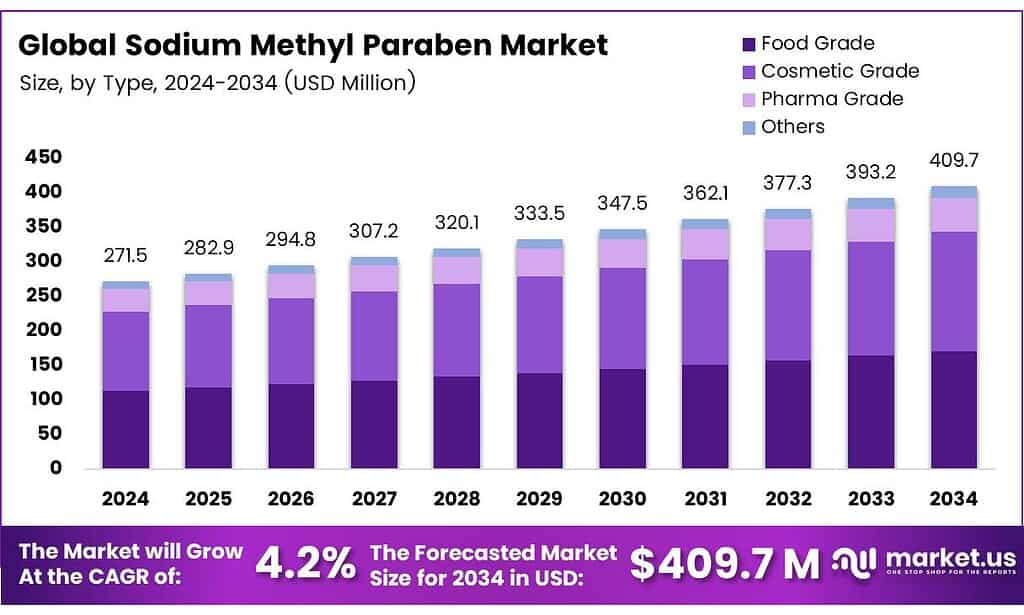
The Global Sodium Methyl Paraben Market size is expected to be worth around USD 409.7 Million by 2034, from USD 271.5 Million in 2024, growing at a CAGR of 4.2% during the forecast period from 2025 to 2034.
Methylparaben, with the chemical formula C8H7NaO3 for its sodium salt form, has been widely used as a preservative in the food, cosmetic, and pharmaceutical industries for over 50 years. It can also be found naturally in fruits such as blueberries, where it exhibits antimicrobial properties. As the sodium salt of methylparaben, it serves as an effective preservative due to its ability to inhibit microbial growth.
When applied topically or ingested, methylparaben is completely absorbed through the skin or digestive system. Once absorbed, it is hydrolyzed into para-hydroxybenzoic acid, and its metabolites are rapidly excreted in the urine without evidence of accumulation. Methylparaben is included on the FDA’s Generally Regarded as Safe (GRAS) list, reflecting its low risk when used as intended.
The EU’s SCCS deems methylparaben safe in cosmetics at 0.4% (as acid) or 0.8% with other parabens, guiding global formulators. JECFA sets a 0–10 mg/kg body weight ADI for methylparaben (E218) and ethylparaben (E214) in food. The U.S. FDA allows methylparaben in cosmetics without pre-market approval and as GRAS in animal feed up to 0.1%, ensuring North American compliance.
Acute toxicity studies in animals have shown that methylparaben is practically non-toxic via oral and injectable routes. It is not teratogenic, carcinogenic, mutagenic, or embryotoxic. While generally non-irritating when used topically, some individuals may experience cross-sensitivity, particularly those allergic to local anesthetics metabolized to para-aminobenzoic acid. Additionally, cases of local contact dermatitis have been reported in sensitive individuals.
All parabens, including methylparaben, share a structural similarity to estrogen. Studies in the early 2000s detected traces of parabens in breast tumors, but no conclusive evidence has linked parabens to breast cancer. The Cosmetic Ingredient Review (CIR) evaluated the safety of methylparaben, propylparaben, and butylparaben in 1984, concluding they are safe for use in cosmetic products at concentrations up to 25%. In practice, parabens are typically used at much lower levels, ranging from 0.01% to 0.3%.
Key Takeaways
- The Global Sodium Methyl Paraben Market is projected to grow from USD 271.5 million in 2024 to USD 409.7 million by 2034, at a CAGR of 4.2%.
- Cosmetic Grade held a 42.2% market share in 2024, valued for its antimicrobial properties in creams, lotions, and shampoos.
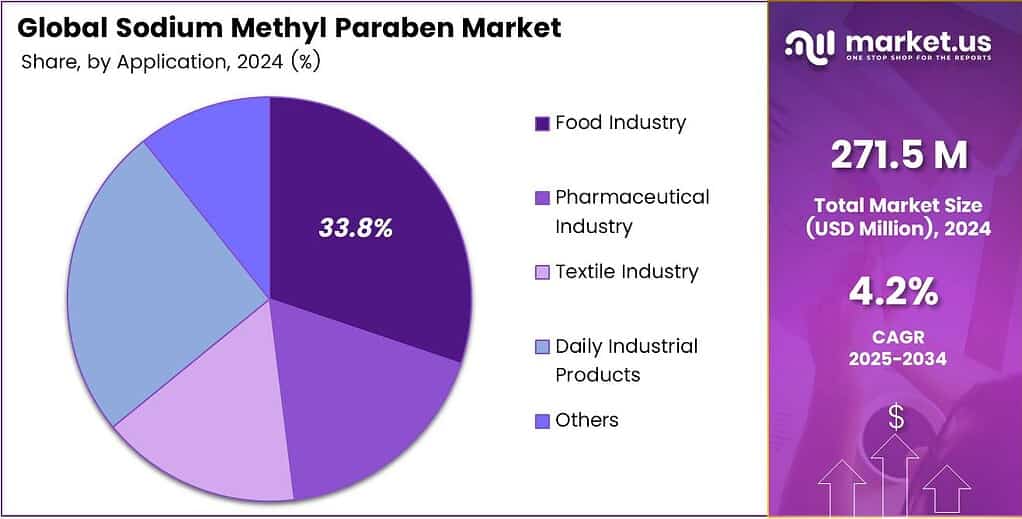
- The Food Industry led applications in 2024 with a 33.8% share, driven by its use in bakery items, sauces, and beverages.
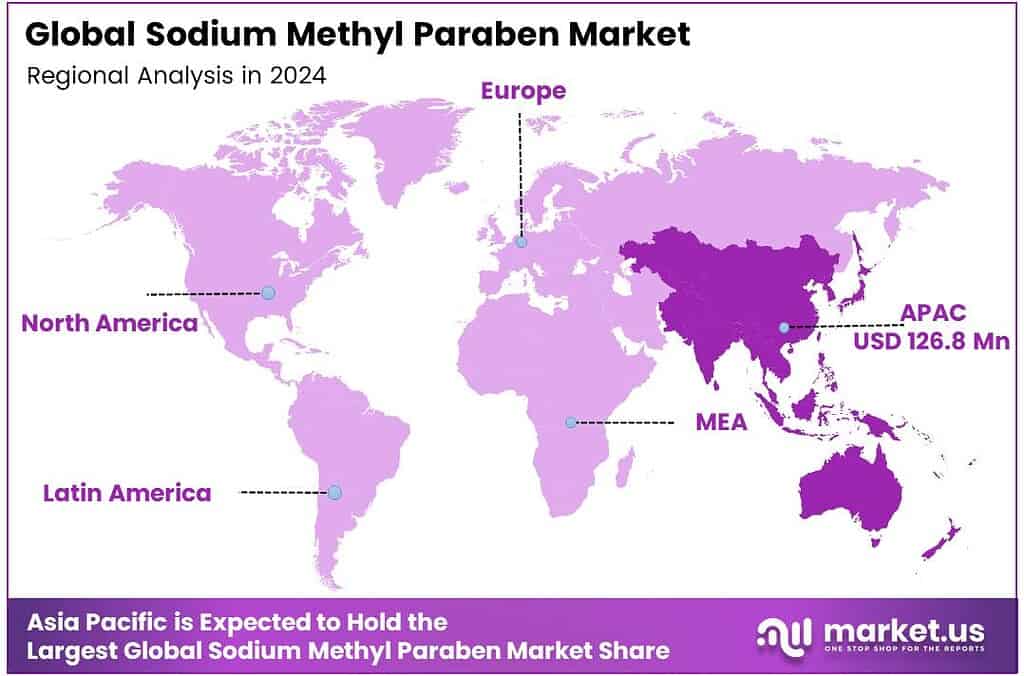
- Asia Pacific dominated the market in 2024 with a 46.8% share, valued at USD 126.8 million, led by strong demand in China, India, Japan, and South Korea.
By Type Analysis
Cosmetic Grade dominates with 42.2% due to its high use in skincare and beauty formulations.
In 2024, Cosmetic Grade held a dominant market position in the By Type analysis segment of the Sodium Methyl Paraben Market, with a 42.2% share. This grade is widely preferred for its excellent antimicrobial activity and compatibility with creams, lotions, and shampoos. It ensures product safety by preventing microbial contamination and extending shelf life.
The Food Grade segment plays a critical role in processed and packaged food preservation. Its ability to inhibit mold and yeast growth makes it a suitable additive for bakery, confectionery, and beverage products. Rising demand for extended shelf-life food products and growing consumption of packaged snacks are propelling steady demand for sodium methyl paraben in this category.
The Pharma Grade type is mainly used in pharmaceutical formulations such as syrups, ointments, and creams due to its stable antibacterial profile. It ensures product consistency and safety, particularly in multi-dose preparations. The ongoing expansion of the healthcare sector and increased generic drug production enhance the pharmaceutical-grade usage outlook.
By Application Analysis
Food Industry dominates with 33.8% driven by its strong usage in packaged and ready-to-eat products.
In 2024, the Food Industry held a dominant market position in the By Application analysis segment of the Sodium Methyl Paraben Market, with a 33.8% share. It is extensively used in bakery items, sauces, and beverages to prevent bacterial spoilage. Increasing global demand for convenient packaged foods, along with tighter food safety standards, drives this segment’s significant share across major economies.
The Pharmaceutical Industry uses sodium methyl paraben as a preservative in topical creams, injectables, and oral syrups. Its chemical stability and broad antimicrobial efficacy maintain drug safety throughout shelf life. The rise in chronic diseases and pharmaceutical manufacturing in emerging regions supports consistent market demand.
The Textile Industry segment utilizes sodium methyl paraben as an auxiliary chemical for stabilizing dyes and finishing solutions. It ensures preservation against microbial deterioration during storage. With expanding textile exports and industrial modernization, moderate but steady growth is observed in this segment.
The Daily Industrial Products category includes household and personal hygiene goods such as detergents, cleaners, and soaps. Sodium methyl paraben provides effective microbial resistance, maintaining product stability. Growing hygiene awareness post-pandemic sustains its relevance in daily-use products.
Key Market Segments
By Type
- Cosmetic Grade
- Food Grade
- Pharma Grade
- Others
By Application
- Food Industry
- Pharmaceutical Industry
- Textile Industry
- Daily Industrial Products
- Others
Drivers
Proven, rule-compliant preservation keeps everyday products safe
Sodium methyl paraben (the sodium salt of methylparaben) continues to be a workhorse preservative because it delivers broad-spectrum protection at very low use levels while fitting cleanly inside modern safety rules. Real-world formulations typically need only about 0.01–0.3% paraben to stop bacterial and mold growth—small doses that help keep creams, gels, shampoos, and syrups safe through shipping and consumer use.
That usage range is consistent with industry and regulator briefings in the U.S., where the FDA explains why parabens are widely used and how they protect both products and people. On the regulatory side, Europe’s independent Scientific Committee on Consumer Safety (SCCS) reconfirmed that methylparaben is safe in cosmetics up to 0.4% (and 0.8% when multiple parabens are combined).
Those clear caps make life easier for formulators: they can choose a tried-and-tested antimicrobial, add it within tight limits, and pass safety reviews. Scale also matters. The European cosmetics and personal-care market alone posted €104 billion in retail sales in 2024, a reminder that everyday hygiene and beauty categories remain huge.
Restraints
Tighter EU caps on longer-chain parabens spill over to brand policies
Even though methylparaben itself has a positive safety opinion, policy pressure on the broader paraben group still shapes buying and labeling decisions. In the EU, the Commission cut maximum levels for propyl- and butylparaben to 0.14% and banned their use in leave-on products intended for the nappy area of children under three.
Those changes, formalized via Commission Regulation (EU) No 1004/2014 and grounded in SCCS risk assessments, pushed many global brands to adopt simplified preservative systems or paraben-free claims, sometimes avoiding the whole class to keep messaging simple. The path of least resistance can be to phase down the entire family regardless of member-specific safety opinions.
Publications summarizing the EU actions consistently note the 0.14% cap for propyl/butyl and the baby-product restriction, changes that echoed globally through corporate standard-setting and retailer free-from lists. Regulators in the U.S. take a different stance. The FDA states it currently has no information showing parabens, as used in cosmetics, are unsafe, but multinational companies rarely maintain separate narratives by region.
Opportunity
Pharma & high-hygiene formats need reliable preservation with clear limits
A clear opening sits in regulated, high-hygiene product types, OTC dermal products, oral liquids, topical antibiotics, and certain syrups, where the cost of microbiological failure is high and regulators demand proven antimicrobial effectiveness. Here, sodium methyl paraben benefits from conservative, well-documented limits and decades of compatibility data.
Scientific and regulatory literature note that methylparaben in oral solutions is typically limited to around 0.15%, and pharmacopeial tests (e.g., antimicrobial effectiveness testing) give manufacturers a standardized way to validate preservation. That predictability lowers reformulation risk compared with newer systems that may need higher loadings or complex boosters.
Food and beverages provide a second wedge. Paraben salts, including E219, appear across Codex and legacy EU additive listings, with acceptable daily intake discussions from EFSA/JECFA (0–10 mg/kg bw/day for methyl/ethyl parabens). For shelf-stable, low-pH foods where a small, sodium methyl paraben remains a pragmatic tool, especially in emerging markets, upgrading cold-chain and packaging.
Trends
Lower-alkyl pivot: keep methyl, drop the rest, and document it
A visible reformulation trend is the pivot toward lower-alkyl parabens (methyl/ethyl) while trimming or eliminating longer-chain members. The science/regulation arc explains why: the SCCS reaffirmed methylparaben safe up to 0.4% (0.8% total esters), while propyl/butyl sit at 0.14% with added child-product restrictions in the EU.
Formulators thread the needle by keeping sodium methyl paraben often at 0.1–0.3% and pairing it with supportive hurdles (pH control, chelators) to meet antimicrobial-effectiveness tests. This approach preserves shelf life, avoids major texture or fragrance shifts, and fits documentation packages for audits.
Risk communication has also matured. FDA continues to explain why parabens are used and emphasizes the lack of evidence that they’re unsafe when used in cosmetics. Meanwhile, academic and review papers highlight that typical cosmetic concentrations are far below levels of toxicological concern, with allergic reactions uncommon.
Regional Analysis
Asia-Pacific leads with a 46.8% share and a USD 126.8 Million market value.
Asia-Pacific continues to dominate the global Sodium Methyl Paraben market, holding a commanding 46.2% share, valued at USD 126.8 million in 2024. The region’s leadership is strongly supported by its vast personal care, food processing, and pharmaceutical industries, especially in China, India, Japan, and South Korea, where large-scale manufacturing and export activities thrive.
Rapid urbanization and rising disposable incomes are creating greater consumption of cosmetics, skincare, and packaged food products, all of which rely on safe and stable preservatives like sodium methyl paraben for extended shelf life. China remains the primary hub for chemical synthesis and downstream formulation, with domestic producers benefiting from lower raw material costs and integrated production clusters.
India, supported by government initiatives under Make in India and Production Linked Incentive (PLI) schemes for pharmaceuticals and specialty chemicals, has also emerged as a critical exporter of parabens for both food-grade and cosmetic applications. The growing awareness of hygiene and microbial safety post-pandemic has further accelerated demand for effective preservatives in personal care and healthcare segments.
Japan and South Korea contribute through innovation-led product development, favoring high-purity and compliance-oriented ingredients aligned with ISO 22716 and Good Manufacturing Practices (GMP). Asia-Pacific’s combination of manufacturing scale, supportive policy frameworks, and expanding end-user sectors secures its dominance and positions it as the fastest-growing production and consumption center for sodium methyl paraben globally.
Key Regions and Countries
- North America
- US
- Canada
- Europe
- Germany
- France
- The UK
- Spain
- Italy
- Rest of Europe
- Asia Pacific
- China
- Japan
- South Korea
- India
- Australia
- Rest of APAC
- Latin America
- Brazil
- Mexico
- Rest of Latin America
- Middle East & Africa
- GCC
- South Africa
- Rest of MEA
Key Players Analysis
Alta Laboratories is a prominent global supplier, recognized for its high-volume production and stringent quality control. The company serves a diverse international clientele across pharmaceuticals, cosmetics, and personal care. Its competitive edge lies in robust manufacturing capabilities and a reliable supply chain, ensuring consistent product availability.
Ueno Fine Chemicals Industry, a key Japanese player, is distinguished by its strong focus on research and high-purity specialty chemicals. The company excels in serving the demanding pharmaceutical and high-end cosmetic sectors, where product quality and consistency are paramount. Its strategy involves developing advanced, application-specific solutions rather than competing on price alone.
Mubychem operates as a high-volume, cost-effective manufacturer primarily based in India. The company strategically targets price-sensitive markets by leveraging large-scale production efficiencies. Its extensive product portfolio and competitive pricing make it a significant supplier for bulk industrial buyers in regions like Asia and Africa.
Top Key Players in the Market
- Alta Laboratories
- Ueno Fine Chemicals Industry
- Mubychem
- NBS Biological
- Others
Recent Developments
- In 2024, Mubychem highlighted BP/USP/NF/IP/FCC grades of sodium methyl paraben (CAS 502-62-0) on its site, focusing on antimicrobial applications in food/pharma. No new product launches, but emphasis on low-toxicity profiles aligns with global trends.
- In 2024, Ueno invested in modified parabens research to address endocrine concerns, aiming for enhanced safety in cosmetics. This includes derivatives of p-hydroxybenzoic acid (POB), a paraben precursor. In 2024 saw increased shipments of methyl/propyl paraben variants to South America, driven by demand for food preservatives.
Report Scope
Report Features Description Market Value (2024) USD 271.5 Million Forecast Revenue (2034) USD 409.7 Million CAGR (2025-2034) 4.2% Base Year for Estimation 2024 Historic Period 2020-2023 Forecast Period 2025-2034 Report Coverage Revenue Forecast, Market Dynamics, Competitive Landscape, Recent Developments Segments Covered By Type (Cosmetic Grade, Food Grade, Pharma Grade, Others), By Application (Food Industry, Pharmaceutical Industry, Textile Industry, Daily Industrial Products, Others) Regional Analysis North America – US, Canada; Europe – Germany, France, The UK, Spain, Italy, Rest of Europe; Asia Pacific – China, Japan, South Korea, India, Australia, Singapore, Rest of APAC; Latin America – Brazil, Mexico, Rest of Latin America; Middle East & Africa – GCC, South Africa, Rest of MEA Competitive Landscape Alta Laboratories, Ueno Fine Chemicals Industry, Mubychem, NBS Biological, Others Customization Scope Customization for segments, region/country-level will be provided. Moreover, additional customization can be done based on the requirements. Purchase Options We have three licenses to opt for: Single User License, Multi-User License (Up to 5 Users), Corporate Use License (Unlimited Users and Printable PDF)  Sodium Methyl Paraben MarketPublished date: October 2025add_shopping_cartBuy Now get_appDownload Sample
 -
-
- Alta Laboratories
- Ueno Fine Chemicals Industry
- Mubychem
- NBS Biological
- Others
Our Clients

- 161537
- October 2025






