


Report Overview
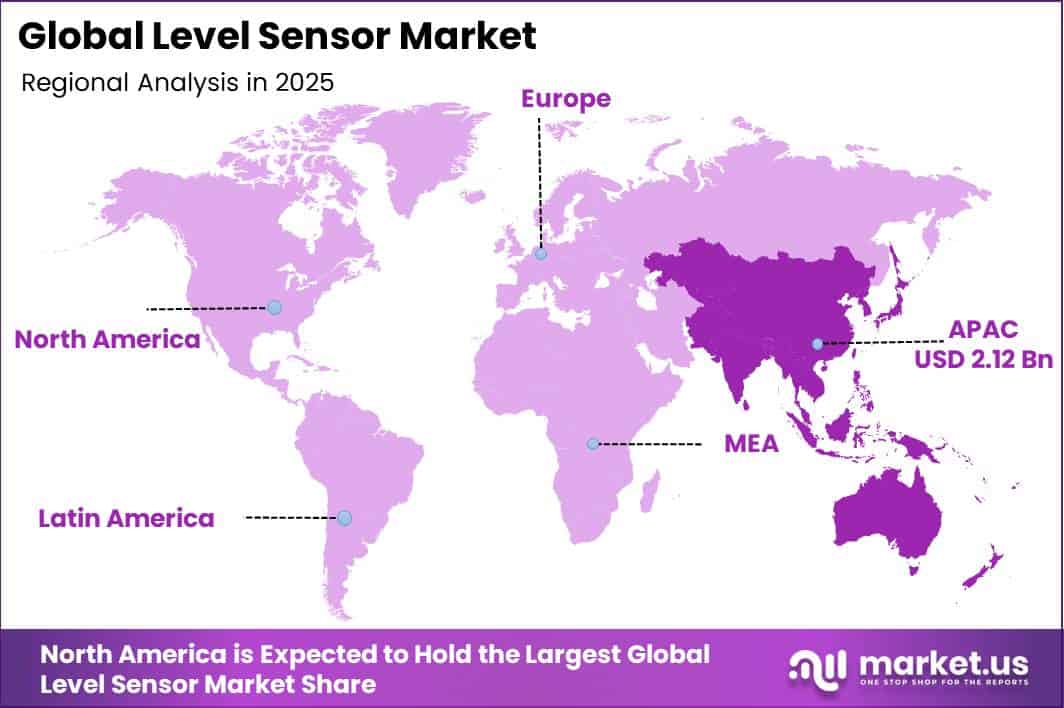
In 2025, the Global Level Sensor Market was valued at USD 5.5 billion. The market is projected to grow at a CAGR of 7.5% during 2026–2035, reaching approximately USD 11.4 billion by 2035. Asia-Pacific dominated the global market in 2025, accounting for more than 38.5% of the total market share and generating approximately USD 2.12 billion in revenue.
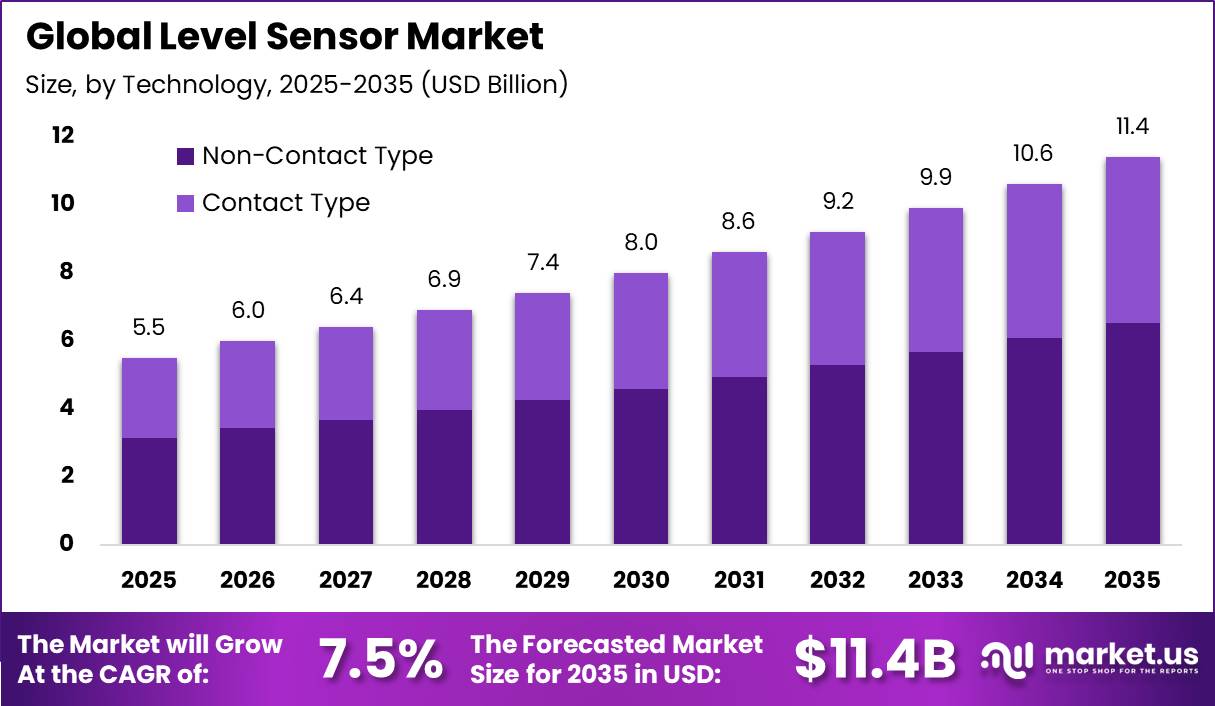
Market growth is supported by rising activity in automotive, oil and gas, chemicals, and other process industries where level sensors are widely used to monitor liquids, gases, and solids. According to OICA, global vehicle production increased from 92.7 million units in 2024 to 96.4 million units in 2025, representing growth of 3.9%.
Asia-Pacific produced more than 61% of global vehicles in 2025, while China manufactured 34.53 million units, up 10.4% year-on-year. Global vehicle sales also rose from 95.3 million units to 99.8 million units, an increase of 4.7%. Demand is also supported by the oil and gas industry.
The IEA reported that global oil demand increased by around 830,000 barrels per day in 2025, while supply expanded by roughly 3 million barrels per day. In addition, UNIDO reported that global manufacturing output grew by 1.3% quarter-on-quarter in the first quarter of 2025. These trends continue to increase the need for reliable level monitoring across tanks, pipelines, reactors, and industrial processing systems.
Key Takeaway
- The Level Sensor Market was valued at USD 5.5 billion in 2025 and is projected to reach USD 11.4 billion by 2035 at a CAGR of 7.5%.
- Ultrasonic level sensors held the leading sensor-type share at 23.5%.
- Non-contact technology dominated with a 57.3% share.
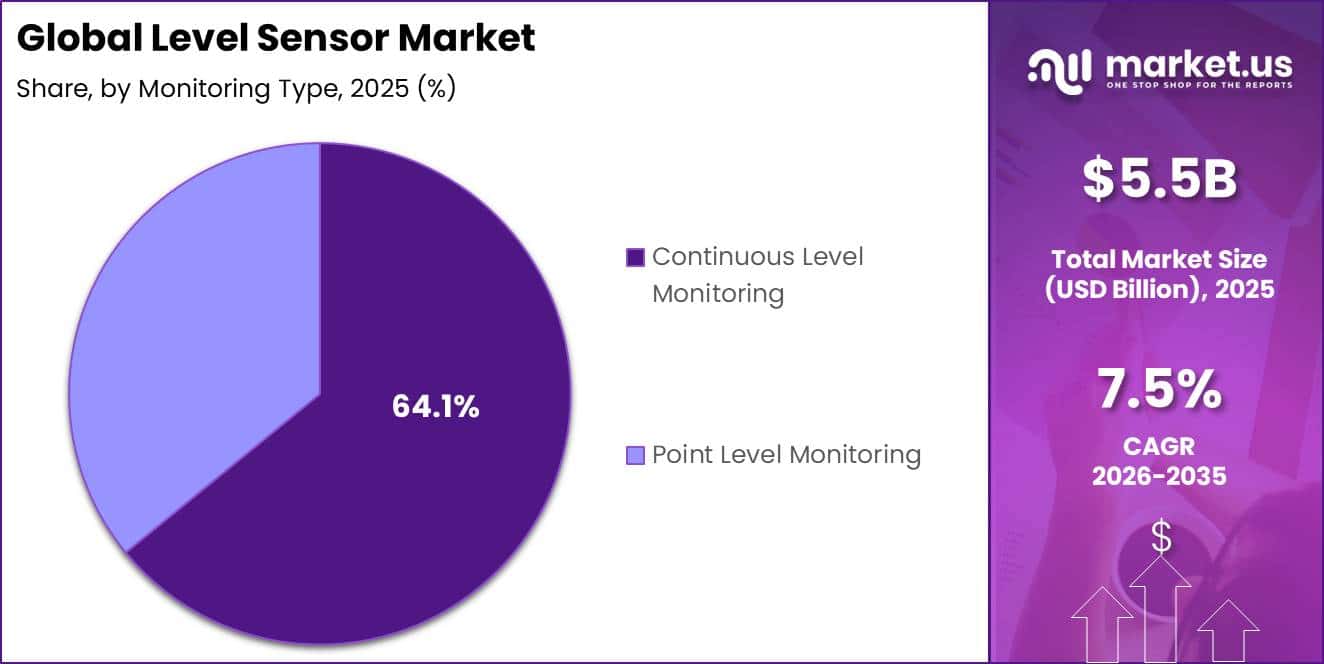
- Continuous level monitoring led with a 64.1% share.
- Oil and gas was the leading end-use industry with a 28.9% share.
- Asia-Pacific led the market in 2025 with a 38.5% share, generating around USD 2.12 billion in revenue.
Market Statistics and Data Insights
- Global factories installed 542,000 industrial robots in 2024, more than double the level 10 years earlier. Annual installations exceeded 500,000 units for the fourth consecutive year.
- The worldwide operational stock reached 4.664 million robots, increasing 9% year-on-year. Asia represented 74% of new installations, Europe 16%, and the Americas 9%. China installed 295,000 units, Japan 44,500, and the U.S. 34,200.
- The IEA reported that global refinery runs averaged about 83.6 million barrels per day in 2025, increasing by roughly 710,000 barrels per day. Global oil demand increased by around 830,000 barrels per day in 2025, while supply grew by about 3 million barrels per day to approximately 106.2 million barrels per day. Refinery throughput was expected to increase further to around 84.4 million barrels per day in 2026.
- UNEP states that the global chemical industry was worth about USD 5 trillion in 2017 and could double in size by 2030. UNEP also reports that around 1 million workers die every year from hazardous chemical exposure, equal to roughly 1 death every 30 seconds.
- Pollution overall is linked to about 9 million deaths annually. These conditions support non-contact and hazardous-area instrumentation in tanks and reactors.
- Global semiconductor sales reached USD 795.6 billion in 2025, up 26.2% year-on-year. Fourth-quarter sales reached USD 238.9 billion, increasing 38.4%. Asia-Pacific/All Other semiconductor sales increased 45.4%, China increased 17.9%, the Americas 31.4%, and Europe 6.7%. WSTS also reported 5% growth in the industrial semiconductor segment.
- The World Bank expects global growth to slow from 2.9% in 2025 to 2.5% in 2026, with forecasts downgraded for about two-thirds of economies versus its January outlook. Global commodity prices were projected to decline another 7% in 2026, while energy prices were expected to fall around 10%.
- ABB’s LRT100 radar family uses 80 GHz technology, offers measurement ranges up to 30 metres and accuracy as good as ±2 mm. Selected models provide beam angles as narrow as 4° and support Bluetooth 5.0 commissioning. Operating ranges extend from approximately -40°C to +80°C depending on model.
- In Rockwell Automation’s 2026 survey of 1,560 manufacturing decision-makers across 17 major manufacturing countries, 59% reported already using smart-manufacturing technology in operations, while only 18% remained in the pilot stage.
- Emerson launched its Rosemount 3408 Wireless level transmitter in October 2025 using 80 GHz FMCW radar and native WirelessHART connectivity for continuous non-contact measurement of liquids and solids in remote industrial locations.
- Endress+Hauser’s Micropilot FMR43 supports both 80 GHz and 180 GHz radar, delivers ±1 mm accuracy, measures up to 15 m, handles process temperatures from -40°C to +150°C, and operates at pressures from -1 to +20 bar.
- A 2025 Nano Energy study developed a triboelectric liquid-level sensor capable of detecting 2 mm level changes; its sensitivity was 2 times that of the commercial sensor used for comparison.
- In the same 2025 study, the experimental sensor remained stable after 1.5 million operating cycles and recorded a maximum mean deviation of just 0.8 mm, compared with 4.1 mm for the commercial reference sensor.
By Sensor Type
Ultrasonic Level Sensors held a leading 23.5% market share, supported by their ability to provide non-contact level measurement in hygienic, corrosive, and hazardous environments. These sensors are widely preferred where mechanical or contact-based devices can wear out or become damaged by chemicals, sludge, or harsh fluids.
According to UN-Water, global household wastewater generation reached 268 billion cubic meters in 2022, while only 155 billion cubic meters, or 58%, was safely treated. This treatment gap highlights the need for additional wastewater plants, storage tanks, and reservoirs, all of which require reliable level monitoring.
Desalination is also supporting segment growth. The EU Blue Economy Observatory reported that global installed desalination capacity reached around 135 million cubic meters per day across more than 22,000 plants by 2024, with capacity growing at nearly 7% annually.
By Technology
The Non-contact level sensor segment held a dominant 57.3% market share, mainly because industrial operators need accurate measurement without placing sensors directly inside corrosive liquids, vapours, foam, sludge, or moving solids. This demand is especially strong across chemical processing, water treatment, storage facilities, and food production, where contact-based sensors can corrode, become coated, or require frequent cleaning.
According to UNEP, global chemical industry production capacity increased from 1.2 billion tonnes in 2000 to 2.3 billion tonnes in 2017, while the industry’s value exceeded USD 5 trillion. Higher chemical production creates greater demand for tanks, reactors, and storage vessels that require safe and continuous level measurement.
Non-contact technologies such as radar and ultrasonic sensors measure material levels without touching the product, helping reduce contamination, equipment wear, maintenance needs, and production shutdowns. Safety is another important factor, as UNEP estimates that around 1 million workers die each year due to hazardous chemical exposure.
By Monitoring Type
The Continuous Level Monitoring segment held a dominant 64.1% market share, supported by strong demand for real-time measurement across large industrial and utility operations. Unlike point-level switches that only indicate high or low levels, continuous sensors provide live data that helps operators control inventory, flow, and storage conditions more accurately.
According to the International Energy Agency, global refinery crude throughput was projected to reach 83.3 million barrels per day in 2025. At this operating scale, even small level-measurement errors can increase overflow risks, disrupt crude transfers, or reduce processing efficiency.
Water infrastructure also creates steady demand. The U.S. Environmental Protection Agency identifies more than 44,000 community water-system service areas, which cover about 99% of the population served by these systems. Water treatment facilities require continuous monitoring across raw-water reservoirs, treatment tanks, chemical dosing vessels, and clean-water storage.
By End-Use Industry
The Oil and Gas Industry accounted for a leading 28.9% share of level sensor demand, supported by the need for accurate monitoring across extraction, transportation, refining, and storage operations. According to the Energy Institute, global oil production reached a record 96 million barrels per day in 2023.
Level sensors help operators prevent overflow, dry running, product losses, and incorrect oil-water separation while improving process control. Their importance is also increasing in operations where natural gas is produced together with crude oil. The World Bank reported that global gas flaring increased from 148 billion cubic metres in 2023 to 151 billion cubic metres in 2024, reaching its highest level since 2007.
Key Market Segments
By Sensor Type
- Ultrasonic Level Sensors
- Capacitance Level Sensors
- Conductive Level Sensors
- Laser Level Sensors
- Optical Level Sensors
- Float Level Sensors
- Magnetostrictive Level Sensors
- Microwave/Radar Level Sensors
- Hydrostatic Level Sensors
- Other
By Technology
- Contact Type
- Non-Contact Type
By Monitoring Type
- Point Level Monitoring
- Continuous Level Monitoring
By End-Use Industry
- Oil and Gas
- Food and Beverage
- Chemicals
- Energy and Power
- Water and Wastewater
- Other
Geopolitical Impact Analysis
Geopolitical tensions are increasing cost pressure and supply uncertainty for level sensor manufacturers, especially those that depend on Asian electronic components and Europe-bound shipping routes. Level sensors require semiconductors, printed circuit boards, copper wiring, stainless-steel housings, plastics, and specialised transmitters. Trade restrictions have raised sourcing risks, with Chinese-origin semiconductors entering the United States facing a 50% Section 301 tariff from January 2025.
Broader tariffs on China-related electronic products have also increased uncertainty around component prices. Manufacturers can diversify sourcing toward Taiwan, South Korea, Japan, India, Mexico, and Southeast Asia, but qualifying alternative chips and electronic modules can increase engineering, testing, purchasing, and inventory costs.
Shipping disruption in the Red Sea has created additional pressure on deliveries between Asian production hubs and customers across Europe, the Middle East, and North Africa. According to UNCTAD, Shanghai–Northern Europe container spot freight rates reached USD 2,648 per TEU on 9 February 2024, which was 256% above early-November 2023 levels, as vessels were rerouted away from the Suez Canal.
Longer routes around the Cape of Good Hope also increased voyage durations by about 17% in 2024. Commodity prices provide some cost relief. The World Bank forecast copper prices at USD 8,200 per tonne in 2025, around 10% below 2024, while Brent oil was projected at USD 64 per barrel, down 21%. However, tariff and shipping risks may limit how much of these savings reach level sensor buyers.
Regional Analysis
Asia-Pacific dominated the global level sensor market in 2025, holding a 38.5% revenue share and generating around USD 2.1 billion. The region’s strong position is supported by its large manufacturing base, rising factory automation, advanced electronics production, and investment across water treatment, chemicals, energy, and other process industries.
According to the International Federation of Robotics, Asia represented 74% of global industrial robot installations in 2024, compared with 16% in Europe and 9% in the Americas. China remained the largest automation market, installing 295,000 industrial robots in 2024, equal to 54% of global installations, while its operational robot stock exceeded 2.0 million units.
This high level of automation increases demand for ultrasonic, radar, capacitive, and pressure-based level sensors used in tanks, silos, chemical vessels, and material-handling systems. The regional electronics supply chain also supports sensor production. World Semiconductor Trade Statistics reported that semiconductor sales in Asia-Pacific/All Other increased 45.4% in 2025, while sales in China rose 17.9%.
North America is expected to be the fastest-growing regional market, supported by factory modernization, manufacturing reshoring, water-infrastructure upgrades, and safety-related investment across chemicals, pharmaceuticals, food processing, and energy.
Key Regions and Countries
North America
- US
- Canada
Europe
- Germany
- France
- The UK
- Spain
- Italy
- Rest of Europe
Asia Pacific
- China
- Japan
- South Korea
- India
- Australia
- Rest of APAC
Latin America
- Brazil
- Mexico
- Rest of Latin America
Middle East & Africa
- GCC
- South Africa
- Rest of MEA
Market Dynamics
Drivers
| Driver | (~) % CAGR | Geographic Relevance | Impact Timeline |
|---|---|---|---|
| Factory Automation Expansion | +1.6% | Asia-Pacific, Europe, North America | Short term (2 years or less) |
| Water Infrastructure Modernisation | +1.3% | Global | Medium term (2 to 4 years) |
| Process Safety Compliance | +1.1% | North America, Europe, Middle East | Short term (2 years or less) |
| Industrial Digitalisation | +1.0% | Global | Medium term (2 to 4 years) |
| Energy Storage Expansion | +0.8% | Asia-Pacific, North America, Europe | Medium term (2 to 4 years) |
Factory Automation Expansion
Factory automation is a major growth driver for the level sensor market because automated production systems require accurate monitoring of liquids, powders, chemicals, and bulk materials.
According to the International Federation of Robotics, global industrial robot installations reached 542,000 units in 2024, with Asia accounting for 74% of new installations. China alone installed 295,000 industrial robots, increasing its operating stock to 2.027 million units.
Growth in smart electronics is also supporting connected level measurement. Worldwide semiconductor sales reached USD 795.6 billion in 2025, increasing 26.2%, which supports greater availability of processors, communication modules, and intelligent sensor components.
As factories shift from basic-level alarms toward continuous and networked monitoring, sensor content per automated production line is increasing. This automation trend provides strong support for the level sensor market’s projected 7.5% CAGR.
Restraints
| Restraint | (~) % CAGR | Geographic Relevance | Impact Timeline |
|---|---|---|---|
| Industrial Capital Spending Delays | -1.4% | Global | Short term (2 years or less) |
| Low-Cost Sensor Substitution | -0.9% | Asia-Pacific, Latin America, Africa | Medium term (2 to 4 years) |
| High Certification Costs | -0.8% | North America, Europe, Middle East | Medium term (2 to 4 years) |
| Legacy Plant Compatibility Limits | -0.7% | Global | Long term (4 years or more) |
| Weak Process-Industry Investment | -0.6% | Europe, Latin America | Short term (2 years or less) |
Industrial Capital Spending Delays
Delayed capital spending is a key restraint for the level sensor market because these devices are often purchased as part of larger automation, plant expansion, tank upgrade, and control-system projects. The World Bank expects global economic growth to slow from 2.9% in 2025 to 2.5% in 2026, while emerging-market and developing-economy growth is projected at 3.6%.
The WTO also forecasts global merchandise trade volume growth of only 0.5% in 2026, down from an earlier estimate of 1.8%. Weaker investment conditions can delay new tank farms, treatment facilities, and process-line expansions. The World Bank also expects commodity prices to decline by another 7% in 2026, potentially reducing investment capacity among oil, metals, and mining companies.
Longer project approvals can extend sensor procurement cycles and increase pricing pressure on suppliers. If capital projects remain delayed, this restraint could reduce potential annual market growth by around 1.4 percentage points.
Challenges
| Challenge | (~) % CAGR | Geographic Relevance | Mitigation Horizon |
|---|---|---|---|
| Semiconductor Supply Exposure | -1.2% | Global | Medium term (2 to 4 years) |
| Calibration Skills Gap | -0.9% | Global | Long term (4 years or more) |
| Harsh Process Conditions | -0.8% | Oil and Gas, Chemicals, Mining | Medium term (2 to 4 years) |
| Protocol Interoperability Complexity | -0.7% | North America, Europe, Asia-Pacific | Medium term (2 to 4 years) |
| Long Component Qualification | -0.6% | Global | Short term (2 years or less) |
Semiconductor Supply Exposure
Semiconductor supply exposure remains a major operational challenge because radar, ultrasonic, guided-wave, and wireless level sensors depend on microcontrollers, analogue chips, communication modules, and power-management devices. Global semiconductor revenue increased 26.2% to USD 795.6 billion in 2025, while Asia-Pacific sales rose 45.4%, showing the industry’s strong dependence on regional electronics supply chains.
Shipping and trade uncertainty add further pressure. UNCTAD reported that the China Containerized Freight Index increased by around 120% between October 2023 and June 2024 during Red Sea disruptions, while the WTO forecast only 0.5% merchandise-trade growth in 2026.
Manufacturers are responding through dual sourcing, product redesign, and larger component inventories, but these measures increase working capital and certification costs. Overall, semiconductor and logistics risks could reduce the market’s achievable growth by around 1.2 percentage points.
Opportunities
| Opportunity | (~) % CAGR | Geographic Relevance | Execution Window |
|---|---|---|---|
| Predictive Maintenance Services | +1.8% | North America, Europe, Asia-Pacific | Medium term (2 to 4 years) |
| Hydrogen Process Instrumentation | +1.4% | Europe, North America, Middle East | Long term (4 years or more) |
| Battery Materials Processing | +1.2% | Asia-Pacific, Europe, North America | Medium term (2 to 4 years) |
| Remote Water Monitoring | +1.0% | Asia-Pacific, Africa, Latin America | Medium term (2 to 4 years) |
| Aftermarket Retrofit Packages | +0.9% | Global | Short term (2 years or less) |
Predictive Maintenance Services
Predictive-maintenance services offer strong future growth potential as many installed level sensors still operate as isolated switches rather than connected devices. The global stock of industrial robots reached 4.28 million units in 2023, while annual robot installations stayed above 500,000 units for the fourth consecutive year in 2024.
With the World Bank expecting global economic growth of only 2.5% in 2026, industrial customers are increasingly focused on improving asset uptime and lowering maintenance costs. Sensor suppliers must still invest in connectivity, cybersecurity, data platforms, and service capabilities.
However, subscription-based diagnostics could improve lifecycle gross margins by an estimated 5%–10% compared with one-time hardware sales and potentially add up to 1.8 percentage points above the market’s 7.5% baseline CAGR.
Key Players Analysis
The Level Sensor Market is mainly led by Tier-1 automation and process-control companies such as Emerson, Siemens, ABB, Honeywell, Schneider Electric, and Yokogawa. These companies have a strong installed base across oil and gas, chemicals, power, water, food, and manufacturing industries. Exact revenue from level sensors is not reported separately, so company-level market shares cannot be fully verified.
However, these 6 companies are estimated to represent around 55–65% of high-end industrial level-sensor demand. Emerson remains a major process-measurement supplier, with its Intelligent Devices business generating USD 12.4 billion in 2025 sales and USD 2.9 billion in earnings, equal to a 23.8% margin.
Its R&D, engineering, and customer-funded development spending represented 8.1% of sales in 2025. Siemens recorded €17.8 billion in Digital Industries revenue in fiscal 2025 and invested €6.6 billion in group R&D, equal to 8.3% of revenue. ABB generated USD 33.2 billion in 2025 revenue, including USD 8.08 billion from Automation, while R&D spending reached USD 1.3 billion, or 4.0% of revenue.
Its capital expenditure increased 25% to USD 1.0 billion. Schneider Electric generated €40.2 billion in 2025 revenue, up 9% organically, while Honeywell reported USD 37.4 billion in sales and USD 2.8 billion in R&D spending, including USD 1.07 billion of customer-sponsored R&D. Tier-2 specialists, including AMETEK, Balluff, SICK, and Omega Engineering, compete through focused products, customization, and faster delivery.
Top Key Players in the Market
- Honeywell International Inc.
- Siemens AG
- ABB Group
- Schneider Electric SE
- Emerson Electric Co.
- AMETEK, Inc.
- Yokogawa Electric Corporation
- Balluff GmbH
- SICK AG
- Omega Engineering, Inc.
Recent Developments
- In 2025, ABB completed the acquisition of Sensorfact B.V. on 3 February for USD 148 million, net of acquired cash. Sensorfact generated approximately USD 15 million in annual revenue and had around 260 employees. Its AI-enabled SaaS platform helps industrial companies analyze machine and energy data to improve efficiency.
- In 2025, AMETEK completed its acquisition of FARO Technologies on 21 July for USD 44.00 per share in cash, representing approximately USD 920 million net of acquired cash. FARO adds advanced 3D measurement, imaging, metrology, and digital-reality technologies to AMETEK’s Electronic Instruments Group.
Report Scope
| Report Features | Description |
|---|---|
| Market Value (2025) | USD 5.5 Billion |
| Forecast Revenue (2035) | USD 11.4 Billion |
| CAGR (2026-2035) | 7.5% |
| Base Year for Estimation | 2025 |
| Historic Period | 2020-2024 |
| Forecast Period | 2026-2035 |
| Report Coverage | Revenue Forecast, Market Dynamics, Competitive Landscape, Recent Developments |
| Segments Covered | By Sensor Type (Ultrasonic, Capacitance, Conductive, Laser, Optical, Float, Magnetostrictive, Microwave/Radar, Hydrostatic, Other); By Technology (Contact Type, Non-Contact Type); By Monitoring Type (Point Level Monitoring, Continuous Level Monitoring); By End-Use Industry (Oil and Gas, Food and Beverage, Chemicals, Energy and Power, Water and Wastewater, Other) |
| Regional Analysis | North America – US, Canada; Europe – Germany, France, The UK, Spain, Italy, Rest of Europe; Asia Pacific – China, Japan, South Korea, India, Australia, Singapore, Rest of APAC; Latin America – Brazil, Mexico, Rest of Latin America; Middle East & Africa – GCC, South Africa, Rest of MEA |
| Competitive Landscape | Honeywell International Inc., Siemens AG, ABB Group, Schneider Electric SE, Emerson Electric Co., AMETEK, Inc., Yokogawa Electric Corporation, Balluff GmbH, SICK AG, Omega Engineering, Inc. |
| Customization Scope | Customization for segments, region/country-level will be provided. Additional customization can be done based on requirements. |
| Purchase Options | We have three licenses to opt for: Single User License, Multi-User License (Up to 5 Users), Corporate Use License (Unlimited Users and Printable PDF) |





































