Report Overview
The Global Coffee Pods Market size is expected to be worth around USD 75.0 Billion by 2035, from USD 41.4 Billion in 2025, growing at a CAGR of 6.1% during the forecast period from 2026 to 2035. In 2025, Europe held a dominant market position, capturing more than a 30.23% share, holding USD 12.5 Billion revenue.
The Coffee Pods industry has developed into an important segment of the global coffee market, supported by changing consumer lifestyles, increasing demand for convenient beverage preparation, and the growing popularity of premium coffee products. Coffee pods provide pre-measured coffee portions in sealed capsules or filter-based containers, allowing consumers to prepare consistent beverages with limited preparation time. The industry includes aluminium capsules, plastic coffee capsules, compostable pods, paper-based pods, and compatible brewing systems.
- According to the Food and Agriculture Organization (FAO), global coffee production exceeded 11 million tonnes in 2024, while the estimated value of coffee production reached USD 25 billion and international coffee trade exceeded USD 34 billion. Brazil and Vietnam together accounted for nearly 50% of global coffee production, highlighting the importance of international agricultural supply chains for coffee manufacturers.
Consumer demand is another important factor supporting the coffee pods industry. According to the National Coffee Association (NCA), 66% of American adults consumed coffee daily in September 2025, making coffee one of the country’s most widely consumed beverages. The association also reported that 82% of past-day coffee drinkers consumed coffee at home, reflecting the importance of household consumption. This consumption pattern creates opportunities for single-serve coffee manufacturers because consumers increasingly seek convenient ways to prepare coffee without visiting cafés.
- The global coffee supply chain is also supporting long-term industrial development. The International Coffee Organization reported that worldwide coffee consumption increased by 1.4% to 175.1 million 60-kilogram bags during coffee year 2024/25. Asia and Oceania recorded a 7.4% increase in consumption, reaching 47.4 million bags. Increasing coffee consumption, speciality beverage preferences, and product diversification are encouraging manufacturers to introduce different roast profiles, intensities, flavours, and capsule formats.
Sustainability is becoming a major consideration in coffee pod manufacturing. Aluminium and plastic capsules offer protection against oxygen and moisture, helping maintain coffee freshness, but their disposal creates environmental challenges. Manufacturers are therefore investing in recyclable aluminium capsules, compostable materials, paper-based packaging, and improved collection systems.
The European Union’s Packaging and Packaging Waste Regulation (EU) 2025/40 entered into force on 11 February 2025 and became applicable on 12 August 2026. The regulation establishes packaging sustainability requirements and aims to make packaging recyclable in an economically viable way by 2030. These requirements are encouraging coffee pod producers to improve packaging design, material selection, and recycling infrastructure.
Key Takeaways
- Coffee Pods Market size is expected to be worth around USD 75.0 Billion by 2035, from USD 41.4 Billion in 2025, growing at a CAGR of 6.1%.
- Nespresso-style held a dominant market position, capturing more than a 57.89% share of the Coffee Pods Market.
- Regular held a dominant market position, capturing more than a 62.21% share of the Coffee Pods Market.
- B2B held a dominant market position, capturing more than a 67.89% share of the Coffee Pods Market.
- Europe dominated the Coffee Pods Market, accounting for 30.23% of the global market, with a reported value of 12.5 Bn in 2025.
By Product Analysis
Nespresso-style pods lead the market through premium coffee quality, convenience, and wide machine compatibility.
In 2025, “Nespresso-style” held a dominant market position, capturing more than a 57.89% share of the Coffee Pods Market by Product. This segment benefits from strong consumer preference for convenient coffee preparation, consistent beverage quality, and premium coffee experiences at home and in workplaces. Nespresso-style capsules are widely preferred because they offer different coffee intensities, flavour profiles, and espresso options. Their compatibility with a broad range of capsule-based coffee machines also supports regular consumer purchases.
DeLonghi-compatible coffee pods serve consumers who prefer using compatible capsule systems to prepare espresso and other coffee beverages at home. The segment benefits from the popularity of automatic coffee machines, product convenience, and the availability of different coffee blends and roast varieties. Consumers value these pods for their ease of use, consistent preparation, and ability to enjoy café-style beverages without purchasing coffee from retail outlets. In 2025, demand was supported by the wider availability of compatible capsules through supermarkets, specialist coffee retailers, and online platforms.
- According to Eurostat, the European Union imported 2.9 million tonnes of coffee in 2025, valued at €18.7 billion. Germany accounted for 34% of these imports, while Italy represented 21%. This strong coffee trade environment supports the availability of coffee supplies for capsule manufacturers and compatible pod producers.
By Flavor Analysis
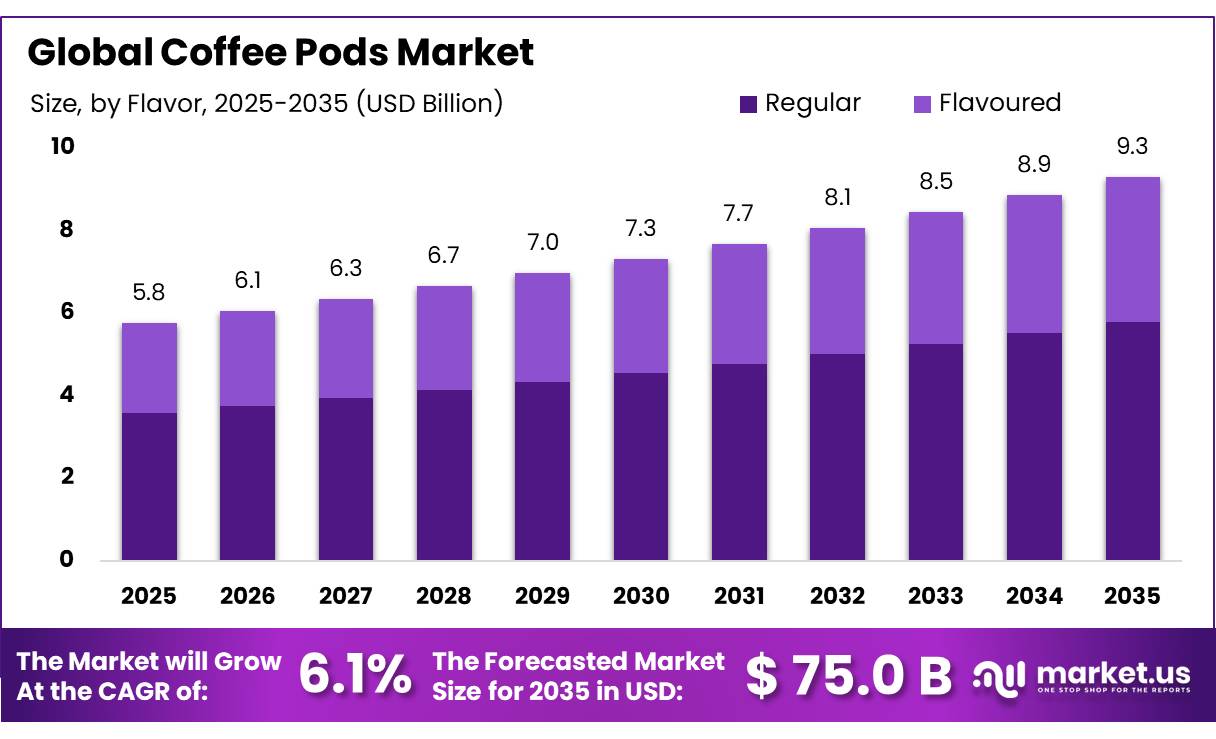
Regular coffee pods dominate due to their familiar taste, everyday consumption, and wide consumer acceptance.
In 2025, “Regular” held a dominant market position, capturing more than a 62.21% share of the Coffee Pods Market by Flavor. The segment maintains its leading position because regular coffee remains a preferred choice among consumers seeking a traditional coffee taste without additional flavouring or sweetness. Regular coffee pods are widely used in households, offices, and hospitality settings because they offer convenient preparation, consistent taste, and compatibility with single-serve brewing machines.
- According to the United States Department of Agriculture (USDA), global coffee production reached 176.82 million 60-kilogram bags in 2024/25 and was estimated at 178.83 million bags in 2025/26. Brazil accounted for 63 million bags, while Vietnam contributed 31.7 million bags in 2025/26. This large global supply base supports the availability of coffee beans for regular coffee pod manufacturing and strengthens the segment’s long-term production potential.
Flavoured coffee pods are gaining attention as consumers explore alternatives to traditional coffee and seek more variety in their daily beverages. These products include popular flavour options such as vanilla, caramel, hazelnut, chocolate, and seasonal blends. Manufacturers are introducing different flavour combinations to attract younger consumers and households interested in café-style beverages at home. The segment also benefits from product innovation, premium packaging, and the growing availability of flavoured capsules through online retail and specialist coffee stores. In 2025, the availability of a wide range of coffee blends and flavour combinations supported product differentiation across the single-serve coffee industry.
According to the USDA Foreign Agricultural Service, global coffee production was estimated at 178.83 million 60-kilogram bags in 2025/26, providing an important raw-material foundation for conventional and flavoured coffee products. This expanding supply base supports opportunities for manufacturers to develop new flavoured coffee pod varieties and strengthen their product portfolios.
By Distribution Channel Analysis
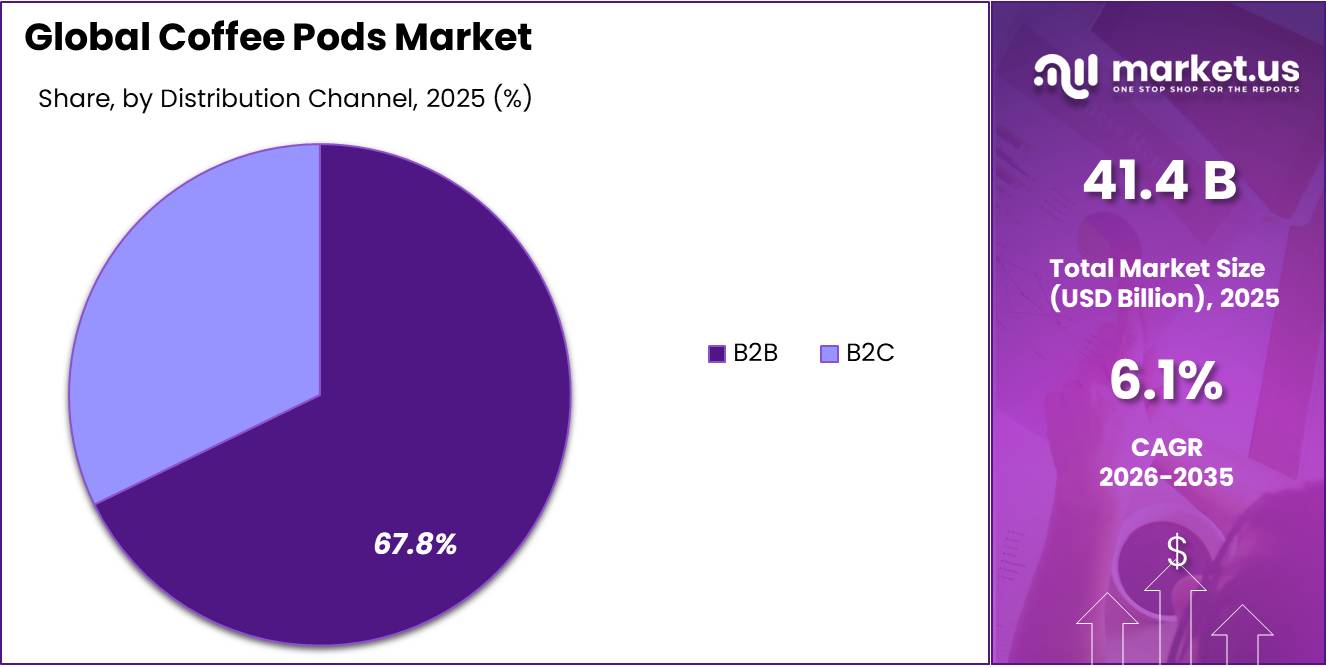
B2B dominates coffee pod distribution through bulk purchasing, commercial demand, and regular institutional consumption.
In 2025, “B2B” held a dominant market position, capturing more than a 67.89% share of the Coffee Pods Market by Distribution Channel. The segment benefits from consistent demand from hotels, restaurants, cafés, bakeries, corporate offices, and hospitality operators that purchase coffee pods in bulk to support regular beverage preparation. Businesses prefer coffee pods because they provide consistent taste, controlled portions, convenient storage, and faster preparation compared with traditional coffee-making methods.
- According to the International Coffee Organization (ICO), global coffee consumption increased by 1.4% to 175.1 million 60-kilogram bags in 2024/25, compared with the previous coffee year. This substantial consumption base supports commercial procurement opportunities for coffee pod manufacturers and distributors. In 2025, bulk supply agreements, institutional partnerships, and specialised coffee distribution networks remained important business opportunities.
Bakeries and coffee shops represent an important distribution channel for coffee pods because these establishments require convenient coffee preparation to serve customers throughout the day. Coffee pods help businesses maintain consistent flavour, control serving portions, and reduce preparation time, particularly where compact brewing machines are used.
In 2025, demand from independent cafés, bakery chains, and speciality coffee outlets was supported by growing interest in premium coffee experiences and convenient foodservice operations. According to the United States Bureau of Labor Statistics, the food services and drinking places industry is an established employment sector in the United States, reflecting the scale of commercial food and beverage operations.
Key Market Segments
By Product
- Nespresso-style
- DeLonghi-compatible
- Keurig K-Cups
- Others
By Flavor
- Regular
- Flavoured
By Distribution Channel
- B2B
- Cafes
- Hotels & Restaurants
- Offices
- Bakeries and coffee shops
- Others
- B2C
- Grocery Stores/Supermarkets
- Hypermarkets
- Convenience Stores
- Online Retailers
- Online Direct-to-Consumer (DTC)
- Others
Driver Analysis
At-home consumption frequency
The National Coffee Association’s Fall 2026 findings reported that 66% of US adults drank coffee daily and 83% of past-day coffee drinkers consumed it at home; out-of-home consumption reached 38%, with the two locations not mutually exclusive. For historical comparison, Fall 2025 findings placed at-home consumption at 82% and single-cup brewing at 23% of past-day coffee drinkers’ preparation methods, demonstrating a substantial established channel rather than evidence that all home consumption is shifting into pods.
An illustrative increase from 1.00 to 1.05 pods daily across 1 million existing active households creates 18.25 million additional pods annually; at an assumed manufacturer realization of $0.35 per pod, that represents approximately $6.39 million in incremental annual revenue. The commercial mechanism is improved replenishment and occasion coverage within existing households—breakfast, a second cup or differentiated household preferences—not new brewer sales. Manufacturers therefore capture value through convenient pack sizes, dependable availability and repeat-order channels.
However, Keurig management reported in November 2026 that existing weekly users were consuming K-Cups less frequently, showing that the home-consumption platform does not guarantee higher pod intensity. The +0.8 pp contribution assumes frequency and retention initiatives generate 2 percentage points of additional annual growth across 40% of market revenue; it is a conditional forecast mechanism, not an observed global usage increase.
Drivers Impact Analysis
| Driver | (~) % Impact on CAGR Forecast | Geographic Relevance | Impact Timeline |
|---|---|---|---|
| At-home consumption frequency | +0.8 pp | US core | Short term (≤ 2 years) |
| Expanding brewer adoption | +0.7 pp | US, Canada | Medium term (2-4 years) |
| Premium coffee assortment | +0.6 pp | North America, Western Europe | Medium term (2-4 years) |
| Branded distribution expansion | +0.4 pp | US retail channels | Short term (≤ 2 years) |
| Manufacturer price realization | +0.5 pp | North America, Western Europe | Short term (≤ 2 years) |
Restraint Analysis
Price-led consumption reduction
Keurig Dr Pepper’s US Coffee segment recorded second-quarter 2025 sales of $948 million, down 0.2% from $950 million, as favorable net pricing of 3.6% was offset by a 3.8% volume/mix decline; management specifically attributed the approximately flat result to K-Cup pricing actions taken against inflation, offset by pod and brewer shipment declines. These are segment figures, not a direct estimate of global pod-price elasticity.
Full-year 2025 US Coffee results similarly combined approximately 4.8% favorable pricing with a 4.2% volume/mix decline, while K-Cup unit volume fell 4.8%. An illustrative 100-million-pod portfolio priced at $0.35 per pod generates $35 million; increasing price by 5% while units decline 4% raises revenue only 0.8%, to $35.28 million, before promotional spending. Consumers can respond by stretching replenishment intervals, choosing lower-priced pods or substituting other brewing methods, weakening factory utilization and increasing the commercial cost of retaining volume.
The -0.5 pp deduction assumes affordability-related demand erosion reduces annual growth by 2 percentage points across 25% of market revenue. It captures reduced purchases and downtrading, while excluding the upstream cost pressure discussed separately; manufacturers should not treat pricing-led growth as equivalent to stronger consumption.
Restraint Impact Analysis
| Restraint | (~) % Impact on CAGR Forecast | Geographic Relevance | Impact Timeline |
|---|---|---|---|
| Price-led consumption reduction | -0.5 pp | US core; Western Europe | Short term (≤ 2 years) |
| Coffee-input margin pressure | -0.4 pp | Global; Arabica-heavy portfolios | Short term (≤ 2 years) |
| Packaging transition costs | -0.4 pp | EU-27; EU import suppliers | Medium term (2-4 years) |
| Brewer acquisition barriers | -0.3 pp | US, Canada; premium systems | Medium term (2-4 years) |
| Limited recycling acceptance | -0.2 pp | US municipal channels | Medium term (2-4 years) |
Opportunity Analysis
Micro-office subscriptions
The opportunity is to aggregate low-consumption workplaces into economically serviceable routes with pooled purchasing commitments, rather than merely extend conventional office subscriptions that already exist. Nespresso’s Canadian professional offer requires minimum monthly purchases of 150 capsules for Zenius and 300 for Momento 100 under 36-month contracts; Dutch offers similarly start at 100 capsules for smaller locations and 300 for Momento. These published commitments provide commercial benchmarks, not evidence that all smaller offices lack access.
An illustrative six-person workplace with 60% average daily attendance and 1.2 coffees per attending worker across 22 working days consumes approximately 95 servings monthly—below the cited Canadian thresholds. A route operator pooling 100 such sites would aggregate approximately 9,500 monthly pods, allowing procurement at meaningful scale while distributing the individual-site demand risk across a portfolio. At an assumed $0.35 manufacturer realization, 10,000 newly converted sites of that size would generate approximately 11.4 million pods and $4.0 million annually; machine leases and servicing revenue remain outside the pods market.
Value creation depends on remote replenishment, standardized equipment and sufficiently dense delivery routes to prevent small orders from destroying contribution. The +0.40 pp scenario assumes 2.0% additional terminal-market revenue from workplaces newly converted from non-pod coffee or previously unserved consumption, excluding existing subscribers and ordinary growth within established office accounts.
Opportunity Impact Analysis
| Opportunity | (~) % Potential CAGR Upside | Geographic Relevance | Execution Window |
|---|---|---|---|
| Pooled micro-office subscriptions | +0.40 pp | US, Canada, Western Europe | Medium term (2-4 years) |
| Managed hospitality conversions | +0.35 pp | Germany, Benelux, Canada | Medium term (2-4 years) |
| Certified private-label platforms | +0.30 pp | France, Germany, Benelux | Medium term (2-4 years) |
| Evening decaf programs | +0.25 pp | US, Canada, UK | Short term (≤ 2 years) |
| Shared specialty-roaster platforms | +0.20 pp | US, Western Europe | Medium term (2-4 years) |
Challenges Analysis
Extraction consistency across batches
Coffee pods must deliver repeatable extraction despite changes in particle-size distribution, filling density and roasted-coffee characteristics, making batch consistency an ongoing process-control challenge rather than a barrier that prevents sales. A study of 43 Nespresso and compatible capsules found fines below 100 µm ranging from approximately 6% to 16% by volume, extraction times of 10–41 seconds and average flow rates of approximately 1–4 g/second; increasing fines from 10% to 15% was associated with approximately 10 additional seconds of extraction.
Crucially, median grind size alone did not adequately explain extraction behavior. Research published in March 2024 reinforced the importance of fines in reducing coffee-bed permeability, although that experiment used professional espresso equipment rather than capsules. For an illustrative 100-million-pod plant, diverting 1% of production into a channel realizing $0.20 instead of $0.35 per pod reduces annual revenue by $150,000; this is a sensitivity calculation, not an observed industry downgrade rate.
Manufacturers therefore need particle-distribution controls, dose-weight monitoring, extraction testing and line-specific operating windows, rather than treating a single grinder setting as a transferable specification. The -0.25 pp allocation assumes inconsistent performance and corrective rework reduce annual growth by 1 percentage point across 25% of revenue. It excludes the sensory effects of changing coffee origins, which are assigned separately to blend substitution.
Challenges Impact Analysis
| Challenge | (~) % CAGR Friction Drag | Geographic Relevance | Mitigation Horizon |
|---|---|---|---|
| Extraction consistency across batches | -0.25 pp | Europe, North America | Medium term (2-4 years) |
| Packaging barrier validation complexity | -0.25 pp | EU, US, Japan | Medium term (2-4 years) |
| Multi-format production scheduling | -0.20 pp | Europe, North America | Medium term (2-4 years) |
| Farm-to-capsule traceability integration | -0.20 pp | EU supply chains; coffee origins | Long term (≥ 4 years) |
| Blend substitution quality control | -0.15 pp | Global multi-origin sourcing | Long term (≥ 4 years) |
Geopolitical Impact Analysis
Geopolitical Impact of Ongoing Wars on the Coffee Pods Market
Ongoing geopolitical conflicts, particularly the Russia-Ukraine war and tensions in the Middle East, are creating supply chain challenges for the global Coffee Pods Market. Disruptions to shipping routes in the Red Sea and surrounding regions have increased transportation uncertainty, insurance costs, and delivery times for coffee beans, aluminium, plastic packaging, and machinery components. These challenges can increase production and distribution costs for coffee pod manufacturers, particularly those dependent on international suppliers. Higher energy and freight expenses can also affect roasting, capsule manufacturing, packaging, and retail pricing.
According to the United Nations Conference on Trade and Development (UNCTAD), global maritime trade is projected to record zero growth in 2026, compared with 1.9% growth in 2025. Container spot freight rates also more than doubled between January and August 2026, reflecting increased shipping costs and route disruptions. These developments can put additional pressure on coffee pod manufacturers that depend on international raw materials and packaging supplies.
However, the United States Department of Agriculture estimated global coffee production at 178.83 million 60-kilogram bags in 2025/26, providing support for raw material availability. Manufacturers are likely to focus on diversified sourcing, local packaging suppliers, inventory management, and alternative shipping routes to reduce geopolitical risks. Overall, prolonged conflicts could increase operating expenses and affect product pricing, while supply chain diversification will create opportunities for more resilient coffee pod production.
Regional Insights
Dominating Region: Europe
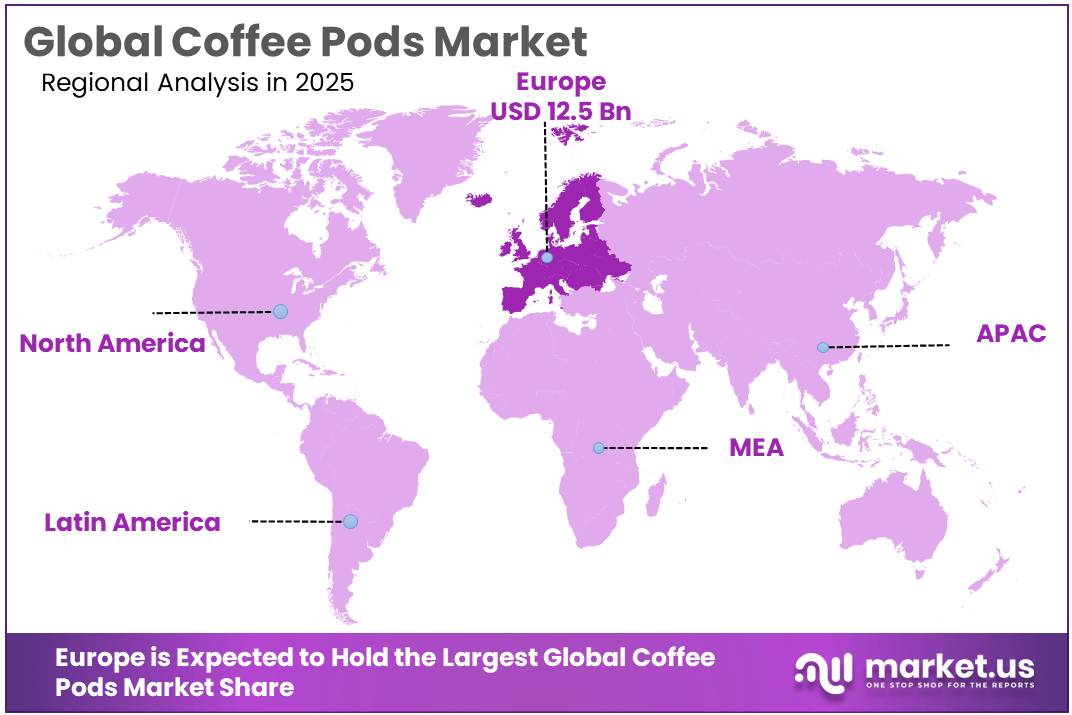
Europe dominated the Coffee Pods Market, accounting for 30.23% of the global market, with a reported value of 12.5 Bn in 2025. The region’s leading position is supported by established coffee-drinking habits, strong demand for premium beverages, and widespread adoption of single-serve coffee machines. Countries such as Germany, Italy, France, and the United Kingdom contribute to regional coffee consumption through household purchases and commercial foodservice demand.
- According to Eurostat, the European Union imported 2.9 million tonnes of coffee in 2025, valued at €18.7 billion. Germany accounted for 34% of these imports, followed by Italy at 21%. This established coffee supply network supports capsule manufacturing, retail distribution, and product innovation. Growing interest in recyclable capsules and speciality coffee blends further strengthens Europe’s market position.
Asia-Pacific is an important growth region for the Coffee Pods Market, supported by changing lifestyles, increasing urbanisation, and rising interest in premium coffee consumption. Consumers in countries such as Japan, China, South Korea, and Australia are showing greater interest in convenient coffee preparation and speciality beverages. According to the International Coffee Organization (ICO), coffee consumption across Asia and Oceania reached 48.9 million 60-kilogram bags in 2024/25, compared with 47.6 million bags in 2023/24.
The region recorded particularly strong growth in coffee consumption, supported by expanding café culture and changing beverage preferences. Coffee machine penetration, online retail expansion, and increasing availability of compatible capsules are creating opportunities for manufacturers. Premium blends, flavoured capsules, and affordable single-serve brewing systems are also expected to support regional demand.
Key Regions and Countries Insights
- North America
- US
- Canada
- Europe
- Germany
- France
- The UK
- Spain
- Italy
- Rest of Europe
- Asia Pacific
- China
- Japan
- South Korea
- India
- Australia
- Rest of APAC
- Latin America
- Brazil
- Mexico
- Rest of Latin America
- Middle East & Africa
- GCC
- South Africa
- Rest of MEA
Key Players Analysis
Keurig Dr Pepper Inc. maintains a strong position in the Coffee Pods Market through its Keurig brewing systems and K-Cup pod portfolio. In 2025, the company reported total net sales of USD 16.60 billion, while its U.S. Coffee segment generated USD 3.99 billion. U.S. Coffee sales increased by 0.6%, supported by higher K-Cup pod sales, which partly offset lower brewer sales. Its extensive coffee distribution network and product range support its commercial position.
Nestlé S.A. is a leading participant in the Coffee Pods Market through its Nespresso brand, offering premium coffee capsules and compatible brewing systems. In 2025, Nespresso generated CHF 6.481 billion in sales, compared with CHF 6.378 billion in 2024, representing 6.0% organic growth. The company continued to strengthen its position through premium coffee offerings, machine innovation, and digital distribution. Its established international presence and capsule product portfolio support its competitive position in the global single-serve coffee industry.
The Kraft Heinz Company participates in the Coffee Pods Market through brands such as Maxwell House and Tassimo. In 2025, the company reported total net sales of USD 24.9 billion, although its overall organic net sales declined by 3.4%. Coffee volume performance faced pressure from higher input costs and weaker demand. In November 2026, Kraft Heinz announced an agreement to divest its North American coffee business for an enterprise value of USD 650 million, while retaining a 30% equity stake.
Top Key Players Outlook
- Keurig Dr Pepper Inc.
- Nestlé S.A.
- The Kraft Heinz Company
- Starbucks Corporation
- Peet’s Coffee
- JDE Peet’s
- Illycaffè S.p.A.
- Caffè Nero
- Costa Coffee
- Tim Hortons
- Other Key Players
Recent Developments
- Starbucks reported Channel Development revenue of USD 494.4 million in Q4 FY2026, compared with USD 542.6 million in Q4 FY2025, representing a 9% decline. The company also reported total FY2026 net revenue of USD 37.9 billion.
- In January 2026, KDP commenced its tender offer for JDE Peet’s at EUR 31.85 per share. The acquisition was substantially completed on April 1, 2026, when KDP acquired 96.22% of JDE Peet’s outstanding shares, increasing its ownership to 97.75% by April 15, 2026.
Report Scope
| Report Features | Description |
|---|---|
| Market Value (2025) | USD 41.4 Bn |
| Forecast Revenue (2035) | USD 75.0 Bn |
| CAGR (2026-2035) | 6.1% |
| Base Year for Estimation | 2025 |
| Historic Period | 2020-2024 |
| Forecast Period | 2026-2035 |
| Report Coverage | Revenue Forecast, Market Dynamics, Competitive Landscape, Recent Developments |
| Segments Covered | By Product (Nespresso-style, DeLonghi-compatible, Keurig K-Cups, Others), By Flavor (Regular, Flavoured), By Distribution Channel (B2B, B2C) |
| Regional Analysis | North America – US, Canada; Europe – Germany, France, The UK, Spain, Italy, Rest of Europe; Asia Pacific – China, Japan, South Korea, India, Australia, Singapore, Rest of APAC; Latin America – Brazil, Mexico, Rest of Latin America; Middle East & Africa – GCC, South Africa, Rest of MEA |
| Competitive Landscape | Keurig Dr Pepper Inc., Nestlé S.A., The Kraft Heinz Company, Starbucks Corporation, Peet’s Coffee, JDE Peet’s, Illycaffè S.p.A., Caffè Nero, Costa Coffee, Tim Hortons, Other Key Players |
| Customization Scope | Customization for segments, region/country-level will be provided. Moreover, additional customization can be done based on the requirements. |
| Purchase Options | We have three licenses to opt for: Single User License, Multi-User License (Up to 5 Users), Corporate Use License (Unlimited User and Printable PDF) |