


Report Overview
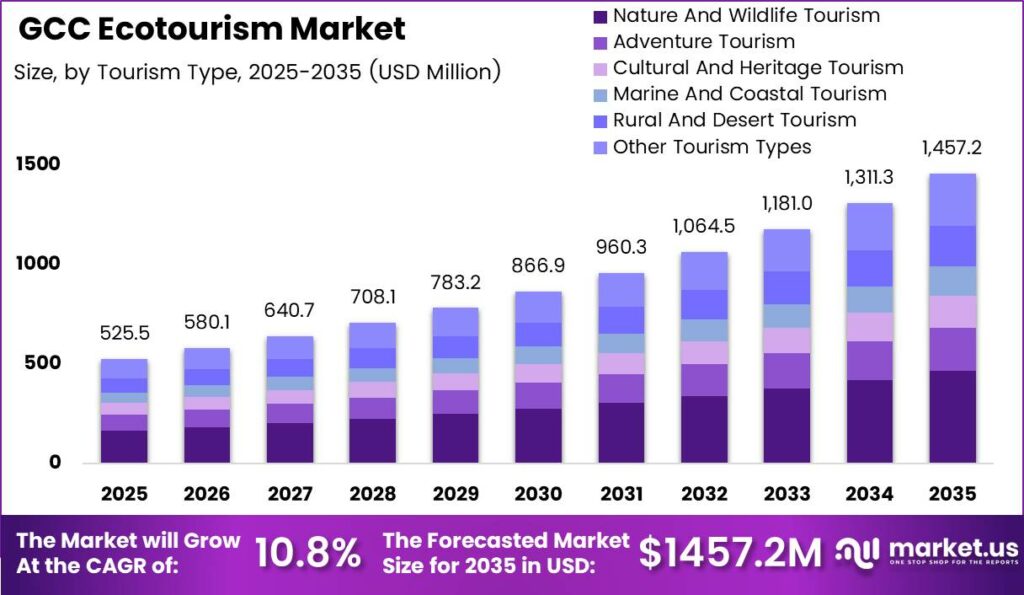
GCC Ecotourism Market size is expected to be worth around USD 1,457.2 Million by 2035 from USD 525.5 Million in 2025, growing at a CAGR of 10.8% during the forecast period 2026 to 2035.
The GCC Ecotourism Market covers nature-based, heritage, adventure, marine, and desert travel products across six Gulf Cooperation Council member states. Operators, national tourism authorities, conservation bodies, hospitality providers, and booking platforms constitute the core structural participants. The market spans guided tours, protected-area access, wildlife experiences, and sustainable accommodation offerings across Saudi Arabia, the UAE, Oman, Qatar, Bahrain, and Kuwait.
Key Takeaways
- The GCC Ecotourism Market was valued at USD 525.5 Million in 2025 and is forecast to reach USD 1,457.2 Million by 2035.
- The market expands at a CAGR of 10.8% during the forecast period 2026 to 2035.
- By Tourism Type, Nature and Wildlife Tourism dominates with a 32.00% share in 2025.
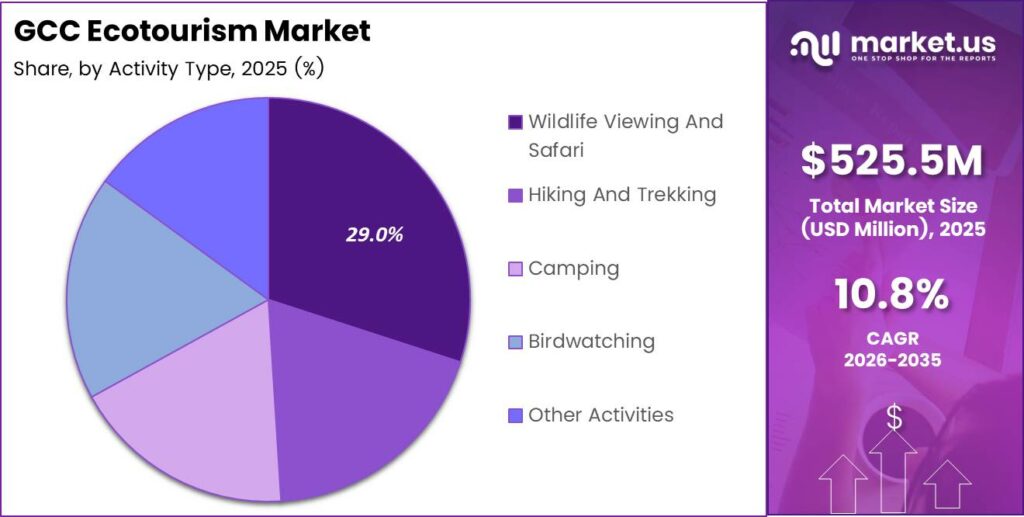
- By Activity Type, Wildlife Viewing and Safari leads with a 29.00% share in 2025.
- By Booking Mode, Direct Booking holds the largest share at 58.00% in 2025.
- By Tourist Type, Domestic tourists represent the dominant segment at 56.00% in 2025.
- By Tour Duration, Short-Duration Tours account for the largest share at 52.00% in 2025.
- By GCC Country, Saudi Arabia leads with a 41.00% share, valued at USD 215.4 Million in 2025.
- Saudi Arabia is the dominant regional market, holding a 41.00% share of total GCC ecotourism revenue.
According to online.gccstat.org, GCC inbound tourism reached 75.70 million tourists in 2025. This volume signals that large-scale visitor flows already exist across the region. Operators that position nature and conservation products within existing inbound travel corridors can capture incremental yield without relying on net-new tourist acquisition.
As reported by online.gccstat.org, GCC tourism employment reached 2.20 million employees in 2025. This workforce base provides a foundation for specialist guide training and ecotourism service scaling. Operators who invest in targeted upskilling within this existing labor pool will reduce dependence on expatriate expertise and lower long-term staffing costs.
Data from online.gccstat.org shows GCC domestic tourism reached 11.30 million tourists in 2025. This domestic base creates a recurring demand layer that operators can activate year-round. The World Bank projected Saudi Arabia to record 3.8% real GDP growth in 2025, expanding the domestic spending capacity that supports premium ecotourism conversion rates across the Kingdom.
Tourism Type Analysis
Nature and Wildlife Tourism dominates with 32.00% due to protected-area depth and wildlife access.
In 2025, Nature and Wildlife Tourism held a dominant market position in the By Tourism Type segment of the GCC Ecotourism Market, with a 32.00% share. Visitor demand concentrates in this sub-segment because GCC governments have progressively opened protected reserves, rewilded native species, and built guided wildlife access infrastructure. This structural supply expansion gives operators a differentiated product that conventional hospitality alternatives cannot replicate, supporting premium per-head pricing and longer average stays.
Adventure Tourism captures the next-largest share in this segment. Trail development, dune traversal, mountain route access, and wadi exploration form the primary product portfolio. Buyers in this sub-segment prioritize physical engagement over passive observation, creating demand for specialist guide services and safety-certified equipment. Operators with certified field staff command pricing premiums that lift revenue per departure beyond standard group-tour benchmarks.
Cultural and Heritage Tourism constitutes a structurally distinct offering within the segment. Itineraries built around pre-Islamic archaeology, traditional craftsmanship, and Bedouin heritage attract high-spend international visitors seeking interpretive depth. As reported by online.gccstat.org, the UAE reported approximately 550 weekly flights operated by Emirati and African carriers, expanding the inbound routes that feed heritage-focused itineraries across the GCC. This connectivity growth allows heritage operators to reach source markets that previously required multi-stop routing.
Marine and Coastal Tourism and Rural and Desert Tourism collectively address complementary traveler segments. Marine products cover coral reef diving, mangrove kayaking, and dugong-watching experiences in Bahrain, Oman, and the UAE. Desert tourism concentrates in Saudi Arabia and Oman, where landscape immersion and night-sky experiences command premium pricing. Other Tourism Types hold the remaining share.
Activity Type Analysis
Wildlife Viewing and Safari dominates with 29.00% due to reserve access and rewilding programs.
In 2025, Wildlife Viewing and Safari held a dominant market position in the By Activity Type segment of the GCC Ecotourism Market, with a 29.00% share. GCC governments have accelerated rewilding programs reintroducing Arabian oryx, cheetahs, and native bird species into protected zones, creating genuine wildlife encounter opportunities. This supply-side investment enables operators to price guided safari departures at a premium relative to conventional sightseeing, improving per-departure margins without requiring high visitor volumes.
Hiking and Trekking represents the second most active sub-segment by revenue contribution. Oman’s Hajar Mountains, Saudi Arabia’s Asir region, and the UAE’s Hajar range collectively provide year-round trekking corridors accessible across skill levels. This geographic diversification across multiple GCC states reduces the seasonal concentration risk that limits single-destination operators and supports multi-country itinerary bundling.
Camping activity captures demand from both domestic and international visitors seeking landscape immersion over structured hospitality. GCC intra-Gulf tourism reached 20.10 million tourists in 2025 according to online.gccstat.org, demonstrating that cross-border movement within the region already supports multi-site camping itineraries. GCC outbound tourism reached 38.70 million tourists in 2025, indicating that converting a portion of this outbound flow into regional ecotourism demand represents a commercial priority for domestic operators.
Birdwatching attracts a globally engaged, high-loyalty segment with dedicated spend on specialist guiding and optic equipment. International visitors represented 27% of AlUla visitors in 2025 based on data from the Royal Commission for AlUla, signaling that internationally sourced visitors already seek nature-focused itineraries at destination level. Other Activities account for the remaining share across the activity segment.
Booking Mode Analysis
Direct Booking dominates with 58.00% due to consumer preference for operator-controlled itineraries.
In 2025, Direct Booking held a dominant market position in the By Booking Mode segment of the GCC Ecotourism Market, with a 58.00% share. Travelers selecting nature and heritage experiences tend to seek customized itineraries, safety assurances, and pre-departure communication that direct operator channels deliver more effectively than third-party platforms. This booking concentration gives operators higher net revenue per booking by eliminating commission leakage to intermediaries, strengthening margin structures across the market.
Travel Agents retain a meaningful share in this segment, particularly for international visitors requiring visa coordination, multi-destination routing, and insurance bundling. As per our research, GCC tourism industries totalled 12.40 thousand establishments in 2025, reflecting a supply base large enough to support dedicated ecotourism agent networks. Agents that specialize in GCC nature itineraries capture higher-value bookings from source markets with limited direct-channel awareness of regional destinations.
Marketplace Booking platforms serve price-sensitive and discovery-driven travelers who compare operators across activity type, duration, and rating before committing. This channel grows as mobile penetration and 5G connectivity reach full deployment across GCC states. Other Booking Modes account for the remaining share, covering corporate travel desks, hotel concierge referrals, and government-facilitated visitor program bookings.
Tourist Type Analysis
Domestic tourists dominate with 56.00% due to government-backed domestic travel promotion.
In 2025, Domestic tourists held a dominant market position in the By Tourist Type segment of the GCC Ecotourism Market, with a 56.00% share. National tourism strategies across Saudi Arabia, the UAE, and Oman have prioritized domestic visitor activation through subsidized access programs, school curriculum integration of nature education, and public campaigns positioning local landscapes as weekend and holiday destinations. This structural policy support insulates domestic demand from external travel disruptions and creates a predictable revenue base for operators.
International tourists account for the remaining 44% of the market by tourist type. Saudi Arabia recorded 29.3 million international tourist arrivals in 2025 according to the OECD, with inbound travel receipts reaching SAR 176.6 billion that year. This volume and spend concentration in Saudi Arabia signals that international visitors already generate material revenue at destination level, and ecotourism operators positioned within the Kingdom’s inbound corridors can convert a portion of that flow into higher-yield nature products.
Tour Duration Analysis
Short-Duration Tours dominate with 52.00% due to weekend and day-trip travel patterns.
In 2025, Short-Duration Tours held a dominant market position in the By Tour Duration segment of the GCC Ecotourism Market, with a 52.00% share. GCC domestic travelers predominantly structure ecotourism activity around weekend breaks and public holiday periods, favoring one-to-two-day formats that require minimal advance planning and no extended leave from work. This behavioral pattern creates high-frequency, lower-yield booking volumes that operators can serve profitably by standardizing departure schedules and optimizing vehicle and guide utilization across multiple weekly departures.
Medium-Duration Tours and Long-Duration Tours serve distinct visitor profiles that generate higher revenue per booking. The average visitor length of stay in AlUla reached 3.6 days in 2025 based on data from the Royal Commission for AlUla, demonstrating that well-resourced destinations can hold visitors beyond the short-duration default through multi-site itinerary depth. Operators that combine nature, heritage, and hospitality assets across three to five days capture proportionally higher spend on accommodation, food, guided activities, and retail than single-day formats allow.
GCC Country Analysis
Saudi Arabia dominates with 41.00% due to scale of investment and destination capacity.
In 2025, Saudi Arabia held a dominant market position in the By GCC Country segment of the GCC Ecotourism Market, with a 41.00% share, valued at USD 215.4 Million. The Kingdom’s Vision 2030 program has converted protected landscapes, heritage sites, and desert terrain into government-backed ecotourism assets at a scale unmatched elsewhere in the GCC. This sovereign capital commitment compresses destination-development timelines and enables operators to access ready-built infrastructure rather than funding access roads, power, and water systems independently.
The United Arab Emirates holds the second-largest country share, driven by a consistent trajectory of tourism investment. The UAE attracted AED 28.8 billion in tourism investment in 2023 and AED 32.2 billion in 2024, with a projected AED 35.2 billion for 2025, according to the UAE Ministry of Economy and Tourism. The World Bank projected UAE real GDP growth at 4.8% in 2025, the highest among GCC peers. This economic momentum expands corporate and high-net-worth domestic demand for premium nature experiences alongside continuing international visitor flows.
Oman follows with a differentiated positioning built on authentic landscapes, low-density visitor design, and established dive and trekking infrastructure. The World Bank projected Oman at 3.1% real GDP growth in 2025, supporting incremental public investment in protected-area access and guided experience development. Qatar and Bahrain contribute growing shares as event-driven visitor flows and marine conservation programs generate nature-adjacent itinerary opportunities. The World Bank projected Qatar and Bahrain at 2.8% and 3.5% real GDP growth respectively in 2025. Kuwait held the lowest projected growth at 2.7% and currently represents the most nascent ecotourism sub-market within the GCC.
Key Market Segments
By Tourism Type
- Nature and Wildlife Tourism
- Adventure Tourism
- Cultural and Heritage Tourism
- Marine and Coastal Tourism
- Rural and Desert Tourism
- Other Tourism Types
By Activity Type
- Wildlife Viewing and Safari
- Hiking and Trekking
- Camping
- Birdwatching
- Other Activities
By Booking Mode
- Direct Booking
- Travel Agents
- Marketplace Booking
- Other Booking Modes
By Tourist Type
- Domestic
- International
By Tour Duration
- Short-Duration Tours
- Medium-Duration Tours
- Long-Duration Tours
GCC Countries Analysis
Saudi Arabia Dominates the GCC Ecotourism Market with a Market Share of 41.00%, Valued at USD 215.4 Million
Saudi Arabia commands the dominant position in the GCC Ecotourism Market on the strength of its destination investment scale, protected-area breadth, and Vision 2030 alignment. According to the OECD, Saudi Arabia recorded 29.3 million international tourist arrivals in 2025, with inbound travel receipts reaching SAR 176.6 billion that year. This combination of volume and spend confirms that the Kingdom has already activated large-scale inbound flows that ecotourism operators can intercept and convert into higher-yield nature products.
The UAE functions as the fastest-growing GCC ecotourism market, supported by accelerating tourism investment and expanding international air connectivity. AlUla airport airlift demand increased 75% based on data from the Royal Commission for AlUla, reflecting the regional appetite for expanded nature destination access. The UAE Ministry of Economy and Tourism hosted the UAE-Africa Tourism Investment Summit on 27 October 2025, with participation from more than 350 leaders and officials from the UAE and 53 African countries, signaling active cross-regional destination development that expands the future visitor pipeline for GCC ecotourism markets.
By GCC Country
- Saudi Arabia
- United Arab Emirates
- Oman
- Qatar
- Bahrain
- Kuwait
Market Dynamics
Market Opportunity Analysis - Underexploited country sub-markets and mid-tier duration segments offer strong entry points for new operators
Kuwait represents the most underexploited country sub-market within the GCC ecotourism structure. The World Bank projected Kuwait’s real GDP growth at 2.7% in 2025, the lowest among GCC peers, yet this reflects macroeconomic caution rather than a structural absence of nature assets. Operators entering Kuwait before infrastructure competition intensifies can establish first-mover positioning in desert and coastal nature products at lower land and operating costs than mature markets like Saudi Arabia or the UAE command.
Medium-Duration Tours and Long-Duration Tours remain underpenetrated relative to their revenue potential. Short-Duration Tours dominate with 52% of the market by tour duration, but longer stays generate proportionally higher per-visitor spend on accommodation, guided activities, food, and retail. Operators that design three-to-five-day itineraries combining nature, heritage, and marine assets across two or more GCC states can shift their revenue mix toward the higher-yield duration tiers without requiring new destination investment.
The International Tourist segment at 44% of the By Tourist Type breakdown remains a conversion opportunity. Domestic visitors represent 56% of the market, and operator economics currently reflect domestic demand patterns. By contrast, international visitors arriving across established GCC aviation hubs generate higher average spend per trip and respond to packaged nature itineraries that bridge multiple country sub-markets. Operators who develop internationally distributed booking channels can activate this segment without proportionate increases in ground infrastructure.
Birdwatching and marine-focused activity sub-segments remain structurally underdeveloped relative to the GCC’s actual natural asset base. Wildlife Viewing and Safari dominates Activity Type with 29% of the segment, while birdwatching and marine activities collectively represent a smaller share. Both sub-segments attract globally engaged, high-loyalty visitor profiles that generate repeat bookings and specialist spend. This means that early operators who build credible product in these niches face limited direct competition from the mass-market safari and desert products that currently absorb most operator investment.
Technology and Innovation Landscape - Digital connectivity, low-carbon transport, and heritage data systems reshape destination competitiveness
All GCC countries achieved 5G coverage exceeding 90% according to the World Bank, creating an infrastructure layer that enables real-time visitor management, app-based guided experiences, and remote reserve monitoring. This connectivity allows ecotourism operators to replace paper-based booking and on-site briefing systems with digital platforms that reduce per-departure administrative costs and improve data capture for capacity planning and conservation monitoring.
AlUla’s planned low-carbon tram system, targeted for full operation by the third quarter of 2030, represents the GCC’s most concrete deployment of sustainable last-mile mobility within a nature-heritage destination. This infrastructure investment signals that low-emission transport is transitioning from a sustainability aspiration to an operational asset class. Operators at other GCC destinations can use this model as a reference framework for electric shuttle, solar-powered boat, and zero-emission vehicle deployment within their own site management plans.
More than 50% of AlUla is designated as protected nature reserves, and the Royal Commission for AlUla has identified more than 30,000 archaeological sites alongside 14 activated heritage sites open to visitors. The data and site-mapping infrastructure required to manage this asset base has generated replicable systems for reserve boundary management, visitor flow control, and heritage interpretation. Operators and authorities at comparable GCC destinations can adopt analogous digital site-management platforms to reduce ecological impact per visitor while increasing per-site dwell time and spend.
Heritage-data digitization is accelerating the development of interpretation technology across GCC nature destinations. AlUla’s management of more than 30,000 mapped archaeological sites demonstrates the operational scale at which digital inventory systems, augmented-reality interpretation tools, and sensor-based conservation monitoring become economically viable. This signals a shift toward technology-integrated nature-heritage experiences where visitor engagement is enhanced through digital layering rather than relying solely on guide narration, creating a product differentiation path that supports premium pricing for tech-enabled operators.
Drivers
Hydrocarbon-diversification agendas have repositioned tourism from a discretionary activity into a state-backed economic development platform. Public entities now fund destination access, conservation infrastructure, accommodation supply, and global route development simultaneously. This absorption of fixed destination-enablement costs through public capital lowers entry barriers for lodges, guided-experience providers, and specialist mobility operators across Saudi Arabia, the UAE, Oman, and Qatar.
GCC governments have aligned around an objective of raising inbound-tourist spending by 8.0% annually through 2030. This demand and investment flywheel improves operator load factors, extends seasons beyond urban stopovers, and enables higher-yield nature experience packaging alongside existing aviation and luxury hospitality flows. National tourism diversification investment contributes an estimated +2.1% incremental addition to the 10.8% baseline CAGR.
| Driver | (~) % Impact on CAGR Forecast | Geographic Relevance | Impact Timeline |
|---|---|---|---|
| National tourism diversification investment | +2.1% | Saudi Arabia, UAE, Oman, Qatar | Short term (≤ 2 years) |
| Protected-area destination expansion | +1.6% | Saudi Arabia, Oman, UAE | Medium term (2–4 years) |
| High-value experiential travel demand | +1.4% | UAE, Saudi Arabia, Oman, Qatar | Short term (≤ 2 years) |
| Sustainable hospitality compliance | +1.1% | UAE, Saudi Arabia, Qatar | Short term (≤ 2 years) |
| Regional air-connectivity growth | +0.9% | All GCC markets | Medium term (2–4 years) |
| Heritage and nature itinerary integration | +0.7% | Oman, Saudi Arabia, Bahrain | Medium term (2–4 years) |
Restraints
Extreme heat constrains the sellable operating calendar for outdoor desert, mountain, marine, and wildlife products. This creates a direct mismatch between annual fixed costs and usable visitor days. In most GCC nature destinations, core daytime excursions become commercially unattractive during the hottest months, pushing demand into a narrower cool-season window and requiring higher spend on shaded transport, cooled visitor facilities, water provision, staff rotation, and emergency protocols.
Small operators face the sharpest margin pressure because revenue concentrates in roughly 5 to 7 climatically favorable months while vehicle leases, permits, insurance, payroll, and conservation commitments run across all 12 months. Lower annual asset utilization and compressed gross margins slow investment payback. This pattern produces an estimated -1.9% deduction from the baseline CAGR until operators can reliably monetize evening, dawn, shoulder-season, and climate-controlled formats at sufficient scale.
| Restraint | (~) % Impact on CAGR Forecast | Geographic Relevance | Impact Timeline |
|---|---|---|---|
| High heat and seasonality exposure | -1.9% | Saudi Arabia, UAE, Oman, Qatar, Kuwait, Bahrain | Short term (≤ 2 years) |
| Water-intensive operating economics | -1.5% | All GCC markets | Medium term (2–4 years) |
| Remote-site infrastructure deficits | -1.3% | Oman, Saudi Arabia, Kuwait | Medium term (2–4 years) |
| Premium pricing accessibility gap | -1.0% | UAE, Saudi Arabia, Qatar | Short term (≤ 2 years) |
| Conservation permitting constraints | -0.8% | Saudi Arabia, Oman, UAE | Medium term (2–4 years) |
| Imported green-equipment dependence | -0.6% | All GCC markets | Medium term (2–4 years) |
Challenges
Ecotourism depends on staff who combine safety management, environmental interpretation, multilingual guest service, first aid, local-cultural knowledge, and low-impact field practice. This skill combination is scarcer than conventional hospitality labor across all GCC states. The gap limits the number of departures an operator can run safely, reduces guide-to-guest quality, increases reliance on expatriate expertise, and elevates wage, training, and retention costs.
Operators face a recurring need to build 12 to 24-month certification pathways, retain guides through low-season periods, and deploy smaller group sizes to protect experience quality. This structural cost creates an estimated -1.5% drag on maximum CAGR potential. Long-term mitigation requires standardized nature-guiding credentials, local-community recruitment pipelines, digital field-training modules, and shared emergency-response protocols.
| Challenge | (~) % CAGR Friction Drag | Geographic Relevance | Mitigation Horizon |
|---|---|---|---|
| Specialist guide talent gap | -1.5% | All GCC markets | Medium term (2–4 years) |
| Biodiversity carrying-capacity management | -1.3% | Saudi Arabia, Oman, UAE, Bahrain | Long term (≥ 4 years) |
| Fragmented sustainability verification | -1.1% | All GCC markets | Medium term (2–4 years) |
| Last-mile low-carbon mobility | -0.9% | Saudi Arabia, Oman, UAE | Long term (≥ 4 years) |
| Community-benefit distribution | -0.8% | Oman, Saudi Arabia, Bahrain | Long term (≥ 4 years) |
| Nature-data interoperability | -0.6% | Saudi Arabia, UAE, Qatar | Medium term (2–4 years) |
Opportunities
Most GCC eco-products still monetize accommodation, transport, and activities separately. Relatively few operators have embedded transparent conservation levies, habitat-restoration participation, verified wildlife-monitoring access, or measurable local-benefit sharing into a premium bundled proposition. A deliberately designed conservation-financed model can convert a conventional excursion into a limited-capacity, higher-yield product with scarcity pricing that expands margins without requiring proportionate bedstock expansion.
Allocating a visible 5 to 12% of package revenue to reserve management, charging for small-group access, and using pre-booked time slots can raise revenue per operating departure by roughly 15 to 30%. Simultaneously, waste-handling and unscheduled vehicle movement costs per guest can fall by an estimated 8 to 15%. If operators, reserve authorities, and local enterprises standardize benefit-sharing and outcome reporting, this white space could add approximately +1.8% above the 10.8% baseline CAGR.
| Opportunity | (~) % Potential CAGR Upside | Geographic Relevance | Execution Window |
|---|---|---|---|
| Conservation-financed premium experiences | +1.8% | Saudi Arabia, Oman, UAE, Bahrain | Medium term (2–4 years) |
| Multi-country eco-itinerary bundling | +1.5% | All GCC markets | Medium term (2–4 years) |
| Corporate nature-retreat programmes | +1.2% | UAE, Saudi Arabia, Qatar | Short term (≤ 2 years) |
| Community-owned micro-experiences | +1.0% | Oman, Saudi Arabia, Bahrain | Medium term (2–4 years) |
| Blue-carbon tourism products | +0.9% | Saudi Arabia, UAE, Bahrain, Oman | Long term (≥ 4 years) |
| Regenerative wellness tourism | +0.7% | Saudi Arabia, UAE, Oman | Medium term (2–4 years) |
Key Company Insights
AlUla Development Company operates as the central development vehicle for Saudi Arabia’s most capital-intensive ecotourism destination. The company received approximately 320,000 visitors in 2025, recording a 22% visitor volume CAGR between 2021 and 2025, with visitor satisfaction reaching 94%. With more than USD 15 billion earmarked for comprehensive development and a target of 38,000 jobs by 2035, AlUla Development Company’s scale creates a destination moat that smaller operators cannot replicate independently.
Red Sea Global commands structural advantage through sovereign mandate and integrated destination control across Saudi Arabia’s Red Sea coastline. Saudi Arabia attracted 53 tourism-related greenfield projects worth USD 1.94 billion between 2019 and 2024 according to UN Tourism data, with Red Sea Global as the primary vehicle absorbing that pipeline. The company’s conservation-first development model targets zero waste and net-positive impact commitments, positioning it as a credibility anchor for the GCC ecotourism sector. However, its premium price positioning limits the addressable visitor volume in the near term.
Key Players
- Red Sea Global
- AlUla Development Company
- Platinum Heritage
- Arabian Adventures
- Desert Adventures Tourism
- Oman Eco Tours
- Six Senses Zighy Bay
- Qatar Airways Holidays
- Emirates Group
- Jumeirah Group
- OMRAN Group
- Anantara Hotels, Resorts & Spas
- G Adventures
- Intrepid Travel
- Abercrombie & Kent
Recent Developments
- 27 October 2025 – The UAE Ministry of Economy and Tourism hosted the UAE-Africa Tourism Investment Summit with participation from more than 350 leaders and officials from the UAE and 53 African countries, with Emirati companies having invested more than USD 110 billion in new African projects between 2019 and 2023.
- 17 June 2026 – AlUla expanded AlUla International Airport annual passenger throughput from 400,000 to 700,000, supported by a USD 2 billion allocation to key projects under the broader USD 15 billion development program.
- 17 June 2026 – AlUla planned a low-carbon tram system to become fully operational by the third quarter of 2030, targeting last-mile sustainable mobility across the destination’s protected and heritage zones.
- 17 June 2026 – AlUla announced a 230-key five-star Maraya Lodge development beside Maraya Concert Hall, adding premium accommodation supply adjacent to one of Saudi Arabia’s most recognized cultural landmarks.
- 17 June 2026 – AlUla announced a 14,000-square-metre gross-leasable-area Strip Mall development in southern AlUla, expanding retail and dining infrastructure to support growing visitor volumes at the destination.
Report Scope
| Report Features | Description |
|---|---|
| Market Value (2025) | USD 525.5 Million |
| Forecast Revenue (2035) | USD 1,457.2 Million |
| CAGR (2026-2035) | 10.8% |
| Base Year for Estimation | 2025 |
| Historic Period | 2020-2024 |
| Forecast Period | 2026-2035 |
| Report Coverage | Revenue Forecast, Market Dynamics, Market Opportunity Analysis, Technology and Innovation Landscape, Competitive Landscape, Recent Developments |
| Segments Covered | By Tourism Type (Nature and Wildlife Tourism, Adventure Tourism, Cultural and Heritage Tourism, Marine and Coastal Tourism, Rural and Desert Tourism, Other Tourism Types), By Activity Type (Wildlife Viewing and Safari, Hiking and Trekking, Camping, Birdwatching, Other Activities), By Booking Mode (Direct Booking, Travel Agents, Marketplace Booking, Other Booking Modes), By Tourist Type (Domestic, International), By Tour Duration (Short-Duration Tours, Medium-Duration Tours, Long-Duration Tours), By GCC Country (Saudi Arabia, United Arab Emirates, Oman, Qatar, Bahrain, Kuwait) |
| Competitive Landscape | Red Sea Global, AlUla Development Company, Platinum Heritage, Arabian Adventures, Desert Adventures Tourism, Oman Eco Tours, Six Senses Zighy Bay, Qatar Airways Holidays, Emirates Group, Jumeirah Group, OMRAN Group, Anantara Hotels, Resorts & Spas, G Adventures, Intrepid Travel, Abercrombie & Kent |
| Customization Scope | Customization for segments, country-level will be provided. Additional customization can be done based on requirements. |
| Purchase Options | We have three licenses to opt for: Single User License, Multi-User License (Up to 5 Users), Corporate Use License (Unlimited User and Printable PDF) |





































