


Global Flexible, Printed and Thin Film Battery Market By Type (Disposable and Rechargeable), By Application (Wearables, Medical, Consumer Electronics, Smart Cards, and Others), By Region and Companies - Industry Segment Outlook, Market Assessment, Competition Scenario, Trends and Forecast 2025-2035
- Published date: Mar 2026
- Report ID: 180316
- Number of Pages: 247
- Format:
-
keyboard_arrow_up
Quick Navigation
Report Overview
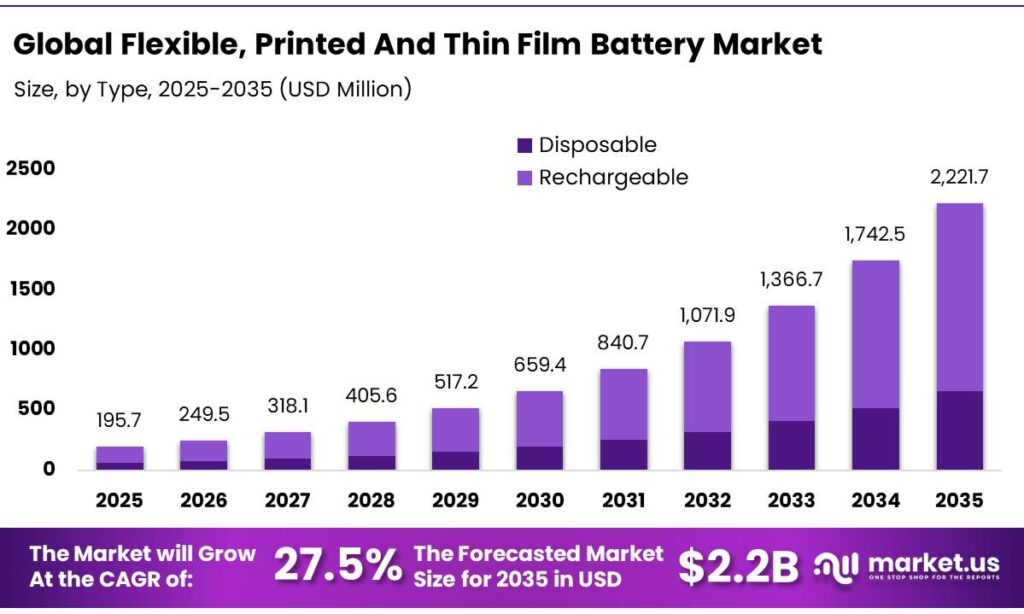
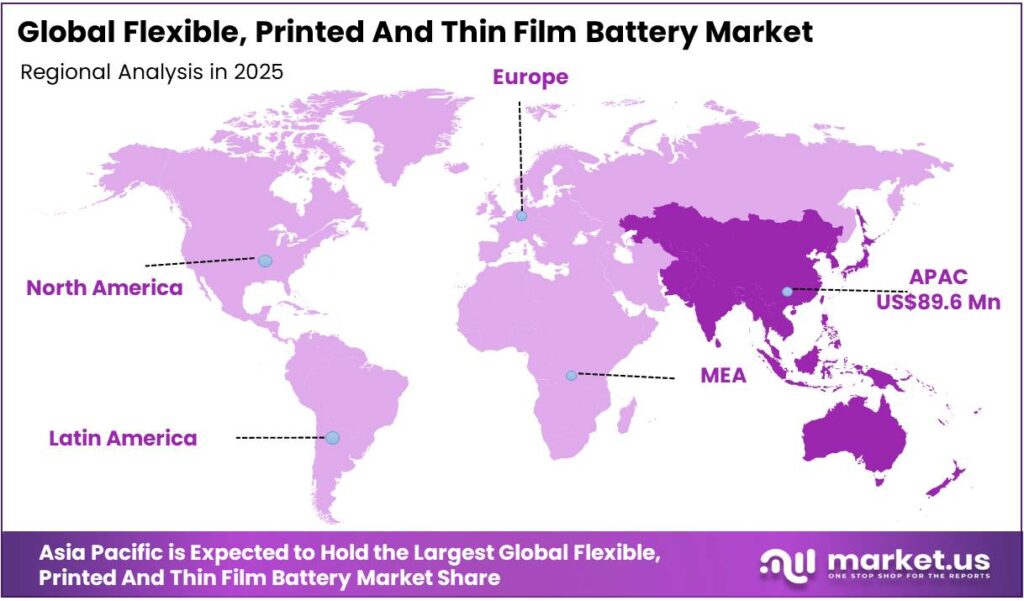
The Global Flexible, Printed and Thin Film Battery Market is expected to be worth around USD 2221.7 Million by 2035, up from USD 195.7 Million in 2025, at a CAGR of 27.5% from 2026 to 2035. The Asia Pacific segment maintained 45.8%, supporting a Flexible, Printed and Thin Film Battery value of USD 89.6 Mn.
Flexible, printed, and thin-film batteries are a class of advanced energy storage devices that prioritize form factor and mechanical properties over traditional rigid bulk. These are ultra-slim batteries, often less than 1 mm thick, fabricated layer-by-layer using techniques such as vacuum deposition. They are often solid-state batteries, which makes them safer than traditional Li-ion batteries as they lack flammable liquid electrolytes. They can be bent, twisted, folded, or even stretched without losing functionality. The market is characterized by form-factor-driven demand, material supply sensitivity, and application-specific performance trade-offs.
Adoption is closely linked to growth in wearables and IoT devices, where thin, lightweight, and bendable energy storage is required to support compact and curved designs. These batteries typically offer lower energy density than conventional rigid lithium-ion cells due to limited active material loading, but provide advantages in conformability, reduced thickness, often in the micron range, and integration into flexible substrates.
Asia Pacific plays a central manufacturing role, supported by established battery and electronics supply chains and concentrated lithium-ion production capacity. The developments in the industry focus on improving cycle life, mechanical durability under flexion, and energy density, while maintaining ultra-thin profiles. The market is application-driven, with wearables currently representing the most technically aligned and commercially viable deployment segment.
Key Takeaways
- The global flexible, printed, and thin-film battery market was valued at USD 195.7 Million in 2025.
- The global flexible, printed, and thin-film battery market is projected to grow at a CAGR of 27.5% and is estimated to reach USD 2221.7 Million by 2035.
- Based on the type, rechargeable flexible, printed, and thin film batteries dominated the market, with a market share of around 70.2%.
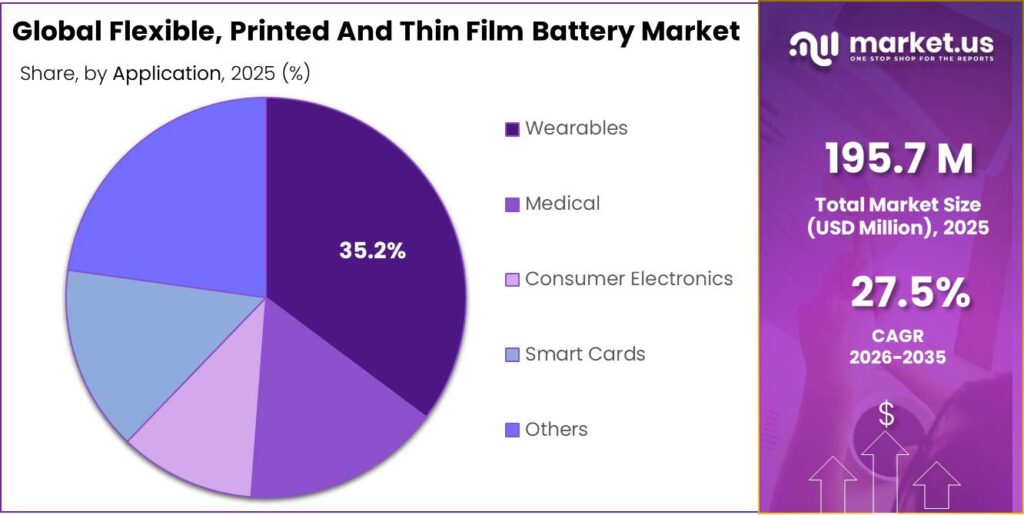
- Among the applications of flexible, printed, and thin-film batteries, wearables held a major share in the market, 35.2% of the market share.
- In 2025, the Asia Pacific was the most dominant region in the flexible, printed, and thin film battery market, accounting for around 45.8% of the total global consumption.
Type Analysis
Rechargeable Flexible, Printed and Thin Film Batteries Held the Largest Share in the Market.
The flexible, printed, and thin-film battery market is segmented based on type into disposable and rechargeable. The rechargeable, flexible, printed, and thin-film batteries dominated the market, comprising around 70.2% of the market share, as their electrochemistries are designed for multiple charge-discharge cycles, enabling reuse within devices that require frequent power replenishment rather than single-use operation.
In contrast, primary (non-rechargeable) batteries exhaust their active materials during the discharge process and are not designed for recharge, limiting them to one-time use before replacement is necessary. Rechargeable systems thus align better with modern device power management paradigms, where embedded charging circuits and user expectations for longevity make rechargeability a practical requirement.
Application Analysis
Flexible, Printed and Thin Film Battery is Mostly Utilized in Wearables.
Based on the applications of flexible, printed, and thin film battery, the market is divided into wearables, medical, consumer electronics, smart cards, and others. The wearables dominated the flexible, printed, and thin film battery market, with a market share of 35.2%, as their form factors and performance characteristics align tightly with the physical and electrical demands of wearable devices. For instance, wearables such as smartwatches and fitness bands require thin, conformable power sources that can bend with straps or curved housings while providing repeated recharge cycles.
In contrast, many medical implants demand stringent regulatory safety standards and long-term biocompatibility, often favoring well-established rigid or hermetically sealed battery technologies. Consumer electronics such as smartphones prioritize high energy and power densities that current flexible formats cannot yet match in compact volumes.
Wearables, by combining moderate power needs with physical flexibility and frequent charging, represent an application niche where flexible, printed, and thin-film batteries’ unique attributes are practically deployable and technically sufficient.
Key Market Segments:
By Type
- Disposable
- Rechargeable
By Application
- Wearables
- Medical
- Consumer Electronics
- Smart Cards
- Others
Drivers
Miniaturization of the Consumer Electronics Devices Drives the Flexible, Printed, and Thin Film Battery Market.
The systematic miniaturization of consumer electronics, characterized by the reduction of internal component volume, serves as the primary catalyst for the adoption of flexible, printed, and thin-film batteries. The ongoing miniaturization of consumer electronics has created a clear technical impetus, as these energy sources align with the form-factor and integration demands of ultra-compact devices.
Thin-film lithium-ion and micro-battery technologies enable active power integration in devices with stringent size and shape constraints, ranging from wearables, smart cards, and RFID tags to sensors embedded in soft, curved surfaces, by virtue of ultra-thin layers that are microns thick and flexible substrates that conform to non-planar designs.
In addition, public agencies are actively subsidizing this transition. For instance, the U.S. Department of Energy (DOE) launched the US$1.1 million Microbattery Design Prize in 2023 specifically to accelerate the commercialization of small-capacity batteries that push the boundaries of size and performance for sensor systems and clean energy manufacturing.
Similarly, miniaturized sensors and smart labels must withstand mechanical stress. While traditional flexible lithium-polymer cells may fail under repeated strain, printed batteries on flexible substrates have demonstrated stability exceeding 1,000 bending cycles.
Restraints
Performance Limitations Might Hamper the Demand for Flexible, Printed, and Thin Film Battery.
The integration of flexible, printed, and thin-film batteries (TFBs) into commercial markets is primarily constrained by inherent performance trade-offs compared to traditional liquid-electrolyte lithium-ion systems. While these formats excel in mechanical adaptability, they face significant hurdles in energy density, capacity scaling, and ionic conductivity. Flexible designs inherently constrain the amount of active material that can be incorporated within ultra-thin form factors, leading to lower energy and volumetric energy densities relative to thicker, rigid counterparts.
Additionally, mechanical stresses from repeated bending and flexing degrade structural and electrochemical integrity, undermining cycle stability and consistent power delivery. The thin-film electrodes and interfaces exhibit reduced capacity retention under deformation, and maintaining adhesion between active layers and flexible substrates remains a research focus. Moreover, flexible energy storage systems cannot yet match the specific energy and power delivery parameters of conventional cells, owing to limited active material content and slower ion transport kinetics in constrained geometries.
Opportunity
Focus on the Smart City Infrastructure Creates Opportunities in the Market.
The expansion of smart city infrastructure, defined by the dense integration of IoT sensors, structural monitoring, and urban automation, represents a high-growth opportunity for flexible, printed, and thin-film batteries. The disclosures on smart city infrastructure demonstrate substantial deployment of connected systems that directly underpin demand for supporting technologies, including compact, flexible power sources such as flexible, printed, or thin-film batteries.
For instance, as part of Singapore’s Smart Nation initiative, the national smart-city platform envisioned an interconnected network of 110, 000 lampposts with wireless sensors and cameras collecting urban data for planning and operations. The following are the percentages of municipalities where national public organizations are involved in the planning and implementation of smart city initiatives.
Planning (%) Implementation(%) Africa 86 54 Asia 56 47 Europe 77 71 Latin America 62 64 North America 62 54 World 71 63 - According to the UN-Habitat- World Smart Cities Outlook 2024 report, 54% of all countries have issued a nationwide smart city plan at the national level.
In addition, India’s smart cities mission evidences large-scale digital infrastructure integration. As of late 2024, all 100 cities under India’s Smart Cities Mission have fully operational Integrated Command and Control Centers (ICCCs). There is pervasive IoT penetration in smart city contexts, where low-profile, long-life, and flexible energy sources are required to power distributed sensing and communications infrastructure without frequent maintenance.
Trends
Proliferation of Wearables.
The proliferation of wearable devices, encompassing smartwatches, fitness trackers, and medical biosensors, has materially influenced demand for flexible, printed, and thin-film batteries by creating a substantial application base for ultra-thin, conformable power sources. For instance, advanced wearables, such as smart rings and clinical-grade patches, require ultra-thin batteries measuring as little as 0.45 mm in thickness and weighing less than 1 gram to eliminate traditional trade-offs between performance and wearability.
Wearables increasingly integrate continuous biometric monitoring, including FDA-cleared medical wearables for seizure detection and sophisticated physiological tracking. The FDA modernized its regulatory framework in January 2026, issuing final guidance that reduces oversight for general wellness wearables, such as those tracking sleep and activity, provided they do not make clinical medical claims. This deregulation encourages the rapid commercialization of battery-integrated sensors. Simultaneously, the National Institutes of Health (NIH) continues to fund research into standardizing data from these devices, emphasizing the need for reliable, long-duration power sources to ensure data continuity in longitudinal health studies.
As weight and volume in wearables are limited, batteries with higher energy densities can enable devices to run for longer periods. Lithium-ion batteries have some of the highest energy densities existing in battery technology, but they still cannot meet the requirements of the wearable market.
Geopolitical Impact Analysis
Geopolitical Tensions Are Impacting the Flexible, Printed, and Thin Film Battery Market Due to Concentrated Production.
The geopolitical tensions notably influence critical mineral supply chains, which underpin the production of flexible, printed, and thin-film batteries due to shared requirements for essential inputs such as lithium, nickel, cobalt, graphite, and rare earth elements. According to the International Energy Agency, the top three refining nations accounted for an average of 86% of global processing for key battery minerals in 2024, highlighting concentrated supply risk.
Consequently, governments are responding with strategic policies. For instance, the U.S. critical minerals list was updated in 2025 to include additional materials such as copper and silver to reduce import vulnerabilities and mobilize domestic and allied sourcing.
Similarly, India’s National Critical Mineral Mission (2025) mandates 1,200 exploration projects through 2030-31 and stockpiles strategic reserves to enhance supply resilience. Similarly, the Minerals Security Partnership, comprising 14 nations plus the EU, prioritizes secure and responsible critical mineral supply chains amidst geopolitical pressures.
Moreover, export controls and state interventions, such as Indonesia’s tightening of nickel resource governance, elevating its share of global production to about 60% by 2024, underscore the geopolitical balancing between the U.S. and China for supply access. These developments reveal how geopolitical contestation over critical minerals directly affects availability, regulatory frameworks, and sourcing strategies for battery components integral to flexible energy storage technologies.
Regional Analysis
Asia Pacific Held the Largest Share of the Global Flexible, Printed, and Thin Film Battery Market.
In 2025, the Asia Pacific dominated the global flexible, printed, and thin film battery market, led by China, holding about 45.8% of the total global consumption, supported by its central role in global battery production and electronics manufacturing ecosystems, creating a concentrated base for these emerging power technologies. China, South Korea, and Japan account for the vast majority of global lithium-ion battery cell output, with China alone responsible for over 80% of all batteries manufactured in 2025, according to the International Energy Agency.
In addition, the region hosts the world’s largest wearable and smartphone manufacturing clusters. In 2024, China alone exported over 140 million wearable devices, creating a localized, high-volume demand for ultra-thin and conformal power sources.
Key Regions and Countries
- North America
- The US
- Canada
- Europe
- Germany
- France
- The UK
- Spain
- Italy
- Russia & CIS
- Rest of Europe
- APAC
- China
- Japan
- South Korea
- India
- ASEAN
- Rest of APAC
- Latin America
- Brazil
- Mexico
- Rest of Latin America
- Middle East & Africa
- GCC
- South Africa
- Rest of MEA
Key Players Analysis
Manufacturers of flexible, printed, and thin-film batteries increasingly focus on technology innovation, strategic partnerships, and ecosystem engagement to secure a competitive advantage. Firms emphasize advancements in form factor, safety, and printable manufacturing processes to meet evolving product specifications.
The activities, such as participation in industry associations to broaden application channels, and the development and announcement of new battery technologies tailored to specific use cases, reflect deliberate efforts by manufacturers to differentiate their offerings, improve integration with end-use systems, and strengthen market positioning through collaboration and technology leadership.
The Major Players in The Industry
- Blue Spark Technologies
- STMicroelectronics
- Enfucell
- Samsung SDI
- Cymbet Corporation
- Panasonic Corporation
- Other Key Players
Report Scope:
Report Features Description Market Value (2025) US$195.7 Mn Forecast Revenue (2035) US$ 2221.7 Mn CAGR (2025-2035) 27.5% Base Year for Estimation 2025 Historic Period 2021-2024 Forecast Period 2025-2035 Report Coverage Revenue Forecast, Market Dynamics, Competitive Landscape, Recent Developments Segments Covered By Type (Disposable and Rechargeable), By Application (Wearables, Medical, Consumer Electronics, Smart Cards, and Others) Regional Analysis North America – The US & Canada; Europe – Germany, France, The UK, Spain, Italy, Russia & CIS, Rest of Europe; APAC– China, Japan, South Korea, India, ASEAN & Rest of APAC; Latin America– Brazil, Mexico & Rest of Latin America; Middle East & Africa– GCC, South Africa, & Rest of MEA Competitive Landscape Blue Spark Technologies, STMicroelectronics, Enfucell, Samsung SDI, Cymbet Corporation, Panasonic Corporation, and Other Players. Customization Scope Customization for segments, region/country-level will be provided. Moreover, additional customization can be done based on the requirements. Purchase Options We have three licenses to opt for: Single User License, Multi-User License (Up to 5 Users), Corporate Use License (Unlimited Users and Printable PDF)  Flexible Printed and Thin Film Battery MarketPublished date: Mar 2026add_shopping_cartBuy Now get_appDownload Sample
 -
-
- Blue Spark Technologies
- STMicroelectronics
- Enfucell
- Samsung SDI
- Cymbet Corporation
- Panasonic Corporation
- Other Key Players
Our Clients

- 180316
- Mar 2026






