Report Overview
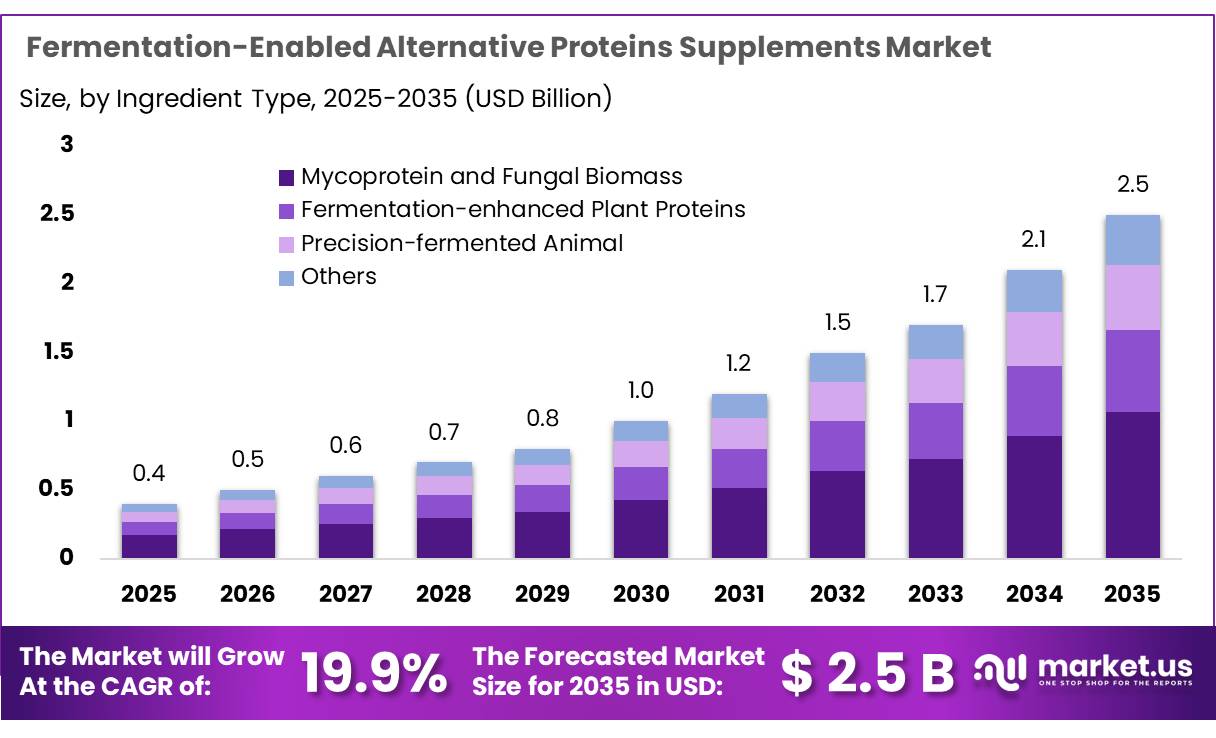
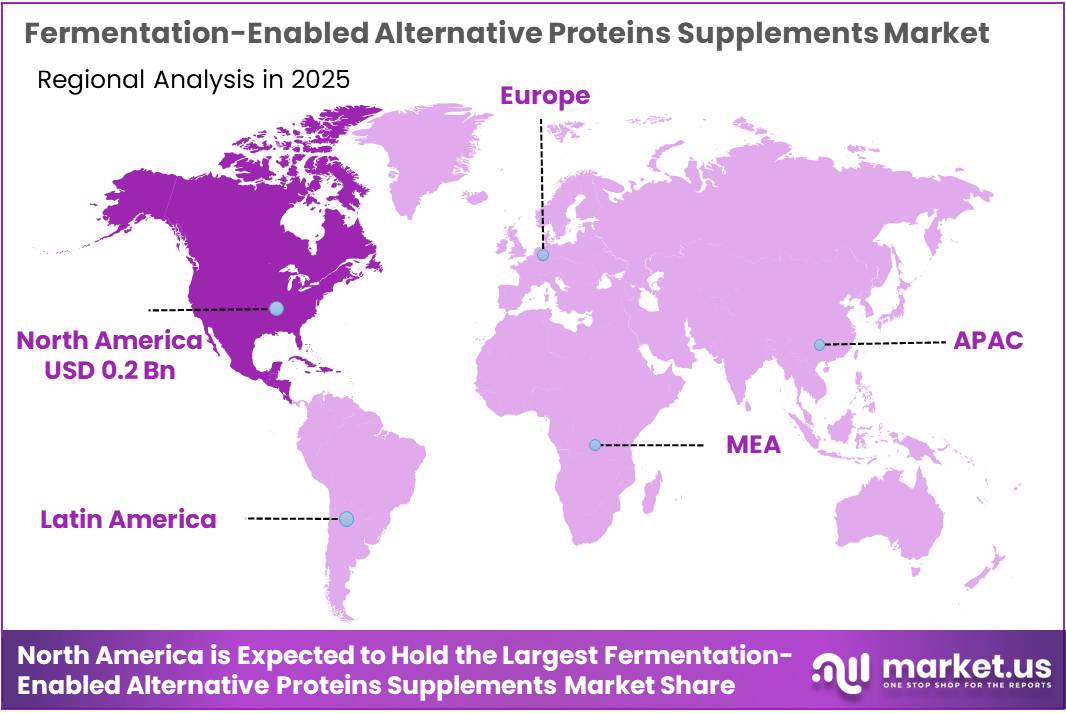
The Global Fermentation-Enabled Alternative Proteins Supplements Market size is expected to be worth around USD 2.5 Billion by 2035, from USD 0.4 Billion in 2025, growing at a CAGR of 19.9% during the forecast period from 2026 to 2035. In 2025, North America held a dominant market position, capturing more than a 62.78% share, holding USD 0.2 Billion revenue.
The fermentation-enabled alternative proteins supplements industry is developing as an important part of the alternative protein and biotechnology sectors. It uses microorganisms such as yeast, bacteria, fungi and microalgae to produce protein ingredients through controlled fermentation processes. These ingredients are increasingly being explored for use in protein powders, sports nutrition, dietary supplements, functional beverages and specialized nutritional products.
- According to the Good Food Institute’s 2026 industry report, fermentation-focused companies raised approximately USD 357 million in 2025, compared with USD 632 million in 2024. Although private investment declined, the industry continued to attract attention from food manufacturers, biotechnology companies and ingredient suppliers.
The report also identified more than 163 specialized companies working on fermentation-enabled products and ingredients in 2025. These developments indicate that the industry is moving from research-led development towards commercial production, although large-scale manufacturing and cost competitiveness remain important challenges.
Another important growth factor is increasing government support for alternative protein development and industrial biotechnology. According to the Good Food Institute’s State of Global Policy report, cumulative government investment in alternative proteins reached at least USD 2.5 billion by 2025, compared with approximately USD 700 million in 2021. This increasing financial support reflects growing government interest in biotechnology, food security and sustainable food production.
In Europe, the European Innovation Council has introduced an indicative budget of EUR 50 million for its precision fermentation and algae challenge, supporting the development of sustainable food production technologies.
However, the industry faces several operational challenges, including high fermentation infrastructure costs, expensive feedstocks, energy consumption, downstream processing requirements and difficulties in achieving consistent protein quality at commercial scale. Regulatory approval, ingredient safety validation and consumer acceptance also influence product commercialization.
The United States Food and Drug Administration requires food ingredients to meet applicable safety requirements, including the Generally Recognized as Safe (GRAS) framework where relevant. Its guidance also highlights the importance of microbial identification, controlled fermentation conditions, purity and quality testing.
Key Takeaways
- Fermentation-Enabled Alternative Proteins Supplements Market size is expected to be worth around USD 2.5 Billion by 2035, from USD 0.4 Billion in 2025, growing at a CAGR of 19.9%.
- Biomass Fermentation held a dominant market position, capturing more than a 56.78% share.
- Mycoprotein and Fungal Biomass held a dominant market position, capturing more than a 42.67% share.
- Yeast held a dominant market position, capturing more than a 48.67% share.
- Powders and Ready-to-Mix Formulations held a dominant market position, capturing more than a 57.78% share.
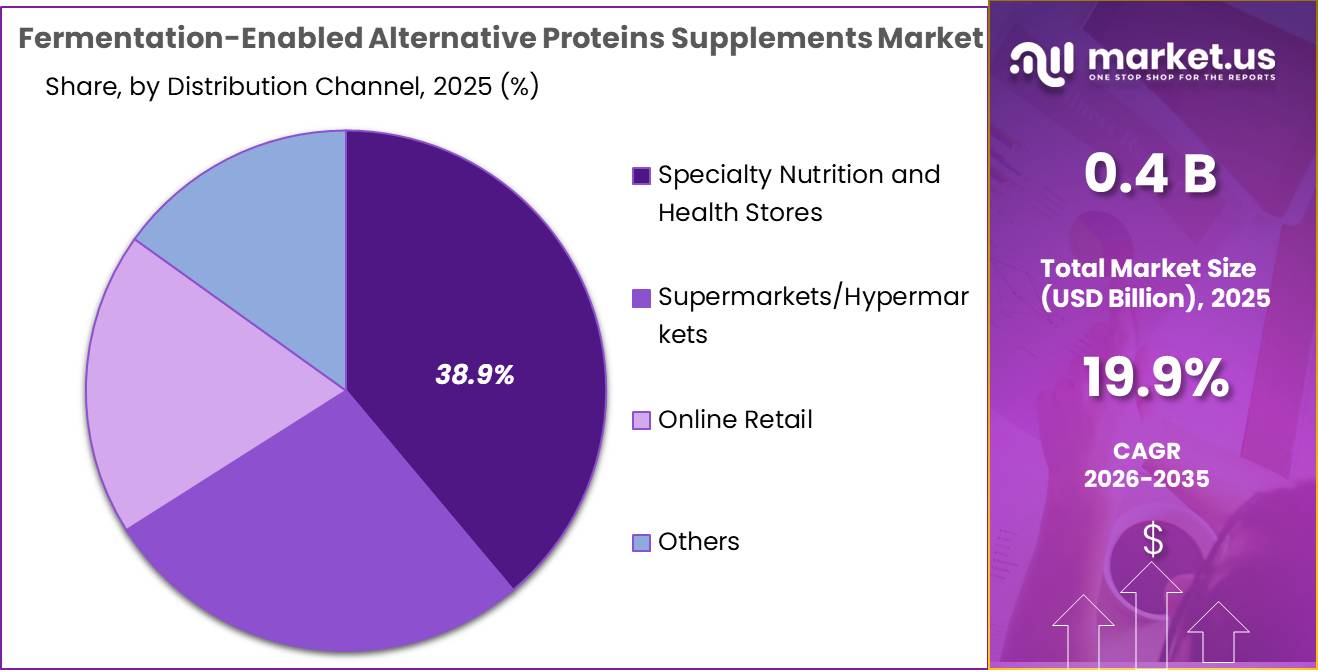
- Specialty Nutrition and Health Stores held a dominant market position, capturing more than a 38.90% share.
- North America dominated the Fermentation-Enabled Alternative Proteins Supplements Market in 2025, accounting for 62.78% of the global market, valued at approximately USD 0.2 billion.
By Process Analysis
Biomass Fermentation – Dominates due to its efficient microbial protein production and suitability for large-scale supplement manufacturing.
In 2025, “Biomass Fermentation” held a dominant market position, capturing more than a 56.78% share. The segment’s leading position is supported by its ability to produce protein-rich microbial biomass through the controlled cultivation of fungi, yeast and other microorganisms. This process allows manufacturers to develop alternative protein ingredients for dietary supplements, sports nutrition, protein powders and functional food applications.
Precision Fermentation is an important process in the fermentation-enabled alternative proteins supplements industry because it enables manufacturers to produce specific proteins and functional ingredients using selected microorganisms. The process supports the development of dairy-identical proteins, whey alternatives, enzymes and other nutritional ingredients for protein supplements, sports nutrition and functional beverages. In 2025, the European Union continued supporting this technology through its precision fermentation and algae initiative, which carried an indicative funding budget of EUR 50 million under the European Innovation Council.
Furthermore, the United States Department of Agriculture’s Economic Research Service reported that cumulative investment in precision fermentation reached USD 2.1 billion between 2015 and 2023. These developments demonstrate growing industrial interest in precision fermentation and its potential to strengthen the supply of specialized protein ingredients for the global supplement industry.
By Ingredient Type Analysis
Mycoprotein and Fungal Biomass – Dominates due to its high protein content, nutritional value and suitability for alternative protein formulations.
In 2025, “Mycoprotein and Fungal Biomass” held a dominant market position, capturing more than a 42.67% share. The segment’s leading position is supported by the growing use of fungal-based ingredients in protein supplements, sports nutrition and functional food products. Mycoprotein is produced through controlled fungal fermentation and provides a protein-rich ingredient that can be used in different nutritional formulations.
Government-backed industrial development further supports this segment. According to the European Union’s Circular Bio-based Europe Joint Undertaking, the PLENITUDE project established an industrial-scale mycoprotein production facility in the Netherlands with a potential annual production capacity of 10,000 tonnes. The project reported its first commercial supply in 2025, demonstrating progress in large-scale fungal protein manufacturing. This development supports the use of mycoprotein as a commercially viable ingredient for protein-rich nutritional products.
Fermentation-enhanced Plant Proteins are gaining attention as manufacturers increasingly use microbial fermentation to improve the functional properties of plant-based protein ingredients. The process can help improve protein digestibility, taste, texture and suitability for nutritional applications. These ingredients are increasingly relevant to vegan protein powders, sports nutrition, meal replacements and functional beverages. In 2026, the UK Food Standards Agency and Food Standards Scotland assessed a fermented pea and rice protein ingredient produced using Shiitake mushroom mycelia.
By Source Microbe Analysis
Yeast – Dominates due to its established fermentation processes, high protein content and suitability for commercial nutritional applications.
In 2025, “Yeast” held a dominant market position, capturing more than a 48.67% share. Its leading position is supported by its widespread use in microbial protein production and its ability to grow under controlled fermentation conditions. Yeast-based ingredients are used in protein supplements, nutritional powders and functional food formulations because they provide protein and essential amino acids.
According to the United States Department of Agriculture’s Economic Research Service, biomass fermentation uses microorganisms such as yeast to produce microbial mass that can serve as a direct protein source. This established production approach supports yeast’s importance in the alternative protein supplements industry.
Filamentous Fungi are gaining attention in the fermentation-enabled alternative protein supplements industry because they can produce protein-rich biomass through controlled cultivation. These microorganisms are particularly useful for developing mycoprotein ingredients, nutritional powders and functional protein formulations. Their fibrous structure and natural protein content make them suitable for manufacturers seeking alternatives to conventional animal and plant proteins.
In 2025, research on fungal fermentation demonstrated the potential of Monascus purpureus biomass, achieving a production yield of 6 grams per litre under submerged fermentation, with a protein content of 35%. The study also identified essential amino acids, highlighting the nutritional potential of fungal biomass. These developments support further applications of filamentous fungi in specialized protein supplements and functional nutrition products.
By Product Form Analysis
Powders and Ready-to-Mix Formulations – Dominate due to their convenience, longer shelf life and flexibility in nutritional product development.
In 2025, “Powders and Ready-to-Mix Formulations” held a dominant market position, capturing more than a 57.78% share. The segment’s leadership is supported by strong demand for convenient protein supplementation, easy storage and flexible consumption options. Fermentation-derived proteins can be processed into dry powders and blended with other nutritional ingredients to develop sports nutrition products, meal replacements and functional supplement mixes.
These formulations also allow manufacturers to offer different flavours and protein concentrations while maintaining convenient packaging and distribution. According to the United States Department of Agriculture (USDA), US production of human-grade whey protein concentrate reached 41.081 million pounds in July 2025, highlighting the established industrial supply of concentrated protein ingredients used in powder-based nutritional formulations.
Ready-to-Drink Supplements are gaining attention as consumers increasingly prefer convenient nutritional products that can be consumed during travel, workouts and daily activities. Fermentation-enabled proteins provide opportunities to develop alternative protein beverages using microbial and plant-derived ingredients. Manufacturers are focusing on improving protein solubility, taste, texture and formulation stability to make these beverages more suitable for everyday consumption.
These products can also be developed in different flavours and nutritional formats to serve sports nutrition, active lifestyle and general wellness applications. In 2025 and 2026, advancements in fermentation technology and ingredient processing continued to create opportunities for incorporating alternative proteins into liquid supplement formulations. Improved processing methods and greater attention to beverage stability are expected to support further product development in this segment.
By Distribution Channel Analysis
Specialty Nutrition and Health Stores – Dominate due to expert product guidance, specialized supplement availability and consumer preference for nutritional products.
In 2025, “Specialty Nutrition and Health Stores” held a dominant market position, capturing more than a 38.90% share. The segment’s leading position is supported by the availability of specialized protein supplements, sports nutrition products and health-focused formulations. These stores provide consumers with access to different protein sources, ingredient information and product recommendations, making them an important sales channel for fermentation-enabled alternative protein supplements.
Government data also highlights the commercial importance of specialized health retail. According to the U.S. Census Bureau’s 2024 Annual Integrated Economic Survey, food supplement stores generated approximately USD 5.30 billion in sales in the United States. In addition, the U.S. Bureau of Labor Statistics reported that the sectoral output of health and personal care stores reached approximately USD 481.23 billion in 2025.
Supermarkets/Hypermarkets are becoming an important distribution channel for fermentation-enabled alternative protein supplements because they provide manufacturers with access to a broad consumer base. These retail outlets offer opportunities to sell protein powders, ready-to-drink nutritional beverages and functional protein products alongside conventional health and food products.
In 2026, the U.S. Census Bureau reported supermarket and other grocery store sales of approximately USD 74.19 billion in August, highlighting the scale of the established grocery retail channel. Wider availability of alternative protein supplements through supermarket chains is expected to improve consumer access and support the segment’s development.
Key Market Segments
By Process
- Precision Fermentation
- Biomass Fermentation
By Ingredient Type
- Mycoprotein and Fungal Biomass
- Fermentation-enhanced Plant Proteins
- Precision-fermented Animal-equivalent Proteins
- Others
By Source Microbe
- Yeast
- Filamentous Fungi
- Bacteria
- Microalgae and Other Microorganisms
By Product Form
- Powders and Ready-to-Mix Formulations
- Ready-to-Drink Supplements
- Capsules and Tablets
- Protein Bars and Supplement Snacks
- Other Forms
By Distribution Channel
- Supermarkets/Hypermarkets
- Specialty Nutrition and Health Stores
- Online Retail
- Others
Driver Analysis
US Ingredient Commercialization
Commercial launches supported by ingredient-specific safety documentation are converting fermentation-derived proteins from development projects into purchasable inputs for nutrition formulators. FDA closed Vivici’s GRAS Notice 1200 on 28 February 2025 with a “no questions” response concerning the notifier’s conclusion for specified uses of fermentation-produced beta-lactoglobulin; the agency’s letter identifies maximum inclusion levels of 15% for meal replacements and supplements, 25% for powdered nutritional beverages and 25% for high-protein performance beverages. The letter expressly states that this is not an FDA affirmation of GRAS status under 21 CFR 170.35, and it does not constitute blanket approval of every finished dietary supplement, dose or claim.
Vivici subsequently documented its March 2025 US commercial launch and stated that initial customer offtake agreements were secured, establishing active commercialization rather than merely an announced future opportunity. In an illustrative portfolio of ten customers each selling 100,000 one-kilogram powder packs annually, 20% inclusion requires 200 tonnes of ingredient; at an assumed USD 12/kg supplier realization, attributable revenue is USD 2.4 million.
If only six customers reach commercial production, revenue falls to USD 1.44 million, demonstrating that legal eligibility and availability do not equal realized demand. The business model shifts toward repeat ingredient supply, application support and customer qualification, with the finished product’s classification assessed separately. The +1.3 pp coefficient assumes 26% revenue exposure grows 5.0 percentage points faster through incremental commercial conversion, excluding subsequent formulation and format effects allocated below.
Drivers Impact Analysis
| Driver | (~) % Impact on CAGR Forecast | Geographic Relevance | Impact Timeline |
|---|---|---|---|
| US ingredient commercialization | +1.3 pp | US; European ingredient exporters | Short term (≤ 2 years) |
| Concentrated sports-nutrition formulations | +1.1 pp | US, China, Southeast Asia | Short term (≤ 2 years) |
| Yeast-protein portfolio adoption | +1.0 pp | China, Indonesia, US | Short term (≤ 2 years) |
| Clear and compact formats | +0.9 pp | US | Short term (≤ 2 years) |
| Fermented bioactive-protein launches | +0.7 pp | US; Netherlands-based suppliers | Medium term (2–4 years) |
Restraint Analysis
Uncompetitive Delivered Protein Costs
A fermentation-derived ingredient can satisfy nutritional and quality specifications yet fail procurement when its delivered cost per gram of usable protein exceeds the customer’s attainable selling-price premium. The FSA’s March 2026 technical review identifies host selection, secretion, harvesting, purification and drying as material determinants of production economics, while noting that some hosts release proteases capable of degrading the target protein. Those process factors explain potential cost pressure but do not establish a universal price premium for all yeast proteins or precision-fermented ingredients.
In an illustrative comparison, a fermentation-derived ingredient assayed at 90% protein and priced at USD 12/kg costs approximately USD 0.333 to supply 25 g of protein; a conventional alternative assayed at 80% and priced at USD 7/kg costs approximately USD 0.219. The difference is USD 0.115 per serving, or approximately USD 3.44 across 30 servings, before formulation adjustments, packaging and distribution. A brand selling 500,000 such packs annually would therefore face approximately USD 1.72 million of incremental ingredient expenditure if it replaced the entire protein contribution on those assumptions.
Lower required inclusion, superior functionality or a defensible premium can offset the gap, but these must be demonstrated rather than inferred from protein concentration alone. The restraint arises when the customer rejects the commercial specification—not simply when the supplier incurs high processing costs. The −0.8 pp deduction assumes 20% revenue exposure grows 4.0 percentage points more slowly through cost-based non-awards, excluding price-competitive yeast products, costs already embedded in the underlying forecast and purchases retained by other in-scope fermentation proteins.
Restraint Impact Analysis
| Restraint | (~) % Impact on CAGR Forecast | Geographic Relevance | Impact Timeline |
|---|---|---|---|
| Uncompetitive delivered protein costs | −0.8 pp | US, UK, China, EU | Short term (≤ 2 years) |
| Product-specific market-access gaps | −0.7 pp | US, Great Britain | Medium term (2–4 years) |
| Milk-allergen customer exclusions | −0.4 pp | US, UK, EU | Long term (≥ 4 years) |
| Technology-related purchase rejection | −0.4 pp | US, Great Britain | Medium term (2–4 years) |
| Unsubstantiated benefit-led propositions | −0.3 pp | US | Medium term (2–4 years) |
Opportunity Analysis
GLP-1 Clinic Nutrition Programs
Clinician-supervised weight-management providers offer an adjacent procurement channel for fermentation-derived protein supplements where products are selected to address an assessed dietary shortfall rather than sold through generic sports-nutrition marketing. A 2025 joint advisory from four professional societies identifies protein adequacy and resistance training as priorities during GLP-1 therapy, discusses proposed protein intakes of 1.2–1.6 g/kg/day during active weight reduction, and cautions that the appropriate body-weight denominator in obesity remains uncertain.
It also states that increased protein intake alone is unlikely to preserve muscle adequately without structured strength training; it does not establish superiority of fermentation-derived protein or prescribe a particular supplement.
The opportunity is therefore a new, adherence-monitored clinic supply agreement—not GLP-1 prescription growth itself or the compact-shot format already counted as a driver. In an illustrative network enrolling 20,000 patients annually, 30% uptake of one daily serving containing 20 g of qualifying protein for 180 days creates 21.6 tonnes of protein demand. At 90% ingredient protein concentration, required ingredient volume is 24 tonnes, worth USD 288,000 at an assumed USD 12/kg. If 25% displaces existing fermentation-protein supplements, net incremental revenue falls to USD 216,000; patient-specific dietary assessment may reduce uptake further.
The +0.50 pp contribution assumes 10% revenue exposure grows 5.0 percentage points faster through new clinic contracts, with product eligibility, tolerability and adherence validated independently and no implication that the ingredient treats obesity or prevents medication-related muscle loss.
Opportunity Impact Analysis
| Opportunity | (~) % Potential CAGR Upside | Geographic Relevance | Execution Window |
|---|---|---|---|
| GLP-1 clinic nutrition programs | +0.50 pp | US; UK subject to ingredient eligibility | Short term (≤ 2 years) |
| Older-adult care contracts | +0.40 pp | China; US subject to product eligibility | Medium term (2–4 years) |
| Retailer-exclusive formulation platforms | +0.35 pp | US, China, Indonesia | Medium term (2–4 years) |
| Evidence-backed women’s nutrition | +0.30 pp | US | Medium term (2–4 years) |
| Regional contract-supply localization | +0.25 pp | India production; authorized export markets | Medium term (2–4 years) |
Challenges Analysis
Oxygen and Cooling Scale-Up
Aerobic microbial processes must maintain oxygen supply, nutrient distribution and heat removal as working volumes increase, but these engineering capacities do not scale proportionately with broth volume. An October 2026 technical review identifies changes in mixing time, oxygen transfer, carbon-dioxide removal, hydrostatic pressure and local nutrient gradients as reasons laboratory performance may not reproduce at commercial scale; increasing agitation or aeration can improve transfer while increasing power demand, foaming and cooling requirements.
In an illustrative precision-fermentation campaign, a 100,000-L working volume reaching 40 g/L target-protein concentration produces 4,000 kg before recovery. A plant-scale reduction to 34 g/L lowers output to 3,400 kg; at an unchanged 75% recovery, saleable output falls from 3,000 to 2,550 kg, a 15% reduction. If batch expenditure remains USD 45,000, expenditure per recovered kilogram rises from USD 15 to approximately USD 17.65, or 17.6%, without assuming that the customer rejects the product.
Across 50 batches, displaced output totals 22.5 tonnes before mitigation. Manufacturers need scale-down models that reproduce plant gradients, measured oxygen-transfer performance, cooling-capacity verification and feed strategies matched to actual vessel limits. The −0.40 pp contribution assumes 16% revenue exposure grows 2.5 percentage points more slowly through residual scale-up losses and commissioning iterations, excluding downstream recovery changes and commercial non-awards already assigned to restraints.
Challenges Impact Analysis
| Challenge | (~) % CAGR Friction Drag | Geographic Relevance | Mitigation Horizon |
|---|---|---|---|
| Oxygen and cooling scale-up | −0.40 pp | US, Netherlands, China, India | Long term (≥ 4 years) |
| Downstream recovery and functionality | −0.40 pp | US, Netherlands, China, India | Medium term (2–4 years) |
| Culture integrity and contamination | −0.35 pp | US, Europe, China, India | Long term (≥ 4 years) |
| Protein characterization and release | −0.30 pp | US, UK, EU, China | Medium term (2–4 years) |
| Application stability and transfer | −0.25 pp | US, China, Indonesia, UK | Medium term (2–4 years) |
Geopolitical Impact Analysis
Geopolitical Impact of the Ongoing Middle East War on the Fermentation-Enabled Alternative Proteins Supplements Market
The ongoing Middle East conflict in 2026 is creating supply chain and cost-related challenges for the fermentation-enabled alternative proteins supplements industry. Disruptions around the Strait of Hormuz and Red Sea are affecting international shipping, energy supplies and the movement of industrial raw materials. These disruptions are increasing transportation, electricity and production costs for manufacturers that depend on imported fermentation feedstocks, glucose, agricultural inputs and specialized processing materials.
According to the World Bank’s October 2026 Commodity Markets Outlook, global energy prices are projected to increase by 32% in 2026, while fertilizer prices are expected to rise by 14%. These increases can indirectly raise the cost of agricultural feedstocks and industrial fermentation operations. Furthermore, UNCTAD reported that shipping through the Strait of Hormuz declined by more than 95% during the conflict, highlighting the severity of trade disruption.
Higher freight costs, delayed deliveries and energy price volatility may affect production planning, ingredient availability and profit margins. However, these conditions may also encourage manufacturers to develop regional fermentation facilities, diversify raw material suppliers and adopt locally available agricultural feedstocks. Such strategies could strengthen supply chain resilience and support long-term industry development.
Regional Insights
Dominating Region: North America
North America dominated the Fermentation-Enabled Alternative Proteins Supplements Market in 2025, accounting for 62.78% of the global market, valued at approximately USD 0.2 billion. The region’s leadership is supported by advanced biotechnology infrastructure, established food processing industries, strong research capabilities and growing investment in alternative protein production.
The United States plays a major role through government-backed research and industrial development initiatives. According to the Good Food Institute’s 2025 policy report, US federal and state governments invested more than USD 150 million in alternative protein development in 2024. Additionally, the US Department of Commerce awarded USD 51 million to the Illinois Fermentation and Agriculture Biomanufacturing (iFAB) Tech Hub to strengthen precision fermentation manufacturing capacity. These developments support regional innovation and commercialization.
Europe is emerging as a major growth region due to increasing public investment in fermentation research, sustainable food technologies and biotechnology infrastructure. Governments are supporting research institutions and food technology companies to improve alternative protein production and reduce dependence on conventional protein supply chains.
According to Good Food Institute Europe, European funders invested EUR 1.3 billion in alternative protein research between 2020 and 2025, including EUR 236 million in 2025. Fermentation accounted for 29% of the total research funding allocation. Denmark, the United Kingdom and the Netherlands remain important innovation centres. These investments are creating opportunities for fermentation-derived protein ingredients in nutritional supplements, functional foods and sports nutrition.
Key Regions and Countries Insights
- North America
- US
- Canada
- Europe
- Germany
- France
- The UK
- Spain
- Italy
- Rest of Europe
- Asia Pacific
- China
- Japan
- South Korea
- India
- Australia
- Rest of APAC
- Latin America
- Brazil
- Mexico
- Rest of Latin America
- Middle East & Africa
- GCC
- South Africa
- Rest of MEA
Key Players Analysis
Perfect Day, Inc. is a biotechnology company specializing in precision fermentation to produce animal-free dairy proteins, particularly whey protein. Founded in 2014, the company uses engineered microorganisms to develop protein ingredients for nutritional products, food and beverages. In January 2024, Perfect Day announced a pre-Series E funding round of up to USD 90 million to support manufacturing scale-up and commercial development. Its technology provides opportunities in protein powders, sports nutrition and functional supplements. The company focuses on improving production efficiency and expanding commercial supply.
Marlow Foods Limited, operating under the Quorn brand, is a leading manufacturer of mycoprotein produced through fungal fermentation. Its products are developed using Fusarium venenatum and serve the alternative protein and nutritional food industries. In 1985, Quorn introduced its first mycoprotein-based product in the UK. Its industrial fermenters can operate continuously for more than 30 days, producing over 2,000 tonnes of biomass. In 2025, the company increased its UK market share by 0.9 percentage points to 31%, strengthening its position in fungal protein production.
ENOUGH, formerly known as 3F BIO Ltd., is a food biotechnology company specializing in mycoprotein production through industrial fermentation. Founded in 2015, the company developed its ABUNDA protein ingredient for alternative food and nutritional applications. Its production facility in Sas van Gent, the Netherlands, covers approximately 15,000 square metres and started with an annual production capacity of 10,000 tonnes. The company has planned to increase capacity to 60,000 tonnes, supporting larger-scale commercial supply. Its collaboration with Cargill further strengthens ingredient development and industrial distribution opportunities.
Top Key Players Outlook
- Perfect Day, Inc.
- Marlow Foods Limited, Quorn
- 3FBIO Ltd., ENOUGH
- The Protein Brewery B.V.
- MycoTechnology, Inc.
- Geltor, Inc.
- The EVERY Company
- Imagindairy Ltd.
- Remilk Ltd.
- Formo Bio GmbH
- Change Foods, Inc.
- New Culture, Inc.
- Other Key Players
Recent Developments
- In June 2026, The Protein Brewery B.V received an additional EUR 18 million through a Series B extension led by ABN AMRO Sustainable Impact Fund, bringing its total funding raised to more than EUR 70 million. The investment is intended to increase production capacity to more than 2,000 metric tonnes, strengthen European commercial operations and expand research into the nutritional benefits of mycoprotein.
- In March 2026, MycoTechnology announced the commercial-scale US availability of its Honey Truffle Sweet Protein under the brand name Zukora™, following self-affirmed GRAS status. The ingredient can be up to 2,500 times sweeter than sucrose, depending on the application, and is designed for protein shakes, sports nutrition powders, nutritional bars and functional beverages.
Report Scope
| Report Features | Description |
|---|---|
| Market Value (2025) | USD 0.4 Bn |
| Forecast Revenue (2035) | USD 2.5 Bn |
| CAGR (2026-2035) | 19.9% |
| Base Year for Estimation | 2025 |
| Historic Period | 2020-2024 |
| Forecast Period | 2026-2035 |
| Report Coverage | Revenue Forecast, Market Dynamics, Competitive Landscape, Recent Developments |
| Segments Covered | By Process (Precision Fermentation, Biomass Fermentation), By Ingredient Type (Mycoprotein and Fungal Biomass, Fermentation-enhanced Plant Proteins, Precision-fermented Animal-equivalent Proteins, Others), By Source Microbe (Yeast, Filamentous Fungi, Bacteria, Microalgae and Other Microorganisms), By Product Form ( Powders and Ready-to-Mix Formulations, Ready-to-Drink Supplements, Capsules and Tablets, Protein Bars and Supplement Snacks, Other Forms), By Distribution Channel ( Supermarkets/Hypermarkets, Specialty Nutrition and Health Stores, Online Retail, Others) |
| Regional Analysis | North America – US, Canada; Europe – Germany, France, The UK, Spain, Italy, Rest of Europe; Asia Pacific – China, Japan, South Korea, India, Australia, Singapore, Rest of APAC; Latin America – Brazil, Mexico, Rest of Latin America; Middle East & Africa – GCC, South Africa, Rest of MEA |
| Competitive Landscape | Perfect Day, Inc., Marlow Foods Limited, Quorn, 3FBIO Ltd., ENOUGH, The Protein Brewery B.V., MycoTechnology, Inc., Geltor, Inc., The EVERY Company, Imagindairy Ltd., Remilk Ltd., Formo Bio GmbH, Change Foods, Inc., New Culture, Inc., Other Key Players |
| Customization Scope | Customization for segments, region/country-level will be provided. Moreover, additional customization can be done based on the requirements. |
| Purchase Options | We have three licenses to opt for: Single User License, Multi-User License (Up to 5 Users), Corporate Use License (Unlimited User and Printable PDF) |