


Report Overview
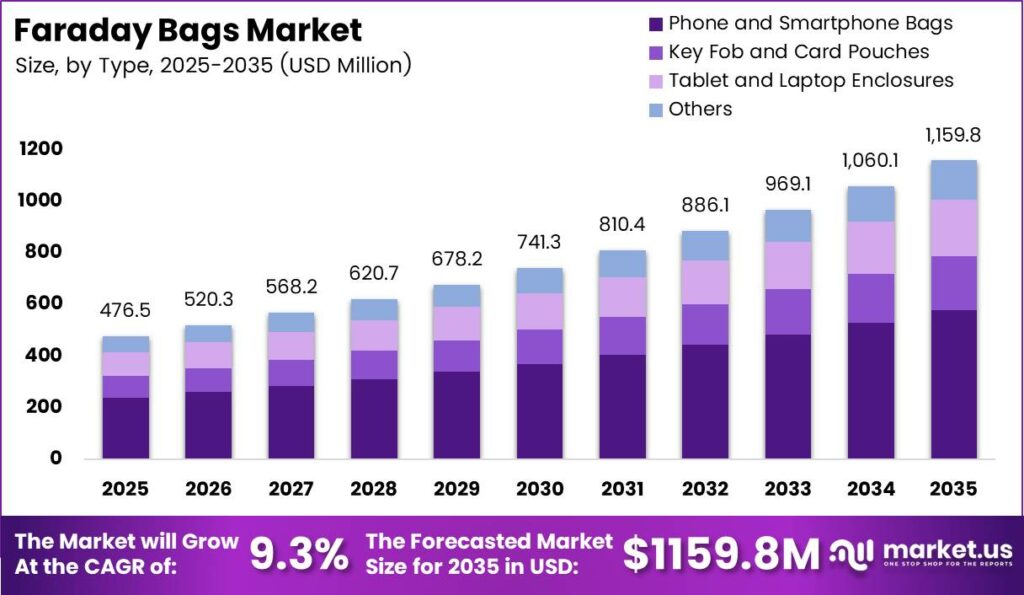
Global Faraday Bags Market size is expected to be worth around USD 1,159.8 Million by 2035 from USD 476.5 Million in 2025, growing at a CAGR of 9.3% during the forecast period 2026 to 2035.
The Faraday Bags Market covers portable electromagnetic shielding enclosures designed to block radio-frequency signals across cellular, Wi-Fi, Bluetooth, and GPS bands. Products span phone sleeves, key fob pouches, tablet enclosures, and large-format forensic sacks. Buyers range from individual consumers protecting vehicle keys to law enforcement agencies preserving digital evidence. This breadth of use cases defines a market with both consumer and institutional demand channels operating simultaneously.
Key Takeaways
- The global Faraday Bags Market is valued at USD 476.5 Million in 2025 and is forecast to reach USD 1,159.8 Million by 2035.
- The market grows at a CAGR of 9.3% during the forecast period 2026 to 2035.
- By Type, Phone and Smartphone Bags dominate with a 38.56% share in 2025.
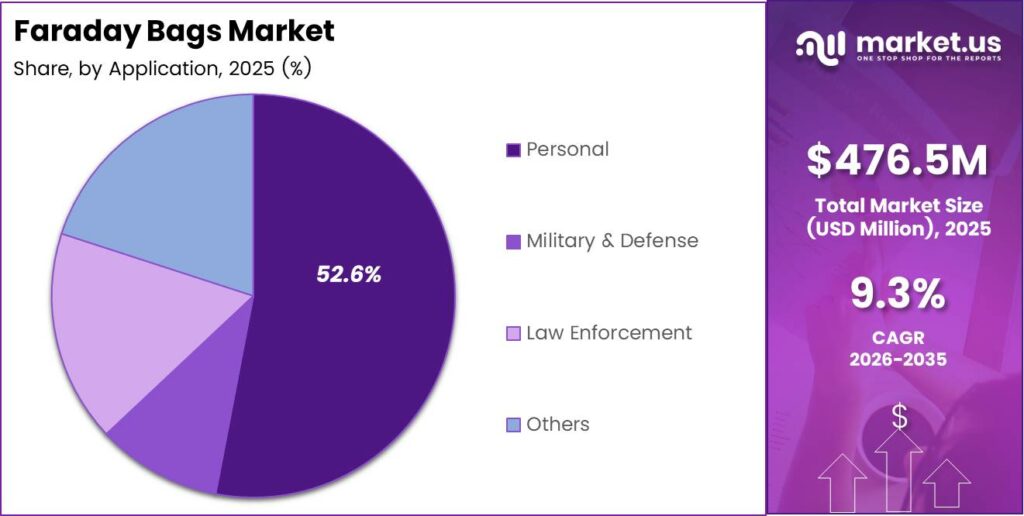
- By Application, Personal use leads with a 52.67% share in 2025.
- By Distribution Channel, Offline channels hold the dominant share at 64.78% in 2025.
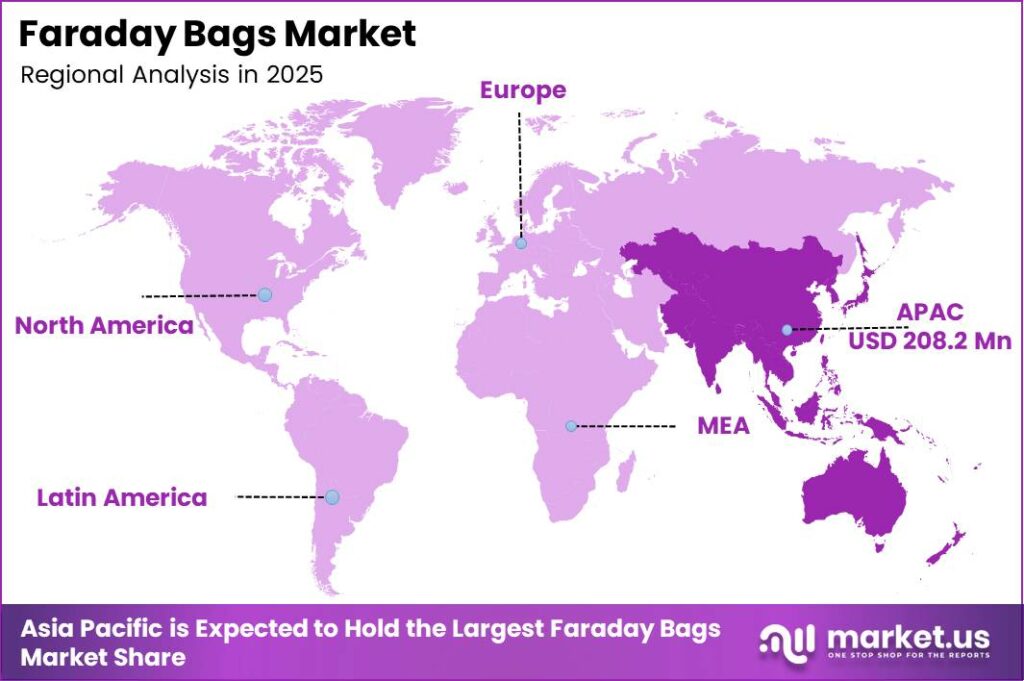
- Asia-Pacific is the dominant region with a 43.78% market share, valued at USD 208.2 Million in 2025.
- Europe is the fastest-growing region during the forecast period.
- Tablet and Laptop Enclosures represent the fastest-growing product type segment.
- Online is the fastest-growing distribution channel.
Institutional procurement is reshaping the market’s revenue quality. In September 2025, MOS Equipment secured a five-year Indefinite Delivery/Indefinite Quantity contract to supply Mission Darkness BlockBox Lab XL forensic enclosures to the U.S. Secret Service’s National Computer Forensic Institute. Contract vehicles of this type create predictable, multi-year revenue that individual consumer sales cannot replicate. This signals a structural shift toward institutional buyers as the market’s primary revenue anchor.
According to ITU, approximately 6 billion people, representing 74% of the world’s population, used the Internet in 2025. This scale of connected device ownership directly expands the addressable base for RF-isolation products. Every new internet user represents a potential owner of a trackable, remotely accessible device, which is the core threat Faraday bags are designed to counter.
ITU data shows an estimated 1.3 billion people came online between 2020 and 2025. This five-year expansion added a substantial new cohort of device owners with limited awareness of RF-based privacy risks. Vendors who target first-time device users in emerging markets with entry-level Faraday products stand to capture demand before competitors establish category recognition in those regions.
Type Analysis
Phone and Smartphone Bags dominates with 38.56% due to high consumer volume and daily carry behavior.
In 2025, Phone and Smartphone Bags held a dominant market position in the By Type segment of the Faraday Bags Market, with a 38.56% share. Smartphones are the most widely carried connected device globally, making RF-blocking sleeves the first purchase most buyers consider. This concentration of demand in a single product type gives manufacturers a high-volume entry point but also creates pricing pressure as competition intensifies at the consumer end.
Key Fob and Card Pouches address a specific, high-frequency theft threat: relay attacks on keyless entry systems. Vehicle owners in Europe and North America have adopted these pouches as a low-cost, passive defense requiring no behavioral change beyond placing keys inside. This segment benefits from repeat purchase cycles as pouches wear out and from rising vehicle theft statistics that consistently generate media coverage and consumer awareness.
Tablet and Laptop Enclosures represent the fastest-growing type segment, driven by enterprise and institutional buyers securing larger devices in sensitive environments. In May 2026, forensic tech evaluators confirmed that standard high-shielding Mission Darkness and SLNT phone sleeves block up to 40GHz spectrum frequencies to fully eliminate 5G, Wi-Fi, and Bluetooth connectivity. This validated performance benchmark strengthens procurement confidence for agencies specifying enclosures for tablets and laptops used in field investigations.
The Others sub-segment captures large-format enclosures, drone isolation sacks, and multi-device bags. These products serve specialized institutional buyers rather than the mass consumer market. Consequently, unit volumes remain lower, but average selling prices and margin profiles are structurally higher than in the consumer phone-bag segment.
Application Analysis
Personal dominates with 52.67% due to broad consumer adoption across everyday privacy use cases.
In 2025, Personal held a dominant market position in the By Application segment of the Faraday Bags Market, with a 52.67% share. Individual consumers purchasing for vehicle key protection, phone privacy, and travel security represent the largest single buyer group. This majority share reflects the market’s retail origins, but it also signals vulnerability: personal buyers are price-sensitive and quick to switch to lower-cost alternatives when product differentiation is unclear.
Military and Defense procurement creates a structurally different demand profile from consumer purchasing. According to SIPRI’s April 2025 publication, global military expenditure reached USD 2,718 billion in 2024, increasing by 9.4% in real terms, the steepest annual rise since at least 1988. This budget expansion directly enlarges the procurement pool for verified RF-isolation equipment. Defense buyers specify performance thresholds, require documented batch traceability, and generate repeat institutional orders that consumer channels cannot match in predictability.
Law Enforcement buyers share the institutional procurement characteristics of military buyers but operate under distinct evidence-handling standards. SWGDE guidance dated February 28, 2025 explicitly identifies Faraday bags as isolation options while requiring documented effectiveness checks. This specification-led purchasing model favors vendors with certified product lines and traceable quality records over undifferentiated commodity suppliers. Law enforcement contracts also carry reputational value that strengthens a vendor’s positioning across adjacent institutional segments.
The Others sub-segment includes corporate security, healthcare, and private security applications. These buyers typically seek customized or co-branded solutions rather than off-the-shelf consumer products. This creates a margin opportunity for vendors willing to develop specification-led variants for non-government institutional buyers outside the primary military and law enforcement categories.
Distribution Channel Analysis
Offline dominates with 64.78% due to institutional procurement and in-person verification requirements.
In 2025, Offline held a dominant market position in the By Distribution Channel segment of the Faraday Bags Market, with a 64.78% share. Institutional buyers including law enforcement agencies, government departments, and defense contractors procure through approved vendor lists and direct purchase orders rather than online retail. This procurement structure anchors a large portion of total market volume in offline channels where product demonstration and specification verification occur before purchase.
Online channels represent the fastest-growing distribution segment, driven by consumer privacy awareness and the convenience of direct-to-consumer e-commerce. Individual buyers researching keyless entry theft or cellular privacy find Faraday bags primarily through search and social content rather than physical retail. Vendors with strong search presence and clear product performance communication hold a structural advantage as online channel share continues to expand relative to offline retail.
Key Market Segments
By Type
- Phone and Smartphone Bags
- Key Fob and Card Pouches
- Tablet and Laptop Enclosures
- Others
By Application
- Personal
- Military & Defense
- Law Enforcement
- Others
By Distribution Channel
- Offline
- Online
Regional Analysis
Asia-Pacific Dominates the Faraday Bags Market with a Market Share of 43.78%, Valued at USD 208.2 Million
Asia-Pacific holds the dominant regional position with a 43.78% share, valued at USD 208.2 Million in 2025. The region’s leadership reflects both its role as the primary manufacturing base for conductive textile and RF-shielding components and its large consumer electronics ownership base. Manufacturers operating in Asia-Pacific benefit from supply chain proximity, but rising institutional demand from defense and law enforcement buyers across the region is gradually shifting the revenue mix toward higher-value procurement contracts.
Europe is the fastest-growing regional market during the forecast period. According to SIPRI’s April 2025 publication, European military expenditure reached USD 693 billion in 2024. This defense spending expansion directly accelerates institutional procurement of verified RF-isolation equipment across European defense and law enforcement agencies. In October 2026, MOS Equipment deployed its updated Mission Darkness NeoLok Window Faraday Bag for Phones, featuring a patented magnetic closure system alongside proprietary dual-layer TitanRF Faraday Fabric to block RF signals from low MHz up to 40GHz, directly targeting the performance specifications that European institutional buyers require.
North America maintains a strong market position supported by institutional procurement infrastructure and an established consumer awareness base for RF-privacy products. The U.S. leads institutional demand through federal agency contracts and a network of forensic technology programs that generate specification-led purchasing. Latin America and the Middle East and Africa regions represent smaller current revenue bases but hold growth potential as law enforcement digitization programs expand access to forensic tool procurement budgets.
Key Regions and Countries
North America
- US
- Canada
Europe
- Germany
- France
- The UK
- Spain
- Italy
- Rest of Europe
Asia Pacific
- China
- Japan
- South Korea
- India
- Australia
- Rest of APAC
Latin America
- Brazil
- Mexico
- Rest of Latin America
Middle East and Africa
- GCC
- South Africa
- Rest of MEA
Drivers
Remote wiping and incoming network traffic create an immediate evidence-preservation requirement for law enforcement and forensic agencies. This makes verified RF-isolation a specification-led procurement consideration rather than a discretionary purchase. SWGDE guidance dated February 28, 2025 explicitly identifies Faraday bags, boxes, and rooms as isolation options while requiring documented effectiveness checks, supporting institutional purchasing over undifferentiated consumer products.
The combined driver contribution of +1.70 percentage points against the baseline CAGR of 9.3% reflects institutional order concentration in documented-performance products. Mobile evidence preservation procurement adds +0.65 percentage points as the leading driver, followed by legacy keyless-entry theft protection at +0.45 percentage points. Vendors who invest in traceable batch documentation and certified performance specifications capture disproportionate share of the institutional procurement pipeline.
| Driver | (~) % Impact on CAGR Forecast | Geographic Relevance | Impact Timeline |
|---|---|---|---|
| Mobile evidence preservation procurement | +0.65% | Global; North America and Europe-led | Short term (≤ 2 years) |
| Legacy keyless-entry theft protection | +0.45% | Europe, North America, developed Asia-Pacific | Short term (≤ 2 years) |
| Sensitive-site device isolation | +0.25% | Global; defense and government hubs | Medium term (2–4 years) |
| Consumer location-privacy purchasing | +0.20% | North America, Europe, urban Asia-Pacific | Short term (≤ 2 years) |
| Portable forensic field deployment | +0.15% | Global; decentralized investigation networks | Medium term (2–4 years) |
Restraints
Phone-free school policies restrict device access but do not inherently require electromagnetic shielding. Conventional lockers, staff collection points, and ordinary lockable pouches satisfy policy compliance without creating a Faraday-bag procurement requirement. England’s guidance became statutory on June 29, 2026, with implementation examples including individual lockers and phones handed to year-group managers, neither of which specifies RF-blocking material.
The aggregate restraint exposure of -1.20 percentage points would leave a standalone downside CAGR of 8.10% against the supplied baseline. Non-shielding school-storage substitution contributes -0.45 percentage points as the leading restraint. Suppliers should prioritize buyers with an explicit RF-isolation requirement rather than treating every phone-ban announcement as a demand signal, as only a fraction of policy-compliant storage solutions will specify shielding.
| Restraint | (~) % Impact on CAGR Forecast | Geographic Relevance | Impact Timeline |
|---|---|---|---|
| Non-shielding school-storage substitution | -0.45% | England; comparable school-policy markets | Short term (≤ 2 years) |
| Secure-ranging vehicle access substitution | -0.30% | Europe, North America, developed Asia-Pacific | Medium term (2–4 years) |
| Long-life products limiting repurchases | -0.20% | Global consumer channels | Medium term (2–4 years) |
| Always-connected user requirements | -0.15% | Global; connected-device users | Short term (≤ 2 years) |
| Institutional vendor-qualification exclusions | -0.10% | North America, Europe, government buyers | Short term (≤ 2 years) |
Challenges
A flexible conductive enclosure depends on correct closure geometry and user handling, creating a reliability vulnerability even when the underlying shielding material performs adequately. NIST identifies improperly sealed bags and exposed connected cables as routes through which network access can persist. SWGDE recommends regular effectiveness testing, establishing the failure mechanism rather than an industry-wide defect rate.
An illustrative quality-control scenario in which 3% of inspected units need closure rework adds approximately 0.6% to blended manufacturing cost before inspection, freight, or warranty expenses. The estimated -0.35 percentage-point friction drag represents slower scalable deployment and weaker unit economics rather than a sales prohibition. Combined challenge drag of -0.90 percentage points leaves an illustrative downside CAGR of 7.20%, preserving positive growth without double-counting restraint impacts.
| Challenge | (~) % CAGR Friction Drag | Geographic Relevance | Mitigation Horizon |
|---|---|---|---|
| Closure integrity under handling | -0.35% | Global; intensive-use institutional buyers | Short term (≤ 2 years) |
| Expanding frequency validation coverage | -0.20% | Global; advanced wireless markets | Medium term (2–4 years) |
| Conductive textile batch variability | -0.15% | Asia-Pacific manufacturing; global distribution | Medium term (2–4 years) |
| Battery management during isolation | -0.10% | Global forensic and enterprise users | Short term (≤ 2 years) |
| Specialist RF testing capacity | -0.10% | Global; emerging-market laboratory networks | Medium term (2–4 years) |
Opportunities
Short-duration events requiring temporary radio isolation represent a service-model gap that reusable rental fleets could address. Organizers could rent shielding inventories instead of purchasing for intermittent use, amortizing acquisition cost across deployments and reducing per-use expense significantly. This model targets connectivity-sensitive use cases where verified RF isolation is the core requirement rather than broad recording prevention.
Under an illustrative operating model, amortizing acquisition cost over 20 paid deployments reduces acquisition expense per deployment to 5% of original unit cost. A target contribution-margin improvement of 5 to 8 percentage points over an outright-sale channel remains conditional on utilization and logistics. The total opportunity upside of +1.30 percentage points would lift the baseline CAGR to 10.60% if fully captured, with early movers in rental commercialization positioned to establish utilization scale before competitors enter.
| Opportunity | (~) % Potential CAGR Upside | Geographic Relevance | Execution Window |
|---|---|---|---|
| Reusable event-isolation rental fleets | +0.40% | North America, Europe, Asian event hubs | Medium term (2–4 years) |
| Embedded RF isolation compartments | +0.30% | Global; luggage and equipment OEM hubs | Medium term (2–4 years) |
| Industrial wireless maintenance kits | +0.25% | Europe, North America, manufacturing Asia-Pacific | Medium term (2–4 years) |
| Regional distributor consolidation | +0.20% | Fragmented regional distribution markets | Long term (≥ 4 years) |
| Localized institutional assembly partnerships | +0.15% | India, Southeast Asia, Middle East | Medium term (2–4 years) |
Key Company Insights
As reported by a September 2026 technical spotlight, GoDark achieves average attenuation of 100 dB across a tested frequency range of 200 MHz to 40 GHz, reducing electromagnetic signal power by roughly 10 billionfold. The company upgraded from 2 to 3 RF-shielding fabric layers in September 2026 and requires a minimum of 2 folds on its double roll-down closure to establish a verified seal.
In September 2026, MOS Equipment released the Mission Darkness TitanRF Faraday Sack, a custom-sizeable large-format cinch enclosure designed for digital forensics teams to isolate seized Unmanned Aerial Vehicles and drones directly in the field. This product extension positions MOS Equipment at the intersection of two fast-moving demand streams: the expansion of drone use in criminal activity and the institutional forensic market’s need for field-deployable isolation solutions.
Key Players
- DefenderShield
- DRY SHIELD
- EDEC
- MOS Equipment
- GODARK
- Onever
- Silent Pocket
- WisdomPro
- Tamfile
- Ticonn
- Other Key Players
Recent Developments
- May 2025 – GoDark Bags introduced updated versions of its specialized cell phone and laptop sleeves featuring an integrated inner felt liner over its RF-shielding solid-state mesh to prevent internal screen gestures from inadvertently activating enclosed hardware.
- July 2026 – SLNT launched its sustainable, consumer-focused Essentials Faraday Bag Collection featuring backpacks and tech organizers constructed from recycled materials embedded with their patented Silent Pocket Faraday sleeve architecture.
- November 10, 2025 – SLNT announced the Concealed Carry Faraday Sling and opened presales in 2 configurations, Medium and Medium Plus. Its company-issued release stated that the launch followed its ninth U.S. military contract.
Report Scope
| Report Features | Description |
|---|---|
| Market Value (2025) | USD 476.5 Million |
| Forecast Revenue (2035) | USD 1,159.8 Million |
| CAGR (2026-2035) | 9.3% |
| Base Year for Estimation | 2025 |
| Historic Period | 2020-2024 |
| Forecast Period | 2026-2035 |
| Report Coverage | Revenue Forecast, Market Dynamics, Market Opportunity Analysis, Technology and Innovation Landscape, Competitive Landscape, Recent Developments |
| Segments Covered | By Type (Phone and Smartphone Bags, Key Fob and Card Pouches, Tablet and Laptop Enclosures, Others), By Application (Personal, Military & Defense, Law Enforcement, Others), By Distribution Channel (Offline, Online) |
| Regional Analysis | North America (US and Canada), Europe (Germany, France, The UK, Spain, Italy, and Rest of Europe), Asia Pacific (China, Japan, South Korea, India, Australia, and Rest of APAC), Latin America (Brazil, Mexico, and Rest of Latin America), Middle East and Africa (GCC, South Africa, and Rest of MEA) |
| Competitive Landscape | DefenderShield, DRY SHIELD, EDEC, MOS Equipment, GODARK, Onever, Silent Pocket, WisdomPro, Tamfile, Ticonn, Other Key Players |
| Customization Scope | Customization for segments, region/country-level will be provided. Additional customization can be done based on requirements. |
| Purchase Options | We have three licenses to opt for: Single User License, Multi-User License (Up to 5 Users), Corporate Use License (Unlimited User and Printable PDF) |





































