


Report Overview
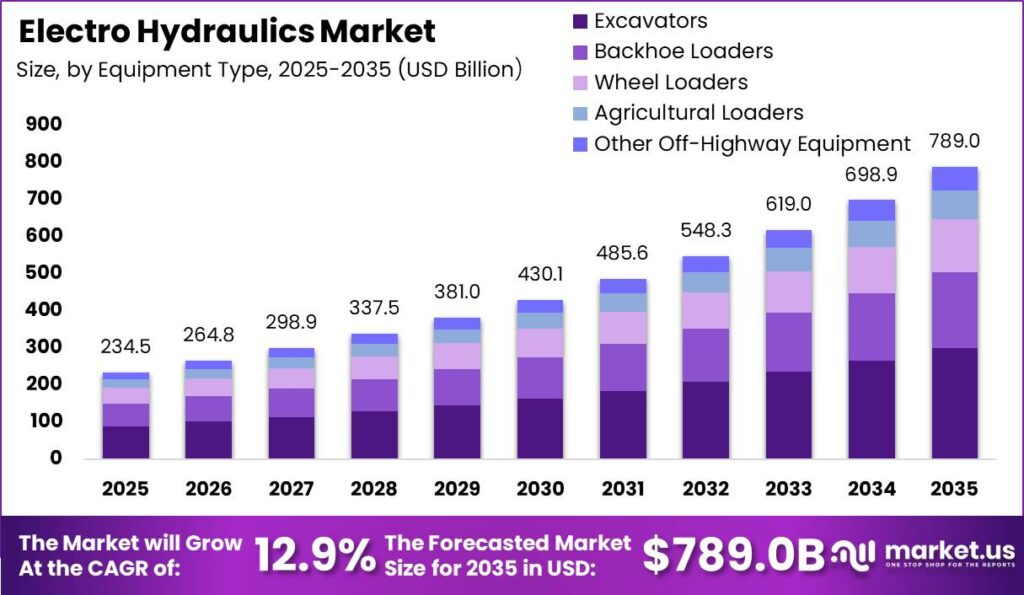
Global Electro Hydraulics Market size is expected to be worth around USD 789.00 Billion by 2035 from USD 234.50 Billion in 2025, growing at a CAGR of 12.9% during the forecast period 2026 to 2035. This expansion reflects rising OEM demand for precise motion control on off-highway platforms. Investors who scale electronic control content early secure pricing power before the installed base converts.
Therefore, the Electro Hydraulics Market covers electrohydraulic pumps, valves, actuators, and closed-loop controllers integrated into mobile and industrial machines. The structure spans equipment type, system architecture, propulsion platform, and end-use industry. Buyers use these systems to replace pure mechanical linkages with software-defined force and position control.
Key Takeaways
- The market reaches USD 234.50 Billion in 2025 and is set to hit USD 789.00 Billion by 2035 at a CAGR of 12.9%.
- Excavators lead equipment type with a 38.00% share.
- Conventional Electro-Hydraulic Systems lead system type with a 63.00% share.
- Internal Combustion Engine Equipment leads propulsion with a 68.00% share.
- Construction leads end-use industry with a 39.00% share.
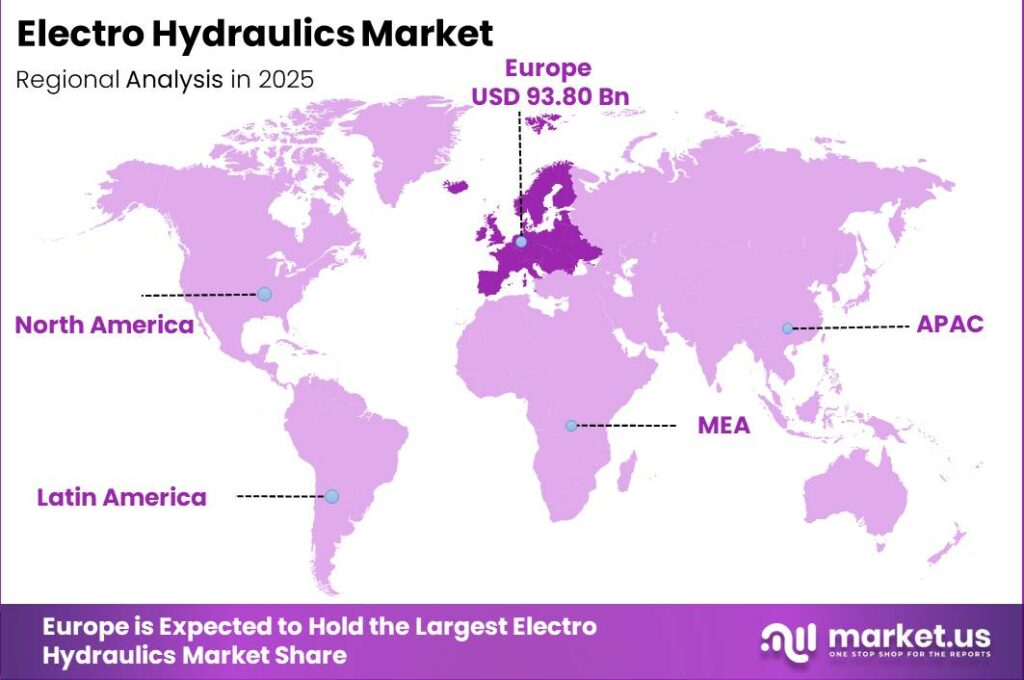
- Europe leads regionally with a 40.00% share valued at USD 93.80 Billion.
As per our research, Volvo Construction Equipment’s updated EC230 Electric excavator delivers 7 to 8 hours of operation on one charge. This runtime covers a full medium-duty shift without mid-day battery swap. Fleet buyers who specify full-day electric platforms cut diesel logistics cost and win urban emission-zone contracts faster.
Consequently, Volvo CE reported that the upgraded electro-hydraulic system on the EC230 Electric delivers a 10% gain in hydraulic efficiency. Higher efficiency lowers energy draw per digging cycle and extends battery life. OEMs that pair efficient electrohydraulics with battery packs improve total cost of ownership claims against diesel rivals.
This signals that Parker Hannifin’s September 2025 launch of the F1e and F12e bent-axis pump series targets electrified mobile equipment directly. Electrified machines need pumps matched to electric motor torque curves rather than engine idle maps. Suppliers who redesign pump families for electric duty cycles capture the fastest-growing propulsion mix before legacy catalogs lose relevance.
Equipment Type Analysis
Excavators dominates with 38.00% due to high hydraulic duty cycles.
In 2025, Excavators held a dominant market position in the By Equipment Type segment of Electro Hydraulics Market, with a 38.00% share. Global construction equipment volume reached about 1,897 thousand units in 2025, and excavators absorb the largest share of high-pressure valve and pump content. This concentration means excavator OEM platform wins set volume for electrohydraulic suppliers for multi-year production runs.
Backhoe loaders serve mixed utility and light construction fleets that need compact swing and dig functions. US fluid power imports totaled about USD 11.50 Billion in 2024, and backhoe platforms pull a steady share of directional valves and joystick actuators. Dealers who stock electrohydraulic kits for backhoe fleets lock aftermarket pull-through on municipal and rental channels.
Wheel loaders demand high-flow steering and lift circuits under continuous cycle loading. Reciprocating hydraulic pump imports into the US alone reached about USD 599 Million in 2024, reflecting loader and similar mobile demand. Vendors who tune load-sensing electrohydraulics for wheel loaders cut fuel burn and win fleet efficiency tenders.
Agricultural loaders and other off-highway equipment hold the remaining share collectively. These platforms need rugged actuators for harsh dust and vibration duty. Suppliers who modularize valve blocks across loader and specialty chassis lower SKU cost while covering niche volume.
System Type Analysis
Conventional Electro-Hydraulic Systems dominates with 63.00% due to proven OEM integration paths.
In 2025, Conventional Electro-Hydraulic Systems held a dominant market position in the By System Type segment of Electro Hydraulics Market, with a 63.00% share. US fluid power exports reached about USD 7.83 Billion in 2024, and conventional electrohydraulic packages still dominate export content on established mobile platforms. This installed base keeps retrofit and spare-parts revenue sticky for incumbent valve and pump brands.
Electric-hydraulic systems form the fastest-growing architecture as OEMs shift control functions into software. Compact and urban off-highway segments already show electric content shares near 60% to 80% in leading duty classes. Early movers who certify electric-hydraulic stacks for zero-emission zones win city construction and indoor material-handling awards first.
Conventional systems still win where diesel powertrains remain standard and operators value field-service familiarity. Mexico alone supplied about USD 2.34 Billion of US fluid power imports in 2024, supporting high-volume conventional assembly. Manufacturers who keep conventional lines while adding software layers protect share during the multi-year propulsion transition.
Equipment Propulsion Analysis
Internal Combustion Engine Equipment dominates with 68.00% due to existing diesel fleet scale.
In 2025, Internal Combustion Engine Equipment held a dominant market position in the By Equipment Propulsion segment of Electro Hydraulics Market, with a 68.00% share. Stage V and Tier 4 Final rules push electrohydraulic throttle and load-sensing content even on diesel machines. This means ICE platforms still drive the bulk of near-term electrohydraulic unit volume for compliance and fuel savings.
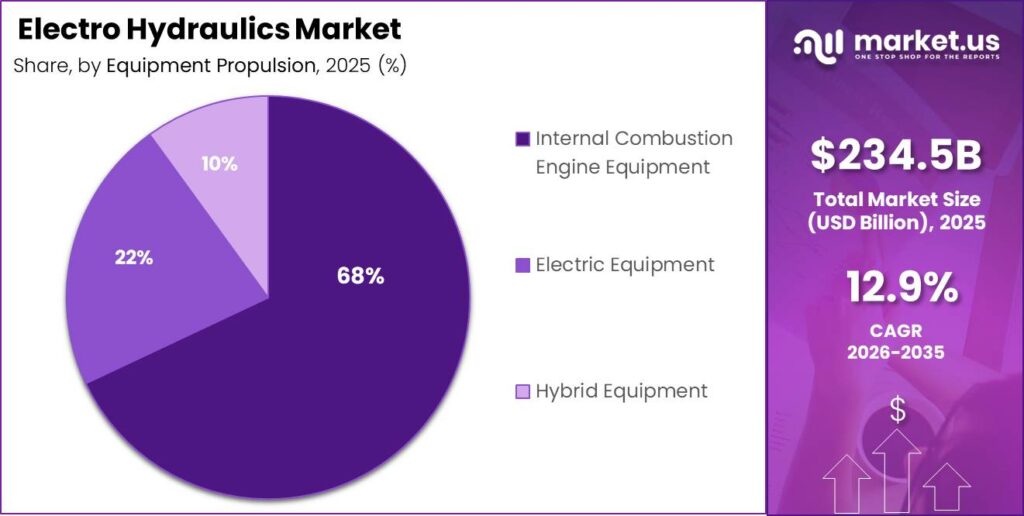
Electric equipment is the fastest-growing propulsion class as battery packs and e-hydraulics mature. Medium and heavy off-highway hybrid or renewable-fuel mixes already approach roughly 40% in progressive fleets. Suppliers who qualify pumps and actuators for pure electric and hybrid bus architectures secure design wins before diesel share erodes.
Hybrid equipment bridges duty cycles where pure battery range remains limited. US fluid power exports to China rose about 9.4% in 2024, reflecting demand for advanced mobile hydraulic content. Hybrid programs let OEMs cut fuel use without full battery CapEx, so electrohydraulic makers who support dual-mode control software expand addressable mix faster.
End-Use Industry Analysis
Construction dominates with 39.00% due to high excavator and loader intensity.
In 2025, Construction held a dominant market position in the By End-Use Industry segment of Electro Hydraulics Market, with a 39.00% share. Construction equipment market value sat near USD 225 Billion to USD 237 Billion in 2025 with roughly 1.9 Million units. This scale makes construction the primary volume engine for electrohydraulic valves, pumps, and actuators worldwide.
Agriculture relies on loaders, sprayers, and harvest implements that need precise flow control. High-pressure system adoption is rising in India and Southeast Asia on a medium-term horizon. Vendors who price modular electrohydraulic kits for mid-tier tractors unlock volume outside premium European fleets.
Mining and forestry demand extreme force density and harsh-environment sealing. Van Halteren-class duty needs and similar heavy actuation profiles push high-pressure electrohydraulic content. OEMs who harden electronics for dust, shock, and wide temperature win multi-year mine and timber fleet contracts.
Material handling and other industries hold the remaining share collectively. Warehouse automation growth in Asia Pacific and Europe shortens payback on smart valves. Integrators who bundle electrohydraulics with diagnostics capture both OEM and retrofit warehouse spend.
Key Market Segments
By Equipment Type
- Excavators
- Backhoe Loaders
- Wheel Loaders
- Agricultural Loaders
- Other Off-Highway Equipment
By System Type
- Conventional Electro-Hydraulic Systems
- Electric-Hydraulic Systems
By Equipment Propulsion
- Internal Combustion Engine Equipment
- Electric Equipment
- Hybrid Equipment
By End-Use Industry
- Construction
- Agriculture
- Mining
- Forestry
- Material Handling
- Other Industries
Regional Analysis
Europe Dominates the Electro Hydraulics Market with a Market Share of 40.00%, Valued at USD 93.80 Billion
Europe leads because Stage V non-road rules and dense OEM clusters force electrohydraulic throttle and valve content on new machines. German fluid power exports into the US still exceeded USD 1.67 Billion in 2024 despite a soft year. Regional suppliers who align software architectures with EU emission timelines protect margin on both OEM and retrofit channels.
Asia Pacific is the fastest-growing region as construction and agriculture fleets expand and high-pressure systems penetrate India and Southeast Asia. Warehouse automation and material-handling growth add short-cycle demand for smart pumps and valves. Investors who localize assembly and service in India and East Asia capture unit growth before European price levels fully transfer.
North America follows with strong aftermarket and electrification retrofit activity, while Latin America and Middle East and Africa trail on fleet replacement cycles. US fluid power imports held near USD 11.50 Billion in 2024, anchoring North American component demand. Multi-region players who balance European compliance content with Asian cost platforms diversify volume risk.
Key Regions and Countries
North America
- US
- Canada
Europe
- Germany
- France
- The UK
- Spain
- Italy
- Rest of Europe
Asia Pacific
- China
- Japan
- South Korea
- India
- Australia
- Rest of APAC
Latin America
- Brazil
- Mexico
- Rest of Latin America
Middle East and Africa
- GCC
- South Africa
- Rest of MEA
Market Dynamics
Market Opportunity Analysis - Electric propulsion, agri fleets in Asia, and data services remain under-penetrated relative to construction ICE volume
Electric equipment is the fastest-growing propulsion class yet still trails the 68.00% ICE share. Most electrohydraulic catalogs remain optimized for diesel idle and peak maps. New entrants who launch pump and valve families solely for electric motor curves win design slots as urban zero-emission rules expand.
Agriculture sits behind construction’s 39.00% end-use lead even as India and Southeast Asia adopt higher-pressure systems. Mid-tier tractor and loader buyers still face price gaps versus conventional hydraulics. Regional assemblers who offer simplified electrohydraulic kits at local price points unlock volume European premium lines miss.
Material handling benefits from warehouse automation in Asia Pacific and Europe but remains a smaller named end-use slice. Smart diagnostics adoption is still more reactive than subscription-based. Integrators who sell hydraulics-as-a-service on forklifts and AGVs create recurring revenue outside one-time OEM shipments.
By contrast, hybrid equipment bridges battery limits on medium and heavy duty cycles without full fleet replacement. Few suppliers treat hybrid as a first-class control software target. Teams that certify dual-mode electrohydraulic stacks early capture OEMs that cannot yet go fully electric.
Technology and Innovation Landscape - Precision actuators, extreme-force EHAs, and low-power safety-rated valves redefine win conditions
Cowan Dynamics’ 2026 electro-hydraulic valve actuator specification states a maximum positioning error of 0.1% of stroke. This precision supports process and mobile valve duties where overshoot wastes energy and product. Manufacturers who match sub-percent accuracy win bids that mechanical linkages cannot meet.
The same Cowan platform offers response times as low as 50 milliseconds, resolution of 0.01% of travel, and maximum overshoot of 0.15% of stroke. Fast closed-loop response improves grade control and implement smoothness on excavators and loaders. OEMs who integrate these actuators raise machine productivity metrics used in fleet tenders.
Van Halteren Technologies’ 2025 Electro Hydraulic Actuator platform generates forces up to 10,000 kN for heavy civil, marine, and offshore work. Force density at this level opens adjacent marine and infrastructure actuation beyond classic off-highway dig and lift. Suppliers who certify EHAs for those codes diversify away from pure construction cycles.
Van Halteren’s portfolio also supports stroke lengths up to 27 metres, installed power up to 150 kW, and operating pressure to 300 bar. Long-stroke high-pressure capability fits locks, gates, and large industrial presses. Investors who back extreme-duty EHA lines access project-based revenue with higher barriers than commodity mobile valves.
Drivers
Tier 4 Final and Stage V non-road rules set in 2024 and 2025 forced OEMs to replace mechanical throttle linkages with electrohydraulic actuators. Electric throttle units help engines under roughly 24.8 hp meet Stage 4-equivalent limits while smart cycling cuts fuel use by 10% to 20%. This shift already compressed mechanical-linkage supplier margins by about 150 to 250 basis points and redirected CapEx toward electronic control integration.
As a result, electrohydraulics moved from optional upgrade to compliance necessity in regulated markets. IEA and OECD tracking for 2025 to 2026 shows controller lead times stretched by 8 to 14 weeks in tight quarters. Buyers who lock long-term ECU supply protect production schedules while laggards face shipment delays and lost tender eligibility.
| Driver | (~) % Impact on CAGR Forecast | Geographic Relevance | Impact Timeline |
|---|---|---|---|
| Off-highway emissions compliance retrofits | +3.1% | Europe, North America | Short term (2 years or less) |
| Fuel-efficiency driven electrification of mobile machinery | +2.4% | Global | Short term (2 years or less) |
| Smart pump/valve diagnostics adoption | +2.0% | North America, East Asia | Medium term (2 to 4 years) |
| Warehouse automation and material handling growth | +1.6% | Asia Pacific, Europe | Short term (2 years or less) |
| Aftermarket remanufacturing and retrofit demand | +1.2% | Global | Medium term (2 to 4 years) |
| Rising high-pressure system adoption in construction/agriculture | +0.9% | India, Southeast Asia | Medium term (2 to 4 years) |
Restraints
Electrohydraulic controllers and closed-loop sensors depend on mature-node chips with concentrated global capacity. OECD 2026 semiconductor supply work flagged this risk for industrial controllers and power electronics. Lead times extend 8 to 14 weeks in constrained quarters and freeze a share of near-term unit shipments rather than only slowing growth.
This creates order-book rescheduling and gross margin pressure of about 150 to 300 basis points when OEMs absorb spot premiums. Firms then defer CapEx on new electrohydraulic lines and allocate scarce chips to higher-margin tiers. Participants who dual-source controllers and redesign for alternate nodes reduce shipment risk while peers stall programs.
| Restraint | (~) % Impact on CAGR Forecast | Geographic Relevance | Impact Timeline |
|---|---|---|---|
| Mature-node power semiconductor supply constraints | -2.8% | Global | Short term (2 years or less) |
| High interest rate environment delaying capital equipment orders | -1.9% | North America, Europe | Short term (2 years or less) |
| Elevated upfront cost versus conventional hydraulics | -1.4% | Emerging markets | Short term (2 years or less) |
| Import tariff exposure on electronic control components | -1.1% | North America | Short term (2 years or less) |
| Legacy fleet replacement resistance | -0.8% | India, Latin America | Medium term (2 to 4 years) |
Challenges
Electrohydraulic work needs hybrid skills across hydraulics, embedded firmware, and sensor calibration. National workforce and fluid power training data show this talent pool did not scale with electrification demand through 2025 into 2026. Commissioning and field integration cycles lengthen by about 15% to 25% versus pure mechanical installs.
This creates a revenue stream in training, modular plug-and-play units, and mechatronics academies. Firms that cut on-site calibration burden raise near-term training CapEx by a single-digit share of unit revenue. Early movers who productize simpler install kits convert fleets faster and sell services competitors cannot staff.
| Challenge | (~) % CAGR Friction Drag | Geographic Relevance | Mitigation Horizon |
|---|---|---|---|
| Skilled mechatronics talent shortage | -1.5% | Global | Medium term (2 to 4 years) |
| System integration complexity with legacy hydraulics | -1.2% | Global | Medium term (2 to 4 years) |
| Fragmented aftermarket service standards | -0.9% | Asia Pacific, Latin America | Long term (4 years or more) |
| Cybersecurity exposure in networked ECUs | -0.7% | North America, Europe | Medium term (2 to 4 years) |
| Raw material and rare-earth magnet cost volatility | -0.6% | Global | Long term (4 years or more) |
Opportunities
Electronic control today mainly serves compliance and efficiency, not packaged data services. Distributor surveys through 2026 still show diagnostics used reactively rather than as paid predictive products. Comparable industrial IoT programs post service-attach margins of 35% to 45% versus 12% to 18% on hardware alone.
This means early movers who fund cloud analytics and sensor standards can cut customer unplanned downtime by about 5% to 8% per unit. Recurring analytics sit outside the baseline forecast until software CapEx is committed. Investors who back data platforms on installed electrohydraulic fleets unlock margin expansion peers leave on the table.
| Opportunity | (~) % Potential CAGR Upside | Geographic Relevance | Execution Window |
|---|---|---|---|
| Predictive-maintenance data monetization via IoT-enabled units | +2.2% | North America, Europe | Medium term (2 to 4 years) |
| Untapped adoption in Indian and Southeast Asian agri-machinery | +1.8% | India, Southeast Asia | Medium term (2 to 4 years) |
| Adjacent expansion into marine and rail actuation systems | +1.4% | Europe, East Asia | Long term (4 years or more) |
| M&A roll-up of fragmented regional integrators | +1.1% | Global | Long term (4 years or more) |
| Hydraulics-as-a-service subscription monetization | +0.9% | North America | Long term (4 years or more) |
Key Company Insights
Bosch Rexroth AG advances software-defined hydraulics through its June 2025 eOC electronic open-circuit architecture. The design moves hydromechanical control into software to raise flexibility, productivity, and energy efficiency on mobile machines. This approach lets OEMs retune machine behavior by update rather than hardware swap, raising switching costs for rivals still tied to pure mechanical governors.
Danfoss Power Solutions pairs mobile pump launches with rugged PVE actuators rated from −40°C to +90°C on 11 to 32 V DC supplies with IP65 to IP67 protection. Digital CAN-bus variants consume under 9 W and offer SIL 2 certification under IEC 61508. Low power and safety ratings win electric and hybrid platforms where thermal budget and functional safety gate supplier selection.
Key Players
- Bosch Rexroth AG
- Danfoss Power Solutions
- Parker Hannifin Corporation
- AB Volvo
- Nott Company
- Kawasaki Precision Machinery Ltd.
- Power-Packer Europa B.V.
- Poclain Hydraulics
- Walvoil S.p.A.
- LHY Powertrain GmbH & Co. KG
- HYDAC International GmbH
- Bucher Hydraulics GmbH
- HAWE Hydraulik SE
- KYB Corporation
- Husco International, Inc.
Recent Developments
- April 2025: Danfoss Power Solutions launched the X1P family of open-circuit piston pumps for electrohydraulic mobile machinery, including excavators, skid-steer loaders, compact-track loaders, and telehandlers.
- June 2025: Bosch Rexroth launched its eOC electronic open-circuit hydraulic architecture, an electrohydraulic system that transfers hydromechanical control functions to software to improve machine flexibility, productivity, and energy efficiency.
- September 2025: Parker Hannifin launched the VA130 mobile valve for mobile hydraulic systems, offering improved controllability, energy efficiency, and configurable electrohydraulic actuation.
Geopolitical Impact Analysis
According to WTO and related trade policy tracking, US baseline import tariffs near 10% and layered duties on Chinese electronics often total 25% to 50% on industrial and semiconductor-related goods. Electrohydraulic ECUs and power stages rely on these components. This raises bill-of-material cost and pushes OEMs to dual-source controllers outside single-country nodes.
Data from UNCTAD shows maritime trade growth slowing to about 0.5% in 2025 after 2.2% in 2024, while container fleet capacity still expands roughly 6.7% in 2025. Uneven freight and routing risk delay pump, valve, and actuator shipments for just-in-time OEM lines. As a result, manufacturers who regionalize final assembly cut transit exposure and protect delivery schedules sold into construction seasons.
Report Scope
| Report Features | Description |
|---|---|
| Market Value (2025) | USD 234.50 Billion |
| Forecast Revenue (2035) | USD 789.00 Billion |
| CAGR (2026-2035) | 12.9% |
| Base Year for Estimation | 2025 |
| Historic Period | 2020-2024 |
| Forecast Period | 2026-2035 |
| Report Coverage | Revenue Forecast, Market Dynamics, Market Opportunity Analysis, Technology and Innovation Landscape, Competitive Landscape, Recent Developments |
| Segments Covered | By Equipment Type (Excavators, Backhoe Loaders, Wheel Loaders, Agricultural Loaders, Other Off-Highway Equipment), By System Type (Conventional Electro-Hydraulic Systems, Electric-Hydraulic Systems), By Equipment Propulsion (Internal Combustion Engine Equipment, Electric Equipment, Hybrid Equipment), By End-Use Industry (Construction, Agriculture, Mining, Forestry, Material Handling, Other Industries) |
| Regional Analysis | North America (US and Canada), Europe (Germany, France, The UK, Spain, Italy, and Rest of Europe), Asia Pacific (China, Japan, South Korea, India, Australia, and Rest of APAC), Latin America (Brazil, Mexico, and Rest of Latin America), Middle East and Africa (GCC, South Africa, and Rest of MEA) |
| Competitive Landscape | Bosch Rexroth AG, Danfoss Power Solutions, Parker Hannifin Corporation, AB Volvo, Nott Company, Kawasaki Precision Machinery Ltd., Power-Packer Europa B.V., Poclain Hydraulics, Walvoil S.p.A., LHY Powertrain GmbH & Co. KG, HYDAC International GmbH, Bucher Hydraulics GmbH, HAWE Hydraulik SE, KYB Corporation, Husco International, Inc. |
| Customization Scope | Customization for segments, region / country-level will be provided. Additional customization can be done based on requirements. |
| Purchase Options | We have three licenses to opt for: Single User License | Multi-User License (Up to 5 Users) | Corporate Use License (Unlimited User and Printable PDF) |





































