


Report Overview
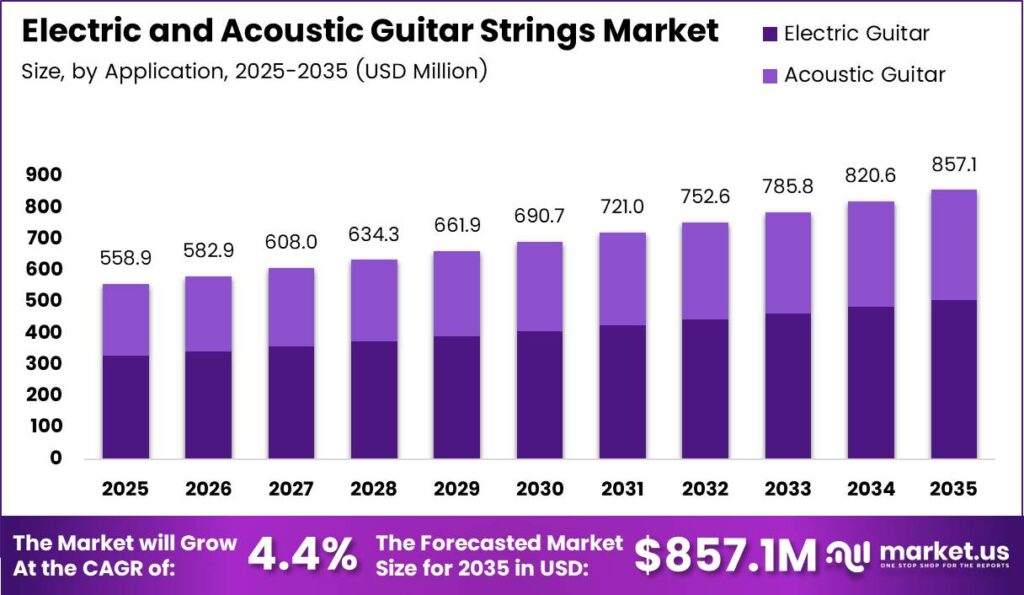
Global Electric and Acoustic Guitar Strings Market size is expected to be worth around USD 857.1 Million by 2035 from USD 558.9 Million in 2025, growing at a CAGR of 4.4% during the forecast period 2026 to 2035.
The electric and acoustic guitar strings market covers manufactured string sets and individual strings designed for fretted guitar instruments across professional, semi-professional, and recreational player segments. Products span multiple alloy types, gauge configurations, and coating technologies, sold through music specialty retailers, mass merchandisers, and online platforms globally. This means manufacturers compete on material performance, longevity, and artist endorsement rather than price alone.
Key Takeaways
- Electric and Acoustic Guitar Strings Market value in 2025 stands at USD 558.9 Million, projected to reach USD 857.1 Million by 2035.
- The market grows at a CAGR of 4.4% during the forecast period 2026 to 2035.
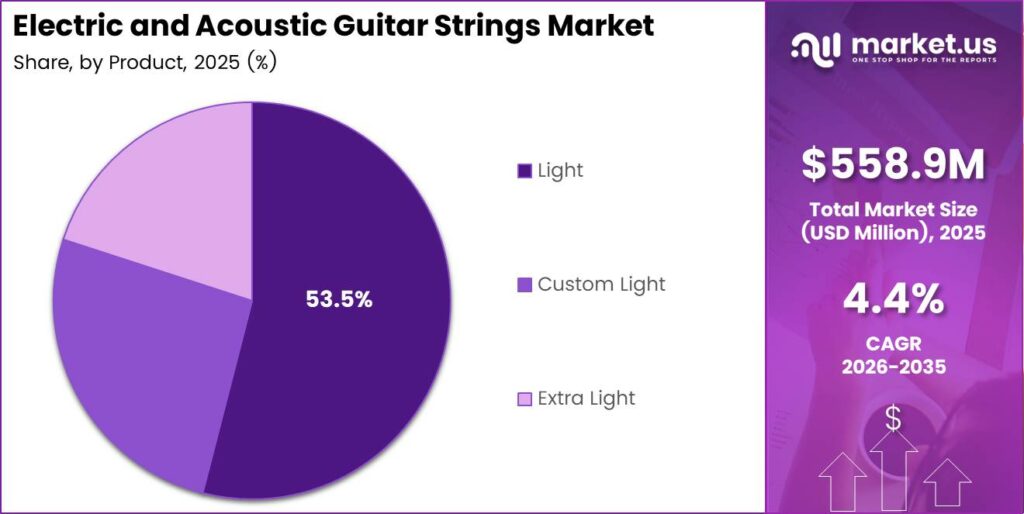
- By Product, Light gauge strings dominate with a 53.56% share and are the fastest-growing sub-segment.
- By Application, Electric Guitar strings dominate with a 58.45% share and are the fastest-growing application segment.
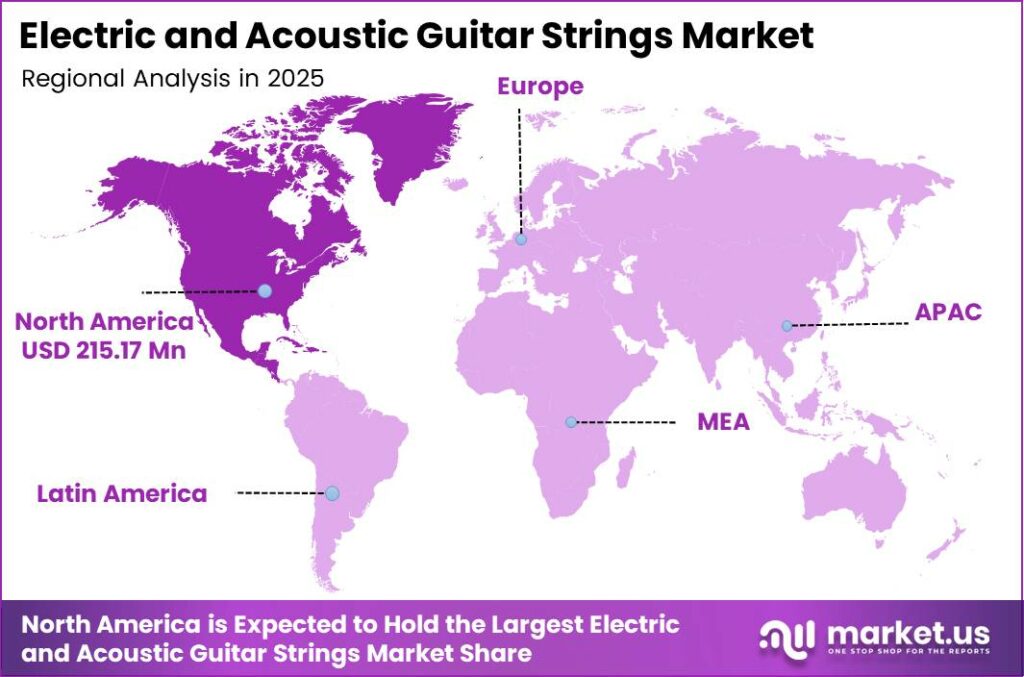
- North America leads all regions with a 38.56% share, valued at USD 215.17 Million.
- Asia-Pacific is the fastest-growing regional market across the forecast period.
As per our research, Mixdown reported three additional Classic Rock N’ Roll pure-nickel electric guitar string configurations in August 2026: Turbo Slinky at 9.5–46, Ultra Slinky at 10–48, and Skinny Top Heavy Bottom at 10–52. This expansion signals that specialty gauge proliferation is accelerating within established product families. Vendors entering this space must support broader SKU ranges to remain shelf-competitive.
Figures from Peghead Nation show Martin Luxe Kovar light-gauge acoustic strings delivering approximately 164 pounds of total tension across diameters spanning 0.012–0.054 inches. This tension profile illustrates how acoustic string design increasingly targets tone-specific playability rather than generic performance. Manufacturers that publish detailed tension data attract informed buyers and command price premiums in specialty retail channels.
In January 2026, Ernie Ball announced single-set retail versions of Papa Het’s Hardwired Master Core and Slash Signature electric guitar strings, with the Papa Het set featuring 11–50 gauges and the Slash set featuring 11–48 gauges. Artist-specific releases convert fan loyalty into direct purchase events. This creates a repeatable revenue mechanism that standard product lines cannot replicate through specification alone.
Product Analysis
Light dominates with 53.56% due to wide player compatibility across skill levels.
In 2025, Light gauge strings held a dominant market position in the By Product segment of the Electric and Acoustic Guitar Strings Market, with a 53.56% share. Light gauge sets suit the widest range of players, from beginners managing finger pressure to experienced players favoring low action and articulate tone. This broad compatibility drives consistent retail velocity across all sales channels.
Custom Light strings occupy the mid-range between extra-light playability and standard light performance. Data from Elixir’s Attune Phosphor Bronze range shows Custom Light acoustic sets spanning 0.011–0.052 inches in diameter with an approximate total tension of 150 pounds. This tension profile appeals to fingerstyle players and singer-songwriters seeking projection without sacrificing comfort, supporting steady demand in acoustic specialist retail.
Extra Light strings target players with technique or physical constraints that require the lowest available tension. Elixir Attune Extra Light acoustic sets span 0.010–0.047 inches with an approximate total tension of 135 pounds. This makes them the preferred entry point for students, younger players, and guitarists managing hand fatigue, creating a reliable replenishment segment tied directly to instructional program enrollment.
In December 2025, Elixir formally announced its Attune Phosphor Bronze range in Custom Light, Light, and Medium gauges, expanding its acoustic portfolio with a new coated-string line. Elixir Attune Light sets span 0.012–0.053 inches with approximately 162 pounds of total tension, while Medium sets span 0.013–0.056 inches at approximately 188 pounds. These additions give retailers structured tension-tier coverage across the full acoustic buyer spectrum.
Application Analysis
Electric Guitar dominates with 58.45% due to higher replacement frequency among active players.
In 2025, Electric Guitar strings held a dominant market position in the By Application segment of the Electric and Acoustic Guitar Strings Market, with a 58.45% share. Electric players restring more frequently because amplification exposes tonal degradation more readily than acoustic instruments. This elevated replacement rate sustains higher per-player annual spend and creates a reliable recurring revenue base for string manufacturers.
Acoustic Guitar strings serve players across folk, country, classical, and singer-songwriter segments where tone warmth and sustain drive purchase decisions. As reported by Ernie Ball’s product catalog, the Nova Slinky set uses six specific diameters including 0.011, 0.015, 0.022, 0.032, 0.044, and 0.054 inches, with the 0.022-inch string wound. This precision construction reflects the engineering investment required to satisfy experienced players who detect tonal inconsistency across string sets.
Key Market Segments
By Product
- Light
- Custom Light
- Extra Light
By Application
- Electric Guitar
- Acoustic Guitar
Regional Analysis
North America Dominates the Electric and Acoustic Guitar Strings Market with a Market Share of 38.56%, Valued at USD 215.17 Million
North America holds the largest regional share at 38.56%, valued at USD 215.17 Million in 2025. The region’s guitar culture is deeply embedded across professional, recreational, and educational segments, generating consistent string replacement demand. High per-capita instrument ownership and dense retail infrastructure give established brands reliable distribution reach and shelf placement advantages.
Asia-Pacific is the fastest-growing region in the global electric and acoustic guitar strings market. Rising guitar adoption in China, India, South Korea, and Southeast Asian markets is expanding the active player base beyond traditional Western strongholds. In October 2025, C. F. Martin & Co. introduced Martin Era Jason Isbell Signature Strings featuring Lifespan treatment and red silk-wrapped ball ends, signaling premium brand interest in diversified global channels. Manufacturers that localize pricing and distribution for Asia-Pacific will capture first-mover advantages in this fast-expanding player cohort.
Key Regions and Countries
North America
- US
- Canada
Europe
- Germany
- France
- The UK
- Spain
- Italy
- Rest of Europe
Asia Pacific
- China
- Japan
- South Korea
- India
- Australia
- Rest of APAC
Latin America
- Brazil
- Mexico
- Rest of Latin America
Middle East and Africa
- GCC
- South Africa
- Rest of MEA
Market Dynamics
Market Opportunity Analysis - Underserved regional markets and institutional channels offer entry points for manufacturers seeking incremental volume
Asia-Pacific holds the fastest-growing regional designation in the Electric and Acoustic Guitar Strings Market yet commands a disproportionately smaller revenue share relative to its player-base growth trajectory compared to North America’s established 38.56% position. This gap signals underpenetrated retail infrastructure rather than weak demand. Manufacturers that build distribution partnerships in China, India, and Southeast Asia before competitive saturation sets in will secure shelf positioning at structurally lower cost than late entrants.
The acoustic guitar segment holds the smaller share of the By Application split, with Electric Guitar strings commanding 58.45%. Acoustic players represent an underexploited replenishment segment because their replacement cycles are less frequently supported by brand-directed marketing and artist-driven purchase triggers. Brands that develop acoustic-specific engagement programs targeting this buyer cohort can accelerate replacement frequency without competing on price.
Extra Light strings within the By Product segment serve students, younger players, and those managing hand fatigue, yet this sub-group is rarely the primary focus of specialty retail display or promotional activity. By contrast, Light gauge strings already dominate at 53.56%, concentrating retail investment in an already-served majority. Vendors that allocate targeted shelf space and instructional content to Extra Light buyers convert a high-churn beginner segment into a durable replacement customer base.
Institutional channels, including school guitar programs and rental fleets, represent a procurement segment where neither product marketing nor direct-to-consumer distribution currently operates at scale. The North American market, valued at USD 215.17 Million, contains the densest concentration of music education infrastructure globally. Suppliers that develop contract restringing and bulk supply programs for institutional buyers access volume that bypasses single-unit retail economics entirely.
Technology and Innovation Landscape - Material innovation and precision gauge engineering define competitive differentiation across electric and acoustic string categories
Ernie Ball’s 2026 string-line expansion introduced Turbo Slinky RPS Nickel Wound strings in a 9.5–46 gauge configuration. The RPS construction reinforces plain strings at the ball-end lock twist, reducing the most common point of breakage under high-tension playing conditions. This targeted engineering improvement directly addresses a pain point for high-output electric players and creates a product performance argument that commodity manufacturers cannot easily replicate.
Elixir’s Attune Phosphor Bronze range, announced in December 2025, applies coating technology to acoustic strings with precisely documented tension profiles across four gauge sets. Publishing tension data at the individual string level, ranging from 16 to 37 pounds per string depending on gauge, gives technically informed buyers a specification framework unavailable from uncoated string manufacturers. This transparency functions as a differentiation tool that shifts buyer preference toward brands with engineering depth.
C. F. Martin & Co.’s Martin Era line combines Lifespan corrosion-protection treatment, Flexible Core construction, and silk-wrapped ball ends in a single product architecture. Integrating multiple performance technologies into one SKU reduces the buyer’s evaluation complexity and supports a premium price point without requiring separate accessory purchases. This bundled-technology approach signals a broader industry shift toward consolidated performance solutions rather than single-attribute string products.
D’Addario’s Jacob Collier Specialty XS Phosphor Bronze set applies XS film coating to wound strings and a polymer treatment to plain steel strings within the same configuration. Differentiating the coating method by string type within a single set demonstrates materials engineering precision that supports both professional endorsement credibility and premium retail pricing. Manufacturers that develop application-specific coating architectures will establish durable barriers against standard-coating competitors in professional and semi-professional channels.
Drivers
Digital instruction platforms support string replacement demand by keeping beginners active past their initial instrument purchase. Fender’s instructional platform documented in 2025 combined thousands of videos with personalized learning paths, practice tools, and real-time feedback. An illustrative cohort with 5% more retained players and unchanged replacement frequency would generate approximately 5% more replacement-set demand within that cohort. Manufacturers that embed string-selection guidance into learning partnerships shift acquisition economics toward repeat purchases.
Recurring replacement demand from the installed guitar-owner base creates a durable revenue floor independent of new instrument sales. Multi-guitar ownership in North America, Europe, and Japan amplifies this effect, as each additional instrument requires its own replacement cycle. Specialty gauge proliferation in North America, Europe, and East Asia further lifts average transaction value. Online retail extends assortment access to underserved secondary cities, converting latent ownership into active purchasing behavior.
| Driver | (~) % Impact on CAGR Forecast | Geographic Relevance | Impact Timeline |
|---|---|---|---|
| Digitally supported learner retention | +0.35% | Global; digitally connected markets | Short term (≤ 2 years) |
| Recurring installed-base replacement | +0.30% | Global | Short term (≤ 2 years) |
| Multi-guitar ownership intensity | +0.20% | North America; Europe; Japan | Medium term (2–4 years) |
| Specialty-gauge product mix | +0.15% | North America; Europe; East Asia | Medium term (2–4 years) |
| Online retail assortment accessibility | +0.10% | Global; underserved secondary cities | Short term (≤ 2 years) |
Restraints
Corrosion-resistant coatings extend string life and allow players to defer replacement purchases, reducing annual set consumption per adopting player. In an illustrative migration scenario, extending replacement intervals by 25% reduces annual set purchases per adopting player by 20%. If the realized price per set rises by only 15%, annual revenue per adopting player falls by approximately 8%. Premium pricing does not automatically offset slower replenishment, creating pressure on production throughput and retailer stock turns.
Budget constraints in price-sensitive markets cause purchase postponement, reducing near-term set volume independent of player activity levels. Import duties raise landed costs in tariff-exposed markets, compressing distributor margins and limiting price competitiveness for foreign brands. Low-price substitutes displace branded strings in fragmented entry-level retail segments. Instrument-owner participation attrition in mature recreational markets gradually shrinks the active replacement base over the medium term.
| Restraint | (~) % Impact on CAGR Forecast | Geographic Relevance | Impact Timeline |
|---|---|---|---|
| Extended-life replacement deferral | -0.30% | Global; premium-string markets | Short term (≤ 2 years) |
| Budget-constrained purchase postponement | -0.20% | Price-sensitive consumer markets | Short term (≤ 2 years) |
| Import-duty landed-price barriers | -0.15% | Tariff-exposed import markets | Short term (≤ 2 years) |
| Low-price substitute displacement | -0.10% | Fragmented entry-level retail markets | Short term (≤ 2 years) |
| Instrument-owner participation attrition | -0.10% | Mature recreational-player markets | Medium term (2–4 years) |
Challenges
String manufacturing requires consistent wire chemistry, diameter, tensile behavior, and surface quality, making qualified material sourcing more consequential than commodity metal access alone. The USGS reported that United States mined copper output declined by an estimated 3% in 2024, illustrating upstream variability without establishing a direct guitar-string wire shortage. An illustrative sensitivity where qualified metal inputs represent 20% of manufacturing cost and their delivered prices increase by 10% produces a 2% manufacturing-cost increase before mitigation. Dual-source qualification and incoming wire testing can preserve continuity but require additional working capital and engineering effort.
Winding process consistency control remains a persistent manufacturing challenge because small deviations in tension or wrap pitch produce audible tonal inconsistencies that professional players detect immediately. Gauge assortment complexity forces wholesalers to carry wider SKU ranges, increasing inventory carrying costs and obsolescence risk. Humidity-sensitive distribution creates storage constraints in South Asia, Southeast Asia, and coastal markets. Specialist maintenance skills continuity in established precision-manufacturing clusters represents a long-term structural risk for the industry.
| Challenge | (~) % CAGR Friction Drag | Geographic Relevance | Mitigation Horizon |
|---|---|---|---|
| Precision wire sourcing variability | -0.25% | Global manufacturing networks | Medium term (2–4 years) |
| Winding process consistency control | -0.15% | Global manufacturing hubs | Medium term (2–4 years) |
| Gauge assortment inventory complexity | -0.10% | Global wholesale networks | Short term (≤ 2 years) |
| Humidity sensitive distribution storage | -0.10% | South Asia; Southeast Asia; coastal markets | Short term (≤ 2 years) |
| Specialist maintenance skills continuity | -0.10% | Established precision-manufacturing clusters | Long term (≥ 4 years) |
Opportunities
Contracted maintenance services for school guitar fleets, rehearsal facilities, and rental operators represent an integrated procurement and restringing opportunity not captured in standard retail replacement demand. In an illustrative pilot, centralized ordering that reduces fulfillment cost per set by 15%, with fulfillment initially representing 10% of contract revenue, improves contribution margin by 1.5 percentage points. A further reduction in servicing and acquisition expense from 8% to 6% of revenue would bring the combined improvement to 3.5 percentage points before incremental labor obligations. Manufacturers that secure institutional contracts convert episodic retail sales into predictable recurring revenue.
Adaptive low-tension string systems address underserved player segments including older adults, students, and guitarists managing physical limitations. Regional private-label production partnerships in South Asia, Latin America, and Africa offer manufacturers a path to local price competitiveness without compromising brand identity in established markets. Verified circular-procurement product lines targeting Europe and North America respond to sustainability-focused procurement policies in institutional channels. Buyer-specific acoustic response customization opens a premium professional niche where price sensitivity is lowest and brand differentiation is most durable.
| Opportunity | (~) % Potential CAGR Upside | Geographic Relevance | Execution Window |
|---|---|---|---|
| Institutional restringing service contracts | +0.30% | North America; Europe; developed Asia-Pacific | Medium term (2–4 years) |
| Adaptive low-tension string systems | +0.20% | Global; accessibility-focused channels | Long term (≥ 4 years) |
| Regional private-label production partnerships | +0.15% | South Asia; Latin America; Africa | Medium term (2–4 years) |
| Verified circular-procurement product lines | +0.10% | Europe; North America | Long term (≥ 4 years) |
| Buyer-specific acoustic response customization | +0.10% | Global professional-player niches | Medium term (2–4 years) |
Key Company Insights
Ernie Ball Inc. built its competitive position through gauge specialization and artist co-development. Its 2026 string-line expansion introduced Silky Slinky Nickel Wound sets in a 9.5–48 gauge configuration and Titan Slinky sets in an 11–56 gauge configuration, extending coverage from ultra-light to heavy tension extremes. In January 2025, the company announced Tim Henson Signature electric strings combining Cobalt and Paradigm technologies, converting high-profile artist relationships into launch-ready retail events that drive immediate sell-through.
D’Addario & Co. competes through precision engineering, broad product architecture, and artist collaboration across both electric and acoustic categories. Its September 2026 launch of the Jacob Collier Specialty XS Phosphor Bronze five-string acoustic set, designed in a .012–.053 configuration for D–A–E–A–D tuning, demonstrates the company’s ability to develop instruments-specific solutions for professional players with non-standard requirements. This approach protects D’Addario’s premium positioning against commodity competitors who cannot match its application-specific engineering depth.
Key Players
- D’Addario & Co.
- Fender Musical Instruments Corporation
- Gibson Brands
- Ernie Ball Inc.
- GHS Strings
- F. Martin & Company Inc.
- Dunlop Manufacturing, Inc.
- Dean Markley USA, Inc.
- Kistron Co., Ltd.
- Rotosound Manufacturing Ltd.
- DR Handmade Strings
- Other Key Players
Recent Developments
- January 2025 – Ernie Ball announced Earthwood Bell Bronze acoustic guitar strings, developed with John Mayer using a patent-pending alloy inspired by metals used in bells and cymbals, with commercial availability scheduled for spring 2025.
- September 2025 – Rotosound launched three-set and ten-set multipacks for Rotos electric guitar strings and Jumbo King acoustic guitar strings; electric sets were offered in 9–42, 9–46, 10–46, and 10–52 gauges, while acoustic sets were offered in 10–50, 11–52, and 12–54 gauges.
- October 2025 – C. F. Martin & Co. launched Martin Era phosphor-bronze acoustic guitar strings, combining Lifespan corrosion-protection treatment, Flexible Core construction, and silk-wrapped ball ends in one product line.
- September 2026 – D’Addario’s Jacob Collier Specialty XS Phosphor Bronze five-string acoustic guitar set was launched, designed for Collier’s signature Taylor guitars in a .012–.053 configuration supporting D–A–E–A–D tuning with XS film coating on wound strings and a polymer treatment on plain steel strings.
Report Scope
| Report Features | Description |
|---|---|
| Market Value (2025) | USD 558.9 Million |
| Forecast Revenue (2035) | USD 857.1 Million |
| CAGR (2026-2035) | 4.4% |
| Base Year for Estimation | 2025 |
| Historic Period | 2020-2024 |
| Forecast Period | 2026-2035 |
| Report Coverage | Revenue Forecast, Market Dynamics, Market Opportunity Analysis, Technology and Innovation Landscape, Competitive Landscape, Recent Developments |
| Segments Covered | By Product (Light, Custom Light, Extra Light), By Application (Electric Guitar, Acoustic Guitar) |
| Regional Analysis | North America (US and Canada), Europe (Germany, France, The UK, Spain, Italy, and Rest of Europe), Asia Pacific (China, Japan, South Korea, India, Australia, and Rest of APAC), Latin America (Brazil, Mexico, and Rest of Latin America), Middle East and Africa (GCC, South Africa, and Rest of MEA) |
| Competitive Landscape | D’Addario & Co., Fender Musical Instruments Corporation, Gibson Brands, Ernie Ball Inc., GHS Strings, F. Martin & Company Inc., Dunlop Manufacturing, Inc., Dean Markley USA, Inc., Kistron Co., Ltd., Rotosound Manufacturing Ltd., DR Handmade Strings, Other Key Players |
| Customization Scope | Customization for segments, region/country-level will be provided. Additional customization can be done based on requirements. |
| Purchase Options | We have three licenses to opt for: Single User License, Multi-User License (Up to 5 Users), Corporate Use License (Unlimited User and Printable PDF) |





































