


Report Overview
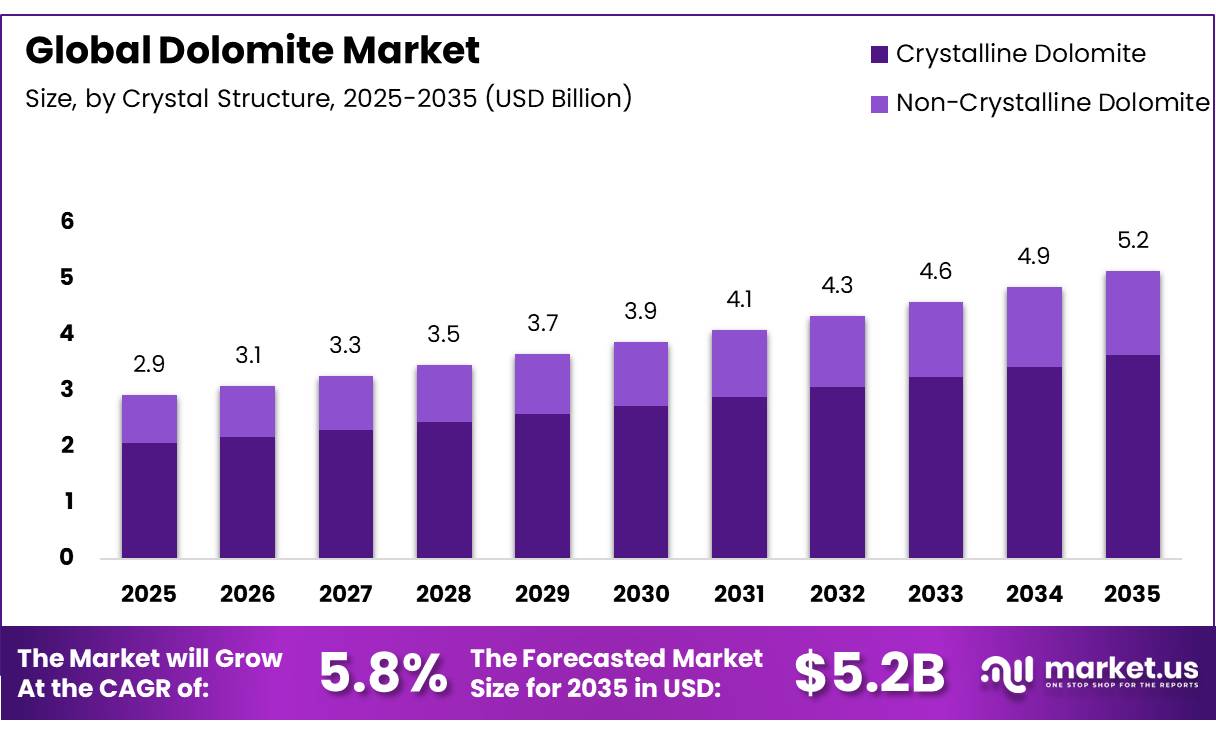
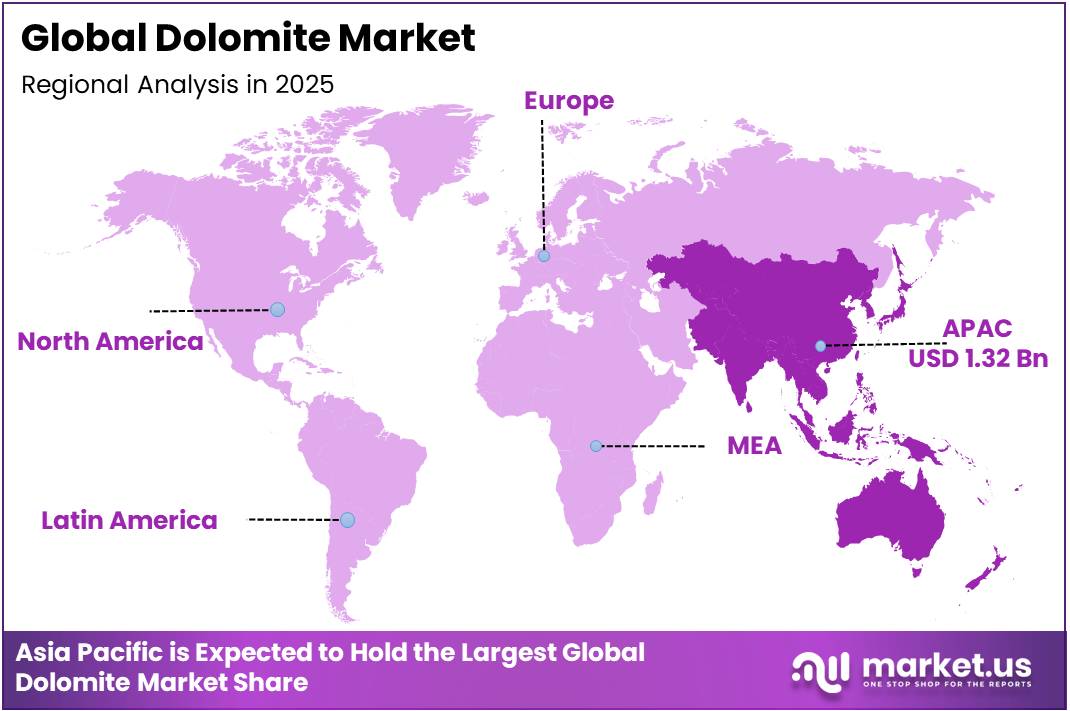
In 2025, the Global Dolomite Market was valued at US$2.9 billion, and between 2026 and 2035, this market is estimated to register a CAGR of 5.8%, reaching about US$5.2 billion by 2035. Asia Pacific held a dominant market position, capturing more than a 45.2% share, holding USD 1.32 billion in revenue.
Dolomite is a naturally occurring calcium magnesium carbonate mineral that serves as a critical industrial raw material across steel making, construction, glass, ceramics, agriculture, and environmental applications. Its high thermal stability, fluxing capability, and magnesium content make it indispensable for refractory linings and impurity removal during steel production. The industrial outlook remains favorable as demand from heavy industries and infrastructure development continues to strengthen.
- According to the World Steel Association, global crude steel production reached approximately 1.88 billion tonnes in 2024, sustaining strong demand for flux minerals such as dolomite used in blast furnaces and electric arc furnaces. Meanwhile, the U.S. Geological Survey reported in January 2025 that the United States produced an estimated 15 million tons of lime in 2025, with steel making remaining the largest end-use sector, highlighting continued consumption of carbonate minerals including dolomite in metallurgical operations.
Key Takeaways
- The global Dolomite market was valued at US$ 2.9 billion in 2025.
- The global Dolomite market is projected to grow at a CAGR of 5.8% and is estimated to reach US$ 5.2 billion by 2035.
- On the basis of Product Type, Crushed & Ground Dolomite dominated the market, constituting 35.6% of the total market share.
- Based on the Crystal Structure, Crystalline Dolomite dominated the market, with a substantial market share of around 70.6%.
- Based on the Form, Powder led the market, comprising 40.6% of the total market.
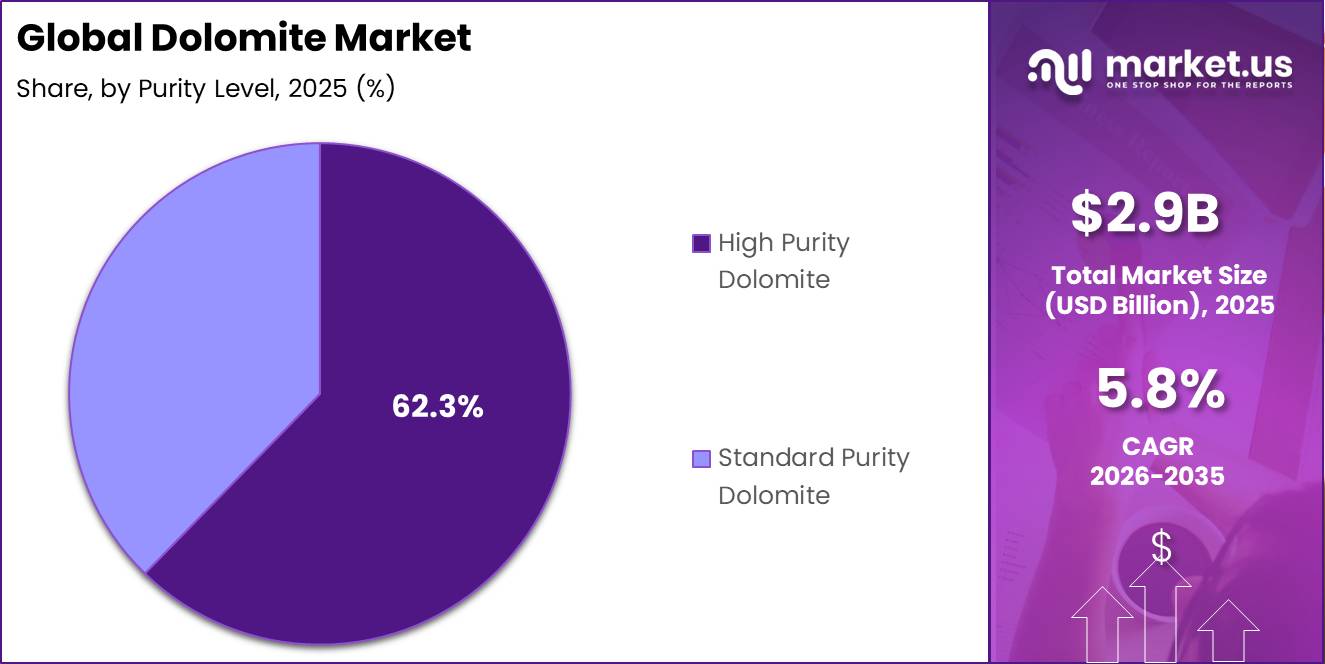
- Based on the Purity Level, High Purity Dolomite dominated the market, accounting for 62.3% of the total market share.
- Among the End-Use Industries, the Iron & Steel industry held a major share in the Dolomite market, with 30.5% of the market share.
- In 2025, Asia Pacific was the most dominant region in the global Dolomite market, accounting for 45.2% of the total global consumption.
Future growth opportunities are supported by global decarbonization strategies and sustainable industrial manufacturing. The International Energy Agency stated in 2025 that achieving near-zero-emission steel and cement production requires rapid deployment of low-carbon materials and process improvements, increasing the importance of high-quality refractory and flux minerals such as dolomite.
Additionally, stricter environmental regulations are accelerating investment in water treatment and flue-gas purification systems, where dolomite is increasingly utilized for pH control and contaminant removal. These trends, combined with technological advancements in mineral processing and circular manufacturing, are expected to strengthen long-term industrial demand while supporting more efficient and sustainable resource utilization.
Dolomite Market Segments
Crystal Structure Analysis
Crystalline Dolomite Represents the Dominant Segment in the Market by Crystal Structure
Crystalline dolomite accounts for a significant 70.6% of the global dolomite market by crystal structure, owing to its superior physical and chemical properties, which make it indispensable in high-performance industrial applications. Its well-defined crystal lattice provides exceptional hardness, chemical stability, and thermal degradation resistance properties that are essential in demanding environments such as steel furnace linings, refractory manufacturing, and high-quality construction applications.
Dolomite’s purity has a significant impact on its value and target applications. High-purity crystalline grades command premium prices and are preferred across specialized industrial end-uses that require consistent mineralogical composition and predictable performance under stress.
Non-Crystalline Dolomite represents the fastest growing region and is used in more general-purpose industrial applications where structural precision is not critical, such as basic construction aggregates and lower-grade soil conditioning in agriculture.
Purity Level Analysis
High Purity Dolomite Represents the Dominant Segment in the Market by Purity Level
High Purity Dolomite accounts for 62.3% of the global dolomite market by purity level, reflecting an increasing industrial preference for refined, contaminant-free grades in a wide range of sophisticated applications. High-purity dolomite commands high prices and is increasingly being targeted at niche chemical applications and tailored solutions for sustainable construction markets where even trace levels of impurities can jeopardize product quality, safety compliance, or end-use performance.
Standard Purity Dolomite is the fastest growing segment and continues to serve high-volume, cost-sensitive applications such as road base construction, general-purpose soil conditioning, and lower-specification industrial uses where premium-grade material is not required or economically justified.
Form Type Analysis
Powder Form Represents the Dominant Segment in the Market by Form
Powder held the largest share of the global dolomite market at 40.6% owing to its excellent flowability, uniform particle size, and high chemical reactivity, making it the preferred form for steelmaking, glass manufacturing, ceramics, paints, plastics, rubber, and agricultural applications. Its fine texture enables better mixing, faster reaction kinetics, and improved process efficiency compared with coarser forms, while also reducing material losses during production.
Dolomite chips are gaining traction due to their increasing use in filtration media, refractory products, and construction applications, where high mechanical strength and uniform sizing are essential. Their durability and ease of handling continue to support gradual demand growth across industrial and infrastructure projects
Product Type Analysis
Crushed & Ground Dolomite Represents the Dominant Segment in the Market by Product Type
Crushed and Ground Dolomite dominates the global dolomite market, accounting for 35.6% of the total market share, owing to its unmatched versatility and cost-effectiveness across multiple industries. Its dominance is due to its processing simplicity, cost-effectiveness, and versatile application capabilities when compared to specialized thermal treatments in commercial industrial operations, making it the preferred product form for everything from road construction and concrete production to steel manufacturing and agricultural soil conditioning.
Calcined Dolomite is widely used in steel fluxing and glass manufacturing due to its high purity and thermal properties. Sintered Dolomite is used in various applications ranging from refractory linings to heavy metal industries. Agglomerated dolomite is becoming increasingly important in construction, agriculture, and specialized chemical processing.
End-Use Industry Analysis
Dolomite Is Majorly Used In Iron & Steel Industry
The iron and steel industry represents the dominant end-use segment of the global dolomite market, accounting for 30.5% of total demand. This dominance is driven by dolomite’s important role in steelmaking, where it is used as a fluxing material and refractory input. It helps support slag formation, impurity removal, furnace lining protection, and process efficiency in high-temperature operations.
After calcination, dolomite is used in refractory applications for basic steelmaking furnaces, converters, ladles, and electric arc furnace operations. This makes demand more process-driven than preference-driven, as steel producers require stable mineral inputs for efficient production. Other end-use industries, including glass and ceramics, chemicals, water treatment, mining and metallurgy, pharmaceuticals, and industrial manufacturing, provide diversified demand support for the market.
Key Market Segments
By Product Type
- Crushed & Ground
- Calcined Dolomite
- Sintered Dolomite
- Agglomerated Dolomite
By Crystal Structure
- Crystalline Dolomite
- Non-Crystalline Dolomite
By Form
- Powder
- Granules
- Lumps
- Chips
By Purity Level
- High Purity Dolomite
- Standard Purity Dolomite
By End-Use Industry
- Iron & Steel
- Building & Construction
- Agriculture
- Chemicals
- Glass & Ceramics
- Water Treatment
- Mining & Metallurgy
- Pharmaceuticals
- Industrial Manufacturing
- Others
Drivers
Pharma & Biologics Pipeline Expansion
Pharmaceuticals represent the highest-quality, highest-margin growth vector within container glass, materially reshaping the industry’s revenue mix. The global pharmaceutical glass packaging market stands at approximately USD 31.0–32.9 billion in 2025–2026 and is forecast to grow at a CAGR of 4.9%–15.5% through 2030–2031, reaching USD 41.7 billion by 2031 at the conservative band and USD 63.1 billion by 2035 under broader scope definitions.
Injectables alone accounted for 67.41% of pharmaceutical glass packaging demand in 2025 and are growing at a 5.71% sub-CAGR, driven by a maturing biologics pipeline that overwhelmingly requires Type I borosilicate primary containers for drug stability and regulatory compliance.
Drivers Impact Analysis
| Driver | (~) % Impact on CAGR | Geographic Relevance | Impact Timeline |
|---|---|---|---|
| EU PPWR & Global Anti-Plastic Mandates | +1.4% | EU core; North America spill-over; India, Southeast Asia secondary | Short–Medium (≤ 3 years) |
| Pharma & Biologics Pipeline Expansion | +1.2% | North America, Europe primary; APAC fastest-growing at +17% sub-CAGR | Long term (≥ 4 years) |
| Premiumisation of Beverages & Cosmetics | +1.0% | North America, EU; APAC corridors (China, India, Japan) | Medium term (2–4 years) |
| APAC Urbanisation & Capacity Build-Out | +0.9% | India, China, Vietnam, Indonesia primary; South America spill-over | Medium–Long (3–6 years) |
| Circular Economy: Cullet Loops & Recycling Mandates | +0.7% | EU (leading ~75% collection rates); North America; selective APAC | Medium term (2–4 years) |
| Energy Transition & Decarbonisation Tech | +0.5% | EU, North America; Japan, Korea early APAC adopters | Long term (≥ 4 years) |
Restraints
EU CBAM Full Implementation
The European Union’s Carbon Border Adjustment Mechanism (CBAM) entered its definitive, financially enforceable phase on 1 January 2026, transitioning from a transitional reporting obligation to a mechanism requiring EU importers to purchase and surrender CBAM certificates priced at the weekly average EU ETS allowance price currently running at EUR 65–75 per tonne of CO₂ — for every tonne of embedded emissions in imported steel, cement, aluminium, fertilisers, hydrogen, and electricity, creating an immediate, quantified carbon cost liability on every non-EU-origin tonne of blast furnace steel or clinker-based cement entering the European single market.
The direct commercial consequence for the dolomite market is a second-order demand destruction mechanism operating through the economics of BF-BOF steel production versus EAF alternatives: as CBAM attaches a carbon border cost of approximately EUR 130–150 per tonne to imported BF-BOF steel, and simultaneously accelerates the EU’s internal phase-out of free ETS allowances for domestic BF-BOF producers, the commercial case for BF-BOF steelmaking — the only route that consumes dolomite flux at 35–65 kg per tonne output weakens relative to EAF production, structurally redirecting European steel investment toward EAF configurations that eliminate dolomite from the steelmaking bill of materials entirely.
Restraint Impact Analysis
| Restraint | (~) % Impact on CAGR | Geographic Relevance | Impact Timeline |
|---|---|---|---|
| Energy Intensity & Carbon Cost Escalation | -1.3% | EU core; North America; energy-import-dependent APAC | Short–Medium (≤ 3 years) |
| Secular Decline in Alcoholic Beverage Demand | -1.1% | North America, Western Europe primary; Australia secondary | Medium term (2–4 years) |
| Inter-Material Substitution: PET, Aluminum & Flexible Packaging | -0.9% | Price-sensitive APAC, South America, Eastern Europe; North America | Medium–Long (3–6 years) |
| High CapEx Intensity & Furnace Decarbonisation Costs | -0.7% | EU primary (CBAM-exposed); North America; emerging APAC producers | Long term (≥ 4 years) |
| Logistical Cost Asymmetry & Fragility Penalty | -0.5% | North America, South America; dispersed APAC markets | Short–Medium (≤ 3 years) |
| Raw Material Volatility: Soda Ash & Silica Sand | -0.4% | China, India, Southeast Asia; North America; Middle East | Short term (≤ 2 years) |
Opportunity
Dolime as Captive EAF Flux & Slag Conditioner
Dolomite producers that invest in vertical integration into a calcined dolime product line — requiring kilns operating at 1,100–1,200°C, reactivity >40 mL HCl, bulk density 1.0–1.2 t/m³, and CaO+MgO purity >95% can target a product that commands USD 80–180 per tonne versus USD 12–35 per tonne for raw dolomite quarry material, representing a 4–10× revenue per tonne uplift that fundamentally restructures the unit economics of dolomite production from a tonnage-driven model to a quality and performance-specification-driven model.
Opportunity Impact Analysis
| Opportunity | (~) % Potential CAGR | Geographic Relevance | Execution Window |
|---|---|---|---|
| Dolime as Captive EAF Flux & Slag Conditioner | +1.5% | China EAF build-out; EU EAF decarbonisation; India IF furnace expansion | Short–Medium (≤ 3 years) |
| ERW Carbon Credit Feedstock | +1.2% | North America Midwest primary; EU croplands; South America | Medium term (2–4 years) |
| Doloma & Refractory Brick Vertical Integration | +1.1% | India, Southeast Asia primary; MENA steel hub secondary | Medium term (2–4 years) |
| Acid Mine Drainage Neutralisation Chemistry | +0.9% | South Africa, Australia, Canada, Chile, Peru | Short–Medium (≤ 3 years) |
| Africa & MENA Greenfield Reserve Monopolisation | +0.8% | Algeria, Morocco, Oman, Saudi Arabia; Sub-Saharan Africa | Long term (≥ 4 years) |
| Nano-Functionalised Dolomite Fertiliser Platforms | +0.7% | EU, North America primary; Australia, Brazil secondary | Medium–Long (2–5 years) |
Challenges
Calcination Energy Cost Volatility
The World Bank’s June 2025 gas price analysis confirmed that the U.S. Henry Hub benchmark surged by more than 50% in full-year 2025 relative to 2024 with European TTF averaging approximately USD 13.5/MMBtu in 2025 while the EU Spring 2026 Economic Forecast documents that “Russia’s invasion of Ukraine triggered a structural shift in the EU gas market from pipeline-based supply towards globally traded LNG,” noting that the EU’s LNG share of total gas imports rose from 20% to 45% between 2021 and 2025, permanently increasing European gas price exposure to global LNG spot dynamics and geopolitical shocks from the Iran conflict, LNG terminal strikes, and Pacific weather events that the pre-2022 Russian pipeline regime shielded European industry from.
A 2023 ScienceDirect publication on Joule-heating dolomite calcination demonstrated a 70-fold reduction in calcination time, 6.22% decrease in energy consumption, and 56.77% drop in direct carbon emissions versus conventional methods, establishing an advanced calcination pathway but one requiring a fundamentally different kiln architecture and vacuum environment that cannot be retrofitted onto existing fired kiln fleets at less than USD 8–15 million per kiln of 50,000 tonne annual capacity.
Challenges Impact Analysis
| Challenge | (~) % CAGR Friction | Geographic Relevance | Mitigation Horizon |
|---|---|---|---|
| Calcination Energy Cost Volatility | -1.2% | EU primary; East Asia secondary; North America | Medium term (2–4 years) |
| Mining Workforce Talent Attrition | -1.0% | North America, Australia primary; EU secondary | Long term (≥ 4 years) |
| Reserve Grade Inconsistency & QC | -0.8% | Global; most acute in South/Southeast Asia, Africa | Medium term (2–4 years) |
| Steel Decarbonisation Demand Uncertainty | -0.9% | EU, Japan, South Korea; North America | Long term (≥ 4 years) |
| Digital Transformation Adoption Gap | -0.6% | South Asia, Africa, South America primary; Southeast Asia secondary | Medium term (2–4 years) |
| Dust, Water & Environmental Compliance Cost Inflation | -0.5% | India, China, Southeast Asia primary; Australia, EU secondary | Short–Medium (≤ 3 years) |
Geopolitical Impact Analysis
Strategic Mineral Policies and Regional Sourcing Accelerating Dolomite Industry Resilience
Geopolitical uncertainty and trade disruptions have prompted governments to strengthen domestic mineral supply chains, indirectly supporting demand for industrial minerals such as dolomite used in steel, glass, refractories, and infrastructure. According to the European Commission’s Critical Raw Materials Act (2024), the European Union has set targets to source at least 10% of its annual strategic raw material consumption through domestic extraction, process 40% within the EU, and recycle 25% by 2030.
Geopolitical diversification is also reshaping downstream industries that consume dolomite. According to the U.S. Department of Energy, the United States allocated US$6 billion in March 2024 under the Industrial Demonstrations Program to accelerate decarbonization across energy-intensive industries, including iron and steel, cement, and glass manufacturing. As these sectors expand domestic production capacity and modernize facilities, demand for refractory and flux materials such as dolomite is expected to strengthen alongside regional supply chain development.
Regional Analysis
Asia Pacific Held the Largest Share in the Global Dolomite Market
Asia Pacific leads the global dolomite market with about 45.2% of total consumption in 2025, supported by strong demand from steel, cement, glass, and construction industries. China and India remain major contributors due to large infrastructure projects, expanding urban housing, and high steel output. The region also benefits from abundant dolomite reserves, low mining costs, and strong domestic supply chains that support consistent industrial consumption across key manufacturing hub markets.
The region’s dominance is further supported by growing agricultural use of dolomitic lime to improve acidic soils and enhance crop productivity. Rapid industrialization in Southeast Asia is also increasing dolomite use in ceramics, refractories, water treatment, and environmental applications.
Asia Pacific’s dominance in the global dolomite market is powered by multiple strong industries driving demand simultaneously rather than dependence on a single sector. Construction and steel form the most prominent consumption pillars, while agriculture adds an equally vital dimension dolomite is widely used to neutralize soil acidity, restore magnesium and calcium levels, and improve crop productivity across the region’s vast farmlands.
Key Regions and Countries Covered
- North America
- The US
- Canada
- Europe
- Germany
- France
- The UK
- Spain
- Italy
- Russia & CIS
- Rest of Europe
- APAC
- China
- Japan
- South Korea
- India
- ASEAN
- Rest of APAC
- Latin America
- Brazil
- Mexico
- Rest of Latin America
- Middle East & Africa
- GCC
- South Africa
- Rest of MEA
Key Players Analysis
The global dolomite market operates within a moderately consolidated competitive landscape, where a handful of well-established multinational players collectively account for a dominant share of global production capacity, processing capability, and distribution reach. The global market remains moderately consolidated, with top-tier companies such as Lhoist Group and Imerys together total market influence and production capacity a concentration that reflects decades of strategic investment in mining infrastructure, vertical integration, and geographic expansion across key consuming regions.
The competitive edge that major dolomite players hold over smaller regional counterparts runs far deeper than production volume alone it lies in their exceptional ability to cater to a wide and diverse spectrum of end-use industries simultaneously, from steel and construction to agriculture and pharmaceuticals, through carefully developed and grade-specific product portfolios that demand a level of technical sophistication, operational scale, and geographic reach that emerging players simply cannot match.
The major Players In The Industry
- Imerys SA
- RHI Magnesita NV
- Sibelco
- Lhoist Group
- Essel Mining & Industries Ltd.
- JFE Mineral Co., Ltd.
- Carmeuse
- Nordkalk Corporation
- Calcinor SA
- Omya AG
- CEMEX S.A.B. de C.V.
- KHD Humboldt Wedag International AG
- Grupo Calidra
- Minerals Technologies Inc.
- Dillon & Company
- Other Key Players
Key Development
- In March 2025, Lhoist Group announced a major capacity expansion across its dolomite mining and processing facilities in Europe and North America, investing significantly in modernizing its extraction technologies and increasing output to meet the growing demand from the steel, construction, and agricultural sectors across key global markets.
- In July 2025, Omya AG launched a comprehensive sustainability program across its global dolomite operations, introducing low-carbon processing technologies and committing to a measurable reduction in its carbon footprint across all major production facilities, directly responding to the growing pressure from industrial buyers and regulators to adopt more environmentally responsible mineral processing practices.
Report Scope
| Report Features | Description |
|---|---|
| Market Value (2025) | USD 2.9 Bn |
| Forecast Revenue (2035) | USD 5.2 Bn |
| CAGR (2026-2035) | 5.8% |
| Base Year for Estimation | 2025 |
| Historic Period | 2020-2024 |
| Forecast Period | 2026-2035 |
| Report Coverage | Revenue Forecast, Market Dynamics, Competitive Landscape, Recent Developments |
| Segments Covered | By Product Type (Crushed and Ground, Calcined Dolomite, Sintered Dolomite, and Agglomerated Dolomite), By Crystal Structure (Crystalline Dolomite and Non-Crystalline Dolomite), By Form (Powder, Granules, Lumps, and Chips), By Purity Level (High Purity Dolomite and Standard Purity Dolomite), By End-Use Industry (Iron and Steel, Building and Construction, Agriculture, Chemicals, Glass and Ceramics, Water Treatment, Mining and Metallurgy, Pharmaceuticals, Industrial Manufacturing, and Others) |
| Regional Analysis | North America – The US & Canada; Europe – Germany, France, The UK, Spain, Italy, Russia & CIS, Rest of Europe; APAC– China, Japan, South Korea, India, ASEAN & Rest of APAC; Latin America– Brazil, Mexico & Rest of Latin America; Middle East & Africa– GCC, South Africa, & Rest of MEA |
| Competitive Landscape | Imerys SA, RHI Magnesita NV, Sibelco, Lhoist Group, Essel Mining & Industries Ltd., JFE Mineral Co. Ltd., Carmeuse, Nordkalk Corporation, Calcinor SA, Omya AG, CEMEX S.A.B. de C.V., KHD Humboldt Wedag International AG, Grupo Calidra, Minerals Technologies Inc., E. Dillon & Company, other players. |
| Customization Scope | Customization for segments, region/country-level will be provided. Moreover, additional customization can be done based on the requirements. |
| Purchase Options | We have three licenses to opt for: Single User License, Multi-User License (Up to 5 Users), Corporate Use License (Unlimited Users and Printable PDF) |





































