Report Overview
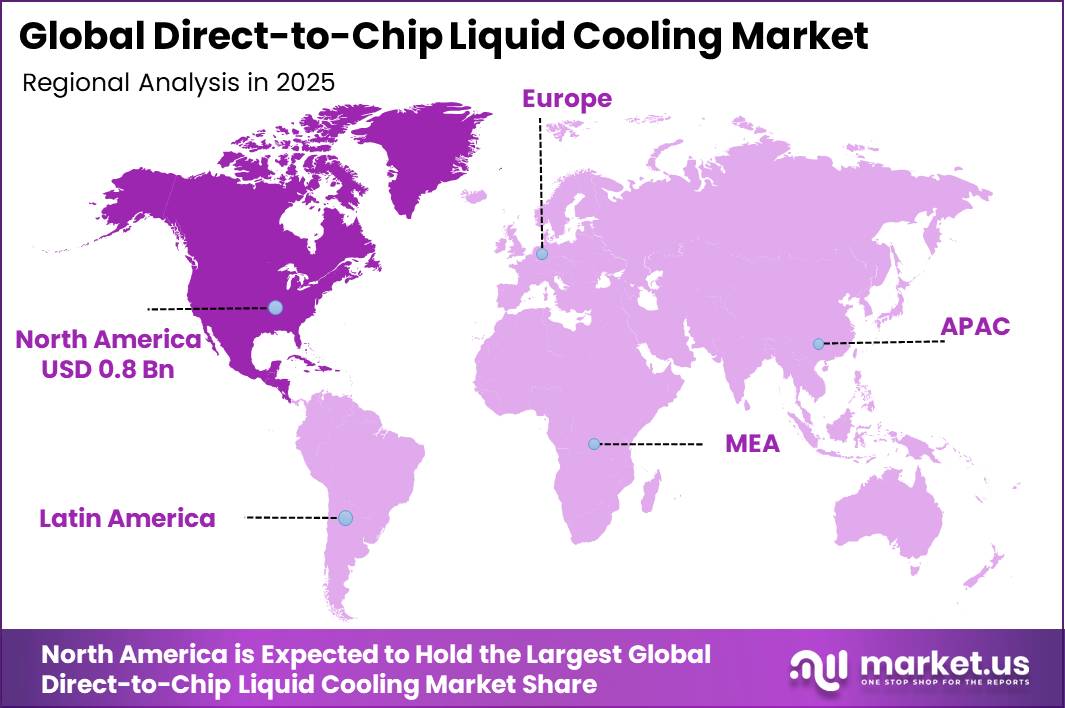
The Global Direct-to-Chip Liquid Cooling Market was valued at USD 2.3 billion in 2025 and is projected to reach USD 14.3 billion by 2035, expanding at a CAGR of 20.2% during the forecast period 2026–2035. North America dominates the global Direct-to-Chip Liquid Cooling Market, accounting for 37.1% of total market share and generating approximately USD 0.8 billion in revenue in 2025.
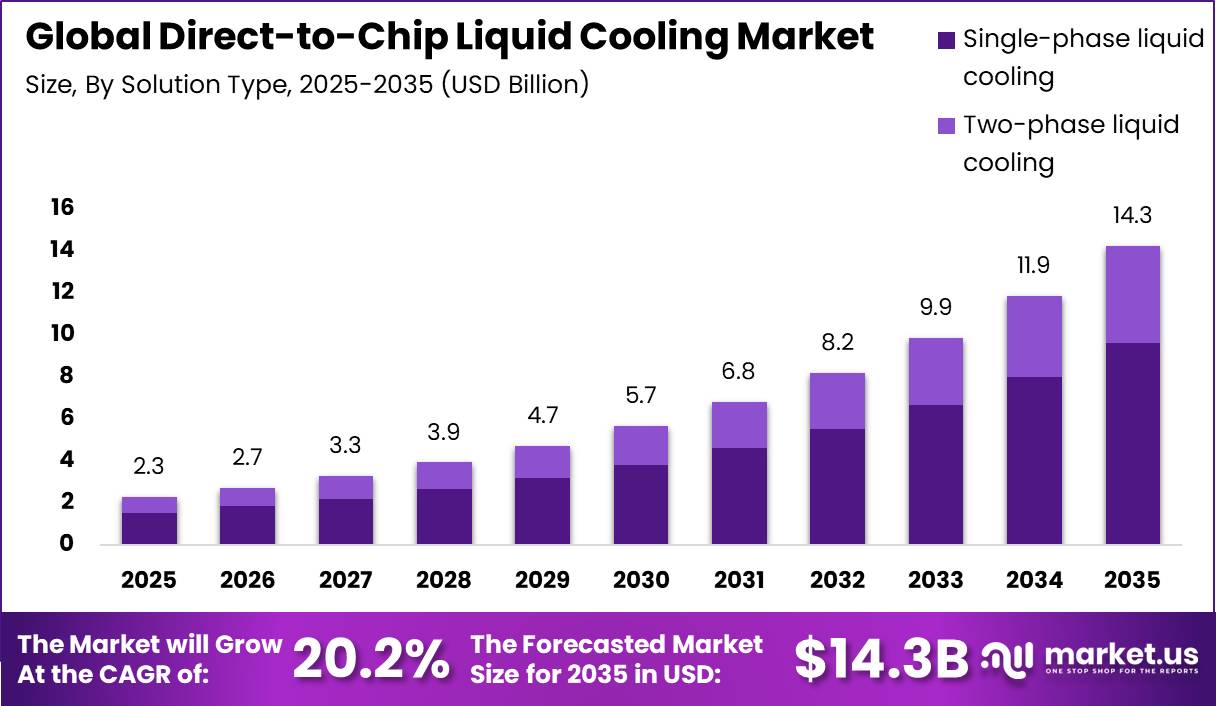
The rapid expansion of the Direct-to-Chip Liquid Cooling Market is mainly driven by the fast growth of AI-based data center infrastructure. According to the International Energy Agency (IEA), global data center electricity consumption reached 415 terawatt-hours (TWh) in 2024, equal to nearly 1.5% of total global electricity use. This consumption has increased at around 12% per year, more than four times faster than overall global electricity demand growth.
The IEA also projects data center electricity use to more than double to 945 TWh by 2030, supported by rising AI workloads and accelerated GPU computing. AI chips create much higher heat loads than traditional processors. Modern AI GPUs consume around 700 to 1,200 watts per chip, compared with only 150 to 200 watts for a conventional CPU.
A single AI server rack with 8 GPUs can require 50 to 150 kilowatts of continuous power, while a traditional computing rack usually consumes only 10 to 15 kilowatts. At these power densities, air cooling is no longer sufficient to maintain safe chip temperatures. Direct-to-chip liquid cooling is therefore becoming essential, as liquid can be up to 3,000 times more thermally effective than air. This enables higher compute density while reducing energy use.
Key Takeaways
- The Direct-to-Chip Liquid Cooling Market was valued at USD 2.3 billion in 2025 and is forecast to reach USD 14.3 billion by 2035.
- The market is expected to grow at a CAGR of 20.2% during the forecast period 2026–2035.
- Single-phase liquid cooling leads with a 67.4% share, while Two-phase liquid cooling is the fastest-growing sub-segment.
- GPU cooling holds the dominant share at 39.6% and is also the fastest-growing sub-segment.
- Water-based coolants dominate with a 53.2% share, while Dielectric fluids represent the fastest-growing sub-segment.
- Datacenter holds the leading share at 56.3% and is also the fastest-growing application segment.
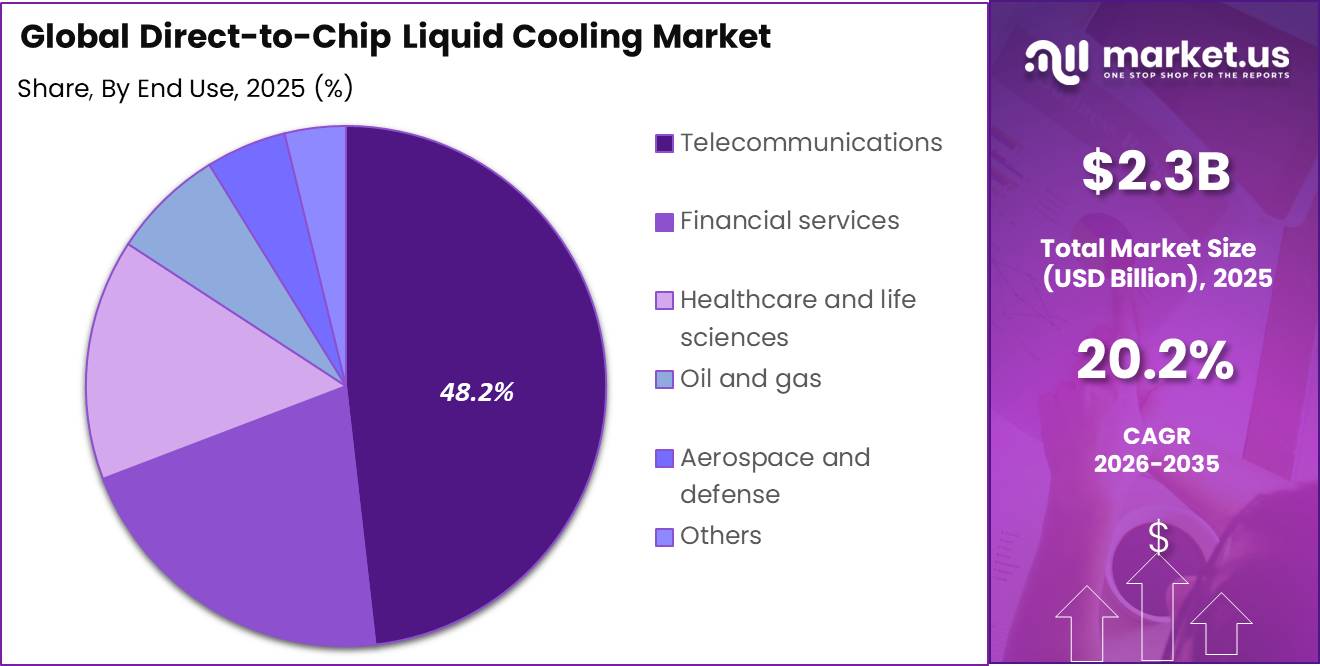
- Telecommunications leads with a 48.2% share and is also the fastest-growing end-use segment.
- North America is the dominant region, holding a 37.1% market share and generating USD 0.8 billion in revenue in 2025.
By Solution Type
Single-phase liquid cooling dominates with 67.4% due to a mature cold plate deployment ecosystem.
Single-phase liquid cooling holds the leading position in the direct-to-chip liquid cooling market because it is the most mature and widely deployed technology available today. In this approach, treated water or a water propylene glycol mixture flows continuously through cold plates mounted directly on CPUs and GPUs, staying in liquid form throughout the entire loop.
Two-phase liquid cooling is the fastest-growing sub-segment, accelerating because leading GPU thermal design power now exceeds 1,000 watts per chip, a heat load that single-phase systems struggle to manage at the end.
Two-phase technology uses engineered dielectric fluids that boil on contact with hot surfaces, absorbing far more energy through latent heat of vaporization than any single-phase approach can deliver, making it the preferred path for next-generation AI accelerator racks that push beyond 120 kW per rack unit.
By Component Cooling
GPU cooling dominates with 39.6% due to AI accelerator thermal design power exceeding 1,000W.
GPU cooling leads every other component category in the direct-to-chip market because modern AI accelerators generate heat at levels no other server component approaches. NVIDIA’s Rubin generation of AI infrastructure became the world’s first platform to achieve 100% liquid cooling across every chip and every networking component, driven entirely by the thermal requirements of GPU-class hardware.
The IEA 4E report confirmed that leading GPU thermal design power now exceeds 1,000 watts per chip, making air cooling structurally impossible for high-density AI deployments and turning GPU-targeted liquid cooling into a hard engineering requirement rather than an optional upgrade.
ASIC cooling is the fastest-growing sub-segment, accelerating sharply as cryptocurrency and custom AI inference hardware scale up. The global crypto cooling market reached USD 1.27 billion in 2025 and is forecast to grow at a compound annual rate of 16.5% through 2032, with ASIC miners generating sustained high-density heat loads that demand dedicated liquid cooling solutions, particularly dielectric fluid systems.
By Coolant Type
Water-based coolants dominate with 53.2% due to high specific heat capacity and low cost.
Water-based coolants hold the largest share in the direct-to-chip market because water delivers a higher specific heat capacity than any competing fluid, is widely available, and benefits from decades of mature handling infrastructure across industrial and data center environments.
Two-phase systems specifically require engineered dielectric fluids designed to boil at low temperatures between 50 and 60 degrees Celsius, enabling phase-change heat absorption that water-based systems cannot replicate.
Net Zero Insights data shows equity investment in data center cooling solutions surged to USD 2.7 billion in 2025 from USD 1.5 billion in 2024, with liquid cooling accounting for 84% of all funded solutions, and a significant share of that capital targeting advanced dielectric fluid development for high-density AI racks.
By Application
Datacenter dominates with 56.3% due to hyperscale AI cluster thermal management demand.
The datacenter segment commands the largest share of the direct-to-chip liquid cooling market because hyperscale cloud operators and AI factory builders face server rack densities that conventional air systems cannot manage economically. The IEA projects that global data center electricity consumption will more than double to approximately 945 TWh by 2030 from 415 TWh in 2024, with AI as the primary driver.
Edge computing is the fastest-growing application sub-segment, accelerating because 5G network rollouts, autonomous systems, and real-time inference workloads push compute nodes into field locations where traditional chiller-based cooling is impractical. The global cooling system for edge computing market was valued at USD 1.77 billion in 2025 and is forecast to grow at a compound annual rate of 11.2% through 2031, with direct-to-chip solutions gaining ground as edge nodes increasingly run GPU-class inference chips that demand targeted liquid cooling.
By End Use
Telecommunications dominates with 48.2% due to 5G infrastructure and dense server rack buildout.
Telecommunications leads end-use adoption of direct-to-chip liquid cooling because telecom operators are building 5G core networks, central office upgrades, and edge data nodes at scale, all of which demand high-density compute in space-constrained environments where rack thermal loads quickly exceed what air systems can handle.
The ITU estimates that the global number of 5G subscriptions surpassed 2 billion by the end of 2024, and the core processing infrastructure behind each network node generates sustained thermal loads that push operators toward direct liquid cooling to maintain uptime and efficiency. Liquid cooling investment in data center infrastructure reached USD 2.7 billion in 2025, with 84% of all deals focused on liquid-based solutions, reflecting the urgency telecom and cloud operators share.
The OECD has documented a 30% increase in financial sector AI infrastructure spending between 2023 and 2025, and direct-to-chip liquid cooling forms a core component of this buildout as firms prioritize low-latency, high-availability compute environments with strict uptime requirements.
Key Market Segments
By Solution Type
- Single-phase liquid cooling
- Two-phase liquid cooling
By Component Cooling
- GPU cooling
- ASIC cooling
- CPU cooling
- Memory cooling
- Other
By Coolant Type
- Water-based coolants
- Dielectric fluids
- Engineered fluids
- Mineral oils
By Application
- Datacenter
- Edge computing devices
- High-performance computing (HPC)
- Supercomputers
- Workstations
- Others
By End Use
- Telecommunications
- Aerospace and defense
- Financial services
- Healthcare and life sciences
- Oil and gas
- Others
Geopolitical Impact Analysis
Escalating trade policy conflicts have introduced high cost and supply pressure across the direct-to-chip liquid cooling supply chain. In July 2025, the U.S. administration imposed a 50% tariff on semi-finished copper products, directly affecting copper tubing, cold plates, and manifold assemblies that form the core of direct-to-chip cooling systems.
Earlier, in February 2025, a 25% tariff on all steel and aluminum imports was enacted and subsequently raised to 50%, impacting server chassis, cooling frames, and structural rack components that integrate with liquid cooling infrastructure. The AI data center sector paid an estimated $6 billion or more in tariffs in 2025 alone, based on conservative estimates covering 50,000 to 60,000 AI rack deployments across the U.S. industry.
Helium is critical for semiconductor fabrication, and South Korea alone sourced approximately 65% of its helium from Qatar in 2025, creating potential bottlenecks for chipmakers whose high-power processors drive direct-to-chip cooling demand. In the first half of 2025, the U.S. imported over 730,000 metric tons of refined copper from just four countries, exposing the cooling sector to concentrated supply chain vulnerability at a time when demand for copper-intensive cold plates and manifold systems is accelerating.
Regional Analysis
North America: Market Leader in Direct-to-Chip Liquid Cooling
North America dominates the Direct-to-Chip Liquid Cooling Market, holding a 37.1% share and generating USD 0.8 billion in revenue in 2025. The United States is the primary engine of this dominance, driven by the world’s highest concentration of hyperscale data centers operated by cloud and AI companies that require chip-level thermal management for dense GPU clusters.
According to the Federal Reserve Board, the U.S. retains structural advantages in compute capacity and AI investment conditions relative to all advanced foreign economies. Data center electricity consumption in the U.S. accounted for 4.4% of the country’s total electricity use in 2023 and is projected to climb to between 6.7% and 12% by 2028, with rising thermal density per rack making direct-to-chip cooling the preferred thermal solution. Canada contributes through growing colocation investment and federal digital infrastructure incentives.
The IEA noted that global data center electricity demand surged 17% in 2025, with North America capturing a disproportionate share of AI-focused deployments. The region also benefits from a mature ecosystem of cooling component manufacturers, systems integrators, and established supply chain networks that reduce deployment timelines for direct-to-chip cooling systems across both new build and retrofit applications.
Asia-Pacific is the fastest-growing region in the Direct-to-Chip Liquid Cooling Market. Goldman Sachs analysts project data center demand in China to grow at a 20% CAGR between 2025 and 2028, driven by large language model training clusters and sovereign AI investments. India is expected to expand its installed data center capacity from approximately 1.5 GW in 2025 to over 4.5 GW by 2030, creating large-scale demand for advanced cooling solutions.
Key Regions and Countries
North America
- US
- Canada
Europe
- Germany
- France
- The UK
- Spain
- Italy
- Rest of Europe
Asia Pacific
- China
- Japan
- South Korea
- India
- Australia
- Rest of APAC
Latin America
- Brazil
- Mexico
- Rest of Latin America
Middle East and Africa
- GCC
- South Africa
- Rest of MEA
Market Dynamics
Challenge
Direct-to-chip liquid cooling adoption is constrained by the difficulty of upgrading existing data center racks, since only about 15–25 percent of installed racks have sufficient space, plumbing access, and structural capacity to support liquid distribution units without significant redesign. As a result, operators must deploy upgrades in phased cycles lasting 18–36 months instead of completing full-facility conversions at once.
Each rack retrofit adds physical complexity, including 10–20 kilograms of additional manifolds and hoses and multiple new shutoff valves per cooling loop. Maintenance constraints further slow deployment, since installations often must be completed within short 4–8-hour shutdown windows per rack row, increasing coordination overhead and extending timelines by 20–30 percent compared to greenfield liquid-ready builds.
On the infrastructure side, higher rack densities enabled by liquid cooling, often rising from 10–15 kW to 30–60 kW per rack for AI and HPC workloads, require upgrades to power distribution systems, including PDUs, busways, and redundancy redesigns. These changes can add roughly 5–10 percent to total project capex and raise internal financial hurdles in a higher interest-rate environment.
| Challenge | (~) % CAGR | Geographic Relevance | Mitigation Horizon |
|---|---|---|---|
| Complex rack retrofits | -1.2% | North America core, EU metros, APAC hyperscale hubs | Medium term (2-4 years) |
| Fragmented liquid supply chain | -0.9% | North America, EU manufacturing belt, East Asia OEM clusters | Medium term (2-4 years) |
| Talent and safety skills gap | -0.8% | Global, stronger in emerging APAC and LatAm | Long term (≥ 4 years) |
| Capex and TCO uncertainty | -0.7% | North America core, EU regulatory hubs, Tier 2 APAC | Short term (≤ 2 years) |
| Regulatory and standards flux | -0.6% | EU regulatory hubs, UK, selected APAC markets | Long term (≥ 4 years) |
| Facility infrastructure constraints | -0.5% | Legacy data center stock globally | Medium term (2-4 years) |
Opportunity
AI/HPC-only D2C cooling platforms target the shift toward high-density AI infrastructure rather than general liquid cooling. Data-center electricity use is expected to more than double by 2030 and potentially triple by 2035 in AI-heavy scenarios, while AI workloads are projected to rise to ~40% of total compute by 2030. This is driving rack densities beyond 50–80 kW and accelerating demand for liquid cooling as a structural requirement rather than an upgrade option.
Purpose-built D2C platforms designed specifically for GPUs and accelerators can deliver 25–30x better energy efficiency per unit of compute versus air cooling, while enabling 2–3x higher rack density than advanced air systems. Hyperscale deployments already operate multi-MW liquid-cooled clusters at ~40–45°C coolant temperatures. At facility scale, a 50 MW AI site can see up to USD 4 million per year in cooling savings, along with 10–15% lower capex per TFLOP and 15–20% lower lifetime energy cost per workload.
If AI accounts for ~30–40% of incremental data-center power to 2030 and only 20–25% of that shift adopts optimized D2C platforms, the incremental TAM could reach USD 5–7 billion by 2030. This supports roughly +2.5 percentage points of CAGR uplift versus baseline forecasts, driven by higher penetration into AI clusters that require densities and thermal performance air systems cannot support.
| Opportunity | (~) % Potential
CAGR |
Geographic Relevance | Execution Window |
|---|---|---|---|
| AI/HPC-Only D2C Cooling Platforms | +2.5% | North America core, EU, East Asia | Short–Medium term |
| Retrofit-as-a-Service for Brownfield Sites | +1.8% | North America, EU, APAC emerging | Short term |
| Modular Edge & Telco D2C Skids | +1.5% | APAC emerging, Middle East, LatAm | Medium term |
| Open Fluids & Components Licensing Model | +1.2% | EU, North America, Global OEMs | Medium–Long term |
| Integration with Energy & Heat-Reuse Monetization | +1.0% | EU, Nordics, East Asia urban hubs | Medium–Long term |
| Vertical M&A Roll-Up of Niche D2C Specialists | +0.8% | Global (platform consolidators) | Short–Medium term |
Driver
EU and national rules like the revised Energy Efficiency Directive (EED) are making data centers report PUE, WUE, energy reuse, and emissions once they cross roughly 300–500 kW IT load, pushing the industry toward tighter efficiency and net-zero targets.
Overall, cooling becomes a compliance-driven and energy-reuse-driven investment rather than a cost-only decision. This allows vendors to price DTC systems based on regulatory compliance value plus energy and heat revenue potential, supporting roughly a ~2 percentage-point uplift in DTC CAGR across Europe, with spillover into the UK and Nordic regions.
| Driver | (~) % Impact on CAGR | Geographic Relevance | Impact Timeline |
|---|---|---|---|
| AI GPU rack power density >50–100 kW pushes shift to direct-to-chip | +3.0% | North America core, EU, APAC corridors | Short–Medium term |
| EU and national data-center efficiency rules (PUE/WUE/heat reuse) favor liquid and DTC | +2.0% | EU core, UK, Nordics, Germany hotspot | Medium–Long term |
| Hyperscaler and cloud capex pivot to AI/ML infrastructure | +2.2% | North America core, APAC corridors, EU hubs | Short–Medium term |
| Rising grid constraints and site power caps drive ultra-efficient cooling | +1.5% | EU, North America tier-1 cities, parts of APAC | Medium term |
| Maturing DTC ecosystem: cold plates, manifolds, and facility integrations | +1.3% | Global, early adopter DC clusters | Medium–Long term |
| Sustainability and corporate net-zero targets accelerate liquid cooling adoption | +1.0% | Global multinationals, EU and developed APAC | Medium–Long term |
Restraint
The biggest constraint on direct-to-chip (DTC) liquid cooling adoption is the high upfront CapEx and uncertain ROI at rack level. Shifting from air cooling to DTC typically raises costs by 20 to 40 percent per rack, moving installed costs from about USD 15,000 to 20,000 (air, 30 to 50 kW) to USD 25,000 to 35,000 (DTC, 60 to 100 kW), including cold plates, CDUs, manifolds, piping, and controls.
Although DTC can reduce cooling energy use by 20 to 30 percent and improve PUE by 0.1 to 0.2 points, these benefits are back-loaded and depend heavily on utilization. For many colocation operators running 10 to 20 kW racks today, this pushes payback to 4 to 6 years, beyond the typical 3 to 4 year ROI hurdle, leading to slower approvals and phased deployment only in new AI and HPC pods.
As a result, operators limit exposure, often capping liquid-cooled racks at 20 to 30 percent of new builds through 2028, to control balance-sheet risk and CapEx growth (kept near 10 to 12 percent annually, even as AI demand would justify 15 to 18 percent). This creates an estimated ~2.2 percentage-point drag on DTC CAGR, especially across North America, Europe, Japan, and South Korea, even as rack densities push toward 70 to 100 kW by 2025 to 2026.
| Restraint | (~) % Impact on CAGR | Geographic Relevance | Impact Timeline |
|---|---|---|---|
| High upfront CapEx and TCO uncertainty | -2.2% | North America core, EU, Tier-1 APAC | Short–Medium term |
| Cold-plate and component supply risk | -1.7% | US, EU, East Asia manufacturing hubs | Short term |
| Facility integration and retrofit complexity | -1.5% | Legacy DC clusters in NA, EU, APAC | Medium term |
| Skills, service, and ecosystem gaps | -1.3% | Global, strongest in emerging APAC, LATAM, MEA | Medium–Long term |
| Standards, interoperability, and OEM lock-in | -1.1% | Global hyperscale and colocation corridors | Medium term |
| Regulatory, water, and environmental constraints | -0.9% | EU, California and select US states, water-stressed APAC | Long term |
Key Players Analysis
Vertiv Holdings Co. stands as the clear Tier 1 leader in the direct-to-chip liquid cooling space, backed by its scale across the full critical data center infrastructure stack. Vertiv posted record net sales of approximately USD 8.0 billion for full-year 2024, representing approximately 17% growth over 2023, with its thermal management division serving as a core revenue driver.
The company reported third-quarter 2025 net sales of USD 2,676 million, a 29% year-over-year increase, reflecting continued strong order intake from hyperscale AI customers. Vertiv acquired Strategic Thermal Labs LLC, a specialist in cold-plate design and high-density thermal validation, directly strengthening its direct-to-chip engineering capabilities at the server-side interface.
AMD reported a record Data Center segment revenue of USD 12.6 billion for full year 2024, a 94% increase year-over-year, with Q4 2025 Data Center revenue reaching a record USD 5.4 billion, up 39% year-over-year, driven by EPYC processor and Instinct GPU deployments that require direct-to-chip thermal solutions.
CoolIT Systems emerged as a significant acquisition target, with Ecolab completing the acquisition of CoolIT Systems in a deal valued at approximately USD 4.75 billion in July 2026, validating the strategic premium placed on direct-to-chip cooling technology leadership. Asetek reported full-year 2025 revenue of USD 41.5 million, compared to USD 52.5 million in 2024, as it navigates competitive pressure in its core liquid cooling hardware business.
Top Key Players in the Market
- Chilldyne, Inc.
- Vertiv Holdings Co
- Submer
- Schneider Electric
- LiquidStack
- JETCOOL Technologies Inc.
- Iceotope Technologies
- Fujitsu Ltd.
- CoolIT Systems
- ZutaCore
- Asetek
- Advanced Micro Devices, Inc.
Recent Developments
- In April 2026, Vertiv acquired Strategic Thermal Labs LLC (STL), a specialist in advanced cold-plate design, server-side liquid cooling, and high-density thermal validation, strengthening Vertiv’s engineering capability at the direct-to-chip interface for AI data centers.
- In March 2026, Trane Technologies completed the acquisition of LiquidStack, a global leader in liquid cooling technology headquartered in Carrollton, Texas, following the agreement announced in February 2026 to expand its end-to-end data center thermal management portfolio.
- In November 2025, Daikin Applied Americas completed the acquisition of Chilldyne, Inc., a Carlsbad, California-based manufacturer of negative-pressure direct-to-chip liquid cooling systems, adding the technology to Daikin Applied’s growing data center cooling portfolio following its August 2025 acquisition of DDC Solutions.
Report Scope
| Report Features | Description |
|---|---|
| Market Value (2025) | USD 2.3 Billion |
| Forecast Revenue (2035) | USD 14.3 Billion |
| CAGR (2026-2035) | 20.2% |
| Base Year for Estimation | 2025 |
| Historic Period | 2020-2024 |
| Forecast Period | 2026-2035 |
| Report Coverage | Revenue Forecast, Market Dynamics, Competitive Landscape, Recent Developments |
| Segments Covered | By Solution Type (Single-phase liquid cooling, Two-phase liquid cooling); By Component Cooling (GPU cooling, ASIC cooling, CPU cooling, Memory cooling, Other); By Coolant Type (Water-based coolants, Dielectric fluids, Engineered fluids, Mineral oils); By Application (Datacenter, Edge computing devices, High-performance computing (HPC), Supercomputers, Workstations, Others); By End Use (Telecommunications, Aerospace and defense, Financial services, Healthcare and life sciences, Oil and gas, Others) |
| Regional Analysis | North America – US, Canada; Europe – Germany, France, The UK, Spain, Italy, Rest of Europe; Asia Pacific – China, Japan, South Korea, India, Australia, Singapore, Rest of APAC; Latin America – Brazil, Mexico, Rest of Latin America; Middle East & Africa – GCC, South Africa, Rest of MEA |
| Competitive Landscape | Chilldyne, Inc., Vertiv Holdings Co, Submer, Schneider Electric, LiquidStack, JETCOOL Technologies Inc., Iceotope Technologies, Fujitsu Ltd., CoolIT Systems, ZutaCore, Asetek, Advanced Micro Devices, Inc. |
| Customization Scope | Customization for segments and region/country-level will be provided. Moreover, additional customization can be done based on the requirements. |
| Purchase Options | We have three licenses to opt for: Single User License, Multi-User License (Up to 5 Users), Corporate Use License (Unlimited Users and Printable PDF) |