


Report Overview
Global Digital Shelf Market size is expected to be worth around USD 10.0 Billion by 2035 from USD 2.8 Billion in 2025, growing at a CAGR of 13.5% during the forecast period 2026 to 2035.
The Digital Shelf Market encompasses software and services that help brands manage product content, pricing visibility, availability signals, and commerce analytics across online retail channels. It spans product experience management platforms, content syndication tools, retail media analytics, and competitive price intelligence solutions serving enterprise and mid-market brands globally.
Key Takeaways
- The global Digital Shelf Market is valued at USD 2.8 Billion in 2025 and is forecast to reach USD 10.0 Billion by 2035.
- The market grows at a CAGR of 13.5% during the forecast period 2026 to 2035.
- By Offering, Services dominates with 72.34% market share in 2025.
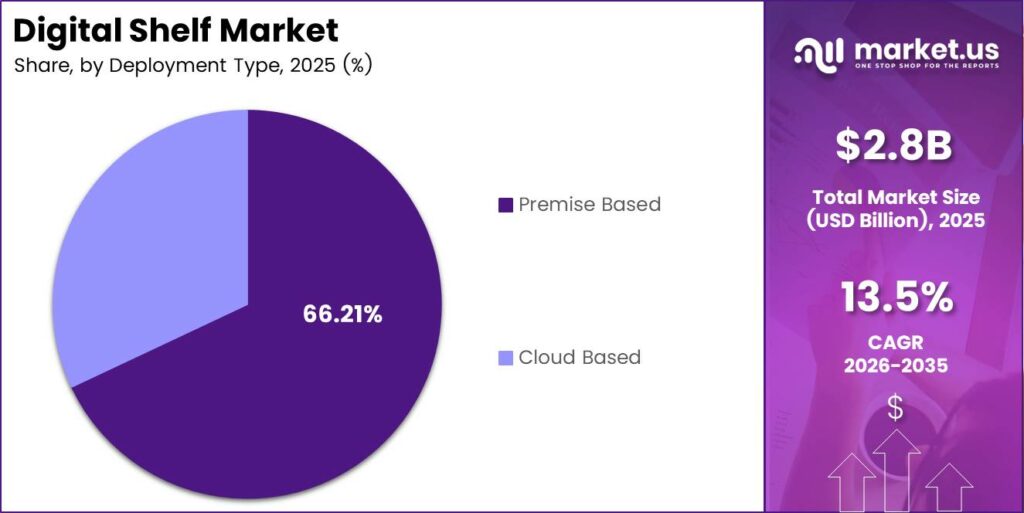
- By Deployment Type, Premise Based holds 66.21% share in 2025.
- By End Use, Large Enterprises leads with 67.33% market share in 2025.
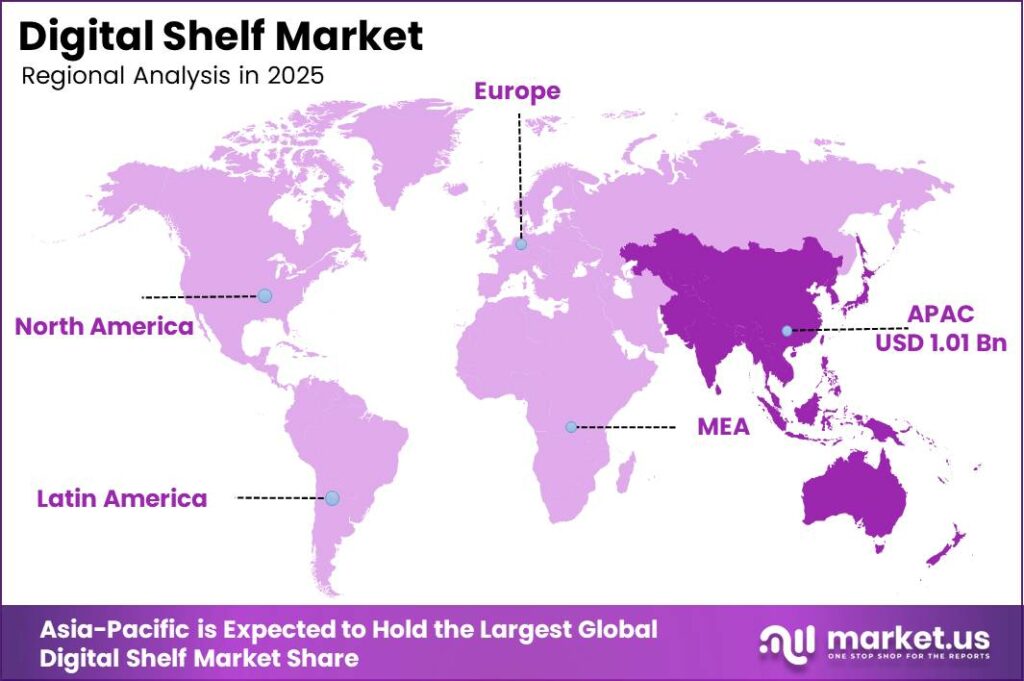
- Asia-Pacific is the dominant region with 36.21% share, valued at USD 1.01 Billion.
- Europe is the fastest-growing region in the Digital Shelf Market.
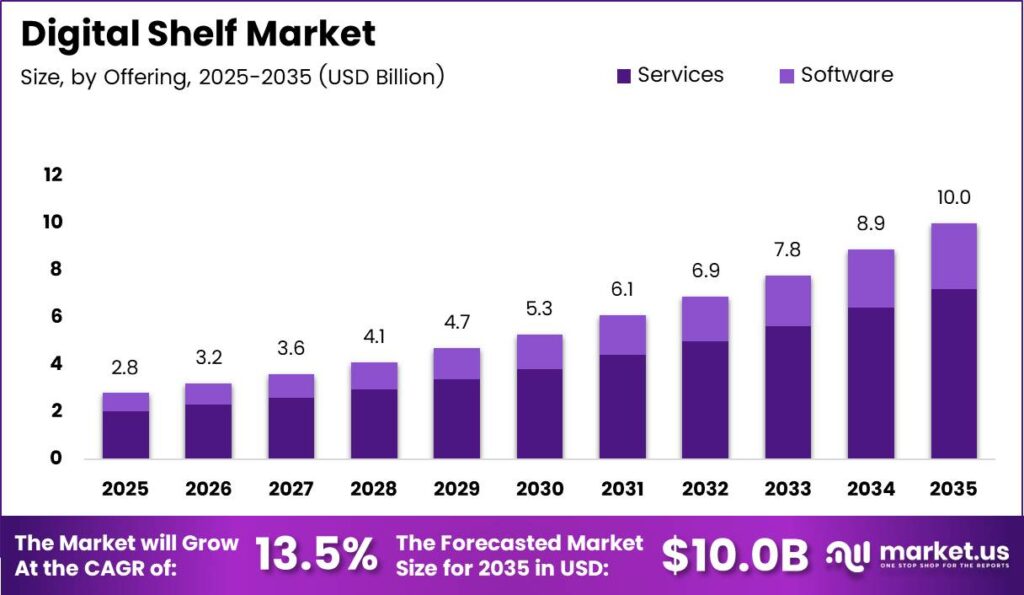
Online retail expansion continues to pressure brands on product content quality, pricing accuracy, and availability execution. As per our research, 58% of shoppers purchased a different brand when their preferred product was out of stock, exposing the revenue risk of poor digital shelf execution. Brands that cannot maintain content accuracy and in-stock signals across channels face direct substitution at the point of purchase.
Data from Salsify and the Digital Shelf Institute’s Q4 2025 report shows 32% of shoppers identified customer ratings and reviews as the product-page element most helpful for their final buying decision. This finding reinforces why brands invest in content syndication and review management platforms. Vendors that integrate review signals directly into their product experience workflows gain a measurable conversion advantage.
In May 2025, Profitero partnered with Mars United and Publicis Commerce to launch Profitero+, combining global digital shelf data across 1,400 retailers with managed services for content production, catalog optimization, and media bidding. This positions managed-service offerings as the next competitive frontier beyond pure software licensing. Vendors that bundle data intelligence with execution services will command higher contract values and reduce churn.
Offering Analysis
Services dominates with 72.34% due to high implementation and ongoing support needs.
In 2025, Services held a dominant market position in the By Offering segment of the Digital Shelf Market, with a 72.34% share. Brands require continuous channel monitoring, content syndication maintenance, and analytics interpretation that go beyond software deployment. This recurring service demand creates predictable revenue streams and high switching costs, making Services the structurally stickier offering category.
Software completes the Offering segment with the remaining share. Standalone software licenses attract technically mature enterprise buyers who build internal implementation capacity. However, the complexity of multi-retailer content workflows drives most buyers toward bundled service contracts, limiting pure software adoption to a narrower buyer segment.
Deployment Type Analysis
Premise Based dominates with 66.21% due to enterprise data control and security requirements.
In 2025, Premise Based held a dominant market position in the By Deployment Type segment of the Digital Shelf Market, with a 66.21% share. Large enterprise buyers in regulated sectors prioritize on-premise deployment to maintain control over proprietary product data and comply with internal security governance frameworks. This preference reinforces longer sales cycles but delivers higher average contract values for vendors that meet enterprise certification requirements.
Cloud Based deployment holds the remaining share and is the fastest-growing deployment mode. Cloud delivery reduces implementation timelines and allows vendors to push feature updates without customer-side infrastructure changes. As per our research, 33% of shoppers redirected purchases to alternative domestic retailers when facing stockouts, creating urgency for brands to adopt faster, cloud-delivered monitoring tools that close availability gaps in real time.
End Use Analysis
Large Enterprises dominates with 67.33% due to multi-channel complexity and high SKU volumes.
In 2025, Large Enterprises held a dominant market position in the By End Use segment of the Digital Shelf Market, with a 67.33% share. Managing thousands of product listings across dozens of retailer channels demands centralized content governance, automated syndication, and continuous performance monitoring at a scale that only dedicated platforms can serve. Salsify and the Digital Shelf Institute’s Q4 2025 report found that 17% of shoppers rated product images and videos as the most helpful purchase-decision element, underscoring the content execution burden large enterprise teams carry across every retailer channel.
Small and Medium Enterprises represent the fastest-growing end-use segment. Lower-cost cloud-based tiers and white-label agency offerings are reducing entry barriers for smaller brands. Salsify and the Digital Shelf Institute’s Q4 2025 report found that 18% of shoppers selected product titles and descriptions as the most helpful product-page element, giving SMEs a high-impact, low-volume content priority that fits their limited operational budgets.
Salsify found that 11% of shoppers abandoned their purchase entirely when a preferred product was out of stock. For SMEs with narrow assortments, even a single availability failure eliminates a buyer who may not return. In May 2026, Salsify launched SalsifyIQ at the Digital Shelf Summit, introducing an AI intelligence layer that automates channel syndication mapping, directly addressing the content execution gap that puts SME brands at greatest availability risk.
Salsify and the Digital Shelf Institute’s Q4 2025 report indicates that 64% of shoppers used an AI-powered tool such as ChatGPT or Amazon’s Rufus to discover or research a new product. Among those, 19% specifically used Amazon’s Rufus for product discovery. Brands that optimize product content for AI-driven search interfaces will disproportionately capture discovery share as this behavior becomes standard across buyer cohorts.
Key Market Segments
By Offering
- Services
- Software
By Deployment Type
- Premise Based
- Cloud Based
By End Use
- Large Enterprises
- Small and Medium Enterprise
Regional Analysis
Asia-Pacific Dominates the Digital Shelf Market with a Market Share of 36.21%, Valued at USD 1.01 Billion
Asia-Pacific commands 36.21% of the global Digital Shelf Market, valued at USD 1.01 Billion in 2025. The region’s dominance reflects its large and fragmented e-commerce landscape, spanning high-volume marketplaces across China, Japan, South Korea, India, and Southeast Asia. Brands operating across these markets require robust content syndication and pricing intelligence tools to manage platform-specific requirements at scale.
Europe is the fastest-growing regional market in the Digital Shelf segment. Tighter digital commerce regulations, cross-border retail expansion within the EU single market, and increasing retailer adoption of structured product data standards are accelerating platform procurement. In October 2025, Morrisons Supermarkets partnered with VusionGroup to roll out 10.8 million smart electronic shelf labels across all 497 of its supermarkets to automate in-store pricing and promotional updates. This signals that European retailers are actively investing in connected shelf infrastructure, creating adjacent demand for digital shelf analytics vendors.
Key Regions and Countries
North America
- US
- Canada
Europe
- Germany
- France
- The UK
- Spain
- Italy
- Rest of Europe
Asia Pacific
- China
- Japan
- South Korea
- India
- Australia
- Rest of APAC
Latin America
- Brazil
- Mexico
- Rest of Latin America
Middle East and Africa
- GCC
- South Africa
- Rest of MEA
Market Dynamic
Market Opportunity Analysis - Underserved deployment models and emerging regional markets offer entry points for digital shelf vendors
Cloud Based deployment holds the fastest-growing share within the Deployment Type segment, yet Premise Based still commands 66.21% of the market. This gap signals that a large portion of enterprise buyers has not yet transitioned to cloud delivery. Vendors that offer hybrid migration pathways can capture contract conversions without requiring customers to abandon existing on-premise infrastructure investments.
Small and Medium Enterprises represent the fastest-growing End Use segment but currently hold a minority share against Large Enterprises at 67.33%. This concentration creates white space for vendors that build tiered pricing models or agency-embedded white-label products priced for SME budgets. First movers that establish SME customer bases in Asia-Pacific and Latin America will build renewal revenue ahead of larger platform entrants.
Europe is the fastest-growing regional market yet holds a smaller absolute share than Asia-Pacific at 36.21%. Regulatory harmonization across the EU single market is standardizing digital product content requirements, which creates a near-term procurement trigger for brands selling across multiple European markets. Vendors that build EU-compliant data infrastructure ahead of competitors will reduce buyer risk and shorten enterprise sales cycles in the region.
Technology and Innovation Landscape - Automation and AI-driven product data infrastructure redefine execution speed and content accuracy
According to gspann, integrating Salsify PIM with Elastic Path eliminated 100% of manual product-data exports for a health-equipment manufacturer in April 2025. The integration supported more than 30,000 products with complex SKU hierarchies. This result demonstrates that PIM-to-commerce API automation is no longer a future capability but a deployable operational standard for enterprise brands today.
As reported by gspann, the product-data synchronization architecture achieved a 12-hour interval: Salsify exported JSON data to AWS S3 and Elastic Path retrieved and imported it through an API. This cadence removes the bottleneck of manual file transfers across large catalogs. Brands managing high-frequency promotional cycles or seasonal range changes will find this synchronization model essential for maintaining content accuracy at retailer level.
As per our research, SalsifyIQ, launched at the Digital Shelf Summit in May 2026, introduced an AI intelligence layer designed for agentic commerce that unifies retailer data schemas and automates channel syndication mapping. This capability directly reduces the analyst labor required to adapt product content across retailer-specific attribute structures. Vendors that embed agentic AI into syndication workflows will accelerate implementation timelines and compress the cost-to-serve for complex enterprise deployments.
Drivers
Online retail channel expansion continues to enlarge the volume of product listings, retailer-specific content requirements, and commercial data signals that brands must actively manage. The U.S. Census Bureau recorded e-commerce growth of 2.7% in Q4 2024 and 1.9% in Q3 2025, establishing an expanding transaction base that directly increases demand for digital shelf analytics and content syndication tools. Brands expanding from 5 to 7 retailer channels increase monitored product-channel combinations by 40%, shifting procurement from periodic audits to recurring subscription contracts.
Retail media performance accountability, automated product-content production, and competitive price surveillance are adding compounding short-term pressure on brands to invest in digital shelf platforms. Centralized brand governance requirements from multinational organizations are driving multi-year procurement decisions in North America and Europe. Vendors that demonstrate measurable ROI across these drivers will command larger deal sizes and longer contract terms.
| Driver | (~) % Impact on CAGR Forecast | Geographic Relevance | Impact Timeline |
|---|---|---|---|
| Online retail channel expansion | +0.65% | Global; North America and Asia-Pacific emphasis | Short term (≤ 2 years) |
| Retail media performance accountability | +0.45% | North America, Europe, developed Asia-Pacific | Short term (≤ 2 years) |
| Automated product-content production | +0.35% | Global; enterprise brands | Short term (≤ 2 years) |
| Competitive price surveillance demand | +0.30% | Global; promotion-intensive categories | Short term (≤ 2 years) |
| Availability-led revenue protection | +0.25% | Global; grocery and consumer goods | Short term (≤ 2 years) |
| Centralized brand-governance procurement | +0.20% | Multinational brands; North America and Europe | Medium term (2–4 years) |
Restraints
Contractual restrictions on data extraction create a direct coverage barrier for digital shelf vendors. Amazon’s published Indian service conditions restrict automated extraction without written consent, illustrating how marketplace terms can block promised data coverage before a vendor activates a new account. In a deployment targeting 10 retailer domains, losing authorization for 2 domains removes 20% of coverage, which can prevent contract acceptance even when most domains remain accessible.
Permission negotiations or replacement-feed validation may extend 8 to 16 weeks, delaying billable revenue and increasing data-acquisition costs by an estimated 10 to 15%. Small-brand affordability barriers and incumbent contract lock-in add further drag, particularly across emerging markets and established enterprise accounts in North America and Europe. Vendors that build pre-authorized retailer feed networks will reduce both activation time and contractual exposure.
| Restraint | (~) % Impact on CAGR Forecast | Geographic Relevance | Impact Timeline |
|---|---|---|---|
| Contractual restrictions on data extraction | -0.50% | Global; marketplace-dependent deployments | Short term (≤ 2 years) |
| Small-brand affordability barriers | -0.30% | Global; emerging markets emphasis | Short term (≤ 2 years) |
| Incumbent contract lock-in | -0.20% | North America and Europe | Medium term (2–4 years) |
| Enterprise security approval gates | -0.15% | Global; regulated enterprises | Short term (≤ 2 years) |
| Cross-border data-transfer prohibitions | -0.15% | Jurisdiction-specific international deployments | Medium term (2–4 years) |
| Standalone-tool procurement exclusions | -0.10% | Global; suite-standardized enterprises | Short term (≤ 2 years) |
Challenges
Fragmented product identity resolution undermines the accuracy of digital shelf analytics even when data access is fully authorized. For a deployment covering 20,000 products across 8 channels, vendors must reconcile 160,000 product-channel records. A 5% exception rate generates 8,000 unresolved records, requiring approximately 267 analyst-hours of review before accounting for ongoing catalog changes. This workload slows time-to-value and consumes implementation capacity.
GS1’s Global Data Model provides a standards-based mitigation path for harmonized product-data exchange, but adoption is uneven across retailer networks. Reducing the exception rate from 5% to 2% would cut review workload by 60%, creating a measurable ROI case for vendors that invest in persistent identity graphs and confidence-scored matching. Vendors that solve identity resolution at scale will differentiate on data quality rather than data volume alone.
| Challenge | (~) % CAGR Friction Drag | Geographic Relevance | Mitigation Horizon |
|---|---|---|---|
| Fragmented product identity resolution | -0.40% | Global; multi-retailer assortments | Medium term (2–4 years) |
| Retailer interface change management | -0.25% | Global; authorized retailer integrations | Short term (≤ 2 years) |
| Incrementality measurement ambiguity | -0.20% | Global; enterprise deployments | Medium term (2–4 years) |
| Multilingual attribute normalization complexity | -0.15% | Europe, Asia-Pacific, Latin America | Medium term (2–4 years) |
| Commerce analytics talent scarcity | -0.15% | Global; specialist implementation teams | Medium term (2–4 years) |
| High-frequency monitoring compute overhead | -0.10% | Global; large monitored assortments | Short term (≤ 2 years) |
Opportunities
Connected-packaging experience orchestration opens an adjacent revenue layer for digital shelf providers beyond retailer listing optimization. GS1’s retail initiative targets point-of-sale capability to process standards-based two-dimensional barcodes by end of 2027, enabling scan-to-experience workflows at checkout. Vendors that build destination management and analytics permissions into existing product experience platforms could achieve gross margins 3 to 5 percentage points above labor-intensive managed services.
Industrial distributor catalog expansion presents a medium-term growth path in North America, Europe, and industrial Asia-Pacific, where complex B2B product data requirements mirror enterprise digital shelf needs. Agency-embedded white-label distribution offers a short-term entry route in Asia-Pacific, Latin America, and the Middle East, where direct enterprise sales cycles remain long. Vendors that combine outcome-based pricing with anonymized category intelligence licensing will build dual revenue streams that reduce dependency on single-contract renewals.
| Opportunity | (~) % Potential CAGR Upside | Geographic Relevance | Execution Window |
|---|---|---|---|
| Connected-packaging experience orchestration | +0.55% | Global; standards-ready retail ecosystems | Medium term (2–4 years) |
| Industrial distributor catalog expansion | +0.35% | North America, Europe, industrial Asia | Medium term (2–4 years) |
| Verified-outcome pricing models | +0.25% | North America and Europe | Medium term (2–4 years) |
| Anonymized category intelligence licensing | +0.20% | Global; permissioned data ecosystems | Medium term (2–4 years) |
| Agency-embedded white-label distribution | +0.15% | Asia-Pacific, Latin America, Middle East | Short term (≤ 2 years) |
| Specialist workflow acquisition roll-ups | +0.10% | North America and Europe | Long term (≥ 4 years) |
Key Company Insights
Salsify holds a structural advantage in enterprise product experience management through its AI-powered PXM platform. In Q4 2025, Ultimate Products ran 4.4 million automated workflow tasks through Salsify, generating annualized savings of 9,000 working hours valued at nearly £200,000 per year. In July 2026, Cinven signed a definitive agreement to acquire Salsify, funding its next phase of global expansion.
In September 2025, Syndigo completed its acquisition of 1WorldSync, merging two of the largest product data networks to expand global PXM and Master Data Management capabilities. This consolidation gives Syndigo a materially larger retailer and brand network than most standalone competitors can match. However, integration complexity across two large platforms creates a near-term execution risk that focused challengers can exploit.
Key Players
- Salsify
- Syndigo
- Pacvue
- Stackline
- eStoresBrands
- ChannelAdvisor
- CommerceIQ
- DataWeave
- PriceSpider
- Wiser Solutions
- Other Key Players
Recent Developments
- August 2025 – ChannelEngine announced a strategic partnership with Salsify to integrate enterprise Product Experience Management and product content syndication with direct marketplace distribution across global commerce destinations.
- March 2026 – Similarweb officially launched its Retail Intelligence Suite, combining Amazon IQ with its new Cross-Retail IQ coverage to deliver unified shopper behavior and digital shelf analytics across more than 650 online stores.
- March 2026 – Syndigo acquired London-based SaaS platform Taggstar to embed real-time social proof messaging, conversion rate optimization, and dynamic product badging directly into its PXM cloud.
- June 2026 – Syndigo released the Syndigo Conversion Framework, introducing new AI-driven product capabilities alongside its Synapse and SynapseGo tools to maximize online shopper conversion rates.
Report Scope
| Report Features | Description |
|---|---|
| Market Value (2025) | USD 2.8 Billion |
| Forecast Revenue (2035) | USD 10.0 Billion |
| CAGR (2026-2035) | 13.5% |
| Base Year for Estimation | 2025 |
| Historic Period | 2020-2024 |
| Forecast Period | 2026-2035 |
| Report Coverage | Revenue Forecast, Market Dynamics, Market Opportunity Analysis, Technology and Innovation Landscape, Competitive Landscape, Recent Developments |
| Segments Covered | By Offering (Services, Software), By Deployment Type (Premise Based, Cloud Based), By End Use (Large Enterprises, Small and Medium Enterprise) |
| Regional Analysis | North America (US and Canada), Europe (Germany, France, The UK, Spain, Italy, and Rest of Europe), Asia Pacific (China, Japan, South Korea, India, Australia, and Rest of APAC), Latin America (Brazil, Mexico, and Rest of Latin America), Middle East and Africa (GCC, South Africa, and Rest of MEA) |
| Competitive Landscape | Salsify, Syndigo, Pacvue, Stackline, eStoresBrands, ChannelAdvisor, CommerceIQ, DataWeave, PriceSpider, Wiser Solutions, Other Key Players |
| Customization Scope | Customization for segments, region/country-level will be provided. Additional customization can be done based on requirements. |
| Purchase Options | We have three licenses to opt for: Single User License, Multi-User License (Up to 5 Users), Corporate Use License (Unlimited User and Printable PDF) |





































