


Report Overview
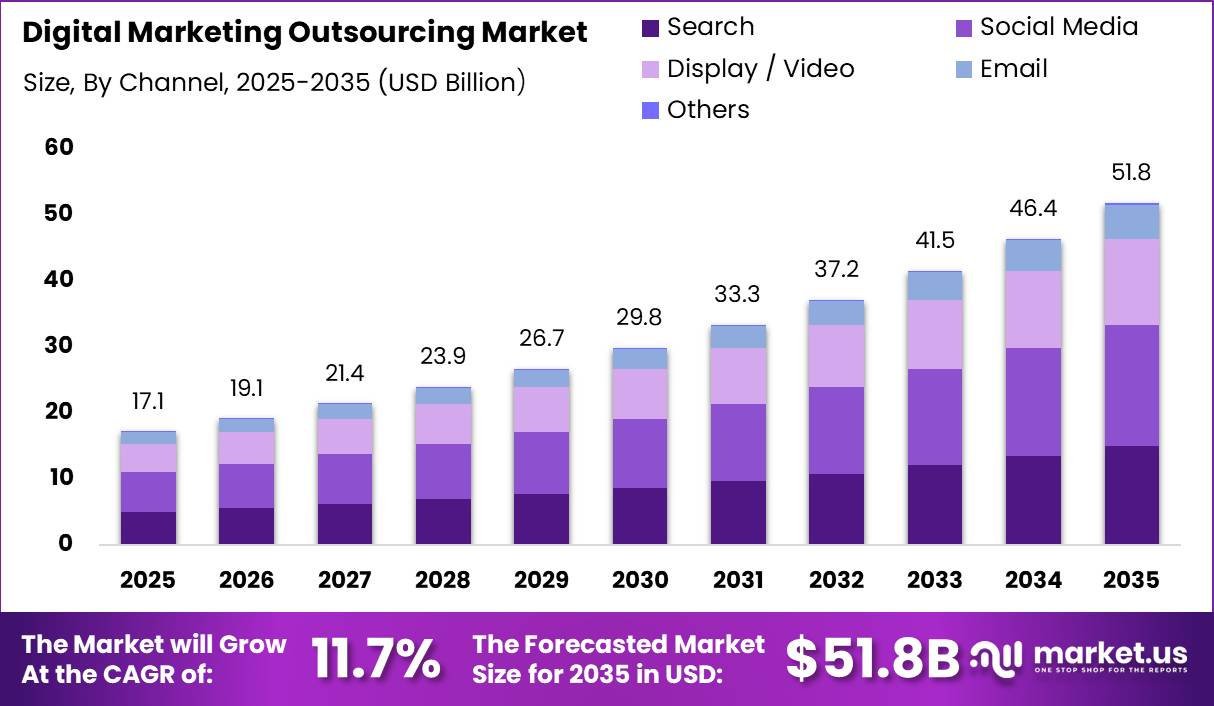
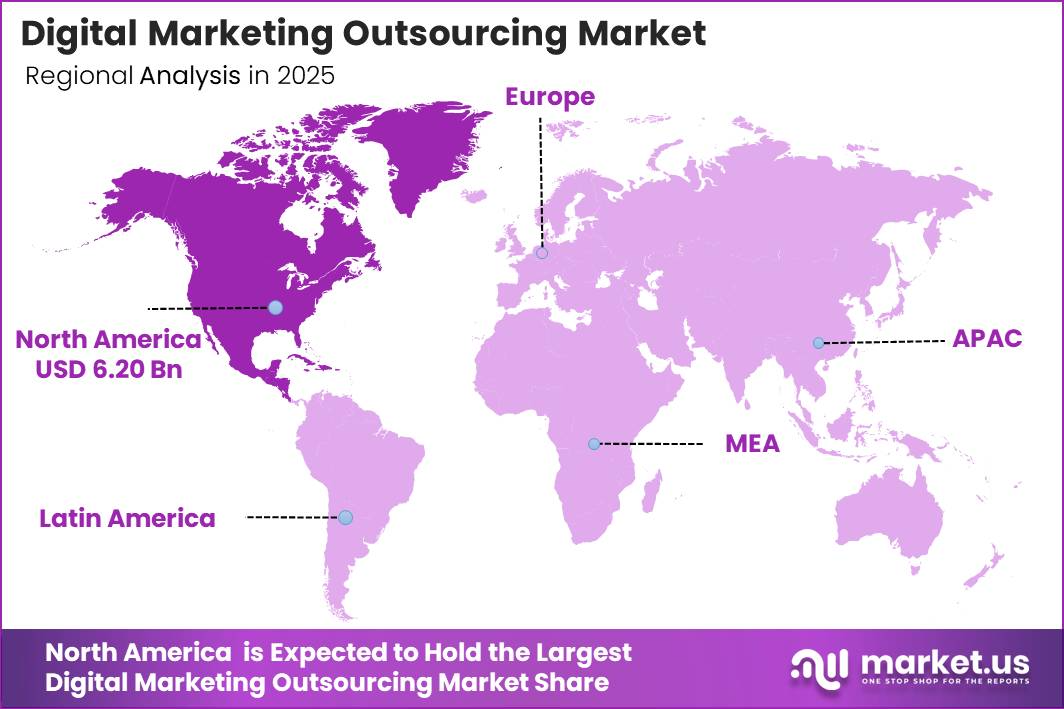
In 2025, the Digital Marketing Outsourcing Market was valued at USD 17.1 billion. The market is projected to grow at a CAGR of 11.7% during 2026–2035, reaching approximately USD 51.8 billion by 2035. North America dominated the global market in 2025, accounting for more than 36.2% of the total market share and generating approximately USD 6.2 billion in revenue.
The expansion of the digital marketing outsourcing market is strongly supported by the rapid growth of the global internet user base. According to the International Telecommunication Union, nearly 6 billion people, representing 74% of the global population, used the internet in 2025, compared with 60% in 2020. This indicates that around 1.3 billion new users came online within five years.
UNCTAD also reported that global business e-commerce sales increased by almost 60% between 2016 and 2022, reaching USD 27 trillion. In addition, the digital economy accounted for nearly 15% of global GDP, or approximately USD 16 trillion, in 2024. As digital activity expands, businesses increasingly require SEO, paid advertising, content marketing, and social media expertise. However, many small and medium-sized companies lack the internal skills and financial resources needed to manage these functions.
The U.S. Bureau of Labor Statistics projects employment of advertising, promotions, and marketing managers to grow by 6% from 2024 to 2034, with around 36,400 job openings each year. The median annual salary for marketing managers reached USD 161,030 in May 2024. Moreover, nearly 47% of SMEs accelerated digital adoption, while digital channels represented 72.7% of global advertising investment, exceeding USD 790 billion in 2024. These factors are expected to support the market’s growth toward USD 51.8 billion by 2035.
Key Takeaway
- The Global Digital Marketing Outsourcing Market was valued at USD 17.1 billion in 2025 and is projected to reach USD 51.8 billion by 2035, growing at a CAGR of 11.7%.
- Search Engine Optimization was the dominant service type with a 23.4% share, while Content Marketing and Creation is the fastest-growing service segment.
- Social Media led the market by channel with a 35.2% share and also recorded the fastest growth.
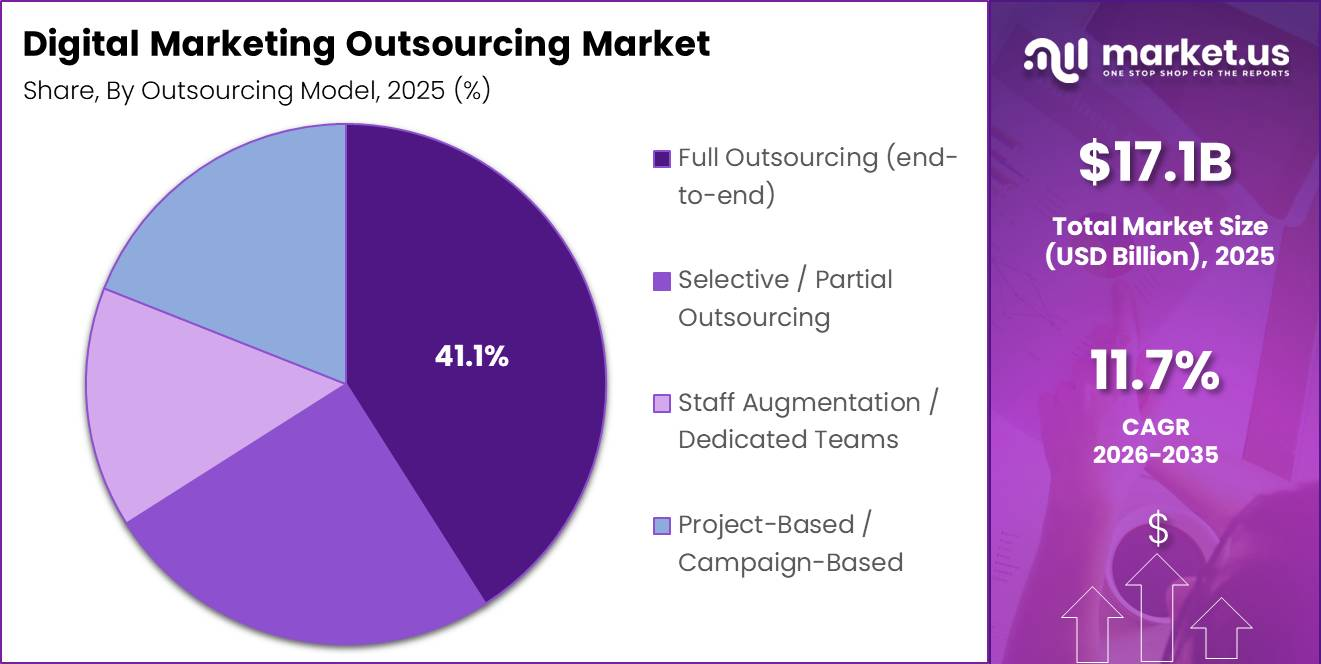
- Full Outsourcing (End-to-End) was the dominant outsourcing model with a 41.1% share, while Project-Based or Campaign-Based outsourcing is growing fastest.
- IT and Telecommunications was the dominant industry vertical with a 25.4% share, while Retail and E-commerce is the fastest-growing vertical.
- North America led the market in 2025 with a 36.2% share, valued at around USD 6.20 billion, while Asia-Pacific is set to grow the fastest.
By Service Type
Search Engine Optimization (SEO) – Dominant Segment
In 2025, Search Engine Optimization held a dominant 23.4% share of the digital marketing outsourcing market. SEO remains a core outsourced service because online visibility directly influences website traffic, customer acquisition, and sales. According to Eurostat, 85.65% of EU enterprises engaged in web sales used their own websites or applications in 2024, while these channels contributed 7.08% of total enterprise turnover. In addition, 76.83% of businesses purchasing online advertising used webpage content or search keywords for audience targeting.
Content Marketing and Creation – Fastest-Growing Segment
Content Marketing and Creation is emerging as the fastest-growing service segment due to rising demand for regular, high-quality digital content. Eurostat reported that 63.57% of EU enterprises used social media in 2025, compared with 42.49% in 2016, while adoption among large enterprises reached 89.09%. EU companies also generated 8.39% of total turnover through web sales in 2024. This growth increases the need for blogs, videos, product descriptions, social posts, and campaign materials.
By Channel
Social Media – Leading and Fastest-Growing Segment
In 2025, Social media held the leading 35.2% share of the digital marketing outsourcing market by channel and also recorded the fastest growth. This position is supported by the large audience reach, strong advertising returns, and continuous content demand across major platforms.
According to the Interactive Advertising Bureau, U.S. social media advertising revenue reached USD 88.8 billion in 2024, increasing by 36.7% from the previous year and accounting for 34.3% of total digital advertising revenue.
Ofcom also reported that YouTube reached 94% of UK online adults in May 2025, while Facebook and Messenger reached 93%. Users spent an average of 51 minutes per day on YouTube and 43 minutes on Facebook and Messenger. These high engagement levels create strong opportunities for brands to promote products, interact with customers, and measure campaign performance in real time.
By Outsourcing Model
Full Outsourcing (End-to-End) – Dominant Segment
In 2025, Full outsourcing accounted for a leading 41.1% share of the digital marketing outsourcing market. Under this model, a single service provider manages strategy, content creation, paid media, marketing automation, analytics, and performance reporting. This integrated structure helps companies lower coordination costs, maintain consistent messaging, and improve campaign accountability.
Eurostat reported that external suppliers carried out ICT functions for 71.92% of EU enterprises in 2023. It also found that 57.5% of enterprises recruiting ICT specialists experienced hiring difficulties. These skill shortages make it costly for companies to build and retain complete in-house digital teams.
Project-Based or Campaign-Based – Fastest-Growing Segment
Project-based or campaign-based outsourcing is expanding rapidly as companies seek flexible support for product launches, seasonal promotions, and short-term sales programs. U.S. Census Bureau data showed that unadjusted e-commerce sales reached USD 365.16 billion in the fourth quarter of 2025, increasing 21.8% from the previous quarter, before declining 17.2% in the first quarter of 2026.
By Industry Vertical
IT & Telecommunications – Dominant Segment
In 2025, IT and telecommunications accounted for a leading 25.4% share of the digital marketing outsourcing market. The segment’s dominance is supported by rapid technology adoption, frequent product launches, and strong competition among telecom operators, software providers, and digital service companies.
According to the OECD, the ICT sector grew by an average of 6.3% annually between 2013 and 2023 across 27 OECD countries, nearly three times faster than the overall economy. The ITU also estimated that global 5G subscriptions reached around 3 billion in 2025, while 5G networks covered 55% of the world’s population.
Retail & E-commerce – Fastest-Growing Segment
Retail and e-commerce are the fastest-growing industry vertical due to the continued rise in online transactions and digital shopping. UN Trade and Development reported that business e-commerce sales across 43 economies reached USD 27 trillion in 2022, almost 60% higher than in 2016. The U.S. Census Bureau also reported that retail e-commerce sales reached USD 326.7 billion in the first quarter of 2026, increasing 9.7% year over year.
Key Market Segments
By Service Type
- Search Engine Optimization (SEO)
- Content Marketing & Creation
- Email Marketing
- Social Media Marketing & Management
- Programmatic & Display Advertising
- Web Design & Development
- Others
By Channel
- Search
- Social Media
- Display / Video
- Others
By Outsourcing Model
- Full Outsourcing (end-to-end)
- Selective / Partial Outsourcing
- Staff Augmentation / Dedicated Teams
- Project-Based / Campaign-Based
By Industry Vertical
- Retail & E-commerce
- IT & Telecommunications
- Healthcare & Life Sciences
- BFSI (Banking, Financial Services & Insurance)
- Media & Entertainment
- Travel & Hospitality
- Education
- Others
Geopolitical Impact Analysis
The digital marketing outsourcing market is mainly service-based, but its operations depend on servers, graphics processing units, storage systems, routers, laptops, and cloud data centres. The World Trade Organization reported that more than 60 tariff measures introduced since early 2025 affected about 11% of global trade by February 2026.
The U.S. trade-weighted tariff rate also reached 13.5%, rising by 11 percentage points. Higher duties on computing and networking equipment can increase technology procurement and replacement costs for agencies, software providers, and cloud operators. The WTO further expects commercial-services trade growth to slow from 5.3% in 2025 to 4.8% in 2026, or 4.1% under a wider Middle East conflict scenario. Slower services trade may reduce corporate marketing budgets and increase price competition among outsourcing providers.
Regional conflicts are also affecting the infrastructure required to deliver digital services. UN Trade and Development reported that Suez Canal shipping tonnage remained 70% below the 2023 average in early May 2025, while Red Sea rerouting added at least 10 days to delivery times. Delays in shipments of chips, servers, transformers, and network equipment can slow data-centre expansion and raise cloud costs.
Regional Analysis
North America Dominates, While Asia-Pacific Shows the Fastest Growth
In 2025, North America led the digital marketing outsourcing market with a 36.2% share, valued at approximately USD 6.2 billion. The region’s dominance is supported by high digital advertising spending, advanced cloud infrastructure, strong internet penetration, and the presence of major technology, retail, financial services, and media companies. UN Trade and Development reported that online retail represented nearly 15% of total retail sales in the United States.
Statistics Canada also recorded CAD 73.7 billion in retail e-commerce revenue in 2024, representing annual growth of 9.0%. These large online sales volumes increase the need for search engine marketing, paid advertising, content creation, customer analytics, and campaign performance tracking.
Asia-Pacific is expected to record the fastest growth as online shopping, mobile connectivity, and digital-first business models expand across the region. The International Telecommunication Union estimated that 77% of the regional population used the internet in 2025. Online retail also accounted for around 25% to 30% of total retail sales in China and the Republic of Korea, according to UN Trade and Development.
Key Regions and Countries
North America
- US
- Canada
Europe
- Germany
- France
- The UK
- Spain
- Italy
- Rest of Europe
Asia Pacific
- China
- Japan
- South Korea
- India
- Australia
- Rest of APAC
Latin America
- Brazil
- Mexico
- Rest of Latin America
Middle East & Africa
- GCC
- South Africa
- Rest of MEA
Market Dynamics
Challenge
The market’s most persistent operating bottleneck is the shortage of specialists who can integrate channel execution, analytics, creative testing, and martech systems at production quality. This capability gap constrains service capacity even when marketing budgets and demand remain strong, creating a structural execution limit rather than a pure demand constraint.
In practical terms, this results in an estimated -1.4 percentage point drag on CAGR, as agencies and outsourcing providers incur 8–15% higher hiring and training costs, along with 10–20% longer ramp times for senior roles in SEO, paid media, lifecycle marketing, and measurement functions. This reduces operational stability, increases variance in campaign performance, and limits the number of accounts each strategist can effectively manage.
| Challenge | (~) % CAGR Friction Drag | Geographic Relevance | Mitigation Horizon |
|---|---|---|---|
| Talent scarcity | -1.4% | North America, EU hubs, India metros | Long term (≥ 4 years) |
| Measurement fragmentation | -1.1% | North America core, EU privacy markets | Medium term (2-4 years) |
| AI capability gap | -0.9% | Global, APAC delivery hubs, EU/NA buyers | Medium term (2-4 years) |
| Client retention friction | -0.8% | Global mid-market, enterprise-heavy regions | Short term (≤ 2 years) |
| Margin compression | -1.0% | APAC delivery corridors, LATAM, Eastern Europe | Medium term (2-4 years) |
| Regulatory adaptation load | -0.7% | EU regulatory hubs, North America, UK | Long term (≥ 4 years) |
Opportunity
GenAI Creative-as-a-Service platforms represent a high-leverage opportunity because they shift creative production from manual, service-heavy workflows to scalable, software-driven infrastructure. By embedding generative AI into hosted systems with templates, brand-safe fine-tuning, and automated A/B testing pipelines, companies can fundamentally improve production economics.
These platforms can reduce per-asset production costs by an estimated 40 to 60% and compress creative cycle times from weeks to days, enabling faster experimentation and higher campaign throughput. Monetization typically comes from usage-based pricing, subscription tiers, and API access for agency and enterprise users.
This is an opportunity rather than a baseline driver because the key gap is not model availability but enterprise-grade deployment, specifically brand governance, IP protection, compliance assurance, and human-in-the-loop oversight. If platforms capture even 2 to 4% of addressable creative spend, this could translate into approximately +1.8 percentage points of topline CAGR and 5 to 8 percentage points improvement in incremental operating margins, particularly in North America, Europe, and advanced APAC digital marketing ecosystems.
| Opportunity | (~) % Potential CAGR | Geographic Relevance | Execution Window |
|---|---|---|---|
| Performance-based Revenue Share (Rev-Share) | +2.5% | North America core, EU enterprise | Short term (≤ 2 years) |
| Verticalized SaaS + Managed Services Bundles | +2.0% | North America core, APAC growth | Medium term (2–4 years) |
| GenAI Creative-as-a-Service Platform | +1.8% | Global, APAC & LATAM adoption | Short term (≤ 2 years) |
| SMB Franchise & Channel Licensing Model | +1.5% | APAC emerging, LATAM, MEA | Short–Medium (≤ 3 years) |
| Data Clean-Room & Privacy-Compliant Monetization | +1.2% | EU (core), North America | Medium term (2–4 years) |
| M&A Roll-up of Niche Specialists (MarTech + Creative) | +2.0% | North America core, EU cross-border | Medium–Long (2–5+ years) |
Driver
Digital advertising is already a trillion-dollar market, with digital channels making up roughly three-quarters of total global ad spend. Growth in digital ad investment of about 7–9 percent annually has pushed online spend into the high hundreds of billions, steadily increasing digital’s share toward the low-70 percent range.
This shift benefits performance marketing providers because search, social, programmatic, and retail media require continuous optimization, bidding, creative testing, and attribution, which many advertisers cannot efficiently run in-house. As digital’s share rises further into the mid-60 to low-70 percent range across major economies, even a small increase in outsourcing, such as 5–10 percent of spend moving from internal teams to agencies or external partners, creates a large incremental revenue pool worth tens of billions of dollars.
| Driver | (~) % Impact on CAGR | Geographic Relevance | Impact Timeline |
|---|---|---|---|
| Digital ad spend mix-shift to online and performance channels accelerates outsourcing demand | +1.4% | North America core, EU, APAC corridors, South America spill-over | Short–Medium term |
| Enterprise cost optimization and shift from in-house to external digital marketing stacks | +0.9% | North America core, EU, APAC corridors | Short term |
| Generative AI and marketing automation platforms require specialist partners | +1.1% | North America core, EU, APAC corridors, Middle East emerging | Medium–Long term |
| Cross-border e-commerce and D2C globalization drive multi-market campaign outsourcing | +0.8% | APAC corridors, EU exporters, North America brands, LATAM | Medium term |
| Data privacy, signal loss and regulatory constraints push brands to expert-led data strategies | +0.7% | EU core, North America, APAC developed | Medium–Long term |
| SME digitization and platform ecosystems (marketplaces, social commerce) expand managed services | +0.6% | APAC corridors, Emerging markets, EU periphery, South America spill-over | Short–Medium term |
Restraint
Enterprises are increasingly shifting a portion of marketing budgets (around 5–12 percent) into in-house AI tools, which reduces demand for external agencies even as total digital ad spend continues to grow at 6–8 percent annually.
Generative AI has cut content production time by 30–50 percent and reduced costs by 20–40 percent, making it easier for brands to internalize work that previously required agency support. As a result, more companies in North America and Europe are explicitly designing workflows to replace outsourced tasks with AI systems, limiting agency pricing power and shortening contract durations from annual retainers to 3–6-month cycles.
For outsourcing providers, this leads to declining revenue per employee in routine services, higher utilization volatility, and overall margin pressure. The net effect is an estimated 2.2 percentage point reduction in long-term CAGR for outsourced marketing services unless firms shift toward higher-value areas like analytics, data strategy, and proprietary AI solutions.
| Restraint | (~) % Impact on CAGR | Geographic Relevance | Impact Timeline |
|---|---|---|---|
| In-house AI automation cannibalizing outsourcing spend | -2.2% | North America core, Western Europe, developed APAC | Medium term (2–4 years) |
| Margin squeeze from talent inflation and currency volatility | -1.9% | India, Philippines, Eastern Europe, LatAm offshoring hubs | Short to medium term (≤ 4 years) |
| Heightened data privacy, AI and cross-border compliance burden | -1.7% | EU, UK, North America, cross-border APAC corridors | Long term (≥ 4 years) |
| Client budget cyclicality and performance-risk rebundling | -1.5% | Global, with concentration in cyclical verticals (SMBs, retail, D2C) | Short term (≤ 2 years) |
| MarTech platform consolidation and vendor lock-in | -1.3% | North America core, EU, digital-mature APAC | Medium to long term (2–5 years) |
| Delivery-side capability gaps in analytics and first-party data | -1.1% | Emerging APAC, MEA, Tier-2 outsourcing hubs | Medium term (2–4 years) |
Key Players Analysis
The digital marketing outsourcing market is fragmented, as major companies do not separately report revenue from these services. Therefore, market shares are analyst estimates based on company size, global delivery capacity, client reach, and digital service strength. Tier-1 companies include Accenture with an estimated 10% to 13% share, Tata Consultancy Services at 6% to 8%, IBM at 5% to 7%, and Capgemini at 4% to 6%.
Accenture reported FY2025 revenue of USD 69.7 billion and invested USD 1.5 billion in 23 acquisitions, USD 0.8 billion in research and development, and USD 1.0 billion in employee training. TCS generated USD 30 billion in FY2026 revenue, including USD 2.3 billion from annualized artificial intelligence services. IBM Consulting recorded USD 21.06 billion in 2025 revenue, while Capgemini reported EUR 22.47 billion in revenue and EUR 24.4 billion in bookings.
Tier-2 companies include Cognizant, Infosys, HCLTech, and Wipro. Cognizant generated USD 21.1 billion in 2025 revenue. Infosys reported USD 20.16 billion in FY2026 revenue, while HCLTech reached USD 14.66 billion and Wipro recorded USD 10.48 billion in IT services revenue. Capgemini’s USD 3.3 billion acquisition of WNS strengthened its position in AI-enabled operations and analytics.
Top Key Players in the Market
- Wipro
- Tata Consultancy Services (TCS)
- Invensis Technologies Pvt Ltd
- Infosys
- IBM Corporation
- HCL Technologies
- Cognizant
- Capgemini
- BCM Marketing Industrial S.L.
- Accenture
Recent Developments
- In June 2026, Accenture agreed to acquire creator and social-media agency Whalar, which had managed over USD 600 million in campaigns across more than 40 countries and 15 languages. The deal also included a three-year partnership with Whalar Group.
- In May 2026, Wipro completed the USD 375 million acquisition of Mindsprint, adding over 3,200 professionals. The deal supports an eight-year outsourcing contract with Olam Group worth more than USD 1 billion.
Report Scope
| Report Features | Description |
|---|---|
| Market Value (2025) | USD 17.1 Billion |
| Forecast Revenue (2035) | USD 51.8 Billion |
| CAGR (2026-2035) | 11.7% |
| Base Year for Estimation | 2025 |
| Historic Period | 2020-2024 |
| Forecast Period | 2026-2035 |
| Report Coverage | Revenue Forecast, Market Dynamics, Competitive Landscape, Recent Developments |
| Segments Covered | By Service Type (Search Engine Optimization (SEO), Content Marketing & Creation, Email Marketing, Social Media Marketing & Management, Programmatic & Display Advertising, Web Design & Development, Others); By Channel (Search, Social Media, Display/Video, Email, Others); By Outsourcing Model (Full Outsourcing (End-to-End), Selective/Partial Outsourcing, Staff Augmentation/Dedicated Teams, Project-Based/Campaign-Based); By Industry Vertical (Retail & E-commerce, IT & Telecommunications, Healthcare & Life Sciences, BFSI (Banking, Financial Services & Insurance), Media & Entertainment, Travel & Hospitality, Education, Others) |
| Regional Analysis | North America – US, Canada; Europe – Germany, France, The UK, Spain, Italy, Rest of Europe; Asia Pacific – China, Japan, South Korea, India, Australia, Singapore, Rest of APAC; Latin America – Brazil, Mexico, Rest of Latin America; Middle East & Africa – GCC, South Africa, Rest of MEA |
| Competitive Landscape | Wipro, Tata Consultancy Services (TCS), Invensis Technologies Pvt Ltd, Infosys, IBM Corporation, HCL Technologies, Cognizant, Capgemini, BCM Marketing Industrial S.L., and Accenture |
| Customization Scope | Customization for segments and region/country-level will be provided. Moreover, additional customization can be done based on the requirements. |
| Purchase Options | We have three licenses to opt for: Single User License, Multi-User License (Up to 5 Users), Corporate Use License (Unlimited Users and Printable PDF) |





























