Report Overview
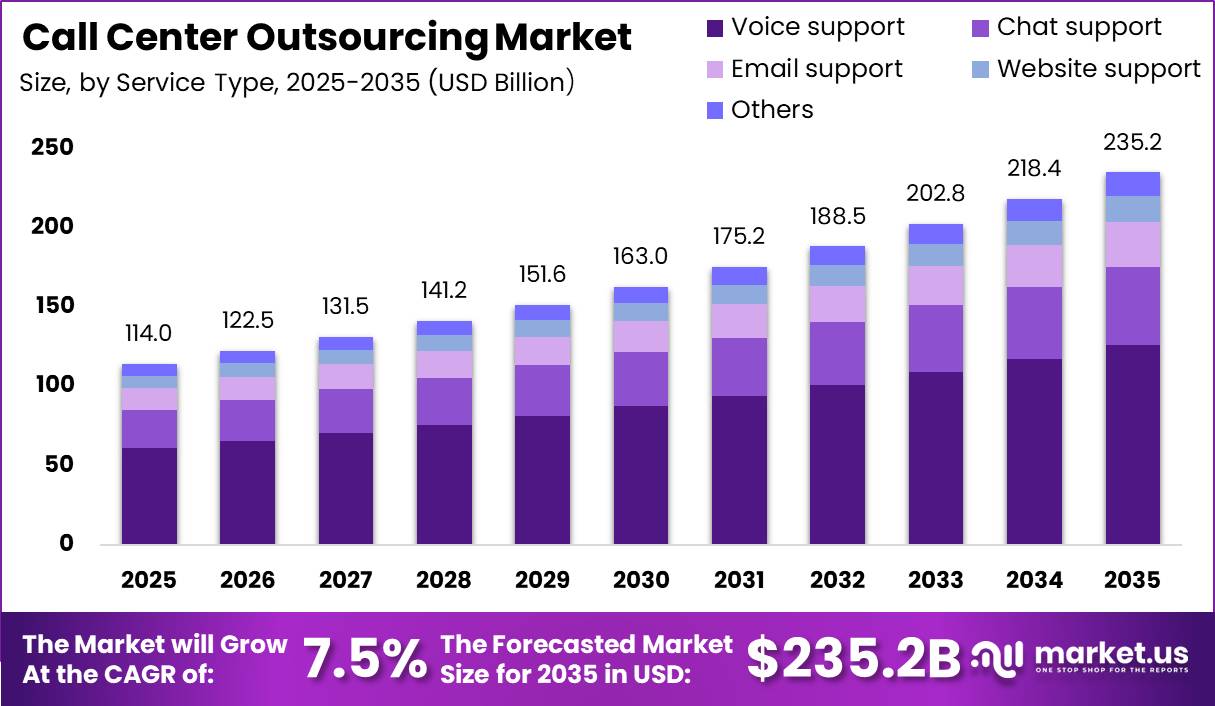
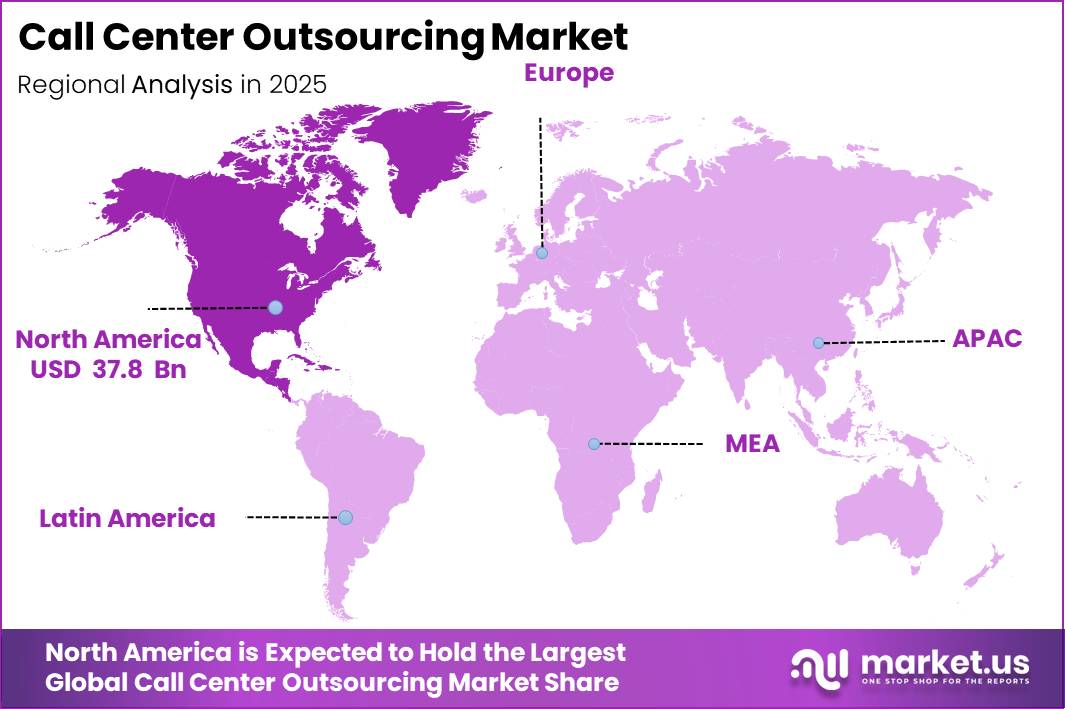
In 2025, the Global Call Center Outsourcing Market was valued at USD 114.0 billion. The market is projected to grow at a CAGR of 7.5% during 2026–2035, reaching approximately USD 235.2 billion by 2035. North America dominated the global market in 2025, accounting for more than 33.2% of the total market share, holding USD 37.8 billion in revenue.
According to the International Telecommunication Union (ITU), around 6 billion people, representing 74% of the global population, were using the internet in 2025, an increase of more than 240 million users compared to 2024. The growing number of internet users has significantly increased customer interactions across e-commerce, banking, healthcare, telecommunications, and digital services.
The OECD Digital Economy Outlook 2024 reported that the global ICT sector expanded by 7.6% in 2023, nearly three times faster than the overall economy. This rapid digital transformation has created millions of additional customer touchpoints, prompting businesses to outsource customer support operations to specialized service providers. As organizations expand their digital services, outsourcing remains a cost-effective and scalable solution for managing growing inbound and outbound customer service requirements.
On the supply side, NASSCOM Strategic Review 2025 reported that India’s technology and BPO export industry reached USD 282.6 billion in FY2025, growing by 5.1%, strengthening the global outsourcing ecosystem through skilled and cost-efficient talent.
UNCTAD reported that global services exports increased at an average annual rate of 5.3% between 2014 and 2024, compared with 2.5% for goods exports, reflecting the steady shift toward cross-border business services. The World Bank also projects global economic growth of 2.7% during 2025–2026, encouraging organizations to reduce operating costs by outsourcing non-core customer support functions, which continues to support long-term market growth.
Key Takeaways
- In 2025, the Global Call Center Outsourcing Market was valued at USD 114.0 billion.
- The market is projected to grow at a CAGR of 7.5% during 2026–2035, reaching approximately USD 235.2 billion by 2035.
- North America dominated the global market in 2025, accounting for more than 33.2% of the total market share and generating approximately USD 37.8 billion in revenue.
- Asia-Pacific is projected to register the fastest growth during the forecast period, supported by expanding outsourcing operations, skilled workforce availability, and increasing digital transformation initiatives.
- By Service Type, Voice Support held the leading position in 2025, accounting for 53.7% of the global market share, while Chat Support is anticipated to witness the fastest growth over the forecast period.
- By Delivery Model, the Offshore segment dominated the market with a 48.5% share in 2025, whereas the Virtual delivery model is expected to grow at the fastest CAGR during the forecast period.
- By Deployment Model, Cloud-based solutions accounted for the largest market share of 45.3% in 2025. The AI-Driven deployment segment is projected to experience the fastest growth throughout the forecast period.
- By Interaction Flow, the Inbound segment led the market in 2025, capturing 60.2% of the global market share. The Omnichannel segment is expected to record the fastest growth over the forecast period.
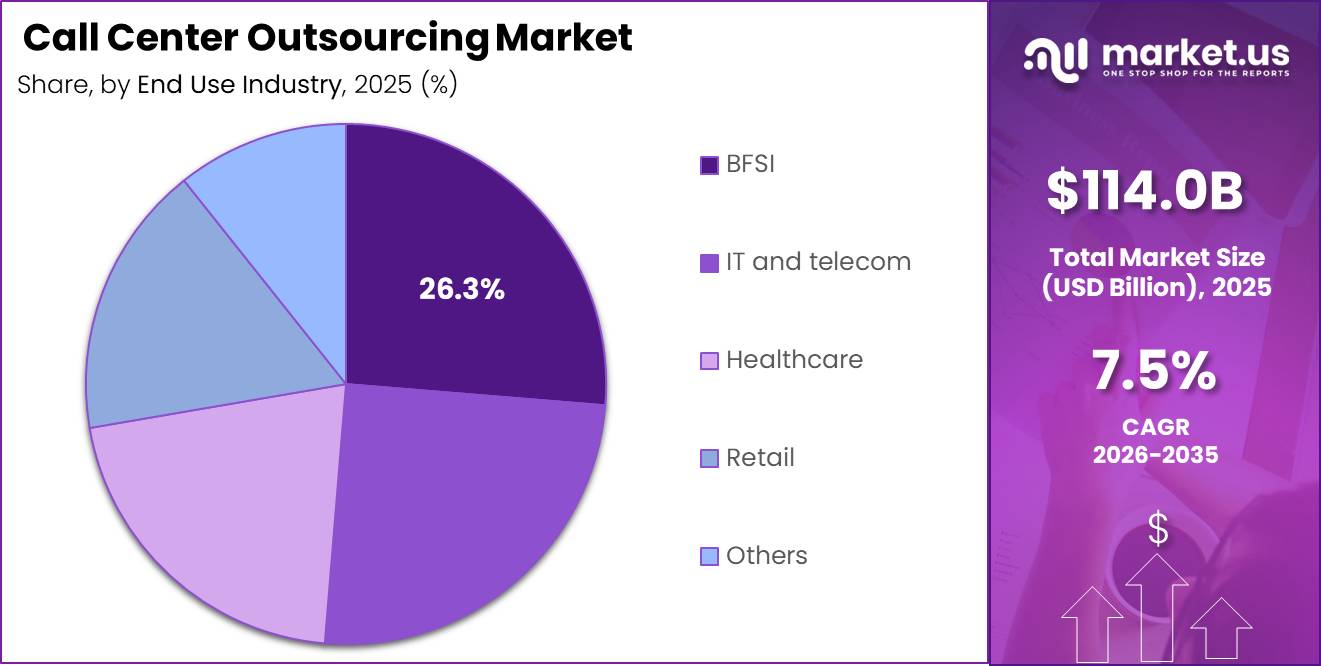
- By End-User Industry, the BFSI segment dominated the market with a 26.3% share in 2025, while the Healthcare segment is projected to expand at the fastest growth rate during the forecast period.
By Service Type
Voice Support accounted for the largest market share of 53.7% in 2025, driven by its critical role in handling complex and high-value customer interactions. Despite the growth of digital channels, voice remains the preferred option for banking, healthcare, insurance, and retail support, where real-time communication and personalized assistance are essential.
According to the GSMA, there are 5.87 billion unique mobile subscribers worldwide as of 2026, creating a vast customer base for voice-based services. The ITU also reported that mobile broadband traffic reached 1.3 zettabytes in 2024, expanding at an average annual growth rate of 19.6% since 2021, reflecting the increasing volume of customer interactions requiring live support. Studies further show that 71% of Gen Z consumers still consider phone calls the fastest way to resolve complex issues, supporting the continued strength of voice support.
Chat Support is projected to register the fastest CAGR during the forecast period, supported by the rapid expansion of digital communication and online customer engagement. According to UNCTAD, digitally deliverable services exports reached USD 3.82 trillion in 2022, highlighting the growing reliance on online business services. In addition, GSMA estimates that 4.7 billion people (58% of the global population) actively use mobile internet services, significantly expanding the demand for real-time chat support.
By Delivery Model
The offshore delivery model dominated the market with a 48.5% share in 2025. Its leadership is mainly driven by lower operating costs and access to large, skilled English-speaking workforces. According to the IT and Business Process Association of the Philippines (IBPAP), the Philippine IT-BPM industry generated over USD 40 billion in export revenue in 2025 and employed around 1.9 million full-time professionals, making it one of the world’s largest offshore customer service hubs.
Offshore agents in the Philippines generally cost 70–80% less than comparable U.S.-based agents, making this model highly attractive for companies handling large customer support operations. India further strengthens the offshore ecosystem, with 60–90 million people expected to work in remote or flexible roles by 2025, according to Forbes, reflecting the country’s expanding digital services workforce.
According to the World Economic Forum (WEF), the number of remote-capable digital jobs is expected to increase by 25%, reaching approximately 92 million by 2030, with customer service representatives identified as one of the major remote job categories. Virtual delivery allows outsourcing providers to recruit talent from multiple countries without investing in physical offices, reducing operating costs by around USD 11,000 per remote employee annually while significantly expanding the available talent pool.
By Deployment Model
Cloud-based solutions dominated the global Call Center Outsourcing Market in 2025, accounting for 45.3% of the total market share. This leadership is driven by the rapid adoption of cloud infrastructure across enterprises worldwide. According to Eurostat, 66.78% of medium-sized EU enterprises purchased cloud computing services in 2025, up from 59.09% in 2023. Additionally, 45.2% of all EU enterprises were highly dependent on cloud services for core business operations.
Cloud platforms reduce infrastructure costs, support remote and global agent teams, enable quick scaling, and integrate voice, chat, email, and social media support on a single platform. The OECD also reported that the ICT sector has grown nearly three times faster than the overall economy over the past decade, reinforcing cloud as the preferred deployment model for outsourcing providers.
According to the International Energy Agency (IEA), data center electricity consumption—reflecting expanding AI infrastructure—is expected to grow by around 15% annually between 2024 and 2030, more than four times faster than overall electricity demand. AI-powered call center platforms already help resolve customer queries 44% faster and reduce average agent handling time by 45%, encouraging organizations to adopt AI-driven outsourcing solutions to improve efficiency, lower operating costs, and enhance customer experience.
By Interaction Flow
Inbound dominates the market with a 60.2% share in 2025. The segment leads because every commercial transaction creates demand for customer support, order tracking, billing assistance, technical help, and complaint resolution. According to UNCTAD, global business e-commerce sales reached USD 27 trillion in 2022, around 15% higher than pre-pandemic levels, with continued growth afterward.
UNCTAD reported that global trade in goods and services exceeded a record USD 35 trillion in 2025, while services trade grew by nearly 9%, increasing customer interactions and support requests. Healthcare also contributes significantly, as the WHO estimates that more than 1 in 10 patients worldwide experiences a safety or care-related event, driving demand for appointment scheduling, medical helplines, and patient support services handled by outsourced call centers.
The WTO reported that global services trade grew 5% year-over-year in Q1 2025, led by digital and cross-border services, increasing the need for seamless customer engagement across multiple channels. Omnichannel contact centers can reduce first-response time by 31% and customer wait times by 39% compared with traditional siloed systems, making them a preferred investment for organizations seeking higher customer satisfaction and operational efficiency.
By End-User Industry
BFSI held the largest market share of 26.3% in 2025. The BFSI sector leads the Call Center Outsourcing Market because it handles one of the highest volumes of customer interactions worldwide. According to the World Bank Global Findex Database 2025, financial account ownership reached 79% of the global adult population, while 40% of adults in developing economies saved through formal financial institutions in 2024.
These accounts generate continuous service requests, including balance inquiries, fraud alerts, loan processing, insurance claims, and dispute resolution. In addition, the IMF Financial Access Survey 2025 reported that 15% of global adults now use mobile-money accounts, further increasing customer support requirements. This large and growing customer base makes BFSI the biggest source of outsourced call center demand globally.
This demographic shift is increasing demand for appointment scheduling, telehealth support, medication assistance, insurance verification, and chronic disease management services. Additionally, Eurostat reported that EU healthcare expenditure reached €1.72 trillion in 2023, accounting for 10% of the region’s GDP, reflecting the growing need for outsourced patient communication and customer support services.
Key Market Segments
By Service Type
- Voice support
- Chat support
- Email support
- Website support
- Others
By Delivery Model
- Onshore
- Nearshore
- Offshore
- Virtual
By Deployment Model
- Cloud
- On-Premise
- Hybrid
- AI-Driven
By Interaction Flow
- Inbound
- Outbound
- Omnichannel
- Self-Service
By End-User Industry
- IT and telecom
- BFSI
- Healthcare
- Retail
- Others
Market Dynamics
Drivers
| Driver | (~) % CAGR | Geographic Relevance | Impact Timeline |
|---|---|---|---|
| AI-augmented omnichannel CX outsourcing | +3.0% | North America, Europe, Asia-Pacific | Short term (≤ 2 years) |
| Shift from in-house to outsourced CX | +2.0% | Global | Medium term (2–4 years) |
| Cloud-native CCaaS adoption by outsourcers | +1.5% | North America, Europe | Medium term (2–4 years) |
| Expansion into emerging nearshore hubs | +1.0% | Latin America, Eastern Europe, South Asia | Long term (≥ 4 years) |
| Industry verticalization of outsourced centers | +0.8% | Global | Short term (≤ 2 years) |
AI-augmented omnichannel CX outsourcing
Broad deployment of AI and automation inside outsourced call centers is reshaping delivery models from labor-centric voice handling toward blended human–bot, omnichannel customer experience contracts, typically priced on interaction volumes and service-level attainment rather than pure full-time equivalent counts, with recent industry data indicating that conversational AI and chatbots now resolve up to 75% of customer inquiries and can cut operational costs by roughly 30% in high-volume environments, thereby enabling providers to offer lower per-contact unit pricing while preserving gross margins above 20–25%.
Restraints
| Restraint | (~) % CAGR | Geographic Relevance | Impact Timeline |
|---|---|---|---|
| Data localization and cross-border transfer limits | -2.5% | India, EU, selected APAC markets | Short term (≤ 2 years) |
| Elevated wage inflation in mature hubs | -1.8% | North America, Western Europe | Medium term (2–4 years) |
| Client-side AI substitution for simple queries | -1.5% | Developed markets | Medium term (2–4 years) |
| Regulatory scrutiny on outsourcing of critical services | -1.2% | Financial services, public sector globally | Long term (≥ 4 years) |
| Contracting delays due to complex compliance | -1.0% | Global | Short term (≤ 2 years) |
Data localization and cross-border transfer limits
Mandatory data localization and tighter cross-border transfer permissions, exemplified by India’s Digital Personal Data Protection Act 2023 enforcement from around September 2025 for critical personal data, force multinational clients to re-architect customer data flows, compelling outsourcers to invest in additional in-country data centers, duplicate infrastructure, and segmented operational footprints that can add 10–20% to annual compliance and hosting costs for affected programs.
Elongate implementation lead times by 3–6 months, and reduce the viability of low-cost offshore routing for some high-sensitivity workloads, thereby compressing EBITDA margins by an estimated 200–300 basis points where scale efficiencies are curtailed and dampening the achievable growth contribution to the market’s baseline CAGR by approximately 2.5%.
Challenges
| Challenge | (~) % CAGR | Geographic Relevance | Mitigation Horizon |
|---|---|---|---|
| Complex AI–human workforce orchestration | -2.2% | Global | Medium term (2–4 years) |
| High agent attrition and skill gaps | -1.9% | Asia-Pacific, Latin America | Short term (≤ 2 years) |
| Legacy telecom and IT integration drag | -1.6% | Global | Long term (≥ 4 years) |
| Cybersecurity posture and compliance overhead | -1.4% | Global | Medium term (2–4 years) |
| Remote and hybrid work management | -1.2% | Global | Short term (≤ 2 years) |
Complex AI–human workforce orchestration
Blending AI agents that can resolve roughly 75% of inquiries with human agents who handle higher-value or escalated interactions introduces structural complexity in forecasting volumes, setting service-level agreements, and designing staffing models, as organizations pairing agents with virtual assistants may handle around 7.7% more simultaneous chats yet also face reskilling requirements for a significant share of their workforce and need to reconfigure workforce management systems.
which can add 5–10% to training budgets and temporarily depress utilization from targeted levels of above 85% to closer to 70–75%, thereby creating friction that slows the pace at which outsourcers can fully monetize AI-driven productivity gains and trims the market’s maximum realizable growth trajectory by an estimated 2.2% relative to its unconstrained potential.
Opportunities
| Opportunity | (~) % Potential CAGR Upside | Geographic Relevance | Execution Window |
|---|---|---|---|
| Outcome-based CX and revenue-sharing models | +2.8% | North America, Europe | Medium term (2–4 years) |
| AI-first specialized micro-outsourcing pods | +2.3% | Global | Short term (≤ 2 years) |
| Expansion into AI-enabled CCaaS partnerships | +2.0% | Global | Long term (≥ 4 years) |
| Vertical-specific regulatory-compliant CX centers | +1.7% | Financial services, healthcare, public sector | Medium term (2–4 years) |
| Nearshore premium multilingual support hubs | +1.5% | Europe, North America | Long term (≥ 4 years) |
Outcome-based CX and revenue-sharing models
Outcome-based commercial structures, where outsourced call centers are compensated on metrics such as net promoter score improvement, churn reduction, or incremental sales per 1,000 interactions rather than only on full-time equivalent counts, remain underpenetrated relative to traditional seat-based pricing despite growing evidence from AI-enabled customer service pilots that automation and advanced analytics can lift client revenue by roughly 30–34% and cut staffing cost requirements by several million dollars over multi-year periods.
Creating white-space for providers to capture an incremental 2.8% upside to market CAGR by sharing in these gains through performance fees while structurally improving their own unit economics via blended human–AI delivery that can reduce cost per resolved ticket by an estimated 20–30% and expand operating margins by 300–500 basis points on well-structured programs.
Geopolitical Impact Analysis
The Call Center Outsourcing Market is being reshaped by rising trade barriers, stricter data regulations, and increasing energy costs. Growing geopolitical tensions have raised the cost of the technology infrastructure used in call centers, including servers, networking equipment, headsets, and telephony systems. According to the World Bank, more than 2,500 trade restrictions were introduced globally during the first ten months of 2025, almost five times the level recorded during the same period in 2015.
In addition, 15–25% US tariffs on imports from Japan and South Korea, along with a 50% tariff on copper imports introduced in August 2025, have increased the cost of data center and networking infrastructure. The WTO also projects global merchandise trade volumes to decline by 0.2% in 2025, creating further cost uncertainty for outsourcing providers. As a result, the cost of on-premise call center hardware systems has increased by an estimated 10–18%, encouraging businesses to adopt cloud-based and offshore delivery models.
The IMF estimates that geopolitical fragmentation could increase global services trade costs by as much as USD 127 billion, reducing the traditional cost advantages of offshore outsourcing. Rising energy costs are adding further pressure, with the IEA projecting global data center electricity consumption to grow by 15% annually through 2030, while US electricity prices increased by 11.5% in 2025. These developments are driving organizations to diversify outsourcing locations, expand virtual delivery models, and invest more in compliance and secure digital infrastructure.
Regional Analysis
North America dominated the global Call Center Outsourcing Market in 2025, accounting for 33.2% of the total market and generating USD 37.8 billion in revenue. The region’s leadership is supported by its large healthcare, BFSI, retail, and technology industries, which generate high volumes of customer interactions.
According to the U.S. Bureau of Labor Statistics (BLS), the healthcare and social assistance sector is expected to add around 2 million jobs between 2024 and 2034, growing at 8.4%, while healthcare spending exceeded USD 4.6 trillion, representing 17.6% of U.S. GDP. This strong demand for patient support, insurance verification, appointment scheduling, and customer service continues to drive outsourcing across the region.
Asia-Pacific is projected to register the fastest CAGR during the forecast period, supported by rapid digitalization and expanding service industries. According to the International Telecommunication Union (ITU), around 66% of the region’s population, or more than 2.8 billion people, were using the internet in 2024, creating strong demand for digital customer support services.
The Asian Development Bank (ADB) forecasts 5.1% economic growth for developing Asia and the Pacific in 2025, driven by rising domestic demand and exports. In India, the services sector contributes around 55% of national GVA, while services exports grew 12.8% between April and November FY2024–25. These factors, combined with the region’s large and cost-effective BPO workforce, are expected to support the fastest growth in the call center outsourcing market.
Key Regions and Countries Covered in this Report
- North America
- The US
- Canada
- Europe
- Germany
- France
- The UK
- Spain
- Italy
- Russia & CIS
- Rest of Europe
- APAC
- China
- Japan
- South Korea
- India
- ASEAN
- Rest of APAC
- Latin America
- Brazil
- Mexico
- Rest of Latin America
- Middle East & Africa
- GCC
- South Africa
- Rest of MEA
Key Players Analysis
The Call Center Outsourcing Market is highly consolidated, with a few global providers accounting for a significant share of outsourcing contracts. Teleperformance SE remains the market leader, reporting €10.21 billion (approximately USD 11.1 billion) in revenue in 2025. The company operates in 95 countries with approximately 446,000 employees. In 2025, it launched a €100 million AI investment program, partnering with companies such as Ema and Parloa.
Through its Future Forward strategy, Teleperformance plans to achieve mid-single-digit organic revenue growth by 2028 while investing nearly 20% of its projected €3 billion net free cash flow (2026–2028) in AI transformation.
Concentrix Corp. is another leading player, generating USD 9.83 billion in revenue in FY2025, representing 2.2% year-on-year growth. The company reported a record adjusted free cash flow of USD 242.3 million in Q2 FY2026, an increase of USD 42 million from the previous year. Concentrix serves more than 160 Fortune 500 companies, with over 1,000 clients using its AI solutions in production. Its AI-enabled tools have helped reduce average agent handling time by 25%–30%, improving service efficiency.
The second tier of the market consists of companies with strong regional presence and industry specialization. Infosys BPM, supported by Infosys, benefits from its parent company’s USD 19.4 billion revenue in FY2025, which grew 4.2% with an operating margin of 21.1%. The company has a strong position in the BFSI and healthcare outsourcing segments.
Hinduja Global Solutions (HGS) reported TTM revenue of approximately ₹46 billion (around USD 548 million). However, the company has experienced earnings pressure, with an average annual earnings decline of 49.3%, reflecting increasing cost and pricing challenges in the mid-sized outsourcing segment.
Sutherland Global Services employs approximately 65,000 people and is estimated to generate around USD 8 billion in annual revenue. The company has built a strong presence in banking, financial services, and insurance (BFSI). Other notable providers, including StarTek, Transcom, and Atento, focus on regional and industry-specific outsourcing opportunities. Atento has a strong presence in Latin America, while Transcom serves major European telecom and utility clients.
The Major Players in the Industry
- Alorica Inc.
- Arvato Connect
- Atento SA
- Computer Generated Solutions
- Concentrix Corp.
- Continuum Global Solutions LLC
- Datacom Group Ltd.
- DiRAD Technologies Inc.
- Epicenter Technologies Ltd.
- Foundever Group
- Helpware Inc.
- Hinduja Global Solutions Ltd.
- Infosys Ltd.
- Serco Group plc
- StarTek Inc.
- Sutherland Global Services
- Teleperformance SE
- Transcom Holding AB
Recent Development
- In June 2026, Concentrix revised its full-year revenue guidance to USD 9.925 billion–USD 10.025 billion. The revision was attributed to an estimated 3% revenue headwind from accelerated client offshoring and an additional ~1% headwind due to changes in client spending across specific customer segments. Despite these challenges, the company reported Q2 FY2026 revenue of USD 2.46 billion, reflecting 1.9% year-over-year growth, and generated a record adjusted free cash flow of USD 242.3 million, highlighting the positive impact of its AI-driven operational efficiency.
- In February 2026, Teleperformance SE reported full-year 2025 revenue of €10.21 billion, representing 1.3% like-for-like growth. The company also achieved a recurring EBITA of €1,485 million, with a 14.8% EBITA margin (excluding specific items). According to its April 2026 quarterly update, AI-powered services, including AI data services, data analytics, and back-office automation, recorded strong momentum in Q1 2026, growing significantly faster than the company’s overall average growth rate.
- In May 2025, TaskUs, Inc. announced a definitive all-cash agreement to be acquired by Blackstone, together with co-founders and executives, for USD 16.50 per share. The offer represented a 26% premium over the 30-day volume-weighted average price (VWAP) and valued the company at approximately USD 1.62 billion. Following the transaction, TaskUs was delisted from Nasdaq and repositioned as a private company focused on AI services, content moderation, and customer experience (CX) outsourcing for digital economy clients.
Report Scope
| Report Features | Description |
|---|---|
| Market Value (2025) | USD 114.0 Bn |
| Forecast Revenue (2035) | USD 235.2 Bn |
| CAGR (2026-2035) | 7.5% |
| Base Year for Estimation | 2025 |
| Historic Period | 2020-2024 |
| Forecast Period | 2026-2035 |
| Report Coverage | Revenue Forecast, Market Dynamics, Competitive Landscape, Recent Developments |
| Segments Covered | By Service Type (Voice support, Chat support, Email support, Website support and Others), By Delivery Model (Onshore, Nearshore, Offshore and Virtual), By Deployment Model (Cloud, On-Premise, Hybrid and AI-Driven), By Interaction Flow (Inbound, Outbound, Omnichannel and Self-Service), By End-User Industry (IT and telecom, BFSI, Healthcare, Retail and Others) |
| Regional Analysis | North America – The US & Canada; Europe – Germany, France, The UK, Spain, Italy, Russia & CIS, Rest of Europe; APAC- China, Japan, South Korea, India, ASEAN & Rest of APAC; Latin America- Brazil, Mexico & Rest of Latin America; Middle East & Africa- GCC, South Africa, & Rest of MEA |
| Competitive Landscape | Alorica Inc., Arvato Connect, Atento SA, Computer Generated Solutions, Concentrix Corp., Continuum Global Solutions LLC, Datacom Group Ltd., DiRAD Technologies Inc., Epicenter Technologies Ltd., Foundever Group, Helpware Inc., Hinduja Global Solutions Ltd., Infosys Ltd., Serco Group plc, StarTek Inc., Sutherland Global Services, Teleperformance SE and Transcom Holding AB |
| Customization Scope | Customization for segments and region/country-level will be provided. Moreover, additional customization can be done based on the requirements. |
| Purchase Options | We have three licenses to opt for: Single User License, Multi-User License (Up to 5 Users), Corporate Use License (Unlimited Users and Printable PDF) |