


Report Overview
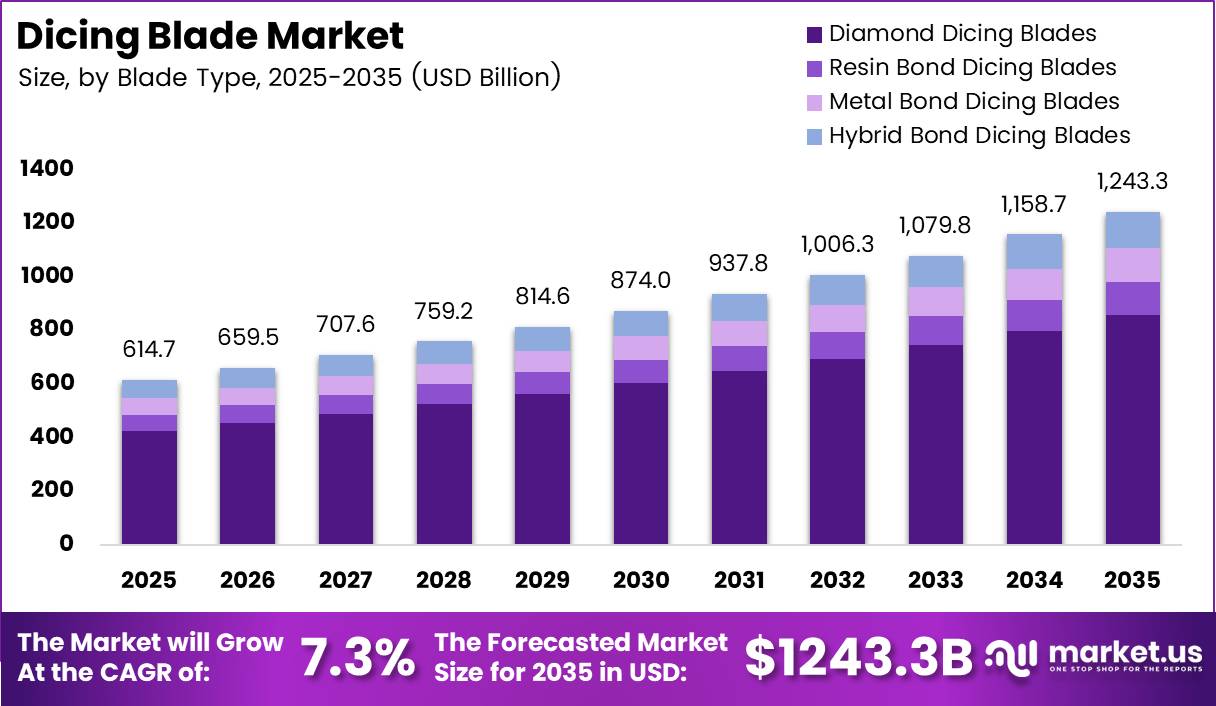
Global Dicing Blade Market size is expected to be worth around USD 1,243.3 Billion by 2035 from USD 614.7 Billion in 2025, growing at a CAGR of 7.3% during the forecast period 2026 to 2035. This trajectory nearly doubles market value in ten years. Suppliers who lock in fab qualifications early will capture the widening consumable spend before competitors scale.
Dicing blades cut processed wafers and substrates into individual dies during semiconductor and electronics manufacturing. The market splits across blade type, application, material processed, blade diameter, end user, and distribution channel. Diamond, resin bond, metal bond, and hybrid bond blades serve distinct hardness and precision needs. This structure lets vendors target high-value niches instead of competing only on commodity price.
Key Takeaways
- Global Dicing Blade Market reached USD 614.7 Billion in 2025 and will hit USD 1,243.3 Billion by 2035 at a CAGR of 7.3%.
- Diamond Dicing Blades led the By Blade Type segment with a 68.40% share.
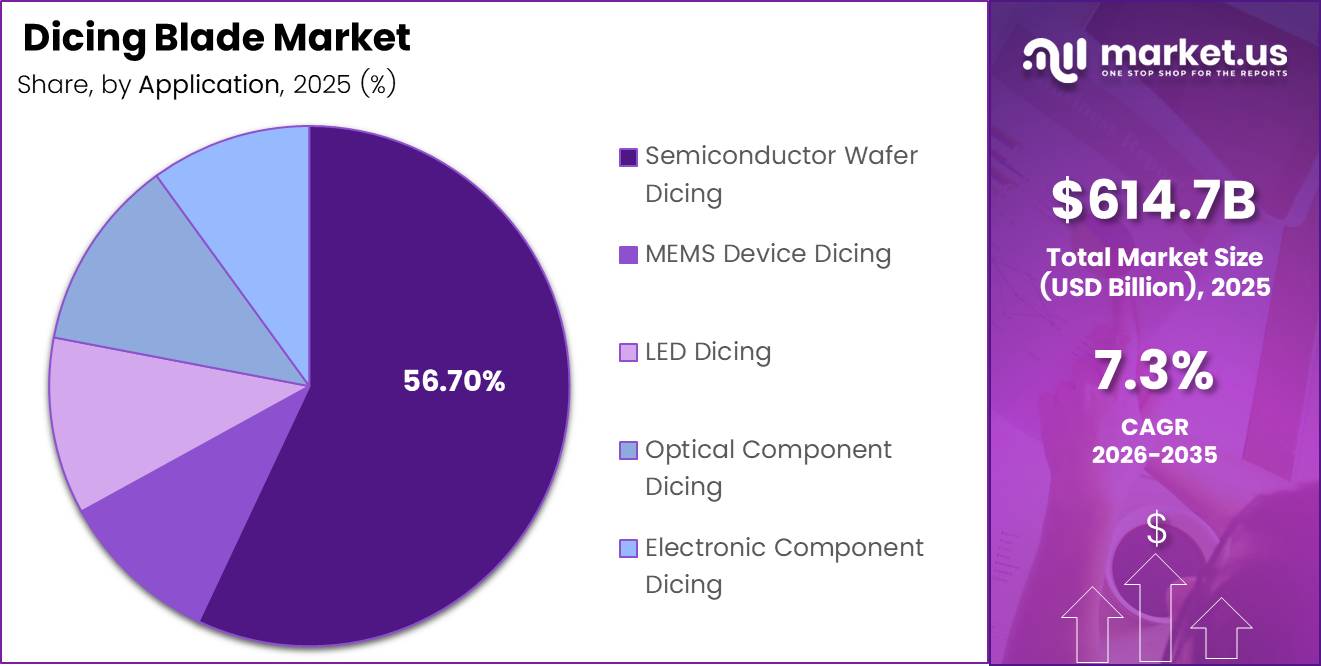
- Semiconductor Wafer Dicing dominated the By Application segment with a 56.70% share.
- Silicon Wafers held the By Material Processed segment with a 52.90% share.
- Semiconductor Manufacturers led the By End User segment with a 61.50% share.
- Direct Sales controlled the By Distribution Channel segment with a 64.80% share.
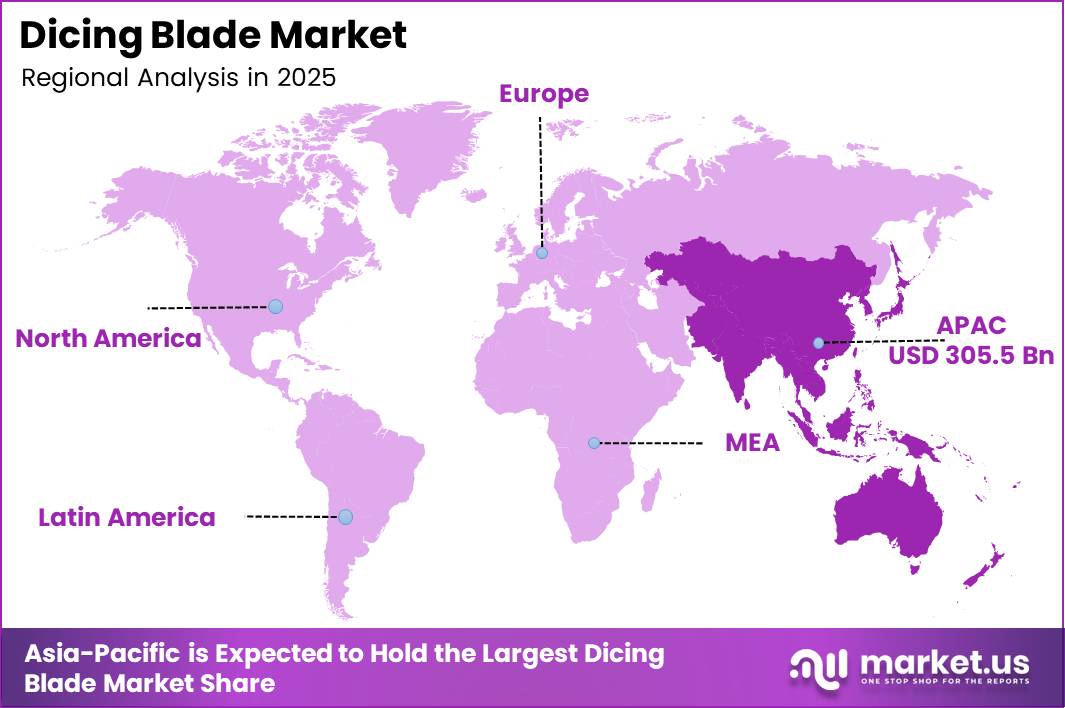
- Asia-Pacific dominated with a 49.70% share, valued at USD 305.5 Billion.
Government-linked chip programs now shape demand across the entire consumable chain. China targets 80% chip self-sufficiency by 2030, directing state fabs to qualify domestic tools and consumables. This policy pull creates captive blade volume at mature nodes. Vendors that secure local qualification early will convert this mandate into durable recurring revenue.
Data from SEMI shows global semiconductor manufacturing equipment sales rising from USD 133 Billion in 2025 to USD 145 Billion in 2026. Rising fab tool installs directly expand the base of dicing lines consuming blades. This means blade suppliers gain a larger recurring aftermarket with every new saw shipped, lifting consumable revenue independent of blade price movements.
SEMI indicates that equipment sales will reach USD 156 Billion by 2027, extending the fab buildout cycle. AA Diamond Technology aims to capture a 10% to 20% hub-blade share through dedicated dicing production. This signals intensifying competition in the highest-volume blade category. Incumbents must defend qualified positions or risk margin erosion from focused new entrants.
Blade Type Analysis
Diamond Dicing Blades dominates with 68.40% due to superior hardness for wafer cutting.
In 2025, Diamond Dicing Blades held a dominant market position in the By Blade Type segment of Dicing Blade Market, with a 68.40% share. As reported by SEMI, worldwide silicon wafer shipments rose 5.8% in 2025 to 12,973 million square inches. Higher wafer volume lifts diamond blade consumption per line. This means diamond blade suppliers ride wafer growth directly into recurring consumable revenue.
Resin Bond Dicing Blades serve fragile and ultra-thin wafers where low chipping matters most. Data from SEMI shows silicon wafer revenue reached USD 11.4 Billion in 2025, while Q2 shipments hit 3,327 MSI. Thin-wafer packaging drives resin-bond preference. This creates a defensible niche for vendors mastering low-chipping formulations that protect delicate die edges and buyer yields.
Application Analysis
Semiconductor Wafer Dicing dominates with 56.70% due to massive chip production volumes.
In 2025, Semiconductor Wafer Dicing held a dominant market position in the By Application segment of Dicing Blade Market, with a 56.70% share. According to SEMI, silicon wafer shipments grew 9.6% year over year in Q2 2025 to 3,327 MSI. Each wafer processed consumes blades during singulation. This ties blade demand tightly to chip output, giving suppliers predictable volume growth.
MEMS Device Dicing supports sensors, actuators, and image chips needing tight kerf control. Figures from SEMI show Q1 2025 shipments reached 2,896 MSI, up 2.2% year over year. Precision device fabrication rewards specialized blades. This means vendors offering ultra-narrow kerf blades can command premium pricing in high-accuracy MEMS lines.
Material Processed Analysis
Silicon Wafers dominates with 52.90% due to universal use in chip fabrication.
In 2025, Silicon Wafers held a dominant market position in the By Material Processed segment of Dicing Blade Market, with a 52.90% share. Based on SEMI data, worldwide shipments reached 3,313 MSI in Q3 2025, a 3.1% annual rise. Silicon remains the volume backbone of chip output. This gives blade makers a stable, high-volume base for standard-grade product lines.
Compound Semiconductors cover SiC and GaN substrates used in EV and power electronics. SEMI forecast global shipments to reach 12,824 MSI in 2025, representing 5.4% annual growth. Harder substrates wear blades faster and lift replacement spend. This creates a higher-margin segment for vendors building abrasion-resistant compound-grade blades.
Blade Diameter Analysis
2 to 4 Inch Blades dominates with 47.30% due to standard wafer line compatibility.
In 2025, 2 to 4 Inch Blades held a dominant market position in the By Blade Diameter segment of Dicing Blade Market, with a 47.30% share. As reported by SEMI, silicon wafer shipments grew 14.9% quarter over quarter in Q2 2025 to 3,327 MSI. Standard diameters fit most installed saws. This means suppliers scaling this size capture the broadest installed-base demand quickly.
End User Analysis
Semiconductor Manufacturers dominates with 61.50% due to continuous high-volume wafer processing.
In 2025, Semiconductor Manufacturers held a dominant market position in the By End User segment of Dicing Blade Market, with a 61.50% share. According to TSMC disclosures, high-performance computing accounted for 60% of Q2 2025 sales. AI and HPC demand pushes fabs to run more wafer starts. This concentrates blade purchasing among large fabs seeking reliable qualified suppliers.
Electronics Manufacturers dice packaged components and modules at high throughput. As reported by Reuters, ASE planned an added USD 1.5 Billion machinery investment in 2026 after USD 3.4 Billion the prior year. Packaging expansion widens blade demand beyond front-end fabs. This opens a second growth channel for vendors serving assembly and test operations.
Distribution Channel Analysis
Direct Sales dominates with 64.80% due to technical qualification and support needs.
In 2025, Direct Sales held a dominant market position in the By Distribution Channel segment of Dicing Blade Market, with a 64.80% share. Based on Reuters reporting, ASE forecast its advanced packaging business would double to USD 3.2 Billion in 2026. Complex qualification favors direct supplier relationships. This means vendors with strong field engineering lock in fabs and block distributor-led competitors.
Key Market Segments
By Blade Type
- Diamond Dicing Blades
- Resin Bond Dicing Blades
- Metal Bond Dicing Blades
- Hybrid Bond Dicing Blades
By Application
- Semiconductor Wafer Dicing
- MEMS Device Dicing
- LED Dicing
- Optical Component Dicing
- Electronic Component Dicing
By Material Processed
- Silicon Wafers
- Compound Semiconductors
- Glass Substrates
- Ceramics
- Sapphire
By Blade Diameter
- 2–4 Inch Blades
- Below 2 Inch Blades
- Above 4 Inch Blades
By End User
- Semiconductor Manufacturers
- Electronics Manufacturers
- Research Institutes
- Photonics Manufacturers
By Distribution Channel
- Direct Sales
- Distributors & Channel Partners
Regional Analysis
Asia Pacific Dominates the Dicing Blade Market with a Market Share of 49.70%, Valued at USD 305.5 Billion
Asia Pacific led the Dicing Blade Market in 2025 with a 49.70% share worth USD 305.5 Billion. The region hosts the largest concentration of wafer fabs and packaging houses. Dense fab clusters keep blade consumption high and steady. This means suppliers with regional service networks defend share against distant competitors on delivery speed and support.
Asia Pacific also anchors the fastest supply innovation in the market. In 2025, Tokyo Seimitsu and Asahi Diamond launched a strategic manufacturing partnership targeting the semiconductor hub-blade segment, one of the largest categories in the industry. Local capacity investment sharpens regional cost advantage. This means new entrants face entrenched, well-funded incumbents controlling the highest-volume blade categories.
Key Regions and Countries
North America
- US
- Canada
Europe
- Germany
- France
- The UK
- Spain
- Italy
- Rest of Europe
Asia Pacific
- China
- Japan
- South Korea
- India
- Australia
- Rest of APAC
Latin America
- Brazil
- Mexico
- Rest of Latin America
Middle East and Africa
- GCC
- South Africa
- Rest of MEA
Market Dynamics
Market Opportunity Analysis - Underserved substrates and channel niches open entry points for focused blade suppliers
Compound Semiconductors remain underexploited despite rising EV and power demand. This segment sits below the 52.90% silicon share, leaving room for specialized WBG blade lines. Harder substrates justify premium pricing. This means new entrants building SiC-grade formulations can win share before incumbents fully pivot their portfolios.
Photonics Manufacturers form a small but growing end-user niche below the 61.50% semiconductor share. This creates space for vendors serving optical and LiDAR chip singulation. Precision needs favor focused suppliers. This means early specialists capture loyal customers before larger players target the segment.
Distributors & Channel Partners hold the minority position against the 64.80% Direct Sales share. This gap signals underserved smaller buyers and regional research users. Efficient channel models reach them cheaply. This means partners building distribution reach unlock volume that direct-only competitors overlook.
The By Blade Diameter mix leaves Below 2 Inch and Above 4 Inch segments trailing the 47.30% mid-size leader. This spread signals demand at diameter extremes for niche substrates. Specialized sizing commands premiums. This means agile suppliers serving edge diameters avoid crowded mid-size price competition.
Technology and Innovation Landscape - Hubless designs, smart monitoring, and low-chipping bonds reshape competitive edges
Hubless blade designs now replace conventional hub blades across precision lines. This transition improves handling and reduces material waste per cut. Cleaner singulation lifts customer yields. This means suppliers leading hubless adoption differentiate on performance rather than commodity price alone.
Smart process monitoring integrates real-time blade wear and cutting analysis into dicing lines. This capability lets fabs predict replacement and cut unplanned downtime. Predictive data protects throughput. This means vendors bundling analytics with blades create recurring service revenue beyond consumable sales.
Resin-bond diamond blades gain ground for fragile and ultra-thin semiconductor wafers. Low-chipping formulations protect delicate die edges during wafer-level packaging. Higher yields reward the material choice. This means suppliers mastering resin-bond chemistry secure defensible positions in advanced packaging accounts.
Drivers
The global ramp in SiC and GaN wafer production stands as the strongest demand driver for dicing blades today. As per our research, the SiC wafer market grew at a 24.3% CAGR as of 2026, with SiC device use in EV inverters set to exceed 30% penetration of new platforms by 2027. Harder substrates wear blades faster. This means blade suppliers earn a per-wafer cost uplift on every SiC line they serve.
The economics favor blade makers directly. As per our research, SiC and GaN substrates require diamond blades wearing at 3 to 5 times the rate of silicon-grade blades, lifting per-wafer blade cost to $15 to $35 versus $3 to $8 for silicon. Higher replacement frequency expands consumable spend. This pushes suppliers toward WBG-optimized lines carrying gross margins near 45% to 60%.
| Driver | (~) % Impact on CAGR Forecast | Geographic Relevance | Impact Timeline |
|---|---|---|---|
| SiC & GaN Wafer Volume Ramp for EV & Power Electronics | +2.6% | China, Japan, South Korea, Germany, United States | Short term (≤ 2 years) |
| Advanced Packaging & 3D IC / Chiplet Singulation Intensity Increase | +2.0% | Taiwan, South Korea, United States, Japan | Short term (≤ 2 years) |
| China Domestic Semiconductor Fab Capacity Expansion (Localization Drive) | +1.3% | China (primary), with secondary equipment sourcing impact across Asia | Short term (≤ 2 years) |
| MEMS, LED & Compound Semiconductor Device Proliferation | +0.9% | Global, led by Asia-Pacific & North America | Medium term (2–4 years) |
| Miniaturization & Ultra-Thin Wafer Adoption Driving Blade Consumption per Wafer | +0.7% | Global, accelerating in advanced node & mobile device fabs | Medium term (2–4 years) |
Restraints
Laser stealth and plasma dicing increasingly displace mechanical blades in ultra-thin wafer segments. As per our research, blade dicing below 100 μm thickness cuts die flexural strength by 30% to 50% through chipping and micro-cracks. Yield loss forces fabs to switch methods. This means blade suppliers lose access to the fastest-growing advanced packaging applications.
The kerf advantage widens the gap further. As per our research, plasma dicing achieves street widths of 5 to 10 μm versus a 15 to 50 μm minimum blade kerf, lifting die-per-wafer yield by 1% to 4%. Narrower streets add usable die. This caps blade growth to mature nodes and thicker substrates where blades keep clear cost and throughput advantages.
| Restraint | (~) % Impact on CAGR Forecast | Geographic Relevance | Impact Timeline |
|---|---|---|---|
| Laser Dicing & Plasma Dicing Substitution in Ultra-Thin & Fragile Substrate Segments | -2.0% | Global, concentrated in advanced node fabs in Taiwan, South Korea, Japan | Short term (≤ 2 years) |
| U.S. & Allied Semiconductor Equipment Export Controls Constraining China Sales | -1.4% | United States, Japan, Netherlands — export-origin suppliers; China as end-market | Short term (≤ 2 years) |
| Cyclical Semiconductor Capex Downturns Deferring Fab Consumable Procurement | -0.9% | Global, most acute in memory-dominated markets (South Korea, Taiwan) | Short term (≤ 2 years) |
| Concentrated Supplier Structure Limiting Pricing Power of Downstream Integrators | -0.6% | Global | Medium term (2–4 years) |
| Stealth / DBG Dicing (Laser Stealth + Grinding) Displacing Blade in Logic Wafer Thinning | -0.5% | Japan, Taiwan, South Korea | Medium term (2–4 years) |
Challenges
Sub-50 μm synthetic diamond abrasive supply is the sharpest challenge for blade makers targeting SiC. As per our research, roughly 80% to 85% of global synthetic industrial diamond output comes from China, now under November 2025 export licensing controls. Concentration creates single-source risk. This forces non-China suppliers to absorb feedstock cost rises of 20% to 40% per kilogram.
Qualification friction compounds the input squeeze. As per our research, switching diamond powder grades triggers a re-qualification across 20 to 50 wafer lots, costing $50,000 to $150,000 over 3 to 6 months. Long trials block quick supplier changes. This pressures gross margins toward 32% to 45% and rewards firms that forward-integrate into powder processing.
| Challenge | (~) % CAGR Friction Drag | Geographic Relevance | Mitigation Horizon |
|---|---|---|---|
| SiC-Grade Diamond Abrasive Supply Constraint | -1.6% | Global non-Chinese blade manufacturers; Japan, South Korea, U.S., Europe | Medium term (2–4 years) |
| Blade Qualification Cycle Length at Advanced Fabs | -1.2% | Taiwan, South Korea, Japan, United States | Long term (≥ 4 years) |
| Kerf Width & Chipping Specification Tightening | -0.9% | Global, most acute at leading-edge packaging fabs | Medium term (2–4 years) |
| Skilled Process Engineering Talent Shortage | -0.7% | North America, Europe, India | Long term (≥ 4 years) |
| Coolant Waste & Swarf Disposal Regulatory Compliance | -0.5% | EU, Japan, United States (state-level EPA regulations) | Medium term (2–4 years) |
Opportunities
China domestic blade localization is the largest untapped opportunity in the market. As per our research, Chinese domestic makers supply only 20% to 30% of local volume, leaving 70% to 80% imported, mostly from Japan. Localization mandates redirect procurement inward. This opens sizable import-substitution white space for local producers and joint venture partners.
The unit economics reward early movers. As per our research, mature-node Chinese fabs consume $2 Million to $8 Million in annual blade procurement each, supporting China’s 80% chip self-sufficiency target by 2030. Captive volume grows with every qualified fab. This means suppliers qualifying at key OSATs within 24 to 36 months secure first-mover margins near 35% to 50%.
| Opportunity | (~) % Potential CAGR Upside | Geographic Relevance | Execution Window |
|---|---|---|---|
| China Domestic Blade Supply Localization (Import Substitution White Space) | +2.2% | China (primary); also benefits non-Chinese suppliers entering via JV or licensing | Medium term (2–4 years) |
| Hybrid Dicing Solution Integration (Blade + Laser Combo for WBG Substrates) | +1.6% | Japan, South Korea, Germany, United States | Medium term (2–4 years) |
| Gallium Oxide & Next-Gen Ultra-WBG Substrate Singulation Market Entry | +1.1% | United States, Japan, South Korea, Germany | Long term (≥ 4 years) |
| Dicing Blade-as-a-Subscription (Managed Consumables & Blade Analytics Service) | +0.9% | North America, Japan, South Korea, Europe | Medium term (2–4 years) |
| Photonics, LiDAR & Optical Chip Singulation Volume Growth | +0.7% | United States, Japan, Germany, China | Medium term (2–4 years) |
Key Company Insights
DISCO Corporation holds the leading position in dicing equipment and precision blades worldwide. In December 2025, DISCO unveiled the DFD6080 fully automatic dicing saw handling workpieces up to 400 × 400 mm for panel-level and fan-out packaging. This platform ties blade sales to installed saws. However, reliance on packaging demand exposes DISCO to fab capex cycles that defer consumable procurement during downturns.
ADT (Advanced Dicing Technologies) competes through specialized dicing systems and blade compatibility across substrate types. Rising advanced packaging volume favors flexible platform suppliers, as reflected in ASE forecasting its packaging business to double to USD 3.2 Billion in 2026. Broad substrate support strengthens ADT positioning. However, scale gaps against dominant incumbents limit pricing power in the highest-volume hub-blade categories.
Key Players
- DISCO Corporation
- ADT (Advanced Dicing Technologies)
- K&S (Kulicke & Soffa)
- Accretech
- Tokyo Seimitsu
- Nitto Denko Corporation
- Asahi Diamond Industrial Co., Ltd.
- UKAM Industrial Superhard Tools
- Saint-Gobain Abrasives
- Kinik Company
- Ehwa Diamond Industrial Co., Ltd.
- SHINHAN Diamond Industrial Co., Ltd.
- Tyrolit Group
- ILJIN Diamond
- Zhengzhou Sino-Crystal Diamond Co., Ltd.
Recent Developments
- January 2025: Tokyo Seimitsu and Asahi Diamond Industrial signed a memorandum of understanding to establish a joint venture focused on developing, manufacturing, and selling hub blades for semiconductor wafer dicing machines.
- March 2025: Tokyo Seimitsu and Asahi Diamond Industrial signed the formal joint venture agreement to establish a company dedicated to developing, manufacturing, and selling hub-type dicing blades.
- May 2025: Tokyo Seimitsu and Asahi Diamond Industrial established AA Diamond Technology Co., Ltd., a 50:50 joint venture with capital of 1 Billion yen focused on dicing blade development and production.
- May 2025: AA Diamond Technology announced plans to establish a pilot manufacturing line for hub blades and target mass production and sales beginning in the second half of FY2027.
- December 2025: DISCO Corporation developed and unveiled the DFD6080 fully automatic dicing saw for package dicing of workpieces up to 400 × 400 mm, addressing demand from panel-level and fan-out packaging applications.
Report Scope
| Report Features | Description |
|---|---|
| Market Value (2025) | USD 614.7 Billion |
| Forecast Revenue (2035) | USD 1,243.3 Billion |
| CAGR (2026-2035) | 7.3% |
| Base Year for Estimation | 2025 |
| Historic Period | 2020-2024 |
| Forecast Period | 2026-2035 |
| Report Coverage | Revenue Forecast, Market Dynamics, Market Opportunity Analysis, Technology and Innovation Landscape, Competitive Landscape, Recent Developments |
| Segments Covered | By Blade Type (Diamond Dicing Blades, Resin Bond Dicing Blades, Metal Bond Dicing Blades, Hybrid Bond Dicing Blades), By Application (Semiconductor Wafer Dicing, MEMS Device Dicing, LED Dicing, Optical Component Dicing, Electronic Component Dicing), By Material Processed (Silicon Wafers, Compound Semiconductors, Glass Substrates, Ceramics, Sapphire), By Blade Diameter (2–4 Inch Blades, Below 2 Inch Blades, Above 4 Inch Blades), By End User (Semiconductor Manufacturers, Electronics Manufacturers, Research Institutes, Photonics Manufacturers), By Distribution Channel (Direct Sales, Distributors & Channel Partners) |
| Regional Analysis | North America (US and Canada), Europe (Germany, France, The UK, Spain, Italy, and Rest of Europe), Asia Pacific (China, Japan, South Korea, India, Australia, and Rest of APAC), Latin America (Brazil, Mexico, and Rest of Latin America), Middle East and Africa (GCC, South Africa, and Rest of MEA) |
| Competitive Landscape | DISCO Corporation, ADT (Advanced Dicing Technologies), K&S (Kulicke & Soffa), Accretech, Tokyo Seimitsu, Nitto Denko Corporation, Asahi Diamond Industrial Co., Ltd., UKAM Industrial Superhard Tools, Saint-Gobain Abrasives, Kinik Company, Ehwa Diamond Industrial Co., Ltd., SHINHAN Diamond Industrial Co., Ltd., Tyrolit Group, ILJIN Diamond, Zhengzhou Sino-Crystal Diamond Co., Ltd. |
| Customization Scope | Customization for segments, region / country-level will be provided. Additional customization can be done based on requirements. |
| Purchase Options | We have three licenses to opt for: Single User License | Multi-User License (Up to 5 Users) | Corporate Use License (Unlimited User and Printable PDF) |





































