


Report Overview
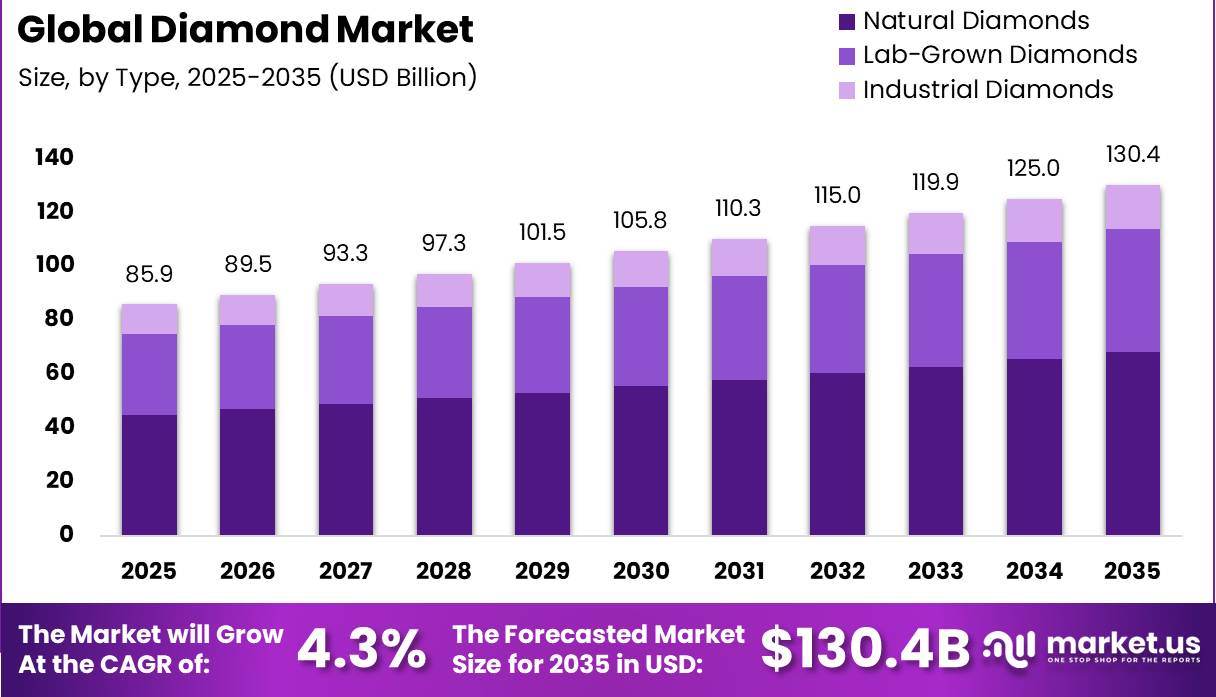
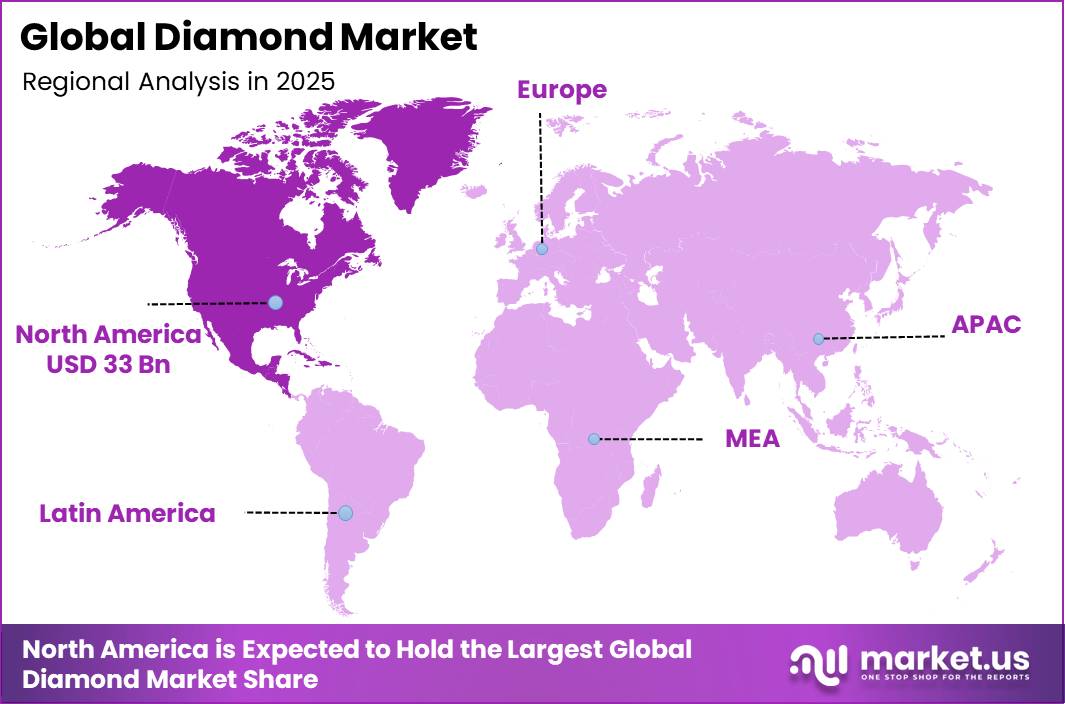
Global Diamond Market size is expected to be worth around USD 130.4 Billion by 2035 from USD 85.9 Billion in 2025, growing at a CAGR of 4.3% during the forecast period 2026 to 2035. North America leads all regions with a 38.40% share, valued at USD 33.0 Billion, confirming its position as the primary demand center for both gem-quality and industrial-grade diamonds globally.
The diamond market encompasses the full value chain from rough stone extraction through cutting, polishing, grading, and retail distribution across gem, industrial, and high-technology end-use applications. It spans natural mined diamonds, lab-grown diamonds produced via CVD and HPHT processes, and industrial-grade stones used in precision manufacturing. This structure creates distinct commercial sub-markets with separate pricing dynamics, buyer profiles, and competitive pressures operating simultaneously.
Key Takeaways
- The global Diamond Market is valued at USD 85.9 Billion in 2025 and is forecast to reach USD 130.4 Billion by 2035, growing at a CAGR of 4.3%.
- North America dominates with a 38.40% regional share, valued at USD 33.0 Billion in 2025.
- Asia-Pacific is the fastest-growing region, driven by rising consumer demand in India and expanding luxury retail penetration across Southeast Asia.
- By Type, Natural Diamonds hold the dominant position with a 52.40% share in 2025.
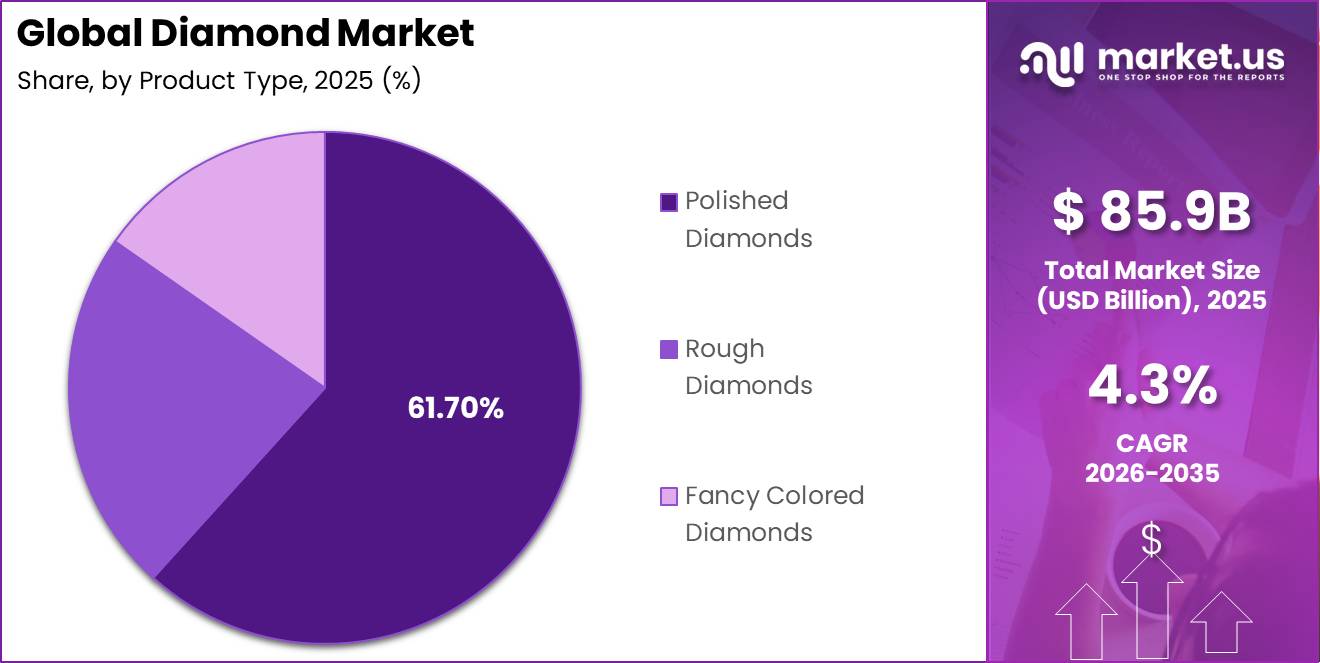
- By Product Type, Polished Diamonds lead with a 61.70% share; Electronics & Semiconductors is the fastest-growing application sub-segment.
- By Application, Jewelry accounts for 72.90% of market share; Electronics & Semiconductors is the fastest-growing application.
- By End User, Individual Consumers hold a 68.50% share; Jewelry Manufacturers & Retailers is the fastest-growing end-user segment.
- By Distribution Channel, Offline Retail Stores lead with 63.20% share; Online Retail is the fastest-growing channel.
- By Price Range, Mid-Range Diamonds hold the largest share at 44.60%; Economy Diamonds is the fastest-growing tier.
As per our research, Canadian rough diamond production totaled 13.3 million carats in 2024, a 17% year-over-year decline, while production value fell 30% to CAD 1.47 Billion. This compression in one of the world’s major mining jurisdictions signals that upstream supply contraction is structural, not cyclical. Investors evaluating natural diamond asset exposure must price in reduced Canadian output as a lasting supply-side constraint through the forecast period.
As reported by the Financial Times, GIA’s revised 2025 grading framework prices lab-grown diamond assessments at USD 15 per carat, a sharp reduction from prior certification fees. This shift formalizes the commoditization of lab-grown stones at the institutional level. Consequently, grading economics now reinforce the bifurcation between natural and synthetic categories, giving certified natural stones a clearer premium positioning in retail channels where provenance and scarcity carry pricing power.
As per our research, the Tracr blockchain traceability platform registered 5 million diamonds and expanded to more than 40 live industry participants by 2025. This signals that digital provenance infrastructure is reaching viable commercial scale across the natural diamond supply chain. Operators who integrate verified traceability now gain a durable margin advantage, as consumer willingness to pay for authenticated origin continues to translate into measurable transaction price uplift at retail.
Type Analysis
Natural Diamonds dominate with 52.40% due to gem scarcity, bridal demand, and pricing power.
In 2025, Natural Diamonds held a dominant market position in the By Type segment of the Diamond Market, with a 52.40% share. Kimberlite mine depletion across Botswana, Canada, and Russia is tightening gem-quality supply while bridal and gifting demand sustains volume. This scarcity dynamic gives natural diamond producers structural pricing leverage that lab-grown alternatives cannot replicate, creating a durable valuation premium for certified gem-quality stones through the forecast period.
Lab-Grown Diamonds are the fastest-growing sub-segment within the By Type category. Data from Natural Resources Canada shows Russia accounted for 34.6% of global rough diamond production value in 2024, and geopolitical sanctions on Russian rough supply are accelerating retailer interest in traceable, domestically produced lab-grown alternatives. This shift is most visible in U.S. and European fashion jewelry channels, where lab-grown stones now fill mid-price-point inventory gaps left by sanctioned natural rough supply.
Industrial Diamonds serve a separate demand structure anchored in precision manufacturing, semiconductor fabrication, and cutting tool production. As per our research, adoption in semiconductor wafer dicing and ultra-precision tooling is expanding the addressable market for synthetic industrial-grade stones beyond traditional abrasive applications. This creates a parallel demand channel that is insulated from gem market price volatility and responds instead to electronics and advanced manufacturing cycle dynamics.
Product Type Analysis
Polished Diamonds dominate with 61.70% due to end-consumer retail demand for finished gem stones.
In 2025, Polished Diamonds held a dominant market position in the By Product Type segment of the Diamond Market, with a 61.70% share. According to Rapaport, diamond professionals conducted 21,789,779 searches for round polished diamonds on its Trade platform in 2025, up 25.8% from 2024. This search volume growth signals recovering commercial intent among dealers and retailers. The implication for polished stone suppliers is that inventory positioning and grading certification quality will increasingly determine which sellers capture margin as buyer activity accelerates.
Rough Diamonds occupy the upstream position in the value chain, supplying cutting and polishing centers globally. As per our research, Surat processes approximately 90% of the world’s rough diamonds by volume, giving India’s midstream cluster outsized influence over polished supply availability and per-carat finishing costs. Rough diamond pricing and supply discipline at the miner level directly determines cutting center profitability and, by extension, polished stone margins downstream.
Fancy Colored Diamonds are the fastest-growing product sub-segment, driven by collector-grade demand and investment positioning in the high-net-worth segment. As per our research, collector and investor appetite for rare fancy color stones is expanding in the United States, Europe, and Gulf markets as buyers treat certified fancy diamonds as alternative assets with scarcity-backed appreciation potential. This creates a niche but high-margin growth lane for specialized dealers and auction houses with established provenance documentation capabilities.
Application Analysis
Jewelry dominates with 72.90% due to bridal, gifting, and self-purchase occasion volumes.
In 2025, Jewelry held a dominant market position in the By Application segment of the Diamond Market, with a 72.90% share. According to Natural Diamonds, bridal jewelry accounted for 33% of natural diamond jewelry sales value in 2024, while average wedding-set prices rose 31% in the same year. These figures confirm that the bridal occasion category is both volume-critical and price-supportive, making it the single highest-value commercial segment within the broader jewelry application and a strategic priority for natural diamond brands.
Industrial Applications represent a stable and growing off-take channel for both natural and synthetic industrial-grade diamonds. Demand from cutting and grinding tool manufacturers continues to expand as precision engineering standards tighten across automotive, aerospace, and heavy equipment sectors. This application base provides a predictable volume floor for synthetic industrial diamond producers, partially offsetting the revenue exposure that gem-grade natural diamond miners face from lab-grown substitution in the jewelry segment.
Electronics and Semiconductors is the fastest-growing application, driven by diamond’s exceptional thermal conductivity, hardness, and electrical properties. As per our research, adoption in semiconductor wafer dicing and high-power electronics substrates is expanding the industrial diamond addressable market into advanced computing and quantum technology sectors. This growth lane is insulated from consumer discretionary cycles and responds to capital expenditure in the global semiconductor supply chain, making it a structurally distinct demand driver.
End User Analysis
Individual Consumers dominate with 68.50% due to jewelry purchase volumes across bridal and gifting occasions.
In 2025, Individual Consumers held a dominant market position in the By End User segment of the Diamond Market, with a 68.50% share. Consumer spending in this segment is occasion-driven, with bridal, anniversary, and self-purchase events sustaining volume across natural and lab-grown categories. This concentration means that macro-level consumer sentiment, credit availability, and discretionary income trends directly govern the largest revenue segment in the market.
Industrial Users form a distinct and stable demand base, purchasing diamonds primarily for cutting, grinding, polishing, and semiconductor applications. As per our research, industrial end-users exhibit lower price sensitivity than jewelry consumers because diamond performance characteristics deliver measurable operational productivity gains that justify the material cost. This makes industrial demand less volatile and more predictable across economic cycles than consumer gem demand.
Distribution Channel Analysis
Offline Retail Stores dominate with 63.20% due to tactile purchase behavior and trust in high-value transactions.
In 2025, Offline Retail Stores held a dominant market position in the By Distribution Channel segment of the Diamond Market, with a 63.20% share. High-value diamond purchases remain anchored in physical retail because consumers demand in-person grading verification, tactile stone assessment, and direct sales consultation before committing. This behavioral pattern limits pure online displacement in the natural diamond segment, particularly for stones above one carat where purchase risk perception is highest.
Online Retail is the fastest-growing channel, supported by digital diamond retail configurators that enable real-time 3D customization and virtual try-on. As per our research, e-commerce platforms are capturing a growing share of sub-one-carat and lab-grown diamond purchases where price transparency and convenience outweigh the need for in-person inspection. Retailers that invest in high-resolution imaging, AI-assisted stone matching, and digital grading report integration are converting online browsers into buyers at measurably higher rates than static product-page formats.
Auction Houses serve the specialty segment for collector-grade, fancy colored, and high-carat natural diamonds where realized prices frequently exceed standard retail valuations. As per our research, digital grading reports and AI valuation models are increasing transparency in auction pricing, expanding buyer participation beyond traditional high-net-worth bidders to include institutional investors and family offices treating rare stones as alternative assets. This democratization of access supports auction volume growth in the long-term forecast period.
Price Range Analysis
Mid-Range Diamonds dominate with 44.60% due to mass-market bridal and gifting purchase concentration.
In 2025, Mid-Range Diamonds held a dominant market position in the By Price Range segment of the Diamond Market, with a 44.60% share. This tier captures the broadest buyer base, spanning engagement ring purchasers, anniversary gifts, and self-purchase buyers in established markets. As per our research, the mid-range segment benefits from both natural and lab-grown diamond supply availability, giving retailers pricing flexibility to maintain margin while meeting consumer expectations on stone size and quality.
Luxury and Premium Diamonds occupy the top tier, driven by collector demand, branded jewelry positioning, and gifting occasions among high-net-worth consumers. As per our research, natural diamond premiumization is widening the price gap between certified gem-quality naturals and lab-grown alternatives, enabling luxury tier retailers to sustain average selling price growth even as mid-market volumes face margin compression. This positions premium natural diamond brands as the primary beneficiaries of the bifurcation dynamic reshaping the broader market.
Economy Diamonds is the fastest-growing price tier, driven by lab-grown diamond price deflation making diamond jewelry accessible to first-time buyers in emerging markets. As per our research, sub-one-carat lab-grown stones now reach retail price points competitive with semi-precious gemstone jewelry, opening an entirely new addressable consumer base across India, Southeast Asia, and Latin America. This expansion at the entry level increases overall category volume but compresses average selling prices across the distribution channel.
Key Market Segments
By Type
- Natural Diamonds
- Lab-Grown Diamonds
- Industrial Diamonds
By Product Type
- Polished Diamonds
- Rough Diamonds
- Fancy Colored Diamonds
By Application
- Jewelry
- Industrial Applications
- Cutting & Polishing Tools
- Electronics & Semiconductors
By End User
- Individual Consumers
- Industrial Users
- Jewelry Manufacturers & Retailers
By Distribution Channel
- Offline Retail Stores
- Online Retail
- Auction Houses
By Price Range
- Mid-Range Diamonds
- Luxury/Premium Diamonds
- Economy Diamonds
Regional Analysis
North America Dominates the Diamond Market with a Market Share of 38.40%, Valued at USD 33.0 Billion
North America holds the largest regional share of the Diamond Market at 38.40%, valued at USD 33.0 Billion in 2025. According to Natural Diamonds, bridal jewelry accounted for 33% of natural diamond jewelry sales value in 2024, while average wedding-set prices increased 31% in the same year. These figures confirm that the U.S. bridal occasion cycle is a primary revenue engine for the region, supporting above-average per-unit transaction values and sustaining demand for premium-certified natural stones.
Asia-Pacific is the fastest-growing region in the Diamond Market. As per our research, India’s diamond jewelry consuming base is on a trajectory to exceed 65 million active purchasers by 2030, driven by expanding urban affluence and bridal occasion spending. This volume growth makes Asia-Pacific the most commercially critical emerging region for natural diamond producers and polished stone distributors seeking demand-side offsets to flat growth in mature Western markets.
Europe, the Middle East and Africa, and Latin America represent the remaining regional demand base. As per our research, GCC markets are expanding luxury jewelry retail as sovereign wealth and high-net-worth consumer segments drive premium diamond gifting occasions. By contrast, Latin America remains an early-stage growth market where economy and mid-range diamond penetration is beginning to scale through organized retail channel development and increased lab-grown diamond accessibility.
Key Regions and Countries
North America
- US
- Canada
Europe
- Germany
- France
- The UK
- Spain
- Italy
- Rest of Europe
Asia Pacific
- China
- Japan
- South Korea
- India
- Australia
- Rest of APAC
Latin America
- Brazil
- Mexico
- Rest of Latin America
Middle East and Africa
- GCC
- South Africa
- Rest of MEA
Market Dynamics
Market Opportunity Analysis - Underpenetrated emerging regions and specialty segments offer the clearest entry points for new market participants
Asia-Pacific presents the most commercially accessible underexploited growth region in the Diamond Market. As per our research, India’s consumer base is expanding toward 65 million active diamond purchasers by 2030, yet organized branded diamond retail penetration outside major metros remains thin relative to this demand trajectory. New entrants focusing on Tier 2 and Tier 3 Indian cities with mid-range natural and lab-grown product assortments can capture first-mover share before established brands saturate these geographies.
The Economy Diamond price tier is the fastest-growing segment within the By Price Range category, yet it remains structurally underdeveloped in Latin America and Southeast Asia. As per our research, lab-grown diamond price deflation has brought sub-one-carat stones to price points competitive with semi-precious gemstone jewelry, creating a new addressable consumer base that existing distribution networks have not yet reached at scale. This means that direct-to-consumer and e-commerce-led entrants face a lower competitive barrier in these geographies than in established Western markets.
Auction Houses represent an underexploited distribution channel for the Fancy Colored Diamond and collector-grade natural diamond sub-segments. As per our research, AI valuation models and digital GIA-certified grading reports are increasing pricing transparency, expanding the buyer pool beyond traditional high-net-worth individuals to include institutional investors and family offices. New specialized auction platforms that aggregate fancy color inventory and offer digital grading integration can capture this emerging buyer segment without requiring physical gallery infrastructure.
The Electronics and Semiconductors application segment is the fastest-growing application in the Diamond Market and remains commercially underserved by current supply chain configurations. As per our research, industrial diamond adoption in semiconductor wafer dicing and high-power electronics substrates is accelerating, yet the upstream supply infrastructure linking synthetic industrial diamond producers to semiconductor fabrication buyers is immature relative to established gem supply chains. Suppliers that build direct relationships with semiconductor capital equipment manufacturers now can lock in volume contracts ahead of the broader market’s attention shifting to this application lane.
Technology and Innovation Landscape - Blockchain provenance systems, digital grading, and semiconductor-grade synthesis are redefining competitive positioning across the diamond value chain
Blockchain-based traceability is transitioning from a compliance tool to a commercial differentiator in the natural diamond segment. According to Tracr, the platform registered 5 million diamonds and expanded to more than 40 live industry participants by 2025. This scale confirms that mine-to-retail digital provenance tracking is operationally viable. Operators embedding blockchain certification into consumer-facing retail experiences are converting the compliance investment into transaction price uplifts of 12 to 18% per stone versus unverified equivalents.
Digital diamond retail configurators are restructuring the online purchase decision process by enabling real-time 3D stone customization and virtual try-on. As per our research, e-commerce platforms deploying AI-assisted stone matching and high-resolution imaging are converting online browsers into buyers at measurably higher rates than static product-page formats. This technology shift is the primary mechanism driving Online Retail’s status as the fastest-growing distribution channel and is compressing the competitive moat of traditional offline-only retailers in the sub-one-carat and lab-grown categories.
GIA-certified digital grading reports are increasing pricing transparency across cut, clarity, and fluorescence parameters, making the secondary diamond market more liquid and accessible. As per our research, AI valuation models integrated with digital grading data are enabling authentication-driven secondary resale marketplaces to scale. This technology creates a new transaction layer between the primary retail channel and end consumers, particularly for investors treating certified fancy colored and collector-grade natural diamonds as alternative assets with verifiable market valuations.
CVD diamond production scaling in India and China is the technology trend most directly reshaping global supply composition. As per our research, rapid expansion of CVD and HPHT production clusters is driving further lab-grown diamond price deflation, with Chinese and Indian producers adding capacity at a rate that faces no meaningful supply discipline constraint. This technology trajectory means that lab-grown price reductions are structural rather than cyclical, permanently altering the pricing relationship between natural and synthetic categories across every price tier in the market.
Drivers
India’s rise to the world’s second-largest diamond jewelry market is reshaping global demand geography. As per our research, India’s domestic natural diamond jewelry market is projected to nearly triple by 2030, with the country’s consumer base expanding from approximately 32 million buyers in 2025 toward 65 million active purchasers by 2030. This scale of demand growth creates an immediate commercial opportunity for natural diamond producers and polished stone suppliers seeking volume-based off-take outside of flat Western markets.
U.S. bridal demand and industrial high-technology applications reinforce the market’s dual growth structure. As per our research, U.S. Gen Z self-purchase behavior and occasion-driven demand are sustaining jewelry retail volume independent of the bridal cycle. Industrial adoption in semiconductor wafer dicing, quantum computing substrates, and ultra-precision cutting tool manufacturing is adding a technology-driven demand lane that is structurally insulated from consumer discretionary cycles and responds instead to semiconductor capital expenditure.
| Driver | (~) % Impact on CAGR Forecast | Geographic Relevance | Impact Timeline |
|---|---|---|---|
| India Emerging as World’s Second-Largest Diamond Jewellery Market | +1.7% | India (primary); ripple effect on global rough & polished trade flows | Short term (≤ 2 years) |
| Gen Z & Self-Purchase Occasion-Driven Demand in the United States | +1.2% | United States, Canada, UK, Australia | Short term (≤ 2 years) |
| Industrial & High-Tech Diamond Demand (Semiconductors, Quantum Computing, Cutting Tools) | +0.9% | Global, led by North America, East Asia, Europe | Medium term (2–4 years) |
| Natural Diamond Premiumization vs. Lab-Grown Bifurcation Raising Average Selling Prices | +0.8% | United States, Europe, Gulf Cooperation Council, India | Short term (≤ 2 years) |
| GCC & Middle East Luxury Jewellery Market Expansion | +0.7% | Saudi Arabia, UAE, Qatar, Kuwait | Medium term (2–4 years) |
Restraints
Lab-grown diamond price deflation is the most severe restraint operating on the natural diamond market today. As per our research, LGD prices have fallen to approximately 90% below natural diamond equivalents, with a one-carat LGD retailing for roughly USD 300 to USD 500 versus USD 4,000 to USD 6,000 for a natural stone. This price gap is driving measurable demand transfer in the U.S. engagement ring segment, compressing natural diamond midstream margins from a historical 8 to 12% band to an estimated 3 to 6% at current price levels.
G7 sanctions on Russian rough diamonds and a macro-driven pullback in Chinese luxury spending compound the structural pressure on the market. According to Debswana, the company reduced diamond production by 27% in 2024, lowering output to 17.93 million carats, while reporting a 46% decline in sales revenue amid weak global demand. This simultaneous supply curtailment and revenue compression across major producers signals that the market’s near-term revenue recovery depends heavily on demand stabilization in China and resolution of Russian supply routing disruptions through Antwerp.
| Restraint | (~) % Impact on CAGR Forecast | Geographic Relevance | Impact Timeline |
|---|---|---|---|
| Lab-Grown Diamond Price Collapse Cannibalizing Natural Diamond Demand & Valuations | -2.2% | United States, Europe, China, Australia; accelerating globally | Short term (≤ 2 years) |
| G7 Sanctions on Russian Diamonds Disrupting Rough Supply & Traceability Infrastructure | -1.3% | EU, United States, UK, G7 import markets | Short term (≤ 2 years) |
| Declining Natural Rough Diamond Prices Suppressing Miner Revenue & CapEx | -1.0% | Global mining producers: Botswana, Canada, Namibia, South Africa, Russia | Short term (≤ 2 years) |
| Consumer Macro Sensitivity & Luxury Discretionary Pullback in China | -0.8% | China, Hong Kong, Macau | Short term (≤ 2 years) |
| Excess Inventory Overhang Across Midstream Polished Diamond Segment | -0.7% | India (Surat), Belgium (Antwerp), UAE (Dubai) | Short term (≤ 2 years) |
Challenges
Ethical sourcing perception and conflict diamond concerns continue to create a trust deficit that lab-grown diamond marketing actively exploits. As per our research, 60 to 75% of diamond purchasers aged 18 to 35 in Western markets report uncertainty about the provenance of their diamonds even after purchase. This unresolved credibility gap adds an estimated 8 to 12% uplift to lab-grown diamond conversion rates in the engagement ring segment by reducing the ethical objection to choosing a synthetic alternative.
G7 traceability requirements and detection gaps between natural and lab-grown stones are adding compliance costs across the supply chain. As per our research, G7 sanctions require verified origin documentation for diamonds of 0.5 carats and above, yet traceability infrastructure remains technically incomplete as of 2026. This creates an estimated 3 to 6 week administrative delay for certified supply chains using third-country processing hubs, adding cost and lead-time friction for EU and U.S. importers dependent on non-Russian rough supply rerouting.
| Challenge | (~) % CAGR Friction Drag | Geographic Relevance | Mitigation Horizon |
|---|---|---|---|
| Ethical Sourcing & Conflict Diamond Perception | -1.2% | Global consumer markets; regulatory pressure in EU, UK, U.S. | Long term (≥ 4 years) |
| Natural vs. LGD Detection & Disclosure Gaps | -0.9% | Global, especially high-volume wholesale and retail channels | Medium term (2–4 years) |
| Midstream Financing & Credit Availability Tightening | -0.8% | Antwerp, Mumbai, Dubai, Hong Kong trading hubs | Medium term (2–4 years) |
| Skilled Artisan & Polisher Workforce Erosion | -0.6% | India (Surat, Gujarat), Belgium, Israel | Long term (≥ 4 years) |
| Carbon Footprint & ESG Reporting Pressure on Mining Operations | -0.5% | Botswana, Canada, Namibia, South Africa; EU institutional investor scrutiny | Medium term (2–4 years) |
Opportunities
Blockchain-verified provenance platforms represent an underdeveloped commercial monetization opportunity for natural diamond producers and retailers. As per our research, the EU’s mandatory G7 traceability scheme for diamonds of 0.5 carats and above became fully binding in March 2025, yet fewer than 15 to 20% of diamonds entering EU retail channels carry a consumer-accessible digital blockchain-anchored provenance record. The per-stone cost of issuing a blockchain-linked certificate has fallen to approximately USD 5 to USD 15 at scale, against a potential retail value capture of USD 200 to USD 800 per stone in the 0.5 to 2 carat segment.
Diamond-based semiconductor substrates and self-purchase occasion expansion in emerging markets create two parallel long-term growth lanes. As per our research, diamond substrates for high-power electronics and quantum computing are expanding the addressable industrial market beyond traditional abrasive applications into advanced technology manufacturing. This creates a demand channel insulated from gem market price cycles. Simultaneously, self-purchase and non-bridal occasion demand growth in India, GCC, and Latin America is opening new consumer volume at price points accessible to first-time diamond buyers.
| Opportunity | (~) % Potential CAGR Upside | Geographic Relevance | Execution Window |
|---|---|---|---|
| Blockchain-Verified Provenance Platform as Premium Monetization Layer | +1.8% | Global, anchored by EU traceability mandate & U.S./India premium retail | Medium term (2–4 years) |
| Diamond-as-a-Material for Quantum Computing & Semiconductor Substrates | +1.3% | United States, Japan, Germany, South Korea, China | Long term (≥ 4 years) |
| Self-Purchase & Non-Bridal Occasion Segment Expansion in Emerging Markets | +1.1% | India, Southeast Asia, GCC, Latin America | Medium term (2–4 years) |
| LGD Premium Certification & Designer Positioning for Fashion & Luxury Segment | +0.9% | North America, Europe, Japan, South Korea | Short term (≤ 2 years) |
| Natural Diamond Investment & Collector-Grade Fancy Color Market | +0.7% | United States, Europe, Hong Kong, Singapore, UAE | Long term (≥ 4 years) |
Key Company Insights
De Beers Group sold 20.946 million carats of rough diamonds in 2025, up from 17.883 million carats in 2024, signaling a recovery in sightholder off-take. In May 2025, De Beers closed its Lightbox lab-grown diamond jewelry business and refocused entirely on natural diamond branding. This strategic pivot positions De Beers as the primary institutional advocate for natural diamond premiumization at a time when the category requires credible differentiation from lab-grown alternatives.
According to Debswana, the company reduced diamond production by 27% in 2024 to 17.93 million carats and reported a 46% decline in sales revenue amid weak global diamond demand. As reported by Reuters, Botswana’s national diamond inventory reached 12 million carats in January 2026, nearly double the government’s target ceiling of 6.5 million carats. In March 2025, Lucara Diamond Corp restructured the Karowe Underground Project by shifting to an owner-managed execution model, and in January 2026, filed an updated feasibility study confirming the next phase of underground mine-life extension. This restructuring signals a capital discipline response by junior producers to sustained rough price weakness.
Key Players
- De Beers Group
- Alrosa
- Rio Tinto
- Petra Diamonds
- Lucara Diamond Corp
- Sarine Technologies
- Gem Diamonds
- Mountain Province Diamonds
- Dominion Diamond Mines
- Signet Jewelers
- Tiffany & Co.
- Chow Tai Fook
- Malabar Gold & Diamonds
- De Beers Forevermark
- Blue Nile
Recent Developments
- May 2025 – De Beers Group announced the closure of its Lightbox lab-grown diamond jewelry business, refocusing its commercial strategy on natural diamonds while retaining synthetic diamond production through Element Six for industrial applications only.
- June 2025 – De Beers launched ORIGIN, a blockchain-enabled natural diamond program providing verified provenance information through the Tracr platform, targeting premium retail channels in the U.S., Europe, and India.
- August 2025 – De Beers and Angola’s Endiama discovered a new kimberlite field in Angola, representing De Beers’ first new kimberlite field discovery in more than 30 years and signaling potential long-term supply pipeline additions for natural rough production.
Report Scope
| Report Features | Description |
|---|---|
| Market Value (2025) | USD 85.9 Billion |
| Forecast Revenue (2035) | USD 130.4 Billion |
| CAGR (2026-2035) | 4.3% |
| Base Year for Estimation | 2025 |
| Historic Period | 2020-2024 |
| Forecast Period | 2026-2035 |
| Report Coverage | Revenue Forecast, Market Dynamics, Market Opportunity Analysis, Technology and Innovation Landscape, Competitive Landscape, Recent Developments |
| Segments Covered | By Type (Natural Diamonds, Lab-Grown Diamonds, Industrial Diamonds), By Product Type (Polished Diamonds, Rough Diamonds, Fancy Colored Diamonds), By Application (Jewelry, Industrial Applications, Cutting & Polishing Tools, Electronics & Semiconductors), By End User (Individual Consumers, Industrial Users, Jewelry Manufacturers & Retailers), By Distribution Channel (Offline Retail Stores, Online Retail, Auction Houses), By Price Range (Mid-Range Diamonds, Luxury/Premium Diamonds, Economy Diamonds) |
| Regional Analysis | North America (US and Canada), Europe (Germany, France, The UK, Spain, Italy, and Rest of Europe), Asia Pacific (China, Japan, South Korea, India, Australia, and Rest of APAC), Latin America (Brazil, Mexico, and Rest of Latin America), Middle East and Africa (GCC, South Africa, and Rest of MEA) |
| Competitive Landscape | De Beers Group, Alrosa, Rio Tinto, Petra Diamonds, Lucara Diamond Corp, Sarine Technologies, Gem Diamonds, Mountain Province Diamonds, Dominion Diamond Mines, Signet Jewelers, Tiffany & Co., Chow Tai Fook, Malabar Gold & Diamonds, De Beers Forevermark, Blue Nile |
| Customization Scope | Customization for segments, region/country-level will be provided. Additional customization can be done based on requirements. |
| Purchase Options | We have three licenses to opt for: Single User License, Multi-User License (Up to 5 Users), Corporate Use License (Unlimited User and Printable PDF) |





































