


Report Overview
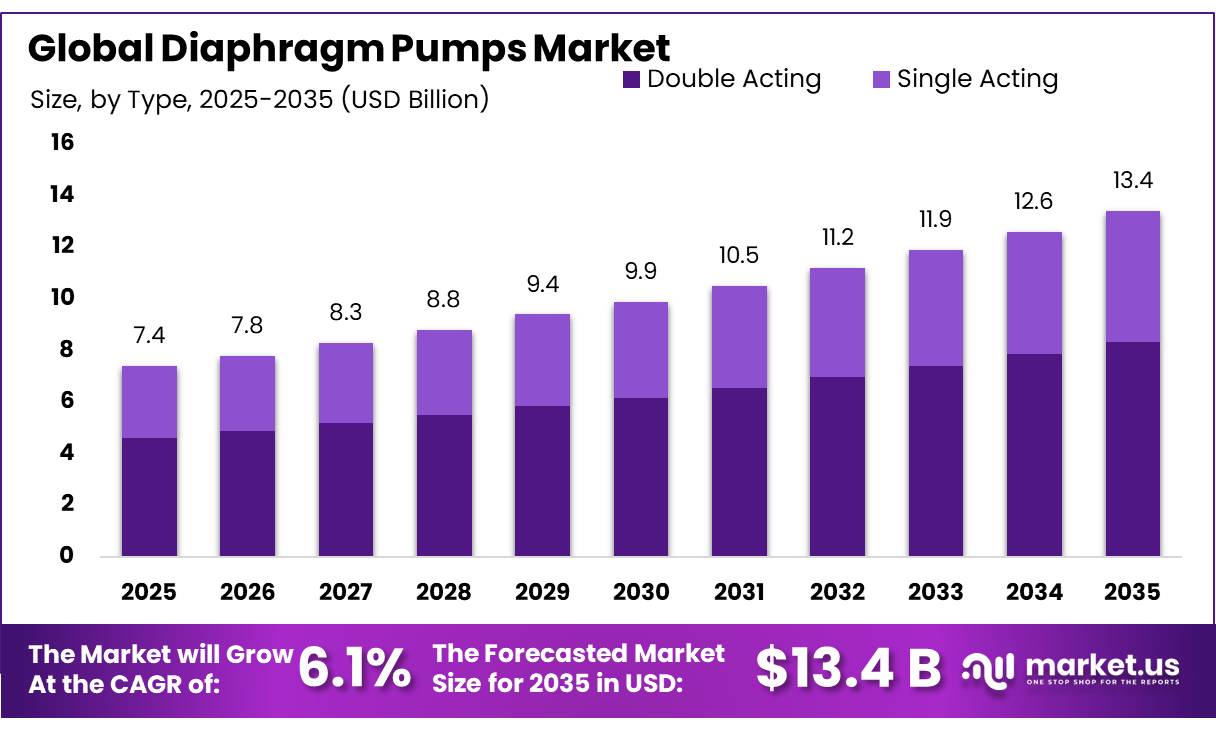
The Global Diaphragm Pumps Market size is expected to be worth around USD 13.4 Billion by 2035, from USD 7.4 Billion in 2025, growing at a CAGR of 6.1% during the forecast period from 2026 to 2035. In 2025, Asia-Pacific held a dominant market position, capturing more than a 40.23% share, holding USD 2.9 Billion revenue.
Diaphragm pumps are positive-displacement pumps designed to move chemicals, wastewater, slurries, acids, solvents, viscous fluids, and liquids containing suspended solids. Their operating design separates the pumped fluid from major mechanical components through a flexible diaphragm, reducing leakage risk and allowing safer handling of aggressive or sensitive materials.
- According to Cefic’s 2025 Facts & Figures, the European chemical industry generated €635 billion in turnover and directly employed about 1.2 million people. Around 31,000 companies operate across the European chemical sector, creating a large installed base for pumps used in chemical production and material handling. Europe still represents around 13% of the global chemical market, while the industry’s energy efficiency has improved by approximately 40% since 1990.
Water and wastewater infrastructure is another major demand area. The U.S. Bipartisan Infrastructure Law provides more than US$50 billion for drinking-water and wastewater systems, including more than US$868 million for tribal drinking-water and wastewater infrastructure during fiscal years 2022–2026. Separately, the U.S. government’s FY2025 budget proposed US$2.4 billion for Drinking Water and Clean Water State Revolving Funds.
Environmental regulation is also increasing the technical requirements placed on fluid-handling systems. The revised EU Urban Wastewater Treatment Directive introduces tighter nutrient-removal requirements and additional treatment for micropollutants. It also requires integrated wastewater-management plans for agglomerations above 100,000 population equivalent, while certain requirements also extend to systems above 10,000 population equivalent.
Future opportunities are expected to come from smart diaphragm pumps equipped with electronic monitoring, leak detection, automated flow adjustment and predictive-maintenance functions. Growth potential is also emerging from PFAS treatment, chemical recycling, battery materials, specialty chemicals and water reuse. U.S. infrastructure programs have allocated nearly US$1 billion toward PFAS testing and treatment, as part of a broader US$9 billion investment addressing PFAS and other emerging contaminants.
Key Takeaways
- Diaphragm Pumps Market size is expected to be worth around USD 13.4 Billion by 2035, from USD 7.4 Billion in 2025, growing at a CAGR of 6.1%.
- Double Acting held a dominant market position, capturing more than a 62.13% share.
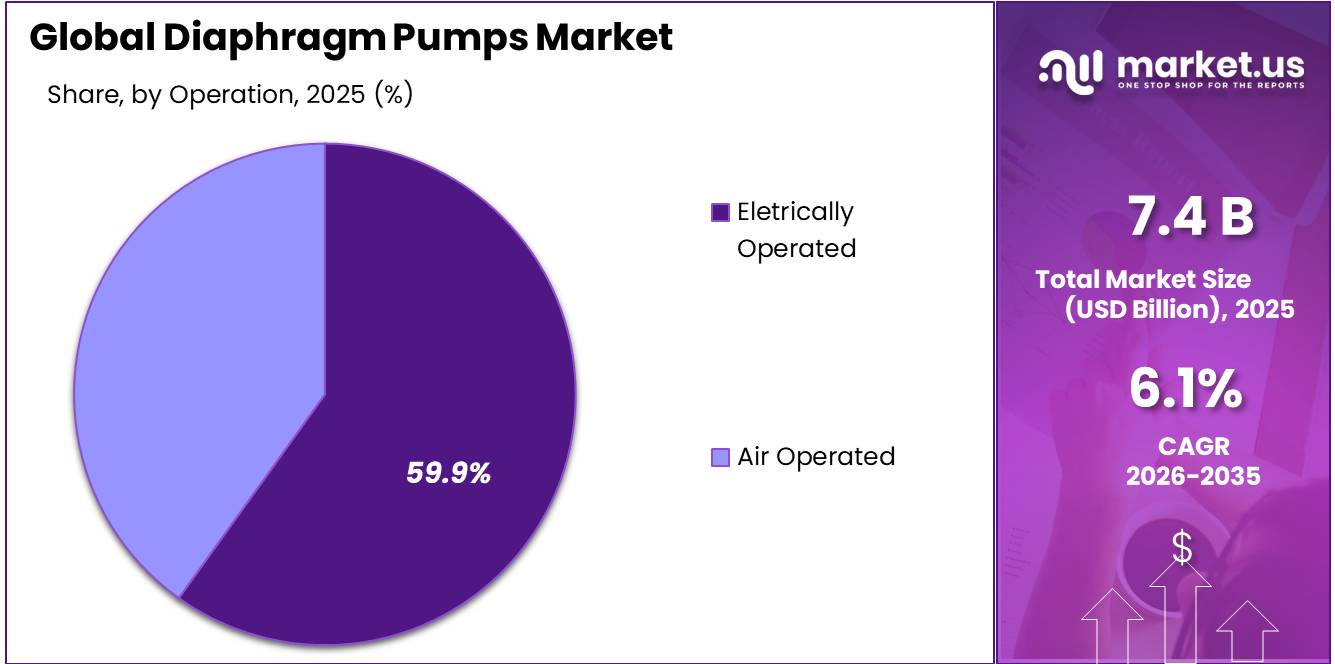
- Eletrically Operated held a dominant market position, capturing more than a 59.90% share.
- 80 to 200 Bar held a dominant market position, capturing more than a 58.29% share.
- Chemical and Petrochemical held a dominant market position, capturing more than a 22.60% share.
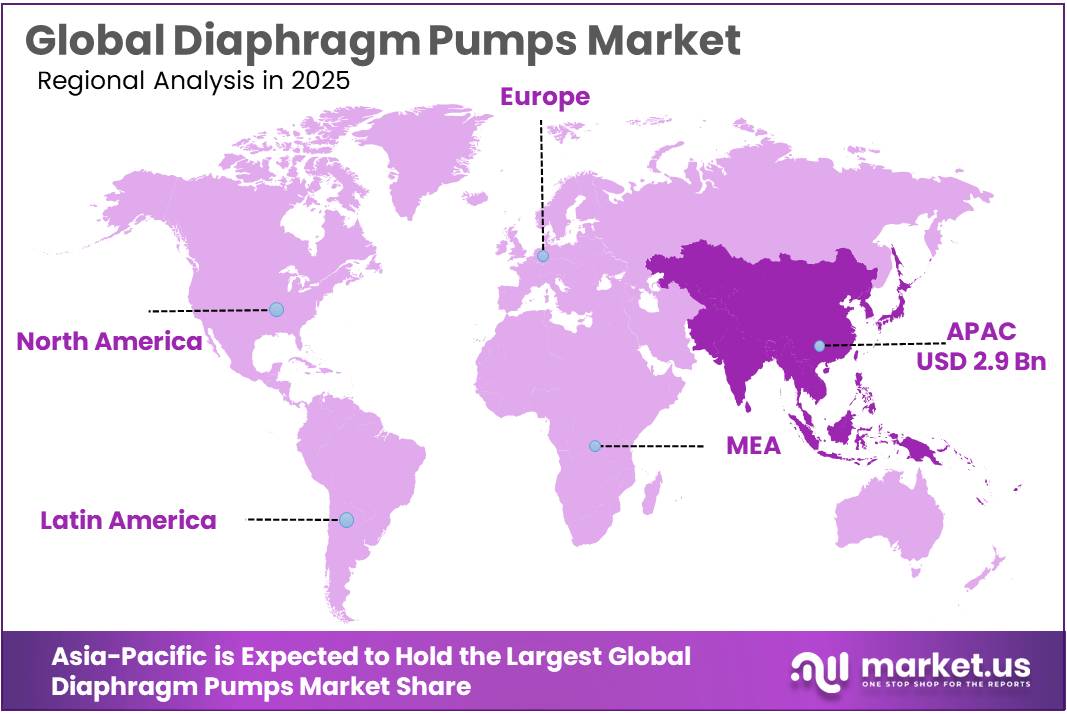
- Asia-Pacific held a dominant position in the Diaphragm Pumps Market, capturing more than a 40.23% share and generating around USD 2.9 billion.
By Type Analysis
Double Acting Pumps Lead with 62.13% Share, Supported by Reliable Handling of Chemicals, Slurries and Wastewater
In 2025, “Double Acting” held a dominant market position, capturing more than a 62.13% share in the Diaphragm Pumps Market by type. Double-acting designs are widely preferred in chemical processing, wastewater treatment, coatings, mining and other fluid-transfer operations because their two diaphragms work alternately, allowing suction and discharge to take place within the same operating cycle.
- The strength of major end-use industries provides further support for this segment. Cefic reported in its 2025 Facts & Figures that the European chemical industry generated €635 billion in turnover, employed 1.2 million people, and included around 31,000 companies, demonstrating the large industrial base requiring reliable chemical-transfer and process-pumping systems.
Demand is also being supported by continued wastewater-infrastructure investment. In November 2025, the U.S. Environmental Protection Agency announced US$6.5 billion in available Water Infrastructure Finance and Innovation Act funding, together with another US$550 million for states, supporting water-system modernization where chemical dosing, sludge handling and fluid transfer are important operations.
Single Acting diaphragm pumps continued to maintain an important position in 2025, particularly in applications requiring controlled fluid delivery, compact equipment design and intermittent pumping. In this design, pressure acts primarily during one working stroke, making the pump suitable for metering, sampling, laboratory systems, chemical injection and other lower-flow processes where precise fluid movement can be more important than continuous high-volume transfer.
By Operation Analysis
Electrically Operated Diaphragm Pumps Lead with 59.90% Share, Supported by Energy-Efficient and Automated Fluid Handling
In 2025, “Eletrically Operated” held a dominant market position, capturing more than a 59.90% share in the Diaphragm Pumps Market by operation. Electrically operated diaphragm pumps are widely used where plants require accurate flow control, continuous operation, lower compressed-air dependence, and easier integration with automated production systems.
The U.S. Department of Energy states that electric motors used for equipment such as pumps, compressors, conveyors, and mixers account for about 54% of electricity consumption in the U.S. manufacturing sector, showing the importance of electrically driven equipment in industrial operations.
- Demand is also supported by continued investment in water and wastewater infrastructure. According to the U.S. EPA’s 2025 WIFIA Annual Report, approximately US$900 million in WIFIA loans were closed during 2025, supporting around US$1.8 billion in water infrastructure projects. The program also received financing requests exceeding US$6 billion for projects representing about US$13 billion in total infrastructure investment.
Air Operated diaphragm pumps remained an important operating category in 2025, particularly in chemical plants, mining facilities, wastewater systems, paint and coatings production, and other applications where abrasive, corrosive, viscous, or solids-containing fluids must be handled safely. These pumps use compressed air rather than an electric motor and are valued for their simple design, dry-running ability, variable flow, and suitability for areas where direct electrical equipment may be less desirable.
By Pressure Analysis
80 to 200 Bar Diaphragm Pumps Dominate with 58.29% Share as High-Pressure Process Applications Expand
In 2025, “80 to 200 Bar” held a dominant market position, capturing more than a 58.29% share in the Diaphragm Pumps Market by pressure. This pressure range is widely suited to demanding chemical dosing, water treatment, filtration, process-fluid injection and industrial transfer applications where stable pressure and accurate flow are important. In 2025, Cefic reported that the European chemical industry generated €635 billion in turnover, directly employed 1.2 million people, and included around 31,000 companies.
- Water infrastructure is another important demand area for medium- and high-pressure diaphragm pumps. The U.S. EPA reported that US$900 million in WIFIA loans were closed in 2025, supporting approximately US$1.8 billion in water infrastructure projects. During the same year, project applicants requested more than US$6 billion in WIFIA financing for infrastructure representing around US$13 billion in total investment.
Upto 80 Bar diaphragm pumps continued to hold an important position in 2025, particularly for chemical transfer, metering, wastewater treatment, coatings, food processing and general industrial applications that do not require very high discharge pressure. These pumps can provide controlled fluid handling while maintaining simple installation and operating flexibility.
By End User Analysis
Chemical and Petrochemical End Users Lead with 22.60% Share as Process Plants Require Reliable Chemical Transfer
In 2025, “Chemical and Petrochemical” held a dominant market position, capturing more than a 22.60% share in the Diaphragm Pumps Market by end user. The segment benefits from the regular movement of acids, solvents, polymers, additives, resins, and other aggressive fluids across chemical production facilities. Cefic’s 2025 Facts & Figures reported that the European chemical industry generated €635 billion in turnover and directly employed 1.2 million people, showing the scale of industrial activity requiring reliable fluid-handling equipment.
- The same 2025 industry assessment showed that Europe had around 31,000 chemical companies, while 97% were small and medium-sized enterprises. Cefic also reported that the chemical sector contributed around 7% of EU manufacturing added value. These figures indicate a broad installed manufacturing base where diaphragm pumps are used for chemical dosing, drum unloading, reactor feeding, filtration, and hazardous-fluid transfer.
Water and Wastewater remained an important end-user segment in 2025, supported by rising investment in treatment plants, drinking-water systems, sludge handling, chemical dosing, and wastewater reuse infrastructure. Diaphragm pumps are suited to these applications because they can handle treatment chemicals, contaminated liquids, sludge, and fluids containing suspended solids while maintaining controlled flow.
Government investment continues to strengthen this application base. According to the U.S. Environmental Protection Agency’s 2025 WIFIA Annual Report, the program had closed 147 loans by December 2025, supporting US$49 billion in total water infrastructure investment. Total WIFIA financing reached US$22 billion, while US$12 billion had already been disbursed to borrowers for eligible project costs.
Key Market Segments
By Type
- Single Acting
- Double Acting
By Operation
- Eletrically Operated
- Air Operated
By Pressure
- Upto 80 Bar
- 80 to 200 Bar
- Above 200 Bar
By End User
- Water and Wastewater
- Oil and Gas
- Chemical and Petrochemical
- Pharmaceutical and Biotechnology
- Food and Beverage
- Mining and Metals
- Pulp and Paper
- Other Key Players
Driver Analysis
PFAS remediation dosing demand
The EPA’s 2024 PFAS drinking-water rule is a direct growth driver because it converts contamination concern into enforceable monitoring and treatment deadlines, forcing utilities and industrial water operators to add precision chemical dosing, transfer, recirculation, and waste-handling equipment around granular activated carbon, ion exchange, nanofiltration, and reverse osmosis skids. EPA set enforceable MCLs at 4 ppt for PFOA and PFOS, 10 ppt for PFHxS, PFNA, and HFPO-DA, and a hazard-index requirement for specified mixtures; systems have until 2027 for initial monitoring and until 2029 to implement treatment when exceedances occur, while EPA estimates that roughly 6% to 10% of the 66,000 public drinking-water systems subject to the rule may need action.
That implies roughly 4,000 to 6,600 systems entering assessment, pilot, retrofit, or full treatment phases, and even if only 35% to 45% of those procure 2 to 8 diaphragm metering or air-operated diaphragm units for coagulants, pH control, antiscalants, backwash chemicals, spent-media handling, or concentrate management, the addressable equipment pull-through is material. In practical unit-economics terms, a mid-sized PFAS treatment train can require USD 20,000 to 150,000 of diaphragm-pump content across duty, standby, and chemical-isolated feed loops, while smart dosing packages with sensors and controllers can raise supplier gross margin by 300 to 800 basis points over bare pump sales.
This driver also changes business models by shifting procurement from one-off pump replacement to spec-driven packaged systems with validation, leak detection, elastomer compatibility, and multi-year maintenance kits; that increases aftermarket attachment, raises spare-parts revenue to 15% to 25% of initial equipment value over five years, and compresses customer switching because compliance risk now outweighs lowest-price purchasing.
Drivers Impact Analysis
| Driver | (~) % Impact on CAGR Forecast | Geographic Relevance | Impact Timeline |
|---|---|---|---|
| PFAS remediation dosing demand | +2.1% | North America core, EU, developed APAC | Short term (≤ 2 years) |
| Wastewater quaternary treatment rollout | +1.8% | EU, UK spill-over, advanced APAC | Medium term (2-4 years) |
| Process automation smart retrofits | +1.5% | North America, EU, China, GCC | Medium term (2-4 years) |
| Hygienic chemical-transfer upgrades | +1.3% | Pharma hubs, food processing, biotech corridors | Short term (≤ 2 years) |
| Hydrogen and clean-energy balance-of-plant | +1.1% | EU, U.S., China, Middle East | Long term (≥ 4 years) |
| Aftermarket elastomer replacement cycle | +0.9% | Global installed base | Short term (≤ 2 years) |
Restraint Analysis
Elastomer Regulatory Uncertainty
Elastomer regulatory uncertainty is a material restraint because diaphragm-pump reliability depends on wetted diaphragms, seats, balls, gaskets, linings, hoses, and seals made from PTFE, FKM, EPDM, NBR, polyurethane, and other engineered polymers, yet evolving PFAS restrictions can raise qualification cost, limit material choice, complicate inventory planning, and delay customer approvals in high-chemical-resistance applications. The EU’s broad PFAS restriction dossier, submitted to ECHA in March 2023, remains under scientific assessment, and the European Commission states that the proposal seeks a broad restriction rather than a substance-by-substance approach; the Industrial Emissions Directive will additionally require reporting of PFOA, PFHxS, and their salts from 2028.
In the most exposed pump segments—solvents, acids, surfactants, pharmaceuticals, coatings, semiconductor chemicals, PFAS-treatment systems, and aggressive wastewater chemicals—PTFE and FKM components can represent 8–20% of the bill of materials but account for 40–70% of the chemical-compatibility value proposition, so replacing them with alternative fluorine-free compounds can require 6–18 months of material trials, 500–5,000 operating-hour validation, and USD 50,000–500,000 of engineering, testing, documentation, and customer qualification per product family.
If a supplier carries 50–200 wetted-material configurations, even a 20% redesign rate can absorb USD 1–10 million in R&D and inventory write-downs before the new portfolio generates revenue, while dual-sourcing interim materials can add 5–15% to unit cost and increase stock-keeping units by 20–40%. This restraint is estimated to deduct -1.5 percentage points from attainable CAGR in EU-regulated and export-led pump markets during 2026–2030.
Restraint Impact Analysis
| Restraint | (~) % Impact on CAGR Forecast | Geographic Relevance | Impact Timeline |
|---|---|---|---|
| Elastomer regulatory uncertainty | -1.5% | EU, UK, North America, global exporters | Medium term (2-4 years) |
| Low-cost import price pressure | -1.4% | North America, EU, India, ASEAN | Short term (≤ 2 years) |
| Process-project CapEx delays | -1.2% | EU, North America, China, GCC | Medium term (2-4 years) |
| Metal and polymer inflation | -1.1% | Global manufacturing hubs | Short term (≤ 2 years) |
| Compliance redesign burden | -0.9% | EU regulatory hubs, global OEMs | Short term (≤ 2 years) |
| Application-fit substitution risk | -0.8% | Mature industrial markets worldwide | Long term (≥ 4 years) |
Opportunity Analysis
PFAS Treatment Skids
EPA’s PFAS drinking-water rule requires initial monitoring by 2027 and compliance action by 2029 for systems exceeding enforceable limits, including 4 ppt for PFOA and PFOS and 10 ppt for PFHxS, PFNA, and HFPO-DA; EPA stated in 2026 that utilities may need to diagnose contamination, evaluate options, run pilots, finance, construct, test, and operate new control systems, creating a multi-year project pipeline rather than a one-time pump replacement cycle.
A municipal or industrial treatment installation can require 4–16 diaphragm-pump positions across pH adjustment, antiscalant, coagulant, regeneration chemistry, backwash, spent-media slurry, brine, and neutralization duties, generating an analyst-modelled USD 40,000–250,000 equipment-and-controls package per site versus USD 3,000–20,000 from isolated pump sales; a vendor capturing 250 projects annually at USD 100,000 average system value creates USD 25 million of annual revenue before spares.
Bundling can lift gross margin from 25–35% on distribution-led pump sales to 35–45% on engineered skids, add USD 5,000–30,000 annually in calibration, diaphragm, sensor, and remote-service revenue per installation, and reduce customer acquisition cost by 20–40% when engineering firms specify a validated package. This strategic pivot could add approximately +2.2 percentage points to market CAGR in North America, Canada, EU water utilities, and developed APAC treatment markets within two years.
Opportunity Impact Analysis
| Opportunity | (~) % Potential CAGR Upside | Geographic Relevance | Execution Window |
|---|---|---|---|
| PFAS treatment skids | +2.2% | U.S., Canada, EU, developed APAC | Short term (≤ 2 years) |
| Quaternary wastewater packages | +1.9% | EU, UK, advanced APAC | Medium term (2–4 years) |
| Pump-as-a-service contracts | +1.6% | North America, EU, GCC, Australia | Medium term (2–4 years) |
| Smart dosing software | +1.4% | North America, EU, China, Japan | Short term (≤ 2 years) |
| Hydrogen balance-of-plant | +1.2% | EU, U.S., China, Middle East | Long term (≥ 4 years) |
| Distributor roll-up platforms | +1.0% | North America, EU, India, ASEAN | Long term (≥ 4 years) |
Challenges Analysis
Fluoropolymer Qualification Transition
CHA’s proposed broad PFAS restriction has progressed through Risk Assessment Committee and Socio-Economic Analysis Committee review, with the proposal covering manufacture, placing on the market, and all uses of PFAS; its eventual scope, derogations, and transition periods remain uncertain, forcing manufacturers to invest before final requirements are known.
A single new diaphragm compound typically needs 1,000–5,000 hours of cyclic fatigue testing, 20–100 chemical-immersion tests, permeation analysis, temperature-pressure cycling, and third-party documentation; qualifying 10 materials across 20 pump platforms and 15 critical chemical families can require USD 2–8 million, 24–60 months, and 50–150 separate customer approvals. Field failure risk remains asymmetric: a diaphragm that achieves 20 million cycles in water may fail below 3 million cycles in solvent, caustic, abrasive, or oxidizing service, and one rupture can contaminate a batch worth USD 25,000–500,000, trigger unplanned plant downtime of 8–48 hours, and undermine replacement-material adoption.
The required mitigation is a portfolio of fluorine-free elastomer research, dual-material designs, accelerated chemical compatibility databases, digital batch traceability, strategic inventory of validated legacy materials, and customer co-testing agreements; however, different customers may require 6–18 months of plant-level qualification before accepting a substitute. This ongoing materials-engineering burden is estimated to impose a -1.4-percentage-point CAGR friction across EU, UK, North America, and export-dependent OEMs over four or more years.
Challenges Impact Analysis
| Challenge | (~) % CAGR Friction Drag | Geographic Relevance | Mitigation Horizon |
|---|---|---|---|
| Fluoropolymer qualification transition | -1.4 pp | EU, UK, North America, export OEMs | Long term (≥ 4 years) |
| Application-engineering talent gap | -1.2 pp | North America, EU, China, GCC, Australia | Long term (≥ 4 years) |
| Multi-source component volatility | -1.1 pp | Global manufacturing hubs | Medium term (2–4 years) |
| Smart-pump data integration | -1.0 pp | North America, EU, Japan, Korea, China | Medium term (2–4 years) |
| Compliance evidence fragmentation | -0.9 pp | EU, UK, North America, global exporters | Medium term (2–4 years) |
| Field-service response coverage | -0.8 pp | Mining, water, chemicals, remote regions | Long term (≥ 4 years) |
Geopolitical Impact Analysis
Middle East and Russia–Ukraine Conflicts Increase Supply and Operating Pressure on Diaphragm Pump Manufacturers
The ongoing Middle East conflict and the Russia–Ukraine war continue to influence the Diaphragm Pumps Market through higher energy costs, shipping disruption, raw-material uncertainty, and longer equipment delivery schedules. Diaphragm pumps depend on materials such as stainless steel, aluminium, engineering plastics, elastomers, and specialized components, making manufacturers sensitive to changes in industrial supply chains. During 2026, disruption around the Strait of Hormuz increased pressure on energy and freight markets.
UN Trade and Development reported that the Strait carries around one-quarter of global seaborne oil trade, while Brent crude moved above US$90 per barrel during the disruption. The U.S. Energy Information Administration also reported that Brent crude reached US$118 per barrel in April 2026 before falling to US$72 per barrel in June. (EIA) At the same time, sanctions and trade restrictions connected with the Russia–Ukraine war continue to reshape European energy and industrial sourcing. T
These conditions can increase production and transportation costs for pump suppliers, while also creating demand from water treatment, chemical processing, energy infrastructure, and emergency fluid-handling projects requiring durable diaphragm pumping systems.
Regional Insights
Asia-Pacific Leads the Diaphragm Pumps Market with 40.23% Share and USD 2.9 Billion Value
In 2025, Asia-Pacific held a dominant position in the Diaphragm Pumps Market, capturing more than a 40.23% share and generating around USD 2.9 billion in market value. Regional demand is supported by large chemical, manufacturing, water-treatment, mining, electronics, and process-industry operations that require safe handling of corrosive, abrasive, and high-viscosity fluids.
According to UNIDO’s International Yearbook of Industrial Statistics 2025, Asia and Oceania generated 57.2% of global manufacturing value added in 2024 and accounted for 47.2% of worldwide manufactured exports. Chemicals, machinery, electronics, and transport equipment form an important part of this manufacturing base.
Asia-Pacific’s strong position is also supported by growing investment in water and wastewater infrastructure. The Asian Development Bank’s Asian Water Development Outlook 2025 reported that 2.7 billion people across Asia and the Pacific had moved out of extreme water insecurity since 2013. However, the region still requires around USD 4 trillion in water, sanitation, and hygiene investment through 2040, while current spending covers less than 40% of the requirement.
Key Regions and Countries Insights
- North America
- US
- Canada
- Europe
- Germany
- France
- The UK
- Spain
- Italy
- Rest of Europe
- Asia Pacific
- China
- Japan
- South Korea
- India
- Australia
- Rest of APAC
- Latin America
- Brazil
- Mexico
- Rest of Latin America
- Middle East & Africa
- GCC
- South Africa
- Rest of MEA
Key Players Analysis
Flowserve Corporation holds a strong position in industrial pumping through its broad portfolio serving chemicals, petrochemicals, energy, water, and general industries. In 2025, its Flowserve Pumps Division generated US$3.24 billion in sales, with bookings of US$3.27 billion. Segment operating income reached US$600.9 million, while operating margin improved to 18.6%. These figures underline Flowserve’s scale in engineered pumping systems and support its competitive presence in diaphragm and other process-pump applications. Flowserve
Graco Inc. is an important fluid-handling equipment supplier with products used for transferring, dispensing, spraying, and controlling industrial fluids. In 2025, the company recorded net sales of US$2.24 billion, increasing 6% year over year. Operating earnings reached US$624.8 million, while net earnings stood at US$521.8 million. Graco also generated US$684 million in operating cash flow and invested nearly US$50 million in capital expenditure, supporting product development and manufacturing capacity.
Xylem Inc. maintains a major presence in water and fluid-management technologies, including pumps used across municipal, commercial, and industrial applications. In 2025, Xylem generated US$9.04 billion in revenue, representing 5.5% annual growth. Operating income reached US$1.22 billion, while net income totaled US$957 million. The company generated US$1.24 billion in operating cash flow and invested more than US$226 million in research and development, supporting continued innovation across water-moving and treatment technologies.
Top Key Players Outlook
- Flowserve Corporation
- Graco Inc.
- Xylem Inc.
- SPX FLOW Inc.
- Grundfos A/S
- Verder Group
- Tapflo Group
- LEWA GmbH
- Yamada Corporation
- KNF Neuberger
- Atlas Copco
- Other Key Players
Recent Developments
- In March 2026, when ITT completed the acquisition of SPX FLOW for US$4.775 billion, combining its fluid-handling, mixing, separation and process technologies under ITT Flow Technologies.
- By 2026, Grundfos also expanded dosing-skid production at its Fresno facility, which employs 265 people, improving local supply for water-treatment and chemical-dosing systems. Grundfos reported €4.7 billion in 2025 revenue, 5.7% sales growth, and €492 million in EBIT before special items, showing a strong financial base for continued pump innovation and expansion.
Report Scope
| Report Features | Description |
|---|---|
| Market Value (2025) | USD 7.4 Bn |
| Forecast Revenue (2035) | USD 13.4 Bn |
| CAGR (2026-2035) | 6.1% |
| Base Year for Estimation | 2025 |
| Historic Period | 2020-2024 |
| Forecast Period | 2026-2035 |
| Report Coverage | Revenue Forecast, Market Dynamics, Competitive Landscape, Recent Developments |
| Segments Covered | By Type (Single Acting, Double Acting), By Operation (Eletrically Operated, Air Operated), By Pressure (Upto 80 Bar, 80 to 200 Bar, Above 200 Bar), By End User (Water and Wastewater, Oil and Gas, Chemical and Petrochemical, Pharmaceutical and Biotechnology, Food and Beverage, Mining and Metals, Pulp and Paper, Other Key Players) |
| Regional Analysis | North America – US, Canada; Europe – Germany, France, The UK, Spain, Italy, Rest of Europe; Asia Pacific – China, Japan, South Korea, India, Australia, Singapore, Rest of APAC; Latin America – Brazil, Mexico, Rest of Latin America; Middle East & Africa – GCC, South Africa, Rest of MEA |
| Competitive Landscape | Flowserve Corporation, Graco Inc., Xylem Inc., SPX FLOW Inc., Grundfos A/S, Verder Group, Tapflo Group, LEWA GmbH, Yamada Corporation, KNF Neuberger, Atlas Copco , Other Key Players |
| Customization Scope | Customization for segments, region/country-level will be provided. Moreover, additional customization can be done based on the requirements. |
| Purchase Options | We have three licenses to opt for: Single User License, Multi-User License (Up to 5 Users), Corporate Use License (Unlimited User and Printable PDF) |





































