Report Overview
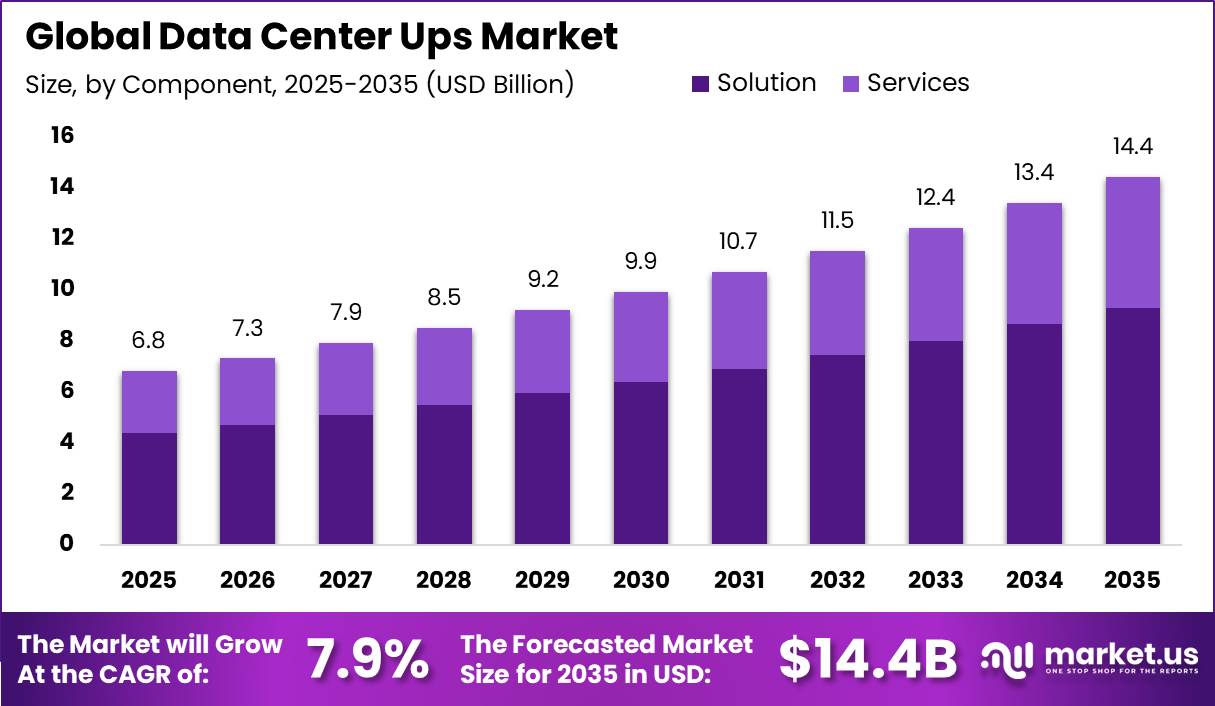
In 2025, the Global Data Center UPS Market was valued at USD 6.8 billion. The market is projected to grow at a CAGR of 7.9% during 2026–2035, reaching approximately USD 14.4 billion by 2035. North America dominated the global market in 2025, accounting for more than 37.1% of the total market share and generating approximately USD 2.5 billion in revenue.
This growth is closely linked to the rapid increase in electricity consumption across global data centers. According to the IEA, data center electricity use increased by 17% in 2025, while power demand from AI-focused facilities rose by 50%. Global data center electricity consumption is expected to increase from 485 TWh in 2025 to nearly 950 TWh by 2030.
In the United States, data centers consumed around 176 TWh of electricity in 2023, compared with 58 TWh in 2014, and consumption could reach 580 TWh by 2028 as AI workloads expand. The United States, China, and Europe are expected to contribute nearly 80% of global data center electricity growth through 2030, with the U.S. adding around 240 TWh compared with 2024 levels.
In addition, Meta, Amazon, Alphabet, and Microsoft planned around USD 320 billion in data center and AI infrastructure spending in 2025, compared with USD 230 billion a year earlier, further supporting UPS demand.
Key Takeaway
- The Data Center UPS Market is valued at USD 6.8 billion in 2025, projected to reach USD 14.4 billion by 2035 at a CAGR of 7.9%.
- The Solution segment holds a leading 64.5% share by component.
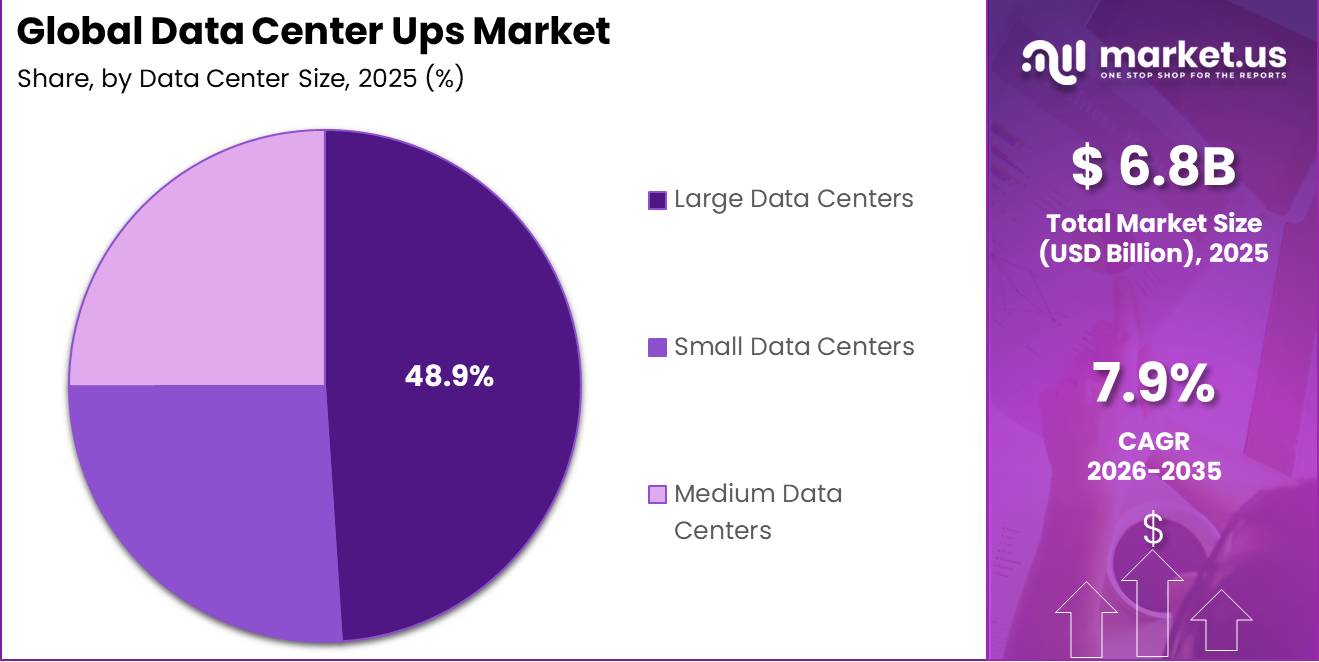
- Large Data Centers account for a leading 48.9% share by data center size.
- IT and Telecommunications leads by industry vertical with a 26.4% share.
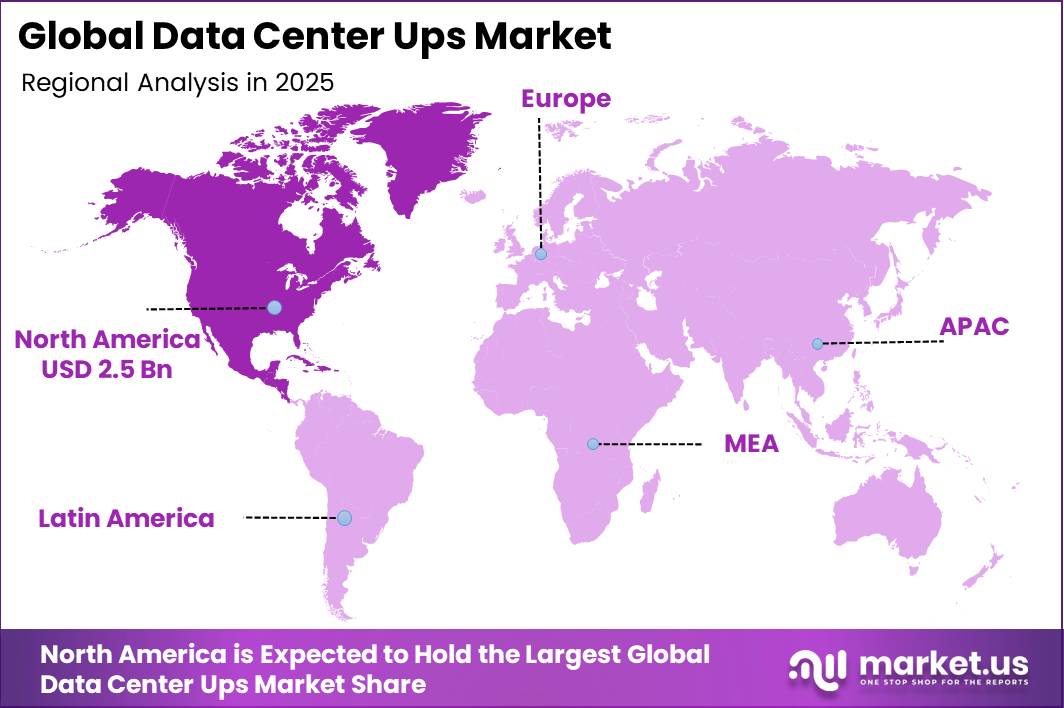
- North America led the market in 2025 with a 37.1% share and approximately USD 2.5 billion in revenue.
By Component
The Solution segment holds a leading 64.5% share of the Data Center UPS Market, supported by the rapid expansion of global data center infrastructure. Global data center IT load capacity is expected to increase from around 100 GW in 2024 to approximately 220 GW by 2030. This growing capacity requires large investments in UPS hardware, batteries, and control systems, as every new server rack needs reliable backup power to avoid unexpected shutdowns.
The IEA also estimates that data centers worldwide could install around 20–25 GW of battery storage by 2030 to improve power stability and support continuous operations. This trend is creating direct demand for solution-based UPS equipment. Unlike software and maintenance services, UPS hardware is generally purchased during the construction or expansion of a data center, making it an essential part of infrastructure spending.
By Data Center Size
Large Data Centers account for a leading 48.9% share of the Data Center UPS Market, mainly because hyperscale facilities require much higher power capacity than traditional enterprise sites. Large hyperscale campuses can demand between 100 MW and more than 1 GW of power, compared with only 1–5 MW for many enterprise data centers.
In late 2025, Synergy Research identified around 1,297 operational hyperscale facilities worldwide, representing nearly 44% of global data center capacity. Hyperscale-owned infrastructure is also expected to expand by at least 20% annually through 2030.
The growing use of AI servers is further increasing UPS requirements. AI-focused racks can consume around 40–100+ kW, compared with approximately 5–15 kW for traditional racks. Large campuses often contain tens of thousands of these high-density racks, creating significant demand for reliable backup power.
By Industry Vertical
The IT and Telecommunications segment leads the Data Center UPS Market with a 26.4% share, supported by the continuous growth of global internet, mobile, and broadband traffic. According to the International Telecommunication Union, global fixed broadband traffic reached 7.3 zettabytes in 2025, compared with 6.2 zettabytes a year earlier. Mobile broadband traffic also reached around 1.5 zettabytes, supported by average annual growth of 19% since 2021.
Around 6 billion people worldwide now use the internet, up from 5.8 billion in 2024, while approximately 9.2 billion mobile-cellular subscriptions are active globally. This large connected population generates continuous volumes of voice, video, cloud, and digital data that must be processed and stored in data centers.
Key Market Segments
By Component
- Solution
- Services
By Data Center Size
- Small Data Centers
- Medium Data Centers
- Large Data Centers
By Industry Vertical
- IT and Telecommunications
- BFSI
- Retail
- Manufacturing
- Healthcare
- Government
- Other
Geopolitical Impact Analysis
Rising US-China trade tensions are increasing cost pressure across the Data Center UPS Market, particularly because UPS systems depend heavily on lithium-ion and lead-acid batteries and other electronic components sourced from China. Under the USTR Section 301 measures, US tariffs on non-EV lithium-ion batteries imported from China increased from 7.5% to 25%, effective January 1, 2026.
When combined with a 3.4% baseline MFN duty and a 54% reciprocal tariff, the effective rate can reach approximately 82.4%, compared with about 11% before 2026. Natural graphite and permanent magnets, which are important inputs for batteries and power-control equipment, also face additional 25% Section 301 tariffs starting in 2026.
The WTO’s World Tariff Profiles 2026 further shows that more than 150 economies adjusted tariff schedules during the year, highlighting wider changes in global component trade.
These higher duties are forcing UPS manufacturers to either absorb additional costs or increase equipment prices. Battery pack landed costs in the US can effectively double compared with pre-2026 levels for Chinese-origin cells. Manufacturers are therefore expanding sourcing from South Korea, Japan, and Vietnam, where battery tariff rates are estimated at around 13.4% to 15.9%, compared with China’s blended rate of about 40.9%.
Regional Analysis
North America remains the dominant region in the Data Center UPS Market, accounting for a 37.1% share and generating around USD 2.5 billion in 2025. This position is supported by the large concentration of hyperscale and cloud data centers across the region. Data centers in the United States consumed about 176 TWh of electricity in 2023, highlighting the scale of power needed to support digital infrastructure.
For comparison, computing centers in China consumed nearly 170 billion kWh in 2025, showing how rising computing demand is increasing the need for reliable UPS systems. Europe also holds an important market position, supported by continued colocation expansion, grid reliability requirements, and growing investment in secure backup power infrastructure.
Asia Pacific is emerging as the fastest-growing region, supported by rapid data center construction. The region’s development pipeline increased by 7,103 MW in the first half of 2026, reaching approximately 26,455 MW. In India, installed data center capacity increased from 375 MW in 2020 to around 1,500 MW by 2025, while electricity demand from data centers is projected to reach 13.56 GW by 2031-32.
Malaysia and India together represented around 58% of the region’s new operational IT load in 2025. India’s capacity is also expected to rise to nearly 12 GW by 2030, compared with about 2.2 GW currently. These developments are strengthening UPS demand across Asia Pacific.
Key Regions and Countries
North America
- US
- Canada
Europe
- Germany
- France
- The UK
- Spain
- Italy
- Rest of Europe
Asia Pacific
- China
- Japan
- South Korea
- India
- Australia
- Rest of APAC
Latin America
- Brazil
- Mexico
- Rest of Latin America
Middle East & Africa
- GCC
- South Africa
- Rest of MEA
Market Dynamics
Drivers
| Driver | (~) % CAGR | Geographic Relevance | Impact Timeline |
|---|---|---|---|
| AI-driven hyperscale power density surge | +2.4% | North America, China | Short term (2 years or less) |
| Grid instability pushing on-site backup mandates | +1.3% | Global | Short term (2 years or less) |
| Hyperscaler capital expenditure acceleration | +1.1% | North America, Asia Pacific | Short term (2 years or less) |
| Colocation uptime SLA tightening | +0.6% | Europe, North America | Medium term (2 to 4 years) |
| Lithium-ion UPS battery replacement cycles | +0.5% | Global | Medium term (2 to 4 years) |
AI-driven hyperscale power density surge
Rising rack power density is a major growth driver for the Data Center UPS Market. Average rack loads have increased from around 10–15 kW to nearly 40–100 kW for AI training clusters. This shift is pushing hyperscale operators toward larger, modular UPS systems that can support higher power loads across multiple zones.
Higher redundancy requirements are also increasing UPS capacity per megawatt. 2N configurations can effectively double UPS capacity compared with traditional N+1 designs used before 2024. As a result, UPS spending per deployed megawatt is rising, while several suppliers have reported order backlogs increasing by more than 30% year over year, supported by growing AI and high-density computing requirements.
Restraints
| Restraint | (~) % CAGR | Geographic Relevance | Impact Timeline |
|---|---|---|---|
| Grid interconnection queue backlogs | -1.6% | North America | Short term (2 years or less) |
| Battery raw material tariff escalation | -1.0% | United States, China | Short term (2 years or less) |
| High interest rate CapEx deferral | -0.7% | Global | Short term (2 years or less) |
| Power transformer and switchgear shortages | -0.5% | Europe, North America | Medium term (2 to 4 years) |
Grid interconnection queue backlogs
Utility interconnection delays remain a major near-term restraint for the Data Center UPS Market. In several U.S. regions, large-load projects can face grid connection wait times of more than 3 to 5 years, compared with around 2 years before 2023. Since UPS procurement is usually linked to a confirmed facility energization date, delayed grid access can postpone equipment orders for planned hyperscale projects.
Tens of gigawatts of proposed data center capacity remain dependent on substation and transmission upgrades. For UPS suppliers, these delays can extend the order-to-revenue cycle by around 12 to 18 months for affected projects. This slows near-term revenue recognition even though long-term demand for backup power remains strong.
Challenges
| Challenge | (~) % CAGR | Geographic Relevance | Mitigation Horizon |
|---|---|---|---|
| Skilled electrical technician shortage | -0.9% | North America, Europe | Medium term (2 to 4 years) |
| Semiconductor and IGBT component lead times | -0.6% | Global | Medium term (2 to 4 years) |
| Fragmented regional efficiency standards | -0.4% | Asia Pacific, Europe | Long term (4 years or more) |
| Legacy facility retrofit complexity | -0.3% | North America, Europe | Long term (4 years or more) |
Skilled electrical technician shortage
A shortage of certified electrical and critical-infrastructure technicians remains a key challenge for the Data Center UPS Market. U.S. workforce projections indicate that electrician job openings could continue to exceed new worker availability through 2032, while rapid data center construction is increasing demand for technicians qualified to install and maintain redundant UPS systems.
This labor gap can slow project commissioning and maintenance activities, particularly in markets with limited skilled-worker availability. Installation timelines may increase by around 15% to 20% between 2026 and 2030 in tighter labor markets. To reduce this pressure, UPS suppliers are expanding in-house training and remote diagnostic capabilities, although these measures can increase operating costs by low single-digit percentages.
Opportunities
| Opportunity | (~) % CAGR | Geographic Relevance | Execution Window |
|---|---|---|---|
| UPS-as-a-Service subscription monetization | +1.7% | Global | Medium term (2 to 4 years) |
| Edge and micro data center white space | +1.2% | Asia Pacific, Africa | Medium term (2 to 4 years) |
| Second-life battery repurposing roll-ups | +0.8% | Europe, North America | Long term (4 years or more) |
| Integrated grid-services revenue sharing | +0.6% | North America, Europe | Long term (4 years or more) |
UPS-as-a-Service subscription monetization
This opportunity remains largely untapped because Data Center UPS revenue is still mainly based on one-time hardware sales. A shift toward subscription-based services covering uptime guarantees, predictive maintenance, and battery-health monitoring could create a new recurring revenue stream. Such service models can potentially deliver gross margins around 10 to 15 percentage points higher than traditional hardware sales.
If adopted at scale, this model could also reduce dependence on large capital expenditure cycles and improve revenue stability. Over a multi-year rollout, the shift could potentially increase blended operating margins by around 3% to 5%, while helping suppliers capture more value from maintenance, monitoring, and other lifecycle services.
Key Players Analysis
The Data Center UPS Market has a clear Tier-1 and Tier-2 competitive structure. Vertiv Group holds strong exposure to the UPS and data center infrastructure business, reporting FY2025 net sales of USD 10.2 billion, with organic sales growth of 26%. Orders increased 252%, while adjusted operating profit rose 35% to USD 2.09 billion, supported by strong AI data center demand.
Eaton Corporation generated FY2025 sales of USD 27.4 billion, while its Electrical Americas segment reached USD 13.2 billion. Data center revenue increased around 40%, Q4 2025 orders rose 200%, and backlog expanded 31% year over year. Schneider Electric recorded FY2025 group revenue of EUR 40.1 billion, supported by continued hyperscale demand for its Secure Power and UPS solutions.
ABB’s Electrification division generated USD 17.4 billion in 2025, increasing 11% like-for-like, with an operational EBITA margin of 23.5% and double-digit data center demand growth.
Tier-2 companies continue to compete through specialized products and strong regional networks. Delta Electronics reported Q1 2025 revenue of NT$108.3 billion, equivalent to USD 3.3 billion, increasing 28.4% year over year. Its power infrastructure and data center segment represented 41% of total revenue, compared with 33% a year earlier.
Top Key Players in the Market
- Schneider Electric SE
- Eaton Corporation plc
- Vertiv Group Corp.
- ABB Group
- Huawei Technologies Co., Ltd.
- Mitsubishi Electric Corporation
- Legrand Group
- Fuji Electric Co., Ltd.
- Delta Electronics, Inc.
Recent Developments
- In 2025, Eaton completed the acquisition of Fibrebond on April 1 for USD 1.4 billion. Fibrebond provides pre-integrated modular power enclosures for data centers and other critical infrastructure. The business generated approximately USD 378 million in revenue during the 12 months ended February 28, 2025, and Eaton estimated around USD 110 million in adjusted EBITDA for 2025.
- In 2025, Vertiv completed its acquisition of Great Lakes Data Racks & Cabinets on August 20 for approximately USD 200 million. The transaction expanded Vertiv’s rack, cabinet, and integrated infrastructure portfolio for high-density and AI data center environments. The originally announced purchase price represented approximately 11.5 times expected 2026 EBITDA, including expected synergies.
Report Scope
| Report Features | Description |
|---|---|
| Market Value (2025) | USD 6.8 Billion |
| Forecast Revenue (2035) | USD 14.4 Billion |
| CAGR (2026-2035) | 7.9% |
| Base Year for Estimation | 2025 |
| Historic Period | 2020-2024 |
| Forecast Period | 2026-2035 |
| Report Coverage | Revenue Forecast, Market Dynamics, Competitive Landscape, Recent Developments |
| Segments Covered | By Component – (Solution, Services); By Data Center Size – (Small Data Centers, Medium Data Centers, Large Data Centers); By Industry Vertical – (IT and Telecommunications, BFSI, Retail, Manufacturing, Healthcare, Government, Other) |
| Regional Analysis | North America – US, Canada; Europe – Germany, France, The UK, Spain, Italy, Rest of Europe; Asia Pacific – China, Japan, South Korea, India, Australia, Singapore, Rest of APAC; Latin America – Brazil, Mexico, Rest of Latin America; Middle East & Africa – GCC, South Africa, Rest of MEA |
| Competitive Landscape | Schneider Electric SE, Eaton Corporation plc, Vertiv Group Corp., ABB Group, Huawei Technologies Co., Ltd., Mitsubishi Electric Corporation, Legrand Group, Fuji Electric Co., Ltd., Delta Electronics, Inc. |
| Customization Scope | Customization for segments, region/country-level will be provided. Moreover, additional customization can be done based on the requirements. |
| Purchase Options | We have three licenses to opt for: Single User License, Multi-User License (Up to 5 Users), Corporate Use License (Unlimited Users and Printable PDF) |