


Report Overview
In 2024, the Global Custom Cloud Solutions Market was valued at USD 4.5 billion. The market is projected to grow at a CAGR of 4.5% during 2025–2034, reaching approximately USD 29.2 billion by 2034. North America dominated the global market in 2024, accounting for the largest market share and generating approximately USD 1.65 billion in revenue.
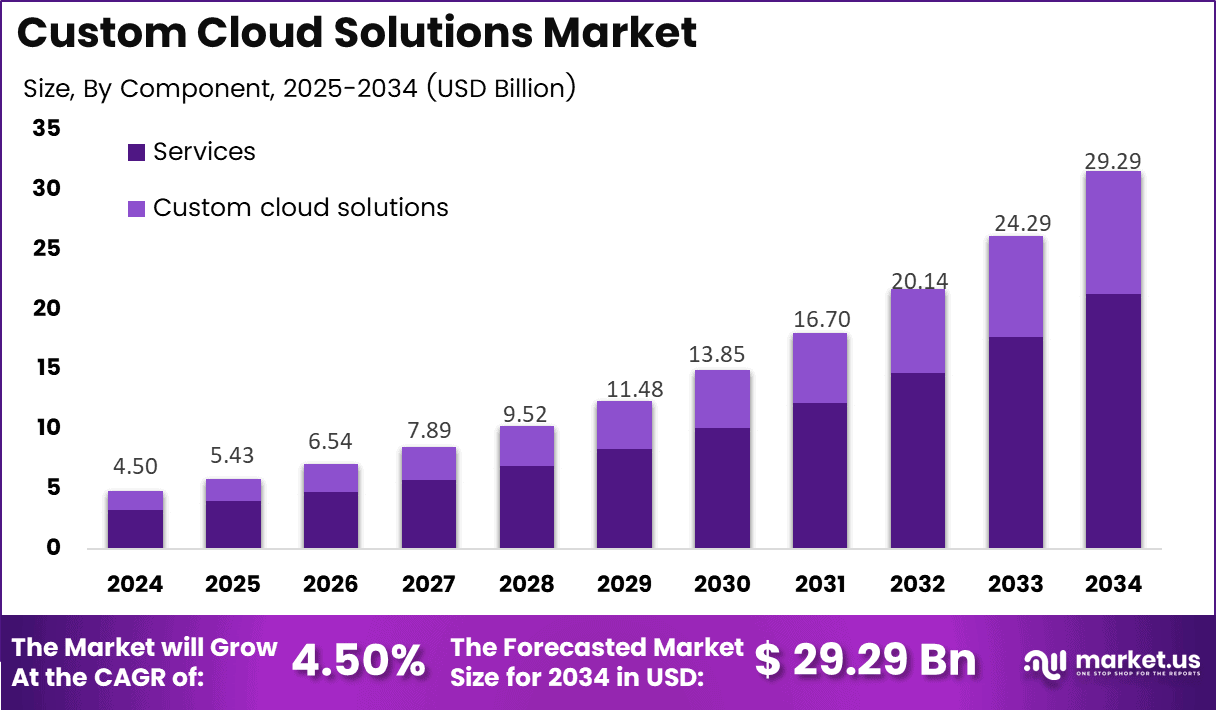
The higher growth case is supported by expanding cloud and AI adoption. In 2024, 59.0% of surveyed U.S. organizations used cloud-based technology, while 40.0% used cloud-based AI tools. This increases demand for custom cloud solutions that support secure data integration, tailored applications, workload migration, and governance.
The U.S. digital economy generated USD 2.41 trillion in value added in 2021, representing 10.3% of U.S. GDP. Cloud services also grew 21.8% during the same year, showing the increasing role of cloud infrastructure in supporting digital business activity.
North America led the market in 2024, supported by strong demand from data processing, hosting, software, finance, healthcare, retail, and public-sector organizations requiring customized cloud systems for security and scalability. U.S. business AI adoption increased from 3.7% in September 2023 to 5.4% by February 2024, with adoption expected to reach 6.6% by early fall 2024.
This trend is increasing demand for specialized data pipelines, high-performance computing, security controls, and digital transformation. Hosting-related services accounted for 52% of revenue among U.S. data-processing, hosting, and related-service firms, highlighting the strong role of cloud delivery within the regional technology ecosystem.
Key Takeaways
- The Global Custom Cloud Solutions Market was valued at USD 4.5 billion in 2024 and is projected to reach USD 29.2 billion by 2034, growing at a 4.5% CAGR during 2025–2034.
- By component, Custom Cloud Solutions led the market with a 72.8% share, driven by demand for tailored infrastructure and applications.
- By type, Infrastructure as a Service (IaaS) accounted for 45.7%, supported by scalable, on-demand computing and lower upfront hardware costs.
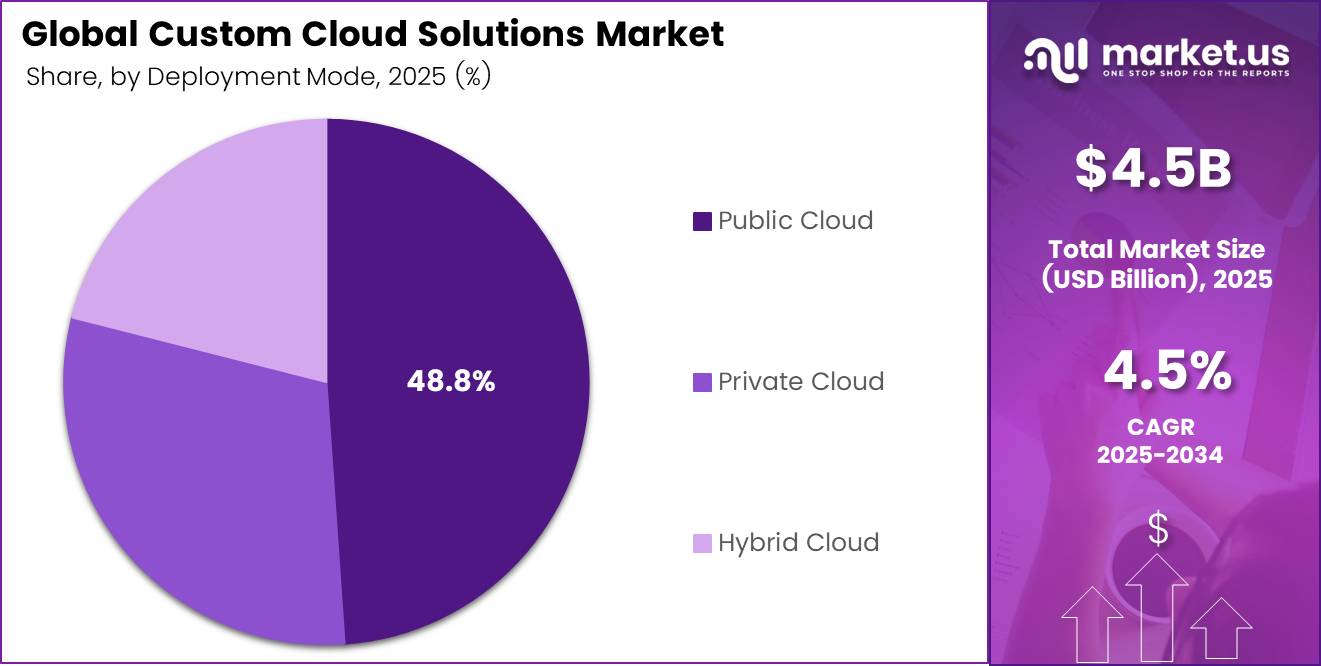
- By deployment model, Public Cloud held the largest share at 48.8%, benefiting from cost efficiency, scalability, and pay-as-you-go pricing.
- By organization size, Large Enterprises dominated with a 70.4% share, reflecting higher spending on secure and customized cloud environments.
- By industry vertical, BFSI led with a 34.8% share, supported by strong demand for secure data handling and regulatory compliance.
- North America dominated the market in 2024, generating approximately USD 1.65 billion in revenue.
By Component
The Custom Cloud Solutions segment dominates the market with a substantial 72.8% share, reflecting its critical role in delivering tailored cloud services that align with specific business needs. This segment’s strength lies in its ability to offer personalized infrastructure and applications, driving efficiency across industries.
Analysts predict a steady growth trajectory, with an expected 20% increase in adoption over the next two years as companies prioritize flexibility. Additionally, the segment is poised to see a 15% rise in investment by 2027, fueled by demand for scalable, bespoke solutions that enhance operational agility in a competitive landscape.
By Type
Infrastructure as a Service (IaaS) holds a significant 45.7% share, serving as the backbone for custom cloud deployments by providing scalable computing resources on demand. This type is especially popular among businesses seeking to avoid heavy upfront investments in hardware.
Looking ahead, experts forecast a 25% growth in IaaS usage by 2028, driven by its cost-effectiveness and ease of integration. Moreover, with 18% of organizations planning to expand IaaS adoption next year, it remains a key enabler for innovation and rapid deployment across diverse sectors.
By Deployment Model
The Public Cloud deployment model leads with a 48.8% share, offering accessible and cost-efficient solutions that appeal to a wide range of businesses. Its appeal lies in shared resources and pay-as-you-go pricing, making it ideal for organizations testing custom cloud waters.
Analysts anticipate a 22% increase in public cloud adoption by 2029, as companies leverage its scalability for data-heavy applications. Additionally, with 12% of SMEs expected to shift to public cloud models in the next year, this segment is set to bolster market growth and accessibility globally.
By Organization Size
Large Enterprises account for a commanding 70.4% of the market, reflecting their substantial investment in custom cloud solutions to support complex operations and data needs. These organizations benefit from tailored setups that enhance security and compliance across sprawling networks.
Predictions suggest a 30% rise in adoption among large firms by 2026, driven by digital transformation initiatives. Furthermore, with 20% of these enterprises planning to integrate advanced AI tools into their clouds next year, this segment is poised to lead innovation and set industry benchmarks for scalability and efficiency.
By Industry Vertical
The Banking, Financial Services, and Insurance (BFSI) sector claims a 34.8% share, highlighting its reliance on custom cloud solutions for secure data handling and regulatory compliance. This vertical’s growth is fueled by the need for robust, tailored platforms to manage sensitive transactions and customer data.
Analysts predict a 28% increase in BFSI cloud adoption by 2027, as firms seek to streamline operations. Moreover, with 15% of BFSI companies expected to invest in enhanced security features next year, this sector remains a key driver of market evolution and innovation.
Key Market Segment
By Component
- Custom cloud solutions
- Services
By Type
- Infrastructure as a Service
- Platform as a Service
- Software as a Service
By Deployment Model
- Public Cloud
- Private Cloud
- Hybrid Cloud
By Organization Size
- Small and Medium Enterprises
- Large Enterprises
By Industry Vertical
- BFSI
- Healthcare
- Retail
- IT and Telecommunications
- Government
- Others
Regional Analysis
North America’s dominance, capturing the largest share in 2024 at USD 1.65 billion in revenue, is fueled by early adoption in tech hubs like Silicon Valley and robust demand for tailored infrastructures in finance and healthcare. This reflects a broader North American footprint, where custom clouds enable seamless data integration and AI-driven scalability for enterprises.
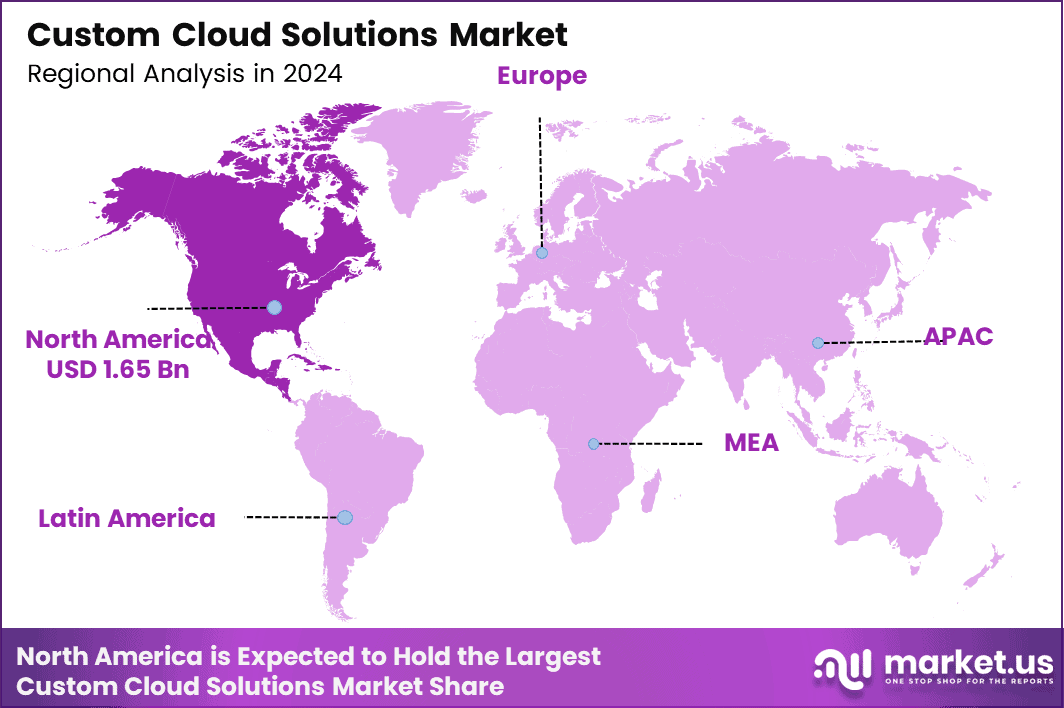
Projections indicate a 25% year-over-year growth through 2028, with an anticipated 80% enterprise adoption rate by 2030 and SME uptake rising 30%, positioning the US to drive 60% of regional IT spending on flexible, secure solutions amid digital acceleration.
US Market Size
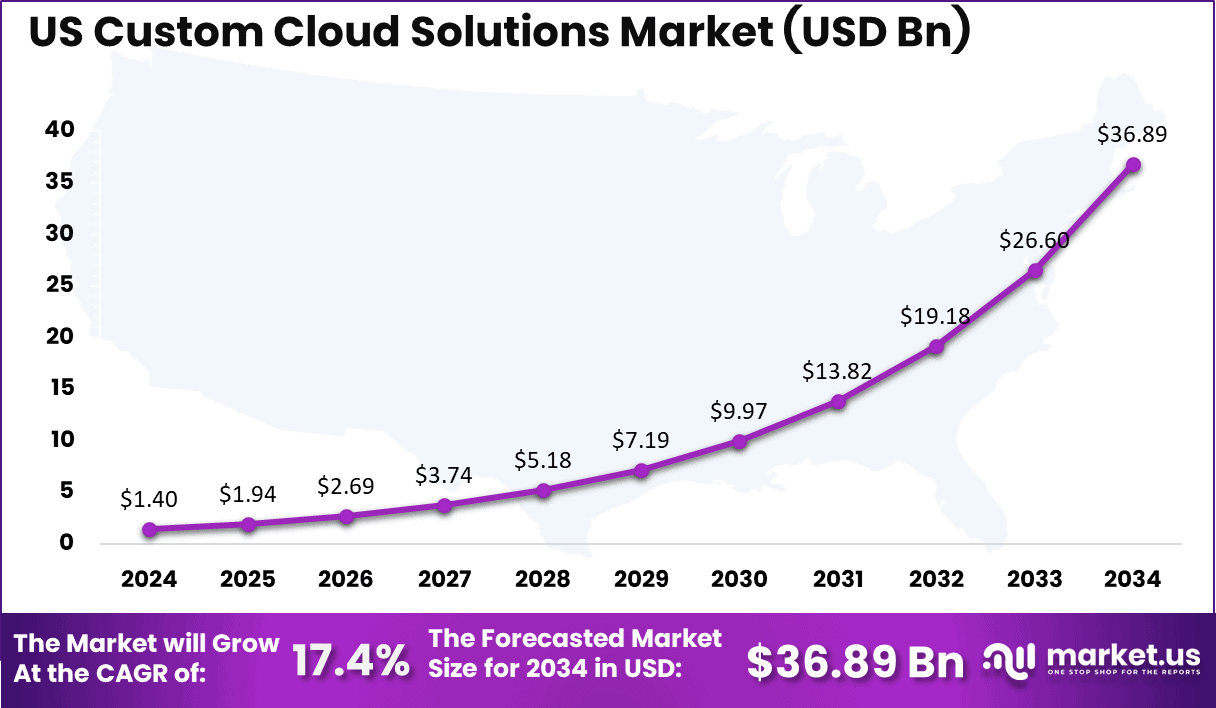
The US Custom Cloud Solutions Market, offering tailored cloud solutions for industries like finance and healthcare, began 2024 at USD 1.4 billion, highlighting strong demand for customized data management in a digital-first era. By 2034, the market is forecasted to reach USD 36.9 billion, driven by a CAGR of 17.4%.
This growth reflects an anticipated 80% adoption rate among enterprises by 2030, with a predicted 30% increase in small business uptake due to cost-effective scalability. The market’s rise is also tied to broader US tech trends, where cloud services are expected to account for 60% of IT spending by 2034, boosting innovation and flexibility across sectors.
Key Regions and Countries
- North America
- US
- Canada
- Europe
- Germany
- France
- The UK
- Spain
- Italy
- Rest of Europe
- Asia Pacific
- China
- Japan
- South Korea
- India
- Australia
- Rest of APAC
- Latin America
- Brazil
- Mexico
- Rest of Latin America
- Middle East & Africa
- GCC
- South Africa
- Rest of MEA
Market Dynamics
Drivers
| Driver | (~) % Impact on CAGR Forecast | Geographic Relevance | Impact Timeline |
|---|---|---|---|
| Critical-sector cloud compliance modernization | +1.2% | Europe, North America | Short term (2 years or less) |
| Enterprise cloud service adoption | +0.9% | Global | Short term (2 years or less) |
| AI workload customization demand | +0.8% | North America, Asia Pacific | Medium term (2 to 4 years) |
| Hybrid infrastructure integration programs | +0.7% | Global | Medium term (2 to 4 years) |
| Public-sector digital service renewal | +0.5% | Europe, Asia Pacific | Medium term (2 to 4 years) |
Critical-Sector Cloud Compliance Modernization
Cybersecurity compliance is actively shifting custom cloud procurement from isolated infrastructure projects toward integrated managed architectures. This scope expansion forces buyers to combine identity controls, monitoring, recovery tools, and sector-specific data handling into one custom cloud design rather than purchase standard capacity alone.
Eurostat reported that 52.7% of EU enterprises used paid cloud services in 2025, up 7.4 percentage points from 2023, increasing the installed base that needs tailored security and compliance layers. ENISA reviewed 4,875 cybersecurity incidents between 1 July 2024 and 30 June 2025, reinforcing demand for contracts that combine implementation, monitoring, and incident response.
Restraints
| Restraint | (~) % Impact on CAGR Forecast | Geographic Relevance | Impact Timeline |
|---|---|---|---|
| Data sovereignty approval delays | -0.9% | Europe, Middle East | Short term (2 years or less) |
| Cloud switching fee phaseout | -0.7% | Europe | Short term (2 years or less) |
| Customer IT budget deferrals | -0.6% | Global | Short term (2 years or less) |
| Long public procurement cycles | -0.5% | Europe, Asia Pacific | Medium term (2 to 4 years) |
| Legacy contract exit costs | -0.4% | Global | Medium term (2 to 4 years) |
Data Sovereignty Approval Delays
Data sovereignty rules can halt custom cloud deal closure when regulated buyers cannot establish where sensitive workloads, backups, access logs, and support personnel sit. The European Commission confirmed that the Data Act entered into application on 12 September 2025, adding requirements that strengthen customer control over data processing and cloud switching.
OECD competition analysis published in 2025 identified concentration, interoperability barriers, and switching barriers as central cloud-market issues, making cross-border architecture approval more complex for buyers that need tailored multicloud designs.
Challenges
| Challenge | (~) % CAGR Friction Drag | Geographic Relevance | Mitigation Horizon |
|---|---|---|---|
| Cloud security talent gap | -0.8% | Global | Medium term (2 to 4 years) |
| Rising data center power demand | -0.7% | Global | Long term (4 years or more) |
| Multicloud interoperability complexity | -0.6% | Global | Medium term (2 to 4 years) |
| Expanding cyber threat exposure | -0.5% | Global | Short term (2 years or less) |
| Custom integration delivery delays | -0.4% | Global | Medium term (2 to 4 years) |
Cloud Security Talent Gap
The shortage of cloud-security talent creates an ongoing delivery constraint because custom cloud solutions require architects who can combine network design, identity management, encryption, compliance controls, and application migration.
OECD workforce analysis identifies a shortage of more than 300,000 cybersecurity professionals in Europe, while cloud technologies rank among the most frequently requested skill areas in cybersecurity hiring. ENISA’s 2025 threat assessment found that ransomware, banking trojans, and infostealers accounted for 87.3% of reviewed intrusions, and 68.6% of those intrusions led to data-related impact.
Opportunities
| Opportunity | (~) % Potential CAGR Upside | Geographic Relevance | Execution Window |
|---|---|---|---|
| Energy-optimized cloud modernization services | +1.1% | Global | Medium term (2 to 4 years) |
| Industry-specific sovereign cloud platforms | +0.9% | Europe, Middle East, Asia Pacific | Medium term (2 to 4 years) |
| Managed cloud exit services | +0.7% | Europe | Short term (2 years or less) |
| Vertical AI operations bundles | +0.6% | North America, Asia Pacific | Long term (4 years or more) |
| Regional delivery partner acquisitions | +0.5% | Global | Long term (4 years or more) |
Energy-Optimized Cloud Modernization Services
Energy-optimized cloud modernization remains a future opportunity rather than a current market driver because many custom cloud contracts still prioritize migration speed and functional performance over workload-level energy design, leaving a sizable untapped pool of optimization work.
The IEA estimates that data centres consumed about 415 TWh in 2024, equal to roughly 1.5% of global electricity consumption, and projects demand to reach around 945 TWh by 2030. The IEA also forecasts data-centre electricity demand growth of about 15% annually from 2024 to 2030, more than 4 times the growth rate of total electricity demand.
Key Player Analysis
Tier 1 leaders include AWS, Microsoft Azure, Google Cloud Platform, Oracle Cloud, IBM Cloud, SAP Cloud Platform, Alibaba Cloud, Tencent Cloud, and Huawei Cloud. AWS leads by scale, with FY2025 revenue of USD 128.7 billion, operating income of USD 45.6 billion, and capital expenditure of USD 96.5 billion.
Microsoft reported FY2026 Intelligent Cloud revenue of USD 137.8 billion, Microsoft Cloud revenue of USD 214.4 billion, and commercial remaining performance obligations of USD 678.0 billion. Google Cloud generated FY2025 revenue of USD 58.7 billion and operating income of USD 13.9 billion, while Alphabet reported a revenue backlog of USD 242.8 billion.
Oracle remained a strong Tier 1 challenger, with FY2026 cloud revenue of USD 34.0 billion and remaining performance obligations of USD 638.0 billion, of which 12% is expected to convert within the next 12 months. IBM reported FY2025 software revenue of USD 30.0 billion, hybrid-cloud revenue of USD 7.3 billion, and software segment income of USD 9.9 billion. SAP recorded FY2025 cloud revenue of EUR 21.0 billion, cloud and software revenue of EUR 32.5 billion, and total cloud backlog of EUR 77.3 billion.
Tier 2 challengers include Salesforce, VMware, Rackspace Technology, HPE Cloud, Dell Technologies Cloud, Cisco Cloud Solutions, Adobe Cloud Services, Fujitsu Cloud, CenturyLink Cloud, and ServiceNow. Salesforce reported FY2026 subscription and support revenue of USD 39.4 billion, gross profit of USD 32.6 billion, and remaining performance obligations of USD 72.4 billion. These players compete mainly through hybrid cloud, private cloud, vertical software, migration, networking, and managed services.
Top Key Players
- Amazon Web Services (AWS)
- Microsoft Azure
- Google Cloud Platform (GCP)
- IBM Cloud
- Oracle Cloud
- Alibaba Cloud
- Salesforce
- SAP Cloud Platform
- VMware
- Rackspace Technology
- Tencent Cloud
- Hewlett Packard Enterprise (HPE) Cloud
- Dell Technologies Cloud
- Cisco Cloud Solutions
- Adobe Cloud Services
- Fujitsu Cloud
- Huawei Cloud
- CenturyLink Cloud
- ServiceNow
- Other
Recent Development
- In September 2025, Atlassian expanded its custom cloud collaboration tools with the acquisition of analytics platform DX, creating an all-in-one environment for AI deployment in project management; this move targets developer productivity in hybrid cloud setups.
- In August 2025, Databricks strengthened its data lakehouse platform for custom cloud ML by buying San Francisco-based startup Tecton, focusing on real-time AI agent contexts from event-driven architectures to support bespoke enterprise analytics.
Report Scope
| Report Features | Description |
|---|---|
| Market Value (2024) | USD 4.5 Bn |
| Forecast Revenue (2034) | USD 29.3 Bn |
| CAGR(2025-2034) | 4.5% |
| Base Year for Estimation | 2024 |
| Historic Period | 2020-2023 |
| Forecast Period | 2025-2034 |
| Report Coverage | Revenue forecast, AI impact on Market trends, Share Insights, Company ranking, competitive landscape, Recent Developments, Market Dynamics, nd Emerging Trends |
| Segments Covered | By Component (Custom cloud solutions, Services), By Type (Infrastructure as a Service, Platform as a Service, Software as a Service), By Deployment Model (Public Cloud, Private Cloud, Hybrid Cloud), By Organization Size (Small and Medium Enterprises, Large Enterprises), By Industry Vertical (BFSI, Healthcare, Retail, IT and Telecommunications, Government, Others) |
| Regional Analysis | North America – US, Canada; Europe – Germany, France, The UK, Spain, Italy, Russia, Netherlands, Rest of Europe; Asia Pacific – China, Japan, South Korea, India, New Zealand, Singapore, Thailand, Vietnam, Rest of Latin America; Latin America – Brazil, Mexico, Rest of Latin America; Middle East & Africa – South Africa, Saudi Arabia, UAE, Rest of MEA |
| Competitive Landscape | Amazon Web Services (AWS), Microsoft Azure, Google Cloud Platform (GCP), IBM Cloud, Oracle Cloud, Alibaba Cloud, Salesforce, SAP Cloud Platform, VMware, Rackspace Technology, Tencent Cloud, Hewlett Packard Enterprise (HPE) Cloud, Dell Technologies Cloud, Cisco Cloud Solutions, Adobe Cloud Services, Fujitsu Cloud, Huawei Cloud, CenturyLink Cloud, ServiceNow, Other |
| Customization Scope | Customization for segments, region/country-level will be provided. Moreover, additional customization can be done based on the requirements. |
| Purchase Options | We have three licenses to choose from: Single User License, Multi-User License (Up to 5 Users), Corporate Use License (Unlimited Users, Printable PDF) |





























