


Report Overview
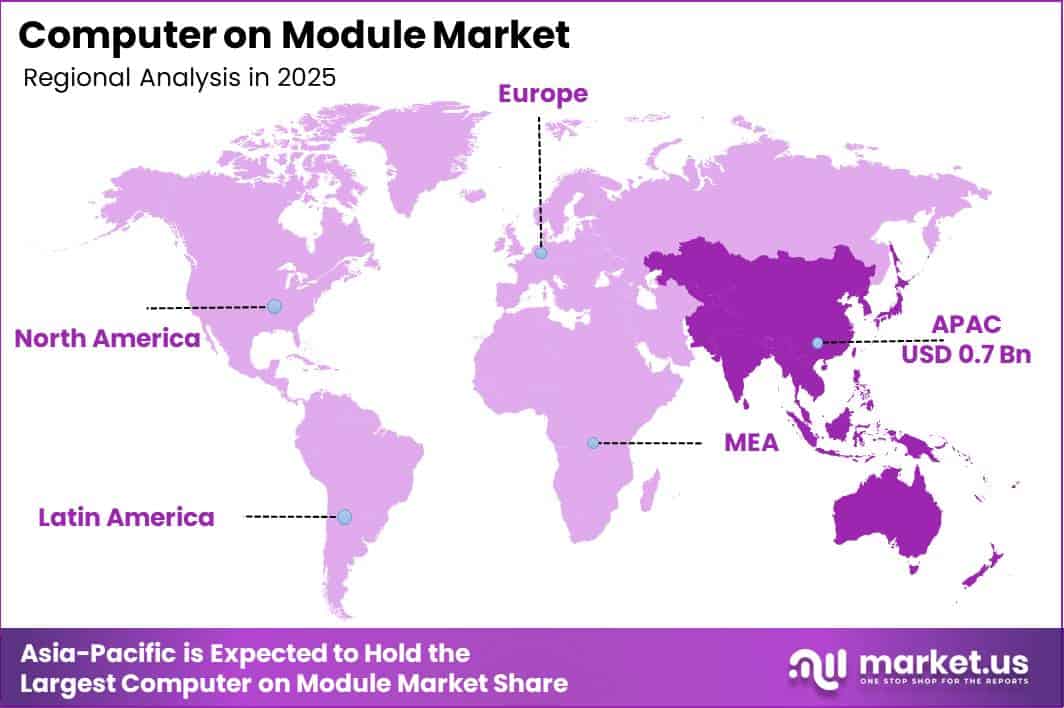
In 2025, the Global Computer on Module Market was valued at USD 1.6 billion. The market is projected to grow at a CAGR of 4.8% during 2026–2035, reaching approximately USD 2.5 billion by 2035. Asia-Pacific dominated the global market in 2025, accounting for more than 44.6% of the total market share and generating approximately USD 0.7 billion in revenue.
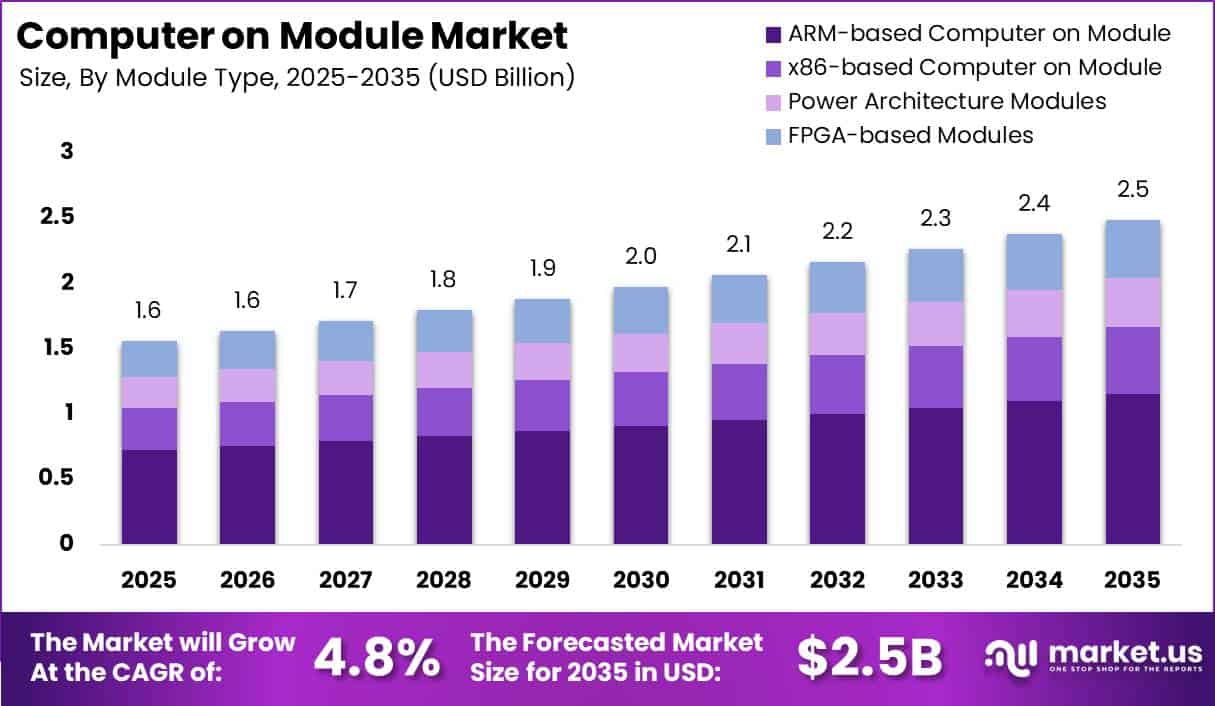
This steady expansion is supported by rising industrial automation and growing electronic content in vehicles. Computer on Modules serve as compact computing boards used in robots, factory controllers, medical equipment, infotainment systems, driver-assistance solutions, and electric vehicle battery management systems.
According to the International Federation of Robotics, global industrial robot installations reached 542,000 units in 2024, more than double the level recorded a decade earlier. Asia represented 74% of these installations, compared with 16% in Europe and 9% in the Americas. The increasing use of robots creates direct demand for embedded boards that process sensor information and control industrial equipment.
Key Takeaway
- The Computer on Module valued at USD 1.6 billion in 2025, projected to reach USD 2.5 billion by 2035 at a CAGR of 4.8%.
- ARM-based modules held the top position by module type with around 46.2% share.
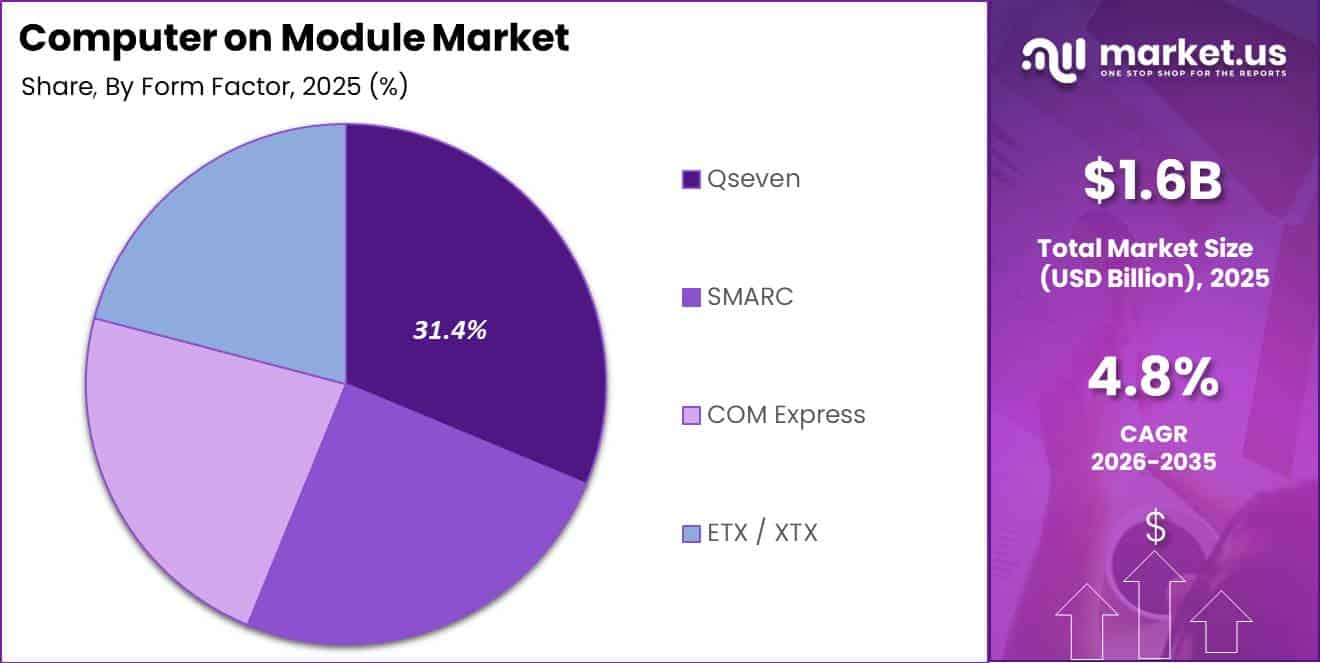
- Qseven led the form factor segment with around 31.4% share.
- Industrial automation led applications with approximately 39.8% share.
- Industrial manufacturing led end-user industries with approximately 42.1% share.
- Low-power modules led processing capability with approximately 36.5% share.
- Wired connectivity modules led with approximately 33.7% share.
- Linux-based modules led operating system support with approximately 48.9% share.
- Asia-Pacific led the market with 44.6% share, generating approximately USD 0.7 billion in revenue in 2025.
By Module Type
ARM-based Computer on Module architectures held the leading market position with around 46.2% share. Their dominance is supported by the large global base of low-power embedded and mobile devices that use Arm instruction sets. ARM reported that its partners have shipped more than 200 billion Arm-based chips, showing their wide adoption across smartphones, routers, industrial sensors, Internet of Things devices, control panels, human-machine interfaces, and edge gateways.
ARM-based modules are well suited for systems that require strong processing performance with low power use and limited heat generation. Manufacturers are also moving from fully customized boards to standardized Computer on Modules because these solutions reduce product development time, simplify system upgrades, and lower engineering costs.
By Form Factor
Qseven Computer on Modules held the leading market position with around 31.4% share. Their strong adoption is supported by their compact design, low power consumption, and standardized pin configuration. These features make Qseven modules suitable for space-limited applications such as vehicle control units, kiosks, industrial control panels, infotainment systems, and telematics devices.
According to the International Organization of Motor Vehicle Manufacturers, global vehicle production reached approximately 96 million units in 2025, with Asia contributing more than 61% of total output. This large production base creates strong demand for small and rugged computing platforms used across dashboards, communication systems, and vehicle electronics.
By Application
Industrial automation held the leading position in the Computer on Module market, accounting for approximately 39.8% of total demand. This dominance is supported by the growing use of digital control, monitoring, and data-processing systems across factories. According to the United Nations Industrial Development Organization, global manufacturing FPGA-based modules’ value added reached nearly USD 16 trillion in 2024, while manufacturing represented around 17% of global GDP.
Computer-on-modules are widely used in industrial environments because they combine the processor, memory, and key interfaces on a compact board. Equipment manufacturers can connect these modules to different carrier boards and reuse the same design across programmable logic controllers, human-machine interfaces, industrial computers, and automation equipment.
By End User Industry
Industrial manufacturing held the leading position in the Computer on Module market, accounting for approximately 42.1% of total demand. This strong share is driven by the rapid digitalisation of production facilities, where reliable computing systems are required across assembly lines, robotic cells, testing stations, and industrial machines.
Computer on Modules offer a cost-effective solution because manufacturers can develop a single carrier board and use different modules for low-, medium-, and high-performance equipment. This modular approach lowers engineering costs, shortens development cycles, simplifies repairs, and supports long-term system upgrades.
By Processing Capability
Low-power computer-on-modules held the leading market position with approximately 36.5% share. Their strong adoption is driven by the need for energy-efficient, compact, and fanless computing systems across embedded applications. These modules are widely used in connected devices, sensors, gateways, and industrial equipment that operate continuously under limited power and cooling conditions.
According to the International Telecommunication Union, around 74% of the global population used the internet in 2025, supporting continued growth in connected devices and communication networks. Arm also reported that its partners have shipped more than 200 billion Arm-based chips, showing the large scale of low-power processors used in mobile, Internet of Things, and embedded systems.
High-performance Computer on Modules are expected to be the fastest-growing segment. Growth is supported by rising demand for artificial intelligence, data analytics, machine vision, and real-time processing at the network edge. The International Energy Agency estimated that data centres consumed between 240 TWh and 340 TWh of electricity in 2022, while power demand from these facilities was increasing by more than 4% annually.
By Connectivity
Wired connectivity Computer on Modules held the leading market position with approximately 33.7% share. Their dominance is supported by strong demand from industrial, automotive, railway, medical, and energy applications that require stable, low-latency, and interference-resistant communication. Wired technologies such as Ethernet, fieldbus, and serial interfaces provide reliable data transfer for safety-critical equipment.
Wireless-enabled Computer on Modules are expected to be the fastest-growing connectivity segment. Growth is driven by rising adoption of connected vehicles, Internet of Things devices, mobile equipment, and remote monitoring systems. China produced approximately 34.5 million vehicles and sold around 34.4 million units in 2025. New energy vehicles represented more than 50% of domestic vehicle sales, increasing demand for telematics, over-the-air software updates, and connected infotainment systems.
By Operating System Support
Linux-based Computer-on-Modules held the leading market position with approximately 48.9% share. Their dominance is supported by Linux’s flexibility, strong security features, and low licensing costs. Linux is widely used across embedded systems, industrial equipment, and Internet of Things platforms. Major semiconductor companies and equipment manufacturers provide board support packages and long-term software support for industrial applications.
Modern vehicles contain a growing number of electronic control units that must operate within strict safety and timing limits. Compliance with standards such as ISO 26262 for automotive systems and IEC 61508 for industrial equipment is encouraging manufacturers to shift critical functions from general-purpose operating systems to real-time platforms.
Key Market Segments
By Module Type
- ARM-based Computer on Module
- x86-based Computer on Module
- Power Architecture Modules
- FPGA-based Modules
By Form Factor
- Qseven
- SMARC
- COM Express
- ETX / XTX
By Application
- Industrial Automation
- Medical Devices
- Transportation & Automotive
- Defense & Aerospace
- Robotics
- IoT & Edge Computing
By End User Industry
- Industrial Manufacturing
- Healthcare
- Automotive
- Aerospace & Defense
- Consumer Electronics
- Energy & Utilities
By Processing Capability
- Low-Power Modules
- High-Performance Modules
- Mid-Range Performance Modules
By Connectivity
- Wired Connectivity Modules
- Wireless-Enabled Modules
- Hybrid Connectivity Modules
By Operating System Support
- Linux-Based COMs
- Windows-Based COMs
- RTOS-Based COMs
Geopolitical Impact Analysis
Geopolitical tensions are increasing costs and delivery times across the Computer on Module supply chain because semiconductors, processors, printed circuit boards, substrates, and connectors depend heavily on international trade. Since 2018, several major economies have introduced additional tariffs of around 10% to 25% on selected information and communication technology products.
These duties directly raise the cost of imported processors, circuit boards, and communication components used in Computer on Modules. Shipping disruptions are creating further pressure. According to UNCTAD’s 2024 assessment, vessels diverted from the Red Sea and Suez Canal to the Cape of Good Hope experienced approximately 10 to 15 additional transit days.
Average container costs on major routes also increased by around USD 200 to USD 300 per twenty-foot equivalent unit, depending on fuel charges and insurance costs. As a result, manufacturers are maintaining larger inventories, extending delivery schedules, and adjusting product prices to protect profit margins.
Energy price volatility is also affecting semiconductor fabrication and electronic board assembly. Brent crude oil prices moved between approximately USD 70 and USD 100 per barrel during 2022 and 2023. European spot natural gas prices also rose to more than 3 times their average levels before 2021, contributing to double-digit increases in industrial electricity costs across several markets.
Higher energy expenses increase the cost of wafer production, soldering, reflow processes, cleanroom operations, and temperature-controlled manufacturing facilities. In response, Computer on Module producers are reviewing prices more frequently, diversifying suppliers, shifting selected production activities to lower-cost regions, and adopting smaller semiconductor process nodes and energy-efficient architectures to reduce the impact of geopolitical and operating-cost pressures.
Regional Analysis
Asia-Pacific held the leading position in the Computer on Module market, accounting for 44.6% of global revenue and generating approximately USD 0.7 billion in 2025. The region benefits from a strong concentration of electronics manufacturing facilities across China, Japan, South Korea, Taiwan, and India. Its established semiconductor production, printed circuit board assembly, and industrial automation industries support the large-scale use of modular embedded computing platforms.
Manufacturers increasingly adopt Computer on Modules to reduce product development time, simplify system upgrades, and offer multiple performance options without redesigning complete hardware systems. Strong demand from robotics, automotive electronics, factory control equipment, and connected devices continues to strengthen Asia-Pacific’s market leadership.
North America is expected to be the fastest-growing regional market. Growth is supported by the return of advanced manufacturing, rising investment in medical equipment, aerospace and defense systems, and the expansion of edge computing across telecom and data center infrastructure. Companies in the region use Computer on Modules to meet strict requirements related to cybersecurity, product reliability, regulatory compliance, and long operating lifecycles.
Modular platforms also allow manufacturers to upgrade processing performance while retaining existing equipment designs. Asia-Pacific is therefore positioned as the main volume-production and cost-efficient manufacturing hub, while North America is developing as a high-growth market for reliable, high-performance Computer on Module solutions used in complex and regulated applications.
Key Regions and Countries
North America
- US
- Canada
Europe
- Germany
- France
- The UK
- Spain
- Italy
- Rest of Europe
Asia Pacific
- China
- Japan
- South Korea
- India
- Australia
- Rest of APAC
Latin America
- Brazil
- Mexico
- Rest of Latin America
Middle East & Africa
- GCC
- South Africa
- Rest of MEA
Market Dynamics
Drivers
| Driver | (~) % CAGR | Geographic Relevance | Impact Timeline |
|---|---|---|---|
| Adoption in industrial automation | +2.0% | Europe, North America, East Asia | Short term (≤ 2 years) |
| Edge AI embedded deployment | +1.4% | Global | Medium term (2–4 years) |
| Modular design reducing NRE | +0.8% | Global | Short term (≤ 2 years) |
| IoT and smart infrastructure rollouts | +0.5% | Asia-Pacific, Middle East, Latin America | Medium term (2–4 years) |
| Medical and defense certification reuse | +0.3% | North America, Europe | Long term (≥ 4 years) |
Accelerating deployment of computer-on-modules in industrial automation stems from the shift toward digitally controlled production lines and machine-level connectivity, with manufacturing surveys since 2024 showing that more than 35–45% of new PLC and industrial PC designs incorporate modular compute to shorten design cycles and support multi-vendor sensor integration.
By reusing standardized COM boards, OEMs report engineering effort reductions of around 20–30% per platform and BOM savings of 5–8% compared with fully custom boards, which directly supports the baseline market CAGR of 4.8% and adds an estimated incremental driver of +2.0% as industrial customers refresh installed bases on 5–7-year cycles.
Strategically, this allows automation vendors to move from one-off hardware sales toward recurring lifecycle and retrofit programs, increasing gross margins by roughly 200–300 basis points via higher attach rates for software, diagnostics, and service contracts tied to COM-enabled platforms.
Restraints
| Restraint | (~) % CAGR | Geographic Relevance | Impact Timeline |
|---|---|---|---|
| Semiconductor supply chain volatility | -1.6% | Global | Short term (≤ 2 years) |
| High interest rate environment | -0.9% | North America, Europe | Short term (≤ 2 years) |
| Export controls on advanced compute | -0.8% | US–China corridor, East Asia | Medium term (2–4 years) |
| Fragmented embedded standards compliance | -0.6% | Global | Medium term (2–4 years) |
| OEM reliance on single-source modules | -0.4% | Global | Long term (≥ 4 years) |
Semiconductor supply chain volatility is a direct restraint on computer on module sales today, as lead times for key MCUs, SoCs, and memory used in COM designs have swung from typical pre-2020 levels of around 8–12 weeks to peaks above 26–40 weeks during successive disruption waves driven by geopolitical tensions, natural hazards at critical fabs, and episodic logistics bottlenecks.
Industry analyses of the semiconductor supply chain show that single points of failure in advanced packaging and specialty substrate production can temporarily remove more than 10–15% of global capacity for certain nodes, forcing COM vendors to carry buffer inventories and pay spot premiums on components that raise unit hardware costs by roughly 7–12% versus baseline contracts.
This cost and availability shock translates into delayed OEM product launches, deferral of CapEx for industrial and infrastructure platforms using COMs, and margin compression of roughly 150–250 basis points at module vendors, collectively shaving an estimated -1.6% off the otherwise achievable CAGR and keeping growth closer to the baseline trajectory despite strong end-demand.
Challenges
| Challenge | (~) % CAGR | Geographic Relevance | Mitigation Horizon |
|---|---|---|---|
| Complex long-term lifecycle support | -1.3% | Global | Long term (≥ 4 years) |
| Embedded cybersecurity compliance burden | -1.1% | North America, Europe, East Asia | Medium term (2–4 years) |
| Shortage of embedded software talent | -0.9% | Global | Medium term (2–4 years) |
| Thermal and power design constraints | -0.7% | Global | Long term (≥ 4 years) |
| Integration complexity with legacy systems | -0.5% | Global | Short term (≤ 2 years) |
Long product lifecycle expectations in industrial, medical, and infrastructure deployments create a structural challenge for computer-on-module vendors, who must maintain form-factor, firmware, and driver compatibility over horizons of often 10–15 years while underlying semiconductor and OS ecosystems refresh on roughly 3–5-year cycles.
Maintaining parallel generations of COMs to satisfy legacy equipment and new designs increases operating costs, with some vendors reporting that sustaining engineering, long-term stocking of older components, and validation testing consume around 20–25% of annual R&D and support budgets, effectively reducing the maximum feasible growth rate by an estimated friction drag of -1.3% as resources are locked into lifecycle obligations rather than new platform launches.
Strategically, this forces companies to adopt multi-tier product roadmaps, extended last-time-buy programs, and contractual lifecycle guarantees, which can add 3–5% to unit pricing for long-lifecycle COMs to preserve margins but simultaneously dampen volume expansion in cost-sensitive segments where customers resist higher prices despite needing lifecycle stability.
Opportunities
| Opportunity | (~) % CAGR | Geographic Relevance | Execution Window |
|---|---|---|---|
| COM-based secure edge platforms | +1.7% | North America, Europe, East Asia | Medium term (2–4 years) |
| Verticalized COM solution bundles | +1.3% | Global | Short term (≤ 2 years) |
| Lifecycle-as-a-service contracts | +1.1% | Global | Long term (≥ 4 years) |
| Emerging market industrial retrofits | +0.9% | Asia-Pacific, Latin America, Middle East | Medium term (2–4 years) |
| Green and energy-efficient COM designs | +0.6% | Europe, North America | Long term (≥ 4 years) |
COM-based secure edge platforms represent untapped upside rather than a current driver because emerging cybersecurity regulations and best-practice frameworks for connected devices increasingly require hardware-rooted security, remote patch management, and secure boot features that many existing COM deployments have not yet fully embedded, particularly in legacy industrial and infrastructure installations.
By designing security-optimized modules with on-board secure elements, encrypted storage, and validated firmware update pipelines, vendors can enable OEMs to reduce field vulnerability remediation costs by around 20–30% per device over its lifecycle and cut incident-related downtime by 15–25%, which can justify price premiums of roughly 10–15% per secure COM while still improving customers’ total cost of ownership.
This shifts unit economics toward higher-margin SKUs, with potential gross margin expansion of about 300–400 basis points on secure edge offerings and an associated incremental CAGR upside of approximately +1.7% above the baseline if vendors actively build security-focused product lines, certification programs, and managed security update services around their COM portfolios.
Key Players Analysis
Tier-1 companies in the Computer on Module market include large industrial computing and semiconductor suppliers with global production networks and strong research capabilities. Advantech reported consolidated revenue of approximately USD 1.1 billion in the first half of 2025. North America and Europe together represented nearly 46% of its sales, while Intelligent Systems and IoT Automation generated more than 40% of segment revenue.
Kontron recorded EUR 1.6 billion in revenue during 2025, supported by EBITDA of EUR 237 million and net profit of EUR 141 million. Its Software and Solutions business contributed 34.7% of total revenue. Through JUMPtec, Kontron also acquired Congatec, strengthening its position across Computer on Modules and higher-value embedded solutions. Intel, NXP Semiconductors, and Texas Instruments further support the market by supplying processors and system-on-chip platforms used by module manufacturers.
Tier-2 companies include Congatec, Eurotech, SECO, ADLINK Technology, Aaeon, Portwell, Radisys, Tria Technologies, Mouser Electronics, and Digi International. Eurotech generated EUR 55.4 million in consolidated revenue in 2025, with Edge AIoT solutions accounting for 59.5% of sales. Digi International reported fiscal 2024 revenue of USD 424 million and annualized recurring revenue of USD 116 million from IoT solutions.
Collectively, Tier-2 suppliers are estimated to represent around 30% to 40% of market value. These companies focus on specialized form factors such as Qseven and SMARC, while larger suppliers typically invest around 8% to 12% of revenue in research and development to maintain technology leadership.
Top Key Players in the Market
- Advantech
- Kontron
- Congatec
- Eurotech
- SECO S.p.A.
- ADLINK Technology
- Radisys
- Aaeon
- Intel
- NXP Semiconductors
- Texas Instruments
- Mouser Electronics
- Digi International
- Portwell
- Tria Technologies
Recent Developments
- In 2025, congatec acquired a 96% stake in JUMPtec GmbH and purchased 100% of Kontron America Modules LLC and Kontron Asia Embedded Design Sdn. Bhd. The transaction expanded congatec’s presence across Europe, North America, and Asia while adding COM-HPC, COM Express, SMARC, and Qseven product lines. JUMPtec’s module business generated approximately EUR 90 million in revenue during 2024.
- In 2026, NXP Semiconductors introduced the i.MX 93W processor with a dedicated artificial intelligence NPU and integrated tri-radio wireless connectivity. The processor can replace up to 60 separate components and offers up to 1.8 eTOPS of AI performance. It supports Wi-Fi 6, Bluetooth Low Energy, and 802.15.4 connectivity, with customer sampling planned for the second half of 2026.
Report Scope
| Report Features | Description |
|---|---|
| Market Value (2025) | USD 1.6 Billion |
| Forecast Revenue (2035) | USD 2.5 Billion |
| CAGR (2026-2035) | 4.8% |
| Base Year for Estimation | 2025 |
| Historic Period | 2020-2024 |
| Forecast Period | 2026-2035 |
| Report Coverage | Revenue Forecast, Market Dynamics, Competitive Landscape, Recent Developments |
| Segments Covered | By Module Type (ARM-based, x86-based, Power Architecture, FPGA-based); By Form Factor (Qseven, SMARC, COM Express, ETX/XTX); By Application (Industrial Automation, Medical Devices, Transportation & Automotive, Defense & Aerospace, Robotics, IoT & Edge Computing); By End User Industry (Industrial Manufacturing, Healthcare, Automotive, Aerospace & Defense, Consumer Electronics, Energy & Utilities); By Processing Capability (Low-Power, High-Performance, Mid-Range); By Connectivity (Wired, Wireless-Enabled, Hybrid); By Operating System Support (Linux-Based, Windows-Based, RTOS-Based) |
| Regional Analysis | North America – US, Canada; Europe – Germany, France, The UK, Spain, Italy, Rest of Europe; Asia Pacific – China, Japan, South Korea, India, Australia, Singapore, Rest of APAC; Latin America – Brazil, Mexico, Rest of Latin America; Middle East & Africa – GCC, South Africa, Rest of MEA |
| Competitive Landscape | Advantech, Kontron, Congatec, Eurotech, SECO S.p.A., ADLINK Technology, Radisys, Aaeon, Intel, NXP Semiconductors, Texas Instruments, Mouser Electronics, Digi International, Portwell, Tria Technologies |
| Customization Scope | Customization for segments and region/country levels will be provided. Moreover, customization can be tailored to the requirements. |
| Purchase Options | We have three licenses to opt for: Single User License, Multi-User License (Up to 5 Users), Corporate Use License (Unlimited Users and Printable PDF) |





































