


Market Overview
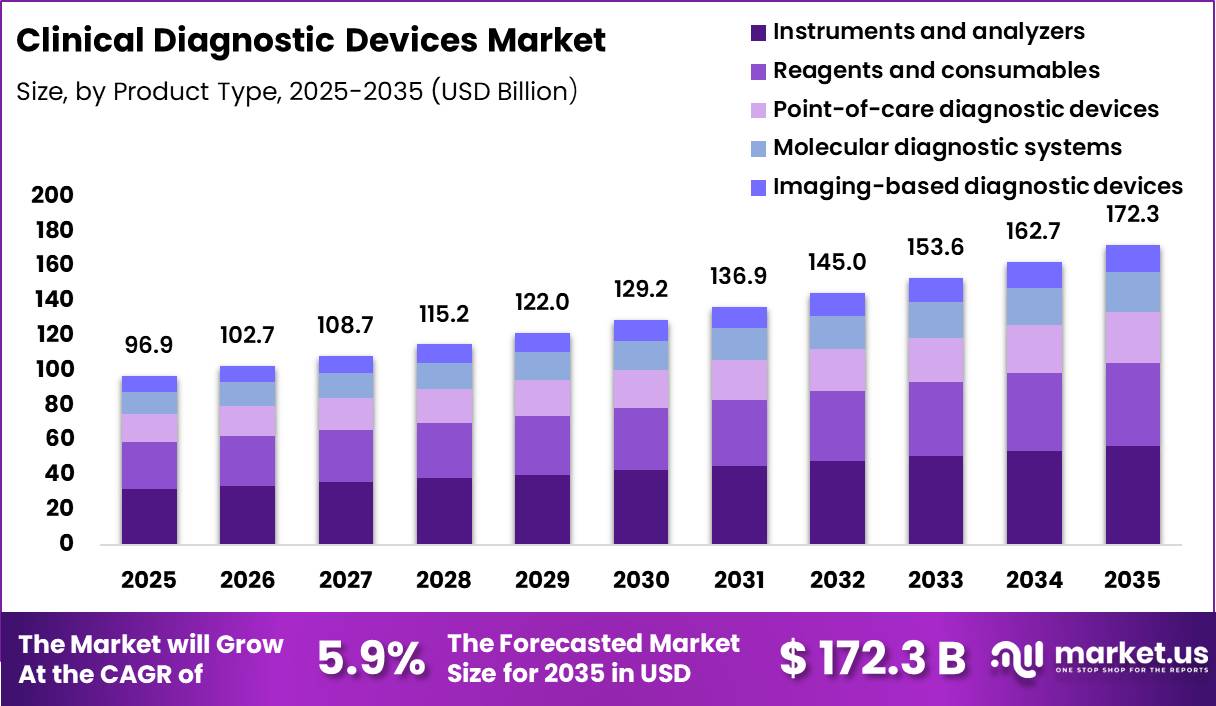
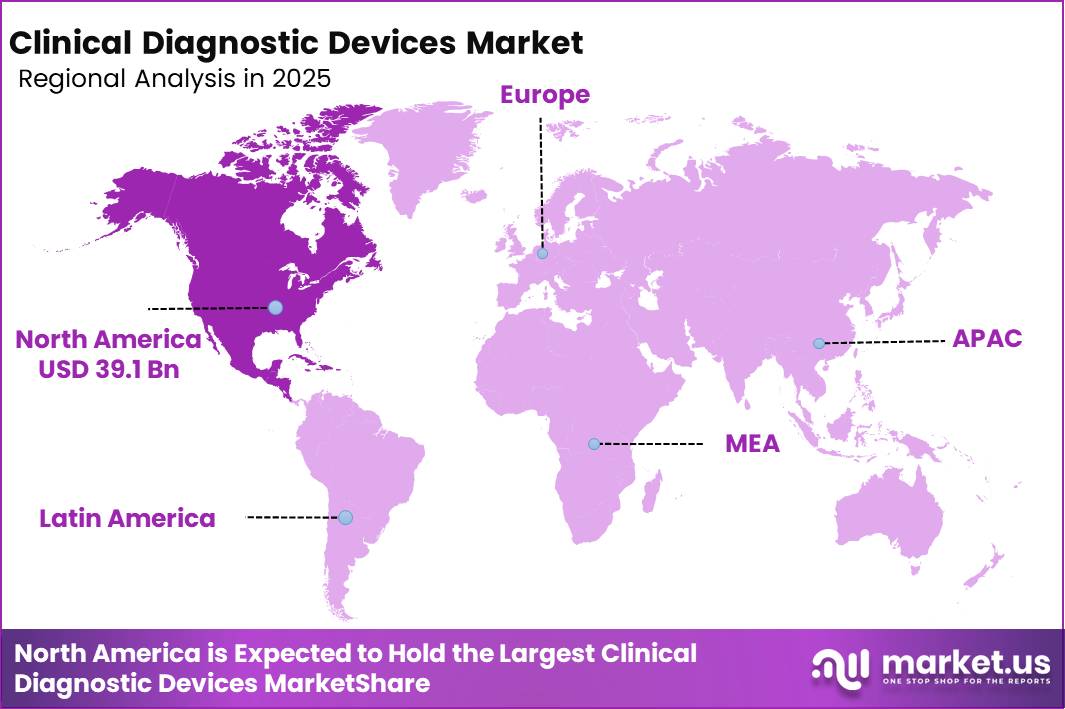
Global Clinical Diagnostic Devices Market size is expected to be worth around US$ 172.3 Billion by 2035 from US$ 96.9 Billion in 2025, growing at a CAGR of 5.9% during the forecast period from 2026 to 2035. In 2025,North America led the market, achieving over 40.3% share with a revenue of US$ 39.1 Billion.
The clinical diagnostic devices market is witnessing steady expansion, driven by rising global disease burden, increased preventive screening, and rapid adoption of advanced laboratory and point-of-care technologies.
According to the World Health Organization (WHO), noncommunicable diseases account for approximately 74% of global deaths annually, significantly increasing the demand for early and accurate diagnostic solutions across healthcare systems.
Clinical diagnostic devices include instruments used for in vitro testing, molecular diagnostics, hematology, immunoassays, and point-of-care testing. These technologies play a critical role in detecting infectious diseases, cancer, diabetes, and cardiovascular conditions at early stages.
The U.S. Centers for Disease Control and Prevention (CDC) reports that nearly 38 million people in the United States live with diabetes, reinforcing the need for continuous glucose monitoring and diagnostic screening tools.
Globally, healthcare infrastructure development and rising laboratory automation are improving diagnostic efficiency and throughput. The World Bank highlights that healthcare expenditure has been increasing steadily in emerging economies, supporting wider access to diagnostic services. Additionally, increasing geriatric population projected by the United Nations to reach 1.5 billion people aged 65 and above by 2050 is further accelerating demand for routine diagnostic testing.
Technological advancements such as AI enabled diagnostic imaging, PCR based molecular testing, and portable point of care devices are transforming clinical workflows. Governments worldwide are also investing in early disease detection programs and strengthening public health laboratories, further boosting adoption. As healthcare systems shift toward preventive care, clinical diagnostic devices are expected to remain a foundational pillar of modern medical diagnostics globally.
Key Takeaways
- Market Size: Global Clinical Diagnostic Devices Market size is expected to be worth around US$ 172.3 Billion by 2035 from US$ 96.9 Billion in 2025.
- Market Share: The market is growing at a CAGR of 5.9% during the forecast period from 2026 to 2035.
- Product Type: The Clinical Diagnostic Devices Market by product type is led by Instruments and analyzers, which accounted for 33.1% of the global market share in 2025.
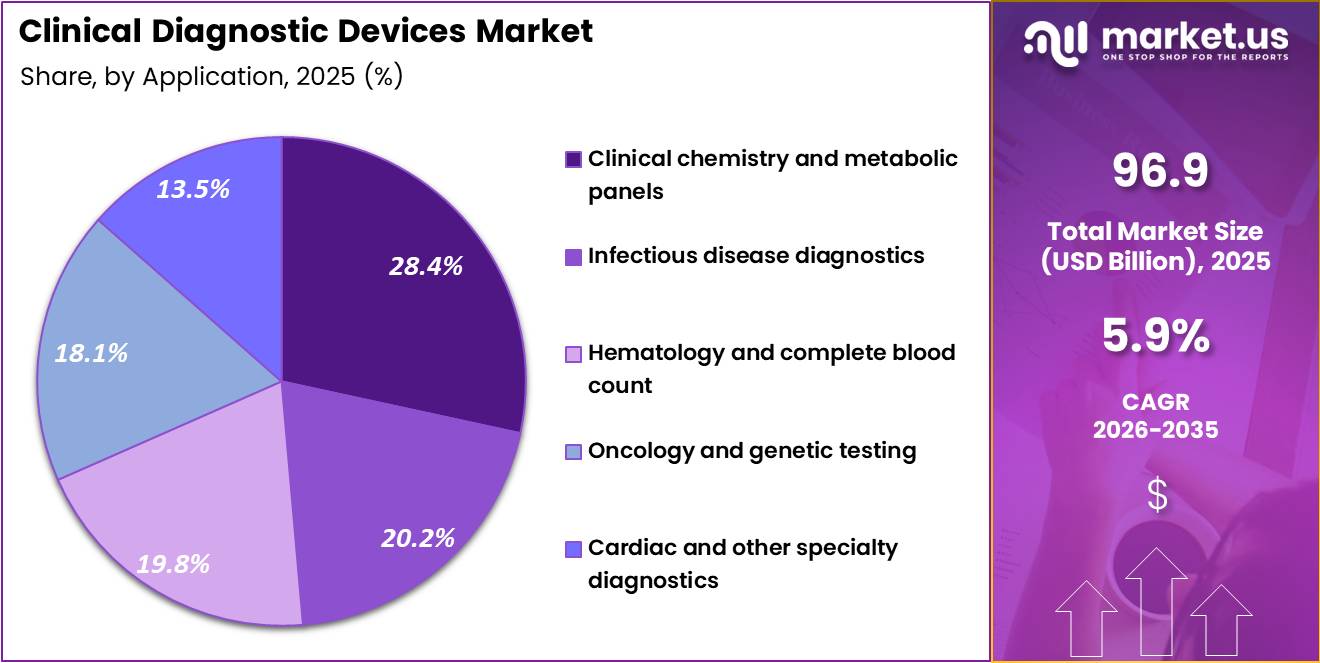
- Application: Clinical chemistry and metabolic panels dominate the application segment with a 28.4% market share in 2025.
- End-user: Hospitals and hospital laboratories dominate the end-user segment with a 50.2% market share in 2025.
- Regional Analysis: In 2025,North America led the Global Clinical Diagnostic Devices Market, achieving over 40.3% share with a revenue of US$ 39.1 Billion.
Product Type Analysis
Instruments and analyzers Producy Type Dominate the Global Clinical Diagnostics Market.
In the Clinical Diagnostic Devices Market, instruments and analyzers dominate the product type segment with a 33.1% market share in 2025. This leadership is primarily driven by their essential role in delivering high precision, automation, and rapid throughput across clinical laboratories.
These systems are widely deployed in hospitals and diagnostic labs for routine testing, enabling consistent performance in high-volume environments and reducing manual errors. Continuous technological advancements such as AI-enabled analyzers, integrated platforms, and automated sample handling further strengthen their dominance in modern diagnostic workflows.
Reagents and consumables account for 27.7% share, supported by recurring demand for test kits, chemicals, and calibration materials required for ongoing diagnostic operations. Point-of-care diagnostic devices hold a 16.8% share, driven by increasing demand for rapid bedside testing and decentralized healthcare delivery.
Molecular diagnostic systems represent 13.3%, gaining traction due to growing adoption in infectious disease detection and personalized medicine. Imaging-based diagnostic devices contribute 9.1%, supported by their use in specialized diagnostic procedures and integration with digital health ecosystems.
Application Analysis
Clinical chemistry and metabolic panels Application Dominate the Global Clinical Diagnostics Market.
Clinical chemistry and metabolic panels dominate the application segment with a 28.4% market share in 2025. This dominance is attributed to their widespread use in routine health assessments, chronic disease monitoring, and preventive screening programs.
These tests are fundamental in evaluating organ function, electrolyte balance, and metabolic disorders, making them indispensable in both primary care and hospital settings. High test volumes and standardized protocols further reinforce their leading position in the market.
Infectious disease diagnostics account for 20.2%, driven by increasing global burden of viral and bacterial infections and rising demand for rapid pathogen detection. Hematology and complete blood count tests hold 19.8%, supported by their critical role in anemia detection, blood disorders, and general health evaluation.
Oncology and genetic testing represent 18.1%, expanding rapidly due to advancements in precision medicine and biomarker-based cancer diagnostics. Cardiac and other specialty diagnostics contribute 13.5%, fueled by rising cardiovascular disease prevalence and growing use of specialized diagnostic panels.
End-user Analysis
Hospitals and hospital laboratories Dominate the Global Clinical Diagnostics Market.
Hospitals and hospital laboratories dominate the end-user segment with a 50.2% market share in 2025. This strong dominance is driven by the high patient inflow, availability of advanced diagnostic infrastructure, and integration of comprehensive testing services within hospital systems.
Hospitals serve as primary points for both emergency and routine diagnostics, requiring high-throughput instruments, automated analyzers, and advanced molecular testing platforms to manage diverse clinical needs efficiently.
Independent and reference laboratories represent a significant share, supported by outsourcing trends and cost-efficient large-scale testing capabilities. Diagnostic centers and clinics are witnessing steady growth due to increasing demand for accessible outpatient testing and preventive health check-ups.
Home-care and self-testing is an emerging segment, driven by rising consumer awareness, chronic disease management needs, and the growing availability of portable point-of-care diagnostic devices. This segment is gaining traction with digital health integration and user-friendly test kits, enabling patients to perform basic diagnostics outside traditional healthcare settings while reducing hospital dependency and turnaround time.
Key Market Segments
By Product Type
- Instruments and analyzers
- Reagents and consumables
- Point‑of‑care diagnostic devices
- Molecular diagnostic systems
- Imaging‑based diagnostic devices
By Application
- Clinical chemistry and metabolic panels
- Infectious disease diagnostics
- Hematology and complete blood count
- Oncology and genetic testing
- Cardiac and other specialty diagnostics
By End-user
- Hospitals and hospital laboratories
- Independent and reference laboratories
- Diagnostic centers and clinics
- Home‑care and self‑testing
Driver
Decentralized point-of-care expansion across primary and acute settings.
Decentralized testing is lifting device demand because procurement is shifting from a single central lab capex decision to repeated multisite placements across clinics, emergency units, retail health points, and public primary care networks, which expands both instrument density and cartridge pull through.
WHO’s essential diagnostics framework continues to prioritize deployable tests across tuberculosis, HIV, diabetes, cardiovascular markers, and maternal health, while India’s updated essential diagnostics approach explicitly pushes rapid diagnostic tests and point of care options deeper into sub centres and primary facilities, increasing the number of care nodes where low footprint analyzers and consumables become commercially viable.
This changes market economics by favoring platforms with faster turnaround, lower operator training burden, room temperature logistics tolerance, and recurring consumables revenue rather than pure high throughput central lab models; in practice, vendors with menu breadth and distributed service capability capture more value than those relying only on flagship laboratory systems.
| Driver | (~) % Impact on CAGR Forecast | Geographic Relevance | Impact Timeline |
|---|---|---|---|
| Decentralized point-of-care expansion across primary and acute settings | +2.1% | APAC corridors, Africa, North America outpatient, EU community care | Short term (≤ 2 years) |
| IVDR transition and compliance-led replacement cycle | +1.8% | EU core, UK adjacency, EEA import hubs | Medium term (2-4 years) |
| Reimbursement selectivity favoring clinically validated molecular and companion diagnostics | +1.6% | North America core, EU oncology centers, Japan, South Korea | Short term (≤ 2 years) |
| Respiratory and infectious disease multiplexing sustaining routine testing intensity | +1.4% | North America, EU, East Asia, urban Latin America | Short term (≤ 2 years) |
| Lab automation and software-linked workflow modernization | +1.7% | North America core, Western Europe, China tier-1 labs, Gulf hubs | Medium term (2-4 years) |
| Public essential-diagnostics programs broadening installed base in lower-tier care networks | +1.5% | India, Southeast Asia, Africa, selected Latin America | Long term (≥ 4 years) |
Challenge
Biologics & reagents fragility.
Unlike capital equipment, clinical diagnostic testing throughput is constrained by a continuous flow of reagents, calibrators, and biologically derived consumables that are highly sensitive to cold chain integrity, shelf life, and batch variability, with multiple lab networks reporting 5 to 10% of reagent SKUs hitting at least one stockout or backorder window of 7 to 21 days annually across high volume immunoassay and molecular lines.
Logistic bottlenecks in temperature controlled transport and packaging, including limited capacity in -20°C and -80°C lanes and increased customs inspections for biologics, extend real world average transit times by 1 to 3 days compared with pre 2020 patterns and force distributors to carry 10 to 15 extra days of inventory, lifting carrying costs and write off risk as expiry windows are typically 6 to 18 months.
Variability in raw biologics input costs, including enzymes, antibodies, and oligonucleotides, has translated into 8 to 12 percent cost swings over 12 month horizons for some test panels, and batch to batch performance drift drives incremental QC and validation runs in reference labs, absorbing laboratory technician time equivalent to 2 to 3 % of staffing capacity that could otherwise support incremental test menu expansion or throughput growth.
To navigate this, OEMs and reagent suppliers are co investing in localized fill finish capacity, redundant cold chain routes, and more standardized cartridge formats, while larger lab networks consolidate suppliers to gain service level guarantees.
But given the complexity of biologics sourcing and distribution, this fragility is likely to persist through at least the medium term, trimming roughly 0.9 % points from the market’s otherwise attainable growth trajectory as utilization ramps are periodically delayed or capped by consumable constraints rather than instrument availability.
| Challenge | (~) % CAGR Friction Drag | Geographic Relevance | Mitigation Horizon |
|---|---|---|---|
| Tier-2 component volatility | -1.2% | North America, EU, East Asia | Medium term (2-4 years) |
| Biologics & reagents fragility | -0.9% | North America, EU, APAC hubs | Medium term (2-4 years) |
| Regulatory changeover fatigue | -1.0% | US, EU, China | Long term (≥ 4 years) |
| Digital & AI talent gap | -0.8% | US, EU, India, China | Long term (≥ 4 years) |
| Capital efficiency & cost creep | -0.7% | Global hospital systems | Medium term (2-4 years) |
| Interoperability & data silos | -0.6% | OECD diagnostic networks | Long term (≥ 4 years) |
Restraints
IVDR recertification drag.
The most material near term restraint remains Europe’s IVDR transition burden, because although the European Commission has extended transition periods and proposed simplification measures, the market still faces a forced step up in conformity assessment, documentation depth, notified body dependency, EUDAMED reporting, and supply continuity obligations that materially slow portfolio throughput and raise fixed compliance costs.
For a mid sized diagnostics manufacturer, regulatory and quality spending that historically sat near 4 to 5 percent of revenue is now more realistically tracking at 6 to 8%, while technical file remediation, performance evaluation upgrades, and notified body engagement can add 9 to 15 months to launch timing for modified assays and 12 to 18 months for higher risk product families, reducing annual SKU refresh velocity by roughly 20 to 30%.
The June 2024 IVDR amendment and staged rollout reduce cliff edge withdrawal risk, but they do not eliminate the need for up front remediation CapEx, and low volume assays with gross margins below roughly 45% are increasingly vulnerable to discontinuation because recertification economics no longer clear internal hurdle rates.
Strategically, this creates a two speed market in which large multinational vendors can absorb dossier costs and preserve share while smaller specialists rationalize 10 to 15 percent of tail portfolios, leading to temporary menu compression in niche microbiology, molecular, and specialty immunoassay categories, delayed distributor stocking decisions, and a realistic 1.0 percentage point drag on 2026 baseline CAGR even before downstream hospital budget effects are layered in.
| Restraint | (~) % Impact on CAGR Forecast | Geographic Relevance | Impact Timeline |
|---|---|---|---|
| IVDR recertification drag | -1.0% | EU core, UK-linked supply chains, global exporters to EU | Short term |
| US lab policy and reimbursement pressure | -0.8% | North America core | Short–Medium term |
| Tender-led CapEx delays | -0.7% | EU periphery, Latin America, MEA, South Asia | Medium term |
| Input cost and logistics volatility | -0.6% | North America, EU, APAC manufacturing corridors | Short term |
| Cybersecurity and interoperability burden | -0.5% | US, EU, Japan, South Korea, Australia | Medium term |
| Skilled labor and installation bottlenecks | -0.5% | Global, acute in rural US, EU, India, Africa | Medium–Long term |
Opportunity
Decentralized oncology CDx networks.
This is an opportunity rather than a current driver because routine baseline diagnostics growth already reflects existing cancer testing demand, whereas the white space sits in moving companion diagnostics and rapid molecular profiling from a small number of tertiary centers into distributed hospital and near patient oncology networks that can support same week therapy decisions and higher test monetization per case.
Roche reported CHF 13.8 billion in diagnostics sales in 2025 with growth supported by pathology and molecular solutions, while Thermo Fisher’s 2025 FDA approved Oncomine Dx Express example highlights a pathway toward 24 hour decentralized sequencing, showing that the enabling infrastructure exists but is not yet broadly scaled across community oncology settings.
The upside comes from expanding served TAM from single assay cancer testing into multiplex tissue plus liquid biopsy workflows, decision support subscriptions, and longitudinal recurrence monitoring.
If companies can shift around 15% to 20% of community oncology centers in the US, EU5, Japan, and major provinces in China to decentralized companion diagnostics (CDx), they can significantly improve their business performance. This transition could increase oncology instrument usage by about 1.3 to 1.6 times and raise reagent revenue per patient by 20% to 35%.
In addition, companies could achieve a gross margin improvement of 300 to 500 basis points compared with relying only on central laboratory testing, mainly because decentralized testing supports higher-value test menus and recurring software-based interpretation services.
However, this opportunity depends on several factors, including certification of testing sites, expansion of available test menus, collaboration with pharmaceutical companies, and strong reimbursement support. As these requirements take time to develop, decentralized CDx represents a medium-term growth opportunity. If successfully adopted across the largely underpenetrated community oncology network beyond major cancer centers, it could contribute approximately 1.9 percentage points to the overall market CAGR.
| Opportunity | (~) % Potential CAGR Upside | Geographic Relevance | Execution Window |
|---|---|---|---|
| Decentralized oncology CDx networks | +1.9% | North America core, EU, Japan, tier-1 China | Medium term (2-4 years) |
| At-home chronic care diagnostics bundles | +1.6% | North America, EU, urban APAC | Short term (≤ 2 years) |
| Emerging-market tiered affordability platforms | +2.3% | India, ASEAN, Africa, LATAM | Medium term (2-4 years) |
| AI-enabled lab productivity monetization | +1.2% | North America core, EU, Gulf, developed APAC | Short term (≤ 2 years) |
| Women’s health lifecycle panels | +1.4% | North America, EU, India, Brazil, GCC | Medium term (2-4 years) |
| Diagnostics roll-up and menu consolidation | +1.8% | US, EU, Japan, selected APAC | Long term (≥ 4 years) |
Regional Analysis
North America dominated the Clinical Diagnostic Devices Market.
North America dominated the Clinical Diagnostic Devices Market in 2025, accounting for over 40.3% share and generating revenue of approximately US$ 39.1 Billion. This leadership is primarily driven by advanced healthcare infrastructure, early adoption of innovative diagnostic technologies, and strong presence of major medical device manufacturers.
High healthcare expenditure, widespread insurance coverage, and rapid integration of automated and AI-enabled diagnostic solutions across hospitals and laboratories further strengthen the region’s dominance. The United States remains the key contributor due to its well-established laboratory networks and continuous investment in precision medicine and point-of-care testing.
Europe holds a significant share of the market, supported by strong public healthcare systems, increasing focus on early disease detection, and growing adoption of digital diagnostic platforms. Countries such as Germany, the United Kingdom, and France are investing in laboratory modernization and expanding screening programs, which continues to support steady market growth.
Asia-Pacific is emerging as the fastest-growing region, driven by rising healthcare investments, expanding diagnostic laboratory networks, and increasing prevalence of chronic and infectious diseases. Growing awareness of preventive healthcare and government initiatives to improve diagnostic accessibility are accelerating adoption in countries such as China, India, and Japan.
Meanwhile, Latin America and the Middle East and Africa are gradually expanding due to improving healthcare infrastructure and increasing diagnostic demand, although access and affordability challenges still limit faster penetration compared to developed regions.
Key Regions and Countries
North America
- The US
- Canada
Europe
- Germany
- France
- The U.K.
- Italy
- Spain
- Russia & CIS
- Rest of Europe
Asia Pacific
- China
- India
- Japan
- South Korea
- ASEAN
- Australia & New Zealand
- Rest of Asia Pacific
Middle East & Africa
- GCC
- South Africa
- Rest of Middle East & Africa
Latin America
- Brazil
- Mexico
- Rest of Latin America
Key Player Analysis
The Clinical Diagnostic Devices Market is moderately consolidated, with a strong presence of global leaders such as Roche Diagnostics, Abbott Laboratories, Siemens Healthineers, Danaher (including Beckman Coulter and Cepheid), Thermo Fisher Scientific, and Becton, Dickinson and Company (BD).
These companies collectively shape pricing trends, technological advancements, and global distribution networks. Competitive dynamics are driven by rapid innovation in molecular diagnostics, immunoassays, and point-of-care testing, alongside increasing demand for automated and AI-integrated diagnostic systems.
The market is highly innovation-focused, with companies investing heavily in precision diagnostics, digital pathology, and cloud-enabled laboratory workflows to improve speed, accuracy, and scalability.
R&D remains a core competitive strategy, particularly for Roche Diagnostics, Abbott Laboratories, and Siemens Healthineers, which continuously expand their assay portfolios and diagnostic platforms. Strategic partnerships and acquisitions are widely adopted by Danaher and Thermo Fisher Scientific to strengthen molecular diagnostics and expand global reach.
Companies such as bioMérieux, Sysmex Corporation, and Hologic focus on specialized diagnostic segments, including infectious disease testing, hematology, and women’s health diagnostics. Workflow integration and ecosystem-based competition are increasingly important, with GE HealthCare and Philips (Koninklijke Philips N.V.) emphasizing imaging-diagnostic convergence and digital health solutions. Fujifilm Holdings is advancing hybrid diagnostic imaging and in vitro diagnostics integration.
Meanwhile, QuidelOrtho Corporation (including Ortho Clinical Diagnostics) and Qiagen are enhancing sample-to-result automation and genomic testing capabilities. Smaller and niche players classified under Others contribute to localized innovation and cost-effective diagnostic solutions, further intensifying competition across global and regional markets.
Top Key Players
- Roche Diagnostics
- Abbott Laboratories
- Siemens Healthineers
- Danaher (incl. Beckman Coulter, Cepheid)
- Thermo Fisher Scientific
- Becton, Dickinson and Company (BD)
- bioMérieux
- Hologic
- Sysmex Corporation
- Qiagen
- Ortho Clinical Diagnostics (now part of QuidelOrtho)
- QuidelOrtho Corporation
- Fujifilm Holdings (diagnostic imaging and IVD)
- GE HealthCare
- Philips (Koninklijke Philips N.V.)
- Others
Recent Developments
- In March 2025, Beckman Coulter Diagnostics received FDA 510(k) clearance for the DxC 500i Clinical Analyzer, an integrated clinical chemistry and immunoassay system that expands automated testing capabilities for hospital and reference laboratories.
- In March 2026, Roche Diagnostics received FDA 510(k) clearance for the cobas c 703 and cobas ISE neo analytical units, adding next-generation high-throughput clinical chemistry and electrolyte testing capabilities with up to 2,000 tests per hour and 1,800 tests per hour, respectively.
- In April 2026, QuidelOrtho Corporation completed the acquisition of LEX Diagnostics, expanding its point-of-care molecular testing portfolio with ultra-fast PCR systems delivering results in under 10 minutes.
Report Scope
| Report Features | Description |
|---|---|
| Market Value (2025) | US$ 96.9 Billion |
| Forecast Revenue (2035) | US$ 172.3 Billion |
| CAGR (2026-2035) | 5.9% |
| Base Year for Estimation | 2025 |
| Historic Period | 2020-2024 |
| Forecast Period | 2026-2035 |
| Report Coverage | Revenue Forecast, Market Dynamics, Competitive Landscape, Recent Developments |
| Segments Covered | By Product Type (Instruments and analyzers, Reagents and consumables, Point-of-care diagnostic devices, Molecular diagnostic systems, Imaging-based diagnostic devices), By Application (Clinical chemistry and metabolic panels, Infectious disease diagnostics, Hematology and complete blood count, Oncology and genetic testing, Cardiac and other specialty diagnostics), By End-user (Hospitals and hospital laboratories, Independent and reference laboratories, Diagnostic centers and clinics, Home-care and self-testing) |
| Regional Analysis | North America – The US, Canada; Europe – Germany, France, U.K., Italy, Spain, Russia & CIS, Rest of Europe; Asia Pacific – China, India, Japan, South Korea, ASEAN, Australia & New Zealand, Rest of Asia Pacific; Middle East & Africa – GCC, South Africa, Rest of Middle East & Africa; Latin America – Brazil, Mexico, Rest of Latin America |
| Competitive Landscape | Roche Diagnostics, Abbott Laboratories, Siemens Healthineers, Danaher (incl. Beckman Coulter, Cepheid), Thermo Fisher Scientific, Becton, Dickinson and Company (BD), bioMérieux, Hologic, Sysmex Corporation, Qiagen, Ortho Clinical Diagnostics (now part of QuidelOrtho), QuidelOrtho Corporation, Fujifilm Holdings (diagnostic imaging and IVD), GE HealthCare, Philips (Koninklijke Philips N.V.), Others |
| Customization Scope | Customization for segments, region/country-level will be provided. Moreover, additional customization can be done based on the requirements. |
| Purchase Options | We have three licenses to opt for: Single User License, Multi-User License (Up to 5 Users), Corporate Use License (Unlimited User and Printable PDF) |





































