


Market Overview
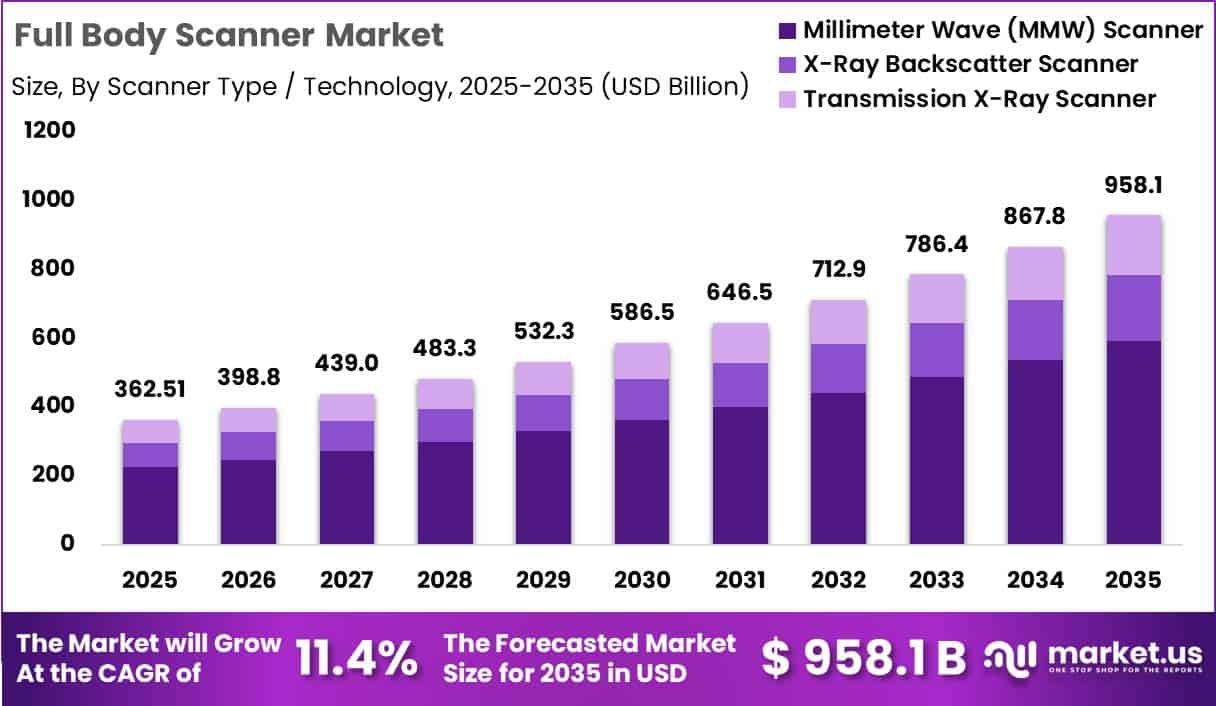
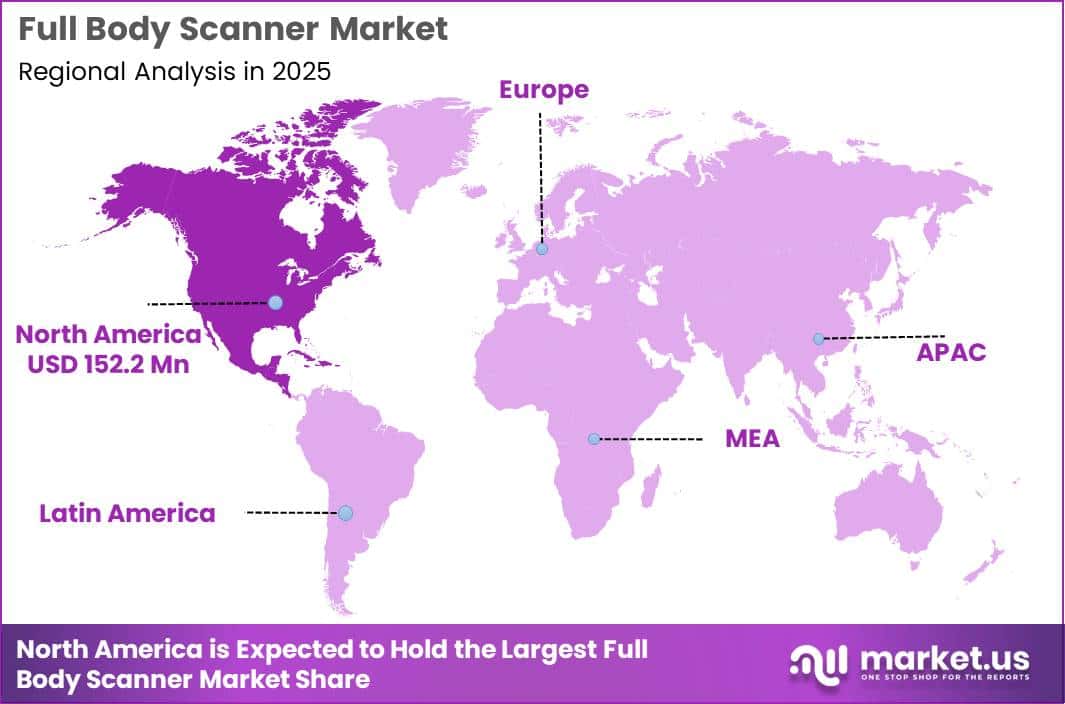
Global Full Body Scanner Market size is expected to be worth around US$ 958.15 Million by 2035 from US$ 362.51 Million in 2025, growing at a CAGR of 11.4% during the forecast period from 2026 to 2035. In 2025, North America led the market, achieving over 42% share with a revenue of US$ 152.2 Million.
The Full Body Scanner Market is experiencing significant growth due to increasing security requirements across airports, border crossings, correctional facilities, government buildings, and other critical infrastructure.
Governments worldwide are strengthening security frameworks to address evolving threats such as terrorism, illegal trafficking, and the smuggling of weapons or contraband. These developments are driving the adoption of advanced full-body scanners that provide rapid, non-invasive screening while maintaining passenger privacy and operational efficiency.
The market is also benefiting from continuous technological advancements in imaging systems. Modern full-body scanners utilize millimeter-wave and low-dose X-ray technologies, combined with artificial intelligence and automated threat detection software, to improve screening accuracy and reduce inspection times.
According to the International Civil Aviation Organization (ICAO), member states are encouraged to implement risk-based aviation security measures supported by advanced screening technologies to enhance passenger safety and streamline airport operations.
Similarly, the International Air Transport Association (IATA) reported that global air passenger traffic reached 94.1% of 2019 levels in 2024, reflecting the steady recovery of air travel and increasing demand for efficient security screening systems.
Beyond aviation, adoption is expanding across correctional institutions, customs agencies, defense facilities, and public event venues, where authorities require reliable methods to detect concealed threats without physical contact.
Furthermore, governments continue to invest in airport modernization, smart transportation infrastructure, and border security initiatives, creating favorable conditions for the deployment of next-generation screening equipment. As regulatory standards become more stringent and security priorities continue to evolve, demand for advanced full-body scanners is expected to remain strong across both developed and emerging economies.
Key Takeaways
- Market Size: Full Body Scanner Market size was US$ 362.51 Million in 2025.The market is estimated to grow to US$ 958.15 Million by 2035.
- Market Share: The Compound Annual Growth Rate (CAGR) of the market from 2026 to 2035 will be 11.4%.
- By Scanner Type / Technology: Millimeter Wave (MMW) Scanner has the largest market share, accounting for 62.00% of total sales.
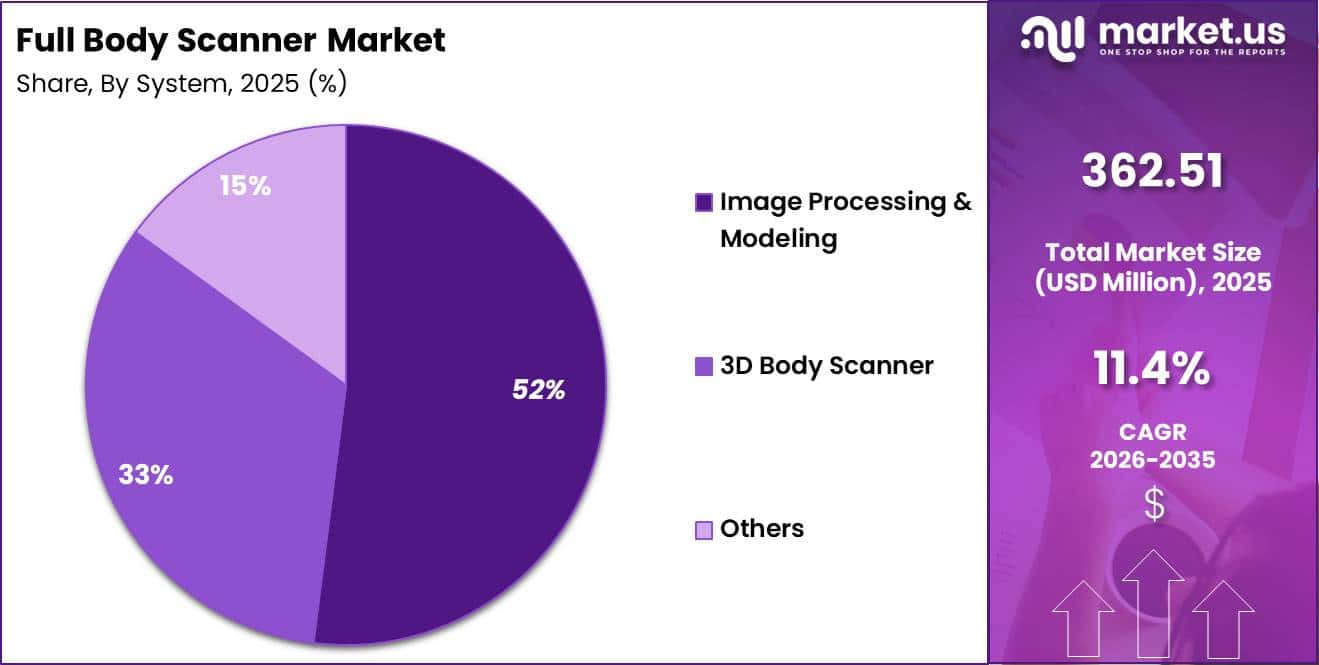
- By System: Image Processing & Modeling, accounting for 52.00% of total revenue.
- By Deployment Mode: Fixed / Stationary leads the segment, accounting for 72.00% of total revenue.
- By Component: Hardware leads the segment, accounting for 60% of total revenue.
- By End User: Airports & Aviation Authorities leads the segment, accounting for 38% of total revenue.
- Regional: North America is the dominant regional market,accounting for 42% of global sales.
By Scanner Type / Technology Analysis
The Millimeter Wave (MMW) Scanner segment dominated the Full Body Scanner Market in 2025, accounting for 62% of the total market share. Its leadership is driven by the widespread adoption of non-ionizing scanning technology, which provides high-resolution imaging while ensuring passenger safety and compliance with radiation regulations.
MMW scanners are extensively deployed at airports, government facilities, and critical infrastructure because they effectively detect concealed metallic and non-metallic threats without direct physical contact. Continuous improvements in image processing, automated threat recognition, and faster screening speeds have further strengthened their position in high-security environments.
The X-Ray Backscatter Scanner segment represented 20% of the market in 2025. These systems continue to serve specialized security applications where detailed surface imaging is required, particularly in correctional facilities, border security, and select government installations. Although concerns regarding radiation exposure have limited broader deployment, technological enhancements have improved operational safety and image clarity.
The Transmission X-Ray Scanner segment captured 18% of the market. These scanners provide comprehensive imaging by penetrating the body and are primarily utilized in high-security environments requiring advanced contraband detection. Despite offering superior detection capabilities, higher installation costs, operational complexity, and stricter regulatory oversight have restrained wider commercial adoption compared with millimeter wave technologies.
System Analysis
The Image Processing & Modeling segment held the largest share of the Full Body Scanner Market in 2025, accounting for 52% of total revenue. The dominance of this segment is attributed to growing demand for advanced software platforms capable of generating accurate body images, minimizing false alarms, and enabling automated threat recognition.
Modern image processing technologies leverage artificial intelligence and machine learning algorithms to improve detection accuracy while reducing manual intervention. Security agencies increasingly prioritize intelligent imaging systems that enhance operational efficiency and accelerate passenger screening without compromising security standards.
The 3D Body Scanner segment accounted for 33% of the market in 2025. Three-dimensional scanning systems are gaining traction across airports, customs, and critical infrastructure due to their ability to provide detailed body visualization from multiple angles. Their enhanced imaging capabilities improve the identification of concealed objects while supporting rapid inspection processes, making them suitable for high-traffic security checkpoints.
The Others segment contributed 15% of market revenue. This category includes supporting scanning platforms, integrated visualization systems, and emerging security technologies designed for specialized industrial, defense, and institutional applications. Although relatively smaller, ongoing innovation and integration with AI-driven security solutions continue to support steady growth across these niche systems.
Deployment Mode Analysis
The Fixed / Stationary segment dominated the Full Body Scanner Market in 2025, capturing 71% of the total market share. Permanent installations remain the preferred choice across airports, government buildings, border checkpoints, correctional facilities, and other high-security environments where continuous passenger or personnel screening is required.
Fixed systems offer superior scanning performance, higher throughput, enhanced image quality, and seamless integration with centralized security infrastructure. Their ability to support uninterrupted operations, advanced threat detection software, and automated screening workflows makes them essential for facilities handling large volumes of individuals daily.
Growing investments in airport modernization and national security infrastructure have further accelerated deployment of stationary scanning solutions.
Portable and mobile deployment solutions accounted for the remaining market share, serving temporary security operations, military deployments, public events, and emergency response scenarios. These systems provide operational flexibility and can be rapidly deployed in locations where permanent installations are impractical.
While mobile scanners continue to improve in terms of imaging capability and ease of transportation, they generally offer lower throughput and fewer advanced integration features than stationary systems.
Nevertheless, increasing demand for flexible security screening during large public gatherings, border patrol missions, and tactical operations is expected to support the gradual expansion of portable deployment solutions throughout the forecast period.
Component Analysis
The Hardware segment accounted for the largest share of the Full Body Scanner Market in 2025, representing 60% of total market revenue. The dominance of this segment is driven by substantial investments in advanced scanning equipment, imaging sensors, antennas, detector arrays, control units, and integrated security infrastructure.
Hardware constitutes the core of every scanning system and requires continuous technological upgrades to improve image quality, detection accuracy, operational reliability, and passenger throughput. Increasing deployment of modern security checkpoints across airports, government facilities, transportation hubs, and defense installations continues to fuel demand for high-performance scanning hardware.
Software and service components collectively represented the remaining market share. Software solutions are becoming increasingly important as organizations adopt artificial intelligence, automated threat detection, image enhancement, and centralized security management platforms to improve operational efficiency.
Meanwhile, services such as installation, preventive maintenance, calibration, technical support, and system upgrades remain essential for ensuring long-term equipment performance and regulatory compliance. As security agencies modernize existing infrastructure and integrate next-generation analytical capabilities, demand for software and professional services is expected to grow steadily.
However, the significant capital investment required for physical scanning equipment ensures that hardware remains the largest revenue-generating component throughout the forecast period.
End User Analysis
The Airports & Aviation Authorities segment dominated the Full Body Scanner Market in 2025, accounting for 38% of the total market share. Airports continue to represent the largest deployment environment due to stringent aviation security regulations, increasing passenger traffic, and ongoing investments in modern screening infrastructure.
Full body scanners have become an integral component of airport security systems, enabling rapid detection of concealed metallic and non-metallic threats while minimizing physical inspections. The adoption of automated threat recognition technologies and contactless screening solutions has further strengthened the segment’s market leadership by improving passenger experience and operational efficiency.
Other significant end users include government agencies, border security organizations, correctional facilities, military establishments, and critical infrastructure operators. These organizations increasingly deploy advanced body scanning technologies to strengthen national security, prevent unauthorized access, and detect contraband or prohibited items.
Commercial facilities, event venues, and transportation terminals are also gradually adopting full body scanners as public safety concerns continue to rise.
Although these sectors collectively account for a smaller share than aviation, growing investments in critical infrastructure protection and expanding security modernization programs are expected to create sustained demand across diverse end-user industries during the forecast period.
Market Segmentations
By Scanner Type / Technology
- Millimeter Wave (MMW) Scanner
- X-Ray Backscatter Scanner
- Transmission X-Ray Scanner
By System
- Image Processing & Modeling
- 3D Body Scanner
- Others
By Deployment Mode
- Fixed / Stationary
- Portable / Mobile
By Component
- Hardware
- Software
By End User
- Airports & Aviation Authorities
- Hospitals & Clinics
- Diagnostic Imaging Centers
- Military & Defense
- Research Institutes & Academic Hospitals
- Retail & Apparel Industry
- Others
Driver
AI Assisted Image Interpretation and Checkpoint Automation Driving Growth
Software is becoming a larger share of scanner value capture as airports move from stand-alone screening hardware to integrated checkpoint orchestration. DHS Science and Technology described airport imaging redesign efforts in 2025, including adjacent screening innovations and planned demonstrations intended to improve checkpoint flow and passenger feedback loops.
Even where the installed scanner hardware changes only modestly, vendors can expand revenue per lane through AI-based anomaly detection, automated target recognition, remote assistance, software maintenance, and analytics dashboards tied to false-alarm reduction and labor deployment.
Beyond aviation security, the medical segment is adding a separate growth leg through full-body imaging systems designed for diagnostic or weight-bearing applications rather than mass screening. FDA clearance for systems such as Planmed’s full-body weight-bearing CT in late 2025 and prior FDA approval for portable full-body CT platforms show that the category continues expanding into clinically specific use cases.
This does not indicate unrestricted volume growth across all medical full-body scanning, but it supports equipment demand in trauma, orthopedic, mobile imaging, and specialty-care environments where workflow speed, positioning flexibility, and whole-body field of view can improve clinical utility.
Strategically, this favors vendors that move up the value chain from hardware manufacturing into protocol libraries, service contracts, AI-enabled body-composition or musculoskeletal analysis, and multi-site enterprise support for hospital networks and premium outpatient imaging centers.
| Driver | (~) % Impact on CAGR Forecast | Geographic Relevance | Impact Timeline |
|---|---|---|---|
| Aviation throughput-led scanner refresh | +1.9% | North America core, EU hubs, APAC corridors, Middle East transit hubs | Short term (≤ 2 years) |
| Non-ionizing millimeter-wave compliance adoption | +1.4% | North America core, Australia, Canada, selective APAC airports | Short term (≤ 2 years) |
| AI-assisted image interpretation and checkpoint automation | +1.6% | U.S. core, EU, Gulf hubs, advanced APAC airports | Medium term (2-4 years) |
| Medical full-body imaging platform expansion | +1.2% | U.S. core, Western Europe, Japan, premium urban Asia | Medium term (2-4 years) |
| Regulatory limits on asymptomatic whole-body CT | +0.8% | U.S. core, Europe, developed reimbursement markets | Medium term (2-4 years) |
| Privacy-preserving screening architecture shift | +0.9% | North America, EU, Australia, Canada | Long term (≥ 4 years) |
Challenge
Skilled Operator Shortage Limiting Full Body Scanner Utilization
High-fidelity full body scanners, especially those using millimeter-wave imaging or advanced X-ray configurations, depend on a cadre of trained operators and image analysts who can interpret anomalies reliably and maintain equipment within prescribed safety and performance envelopes.
International evidence suggests a structural shortage of such personnel, particularly in emerging markets expanding airport and hospital infrastructure rapidly. Where basic security screening staff can be hired with modest training, advanced scanner operation often requires an additional 40–80 hours of classroom and supervised practice plus annual competency re-certification.
Security agencies report attrition rates of 10–20% per year in these skilled roles due to stress and shift patterns, implying that for every 10 new scanners installed, only 7–8 fully qualified operators are available in the first year.
This talent bottleneck leads to chronic under-operation, with scanners running at 50–70% of scheduled hours, forcing airports to keep legacy lanes open and hospitals to reserve scanners for higher-risk cohorts rather than universal screening. These limitations collectively constrain realized volume growth and shave an estimated 0.8 % points off potential CAGR.
In lower-income regions, constrained training budgets and competition with other medical imaging roles, such as radiographers for CT and MRI, further delay adoption, stretching mitigation timelines beyond four years unless international training consortia, standardized curricula, and remote supervision tools are deployed at scale.
Strategically, vendors that embed user-friendly interfaces, automated anomaly classification, and remote operations dashboards into their platforms can reduce per-operator training time by 30–40% and expand the effective talent pool. However, without such measures, the skilled operator gap remains a long-term friction rather than an outright restraint.
| Challenge | (~) % CAGR Friction Drag | Geographic Relevance | Mitigation Horizon |
|---|---|---|---|
| Radiation risk perception | -1.2% | North America, EU hubs | Medium term (2-4 years) |
| Workflow integration friction | -1.0% | Global airports, hospitals | Medium term (2-4 years) |
| Skilled operator shortage | -0.8% | North America core, APAC | Long term (≥ 4 years) |
| Interoperability & data silos | -0.9% | EU, North America, GCC | Long term (≥ 4 years) |
| Regulatory approval latency | -1.1% | North America, EU, Asia | Medium term (2-4 years) |
| Privacy & civil liberties pushback | -0.7% | North America, EU | Long term (≥ 4 years) |
Restraints
Health Risk Perception and Modality Restrictions Impacting Adoption
Although millimeter-wave scanners are classified as using non-ionizing radiation with negligible documented health risks relative to legacy backscatter X-ray devices, recurring media reports and advocacy campaigns maintain public anxiety, particularly for vulnerable groups such as pregnant women, children, and frequent flyers.
Even where clinical risk assessments deem exposure trivial, perceived risk drives regulators to mandate alternative screening pathways, private screening facilities, or opt-out rights, as seen in Australia’s 2025 changes requiring special procedures for passengers with medical devices or special circumstances and explicit accommodations for those unsuitable for body scanners.
These rules impose design constraints on new scanner deployments, including stricter energy emission thresholds, mandatory integration with medical-device-friendly protocols, and expanded footprints to co-locate private screening rooms, which can add 10–20% to installation costs at constrained terminals and reduce the feasibility of full fleet roll-outs.
For manufacturers, this translates into higher compliance engineering overhead, with regulatory affairs and clinical validation costs per model increasing by an estimated 20–30%, and longer certification timelines that increase R&D expenditure and delay revenue recognition by 6–12 months for upgraded platforms.
The net result is that some airports cap scanner adoption at selected lanes rather than full checkpoint coverage, limiting volume growth and reducing potential CAGR by 1–1.5 % points as operators prioritize less contentious modalities such as CT cabin baggage scanners or walk-through detectors.
| Restraint | (~) % Impact on CAGR Forecast | Geographic Relevance | Impact Timeline |
|---|---|---|---|
| Intensifying privacy & civil liberties pushback | -1.8% | North America, EU, selected LATAM | Medium term (2–4 years) |
| Health risk perception & modality restrictions | -1.2% | EU, North America, Australia | Short–Medium term (≤ 4 years) |
| MedTech supply chain volatility & long lead times | -1.6% | Global (NA, EU, APAC, MEA) | Medium–Long term (≥ 3 years) |
| Tight public-sector budgets & delayed security CapEx | -1.4% | North America core, EU, emerging APAC hubs | Medium term (2–4 years) |
| Fragmented, evolving screening regulations & standards | -1.0% | EU, North America, Australia, APAC corridors | Long term (≥ 4 years) |
| Vendor concentration & IP-driven pricing rigidity | -0.9% | Global tier-1 airports & high-security sites | Medium term (2–4 years) |
Opportunity
Privacy By Design and Compliance Services Creating Scanner Growth Opportunities
Privacy-by-design and compliance services constitute a distinct opportunity because they respond to evolving legal and social expectations around body imaging rather than simply reflecting the current presence of scanners at checkpoints, effectively creating a new service and software layer atop installed hardware.
Regulatory and public scrutiny of full body scanners has historically focused on image detail, storage, and potential misuse, prompting moves toward automated target recognition software and generic silhouette displays that limit human viewing of images.
As privacy laws tighten and new data protection regimes emerge, operators will increasingly require specialized consulting, software updates, and certification services to maintain compliance. This demand is not yet fully monetized.
If scanner manufacturers and integrators can bundle privacy enhancements, software upgrades, and annual compliance audits as service contracts priced at 5–8% of hardware value per year, the recurring services revenue pool tied to privacy and compliance could increase materially, potentially adding around 1 % point of CAGR upside by raising the services share of total scanner-related revenue by 10–15% over the next decade.
Beyond revenue, robust privacy-by-design offerings can materially reduce customer churn and price sensitivity by de-risking regulatory exposure. Operators that can demonstrate adherence to recognized privacy and radiation safety standards gain a reputational and legal shield, which in turn supports premium pricing and more favorable total cost of ownership comparisons versus lower-cost, non-compliant competitors, widening gross margins by a few % points and improving long-term customer retention.
| Opportunity | (~) % Potential CAGR Upside | Geographic Relevance | Execution Window |
|---|---|---|---|
| AI-native smart checkpoint platforms | +2.0% | North America, EU, GCC hubs | Short term |
| Non-aviation security vertical expansion | +1.8% | APAC emerging, Latin America, Africa | Medium term |
| Occupational health & wellness scanning | +1.5% | North America, EU, East Asia | Medium term |
| Hybrid security–diagnostic imaging hubs | +1.3% | Global tier-1 cities | Long term |
| Privacy-by-design & compliance services | +1.0% | North America, EU, OECD markets | Short term |
| Subscription & usage-based scanner models | +1.2% | APAC emerging, Latin America | Medium term |
Regional Analysis
In 2025, North America led the market, achieving over 42% share with a revenue of US$ 152.2 Million.
In 2025, the North America region’s leadership is supported by extensive deployment of advanced security screening systems across airports, government facilities, border checkpoints, correctional institutions, and critical infrastructure.
Strong investments in homeland security modernization and continuous upgrades to aviation security systems have accelerated the adoption of millimeter wave and advanced X-ray body scanners. Regulatory requirements issued by transportation and public safety authorities also encourage regular replacement of legacy screening equipment with high-performance, AI-enabled systems that offer faster throughput and improved threat detection capabilities.
The United States represents the largest contributor to regional revenue, driven by substantial security budgets, a dense network of international airports, and the presence of leading manufacturers and technology providers specializing in security imaging solutions.
Canada complements regional growth through investments in airport modernization, smart border management initiatives, and public infrastructure protection programs. The growing emphasis on contactless passenger screening, enhanced cybersecurity integration, and automated image processing is further strengthening market expansion across North America.
Additionally, increasing demand for full-body scanners in non-aviation sectors such as courthouses, prisons, defense installations, event venues, and commercial facilities is broadening the market base. Continuous technological innovation, favorable government procurement policies, and strong research capabilities are expected to help North America maintain its leading position throughout the forecast period.
Key Regions and Countries
North America
- The US
- Canada
Europe
- Germany
- France
- The U.K.
- Italy
- Spain
- Russia & CIS
- Rest of Europe
Asia Pacific
- China
- India
- Japan
- South Korea
- ASEAN
- Australia & New Zealand
- Rest of Asia Pacific
Middle East & Africa
- GCC
- South Africa
- Rest of Middle East & Africa
Latin America
- Brazil
- Mexico
- Rest of Latin America
Key Player Analysis
The Full Body Scanner Market is moderately consolidated, with a mix of established security technology providers and specialized imaging companies competing through technological innovation, regulatory compliance, and long-term government contracts.
Market participants are prioritizing advanced screening capabilities that improve detection accuracy while reducing inspection time and enhancing passenger privacy. Competition is increasingly driven by investments in artificial intelligence, automated threat recognition, high-resolution imaging, and seamless integration with airport, border control, and critical infrastructure security systems.
Vendors are also strengthening their market positions through continuous R&D, strategic partnerships, and ecosystem-based solutions that combine hardware, software, analytics, and remote monitoring capabilities.
Key companies shaping the competitive landscape include Smiths Detection Group Ltd., L3Harris Technologies Inc., Rapiscan Systems (OSI Systems), Nuctech Company Limited, Leidos Holdings Inc., Adani Systems Inc., QinetiQ Group Plc, Analogic Corporation, Brijot Imaging Systems Inc., 3F Advanced Systems, Braun & Co. Limited, Westminster Group Plc, Rohde & Schwarz GmbH & Co. KG, Evolent AI (formerly Evolv Technology), and Tek84 Inc.
These companies are focusing on next-generation body scanning technologies with enhanced image processing, AI-powered anomaly detection, and low-radiation or non-ionizing scanning solutions. Strategic collaborations with transportation authorities, defense organizations, and infrastructure operators are expanding deployment opportunities while improving workflow integration across security checkpoints.
Product innovation emphasizes higher throughput, reduced false alarms, intuitive operator interfaces, and centralized security management. As demand grows for intelligent and connected security ecosystems, competition is increasingly centered on delivering integrated screening platforms that combine detection hardware, analytics software, cybersecurity, and lifecycle service support.
Top Key Players
- Smiths Detection Group Ltd.
- L3Harris Technologies Inc.
- Rapiscan Systems (OSI Systems)
- Nuctech Company Limited
- Leidos Holdings Inc.
- Adani Systems Inc.
- QinetiQ Group Plc
- Analogic Corporation
- Brijot Imaging Systems Inc.
- 3F Advanced Systems
- Braun & Co. Limited
- Westminster Group Plc
- Rohde & Schwarz GmbH & Co. KG
- Evolent AI (formerly Evolv Technology)
- Tek84 Inc.
Recent Developments
- In August 2025, Smiths Detection Group Ltd. acquired Med Graphix Inc., a long-time service partner specializing in component repair and refurbishment, strengthening its global service capabilities and extending the lifecycle of security screening systems.
- In September 2025, Rapiscan Systems (OSI Systems) launched the Orion® Road Mobile X-ray Inspection System, a next-generation mobile inspection platform designed for rapid deployment in border security, customs, and critical infrastructure applications.
- In December 2025, Smiths Detection Group Ltd. and METCO announced the establishment of a new assembly and manufacturing facility in Saudi Arabia to locally produce and support advanced X-ray screening solutions under Saudi Vision 2030.
- In April 2026, Leidos Holdings Inc. announced a strategic joint venture with Analogic Corporation (owned by Altaris) by combining Leidos Security Enterprise Solutions with Analogic’s imaging technologies to expand innovation in airport, border, and critical infrastructure security screening.
Report Scope
| Report Features | Description |
|---|---|
| Market Value (2025) | US$ 362.51 Million |
| Forecast Revenue (2035) | US$ 958.15 Million |
| CAGR (2026-2035) | 11.4% |
| Base Year for Estimation | 2025 |
| Historic Period | 2020-2024 |
| Forecast Period | 2026-2035 |
| Report Coverage | Revenue Forecast, Market Dynamics, Competitive Landscape, Recent Developments |
| Segments Covered | By Scanner Type / Technology (Millimeter Wave (MMW) Scanner ,X-Ray Backscatter Scanner ,Transmission X-Ray Scanner) By System (Image Processing & Modeling ,3D Body Scanner ,Others) By Deployment Mode (Fixed / Stationary, Portable / Mobile) By Component (Hardware ,Software) By End User (Airports & Aviation Authorities ,Hospitals & Clinics, Diagnostic Imaging Centers ,Military & Defense ,Research Institutes & Academic Hospitals ,Retail & Apparel Industry ,Others) |
| Regional Analysis | North America – The US, Canada; Europe – Germany, France, U.K., Italy, Spain, Russia & CIS, Rest of Europe; Asia Pacific – China, India, Japan, South Korea, ASEAN, Australia & New Zealand, Rest of Asia Pacific; Middle East & Africa – GCC, South Africa, Rest of Middle East & Africa; Latin America – Brazil, Mexico, Rest of Latin America |
| Competitive Landscape | Smiths Detection Group Ltd.,L3Harris Technologies Inc.,Rapiscan Systems (OSI Systems),Nuctech Company Limited,Leidos Holdings Inc.,Adani Systems Inc.,QinetiQ Group Plc,Analogic Corporation,Brijot Imaging Systems Inc.,3F Advanced Systems,Braun & Co. Limited,Westminster Group Plc,Rohde & Schwarz GmbH & Co. KG,Evolent AI (formerly Evolv Technology),Tek84 Inc. |
| Customization Scope | Customization for segments, region/country-level will be provided. Moreover, additional customization can be done based on the requirements. |
| Purchase Options | We have three licenses to opt for: Single User License, Multi-User License (Up to 5 Users), Corporate Use License (Unlimited User and Printable PDF) |





































