


Report Overview
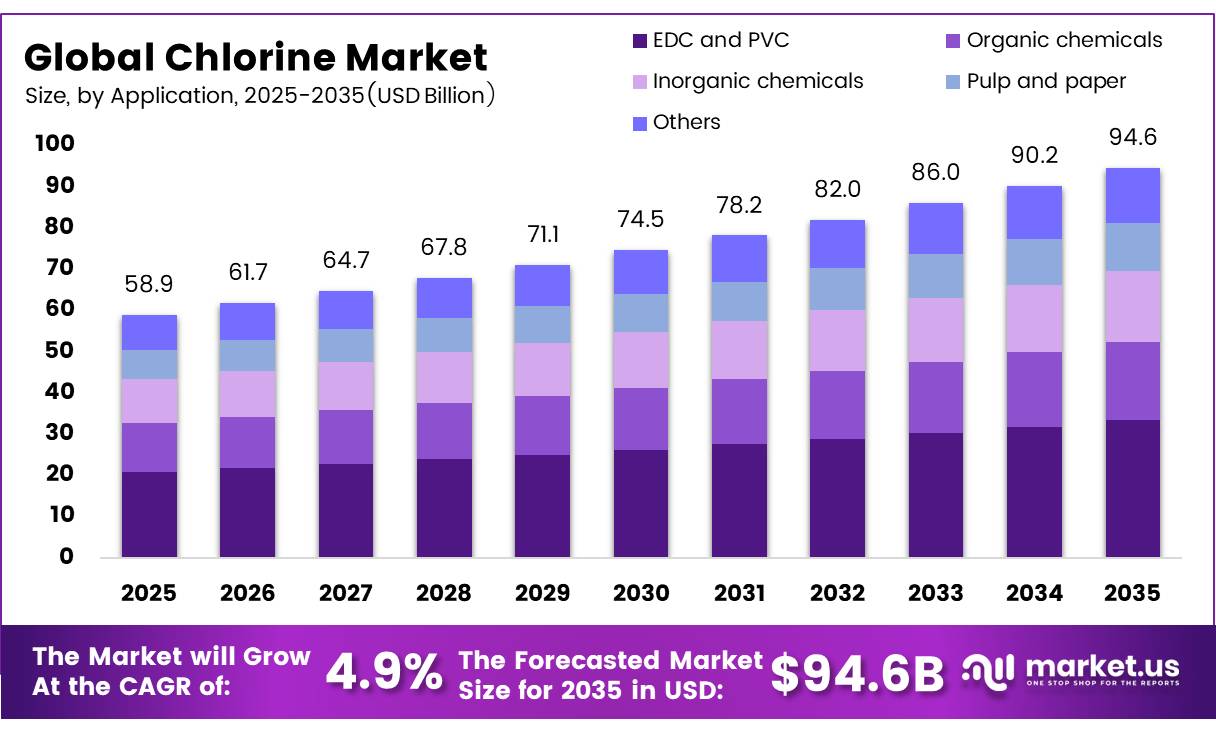
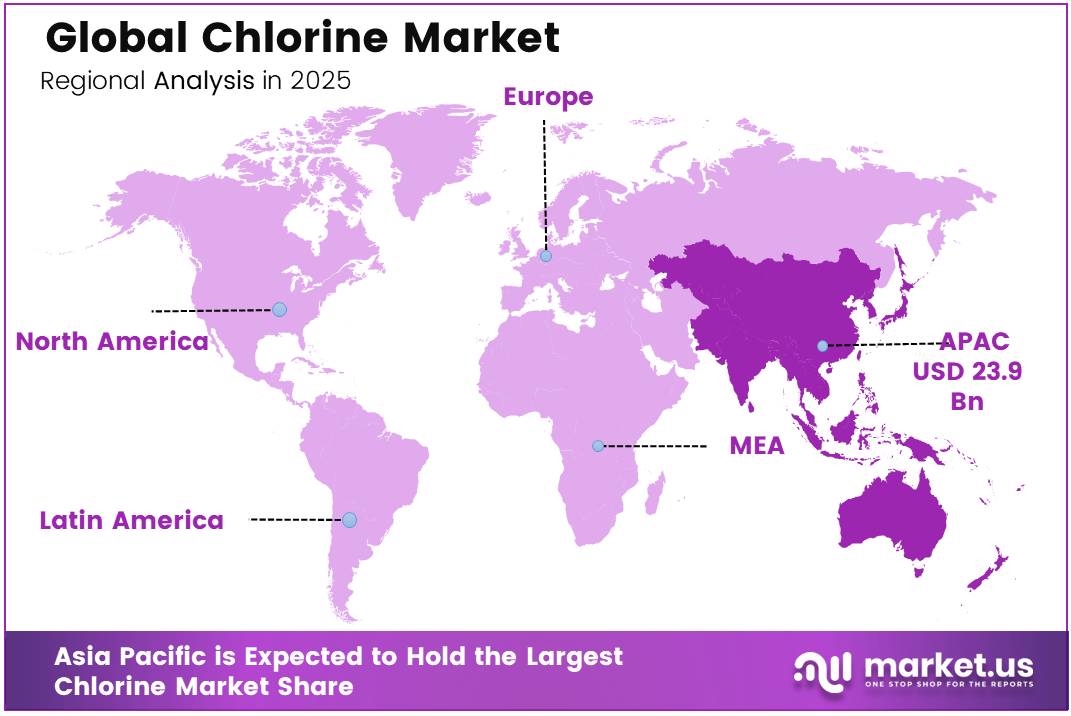
The global chlorine market was valued at USD 58.9 billion in 2025 and is expected to grow to USD 94.6 Billion in 2035. Between 2025 and 2035, this market is estimated to register a CAGR of 4.9%. In 2025, Asia Pacific led the market, achieving over 40.7% share with a revenue of USD 23.9 Billion.
The chlorine industry is a core part of the chlor-alkali value chain, supplying inputs for polyvinyl chloride, organic and inorganic chemicals, pulp and paper processing, pharmaceuticals, and water disinfection.
- Chlorine is mainly produced by electrolysing purified salt brine, alongside caustic soda and hydrogen. Euro Chlor reports that its members operate 60 manufacturing locations across 19 European countries, with 11 million tonnes of chlorine capacity.
Key Takeaways
- The Global chlorine market was valued at USD 58.9 billion in 2025.
- The global market is projected to grow at a CAGR of 4.9% and is estimated to reach USD 94.6 billion by 2035.
- Based on form, liquid chlorine dominated the market, accounting for 65.1% of the total market share.
- Based on application, EDC and PVC represented the leading segment, constituting 35.2% of the chlorine market.
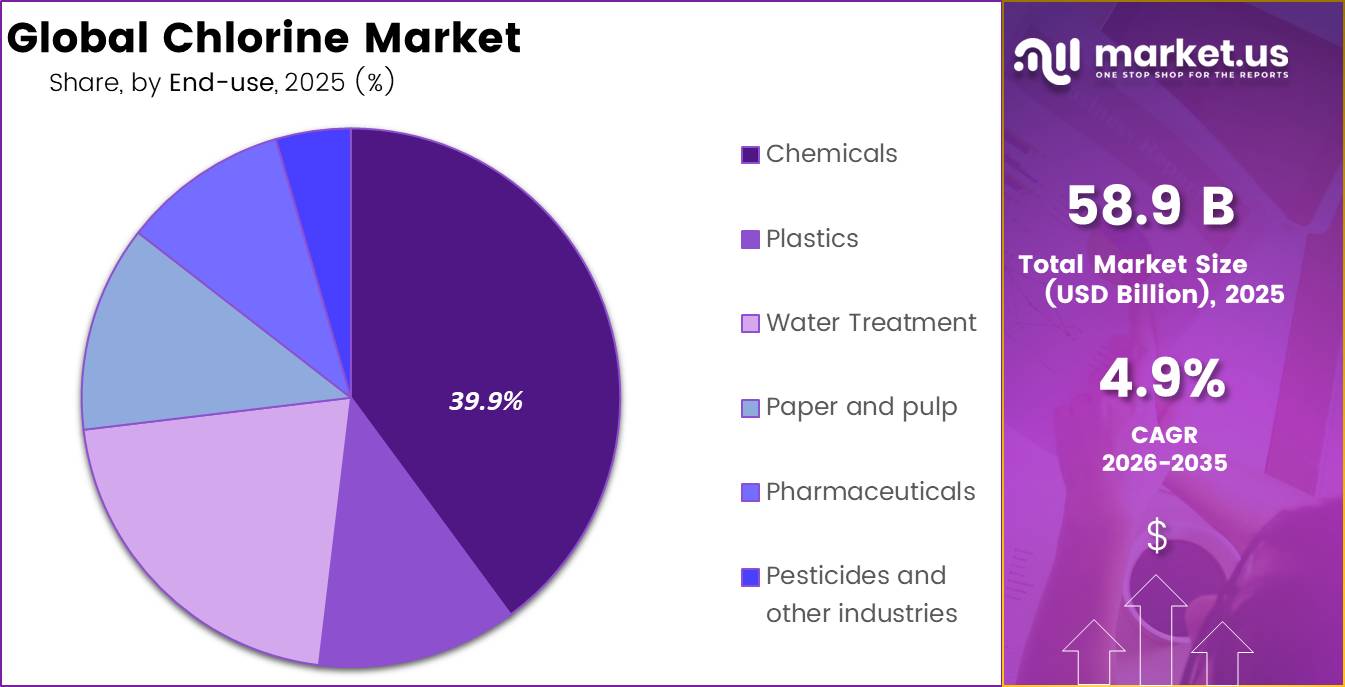
- Among the end-users, the chemicals industry held the largest market share of 39.9%.
- In 2025, Asia Pacific was the dominant region in the global chlorine market, accounting for 40.7% of the total market share.
Current operating conditions remain mixed. European chlorine output reached 629,642 tonnes in April 2026, while elevated electricity prices, weaker chemical demand, regulatory costs, and global overcapacity continued to pressure regional plants. Feedstock availability remains strong: the U.S. Geological Survey estimated American salt production at 40 million tonnes in 2025. The chemical industry represented about 42% of domestic salt sales, and brine supplied nearly 90% of salt used as chemical feedstock, with chlorine and caustic soda producers identified as the principal chemical consumers.
Demand is supported by PVC production, sanitation investment, industrial cleaning, bleaching, and chemical synthesis. WHO and UNICEF reported that 2.1 billion people still lacked safely managed drinking water in 2024, indicating substantial long-term requirements for treatment and disinfection infrastructure. In the United States, more than one in five people receive water treated with chloramines, which are commonly produced by combining ammonia with chlorine.
Future growth opportunities are expected to emerge from expanding PVC and caustic soda requirements, particularly across Asia, alongside municipal water upgrades and industrial wastewater treatment. USGS expects global chlor-alkali brine demand to rise in 2026 as PVC and caustic soda consumption increases.
Chlorine Market Segmentation
By Form Analysis
Liquid Chlorine Leads with 65.1% Due to Its Broad Industrial Use
In 2025, Liquid chlorine held a dominant market position, capturing more than a 65.1% share. Its leading position was supported by wide use in water treatment, chemical production, pulp and paper processing, and disinfectant manufacturing. Liquid chlorine is easier to store and transport in pressurised containers than gaseous chlorine, making it suitable for large municipal and industrial facilities. By June 2026, demand remained steady as manufacturers continued to rely on liquid chlorine for controlled dosing, dependable supply, and integration with existing processing systems.
Gaseous chlorine is emerging as a growing segment because it provides rapid disinfection and strong oxidation performance. It is mainly used at facilities equipped with dedicated handling, monitoring, and safety systems, particularly in large-scale water treatment and chemical processing operations.
Application Analysis
EDC and PVC Dominate with 35.20% Due to Strong Construction and Manufacturing Demand
In 2025, EDC and PVC held a dominant market position, capturing more than a 35.20% share. Their leadership was supported by the extensive use of chlorine in producing ethylene dichloride, the main feedstock for vinyl chloride and PVC. Strong demand from pipes, flooring, cables, window profiles, medical products, and packaging kept chlorine consumption steady across this application.
Organic chemicals are emerging as a growing application segment. Chlorine is widely used as a processing agent and intermediate in solvents, refrigerants, pharmaceuticals, agrochemicals, and speciality chemicals, supporting consistent demand from diversified manufacturing industries.
End User Analysis
Chemicals Leads with 39.9% as Broad Industrial Use Supports Strong Chlorine Demand
In 2025, Chemicals held a dominant market position, capturing more than a 39.9% share. The segment remained ahead because chlorine is widely used in producing solvents, intermediates, disinfectants, bleaching agents, and other essential chemical products. Large chemical facilities depend on a steady chlorine supply for continuous processing, making integrated chlor-alkali plants important to overall demand.
Plastics is emerging as a growing end-user segment as chlorine remains essential in PVC production. Demand is supported by pipes, cables, flooring, packaging, medical products, and durable construction materials.
Key Market Segments
By Form
- Liquid chlorine
- Gaseous chlorine
By Application
- EDC and PVC
- Organic chemicals
- Inorganic chemicals
- Pulp and paper
- Others
By End-user
- Chemicals
- Plastics
- Water Treatment
- Paper and pulp
- Pharmaceuticals
- Pesticides and other industries
Drivers
Water Treatment Infrastructure Investment Under SDG 6
The macroeconomic underpinning is stark: approximately 2.2 billion people worldwide still lack access to safe drinking water, and the UN SDG 6 framework projects that at the current pace of infrastructure deployment, universal safe drinking water coverage will not be achieved until at least 2049. Annual WASH (Water, Sanitation, and Hygiene) target investment requirements stand at approximately USD 114 billion per year, while as recently as 2024 only 74% of the global population had access to safely managed drinking water, up from 68% in 2015.
In the U.S. alone, the 2022 EPA supply chain profile estimated 628 million kg of annual chlorine demand from municipal wastewater and drinking water applications, representing approximately 5% of total domestic chlorine production, and this baseline is expanding as aging infrastructure is upgraded under federal programs. For emerging markets, chlorination remains the most cost-effective and scalable disinfection technology: no substitute achieves the same combination of broad-spectrum efficacy, residual protection through distribution networks, and low unit cost.
This driver structurally supports long-dated supply agreements with municipal authorities, shifts chlorine demand patterns from industrial cyclicality to quasi-sovereign budget allocations, and accelerates electrochloration system adoption (36.5% of injection product mix by 2026), which incentivizes on-site generation rather than transported liquid chlorine, altering last-mile logistics economics for producers.
Drivers Impact Analysis
| Driver | (~) % Impact on CAGR | Geographic Relevance | Impact Timeline |
|---|---|---|---|
| PVC & Construction Boom | +1.2% | APAC core (China, India, SEA); Middle East spill-over | Medium term (2–4 years) |
| Water Treatment Infrastructure | +1.0% | Global; high-intensity in South Asia, Sub-Saharan Africa, SEA | Long term (≥ 4 years) |
| Membrane Cell Technology Transition | +0.7% | EU, North America, China, India mandatory compliance; APAC investment wave | Short-to-Medium term (≤ 3 years) |
| Agrochemical & Pharmaceutical Synthesis | +0.6% | APAC core, North America, EU generics corridors | Short term (≤ 2 years) |
| Green Chemistry & Renewable Energy Inputs | +0.5% | North America, EU, East Asia (South Korea, Japan, China) | Long term (≥ 4 years) |
| Specialty & High-Purity Chlorine | +0.4% | North America, EU, East Asia (fab corridors: Taiwan, South Korea, Japan) | Medium-to-Long term (2–5 years) |
Restraint
Extreme Energy Cost Burden on Chlor-Alkali Production
In Europe which consumed approximately 19.5 billion kWh of electricity annually in chlor-alkali production before the post-2021 energy crisis industrial electricity prices surged to EUR 150–250 per MWh during 2022–2023 and remain structurally elevated at EUR 80–130 per MWh in 2025–2026, 2–3× the pre-crisis norm of EUR 40–60 per MWh; at EUR 100 per MWh, the electricity cost alone for producing one tonne of chlorine via membrane cell is EUR 250–300, representing a cost base that eliminates any margin at chlorine selling prices of EUR 160–220 per tonne in a competitive APAC-pressured market.
The European energy-intensive industry coalition explicitly called in February 2026 for a EUR 50 per MWh electricity benchmark as a survival threshold, and the European Commission’s March 2025 Clean Industrial Deal mobilizing over EUR 100 billion acknowledged the crisis by committing to lower energy bills for energy-intensive sectors including chemicals; Germany’s EU-approved industrial electricity price subsidy of EUR 0.05 per kWh for qualifying chlor-alkali facilities from 2026 provides partial relief but applications are not processable until 2027 retroactively, meaning producers bear the full market-rate burden through 2026.
European chlor-alkali operators have reduced average capacity utilization to 70–75% below the 80–85% floor required for positive EBITDA contribution forcing 11+ million tonnes of permanent capacity closures across European chemicals since 2023; second, greenfield chlor-alkali investment is migrating exclusively to APAC and the Middle East where industrial electricity costs of USD 0.04–0.07 per kWh are 60–70% below European equivalents, creating a structural geographic rebalancing of global chlorine supply that constrains CAGR by an estimated -1.4 percentage points over the medium term.
Restraint Impact Analysis
| Restraint | (~) % Impact on CAGR | Geographic Relevance | Impact Timeline |
|---|---|---|---|
| Extreme Energy Cost Burden on Chlor-Alkali Production | -1.4% | EU primary; North America, India secondary | Medium term (2–4 years) |
| Chlorine–Caustic Soda Co-Product Imbalance | -1.1% | Global — acute in China, EU, North America | Short term (≤ 2 years) |
| Escalating Hazardous Chemical Regulatory Compliance | -0.9% | China (May 2026 law); EU REACH; North America DOT | Medium term (2–4 years) |
| PVC Market Structural Weakness & China Overcapacity | -0.7% | China domestic; APAC, EU import markets | Short term (≤ 2 years) |
| Geopolitical Supply Chain Disruption (Hormuz/Naphtha) | -0.4% | GCC, APAC naphtha corridors; EU import exposure | Short term (≤ 2 years) |
| Alternative Disinfection Technologies Displacing Chlorine | -0.3% | North America, EU (premium municipal markets) | Long term (≥ 4 years) |
Opportunity
Green Chlorine Co-Production Monetization
A world-scale chlorine plant producing 200,000 tonnes per annum of Cl₂ simultaneously generates approximately 5,600 tonnes of H₂ at emerging certified hydrogen prices of USD 3–5/kg versus legacy utility or commodity values of under USD 1/kg, this represents a USD 11–22 million annual incremental revenue stream per large-scale facility that is currently being left on the table.
Simultaneously, load-shifting chlor-alkali electrolysis operations to periods of surplus renewable energy can reduce electricity costs by up to 22% and cut CO₂ emissions by up to 10% by 2040 enabling producers to sell electricity-purchase-agreement-backed, low-carbon hydrogen at a 30–50% price premium over conventional industrial hydrogen. INEOS Inovyn’s Ultra Low Carbon Chlor-Alkali range, launched in 2024, already demonstrated a 70% reduction in CO₂ footprint, establishing the regulatory and commercial template that peers have not yet systematically replicated.
The strategic pivot here requires chlor-alkali operators to invest in hydrogen purification skids, secure off-take agreements with industrial hydrogen consumers, and pursue green hydrogen certification under the EU’s delegated act framework a combination that could generate +2.2 percentage points of incremental CAGR for first movers in the EU and North American markets between 2028 and 2033, above and beyond what any consensus market model currently projects for the chlorine segment.
Opportunity Impact Analysis
| Opportunity | (~) % Potential CAGR | Geographic Relevance | Execution Window |
|---|---|---|---|
| Green Chlorine Co-Production Monetization (H₂ Revenue Stacking) | +2.2% | EU, North America, Japan | Medium term (2–4 years) |
| Chlorine Dioxide (ClO₂) Adjacency: Food Safety & Advanced Disinfection | +1.8% | North America core, APAC emerging, MEA | Short term (≤ 2 years) |
| Pharmaceutical/Specialty API Intermediate Vertical Integration | +2.5% | India, EU, North America (reshoring) | Medium term (2–4 years) |
| Circular Economy PVC Feedstock Recovery & Chlorine Recapture | +1.5% | EU (CBAM-driven), North America, Japan | Long term (≥ 4 years) |
| Emerging-Market Municipal Water Infrastructure TAM Penetration | +1.9% | India, SSA, Southeast Asia, MENA | Short–Medium term (1–3 years) |
| Chlor-Alkali Specialization M&A Roll-Up & Portfolio Arbitrage | +2.8% | North America, EU, select APAC | Medium–Long term (3–6 years) |
Challenge
Energy Price Volatility & Electrolysis Cost Exposure
Chlor-alkali electrolysis is one of the most electricity-intensive industrial processes in the global chemical sector, consuming approximately 2,500–3,000 kWh per metric tonne of chlorine produced via membrane cell technology the dominant production method accounting for approximately 44.8% of global chlor-alkali output in 2026 meaning that electricity represents 60–70% of total cash production costs at most membrane-cell plants, and any sustained dislocation in industrial power tariffs directly compresses producer operating margins with near-zero structural ability to absorb the shock through operational redesign on short notice.
In Europe specifically where the EU energy crisis of 2022–2023 inflated industrial electricity prices to €200–350/MWh versus pre-crisis norms of €40–60/MWh multiple chlor-alkali facilities operated at reduced utilization rates of 55–70% to limit cash burn, directly constraining chlorine supply to downstream customers and accelerating capacity rationalization.
Challenges Impact Analysis
| Challenge | (~) % CAGR Friction | Geographic Relevance | Mitigation Horizon |
|---|---|---|---|
| Energy Price Volatility & Electrolysis Cost Exposure | -2.0% | EU, India, APAC ex-China | Medium term (2–4 years) |
| Chlorine–Caustic Soda Co-Product Demand Imbalance | -1.8% | Global (structurally universal) | Long term (≥ 4 years) |
| Escalating Multi-Jurisdictional Regulatory Compliance | -1.5% | EU regulatory hubs, North America, APAC | Medium term (2–4 years) |
| Hazmat Logistics Friction & Last-Mile Delivery Risk | -1.2% | North America rail corridors, EU, South Asia | Medium term (2–4 years) |
| Decarbonization CAPEX Burden & Carbon Cost Pass-Through | -1.7% | EU (CBAM), North America, Japan | Long term (≥ 4 years) |
| Chinese Overcapacity & PVC Price Pressure on Cl₂ Offtake | -1.9% | Asia-Pacific, MEA, South Asia, Global pricing | Long term (≥ 4 years) |
Geopolitical Impact Analysis
Trade Policies, Energy Security, and Industrial Strategies Are Reshaping the Global Chlorine Market
Geopolitical tensions are affecting the global chlorine market through rising energy costs, trade restrictions, and supply-chain disruptions. Chlorine production requires large amounts of electricity, making operating costs highly sensitive to regional power prices and energy-security policies. This is particularly important in Europe, where industrial electricity prices remain higher than in the United States and China, reducing the competitiveness of chlor-alkali producers.
Shipping disruptions also influence the movement of salt, plant equipment, PVC resin, ethylene dichloride, and other chlorine-based products. In early 2024, trade through the Suez Canal declined by 50%, while Panama Canal trade fell by 32%. Longer shipping routes increased freight costs and delayed chemical deliveries across major industrial markets.
Trade policies are further changing downstream chlorine demand. In January 2025, the European Commission imposed anti-dumping duties ranging from 74.2% to 100.1% on PVC imports from Egypt and 58% to 77% on PVC imports from the United States. Since PVC is a major chlorine-consuming product, these duties can redirect trade flows and support regional production.
Regional Analysis
Asia Pacific Leads Through Strong Chemical and PVC Production
In 2025, Asia Pacific held market leadership, accounting for 40.7% and USD 23.97 billion. The region benefited from large chlor-alkali production bases, expanding chemical manufacturing, municipal water treatment, and demand for PVC across construction, packaging, cables, and consumer goods. China remained the main production centre. In February 2026, its National Bureau of Statistics reported that caustic soda output reached 46.54 million tonnes in 2025, rising 5.0% from the previous year.
As caustic soda and chlorine are produced together through chlor-alkali electrolysis, this scale reflects substantial chlorine availability. Capacity expansion also strengthened supply. In September 2025, Bohai Chemical’s Nangang complex reached 900,000 tonnes of caustic soda capacity and 1.2 million tonnes of PVC capacity. Continued industrial investment and infrastructure demand are expected to support regional leadership.
Key Regions and Countries Covered
- North America
- US
- Canada
- Europe
- Germany
- France
- The UK
- Spain
- Italy
- Rest of Europe
- Asia Pacific
- China
- Japan
- South Korea
- India
- Australia
- Rest of APAC
- Latin America
- Brazil
- Mexico
- Rest of Latin America
- Middle East & Africa
- South Africa
- Saudi Arabia
- UAE
- Rest of MEA
Key Players Analysis
Chlorine manufacturers compete through production scale, energy efficiency, downstream integration, and reliable supply. This structure allows them to use chlorine close to production sites, reduce transport risks, and balance output with caustic soda demand.
Market participants continue investing in membrane-cell technology, plant automation, renewable electricity, and capacity upgrades to lower energy consumption and improve operating safety. Large producers also secure long-term agreements with water-treatment, chemical, pulp and paper, and plastics manufacturers.
Regional expansion remains important, particularly in Asia Pacific, where new chemical and PVC facilities support chlorine consumption. Access to affordable electricity, salt feedstock, established distribution networks, and downstream manufacturing capacity strongly influences competitive positioning. Strategic partnerships and plant integration help key players strengthen customer relationships and protect market share.
Market Key Players
- Olin Corporation
- Occidental Petroleum Corporation OxyChem
- Westlake Corporation
- INEOS Group Holdings SA
- Dow Inc
- Solvay SA
- Hanwha Solutions Corporation
- Tata Chemicals Ltd
- Formosa Plastics Corporation
- Aditya Birla Chemicals India Ltd
- Nouryon
- Ercros SA
- BASF SE
- ERCO Worldwide
- Chemtrade Logistics
- Other companies
Key Development
- In March 2025, major chemical companies expanded chlor-alkali production capacities and invested in energy-efficient technologies, strengthening competition in the global chlorine market and improving overall production efficiency.
- In July 2025, industry players increasingly adopted low-carbon and sustainable chlorine manufacturing technologies in response to stricter environmental regulations, driving a shift toward greener production processes and reduced CO₂ emissions across the sector.
Report Scope
| Report Features | Description |
|---|---|
| Market Value (2025) | USD 58.9 Bn |
| Forecast Revenue (2035) | USD 94.6 Bn |
| CAGR (2026-2035) | 4.9% |
| Base Year for Estimation | 2025 |
| Historic Period | 2020-2024 |
| Forecast Period | 2026-2035 |
| Report Coverage | Revenue Forecast, Market Dynamics, Competitive Landscape, Recent Developments |
| Segments Covered | By Form (Liquid Chlorine, Gaseous Chlorine) By Application (EDC/PVC, Inorganic Chemicals, Organic Chemicals, Paper and Pulp, Others), By End User (Chemicals, Plastics, Water Treatment, Paper and pulp, Pharmaceuticals, Pesticides and other industries) |
| Regional Analysis | North America – The US & Canada; Europe – Germany, France, The UK, Spain, Italy, Russia & CIS, Rest of Europe; APAC– China, Japan, South Korea, India, ASEAN & Rest of APAC; Latin America– Brazil, Mexico & Rest of Latin America; Middle East & Africa– GCC, South Africa, & Rest of MEA |
| Competitive Landscape | BASF SE Profiled, Olin Corporation, The Dow Chemical Company, Occidental Petroleum Corporation, Ercros, PPG Industries, De Nora, Inovyn, Hanwha Chemical Corporation, Formosa Plastics Corporation, Ineos Group Ltd, Tata Chemicals Limited, Xinjiang Zhongtai Chemicals Co. Ltd, Tosoh Corporation |
| Customization Scope | Customization for segments, region/country-level will be provided. Moreover, additional customization can be done based on the requirements. |
| Purchase Options | We have three licenses to opt for: Single User License, Multi-User License (Up to 5 Users), Corporate Use License (Unlimited Users and Printable PDF) |





































