


Market Overview
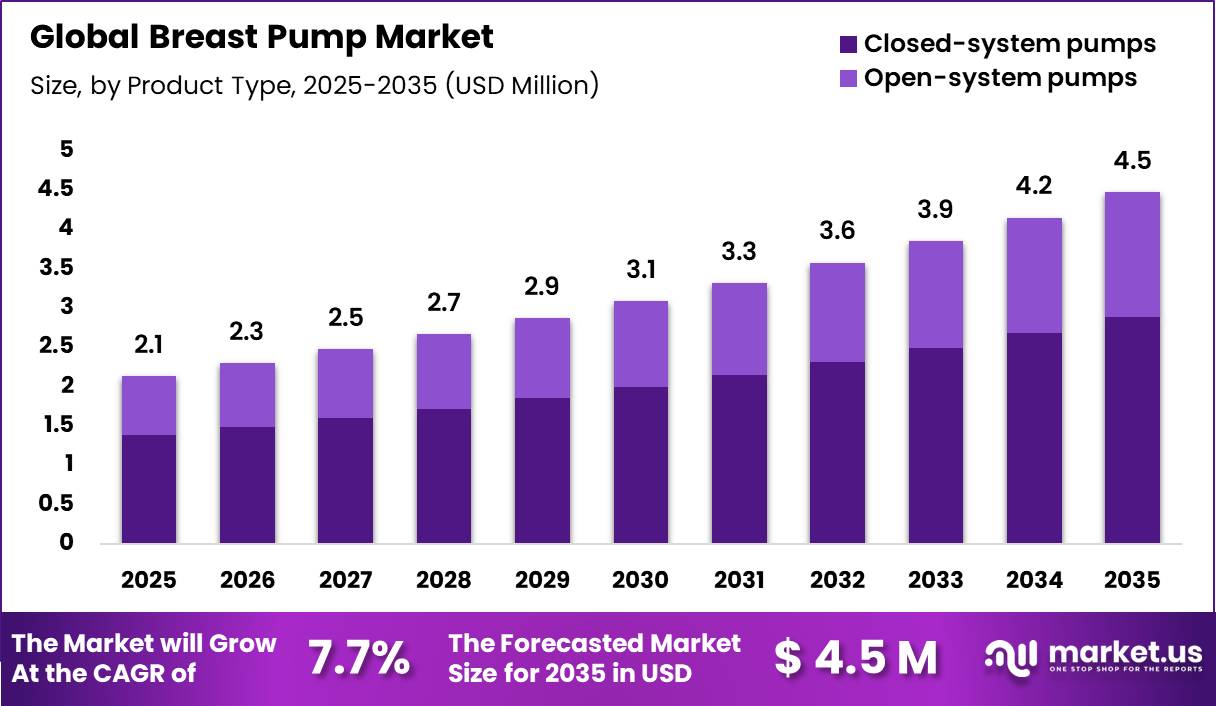
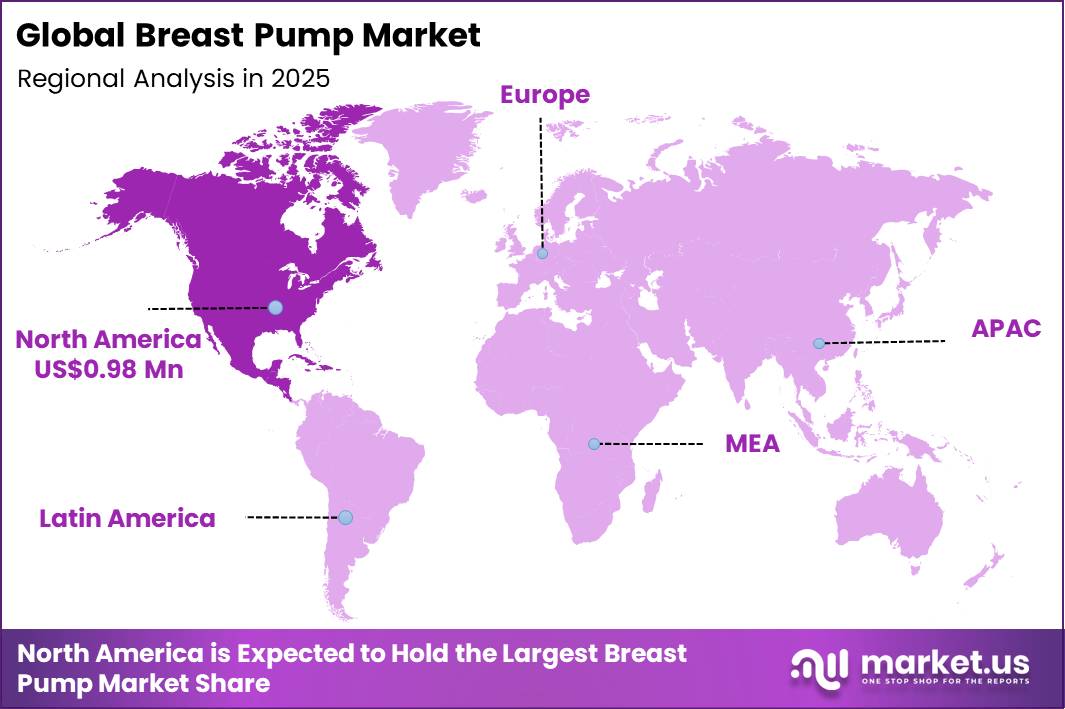
Global Breast Pump Market size is expected to be worth around US$ 4.5 Million by 2035 from US$ 2.1 Million in 2025, growing at a CAGR of 7.7% during the forecast period from 2026 to 2035. In 2025, North America led the market, achieving over 45.6% share with a revenue of US$ 0.98 Million.
The global breast pump market is experiencing steady growth, driven by increasing awareness of breastfeeding benefits, rising female workforce participation, and expanding maternal healthcare support systems.
According to the World Health Organization (WHO) and UNICEF, approximately 48% of infants under six months globally are exclusively breastfed, reflecting gradual improvement in breastfeeding practices worldwide. However, WHO also highlights that more than 820,000 child deaths annually could be prevented through improved breastfeeding support, reinforcing the need for accessible lactation solutions.
UNICEF data shows that early initiation of breastfeeding within one hour of birth occurs in less than half of newborns globally, indicating a significant gap in optimal feeding practices and increasing reliance on breast milk expression devices in working and medically challenged populations.
Breast pumps play a critical role in supporting lactating mothers, especially as global labor participation among women continues to rise. International Labour Organization (ILO) findings indicate rising female employment rates across emerging economies, further strengthening demand for workplace-friendly breastfeeding solutions.
Healthcare systems and governments are increasingly promoting maternal-child health programs, encouraging breastfeeding continuation even after maternity return-to-work periods. With improved neonatal care infrastructure and growing awareness of infant nutrition, breast pumps are becoming an essential component of modern maternal care ecosystems.
Key Takeaways
- Market Size: Global Breast Pump Market size is expected to be worth around US$ 4.5 Million by 2035 from US$ 2.1 Million in 2025.
- Market Share: The market is growing at a CAGR of 7.7% during the forecast period from 2026 to 2035.
- Product Type: The Breast Pump Market by outsourced Product Type is led by Closed-system pumps, which accounted for 64.6% of the global market share in 2025.
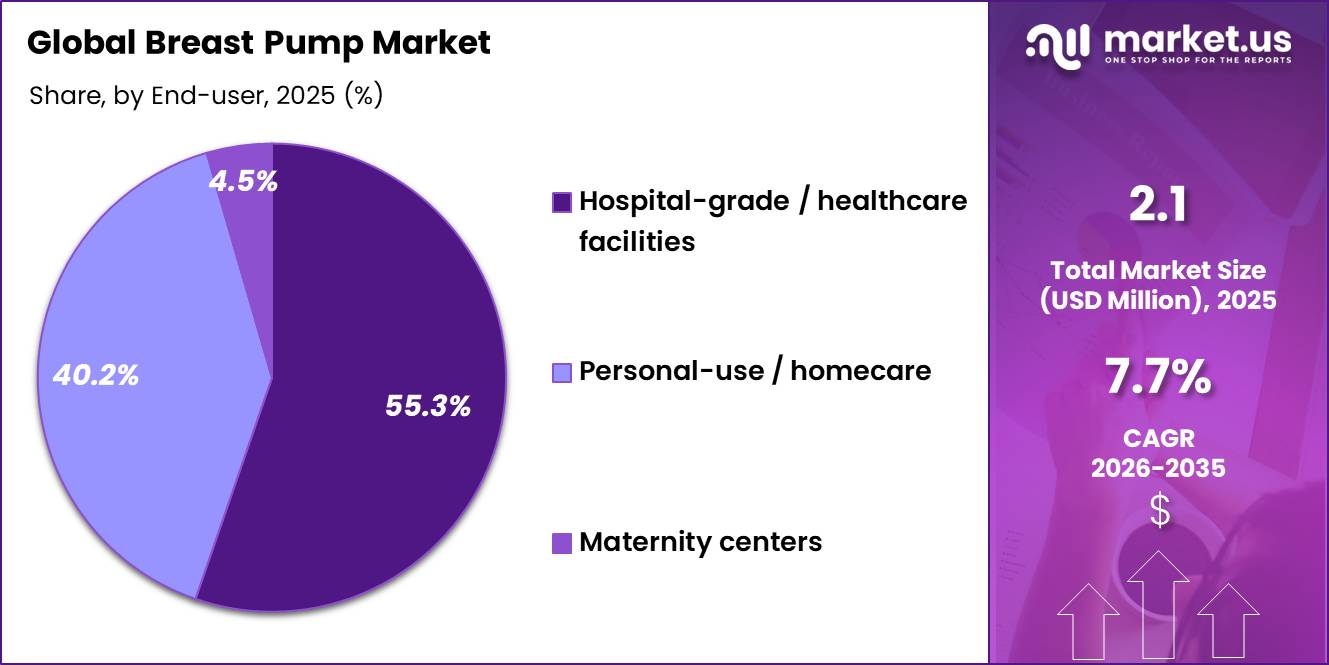
- End-User: The hospital-grade healthcare facilities segment held the largest share of the Breast Pump Markett, accounting for 55.3% of total revenue in 2025.
- Technology: In 2025, Electric pumps account for approximately 54.4% of the global market share.
- Application: Monoclonal antibodies (mAbs) account for approximately 40.1% of the global market share
- Regional Analysis: In 2025, North America led the market, achieving over 45.6% share with a revenue of US$ 0.98 Million.
Product Type Analysis
Closed-system pumps dominate due to hygiene and safety advantages, while open-system pumps serve cost-sensitive users.
By product type is segmented into closed-system pumps and open-system pumps, with closed-system designs leading the market due to superior hygiene, safety, and infection-control benefits.
In 2025, closed-system pumps account for approximately 64.6% of the global market share, driven by their ability to prevent breast milk from entering tubing, reducing contamination risks and improving usability in both hospital and home settings.
These pumps are widely preferred in clinical environments and among health-conscious consumers seeking safer lactation solutions. Technological improvements such as quieter motors, portability, and enhanced suction efficiency further support their dominance.
Open-system pumps, holding around 35.4% share, cater primarily to cost-sensitive users and first-time mothers. Their simpler structure makes them more affordable, but concerns related to hygiene and maintenance limit their usage in hospital-grade applications.
However, ongoing design enhancements, including improved backflow protection and lightweight configurations, are helping sustain demand. Overall, increasing awareness of maternal health and infection prevention continues to strengthen the dominance of closed-system breast pumps globally.
End-User Analysis
Hospital-grade facilities lead demand, supported by NICU usage, while homecare adoption rises with working mothers and portable devices.
By end-user is categorized into hospital-grade healthcare facilities, personal-use/homecare users, and maternity centers, with hospital-grade facilities leading the segment.
In 2025, this category accounts for approximately 55.3% of the global market share, primarily due to extensive use in hospitals and neonatal intensive care units (NICUs). These pumps are essential for supporting premature infants, post-delivery care, and lactation-challenged mothers, making them critical in clinical breastfeeding support systems.
Personal-use or homecare users represent about 40.2% share, driven by increasing female workforce participation, rising breastfeeding awareness, and the availability of portable and wearable devices. This segment is witnessing strong growth as modern mothers seek convenience and flexibility in milk expression while balancing professional responsibilities.
Maternity centers, accounting for around 4.5% share, play a supportive role in early breastfeeding education and lactation assistance, helping improve adoption rates. Overall, rising healthcare infrastructure and lifestyle changes continue to expand demand across all end-user categories.
Technology Analysis
Electric pumps lead the market, driven by efficiency and advanced features, while battery and manual pumps serve portable and low-cost needs.
The breast pump market by technology is segmented into electric pumps, battery-powered pumps, and manual pumps, with electric pumps dominating the segment.
In 2025, electric pumps account for approximately 54.4% of the global market share, owing to their efficiency, consistent suction performance, and suitability for both hospital and personal use. These pumps are widely preferred due to advanced features such as adjustable suction levels, dual pumping capability, and digital controls, which enhance comfort and reduce pumping time.
Battery-powered pumps are gaining traction as a portable alternative, offering mobility and convenience for working mothers and travelers. Improvements in rechargeable battery systems and compact designs are further supporting their adoption.
Manual pumps, while holding a smaller share, remain important in price-sensitive and rural markets due to their affordability, simplicity, and independence from power sources. However, they are generally used for occasional rather than frequent pumping. Overall, technological advancements focused on comfort, portability, and efficiency continue to drive the dominance of electric breast pumps globally.
Application Analysis
Clinical breastfeeding support dominates, while personal milk expression grows rapidly due to lifestyle and workforce changes.
By application segmented into monoclonal antibodies (mAbs), vaccines and viral vectors, and other biologics, with mAbs representing the leading application area. In 2025, monoclonal antibodies (mAbs) account for approximately 40.1% of the global market share, driven by their widespread use in treating chronic diseases, oncology, autoimmune disorders, and infectious diseases.
The increasing global burden of cancer and immune-related conditions, along with strong R&D pipelines, continues to support high demand for advanced biologic production systems and associated processing technologies.
Vaccines and viral vectors form the next key segment, supported by rising immunization programs, pandemic preparedness initiatives, and growing investment in gene and cell therapy platforms. This segment is witnessing steady expansion due to increased government funding and biopharmaceutical innovation focused on next-generation vaccines.
Other biologics, including recombinant proteins and biosimilars, also contribute significantly to market growth as healthcare systems increasingly adopt cost-effective and scalable therapeutic alternatives. Overall, the application landscape is strongly shaped by innovation in biologics manufacturing, rising chronic disease prevalence, and the global shift toward targeted and precision therapies, with mAbs maintaining clear dominance in the market structure.
Key Market Segment
By Product Type
- Closed‑system pumps
- Open‑system pumps
By End-user
- Hospital‑grade / healthcare facilities
- Personal‑use / homecare
- Maternity centers
By Technology
- Electric pumps
- Battery‑powered
- Manual pumps
By Application
- Monoclonal antibodies (mAbs)
- Vaccines and viral vectors
- Other biologics
Drivers
Return to work pumping need and maternal labor participation.
The most immediate demand engine remains the gap between breastfeeding recommendations and the practical reality of maternal return to work. WHO reported that 48% of infants under six months were exclusively breastfed in 2024, up from 37% in 2013, while WHO and UNICEF still recommend exclusive breastfeeding for the first six months and continued breastfeeding up to two years or beyond; that creates a large installed need for milk expression tools whenever mother infant separation rises.
In the US, 83.2% of infants born in 2019 received some breast milk initially, but only 55.8% were still receiving any breast milk at six months and only 24.9% were exclusively breastfed at six months, showing a steep continuation gap that breast pumps partially solve.
Commercially, this favors portable electric and double electric formats because they compress pumping time, support repeat daily use, and improve viability for employed mothers who pump multiple times during workdays; that shifts product mix toward higher ASP devices, recurring accessory sales, and app connected retention models rather than one time low cost manual pump purchases.
| Driver | (~) % Impact on CAGR Forecast | Geographic Relevance | Impact Timeline |
|---|---|---|---|
| Return-to-work pumping need and maternal labor participation | +1.9% | North America core, Western Europe, urban APAC, Gulf metros | Short term (≤ 2 years) |
| Insurance, paid-leave, and reimbursement access expansion | +1.6% | U.S. core, Canada, EU, developed APAC spill-over | Medium term (2-4 years) |
| Wearable and hands-free product innovation | +1.5% | North America core, EU premium tier, Japan, South Korea, China urban | Short term (≤ 2 years) |
| Hospital, NICU, and medically necessary rental demand | +1.2% | U.S., EU, Japan, advanced urban hospitals in APAC and LATAM | Medium term (2-4 years) |
| Breastfeeding-support policy intensity and care-pathway formalization | +1.1% | EU, U.S. states, Australia, selected APAC public-health systems | Long term (≥ 4 years) |
| Quality, safety, and replacement-cycle acceleration | +0.8% | North America, EU, regulated APAC markets | Short term (≤ 2 years) |
Challenges
Reimbursement Code Fragmentation.
The market’s first major challenge is not absence of demand but reimbursement friction created by uneven payer interpretation of pump eligibility, replacement cycles, accessory coverage, and documentation burden, particularly when the category shifts from standard electric systems toward higher priced wearable platforms that do not fit legacy benefit logic cleanly.
This creates a realistic 1.1 % point drag on achievable market CAGR because conversion leakage occurs after clinical recommendation but before purchase, with denial risk concentrated in premium devices, spare part claims, and postpartum timing windows, forcing manufacturers to carry larger patient support teams, build claims navigation capability, and absorb 30 to 90 day cash conversion delays in insured channels while still serving cash pay users at lower attachment rates.
FDA guidance continues to frame breast pumps as regulated medical devices with performance and safety expectations, while European authorities are still adjusting medical device procedures, so companies must maintain multi market coding, evidence, and tender adaptation rather than expecting harmonized reimbursement pathways, which in practice means more health economic dossiers, country specific channel playbooks, and hybrid B2B2C distribution models to reduce payer dependence over the next two to four years.
| Challenge | (~) % CAGR Friction Drag | Geographic Relevance | Mitigation Horizon |
|---|---|---|---|
| Reimbursement Code Fragmentation | -1.1% | North America core; selected EU reimbursement markets | Medium term (2-4 years) |
| Wearable Reliability Variability | -1.3% | North America premium segment; EU urban markets; APAC metros | Medium term (2-4 years) |
| Compliance Pathway Divergence | -0.9% | EU regulatory hubs; UK; North America import corridors | Long term (≥ 4 years) |
| Component Cost Volatility | -1.0% | China-linked supply chains; U.S. importers; EU assembly bases | Medium term (2-4 years) |
| Workplace Pumping Inconsistency | -1.4% | U.S.; India urban workforce; Southeast Asia export zones; Latin America formal sector | Long term (≥ 4 years) |
| Clinical Support Talent Gaps | -0.8% | North America community care gaps; emerging APAC; MENA urban hospitals | Long term (≥ 4 years) |
Restraints
Workplace pumping friction.
Return to work timing remains one of the clearest demand suppressors for sustained pumping behavior because breastfeeding duration declines when mothers return to work early, particularly within three months postpartum and especially in full time schedules, which directly reduces repeat pump usage, accessory replacement frequency, and willingness to invest in higher end devices.
Federal law now requires nearly all U.S. employers covered by the FLSA to provide reasonable break time and a private non bathroom space to express milk for one year after birth, yet enforcement and real world implementation remain uneven, and the law does not eliminate the productivity, scheduling, and line manager friction that many workers still encounter.
Even where accommodation exists, field evidence shows support quality is inconsistent: one workplace study found about 78.8% of participants reported access to private space and 65.4% reported access to break time, meaning a meaningful minority still lacked one or both basics needed for reliable pumping continuity.
This gap is commercially material because the breast pump category monetizes not only first device purchase but also frequency of use, flange resizing, valve and membrane replacement, and upgrades into quieter or wearable formats when pumping must fit into constrained workdays; where break windows stretch to 15–30 minutes or more per session and refrigeration or proximity is poor, attrition into formula or mixed feeding rises.
HHS and CDC linked materials continue to frame employer support, flexible schedules, leave access, and safe storage as core enablers of breastfeeding maintenance, underscoring that the bottleneck is not awareness but execution at the employer level.
For market forecasting, that translates into slower repurchase cycles, lower attach rates for accessories, muted conversion into premium hands free models outside high income professional cohorts, and roughly 1.8 % points of drag on the 2026 growth curve.
| Restraint | (~) % Impact on CAGR Forecast | Geographic Relevance | Impact Timeline |
|---|---|---|---|
| Reimbursement gaps in premium pumps | -2.1% | North America core, EU, developed APAC | Short term |
| Workplace pumping friction | -1.8% | North America core, LATAM, urban APAC | Medium term |
| Compliance and cleaning burden | -1.4% | Global | Short term |
| Product safety and recall risk | -1.1% | North America, EU, developed APAC | Medium term |
| Channel dilution and counterfeit accessories | -0.9% | Global e-commerce corridors | Short term |
| Smart-pump privacy and data risk | -0.7% | North America, EU, developed APAC | Long term |
Opportunity
Employer lactation platforms.
This is an opportunity rather than a current market driver because the baseline breast pump market already benefits from women returning to work, but the white space is the conversion of pumps from one time hardware purchases into employer funded lactation productivity platforms bundling pump fleets, replacement consumables, milk logistics, tele lactation, and compliance support under B2B contracts.
In the U.S., 73.9% of mothers with children under 18 participated in the labor force in 2025, while federal rules continue requiring most employers to provide break time and private pumping space for up to one year after birth, which creates a compliance budget that is still only partially monetized by device makers today.
A scaled employer model can shift customer acquisition cost down by roughly 25% to 40% versus pure direct to consumer channels, raise annual revenue per user by 1.8x to 2.4x through accessories and service attach, and support EBITDA margin expansion of 300 to 500 basis points because enterprise contracts reduce return rates, smooth demand seasonality, and improve refill predictability.
The strategic upside is highest in North America, Western Europe, the Gulf, Japan, South Korea, and Singapore, where formal employment density and HR benefit sophistication are high, and where vendors that move first can lock in 2 to 3 year contracts before the category becomes procurement led rather than brand led.
| Opportunity | (~) % Potential CAGR Upside | Geographic Relevance | Execution Window |
|---|---|---|---|
| Employer lactation platforms | +1.6% | North America core, EU, GCC, developed APAC | Short term (≤ 2 years) |
| Hospital-to-home NICU pathway | +1.3% | North America, EU, urban APAC, LatAm private care | Short term (≤ 2 years) |
| Wearable subscription model | +1.9% | North America core, UK, Australia, affluent APAC metros | Medium term (2-4 years) |
| Tier-2/3 emerging-market access | +2.2% | India, SEA, MENA, LatAm emerging markets | Medium term (2-4 years) |
| Maternal RPM integration | +1.4% | U.S. core, selected EU, advanced Asia health systems | Medium term (2-4 years) |
| Adjacent clinical milk-tech roll-up | +1.1% | North America, EU, Japan, South Korea | Long term (≥ 4 years) |
Regional Analysis
North America dominated the Breast Pump Market in 2025.
In 2025, North America dominated the Breast Pump Market, accounting for over 45.6% share with revenue of US$ 0.98 million. The region’s leadership is primarily driven by high breastfeeding awareness, strong presence of advanced healthcare infrastructure, and widespread adoption of technologically advanced breast pumps, including wearable and hospital-grade devices.
Supportive government initiatives, workplace lactation policies, and insurance reimbursement programs further encourage product uptake among new mothers. The United States remains the contributor due to high birth rates in urban areas and increasing participation of women in the workforce.
Europe follows North America, supported by favorable maternal health policies, rising awareness regarding breastfeeding benefits, and increasing availability of smart breast pumps across pharmacies and online platforms. Countries such as Germany, the UK, and France are key revenue contributors due to strong healthcare systems and government-backed maternal care programs.
Asia-Pacific is emerging as the fastest-growing region, driven by rising birth rates, improving healthcare access, and growing urbanization in countries such as China and India. Increasing disposable income and expanding e-commerce penetration are accelerating market growth.
Latin America and Middle East and Africa are witnessing steady growth, supported by improving healthcare infrastructure and rising awareness campaigns, although adoption remains lower than developed regions.
Key Regions and Countries
North America
- The US
- Canada
Europe
- Germany
- France
- The U.K.
- Italy
- Spain
- Russia & CIS
- Rest of Europe
Asia Pacific
- China
- India
- Japan
- South Korea
- ASEAN
- Australia & New Zealand
- Rest of Asia Pacific
Middle East & Africa
- GCC
- South Africa
- Rest of Middle East & Africa
Latin America
- Brazil
- Mexico
- Rest of Latin America
Key Player Analysis
The Breast Pump Market is moderately consolidated, with a strong presence of global leaders and a growing number of emerging digital-first and direct-to-consumer brands. Competition is intensifying as established medical device companies compete with innovative startups focused on portability, comfort, and smart connectivity.
The market is increasingly innovation-driven, with a strong emphasis on wearable technology, noise reduction, hospital-grade efficiency, and app-based monitoring systems. Ecosystem-based competition is also rising, where companies differentiate through integrated maternal care solutions rather than standalone devices.
Key players such as Medela AG, Koninklijke Philips N.V., Pigeon Corporation, Ameda Inc., Spectra Baby USA, Willow Innovations, Inc., Chiaro Technology Ltd (Elvie), Ardo Medical AG, Hygeia Health / Hygeia Medical Group, Lansinoh Laboratories Inc., Evenflo Feeding Inc., Mayborn Group Ltd (Tommee Tippee), Momcozy, Haakaa, BabyBuddha Products, and Others are actively strengthening their positions through aggressive R&D investments and continuous product innovation.
Companies are heavily focusing on wearable and hands-free breast pumps, smart connectivity, and hospital-to-home care integration. Strategic partnerships with hospitals, maternity clinics, and retail distributors are expanding market reach. Players are also investing in digital platforms and mobile applications to enhance user experience and provide personalized lactation tracking.
Furthermore, innovation in silent pumping technology, lightweight designs, and rechargeable systems is becoming a key differentiator. Competitive strategies increasingly revolve around building full maternal care ecosystems, combining breast pumps, accessories, and digital health support, ensuring long-term customer engagement and brand loyalty across global markets.
Top Key Players
- Medela AG
- Koninklijke Philips N.V.
- Pigeon Corporation
- Ameda Inc.
- Spectra Baby USA
- Willow Innovations, Inc.
- Chiaro Technology Ltd (Elvie)
- Ardo Medical AG
- Hygeia Health / Hygeia Medical Group
- Lansinoh Laboratories Inc.
- Evenflo Feeding Inc.
- Mayborn Group Ltd (Tommee Tippee)
- Momcozy
- Haakaa
- BabyBuddha Products
- Others
Recent Developments
- In October 2025, Medela AG launched new wearable breast pump solutions, including Motion InBra™ and Magic InBra™, strengthening its position in the hands-free pumping segment. The new products focus on discreet use, improved comfort, and mobility for mothers who need flexible pumping solutions during daily activities. Alongside the launch, Medela announced a CHF 20,000 research contribution to support breastfeeding initiatives, highlighting its continued investment in maternal health support.
- In December 2025, Momcozy introduced the Wellness 1 (W1) warm-massage wearable breast pump as part of its new Wellness Series. The product introduced integrated warmth, breast massage technology, and Milk Boost mode, positioning the company toward comfort-focused innovation beyond traditional milk expression features.
- In August 2025, Koninklijke Philips N.V. launched the Philips Avent Hands-free Electric Breast Pump in India, expanding its maternal care product portfolio with a wearable pumping solution. The launch highlighted Philips’ focus on improving flexibility, comfort, and mobility for breastfeeding mothers through hands-free technology. Philips also announced a strategic partnership with Apollo Cradle & Children’s Hospital to support breastfeeding awareness and lactation guidance initiatives.
Report Scope
| Report Features | Description |
|---|---|
| Market Value (2025) | US$ 2.1 Million |
| Forecast Revenue (2035) | US$ 4.5 Million |
| CAGR (2026-2035) | 7.7% |
| Base Year for Estimation | 2025 |
| Historic Period | 2020-2024 |
| Forecast Period | 2026-2035 |
| Report Coverage | Revenue Forecast, Market Dynamics, Competitive Landscape, Recent Developments |
| Segments Covered | By Product Type (Closed-system pumps, Open-system pumps), By End-user (Hospital-grade / healthcare facilities, Personal-use / homecare, Maternity centers), By Technology (Electric pumps, Battery-powered, Manual pumps), By Application (Monoclonal antibodies (mAbs), Vaccines and viral vectors, Other biologics) |
| Regional Analysis | North America – The US, Canada; Europe – Germany, France, U.K., Italy, Spain, Russia & CIS, Rest of Europe; Asia Pacific – China, India, Japan, South Korea, ASEAN, Australia & New Zealand, Rest of Asia Pacific; Middle East & Africa – GCC, South Africa, Rest of Middle East & Africa; Latin America – Brazil, Mexico, Rest of Latin America |
| Competitive Landscape | Medela AG, Koninklijke Philips N.V. , Pigeon Corporation , Ameda Inc., Spectra Baby USA , Willow Innovations, Inc., Chiaro Technology Ltd (Elvie), Ardo Medical AG, Hygeia Health / Hygeia Medical Group, Lansinoh Laboratories Inc., Evenflo Feeding Inc., Mayborn Group Ltd (Tommee Tippee), Momcozy, Haakaa, BabyBuddha Products, Others |
| Customization Scope | Customization for segments, region/country-level will be provided. Moreover, additional customization can be done based on the requirements. |
| Purchase Options | We have three licenses to opt for: Single User License, Multi-User License (Up to 5 Users), Corporate Use License (Unlimited User and Printable PDF) |





































