


Market Overview
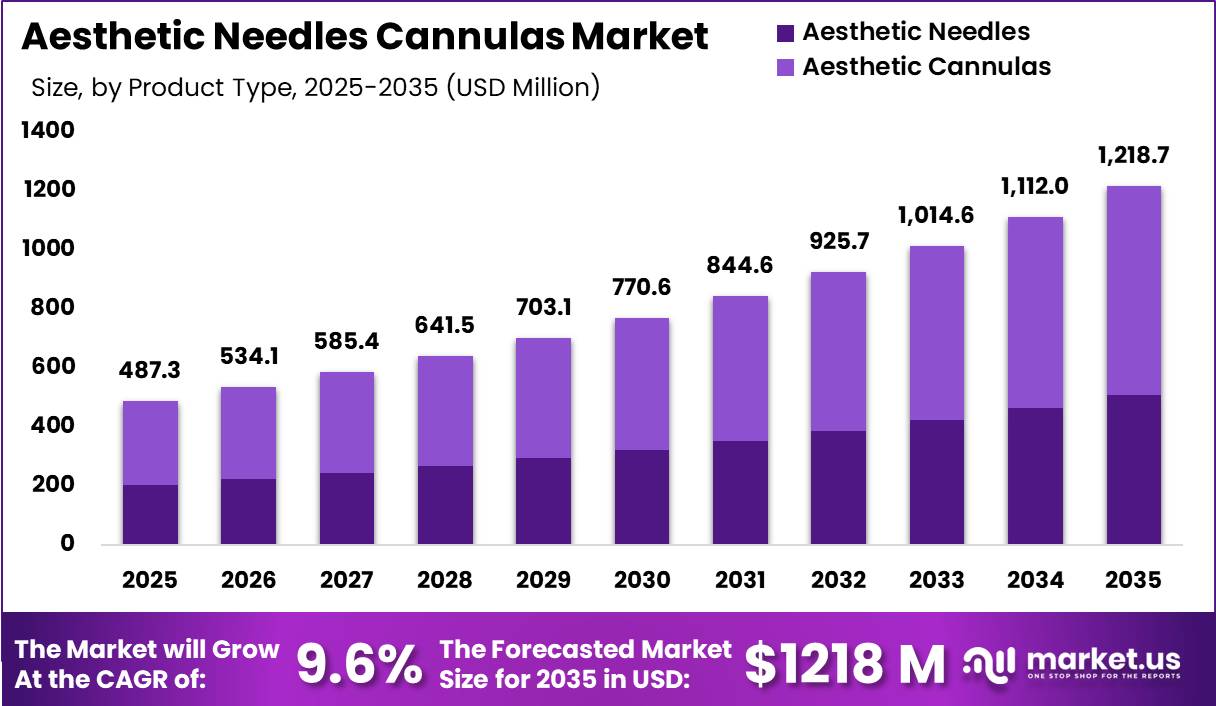
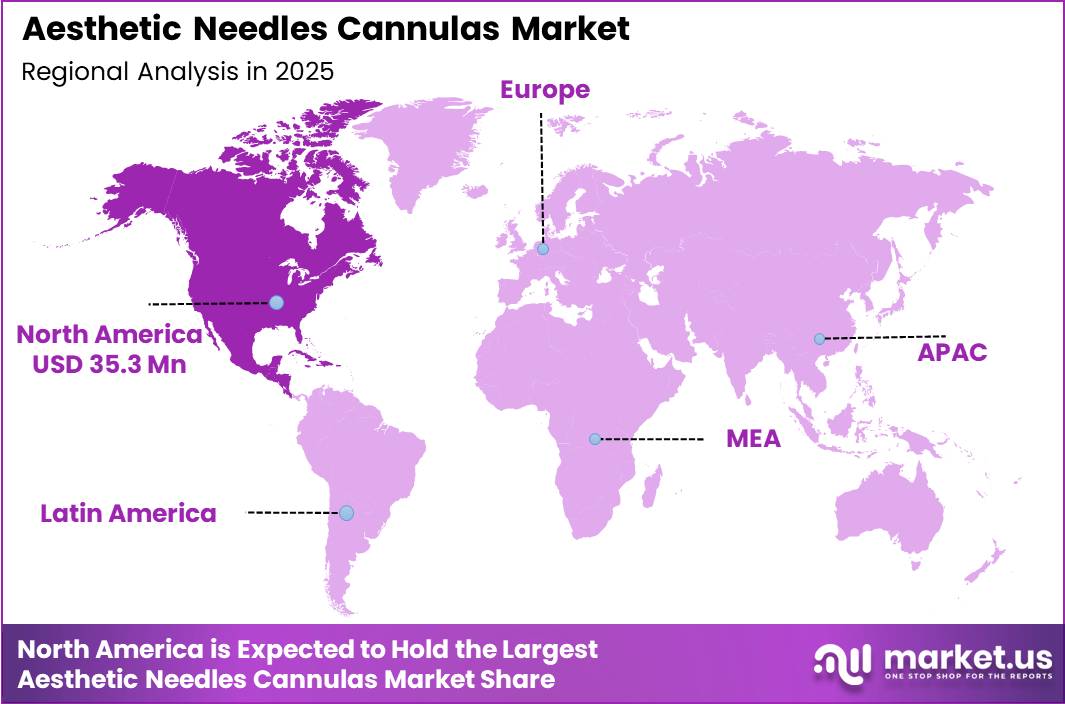
Global Aesthetic Needles and Cannulas Market size is expected to be worth around US$ 1218.7 Million by 2035 from US$ 487.3 Million in 2025, growing at a CAGR of 9.6% during the forecast period from 2026 to 2035. In 2025, North America led the market, achieving over 35.3% share with a revenue of US$ 172.0 Million.
The global aesthetic needles and cannulas supports a rapidly expanding portfolio of minimally invasive cosmetic procedures, including dermal filler injections, botulinum toxin administration, fat transfer, and regenerative aesthetic treatments. These devices are designed to deliver injectables precisely into targeted tissue planes, with blunt-tip cannulas increasingly used to reduce vascular injury, bruising, and post-procedure downtime compared with sharp needles.
Clinical demand is underpinned by the rising volume of non-surgical aesthetic procedures worldwide. According to the International Society of Aesthetic Plastic Surgery, more than 14 million non-surgical aesthetic procedures were performed globally in a recent annual reporting cycle, with injectable treatments accounting for the majority.
Facial rejuvenation procedures such as hyaluronic acid fillers and neuromodulators represent the largest application area for aesthetic needles and cannulas due to high repeat usage and standardized dosing protocols.
Regulatory oversight and safety standards play a critical role in this market. In the United States, aesthetic needles and cannulas are regulated as medical devices by the U.S. Food and Drug Administration, which sets requirements for sterility, biocompatibility, and manufacturing quality. FDA-cleared filler delivery systems must comply with ISO standards for hypodermic needles, ensuring consistent lumen size and break resistance.
Demographic factors also contribute to sustained demand. Aging populations in North America, Europe, and parts of East Asia are driving increased utilization of injectable aesthetic treatments, while younger patient cohorts are adopting preventive and maintenance procedures earlier. Additionally, healthcare organizations report rising outpatient aesthetic visits as procedures increasingly shift from hospital settings to dermatology and cosmetic surgery clinics.
Trusted healthcare sources highlight that minimally invasive cosmetic procedures typically require single-use, sterile needles or cannulas, reinforcing steady replacement demand aligned with procedural volumes rather than long device lifecycles.
Key Takeaways
- The global Aesthetic Needles and Cannulas Market was valued at US$ 487.3 Billion in 2025.
- The global Aesthetic Needles and Cannulas Market is projected to grow at a CAGR of 9.6% and is estimated to reach US$ 1,218.7 Billion by 2035.
- By Product Type,Aesthetic Cannulas dominated the market, accounting for 58.3% of the total market share in 2025.
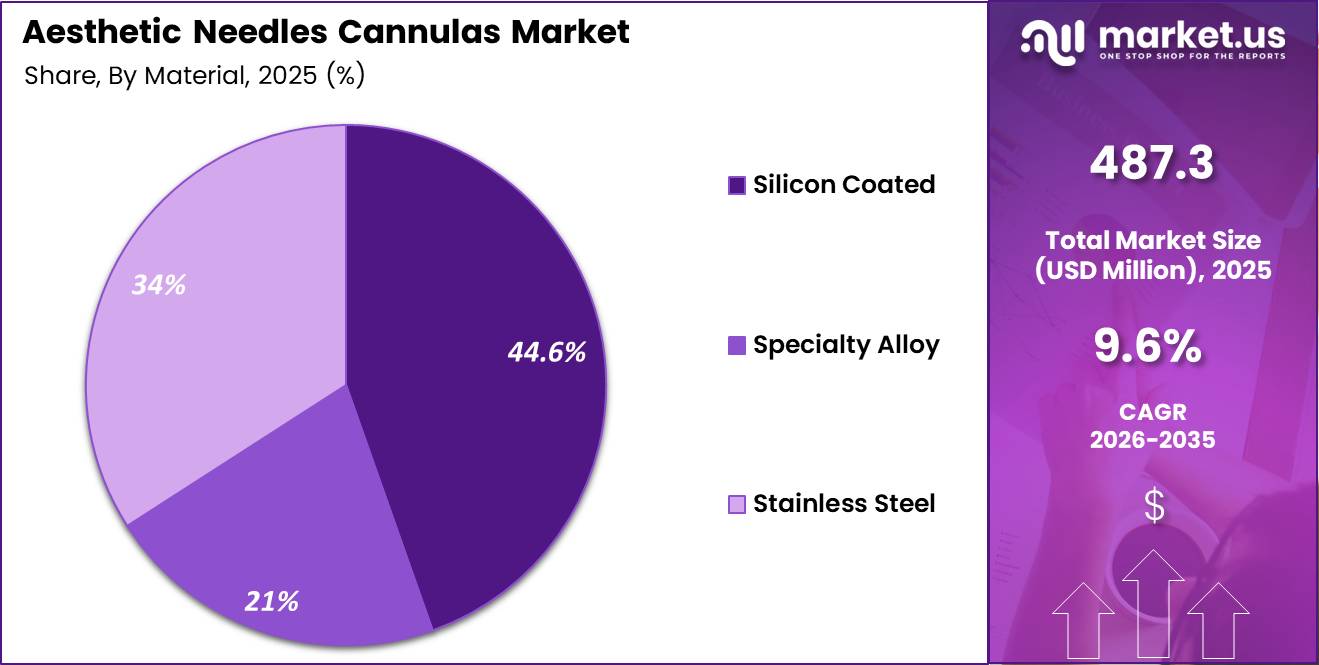
- By Material,Silicon Coated dominated the market, constituting 44.6% of the total market share.
- By Gauge Size, 28G to 30G dominated the market,constituting 30.2% of the total market share.
- By Application, Facial Aesthetics dominated the market,constituting 21.3% of total market share.
- By End Use, Dermatology Clinics dominated the market, constituting 37.5% of the total market share.
- In 2025, North America led the market, achieving over 35.3% share with a revenue of US$ 172.0 Billion.
Product Type Analysis
The product type segmentation of the Aesthetic Needles and Cannulas Market is primarily divided into aesthetic cannulas and aesthetic needles, each serving distinct procedural needs within minimally invasive cosmetic treatments. In 2025, aesthetic cannulas dominate the market with a 58.3% share, driven by their growing adoption in dermal filler injections, fat grafting, and volumizing procedures.
Cannulas are preferred for their blunt-tip design, which minimizes tissue trauma, reduces bruising, and lowers the risk of vascular complications. Their ability to cover larger treatment areas through fewer entry points improves procedural efficiency and patient comfort, making them particularly attractive in advanced facial contouring and rejuvenation procedures.
Aesthetic needles account for the remaining 41.7% market share, maintaining strong relevance in precision-driven applications such as fine-line correction, superficial filler placement, and botulinum toxin injections.
Needles offer superior accuracy and tactile feedback, which is essential for delicate areas requiring controlled depth and placement. Despite the rising preference for cannulas, needles remain indispensable due to their cost-effectiveness, widespread availability, and practitioner familiarity.
The balanced demand between cannulas and needles reflects evolving clinical practices, where hybrid approaches increasingly combine both product types to optimize aesthetic outcomes and procedural safety.
Material Analysis
Material-based segmentation plays a critical role in defining performance, safety, and user comfort within the Aesthetic Needles and Cannulas Market. In 2025, silicon-coated segments lead with a 44.6% market share, supported by their superior lubrication properties that enable smoother skin penetration and reduced insertion force.
Silicon coatings enhance patient comfort by minimizing pain and tissue resistance, while also improving practitioner control during complex aesthetic procedures. These advantages have driven widespread adoption in high-volume cosmetic clinics and premium aesthetic practices.
Stainless steel holds a substantial 34.1% share, reflecting its long-standing reliability, strength, and cost efficiency. Stainless steel instruments are valued for their durability, corrosion resistance, and compatibility with sterilization processes, making them a standard choice across both developed and emerging aesthetic markets. Their consistent performance supports continued demand, particularly in routine injectable treatments.
The specialty alloy segment accounts for 21.3%, representing the fastest-evolving material category. Specialty alloys offer enhanced flexibility, reduced breakage risk, and optimized wall thickness, supporting advanced cannula designs for complex facial anatomy. As procedural sophistication increases and practitioners prioritize precision with safety, specialty alloys are gaining traction, contributing to material innovation and product differentiation across the market
Gauge Size Analysis
Gauge size segmentation significantly influences treatment precision, patient comfort, and clinical outcomes in the Aesthetic Needles and Cannulas Market. In 2025, 28G to 30G segments dominate with a 30.2% market share, driven by their optimal balance between flow control and minimal invasiveness.
These ultra-fine gauges are widely used for facial rejuvenation, superficial filler placement, and wrinkle correction, where reduced tissue trauma and precise delivery are essential. Their popularity is further supported by increasing patient demand for low-pain, quick-recovery aesthetic procedures.
Mid-range gauge sizes continue to serve volumizing and contouring applications that require moderate product flow without compromising accuracy. These gauges are commonly selected for nasolabial folds, cheek augmentation, and jawline enhancement, where both depth and control are critical. Larger gauge sizes, while representing a smaller share, remain essential for fat transfer and deeper tissue augmentation, particularly in body contouring procedures.
Overall, the dominance of 28G–30G reflects a broader industry shift toward minimally invasive, detail-oriented aesthetic treatments. As injectables become more refined and technique-driven, demand for finer gauge instruments is expected to remain strong, reinforcing this segment’s leadership.
Application Analysis
Application-based segmentation highlights the diverse clinical use of aesthetic needles cannulas across cosmetic procedures. In 2025, facial aesthetics lead the market with a 21.3% share, driven by the high global demand for facial rejuvenation, anti-aging treatments, and non-surgical facial contouring.
Procedures such as dermal filler injections, lip augmentation, tear trough correction, and cheek volumization rely heavily on advanced cannula and needle designs to ensure safety, precision, and natural-looking results.
Beyond facial aesthetics, body contouring applications contribute steadily, supported by the growing popularity of non-surgical buttock enhancement, hand rejuvenation, and décolletage treatments. These procedures often require specialized cannulas capable of delivering larger filler volumes with minimal tissue disruption. Medical aesthetics applications, including scar revision and reconstructive procedures, also support market expansion by leveraging precision instruments for therapeutic outcomes.
The dominance of facial aesthetics reflects both high procedure volumes and rapid innovation in facial injectable techniques. As patient awareness and acceptance of minimally invasive facial treatments continue to rise, this application segment remains the primary revenue driver within the overall Aesthetic Needles and Cannulas Market.
End Use Analysis
End-use segmentation underscores the clinical settings driving demand for aesthetic needles cannulas. In 2025, dermatology clinics dominate with a 37.5% market share, supported by their central role in delivering injectable aesthetic procedures.
Dermatology clinics benefit from specialized expertise, high patient trust, and consistent procedural volumes, making them key adopters of advanced needles and cannulas. Their focus on facial aesthetics, anti-aging treatments, and skin rejuvenation reinforces sustained demand across product categories.
Medical spas represent a rapidly growing end-use segment, fueled by increasing consumer preference for minimally invasive cosmetic treatments in non-hospital environments. These facilities emphasize patient comfort and efficiency, driving demand for cannulas that reduce bruising and downtime. Hospitals and ambulatory surgical centers contribute a smaller but stable share, primarily supporting reconstructive and medically indicated aesthetic procedures.
Overall, the dominance of dermatology clinics reflects the shift of aesthetic treatments toward outpatient, specialist-driven care models. As procedural volumes rise and technology advances, dermatology clinics are expected to remain the primary end users, shaping purchasing patterns and product innovation in the Aesthetic Needles and Cannulas Market.
Market Segmentations
By Product Type
- Aesthetic Needles
- Aesthetic Cannulas
By Material
- Silicon Coated
- Specialty Alloy
- Stainless Steel
By Gauge Size
- 18G to 20G
- 21G to 25G
- 26G to 27G
- 28G to 30G
- Others
By Application
- Body Contouring
- Cheek Augmentation
- Facial Aesthetics
- Fat Transfer / Fat Grafting
- Jawline Contouring
- Lip Augmentation
- Nasolabial Fold Correction
- Reconstructive Aesthetic Procedures
- Tear Trough Correction
- Others
By End Use
- Dermatology Clinics
- Cosmetic Surgery Centers
- Medical Spas
- Hospitals
- Others
Drivers
Filler procedure expansion and injector throughput demand
Global nonsurgical aesthetics volumes continue to create a larger installed base for disposable injection accessories, with ISAPS reporting 20.5 million nonsurgical procedures in 2024 and 6.3 million hyaluronic acid filler procedures, up 5.2% year over year.
Total aesthetic procedures were close to 38 million, and the U.S. alone accounted for more than 6.1 million procedures across surgical and nonsurgical categories. That matters directly for needles and cannulas because every filler session converts procedure growth into recurring unit demand at the point of care, while higher injector calendars improve reorder frequency for single use sterile accessories.
Commercially, this supports a consumption led model rather than a capital equipment model: distributors win on clinic penetration, SKU availability, gauge length mix, and just in time supply reliability, especially in high velocity facial practices where even modest patient growth can compound annual accessory pull through.
| Driver | (~) % Impact on CAGR Forecast | Geographic Relevance | Impact Timeline |
|---|---|---|---|
| Filler procedure expansion and injector throughput demand | +2.4% | North America core, Western Europe, Japan, South Korea, GCC, urban China | Short term |
| Safety shift toward blunt-tip cannula use in high-risk facial zones | +1.9% | North America core, EU, UK, Australia, advanced APAC clinics | Short term |
| Tightening device oversight and traceability favoring compliant suppliers | +1.5% | EU core, UK, U.S., Japan, South Korea | Medium term |
| Premiumization of minimally invasive facial rejuvenation | +1.7% | U.S., Brazil, Japan, South Korea, EU metros, Middle East private clinics | Medium term |
| Training-led clinic standardization and protocolization | +1.2% | North America, EU, GCC, Southeast Asia private chains | Short term |
| Cross-border aesthetics and outpatient procedure migration | +0.9% | Turkiye, UAE, Colombia, Thailand spill-over; EU and North America referral markets | Medium term |
Challenges
Competitive pressure from alternative aesthetic modalities
Competitive device and modality pressure reflects the reality that aesthetic needles and cannulas compete not only with each other but also with alternative delivery technologies and non injectable modalities, such as energy based devices, microfocused ultrasound, and novel drug delivery systems, all within a broader minimally invasive aesthetics market that is expanding rapidly but fragmenting across multiple technology platforms.
As next generation facial injectables, including longer lasting fillers and combination products, gain traction, some segments of demand shift toward formulations delivered through specific proprietary systems or prefilled syringes that reduce the need for interchangeable third party cannulas, while in parallel, advances in device based skin tightening or contouring allow certain patient cohorts to delay or substitute away from fillerheavy regimens.
This does not eliminate the role of cannulas and needles given their centrality in a large share of injectable procedures but it introduces a competitive ceiling in some indication segments, especially where payers or patients seek to limit total procedure spend or prefer modalities perceived as less invasive.
Quantitatively, if 10 to 15% of prospective injectable patients in certain urban clusters opt for non injectable alternatives or proprietary delivery platforms over time, the addressable volume growth for generic cannulas in those segments is trimmed accordingly, yielding an estimated 0.4% point drag on the broader market’s CAGR even as overall aesthetic expenditure grows robustly.
Strategically, cannula and needle manufacturers must position themselves as integral partners to both traditional injectables and emerging hybrid protocols by co developing optimized devices for specific products, securing preferred supplier status with leading filler and toxin brands.
Investing in clinical evidence that demonstrates safety and outcome benefits of advanced cannula techniques versus sharp needles or alternative modalities; this includes quantifying reductions in bruising, downtime, or complication rates in thousands of cases, thereby strengthening the economic case for clinics to maintain or increase cannulabased procedure volumes despite the expanding set of competing technologies.
| Challenge | (~) % CAGR Friction Drag | Geographic Relevance | Mitigation Horizon |
|---|---|---|---|
| Sterile supply chain volatility | -0.8% | North America, EU, APAC hubs | Medium term (2-4 years) |
| Regulatory-quality compliance load | -0.7% | EU regulatory hubs, North America, Middle East | Long term (≥ 4 years) |
| Injector skill and staffing gaps | -0.9% | North America core, APAC metros, LATAM | Long term (≥ 4 years) |
| Medical-grade input cost volatility | -0.6% | EU, North America, China, ASEAN | Medium term (2-4 years) |
| OEM–clinic integration inefficiencies | -0.5% | Global tier-2/3 cities | Short term (≤ 2 years) |
| Competitive device and modality pressure | -0.4% | Global premium aesthetics clusters | Medium term (2-4 years) |
Restraints
Emerging market localization and tightening device regulatory burdens
A second restraint arises from the rapid tightening of medical device regulation and localization policies in high growth emerging markets such as India, select ASEAN economies, and Gulf states, subtracting an estimated 1.2% points from global CAGR as foreign OEMs absorb registration delays, local content rules, and interim sales disruptions.
India’s expanded Medical Device Rules, which broadened the number of devices under licensing and set phased deadlines for Class AD devices, created a structural shift where previously unregulated or lightly regulated aesthetic needles and cannulas must secure manufacturing and import licenses, often with documentation similar to EU or US standards.
For foreign suppliers that historically served India on a semi opportunistic basis, the need to build CDSCO compliant technical files, align labeling, obtain plant inspections, and maintain local authorized representatives can add 6 to 12 months to market entry timelines and mid six figure dollar outlays in regulatory and legal costs.
Simultaneously, national strategies such as India’s National Medical Device Policy 2023, which aims to reduce import dependence that currently covers roughly 80% of devices by pushing domestic production and potential price controls via a National List of Essential Medical Devices, create uncertainty around long term pricing and viable operating margins for imported aesthetic cannulas, especially if they are grouped with broader injection devices subject to ceilings.
Similar dynamics play out in ASEAN markets for example Thailand and Indonesia where device listing, importer licensing, and occasional ad hoc import controls can intermittently halt shipments for 1 to 3 quarters, forcing multinationals to hold higher in country buffer inventory or risk stockouts.
From a strategic lens, these regulatory and localization shifts cause OEMs to reevaluate the ROI of entering or expanding in these markets, delay facility investments until clearer incentives or cluster policies emerge, and, in the interim, to focus on fewer key distributors, all of which dampens penetration rates for premium aesthetic cannulas and reduces the contribution of high growth emerging corridors to the global demand curve.
| Restraint | (~) % Impact on CAGR Forecast | Geographic Relevance | Impact Timeline |
|---|---|---|---|
| Stricter device regulations & MDR bottlenecks | -1.8% | EU, UK, EEA, selective LATAM | Medium term (2-4 years) |
| Emerging-market regulatory tightening & localization | -1.2% | India, ASEAN, Middle East | Medium term (2-4 years) |
| Sterile supply chain & input cost inflation | -1.5% | North America, EU, APAC hubs | Short term (≤ 2 years) |
| OEM capacity constraints & long lead times | -1.0% | Global export-oriented hubs | Short term (≤ 2 years) |
| Pricing pressure from commoditization & tendering | -1.3% | EU, APAC hospital channels | Long term (≥ 4 years) |
| Talent, training & adverse-event risk in aesthetics | -0.9% | North America, EU, urban APAC | Long term (≥ 4 years) |
Opportunity
Crossborder premium aesthetic treatment hubs integration model
A significant long-term growth opportunity exists in the integration of cross-border premium treatment hubs, where cannula and needle suppliers establish preferred partnerships with destination clinics in major medical value travel markets such as Turkey, Thailand, the UAE, and South Korea.
While current market expansion is primarily driven by domestic aesthetic procedures, this strategy enables suppliers to capture recurring demand generated by international patients seeking standardized, premium treatment packages. The increasing shift toward ambulatory healthcare, supported by OECD data, along with the continued expansion of global medical tourism for elective procedures, strengthens this opportunity.
Strategic partnerships with destination clinics can improve supply efficiency through concentrated product utilization, faster inventory turnover, and greater adoption of premium consumables. Industry estimates indicate that traveling patient treatment packages can generate approximately 1.3x to 1.6x higher consumable usage than standard domestic procedures.
In addition, reorder cycles may shorten by 20%–30%, while cross-selling post-procedure care kits could increase clinic account revenue by 18%–25% compared with conventional domestic clinic relationships.
| Opportunity | (~) % Potential CAGR Upside | Geographic Relevance | Execution Window |
|---|---|---|---|
| Regenerative injectables kits | +1.9% | North America core, EU, East Asia | Medium term |
| Neck-body indication expansion | +1.6% | U.S., GCC, South Korea, urban China | Short term |
| Injector-as-a-service bundles | +1.4% | North America, EU, ANZ | Short term |
| APAC tier-2 clinic penetration | +2.1% | India, Southeast Asia, inland China | Medium term |
| Safety-led cannula conversion | +1.2% | U.S., EU, Brazil, Mexico | Short term |
| Cross-border premium treatment hubs | +1.5% | Turkey, Thailand, UAE, South Korea | Long term |
Regional Analysis
North America led the market, achieving over 35.3% share with a revenue of US$ 172.0 Million.
The Aesthetic Needles and Cannulas Market demonstrates clear regional differentiation driven by procedure volumes, healthcare infrastructure, practitioner expertise, and consumer spending power. North America led the market, supported by high adoption of minimally invasive aesthetic procedures, strong presence of board-certified dermatologists and plastic surgeons, and rapid uptake of advanced safety cannulas in facial fillers and contouring. High patient awareness and willingness to pay for premium aesthetic outcomes further reinforce regional dominance.
Europe represents a mature and regulation-driven market, where demand is shaped by strict medical standards, widespread use of blunt-tip cannulas to reduce complications, and consistent procedure volumes across countries such as Germany, France, and Italy. The region benefits from an aging population seeking non-surgical rejuvenation and a strong preference for safer, precision-based injection tools.
Asia-Pacific is the fastest-growing regional market, propelled by expanding medical aesthetics tourism, rising disposable income, and increasing acceptance of cosmetic treatments in countries like South Korea, Japan, and China. Growth is amplified by a younger demographic and growing clinic networks.
Meanwhile, Latin America and Middle East & Africa show steady expansion, supported by improving aesthetic healthcare infrastructure, urban clinic growth, and rising demand for minimally invasive cosmetic procedures.
Key Regions and Countries
North America
- The US
- Canada
Europe
- Germany
- France
- The U.K.
- Italy
- Spain
- Russia & CIS
- Rest of Europe
Asia Pacific
- China
- India
- Japan
- South Korea
- ASEAN
- Australia & New Zealand
- Rest of Asia Pacific
Middle East & Africa
- GCC
- South Africa
- Rest of Middle East & Africa
Latin America
- Brazil
- Mexico
- Rest of Latin America
Key Player Analysis
The Aesthetic Needles and Cannulas Market is moderately fragmented, with a mix of global medical device leaders and specialized aesthetic-focused manufacturers. Competitive dynamics reflect a maturing market characterized by incremental innovation, regulatory standardization, and growing demand for precision-driven minimally invasive procedures.
Innovation is primarily focused on advanced materials, ergonomic design, safety-enhancing features, and precision delivery systems that improve practitioner control and patient outcomes rather than disruptive technology shifts.
Market Structure and Strategic Tiers
The first tier comprises large multinational medical device companies, including BD and Terumo, which leverage scale, global distribution networks, and strong regulatory capabilities. These players emphasize product standardization, workflow integration, and compatibility across clinical and aesthetic applications.
The second tier consists of established specialty manufacturers such as TSK Laboratory International, Sterimedix, SoftFil, JAPAN BIO PRODUCTS Co., Ltd., and Needle Concept. These companies compete through precision engineering, clinician-centric design, and targeted portfolio expansion in dermal fillers and facial aesthetics.
The third tier includes innovation- and regionally driven players such as Kindly (KDL) Group, Shanghai Mekon Medical Devices Co., Ltd., ZORAY Precision Technology Co., Ltd., DermaSculpt, PDO Max, Inc., Huons Meditech, Aesthetic Group, and Grand Aespio. These players focus on niche innovation, cost competitiveness, and rapid product iteration, often supported by partnerships with aesthetic clinics and distributors.
Overall, competition is driven by R&D intensity, clinician adoption, product differentiation, and ecosystem alignment within the global aesthetics value chain.
Top Key Players
- Kindly (KDL) Group
- JAPAN BIO PRODUCTS Co., Ltd.
- SoftFil (Prollenium Medical Technologies)
- Shanghai Mekon Medical Devices Co., Ltd. (Mekon Medical)
- TSK Laboratory International
- Sterimedix
- Aesthetic Group
- Grand Aespio
- BD
- Terumo
- ZORAY Precision Technology Co., Ltd.
- Needle Concept
- DermaSculpt (CosmoFrance Inc.)
- PDO Max, Inc.
- Huons Meditech
Recent Developments
- October 2025, Croma-Pharma entered a strategic distribution partnership with Renellence in Canada to expand access to its aesthetic dermal filler portfolio (e.g., Saypha range) and related injectable products, strengthening its regional presence in the Canadian market.
- January 2026, Terumo announced the U.S. launch of its SurTract™ Safety Syringe (with SafeR® passive safety technology) for distribution across hospitals and clinics in the United States, representing a regional product rollout with expanded distribution
- June 2026, Huons Meditech signed an exclusive distribution agreement with Japanese company Nifuji Incorporation to expand its Dermashine Duo RF aesthetic device into the Japanese market effectively a formal commercial partnership supporting product rollout and investment into network expansion.
Report Scope
| Report Features | Description |
|---|---|
| Market Value (2025) | US$ 487.3 Million |
| Forecast Revenue (2035) | US$ 1,218.7 Million |
| CAGR (2026-2035) | 9.6% |
| Base Year for Estimation | 2025 |
| Historic Period | 2020-2024 |
| Forecast Period | 2026-2035 |
| Report Coverage | Revenue Forecast, Market Dynamics, Competitive Landscape, Recent Developments |
| Segments Covered | By Product Type (Aesthetic Needles,Aesthetic Cannulas) By Material (Silicon Coated,Specialty Alloy,Stainless Steel) By Gauge Size (18G to 20G,21G to 25G,26G to 27G,28G to 30G,Others) By Application (Body Contouring,Cheek Augmentation,Facial Aesthetics,Fat Transfer / Fat Grafting,Jawline Contouring,Lip Augmentation,Nasolabial Fold Correction,Reconstructive Aesthetic Procedures,Tear Trough Correction,Others) By End Use (Dermatology Clinics,Cosmetic Surgery Centers,Medical Spas,Hospitals,Others) |
| Regional Analysis | North America – The US, Canada; Europe – Germany, France, U.K., Italy, Spain, Russia & CIS, Rest of Europe; Asia Pacific – China, India, Japan, South Korea, ASEAN, Australia & New Zealand, Rest of Asia Pacific; Middle East & Africa – GCC, South Africa, Rest of Middle East & Africa; Latin America – Brazil, Mexico, Rest of Latin America |
| Competitive Landscape | Kindly (KDL) Group ,JAPAN BIO PRODUCTS Co., Ltd. ,SoftFil (Prollenium Medical Technologies),Shanghai Mekon Medical Devices Co., Ltd. (Mekon Medical),TSK Laboratory International,Sterimedix ,Aesthetic Group,Grand Aespio,BD ,Terumo,ZORAY Precision Technology Co., Ltd. ,Needle Concept ,DermaSculpt (CosmoFrance Inc.,PDO Max, Inc.,Huons Meditech. |
| Customization Scope | Customization for segments, region/country-level will be provided. Moreover, additional customization can be done based on the requirements. |
| Purchase Options | We have three licenses to opt for: Single User License, Multi-User License (Up to 5 Users), Corporate Use License (Unlimited User and Printable PDF) |





































