


Global Baking Enzymes Market By Form (Powder, Liquid), By Product (Proteases, Lipases, Carbohydrases, Amylases, Xylanases/Hemicellulase, Cellulase, Pectinase, Lactases, Polymerases and Nucleases, Phytases, Catalases, Others), By Application (Bread, Cakes, Biscuits, Others), By Distribution Channel (Direct Sales , Supermarkets/Hypermarkets, Specialty Stores, Online Retail, Others) , By Region and Companies - Industry Segment Outlook, Market Assessment, Competition Scenario, Trends, and Forecast 2025-2034
- Published date: Feb 2025
- Report ID: 139885
- Number of Pages: 235
- Format:
-
keyboard_arrow_up
Quick Navigation
Report Overview
The Global Baking Enzymes Market size is expected to be worth around USD 1484.5 Mn by 2034, from USD 869.1 Mn in 2024, growing at a CAGR of 5.5% during the forecast period from 2025 to 2034.
Baking enzymes are a specialized group of enzymes used in the baking industry to enhance the texture, shelf life, and overall quality of baked products. These enzymes, including amylases, lipases, proteases, and cellulases, are crucial for improving dough handling properties, reducing processing time, and increasing the consistency of products. The use of enzymes in baking allows for the development of superior products such as bread, cakes, pastries, and cookies with improved texture, volume, and freshness. Their application in industrial baking has expanded significantly due to their ability to enhance product quality while reducing costs and energy consumption.
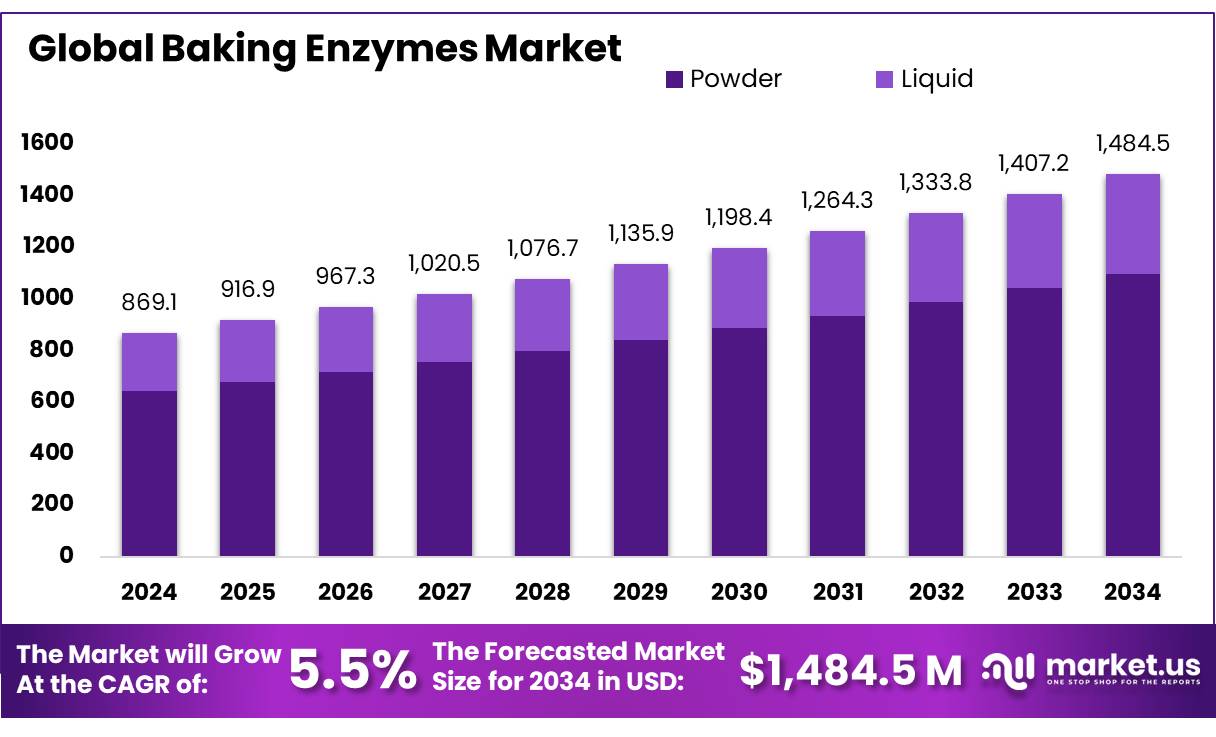
Several driving factors are growth of the baking enzymes market. The increasing consumption of processed and ready-to-eat baked goods is one of the primary drivers. With the rise of busy lifestyles and changing eating habits, the demand for convenient, pre-packaged food products is soaring. Additionally, consumers’ preference for healthier alternatives, including products with natural ingredients and fewer additives, has prompted the integration of enzymes in baking processes. Enzymes help maintain product consistency, reduce food waste, and enhance nutritional content, which further drives their adoption in the industry.
In the industrial baking sector, enzymes are used in various stages of production, including dough preparation, fermentation, and baking. The application of enzymes such as amylases helps in breaking down starches into fermentable sugars, thus improving fermentation and yielding a lighter, fluffier texture in bread. Other enzymes like proteases and lipases improve dough elasticity and extensibility, facilitating better handling during production. The global shift towards healthier and cleaner food formulations has also fueled the adoption of enzyme-based baking ingredients, as enzymes offer a natural, cost-effective solution to improve product quality without relying on artificial additives or preservatives.
Key Takeaways
- Baking Enzymes Market size is expected to be worth around USD 1484.5 Mn by 2034, from USD 869.1 Mn in 2024, growing at a CAGR of 5.5%.
- Powder held a dominant market position, capturing more than a 74.3% share of the global baking enzymes market.
- Proteases held a dominant market position, capturing more than a 30.1% share of the global baking enzymes market.
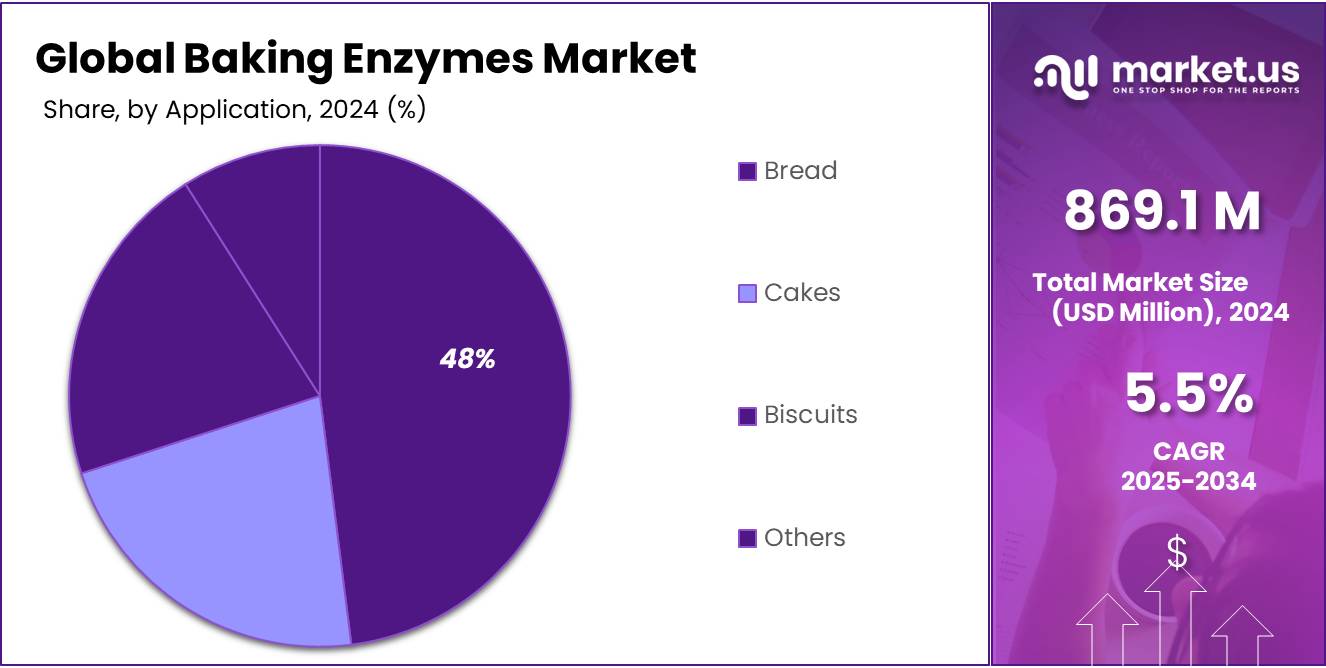
- Bread held a dominant market position, capturing more than a 48.3% share of the global baking enzymes market.
- Supermarkets/Hypermarkets held a dominant market position, capturing more than a 38.2% share of the global baking enzymes market.
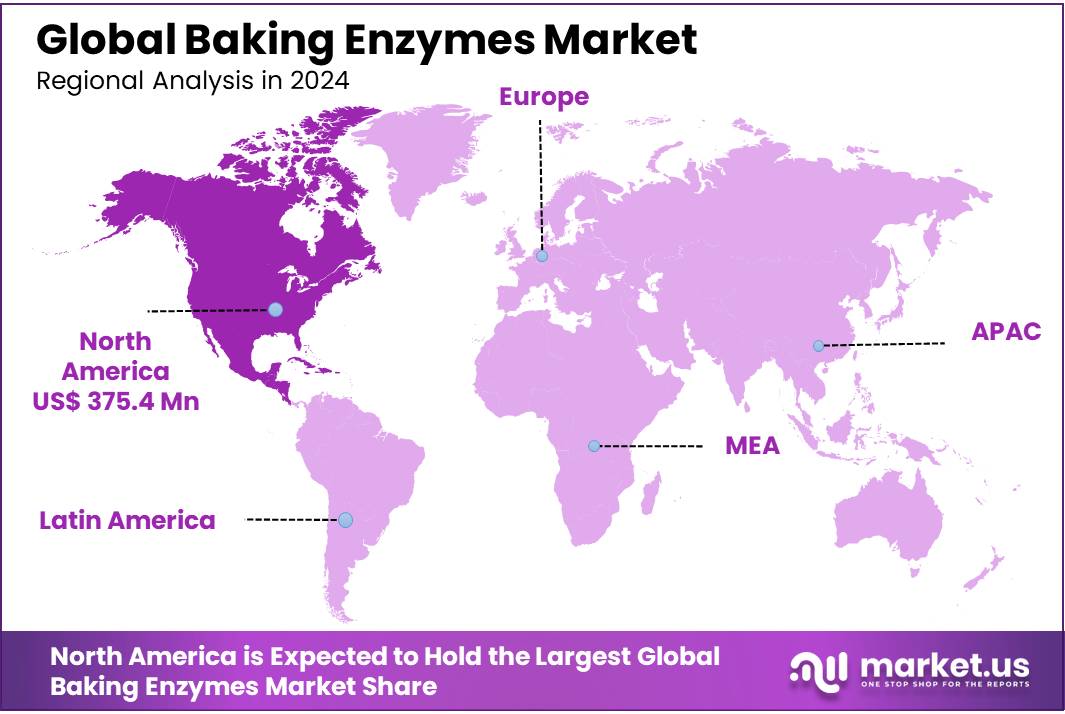
- North America is expected to remain the dominating region in the global baking enzymes market, capturing a substantial share of 43.2%, valued at approximately $375.4 million.
By Form
In 2024, Powder held a dominant market position, capturing more than a 74.3% share of the global baking enzymes market. This was primarily driven by its widespread application in the baking industry due to its easy storage, long shelf life, and efficient formulation. Powdered enzymes are favored for their convenience and ability to blend seamlessly with other dry ingredients, which makes them a preferred choice for large-scale bakery operations.
The liquid form of baking enzymes, although capturing a smaller market share, has been growing steadily. With increasing demand for clean-label products and advancements in enzyme formulation, liquid enzymes are gaining popularity, particularly in artisanal and small-scale bakeries. These enzymes are typically used for their ease of use in liquid dough systems, and their growth is expected to continue at a moderate pace.
By Product
In 2024, Proteases held a dominant market position, capturing more than a 30.1% share of the global baking enzymes market. The widespread use of proteases in bread and other baked goods is a key factor behind this strong market presence. These enzymes are essential for breaking down proteins, which helps improve dough handling and texture, leading to better product quality and shelf life. Their versatile applications in different types of baked goods continue to drive their leading position in the market.
Following proteases, carbohydrases, particularly amylases, have a significant market share as well. Amylases are crucial for breaking down starches into simpler sugars, which helps in fermentation and overall dough rise. This makes them indispensable in the production of high-quality bread and cakes. Their market share in 2024 is expected to continue to grow steadily as demand for bakery products increases globally.
Lipases and xylanases/hemicellulase enzymes are also contributing to the growth of the market, although at a slower pace compared to proteases and amylases. Lipases, used for improving the texture and freshness of baked goods, are seeing increased adoption as consumer demand for healthier options rises. Xylanases and hemicellulases, on the other hand, are gaining traction for their role in enhancing dough softness and improving the quality of whole grain and fiber-rich bakery products.
Cellulase, pectinase, and lactases are smaller segments but are expected to show moderate growth through 2025. Cellulase enzymes are being used to improve the texture of gluten-free and high-fiber products, while pectinase helps in fruit-based bakery products, such as pies and tarts. Lactases are increasingly popular in gluten-free and dairy-free baking as they assist in breaking down lactose and improving the taste and digestibility of baked goods.
By Application
In 2024, Bread held a dominant market position, capturing more than a 48.3% share of the global baking enzymes market. Bread remains the most significant application of baking enzymes due to its widespread consumption and reliance on specific enzyme formulations to improve texture, shelf life, and dough handling properties. The demand for high-quality bread, including whole grain, gluten-free, and artisanal varieties, continues to drive the market for enzymes tailored to enhance bread production.
Following bread, cakes and biscuits also represent key segments in the market, though with a smaller share. Cakes, typically requiring delicate textures and consistent rising, are seeing steady demand for specialized enzymes that support moisture retention and improve crumb structure. The cake segment is expected to experience moderate growth through 2025, driven by the increasing consumer preference for premium, high-quality baked goods.
Biscuits, while a smaller portion of the market, are projected to grow steadily in the coming years. Enzymes used in biscuits are crucial for ensuring the right texture, crispness, and consistency. The growing demand for healthier biscuit options, including low-fat and gluten-free varieties, is expected to further boost the market for enzymes designed specifically for biscuit production.
By Distribution Channel
In 2024, Supermarkets/Hypermarkets held a dominant market position, capturing more than a 38.2% share of the global baking enzymes market. This channel remains the largest due to the widespread availability of baking products and ingredients in these retail outlets. Consumers frequently purchase baking enzymes through supermarkets and hypermarkets because of the convenience and variety these stores offer.
Direct sales are also an important segment of the market, particularly for bulk buyers and professional bakeries. While capturing a smaller share compared to supermarkets/hypermarkets, direct sales offer a specialized service for larger-scale buyers who require tailored enzyme formulations.
Specialty stores, which cater to niche markets, are also contributing to the market, albeit at a slower rate. These stores typically focus on organic, gluten-free, and other specialized baking products, and the demand for enzymes in these segments is growing as consumers become more health-conscious and demand high-quality, tailored baking solutions. The growth in this segment is expected to continue through 2025, driven by changing consumer preferences and the rise of specialty food markets.
Online retail is a rapidly expanding distribution channel, particularly in response to changing shopping habits and the growing convenience of e-commerce. Consumers increasingly prefer the ease of ordering baking ingredients and enzymes online, and this trend is expected to accelerate through 2025.
Key Market Segments
By Form
- Powder
- Liquid
By Product
- Proteases
- Lipases
- Carbohydrases
- Amylases
- Xylanases/Hemicellulase
- Cellulase
- Pectinase
- Lactases
- Polymerases & Nucleases
- Phytases
- Catalases
- Others
By Application
- Bread
- Cakes
- Biscuits
- Others
By Distribution Channel
- Direct Sales
- Supermarkets/Hypermarkets
- Specialty Stores
- Online Retail
- Others
Drivers
Growing Demand for Clean Label and Health-Conscious Bakery Products
One of the major driving factors for the growth of the baking enzymes market is the increasing consumer demand for clean label and health-conscious bakery products. As consumers become more aware of the ingredients in their food, there is a strong preference for products that are perceived as natural, simple, and free from artificial additives. Baking enzymes play a key role in meeting these consumer demands by helping to improve the quality and shelf life of baked goods without the need for artificial preservatives or excessive chemical additives.
According to the International Food Information Council (IFIC), about 77% of consumers are actively looking for foods with clean labels, and 73% of shoppers prioritize natural ingredients when making food purchasing decisions (IFIC, 2023). This shift in consumer behavior is fueling the growth of clean label products in the bakery sector, where enzymes such as amylases, proteases, and lipases can replace chemical additives and improve the texture, taste, and appearance of bakery items.
Government initiatives supporting clean label and sustainable food production are further accelerating this trend. In the European Union, for example, the European Food Safety Authority (EFSA) has been promoting transparency and better regulation of food ingredients to support healthier eating habits and consumer trust. This regulatory backing encourages the food industry to adopt more natural enzyme-based solutions, aligning with consumer preferences for cleaner and more sustainable food options.
Restraints
High Cost of Enzyme Formulations
One major restraining factor for the growth of the baking enzymes market is the high cost of enzyme formulations, which can be a barrier for smaller bakeries and producers. While enzymes offer significant benefits in terms of product quality and shelf life, the cost of sourcing and incorporating these specialized ingredients can be a challenge, especially for small and medium-sized enterprises (SMEs). This can make it difficult for some bakeries to adopt enzymes on a larger scale, limiting their potential for growth.
According to the United Nations Food and Agriculture Organization (FAO), the cost of enzyme production is influenced by factors such as raw material sourcing, enzyme purification processes, and the research and development required to create customized formulations for specific baking needs. The FAO estimates that enzyme-based solutions account for about 10-20% of the total production costs in the bakery industry, which can be prohibitive for some businesses, particularly those with lower profit margins. The overall cost of enzyme technology is expected to remain a concern, especially for smaller bakeries that might not have the resources to invest in these solutions.
Despite this, government initiatives in regions such as Europe and North America are pushing for more cost-effective enzyme solutions. For instance, the European Commission has invested in projects aimed at reducing the cost of enzyme production through innovation in biotechnology and more sustainable sourcing practices. These efforts are focused on making enzymes more accessible to a wider range of food producers, thus addressing the cost barrier over time.
Opportunity
Expansion of Gluten-Free and Specialty Bakery Products
One of the major growth opportunities for the baking enzymes market lies in the expanding demand for gluten-free and specialty bakery products. As more consumers shift towards healthier, allergy-conscious diets, there has been a significant rise in the consumption of gluten-free and other specialized bakery items. This trend is expected to continue, creating an increased demand for enzymes that enhance the quality and texture of gluten-free and other specialty baked goods.
The Gluten-Free Watchdog reports that the global market for gluten-free products is projected to grow at a compound annual growth rate (CAGR) of 9.5%, reaching over $9 billion by 2025. This surge is driven by the growing number of people diagnosed with celiac disease, as well as those adopting gluten-free diets for health and wellness reasons. Gluten-free bakery products, which often lack the elasticity and structure of traditional products, require specialized enzymes like xylanases and cellulases to improve dough texture, consistency, and volume. Enzymes help create more desirable textures and prevent the dry, crumbly texture that is often associated with gluten-free baked goods.
Similarly, the demand for low-sugar, high-protein, and organic bakery products is on the rise. Enzymes play a crucial role in these products as well, helping to improve product stability, freshness, and mouthfeel without the use of artificial additives. According to the International Food Information Council (IFIC), 60% of consumers in the U.S. report trying to reduce sugar intake, and this trend is reflected in bakery product innovations that leverage enzymes for cleaner labels and healthier formulations.
Governments and food organizations are supporting this growth by investing in research and development for healthier, enzyme-enhanced baked goods. In the U.S., the Department of Agriculture (USDA) has backed several initiatives aimed at improving gluten-free production techniques and promoting more nutritious food ingredients. These efforts are creating a favorable environment for enzyme manufacturers to cater to the growing market for gluten-free and specialty products.
Trends
Increasing Adoption of Enzymes in Clean Label and Plant-Based Baked Goods
A major trend currently shaping the baking enzymes market is the increasing adoption of enzymes in clean label and plant-based baked goods. As consumers become more health-conscious and demand transparency in food labeling, there is a growing shift toward products made with natural ingredients and fewer additives. Clean label products, which are made without artificial preservatives, colorings, or flavorings, are now a key focus for many food manufacturers, including those in the bakery sector.
The Clean Label Project reported that over 60% of consumers globally prefer foods with simple, natural ingredients, which has pushed bakeries to innovate with cleaner formulations. Enzymes, particularly those that are naturally derived, play a crucial role in these products by improving texture, shelf life, and overall quality without the need for synthetic additives. For instance, enzymes like amylases and proteases help improve dough quality and bread texture while keeping the ingredient list short and clean.
Simultaneously, plant-based baked goods are gaining significant traction in the market. According to a Mintel report, the plant-based food sector grew by 27% in 2020, and bakery products made with plant-based ingredients are a key contributor to this growth. Plant-based ingredients, however, can pose challenges in terms of texture and structure, making enzymes like xylanases, cellulases, and lipases essential for enhancing the consistency and quality of these products.
Government initiatives are further supporting this trend. In Europe, the European Commission has emphasized the importance of promoting sustainable food systems, including plant-based diets, through initiatives like the Farm to Fork Strategy, which encourages the use of more natural, plant-derived ingredients in food products. This regulatory push is creating a favorable environment for the use of enzymes in plant-based and clean label bakery products.
Regional Analysis
In 2024, North America is expected to remain the dominating region in the global baking enzymes market, capturing a substantial share of 43.2%, valued at approximately $375.4 million. This leadership can be attributed to the region’s advanced food processing infrastructure, a strong focus on clean label products, and the growing consumer demand for health-conscious and specialty bakery goods such as gluten-free, low-sugar, and plant-based products.
Europe holds a prominent position as well, contributing to a significant share of the global market. The region’s rising preference for sustainable and organic bakery products is bolstered by government policies such as the European Commission’s Farm to Fork Strategy, which encourages clean and sustainable food production. With growing demand for artisan and gluten-free products, European countries like Germany, France, and the UK are increasing their usage of enzymes in the bakery industry.
In Asia Pacific, the market is poised for rapid growth, projected to see the highest CAGR through 2025. Rising disposable incomes, urbanization, and the adoption of Western-style baked goods in countries like China, India, and Japan are fueling this expansion. The growing middle-class population and increasing demand for convenience foods further drive the adoption of baking enzymes.
Middle East & Africa is gradually becoming a key market, with expanding bakery sectors in regions like the GCC. Meanwhile, Latin America is experiencing moderate growth, particularly in Brazil and Argentina, where changing consumer preferences are shifting towards healthier bakery options.
Key Regions and Countries
- North America
- US
- Canada
- Europe
- Germany
- France
- The UK
- Spain
- Italy
- Rest of Europe
- Asia Pacific
- China
- Japan
- South Korea
- India
- Australia
- Rest of APAC
- Latin America
- Brazil
- Mexico
- Rest of Latin America
- Middle East & Africa
- GCC
- South Africa
- Rest of MEA
Key Players Analysis
The baking enzymes market features a competitive landscape with several key players driving innovation and growth. Among the leading companies, Novozymes A/S stands out as a dominant player, renowned for its wide range of enzyme solutions that enhance the quality, texture, and shelf life of bakery products. Novozymes has made significant strides in promoting clean label and sustainable enzyme options, a key trend in the market.
AB Enzymes GmbH and Amano Enzyme Inc. are notable players, offering specialized enzyme formulations that cater to various bakery applications, including bread, cakes, and biscuits. These companies are focused on expanding their portfolios through strategic partnerships and investments in research and development to meet growing consumer demand for healthier, cleaner products.
Additionally, BASF, Chr Hansen, and DSM are major contributors to the market, leveraging their global presence and expertise in biotechnology to provide high-quality enzyme solutions for the bakery industry. These companies also prioritize sustainability, with ongoing efforts to reduce the environmental impact of enzyme production.
Puratos Group NV and DowDuPont Inc. have also made notable investments in enzyme-based solutions, particularly in the gluten-free and plant-based bakery segments. Smaller players like Engrain, SternEnzym GmbH & Co. KG, and Enmex are also expanding their influence, focusing on niche enzyme products and regional markets to meet specific customer needs. Together, these key players are shaping the future of the baking enzymes market, providing innovative and tailored solutions that cater to evolving industry demands.
Top Key Players
- AB Enzymes GmbH
- Advanced Enzymes
- Amano Enzyme Inc.
- Aum Enzymes
- Aumgene Biosciences
- BASF
- Chr Hansen
- Danisco
- DowDuPont Inc.
- DSM
- Dyadic International Inc.
- Engrain
- Enmex
- Enzyme Innovation
- Hayashibara Co
- Lumis
- Maps Enzyme Limited
- Novozymes A/S [Denmark]
- Puratos Group NV
- Royal DSM
- SternEnzym GmbH & Co. KG
- Thermo Fisher Scientific
Recent Developments
In 2024, AB Enzymes is expected to see a steady growth in demand, particularly in the clean label and health-conscious segments, where there is an increasing focus on natural and sustainable ingredients.
In 2024, Advanced Enzymes is expected to maintain a strong market presence, leveraging its expertise in enzymology to offer innovative solutions for both traditional and specialty bakery applications.
Report Scope
Report Features Description Market Value (2024) USD 869.1 Mn Forecast Revenue (2034) USD 1484.5 Mn CAGR (2025-2034) 5.5% Base Year for Estimation 2024 Historic Period 2020-2023 Forecast Period 2025-2034 Report Coverage Revenue Forecast, Market Dynamics, Competitive Landscape, Recent Developments Segments Covered By Form (Powder, Liquid), By Product (Proteases, Lipases, Carbohydrases, Amylases, Xylanases/Hemicellulase, Cellulase, Pectinase, Lactases, Polymerases and Nucleases, Phytases, Catalases, Others), By Application (Bread, Cakes, Biscuits, Others), By Distribution Channel (Direct Sales , Supermarkets/Hypermarkets, Specialty Stores, Online Retail, Others) Regional Analysis North America – US, Canada; Europe – Germany, France, The UK, Spain, Italy, Rest of Europe; Asia Pacific – China, Japan, South Korea, India, Australia, Singapore, Rest of APAC; Latin America – Brazil, Mexico, Rest of Latin America; Middle East & Africa – GCC, South Africa, Rest of MEA Competitive Landscape AB Enzymes GmbH, Advanced Enzymes, Amano Enzyme Inc., Aum Enzymes, Aumgene Biosciences, BASF, Chr Hansen, Danisco, DowDuPont Inc., DSM, Dyadic International Inc., Engrain, Enmex, Enzyme Innovation, Hayashibara Co, Lumis, Maps Enzyme Limited, Novozymes A/S [Denmark], Puratos Group NV, Royal DSM, SternEnzym GmbH & Co. KG, Thermo Fisher Scientific Customization Scope Customization for segments, region/country-level will be provided. Moreover, additional customization can be done based on the requirements. Purchase Options We have three licenses to opt for: Single User License, Multi-User License (Up to 5 Users), Corporate Use License (Unlimited User and Printable PDF) 
-
-
- AB Enzymes GmbH
- Advanced Enzymes
- Amano Enzyme Inc.
- Aum Enzymes
- Aumgene Biosciences
- BASF
- Chr Hansen
- Danisco
- DowDuPont Inc.
- DSM
- Dyadic International Inc.
- Engrain
- Enmex
- Enzyme Innovation
- Hayashibara Co
- Lumis
- Maps Enzyme Limited
- Novozymes A/S [Denmark]
- Puratos Group NV
- Royal DSM
- SternEnzym GmbH & Co. KG
- Thermo Fisher Scientific
Our Clients

- 139885
- Feb 2025






