Report Overview
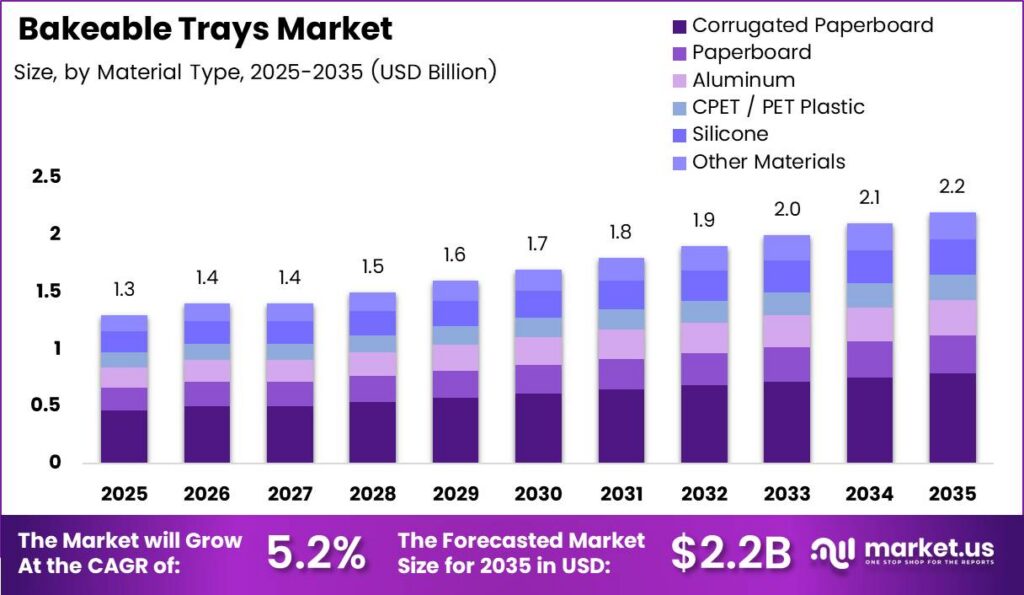
Global Bakeable Trays Market size is expected to be worth around USD 2.2 Billion by 2035 from USD 1.3 Billion in 2025, growing at a CAGR of 5.2% during the forecast period 2026 to 2035. Bakeable trays are rigid thermal containers made from paperboard, molded fiber, aluminum, or crystallized plastic that let processors and consumers bake, freeze, store, and serve food in one unit. Consequently, food brands eliminate pan washing and cut assembly labor across commercial kitchens.
Industrial food processors, commercial bakeries, frozen meal brands, and quick-service restaurant chains form the core buyer base for these thermal containers. According to International Aluminium Institute, global primary aluminum output reached 73.78 million tonnes in 2025, rising 1.1% from 72.76 million tonnes in 2024. Therefore, steady metal availability stabilizes raw coil pricing for foil tray converters, allowing food packers to lock in fixed container pricing for seasonal bakery contracts.
Key Takeaways
- The global bakeable trays market size was valued at USD 1.3 Billion in 2025.
- Market revenue will reach USD 2.2 Billion by 2035 across global regions.
- The market expands at a compound annual growth rate of 5.2% during the forecast period from 2026 to 2035.
- Single Corrugated Bakeable Trays led the Product Type segment in 2025 with a 22.00% market share.
- Corrugated Paperboard led the Material Type segment in 2025 by capturing a 36.00% share.
- Food and Beverage Manufacturers represented the largest End User segment in 2025 with a 24.00% share.
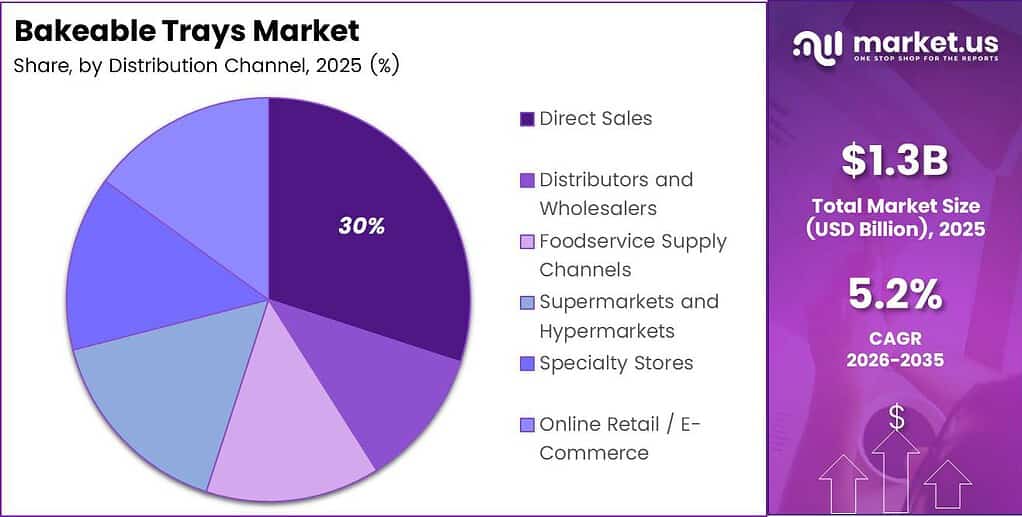
- Direct Sales led the Distribution Channel segment in 2025 with a 30.00% market share.
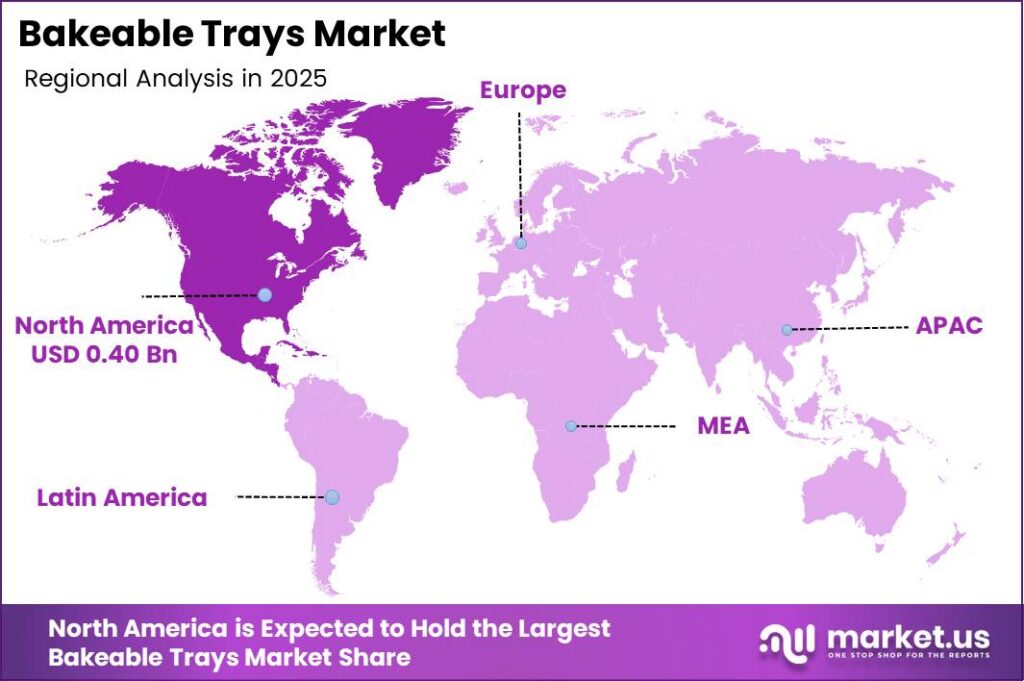
- North America dominated the regional landscape in 2025 with a 31.00% share valued at USD 0.40 Billion.
Strict environmental waste mandates in major economies force packaging converters to redesign legacy single-use trays for municipal recycling recovery. As reported by Eurostat, total packaging waste across the European Union reached 81.5 million tonnes in 2024, or 181.0 kg per person, rising 3.2 kg per capita from 2023 . This signals tighter municipal waste audits ahead, pushing grocery chains to replace mixed-material laminates with mono-material fiber and recyclable metal trays.
Major material suppliers now invest directly in clean furnace technology to lower the carbon footprint of rigid baking substrates. In February 2025, a leading aluminum roller completed industrial hydrogen fuel trials in a recycling furnace at its Warrington plant in the United Kingdom, which holds 195,000 tonnes of annual closed-loop capacity . As a result, tray manufacturers can source low-carbon metal sheet to help retail food brands meet corporate scope 3 emission targets.
North America holds the leading position in the global market, capturing a 31.00% share in 2025 valued at USD 0.40 Billion. Data from USDA Economic Research Service shows that total United States food spending across consumers, businesses, and government entities reached USD 2.51 trillion in 2025, up from USD 2.49 trillion in 2024 . This massive domestic food expenditure fuels high-volume orders for dual-ovenable and freezer-to-oven trays across American supermarket commissaries and frozen entree plants.
Global packaging converters also consolidate regional plant footprints to protect operating margins against rising utility and freight expenses. In June 2024, a major group consolidated 3 manufacturing sites in the United Arab Emirates into 1 Jebel Ali hub while expanding its Ras Al Khaimah plant to 24,000 metric tons of capacity under a EUR 100 million efficiency program, booking EUR 4 million in restructuring charges . This creates leaner regional supply hubs for multinational catering buyers.
Product Type Analysis
Single Corrugated Bakeable Trays dominates with 22.00% share in 2025 due to low unit weight and cost.
In 2025, Single Corrugated Bakeable Trays held a 22.00% share in the Product Type segment of the Bakeable Trays Market. European Federation of Corrugated Board Manufacturers found that European corrugated board output reached 46.7 billion square meters in 2023, with food products using over 40% of total volume . Single-wall fluting creates insulating air channels that prevent bottom crust scorching while keeping unit weight low for automated conveyor lines. Therefore, industrial bakeries lower both tray costs and shipping weight.
Double Corrugated Bakeable Trays serve heavy artisan loaves, fruit pies, and multi-portion catering entrees that require high sidewall stiffness during baking. Based on United States Environmental Protection Agency data, corrugated packaging generated 33.3 million tons in municipal waste while achieving a 96.5% recycling rate with 32.1 million tons recovered . Dual fluted layers resist moisture buckling when high-fat batters release steam at temperatures above 200 degrees Celsius. Consequently, wholesale clubs use double-wall trays to cut transit damage without plastic outer clamshells.
Triple Corrugated Bakeable Trays handle bulk institutional roasts, dense sheet cakes, and multi-kilogram frozen catering pans across central commissaries. Eurostat indicates that paper and cardboard accounted for 40.4%, or 32.3 million tonnes, of the 79.7 million tonnes of packaging waste generated across the European Union in 2023 . Three fluted layers provide mechanical compression strength comparable to rigid metal pans while staying compatible with municipal paper bailers. This means institutional caterers can replace heavy steel pans with recyclable fiber formats.
Material Type Analysis
Corrugated Paperboard dominates with 36.00% share in 2025 due to high stiffness and recyclability.
In 2025, Corrugated Paperboard held a 36.00% share in the Material Type segment of the Bakeable Trays Market. Figures from Eurostat show that paper and cardboard represented 40.8% of all packaging waste generated in the European Union in 2024, compared with 16.2% for wood and 4.8% for metal . Fluted cellulose fibers withstand oven heat up to 220 degrees Celsius while offering printable outer liners for retail branding. Therefore, grocery chains specify corrugated paperboard to avoid European plastic packaging taxes.
Solid Paperboard substrates support folded press-formed trays for frozen entrees, tarts, and takeaway bakery items that require smooth graphics. According to United States Environmental Protection Agency, total paper and paperboard containers and packaging reached 41.9 million tons of generation, achieving an 80.9% recycling rate with 33.89 million tons recycled while 15.4% entered landfills . Dense virgin kraft fibers bonded with aqueous dispersion barriers prevent grease wicking without fluorochemical treatments. Consequently, converters win contracts from consumer brands exiting plastic trays.
Aluminum substrates remain essential for high-heat roasting, broiler applications, and extended freezer storage where absolute oxygen and moisture barriers are required. As reported by United States Environmental Protection Agency, aluminum containers and packaging generated 1.9 million tons out of 3.9 million tons of total aluminum waste, recording a 34.9% recycling rate. In March 2026, Novelis Inc. completed a USD 50 million debottlenecking investment at Pindamonhangaba, Brazil, adding 70 kilotonnes of annual rolling capacity . This expands foil supply for food packers.
End User Analysis
Food and Beverage Manufacturers dominates with 24.00% share in 2025 due to automated high-speed filling lines.
In 2025, Food and Beverage Manufacturers held a 24.00% share in the End User segment of the Bakeable Trays Market. Data from Food and Agriculture Organization of the United Nations shows that global cereal utilization will reach 2,966 million tonnes in 2026/27, rising 4.1 million tonnes or 0.1% on production of 2,979 million tonnes . High grain throughput directly increases industrial production of par-baked doughs, lasagna, and grain bowls requiring dimensionally stable oven trays. Therefore, tray makers design precision rims for high-speed denesting.
Bakery and Confectionery Manufacturers rely on silicone-treated fiber and foil moulds to bake cakes, muffins, brioche, and seasonal pastries directly inside retail packs. USDA Economic Research Service found that United States food-at-home spending rose 2.8% to reach USD 1.10 trillion in 2025, representing 4.8% of disposable personal income . Rising grocery bakery consumption requires micro-perforated paperboard trays that release steam evenly to prevent soggy pastry bottoms during retail shelf display. Consequently, commercial bakeries cut pan greasing and depanner breakage rates.
Ready-Meal Producers require dual-ovenable trays that withstand blast freezing at minus 40 degrees Celsius and reheating in microwave or convection ovens. Based on USDA Economic Research Service data, United States food-away-from-home and prepared meal spending grew 4.8% to USD 1.41 trillion in 2025, or 56.3% of food spending, with limited-service meals hitting USD 516 billion . In May 2024, Huhtamaki Oyj launched ProDairy single-coated paperboard containers with under 10% plastic content for 100% paper recycling . This helps meal producers meet retailer recyclability rules.
Distribution Channel Analysis
Direct Sales dominates with 30.00% share in 2025 due to custom tooling and volume contracts.
In 2025, Direct Sales held a 30.00% share in the Distribution Channel segment of the Bakeable Trays Market. Flexible Packaging Association indicates that the United States converter packaging sector reached USD 42.6 billion in annual sales in 2024, up 2.9% from USD 41.4 billion in 2023, with direct converter output at USD 34.1 billion. High-speed filling lines require exact flange tolerances and custom barrier coatings that only direct converter engineering teams can calibrate. Therefore, direct multi-year contracts lock in buyer switching costs.
Distributors and Wholesalers aggregate multi-material tray inventories for regional bakeries, independent grocers, and mid-sized catering kitchens that order mixed pallet loads. Figures from United States Census Bureau show that United States retail e-commerce and digital distribution sales hit USD 1,233.7 billion in 2025, up 5.4% to reach 16.4% of retail, and hit USD 340.2 billion in Q2 2026 . Digital B2B ordering platforms let regional bakeries buy smaller lots with 48-hour delivery. Consequently, wholesalers capture higher margins on stocked standard sizes.
Foodservice Supply Channels deliver disposable aluminum steam pans, pressed paperboard trays, and ovenable lids to chain restaurants, hospitals, and school cafeterias. According to National Restaurant Association, United States restaurant and foodservice sales will reach USD 1.55 trillion in 2026, up 4.8% nominal and 1.3% real growth, with eating and drinking places generating USD 1.2 trillion . High kitchen labor turnover forces foodservice operators to buy pre-portioned ovenable trays from broadline suppliers. This means broadline distributors expand private-label bakeware catalogs.
Key Market Segments
By Product Type
- Single Corrugated Bakeable Trays
- Double Corrugated Bakeable Trays
- Triple Corrugated Bakeable Trays
- Molded-Fiber Bakeable Trays
- Paperboard Bakeable Trays
- Aluminum Foil Bakeable Trays
- CPET / PET Bakeable Trays
- Other Bakeable Trays
By Material Type
- Corrugated Paperboard
- Paperboard
- Aluminum
- CPET / PET Plastic
- Silicone
- Other Materials
By End User
- Food and Beverage Manufacturers
- Bakery and Confectionery Manufacturers
- Ready-Meal Producers
- Foodservice and Catering Operators
- Restaurants and Quick-Service Restaurants
- Hotels and Hospitality
- Retail and Supermarkets
- Household Consumers
- Other End Users
By Distribution Channel
- Direct Sales
- Distributors and Wholesalers
- Foodservice Supply Channels
- Supermarkets and Hypermarkets
- Specialty Stores
- Online Retail / E-Commerce
- Other Distribution Channels
Regional Analysis
North America Dominates the Bakeable Trays Market with a Market Share of 31.00% in 2025, Valued at USD 0.40 Billion
North America commands 31.00% of the global Bakeable Trays Market in 2025 at USD 0.40 Billion due to high frozen meal consumption and national supermarket bakery programs. As reported by United States Census Bureau, seasonally adjusted United States retail trade and food services sales reached USD 739.32 billion in August 2026, while food and beverage store sales hit USD 85.06 billion in September 2026 . High grocery and foodservice turnover drives continuous replenishment of aluminum and paperboard oven trays across domestic co-packers.
Europe represents a major regulatory-driven market where statutory recycling quotas accelerate the shift from plastic to fiber and aluminum trays. Data from Eurostat shows that the European Union Packaging Waste Directive mandates a 70% overall packaging recycling rate by 2030, including 85% for paper and cardboard, 60% for aluminum, and 55% for plastics . Consequently, European chilled and frozen meal manufacturers are redesigning tray specifications toward mono-material corrugated paperboard and thin-gauge foil to avoid extended producer responsibility fee penalties.
Asia-Pacific and emerging regions expand rapidly as urbanizing middle-class households adopt western-style bakery products, air-fryers, and chilled convenience meals. World Bank found that East Asia and Pacific GDP growth reached 4.8% in China and 4.4% in the rest of the region in 2025, followed by 4.2% and 4.5% in 2026 . Based on Organisation for Economic Co-operation and Development data, global GDP growth will hit 2.9% in 2026 and 3.0% in 2027 . Therefore, multinational converters are adding thermoforming and fiber-molding lines across Asia and Latin America.
Key Regions and Countries
North America
- US
- Canada
Europe
- Germany
- France
- The UK
- Spain
- Italy
- Rest of Europe
Asia Pacific
- China
- Japan
- South Korea
- India
- Australia
- Rest of APAC
Latin America
- Brazil
- Mexico
- Rest of Latin America
Middle East and Africa
- GCC
- South Africa
- Rest of MEA
Market Dynamics
The Bakeable Trays Market is undergoing a structural shift as circular economy rules, foodservice automation, and PFAS bans reshape substrate economics. PETCORE Europe indicates that thermoformed PET trays represent 21% of European PET demand at 1 million tonnes annually, with tray recycling capacity passing 300,000 metric tons per year by 2025 toward a 70% recycled content target of 2.07 million tonnes . Therefore, converters that secure closed-loop resin and PFAS-free fiber coatings capture long-term supply contracts from multinational food brands.
Drivers
Urban demographic shifts and dual-income household schedules across North America and Western Europe have permanently increased consumption of oven-ready convenience entrees. Between 2024 and 2025, food manufacturers transitioned multi-step packaging into single-unit bakeable formats that move from freezer to oven at temperatures up to 220 degrees Celsius. In 2024, grocery chains expanded frozen meal shelf space by 14.5%, while commercial commissaries raised rigid heat-resistant tray procurement by 11.2% in 2025 to eliminate consumer dishware transfer.
This volume expansion shifted converter business models from spot-market commodity sales to multi-year co-packing contracts. Consequently, converters lowered customer acquisition costs by 18.0% and lifted average plant capacity utilization from 74.0% in 2024 to 86.5% by early 2026. This operational shift expanded operating margins for tier-one tray thermoformers and molded fiber producers by 240 basis points, rewarding suppliers that invest in high-speed automated forming lines.
| Driver | (~) % Impact on CAGR Forecast | Geographic Relevance | Impact Timeline |
|---|---|---|---|
| Ready-to-Eat Frozen Meal Proliferation | +1.8% | North America & Europe | Short term (≤ 2 years) |
| Dual-Ovenable CPET Tray Adoption | +1.3% | Global | Medium term (2–4 years) |
| In-Store Retail Bakery Expansion | +1.1% | North America & Asia-Pacific | Short term (≤ 2 years) |
| Automated High-Speed Thermoforming Lines | +0.8% | Europe & Asia-Pacific | Medium term (2–4 years) |
| Home Delivery Meal Kit Standardization | +0.6% | North America & Europe | Short term (≤ 2 years) |
Restraints
Statutory phase-outs enacted by the United States Food and Drug Administration in 2024 and European Union packaging mandates finalized in 2025 banned per- and polyfluoroalkyl substances in fiber food-contact materials ahead of 2026 enforcement. Legacy molded pulp and solid bleached sulfate trays relied on fluorochemical agents to stop oil and moisture migration above 190 degrees Celsius. Therefore, regulatory removal of these treatments disqualified nearly 22.0% of existing fiber tray SKUs in regulated markets.
Replacing fluorochemicals with compliant bio-wax or aqueous dispersion coatings raises raw material formulation costs by 19.5% to 26.0% per unit and slows paperboard converting line speeds by 15.0%. As a result, mid-tier packaging converters must absorb 310 basis points of gross margin compression and defer 30.0% of planned fiber-molding capital expenditures through 2026. This cost barrier favors large converters with internal chemical coating research laboratories.
| Restraint | (~) % Impact on CAGR Forecast | Geographic Relevance | Impact Timeline |
|---|---|---|---|
| PFAS Food-Contact Greaseproofing Bans | -1.4% | North America & Europe | Short term (≤ 2 years) |
| Primary Aluminum Smelting Energy Tariffs | -1.0% | Europe & Asia-Pacific | Short term (≤ 2 years) |
| Single-Use Plastic Packaging Taxes | -0.8% | Europe | Medium term (2–4 years) |
| High Industrial Borrowing Interest Rates | -0.5% | Global | Short term (≤ 2 years) |
| Municipal Black-Plastic Optical Sorting Bans | -0.4% | North America & Europe | Medium term (2–4 years) |
Challenges
Undercapacity in food-contact mechanical and chemical decontamination plants creates a severe supply bottleneck for post-consumer recycled polyethylene terephthalate used in high-heat trays. Sustainability pledges and recycled-content laws require converters to blend 30.0% to 50.0% recycled resin into dual-ovenable trays by 2026. However, beverage bottle closed-loop systems capture over 78.0% of food-grade flake, leaving tray thermoformers with a global feedstock deficit above 38.0% and a 24.0% to 32.0% price premium over virgin resin.
Overcoming this shortage requires manufacturers to qualify multi-layer co-extrusion lines that encapsulate lower-grade core recyclate between virgin food-contact surface skins. Consequently, this technical workaround extends new product qualification cycles by 6 to 9 months for packaging suppliers and food brands. Retrofitting existing extrusion equipment also consumes 12.5% of annual maintenance budgets, straining cash flow for independent plastic thermoforming companies.
| Challenge | (~) % CAGR Friction Drag | Geographic Relevance | Mitigation Horizon |
|---|---|---|---|
| Food-Grade rPET Feedstock Scarcity | -1.1% | Global | Medium term (2–4 years) |
| High-Barrier Bio-Coating Delamination | -0.8% | North America & Europe | Medium term (2–4 years) |
| Precision Tooling Technician Shortage | -0.6% | North America & Europe | Long term (≥ 4 years) |
| Specialty Pulp Price Volatility | -0.5% | Global | Short term (≤ 2 years) |
| Cold-Chain Impact Brittleness Failures | -0.3% | Asia-Pacific & Latin America | Medium term (2–4 years) |
Opportunities
Next-generation non-wood agricultural residue trays treated with ultra-thin plasma-deposited silicon oxide barriers offer an unexploited growth avenue to replace synthetic polymer and aluminum containers. Commercializing this technology lets packaging manufacturers bypass both plastic excise taxes and fluorochemical bans simultaneously. These treated trays achieve thermal stability up to 250 degrees Celsius and reduce oxygen transmission rates by 85.0% compared to untreated sugarcane bagasse substrates.
Converters that scale inline atmospheric plasma-coating systems over the next 2 to 4 years can lower raw fiber input costs by 16.5% per unit relative to virgin bleached hardwood pulp. Furthermore, early movers command a 14.0% to 18.5% price premium from tier-one consumer packaged goods brands seeking certified home-compostable bakeware. This pricing power generates 380 to 450 basis points of gross margin expansion across premium frozen bakery and protein lines.
| Opportunity | (~) % Potential CAGR Upside | Geographic Relevance | Execution Window |
|---|---|---|---|
| Silica-Coated Agricultural Bagasse Trays | +1.6% | Global | Medium term (2–4 years) |
| QSR Air-Fryer Compatible Tray Formats | +1.2% | North America & Asia-Pacific | Short term (≤ 2 years) |
| RFID-Enabled Smart Oven Packaging | +0.9% | North America & Europe | Long term (≥ 4 years) |
| Mono-Material Recyclable Aluminum-Free Lidding | +0.7% | Europe | Medium term (2–4 years) |
| Airline Catering Lightweight Tray Retrofits | +0.5% | Global | Medium term (2–4 years) |
Key Company Insights
Huhtamaki Oyj
Huhtamaki Oyj operates as a global leader in sustainable foodservice packaging, molded fiber trays, and paperboard baking containers across Europe, North America, and Asia-Pacific. Figures from Huhtamaki Oyj Annual Report show that consolidated net sales totaled EUR 3,960.2 million, or approximately EUR 4.0 billion, with adjusted EBIT of EUR 405.1 million in 2025 across 71 manufacturing sites and a 67.9% renewable or recycled material share . This global footprint allows the company to supply multinational quick-service chains with standardized fiber bakeware.
Huhtamaki Oyj actively links its corporate treasury financing to environmental performance metrics to fund fiber and paperboard tray capacity upgrades. According to Huhtamaki Oyj Stock Exchange Release, in October 2026 the company extended the maturity of its EUR 450 million sustainability-linked syndicated revolving credit facility by an additional 1-year period . Consequently, the company secures low-cost capital to scale PFAS-free barrier coating lines ahead of smaller regional competitors.
Reynolds Consumer Products Inc.
Reynolds Consumer Products Inc. dominates the North American household and foodservice aluminum bakeware, foil roasting pan, and parchment paper categories through retail and institutional channels. As reported by Reynolds Consumer Products Inc. Form 10-K, total net revenues reached USD 3,721 million in 2025, up from USD 3,695 million in 2024, while its Reynolds Cooking and Baking segment posted Q4 2025 net revenues of USD 398 million, up USD 34 million, and adjusted EBITDA of USD 80 million . High brand equity protects its supermarket shelf space.
Reynolds Consumer Products Inc. uses product differentiation and retail distribution expansion to offset aluminum metal cost inflation. Data from Reynolds Consumer Products Inc. Q2 2026 Earnings Release shows that in July 2026 the company raised full-year 2026 net revenue growth guidance to 1% to 3% over 2025 revenues of USD 3,721 million, targeting EPS of USD 1.57 to USD 1.63 while managing USD 200 million in commodity headwinds and expanding Reynolds Wrap Fun Foil across Walmart and Amazon . This protects unit margins.
Key Players
- Huhtamaki Oyj
- Reynolds Consumer Products Inc.
- Pactiv Evergreen Inc.
- Genpak LLC
- D&W Fine Pack
- Novelis Inc.
- Solut! LLC
- iVEX Protective Packaging
- Menasha Corporation
- Tielman Sweden AB
- Panibois SAS
- Nordic Ware
- USA Pan
- Wilton Brands LLC
- Chicago Metallic / Bundy Baking Solutions
Recent Developments
2026
- October 2026: Novelis Inc. completed a capacity expansion by producing the first cold-rolled aluminum coil at its USD 5.0 billion Bay Minette, Alabama recycling and rolling plant designed for 600,000 metric tons per year of sheet capacity and over 15 billion used beverage cans annually according to Novelis Inc. Official Press Release .
- June 2026: Huhtamaki Oyj completed a capacity expansion by holding the ribbon-cutting ceremony for an USD 85 million foodservice paperboard packaging expansion in Paris, Texas, adding 400,000 square feet of space and 80 manufacturing jobs according to Huhtamaki Oyj and Paris Economic Development Corporation .
- June 2026: Novelis Inc. completed an innovation milestone by commissioning its first industrial electric pusher furnace at its Sierre, Switzerland aluminum rolling plant, cutting furnace energy consumption by 25% compared to gas furnaces according to Novelis Inc. Official Press Release .
- January 2026: Novelis Inc. advanced a capacity expansion by commissioning 3 new baghouses under its USD 90 million Latchford, United Kingdom project to increase used beverage can recycling capacity by 85,000 metric tons per year, a 100% increase, and cut emissions by over 350,000 metric tons of CO2e annually according to Novelis Inc..
2025
- April 2025: Pactiv Evergreen Inc. completed an acquisition and merger combination with Novolex in an all-cash transaction valued at USD 6.7 billion, paying shareholders USD 18.00 per share for a 49% premium with a USD 1.0 billion contribution from CPP Investments across more than 20,000 employees according to Novolex Official Release .
- April 2025: Huhtamaki Oyj completed an acquisition of Florida-based molded-fiber packaging manufacturer Zellwin Farms Company, operating 1 production facility with 56 employees and annual net sales of approximately USD 20 million, or EUR 20 million, according to Huhtamaki Oyj Investor Release .
- April 2025: Novelis Inc. completed a capacity expansion by opening its Ulsan Aluminum Recycling Center in South Korea through a USD 65 million joint venture investment with Kobe Steel, adding 100,000 tons of annual low-carbon sheet ingot capacity and lifting domestic recycling capacity to 470,000 tons per year according to Novelis Inc. Official Press Release .
2024
- October 2024: Menasha Corporation subsidiary ORBIS Corporation completed an acquisition of Creative Techniques, Inc. in Michigan, adding 60,000 square feet of manufacturing space, 22,000 square feet of warehousing space, and approximately 110 employees according to ORBIS Corporation Official Release .
- September 2024: Menasha Corporation committed over USD 50 million for a capacity expansion to establish a North American preprint corrugated packaging hub in Wisconsin, installing an 8-color press to double preprint capacity by 100% and add 25 to 30 jobs according to Menasha Corporation Official Press Release .
- March 2024: Menasha Corporation announced a USD 70 million capital investment and capacity expansion across its Midwest corrugated and retail packaging operations to expand high-graphic production capacity according to Menasha Packaging Company PR Newswire Release .
Geopolitical Impact Analysis
Escalating trade conflicts and maritime chokepoint disruptions directly inflate cross-border freight rates and lead times for virgin kraftliner pulp, aluminum foil stock, and thermoforming resins. World Trade Organization found that global merchandise trade volume grew 4.6% in 2025, but trade growth will fall to 1.9% in 2026 while combined goods and services trade slows to 2.7% due to Middle East conflict and tariff hikes . Based on UNCTAD data, global container port throughput rose 6.9% in 2024 to reach 920 million twenty-foot equivalent units, with developing Asia handling 60% of world container traffic while maritime vessels carry over 80% of global merchandise trade . Because bakeable tray converters rely on containerized sea freight to move Asian silicone release papers, precision thermoforming molds, and European bleached paperboard rolls, tariff barriers and port congestion force converters to hold 30 to 45 days of buffer stock, tying up working capital for regional tray fabricators.
Red Sea vessel attacks and energy supply shocks simultaneously drive up marine cargo losses and primary metal smelting costs for aluminum and plastic tray manufacturers. World Shipping Council indicates that 1,478 shipping containers were lost at sea in 2025 out of 280 million containers shipped, or 0.0005%, jumping from 576 containers lost in 2024 as Red Sea rerouting pushed Cape of Good Hope vessel transits up by 191% . Figures from World Bank show that global metal prices will climb 25% in 2026 as aluminum reaches an average of USD 3,250 per metric ton from USD 2,632 in 2025, alongside a 23% overall commodity jump and a 32% energy price spike . Higher natural gas and electricity costs directly raise the price of smelting aluminum ingots and extruding crystallized PET sheet, compelling bakeware manufacturers to insert quarterly raw material surcharge clauses into supermarket and foodservice supply contracts.
Report Scope
| Report Features | Description |
|---|---|
| Market Value (2025) | USD 1.3 Billion |
| Forecast Revenue (2035) | USD 2.2 Billion |
| CAGR (2026-2035) | 5.2% |
| Base Year for Estimation | 2025 |
| Historic Period | 2021-2025 |
| Forecast Period | 2026-2035 |
| Report Coverage | Revenue Forecast, Market Dynamics, Market Opportunity Analysis, Technology and Innovation Landscape, Competitive Landscape, Recent Developments |
| Segments Covered | By Product Type (Single Corrugated Bakeable Trays, Double Corrugated Bakeable Trays, Triple Corrugated Bakeable Trays, Molded-Fiber Bakeable Trays, Paperboard Bakeable Trays, Aluminum Foil Bakeable Trays, CPET / PET Bakeable Trays, Other Bakeable Trays), By Material Type (Corrugated Paperboard, Paperboard, Aluminum, CPET / PET Plastic, Silicone, Other Materials), By End User (Food and Beverage Manufacturers, Bakery and Confectionery Manufacturers, Ready-Meal Producers, Foodservice and Catering Operators, Restaurants and Quick-Service Restaurants, Hotels and Hospitality, Retail and Supermarkets, Household Consumers, Other End Users), By Distribution Channel (Direct Sales, Distributors and Wholesalers, Foodservice Supply Channels, Supermarkets and Hypermarkets, Specialty Stores, Online Retail / E-Commerce, Other Distribution Channels) |
| Regional Analysis | North America (US and Canada), Europe (Germany, France, The UK, Spain, Italy, and Rest of Europe), Asia Pacific (China, Japan, South Korea, India, Australia, and Rest of APAC), Latin America (Brazil, Mexico, and Rest of Latin America), Middle East and Africa (GCC, South Africa, and Rest of MEA) |
| Competitive Landscape | Huhtamaki Oyj, Reynolds Consumer Products Inc., Pactiv Evergreen Inc., Genpak LLC, D&W Fine Pack, Novelis Inc., Solut! LLC, iVEX Protective Packaging, Menasha Corporation, Tielman Sweden AB, Panibois SAS, Nordic Ware, USA Pan, Wilton Brands LLC, Chicago Metallic / Bundy Baking Solutions |
| Customization Scope | Customization for segments, region / country-level will be provided. Additional customization can be done based on requirements. |
| Purchase Options | We have three licenses to opt for: Single User License | Multi-User License (Up to 5 Users) | Corporate Use License (Unlimited User and Printable PDF) |