


Report Overview
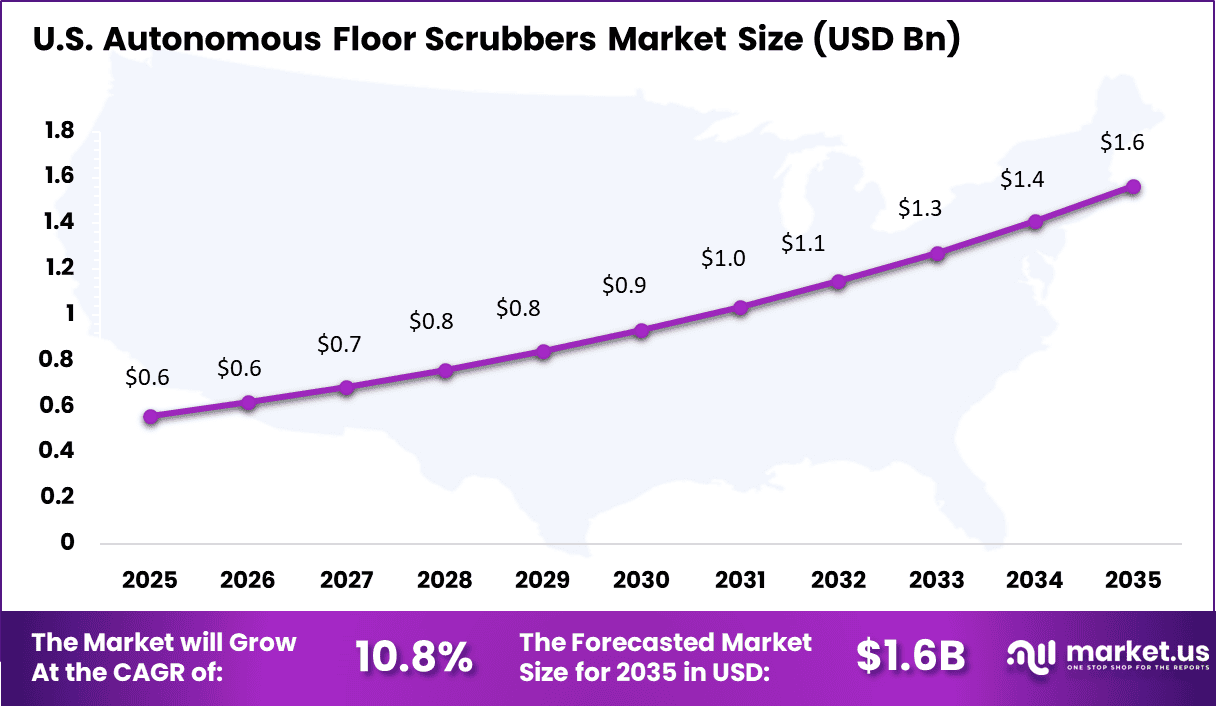
The Global Autonomous Floor Scrubbers Market generated USD 1.8 billion in 2025 and is predicted to register growth from USD 2.0 billion in 2026 to about USD 5.9 billion by 2035, recording a CAGR of 12.6% throughout the forecast span. In 2025, North America held a dominant market position, capturing more than a 35.2% share, with USD 0.63 billion in revenue.
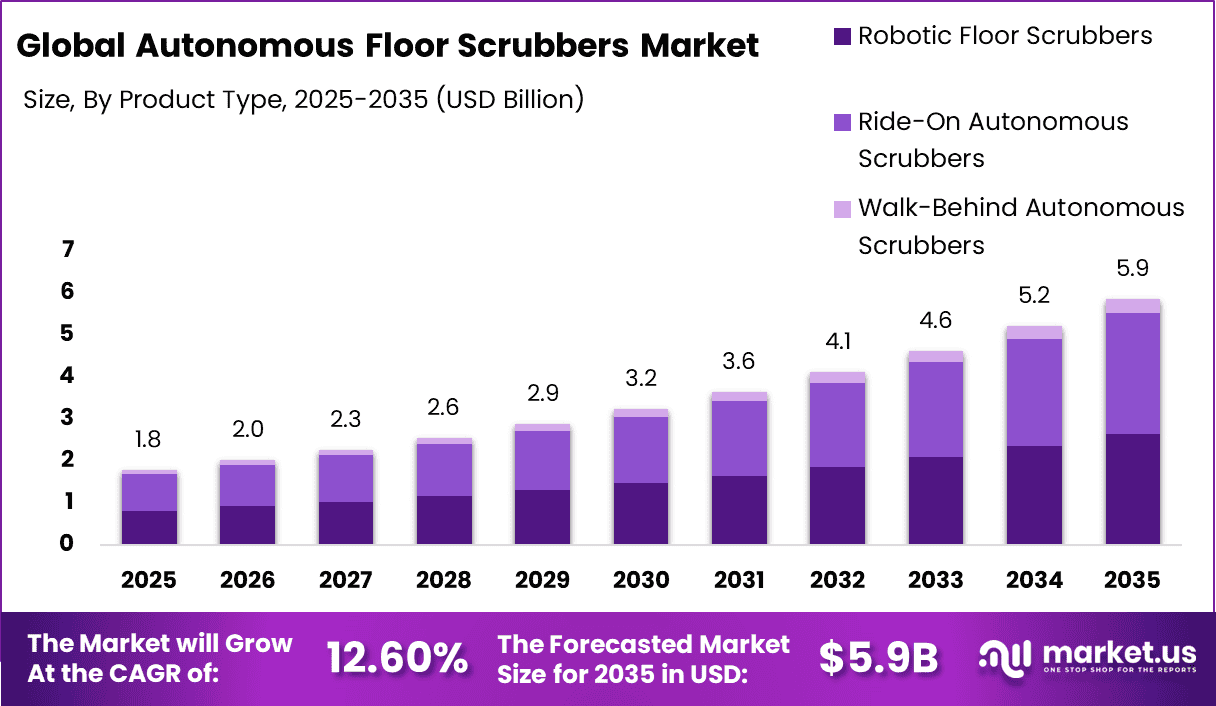
Autonomous Floor Scrubbers market refers to self-operating floor cleaning machines designed to scrub, wash, and dry hard floor surfaces in commercial and industrial environments with limited human involvement. These systems use sensors, mapping tools, route planning, and obstacle detection to clean large indoor spaces such as hospitals, warehouses, airports, retail stores, and public buildings with better consistency.
Autonomous floor scrubbers help organizations maintain regular cleaning schedules while allowing staff to focus on supervision and other important facility tasks. Another important factor is the improvement in navigation, sensing, and machine control, which allows these systems to operate more effectively in dynamic indoor spaces and deliver more reliable cleaning results.
Top Market Takeaways
- Robotic floor scrubbers command 45.2% market share, delivering SLAM navigation, obstacle avoidance, and scheduled cleaning paths for large-scale facility maintenance.
- Industrial applications capture 36.8%, enabling warehouse floor scrubbing, manufacturing plant sanitation, and food processing area decontamination.
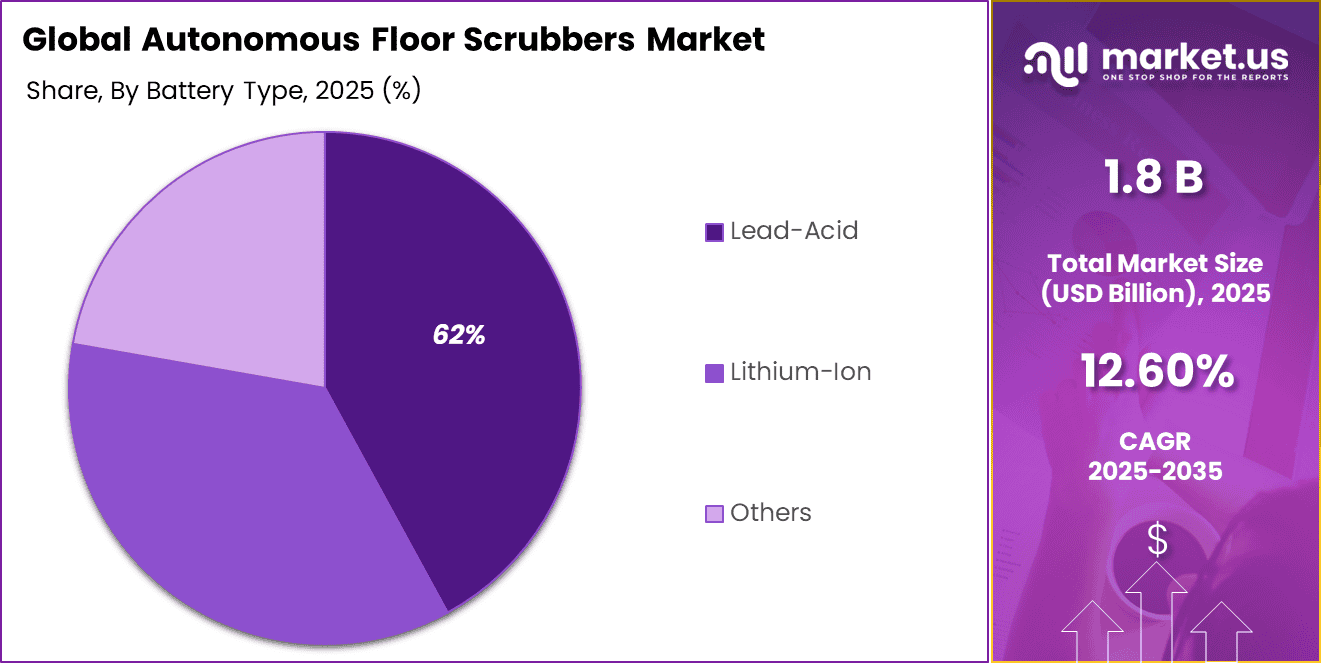
- Lead-acid batteries dominate at 62.4%, providing cost-effective runtime, simple replacement, and proven durability in heavy-duty cleaning cycles.
- Retail & shopping malls hold 28.6%, leveraging autonomous scrubbers for overnight mall corridor cleaning, store aisle maintenance, and high-traffic area disinfection.
- Direct sales channel claims 57.8%, facilitating customized deployments, service contracts, and integration with facility management systems.
- North America drives 35.2% global value, with the U.S. market at USD 0.56 billion and 10.8% CAGR, fueled by commercial real estate automation mandates.
By Product Type Analysis
Robotic floor scrubbers accounted for 45.2% of the Autonomous Floor Scrubbers Market. This segment leads because automated machines reduce manual cleaning effort and deliver consistent cleaning performance across large floor areas. These systems operate independently, follow predefined routes, and improve overall cleaning efficiency.
The segment is also supported by growing demand for automation in facility management. Organizations prefer robotic scrubbers to reduce labor dependency and maintain hygiene standards, especially in high-traffic environments where frequent cleaning is required.
By Application Analysis
Industrial represented 36.8% of the market. This segment dominates because factories, warehouses, and production units require regular and efficient cleaning to maintain safety and operational standards. Autonomous scrubbers help manage large spaces with minimal human intervention.
The segment is driven by the need to improve productivity and maintain clean working conditions. Industrial facilities adopt automated cleaning systems to ensure consistent results while reducing operational downtime and labor costs.
By Battery Type Analysis
Lead acid accounted for 62% of the market. This segment leads because lead-acid batteries are cost-effective and widely used in industrial cleaning equipment. They provide reliable power for extended cleaning cycles and are suitable for heavy-duty applications.
The segment is also supported by established usage and easy availability. Many organizations continue to use lead-acid powered machines due to familiarity and lower upfront costs, which keeps demand stable in this category.
By End User Analysis
Retail and shopping malls represented 28.6% of the market. This segment leads because large commercial spaces require continuous cleaning to maintain hygiene and enhance customer experience. Autonomous scrubbers help manage cleaning tasks efficiently without disrupting daily operations.
The segment is driven by increasing focus on cleanliness in public spaces. Retail environments adopt automated cleaning solutions to ensure consistent floor maintenance and improve overall facility appearance.
By Distribution Channel Analysis
Direct sales accounted for 57.8% of the market. This segment dominates because many manufacturers prefer selling directly to businesses to offer customized solutions, installation support, and maintenance services. Direct engagement helps build long-term customer relationships.
The segment is also supported by the need for tailored cleaning systems. Organizations often require specific configurations based on facility size and usage, which makes direct sales channels more effective for delivering suitable solutions.
Key Market Segments
By Product Type
- Robotic Floor Scrubbers
- Ride-On Autonomous Scrubbers
- Walk-Behind Autonomous Scrubbers
By Application
- Commercial
- Industrial
- Healthcare
- Education
- Hospitality
- Retail
- Others
By Battery Type
- Lithium-Ion
- Lead-Acid
- Others
By End-User
- Airports & Transportation
- Retail & Shopping Malls
- Warehouses & Logistics
- Hospitals & Healthcare
- Others
By Distribution Channel
- Direct Sales
- Distributors/Dealers
- Online Retail
Regional Analysis
North America accounted for 35.2% of the Autonomous Floor Scrubbers Market, reflecting strong adoption of automated cleaning solutions across commercial and industrial facilities. Businesses across sectors such as retail, healthcare, airports, and manufacturing increasingly deploy autonomous scrubbers to maintain hygiene standards while reducing manual labor.
The growing focus on operational efficiency and consistent cleaning performance continues to support demand for robotic floor cleaning systems across the region.
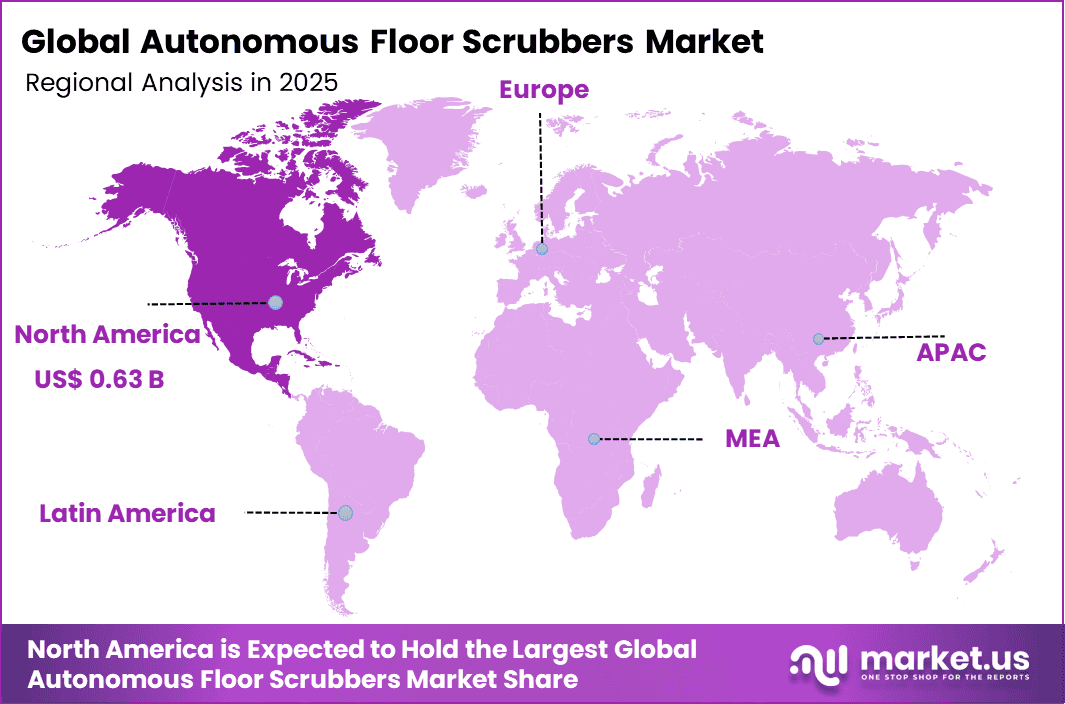
The U.S. generated about USD 0.56 billion within the regional market and is projected to expand at a CAGR of 10.8%. Facility managers across the country continue to invest in automation to improve cleaning productivity and manage large floor areas with minimal human intervention.
Autonomous scrubbers help reduce labor costs, ensure uniform cleaning quality, and support round-the-clock operations. As hygiene expectations rise and workforce constraints persist, demand for autonomous floor cleaning solutions continues to grow steadily across the US market.
Key Regions and Countries
- North America
- US
- Canada
- Europe
- Germany
- France
- The UK
- Spain
- Italy
- Russia
- Netherlands
- Rest of Europe
- Asia Pacific
- China
- Japan
- South Korea
- India
- Australia
- Singapore
- Thailand
- Vietnam
- Rest of APAC
- Latin America
- Brazil
- Mexico
- Rest of Latin America
- Middle East & Africa
- South Africa
- Saudi Arabia
- UAE
- Rest of MEA
Drivers Impact Analysis
| Key Driver | Impact on CAGR Forecast (~%) | Geographic Relevance | Impact Timeline | Strategic Effect |
|---|---|---|---|---|
| Increasing adoption of automation in cleaning and facility management | +2.8% | North America, Europe, Asia Pacific | Short to Mid Term (2025–2031) | Improves operational efficiency |
| Rising labor costs and workforce shortages in cleaning services | +2.5% | US, Europe, Japan | Mid Term (2026–2032) | Drives shift toward autonomous solutions |
| Growing demand for hygiene and sanitation in commercial spaces | +2.3% | Global | Mid Term (2026–2032) | Expands use in healthcare and retail |
| Expansion of smart buildings and automated facility systems | +2.1% | North America, Asia Pacific, Europe | Mid to Long Term (2026–2035) | Supports integration with building management |
| Increasing use in large facilities such as airports and warehouses | +1.9% | Global | Mid to Long Term (2026–2035) | Enhances large area cleaning efficiency |
Restraints Impact Analysis
| Key Restraint | Impact on CAGR Forecast (~%) | Geographic Relevance | Impact Timeline | Strategic Effect |
|---|---|---|---|---|
| High initial cost of autonomous cleaning equipment | -2.3% | Global | Mid Term (2026–2032) | Limits adoption among smaller facilities |
| Technical limitations in complex or crowded environments | -2.0% | Global | Mid Term (2026–2032) | Affects operational efficiency |
| Maintenance and operational complexity | -1.8% | Global | Mid Term (2026–2032) | Increases total cost of ownership |
| Lack of awareness in emerging markets | -1.6% | Asia Pacific, Latin America | Short to Mid Term (2025–2030) | Slows adoption |
| Integration challenges with existing facility systems | -1.5% | North America, Europe | Mid Term (2026–2032) | Delays deployment |
Investor Type Impact Analysis
| Investor Type | Growth Sensitivity | Risk Exposure | Geographic Focus | Investment Outlook |
|---|---|---|---|---|
| Venture Capital Firms | High | Medium | US, Europe | Growth in robotics and automation startups |
| Private Equity Firms | High | Medium | North America, Europe | Expansion in facility automation solutions |
| Strategic Technology Investors | High | Medium | US, Japan, South Korea | Strengthens robotics ecosystem |
| Corporate Venture Arms | Medium to High | Medium | Global | Partnerships with facility management firms |
| Government and Smart Infrastructure Funds | Medium | Low | Asia Pacific, Europe | Supports smart building initiatives |
Technology Enablement Analysis
| Technology Enabler | Impact on CAGR Forecast (~%) | Geographic Relevance | Impact Timeline | Implementation Significance |
|---|---|---|---|---|
| Autonomous navigation and mapping technologies | +2.9% | Global | Short to Mid Term (2025–2031) | Enables independent cleaning operations |
| AI-based obstacle detection and path optimization | +2.6% | Global | Mid Term (2026–2032) | Improves efficiency in dynamic environments |
| Integration with IoT and smart building systems | +2.3% | Global | Mid to Long Term (2026–2035) | Enhances coordination and control |
| Cloud-based fleet management platforms | +2.1% | Global | Mid Term (2026–2032) | Supports centralized monitoring |
| Advanced sensors and machine vision technologies | +1.9% | Global | Mid to Long Term (2026–2035) | Improves cleaning precision |
Key Challenges
- High initial cost is a major challenge because autonomous floor scrubbers require advanced sensors, navigation systems, software, and charging support, which can limit adoption for some buyers.
- Navigation in complex environments can be difficult because crowded spaces, moving people, unexpected obstacles, and changing floor layouts may affect cleaning performance.
- Battery life and charging time remain important concerns because scrubbers need to operate for long hours without reducing cleaning efficiency.
- Maintenance and repair can be costly because these machines use electronic components, brushes, tanks, and sensors that need regular servicing and replacement.
- Integration with existing cleaning workflows is also a challenge because businesses must train staff, adjust routines, and ensure the machines work well across different floor types and facility sizes.
Emerging Trends
A key trend in the Autonomous Floor Scrubbers market is the growing use of intelligent cleaning machines that operate with minimal human intervention. These systems use sensors and mapping capabilities to navigate spaces such as malls, warehouses, and airports while adjusting cleaning paths based on real time conditions.
Facilities are increasingly adopting machines that can work continuously and maintain consistent cleaning standards. This trend reflects a shift toward automated facility management where cleaning operations become more efficient and less dependent on manual labor.
Growth Factors
The increasing focus on hygiene and operational efficiency is supporting the growth of autonomous floor scrubbers. Businesses and public facilities aim to maintain clean environments while reducing reliance on manual cleaning staff. These machines help improve productivity by covering large areas consistently and reducing cleaning time. At the same time, rising labor constraints and the need for cost optimization encourage organizations to adopt automated cleaning solutions that ensure reliable performance and better resource utilization.
Competitive Analysis
The competitive landscape of the Autonomous Floor Scrubbers market includes established cleaning equipment manufacturers and specialized robotics companies. Diversy, Hako Group, Karcher, Nilfisk, Tennant, Amano, Cleanfix, and Murata Machinery Ltd hold strong positions because they offer reliable floor cleaning systems, wide service networks, and strong experience in commercial and industrial cleaning operations.
These companies compete by improving cleaning efficiency, machine durability, navigation accuracy, and ease of use. Other players such as Adalatus, Avidbots, Aziobot, Bharati Robotic Systems, DDROBO, Gaussian Robotics, and Iclean Robotics Co. add competition through robotics-focused innovation and autonomous cleaning technologies.
Their solutions often target airports, malls, hospitals, factories, and large public buildings that need automated floor maintenance. The market is shaped by product performance, battery life, mapping capability, and the ability to reduce manual labor in routine cleaning tasks.
Top Key Players in the Market
- Diversy
- Hako Group
- Karcher
- Nilfisk
- Tennant
- Adalatus
- Amano
- Avidbots
- Aziobot
- Bharati Robotic Systems
- Cleanfix
- DDROBO
- Gaussian Robotics
- Iclean Robotics Co.
- Murata Machinery Ltd
- Other Key Players
Future Outlook
The future outlook for the Autonomous Floor Scrubbers Market looks strong as more businesses adopt automated cleaning to improve labor efficiency, maintain cleaning consistency, and reduce pressure from staffing shortages. Current industry guidance shows that robotic scrubbers help teams shift workers to higher-value tasks while improving productivity in large facilities such as retail spaces, offices, airports, and healthcare sites. As cleaning operations place more focus on cost control, reliable performance, and smart facility management, demand for autonomous floor scrubbers is expected to grow steadily in the coming years.
Recent Developments
- In February 2026, Diversy Ecobot Scrub 50 AMR integrated BrainOS navigation processing 5K m²/hour across 200+ hospital deployments with 99% obstacle avoidance and 40L solution capacity. Cloud fleet management optimized 50+ robot schedules daily.
- In January 2026, Hako Scrubmaster E64RS V2 achieved 99.9% coverage autonomy across airport terminals, cleaning 10K m²/shift with EC-H2O NanoClean reducing water usage by 70%. Multi-floor mapping supported 50+ level facilities.
Report Scope
| Report Features | Description |
|---|---|
| Market Value (2025) | USD 1.8 Billion |
| Forecast Revenue (2035) | USD 5.9 Billion |
| CAGR(2025-2035) | 12.6% |
| Base Year for Estimation | 2024 |
| Historic Period | 2020-2024 |
| Forecast Period | 2025-2035 |
| Report Coverage | Revenue forecast, AI impact on Market trends, Share Insights, Company ranking, competitive landscape, Recent Developments, Market Dynamics and Emerging Trends |
| Segments Covered | By Product Type (Robotic Floor Scrubbers, Ride-On Autonomous Scrubbers, Walk-Behind Autonomous Scrubbers), By Application (Commercial, Industrial, Healthcare, Education, Hospitality, Retail, Others), By Battery Type (Lithium-Ion, Lead-Acid, Others), By End-User (Airports & Transportation, Retail & Shopping Malls, Others), By Distribution Channel (Direct Sales, Distributors/Dealers, Online Retail) |
| Regional Analysis | North America – US, Canada; Europe – Germany, France, The UK, Spain, Italy, Russia, Netherlands, Rest of Europe; Asia Pacific – China, Japan, South Korea, India, New Zealand, Singapore, Thailand, Vietnam, Rest of Latin America; Latin America – Brazil, Mexico, Rest of Latin America; Middle East & Africa – South Africa, Saudi Arabia, UAE, Rest of MEA |
| Competitive Landscape | Diversy, Hako Group, Karcher, Nilfisk, Tennant, Adalatus, Amano, Avidbots, Aziobot, Bharati Robotic Systems, Cleanfix, DDROBO, Gaussian Robotics, Iclean Robotics Co., Murata Machinery Ltd, Other Key Players |
| Customization Scope | Customization for segments, region/country-level will be provided. Moreover, additional customization can be done based on the requirements. |
| Purchase Options | We have three licenses to opt for: Single User License, Multi-User License (Up to 5 Users), Corporate Use License (Unlimited Users and Printable PDF) |





































