


Report Overview
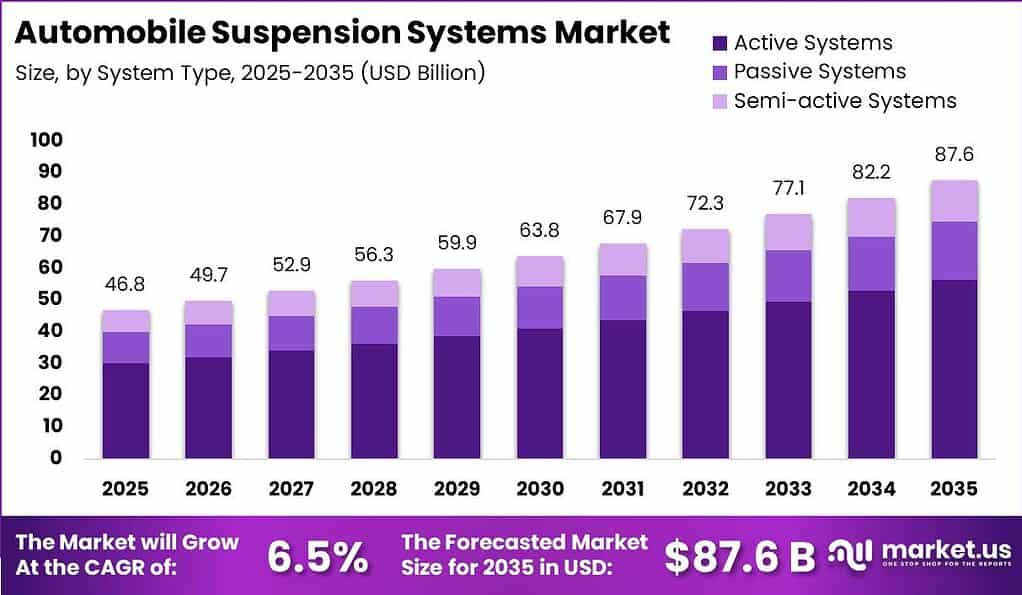
Global Automobile Suspension Systems Market size is expected to be worth around USD 87.60 Billion by 2035 from USD 46.80 Billion in 2025, growing at a CAGR of 6.5% during the forecast period 2026 to 2035. OE fitment on every assembled vehicle converts production volume into recurring component demand. Investors should track platform mix shifts because content value rises faster than unit counts alone.
Therefore, the market covers passive, semi-active, and active ride-control architectures plus core hardware such as shock absorbers, springs, control arms, ball joints, bushings, and struts. Suppliers serve passenger, commercial, two-wheeler, and off-road platforms through OEM channels and replacement networks. System choice follows vehicle mass, software readiness, and buyer comfort targets.
Key Takeaways
- The market reaches USD 46.80 Billion in 2025 and USD 87.60 Billion by 2035 at a 6.5% CAGR.
- Passive Systems lead By System Type with a 64.34% share.
- Shock Absorbers lead By Component with a 42.34% share.
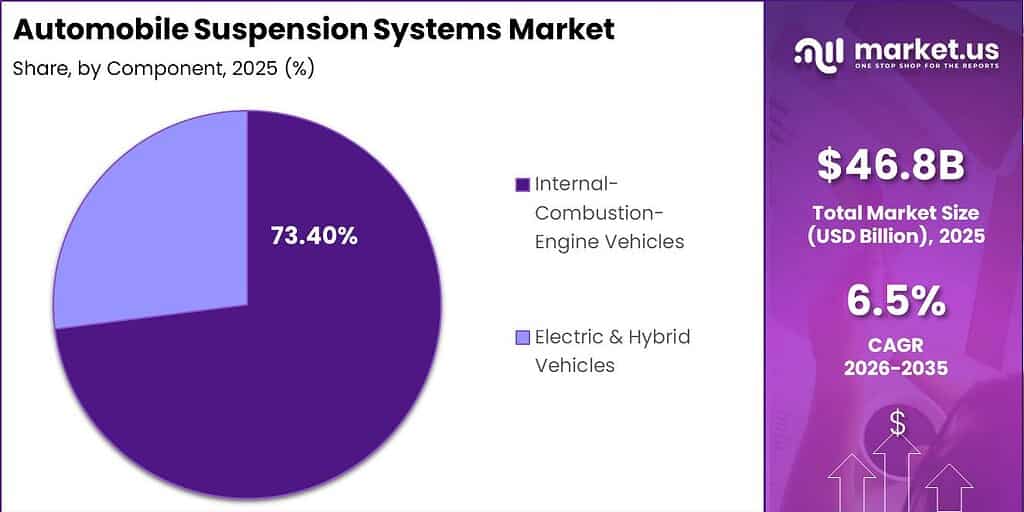
- Internal-Combustion-Engine Vehicles lead By Propulsion with a 73.40% share.
- Passenger Vehicles lead By Vehicle Type with a 58.45% share and also grow fastest.
- OEM leads By Sales Type with a 72.34% share.
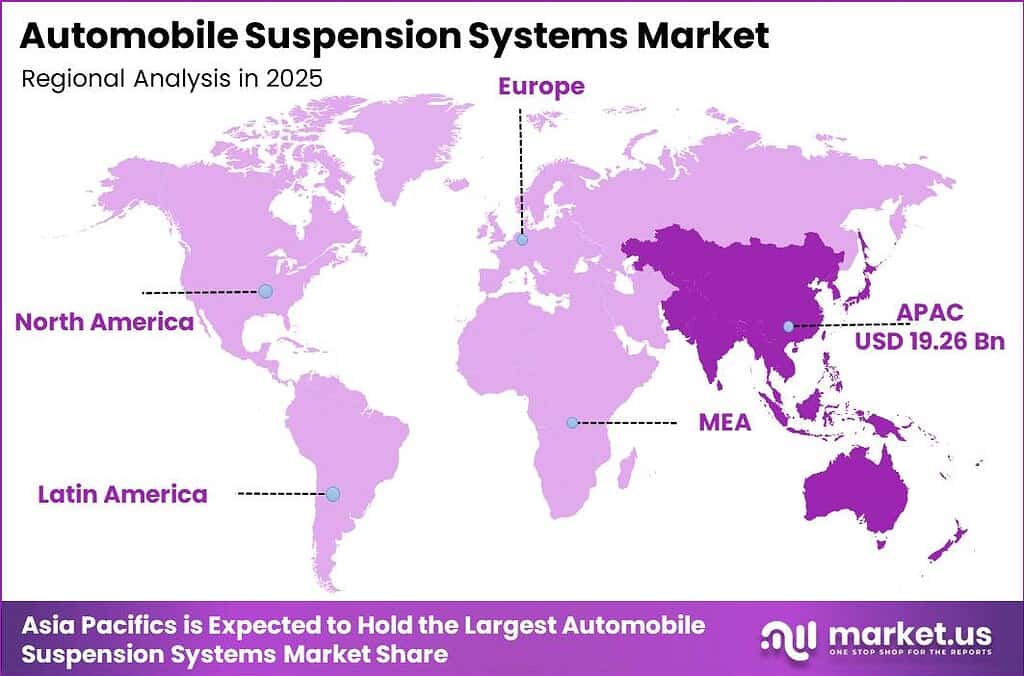
- Asia-Pacific leads regionally with a 41.23% share valued at USD 19.30 Billion.
Government safety rules push electronic damping and chassis sensing into more vehicle programs. This creates higher electronic content per axle and longer validation cycles for suppliers. As a result, capital shifts toward software-capable damper platforms rather than purely mechanical stock. End-use growth in utility vehicles and electrified models then lifts demand for adaptive air and lightweight architectures.
According to ACEA, the European Union recorded approximately 10.6 million new passenger car registrations in 2024. This volume directly supports OEM suspension fitment across mass and premium lines. Suppliers aligned to European platforms secure steadier call-offs when registration recovery holds.
Data from ACEA shows battery-electric vehicles accounted for 13.6% of all new EU passenger car registrations in 2024. Heavier battery packs raise the need for optimized springs, bushings, and electronic ride control. Vendors who tune for mass and NVH early win EV program nominations before ICE-only peers adjust.
System Type Analysis
Passive Systems dominates with 64.34% due to low cost mass-market fitment scale.
In 2025, Passive Systems held a dominant market position in the By System Type segment of Automobile Suspension Systems Market, with a 64.34% share. Figures from OICA show global motor-vehicle production reached 96.4 million units in 2025. High-volume assembly still favors fixed damping for cost control. Suppliers who automate coil-over and strut lines protect margins on price-sensitive platforms.
Active Systems use sensors, actuators, and controllers to adjust ride forces in real time. IEA data indicates electric car sales exceeded 20 million units globally in 2025 as software-defined chassis programs expanded. Active architectures capture premium SUV and luxury budgets first. Early movers with validated fail-safe modes gain preferred status on high-content nameplates.
Semi-Active Systems change damping continuously without full active force generation, balancing comfort and cost. The International Federation of Robotics reports Europe’s car industry installed 23,000 industrial robots in 2024, lifting precision for electronic damper builds. This signals faster scale-up of continuously variable valves. Tier-1 firms that pair CDC-class hardware with reusable software libraries shorten OEM launch risk.
Component Analysis
Shock Absorbers dominates with 42.34% due to universal axle fitment necessity.
In 2025, Shock Absorbers held a dominant market position in the By Component segment of Automobile Suspension Systems Market, with a 42.34% share. OICA data shows Asia-Pacific output rose to about 59.2 million vehicles in 2025, feeding massive damper demand. Every new axle still needs damping hardware regardless of propulsion. Plants near Asian OEM clusters cut logistics cost and win multi-year blanket orders.
Springs manage vehicle load and ride frequency across coil, leaf, and air designs. China alone produced about 34.53 million vehicles in 2025 according to OICA, concentrating spring-forming capacity. Premium SUVs add air-spring content that raises average selling price. Steel and aluminum cost control decides which spring makers keep OEM dual-source slots.
Control Arms are the fastest growing component line as geometry precision and lightweight materials rise in importance. India reached 6.49 million vehicles produced and more than 4.6 million passenger-vehicle sales in fiscal year 2025 to 2026 per OICA. This creates, for forging and aluminum arm specialists, dense regional demand. Suppliers offering modular arm kits for EV skateboards gain design-in speed.
Ball Joints and Bushings translate loads between arms and knuckles while isolating vibration. Struts and other linkages hold the remaining component share collectively in multi-link and MacPherson layouts. Global vehicle sales advanced to 99.8 million units in 2025 based on OICA figures. Replacement bushings and joints then extend revenue after the first wear cycle.
Propulsion Analysis
Internal-Combustion-Engine Vehicles dominates with 73.40% due to large installed production base.
In 2025, Internal-Combustion-Engine Vehicles held a dominant market position in the By Propulsion segment of Automobile Suspension Systems Market, with a 73.40% share. ACEA reports petrol still held 33.3% of EU new car registrations in 2024, anchoring conventional chassis volumes. ICE platforms keep high run rates for passive struts and steel springs. Suppliers must keep dual roadmaps so ICE cash flow funds electronic R&D.
Electric and Hybrid Vehicles are the fastest growing propulsion group as battery mass and software control reshape ride targets. IEA found electric cars reached a 25% global sales share in 2025, while China approached a 55% electric sales share. In May 2025, Astemo introduced a compact, lightweight air-cooled direct-drive system for in-wheel electric vehicles that supports future chassis integration. Vendors who co-design dampers with motor mass distribution lock EV platform positions early.
Vehicle Type Analysis
Passenger Vehicles dominates with 58.45% due to high global registration volume.
In 2025, Passenger Vehicles held a dominant market position in the By Vehicle Type segment of Automobile Suspension Systems Market, with a 58.45% share. IEA reports Europe electric car sales reached about 4.2 million units in 2025, lifting electronic chassis content inside the passenger mix. Comfort and safety ratings decide damper specification on family cars and crossovers. Passenger programs therefore remain the primary profit pool for ride-control innovators.
Commercial Vehicles need durable leaf springs, heavy-duty shocks, and increasingly air systems for load variation. IFR data shows India installed a record 9,100 industrial robots in 2024, with automotive holding a 45% share of those deployments. Automated axle lines raise consistency on truck and van suspensions. Fleet buyers reward suppliers who cut downtime through longer service intervals.
Two-Wheelers use compact forks, mono-shocks, and progressive springs tuned for mixed road quality. In October 2025, Astemo presented next generation motorcycle suspension systems alongside ADAS technologies at EICMA 2025. Electric two and three wheelers already represented about 15% of total sales in 2024 across tracked mobility segments. Motorcycle brands that adopt adjustable electronic damping differentiate premium urban models quickly.
Off-Road Vehicles hold the remaining vehicle-type share collectively with reinforced arms, long-travel dampers, and sealed joints. Harsh-duty validation raises barrier to entry for generalist chassis makers. Suppliers with proven dirt and construction duty cycles capture higher aftermarket attach rates.
Sales Type Analysis
Oem dominates with 72.34% due to factory fitment on new builds.
In 2025, Oem held a dominant market position in the By Sales Type segment of Automobile Suspension Systems Market, with a 72.34% share. OICA reports Asia-Pacific vehicle sales rose to 55.02 million units in 2025, concentrating OEM release schedules. Long-term contracts stabilize plant loading for struts and electronic modules. Missing an OEM nomination locks suppliers out of a full model cycle.
Aftermarket is the fastest growing sales channel as aging fleets replace shocks, springs, bushings, and mount kits. IFR states the global operational stock of industrial robots reached 4,664,000 units in 2024, improving remanufacturing and precision finishing for service parts. Independent channels win when catalogs cover multi-brand fitment quickly. Brands with strong installer training convert wear cycles into repeat revenue.
Key Market Segments
By System Type
- Active Systems
- Passive Systems
- Semi-Active Systems
By Component
- Shock Absorbers
- Springs
- Control Arms
- Ball Joints & Bushings
- Struts
- Others
By Propulsion
- Internal-Combustion-Engine Vehicles
- Electric & Hybrid Vehicles
By Vehicle Type
- Passenger Vehicles
- Commercial Vehicles
- Two-Wheelers
- Off-Road Vehicles
By Sales Type
- Oem
- Aftermarket
Regional Analysis
Asia-Pacific Dominates the Automobile Suspension Systems Market with a Market Share of 41.23%, Valued at USD 19.30 Billion
Asia-Pacific leads because regional vehicle output and sales concentrate OEM suspension call-offs at unmatched scale. Local steel sourcing and modular axle plants cut landed cost for high-volume passive and semi-active systems. This means global suppliers must engineer platforms for Asian OEM clusters first. Capacity near China and India secures both export hubs and domestic replacement demand.
Europe and North America add higher electronic content even when unit growth trails Asia. Based on UNECE data, Germany recorded more than 580 passenger cars per 1,000 inhabitants, while Austria recorded 570 in 2024. Dense vehicle parks sustain aftermarket shocks and bushings. In July 2025, Astemo began operation of a new inverter production line at its Bolton, UK facility to support next generation EV platforms needing advanced chassis technologies.
Key Regions and Countries
North America
- US
- Canada
Europe
- Germany
- France
- The UK
- Spain
- Italy
- Rest of Europe
Asia Pacific
- China
- Japan
- South Korea
- India
- Australia
- Rest of APAC
Latin America
- Brazil
- Mexico
- Rest of Latin America
Middle East and Africa
- GCC
- South Africa
- Rest of MEA
Market Dynamics
Market Opportunity Analysis - Aftermarket fleets, EV skateboards, and predictive services open white space beyond passive OEM cores
Electric and Hybrid Vehicles remain the fastest growing propulsion path, yet many suppliers still price only mechanical kits for ICE lines. Heavier packs need new spring rates, bushing compounds, and electronic damping maps. New entrants that specialize in EV-ready modules can win nominations without fighting legacy ICE catalogs. This creates a clean entry lane for software-capable chassis specialists.
Control Arms are the fastest growing component class, but aluminum and composite designs stay under-served on mass EV platforms. Geometry accuracy and weight reduction decide handling and range together. Investors backing modular arm families for skateboard architectures gain design-in leverage across multiple body styles. Early tooling commitments lock multi-year volume before generalists retool.
Aftermarket growth outpaces OEM share gains as large vehicle parks age, especially where ownership density stays high. Independent channels still lack authenticated electronic damper diagnostics in many emerging markets. Brands that pair certified parts with installer training capture replacement cycles that pure OE players leave behind. Consequently, service networks become as valuable as factory contracts.
Two-Wheelers and commercial last-mile fleets still receive fewer modular electronic suspension options than passenger cars. Urban delivery growth needs durable, low-maintenance ride packages more than luxury comfort features. Suppliers offering compact adjustable kits for electric scooters and light vans address an underexploited specification gap. Regional specialists can scale without matching full-line passenger OEMs.
Technology and Innovation Landscape - Predictive control, 48V actuation, OTA tuning, and energy recovery redefine chassis value
AI-powered predictive suspension control uses camera and sensor fusion to prepare damping before road inputs arrive. This shortens reaction lag versus reactive valves alone. OEMs gain comfort scores without full active hydraulic cost. Suppliers owning perception-to-damper software stacks raise switching costs inside the vehicle domain.
Expansion of 48-volt active suspension into mid-range passenger platforms spreads electronic content beyond luxury badges. Lower voltage architectures cut packaging bulk versus high-voltage-only designs. Mid-segment buyers then receive adaptive comfort previously reserved for premium trims. Volume leverage improves for actuator and ECU makers who qualify 48V lines early.
Over-the-air software updates let automakers refine adaptive suspension maps after vehicles leave the plant. Calibration fixes and feature unlocks extend program life without hardware recalls. This reflects a shift from one-time mechanical sale to continuous performance management. Partners who secure secure update pipelines earn recurring engineering fees.
Regenerative suspension technologies harvest vibration energy that conventional dampers discard as heat. Recovered energy supports auxiliary loads on electrified platforms and improves system efficiency claims. Prototype maturity still varies, yet patent activity signals strategic interest. Investors should watch first commercial fleet pilots for proof of durability and payback.
Drivers
Vehicle production recovery is the strongest near-term driver because every new car, van, truck, and bus takes a full suspension set at the factory. OICA reports global motor-vehicle production rose from 92.7 million units in 2024 to 96.4 million units in 2025, a 3.9% increase. Global sales advanced from 95.3 million to 99.8 million units, or 4.7%. This lifts annual OE demand for struts, shocks, springs, arms, and electronic ride modules before premium mix is counted.
Asia-Pacific remains the operating center of that recovery. Regional output rose 7.6% to about 59.2 million vehicles in 2025 and exceeded 61% of world production, while regional sales climbed 7.1% to 55.02 million units. China added about 3.25 million vehicles to reach 34.53 million produced. Suppliers that localize forging, damper assembly, and validation near Asian OEM clusters amortize tooling faster and capture the stated +1.4% CAGR contribution.
| Driver | (~) % Impact on CAGR Forecast | Geographic Relevance | Impact Timeline |
|---|---|---|---|
| Vehicle production recovery and Asian output expansion | +1.4% | Asia-Pacific, global export hubs | Short term (2 years or less) |
| Electrified vehicle chassis recalibration | +1.1% | China, Europe, North America | Medium term (2 to 4 years) |
| SUV and pickup mix premiumization | +0.8% | North America, India, Middle East | Short term (2 years or less) |
| Electronic damping and ride-control adoption | +0.7% | Europe, China, Japan, North America | Medium term (2 to 4 years) |
| Commercial fleet renewal demand | +0.5% | Asia-Pacific, Europe, Latin America | Medium term (2 to 4 years) |
Restraints
Steel and aluminum tariff escalation hits suspension makers first because springs, tubes, rods, knuckles, arms, and bars are metal heavy. The White House proclamation of June 3, 2025 raised U.S. Section 232 tariffs on covered steel, aluminum, and derivative articles from 25% to 50%, effective June 4, 2025. No duty drawback was available under the proclamation. Fixed-price OE contracts cannot absorb that shock in one quarter.
A 50% duty on imported metal or derivative chassis parts can erase normal operating margin on competitively bid components. Suppliers then face price reopeners, dual sourcing, inventory cuts, or temporary margin loss. Affordable vehicle programs resist cost pass-through hardest. This combination plausibly deducts about -1.3% from the 6.5% baseline CAGR and delays die and damper capacity spending until terms reset.
| Restraint | (~) % Impact on CAGR Forecast | Geographic Relevance | Impact Timeline |
|---|---|---|---|
| Steel and aluminum tariff cost shock | -1.3% | United States, import-linked supply chains | Short term (2 years or less) |
| Affordable-vehicle demand erosion | -0.8% | North America, Europe, emerging markets | Short term (2 years or less) |
| High financing costs delaying vehicle purchases | -0.7% | North America, Europe, Latin America | Medium term (2 to 4 years) |
| OEM price-down pressure on mature components | -0.6% | Global | Short term (2 years or less) |
| Localized trade-content requirements | -0.4% | North America, Europe, India | Medium term (2 to 4 years) |
Challenges
Moving from passive hardware to electronic damping, height control, and chassis-domain software creates a lasting validation burden. Suppliers must prove durability, sensor integrity, actuator speed, and safe degraded modes across many more operating states. UNECE WP.29 work brings technological innovation into safety rules and stresses information access for inspection of electronic safety functions. Design cycles stretch until teams build shared mechanical-electronic test libraries.
IEA policy tracking records weight-linked electric-vehicle thresholds, including designs above 2.1 tonnes with a 600 kg allowance relative to other cars. Heavier packs force new NVH and life targets for arms, bushings, and dampers. This expands prototype, track, simulation, and cybersecurity workloads. The friction drag is estimated near -1.0% on attainable CAGR, yet firms that productize reusable validation kits open paid engineering services as a new revenue stream.
| Challenge | (~) % CAGR Friction Drag | Geographic Relevance | Mitigation Horizon |
|---|---|---|---|
| Electromechanical validation complexity | -1.0% | Europe, China, Japan, North America | Long term (4 years or more) |
| Multi-tier metal traceability | -0.8% | Global | Medium term (2 to 4 years) |
| NVH calibration for heavier vehicles | -0.7% | China, Europe, North America | Medium term (2 to 4 years) |
| Software and controls talent scarcity | -0.6% | Global engineering centers | Long term (4 years or more) |
| Aftermarket part authentication gaps | -0.4% | Asia-Pacific, Latin America, Africa | Medium term (2 to 4 years) |
Opportunities
Predictive suspension health services remain open white space because most revenue still comes from one-time OE parts or spot replacements. UNECE vehicle regulation work stresses access to information for inspection of electronically controlled safety functions through the WP.29 pathway. Connected dampers already generate field signals that few suppliers monetize as subscriptions. Early movers can sell diagnostics, calibration, and uptime contracts instead of hardware alone.
OICA recorded 96.4 million vehicles produced globally in 2025, including roughly 59.2 million in Asia-Pacific, creating a vast installed base for condition monitoring. IEA tracking shows weight rules already differentiate electric vehicles above 2.1 tonnes, raising the value of ride-control upkeep. Disciplined execution can lift lifecycle gross margin by about 5% to 10% versus hardware-only sales and cut avoidable downtime interventions by roughly 10% to 15%. That path supports about +1.2% upside to the 6.5% baseline CAGR.
| Opportunity | (~) % Potential CAGR Upside | Geographic Relevance | Execution Window |
|---|---|---|---|
| Predictive suspension health services | +1.2% | North America, Europe, China, Japan | Medium term (2 to 4 years) |
| Fleet air-suspension retrofits | +1.0% | Europe, North America, India, China | Medium term (2 to 4 years) |
| Localized remanufacturing networks | +0.8% | Latin America, Africa, Southeast Asia | Medium term (2 to 4 years) |
| Modular skateboard-platform suspension kits | +0.7% | China, India, Europe | Long term (4 years or more) |
| Off-highway electrified equipment systems | +0.6% | North America, Europe, China, Australia | Long term (4 years or more) |
Key Company Insights
Continental AG positions itself through electronics-rich chassis integration rather than pure mechanical commodity parts. Scale in sensors and control software helps the firm bundle ride functions with broader vehicle domain controllers. This creates stickier OEM software relationships on premium platforms. Competitors limited to passive hardware face lower content growth as electronic damping spreads.
ZF Friedrichshafen AG holds depth in semi-active control, with Continuous Damping Control already deployed in millions of vehicles worldwide. Its Smart Chassis Sensor can cut component weight by up to 400 grams per vehicle by replacing multiple sensing parts. In 2025, ZF sold its passenger-car ADAS business to Harman International while retaining chassis technology. This signals a sharper focus on ride-control profitability inside a global robot-enabled manufacturing base exceeding 4.28 million operational industrial robots industry-wide.
Key Players
- Continental AG
- ZF Friedrichshafen AG
- Tenneco Inc.
- KYB Corporation
- Hitachi Astemo Ltd.
- thyssenkrupp AG
- Mando Corporation
- Marelli Corporation
- Hyundai Mobis Co. Ltd.
- BWI Group
- Sogefi SpA
- Parker Lord Corporation
Recent Developments
- April 2025: Tenneco Monroe Ride Solutions launched the Monroe Intelligent Suspension CVSA2, a next generation semi active suspension system designed for OEM passenger vehicles, including SUVs and luxury cars.
- April 2025: Astemo showcased its latest intelligent mobility technologies, including advanced suspension systems, at Auto Shanghai 2025.
- June 2025: Astemo demonstrated its cross domain vehicle control technologies for the software defined vehicle era at the Automotive Engineering Expo 2025, highlighting integrated chassis and suspension control.
- October 2025: Astemo exhibited its next generation suspension systems and advanced mobility technologies at the Japan Mobility Show 2025.
Geopolitical Impact Analysis
According to UNCTAD, maritime transport moves over 80% of world merchandise trade, so chassis steel, aluminum arms, and damper assemblies remain exposed to ocean freight shocks. The Review of Maritime Transport 2025 expects seaborne trade volumes to rise only about 0.5% in 2025 after firmer 2024 growth. Rerouting and volatile container rates raise landed cost for suspension subcomponents. Manufacturers near OEM clusters reduce tariff-plus-freight stacking on time-critical parts.
As reported by the IEA, global electric car sales exceeded 20 million units in 2025 and reached a 25% share of new cars, intensifying cross-border flows of battery-heavy platforms that need retuned suspension hardware. Trade friction and longer transit times delay axle module deliveries into final assembly. Consequently, dual-sourcing of springs, rods, and electronic valves becomes a hedge rather than optional strategy. Buyers should model freight and duty scenarios inside program cost targets.
Report Scope
| Report Features | Description |
|---|---|
| Market Value (2025) | USD 46.80 Billion |
| Forecast Revenue (2035) | USD 87.60 Billion |
| CAGR (2026-2035) | 6.5% |
| Base Year for Estimation | 2025 |
| Historic Period | 2020-2024 |
| Forecast Period | 2026-2035 |
| Report Coverage | Revenue Forecast, Market Dynamics, Market Opportunity Analysis, Technology and Innovation Landscape, Competitive Landscape, Recent Developments |
| Segments Covered | By System Type (Active Systems, Passive Systems, Semi-Active Systems), By Component (Shock Absorbers, Springs, Control Arms, Ball Joints & Bushings, Struts, Others), By Propulsion (Internal-Combustion-Engine Vehicles, Electric & Hybrid Vehicles), By Vehicle Type (Passenger Vehicles, Commercial Vehicles, Two-Wheelers, Off-Road Vehicles), By Sales Type (Oem, Aftermarket) |
| Regional Analysis | North America (US and Canada), Europe (Germany, France, The UK, Spain, Italy, and Rest of Europe), Asia Pacific (China, Japan, South Korea, India, Australia, and Rest of APAC), Latin America (Brazil, Mexico, and Rest of Latin America), Middle East and Africa (GCC, South Africa, and Rest of MEA) |
| Competitive Landscape | Continental AG, ZF Friedrichshafen AG, Tenneco Inc., KYB Corporation, Hitachi Astemo Ltd., thyssenkrupp AG, Mando Corporation, Marelli Corporation, Hyundai Mobis Co. Ltd., BWI Group, Sogefi SpA, Parker Lord Corporation |
| Customization Scope | Customization for segments, region / country-level will be provided. Additional customization can be done based on requirements. |
| Purchase Options | We have three licenses to opt for: Single User License | Multi-User License (Up to 5 Users) | Corporate Use License (Unlimited User and Printable PDF) |





































