


Market Overview
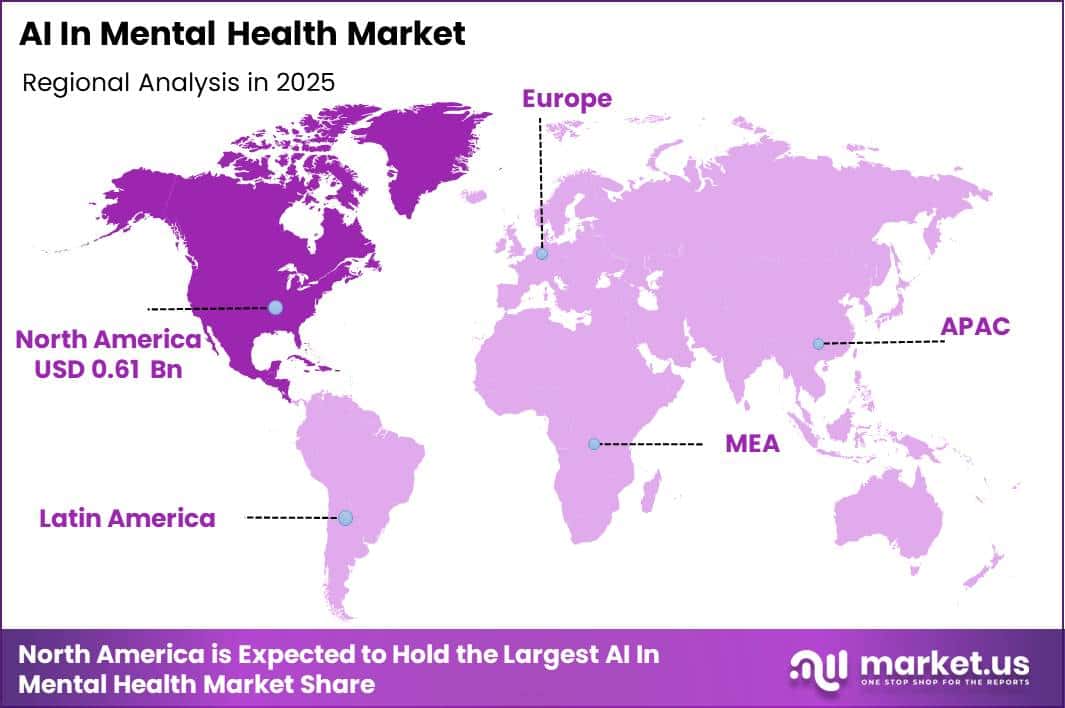
The Global AI in Mental Health Market size is expected to reach around US$ 8.0 Billion by 2035, up from US$ 1.6 Billion in 2025, growing at a CAGR of 15.6% during the forecast period from 2026 to 2035. In 2025, North America led the market, achieving over 37.89% market share with revenue of US$ 0.61 Billion.
The Global AI in Mental Health Market is witnessing significant growth as artificial intelligence technologies are increasingly integrated into mental healthcare delivery, including early screening, digital therapy support, patient monitoring, clinical decision assistance, and personalized treatment planning.
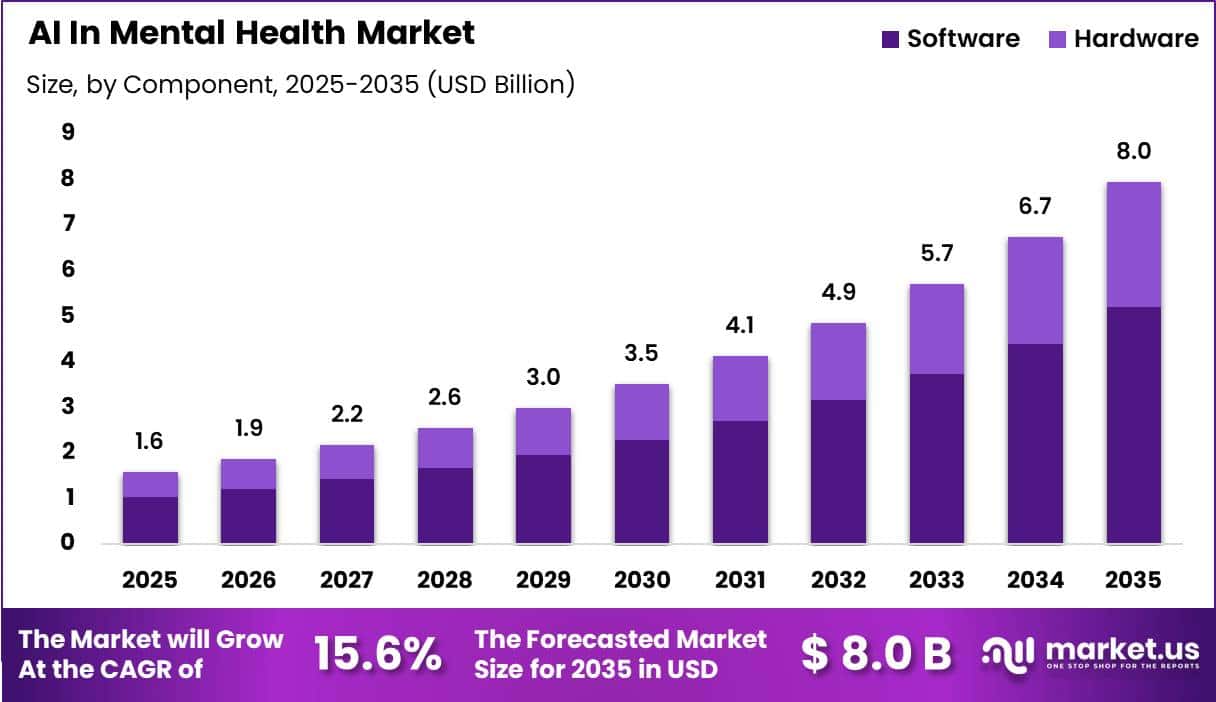
Rising mental health challenges worldwide, limited availability of mental healthcare professionals, and increasing demand for accessible digital solutions are accelerating the adoption of AI-powered platforms. According to the World Health Organisation, more than 1 billion people globally live with mental health conditions, highlighting the urgent need for scalable and innovative care approaches.
AI-based mental health solutions utilize machine learning, natural language processing, predictive analytics, and conversational AI to identify behavioral patterns, assess emotional states, support remote consultations, and improve patient engagement. These technologies are being explored for conditions such as depression, anxiety disorders, stress-related disorders, and other psychiatric conditions.
WHO data indicates that approximately 332 million people worldwide experience depression, while anxiety disorders affected around 359 million people in 2021, demonstrating the growing requirement for effective mental health support systems. Healthcare organizations and regulators are increasingly focusing on the safe implementation of AI-driven mental health technologies.
The U.S. Food and Drug Administration (FDA) continues to evaluate digital health technologies, including AI-enabled tools, to ensure safety, effectiveness, and appropriate clinical use. The market is expected to expand as AI improves access to mental healthcare through virtual assistants, remote monitoring tools, personalized interventions, and data-driven clinical insights, supporting healthcare systems facing increasing demand for mental health services.
Key Takeaways
- Market Size: The Global AI in Mental Health Market size was US$ 1.6 billion in 2025. The market is estimated to grow to US$ 8.0 billion by 2035.
- Market Share: The Compound Annual Growth Rate (CAGR) of the market from 2026 to 2035 will be 15.6%.
- Component: Software has the largest market share, accounting for 65.4% of total sales.
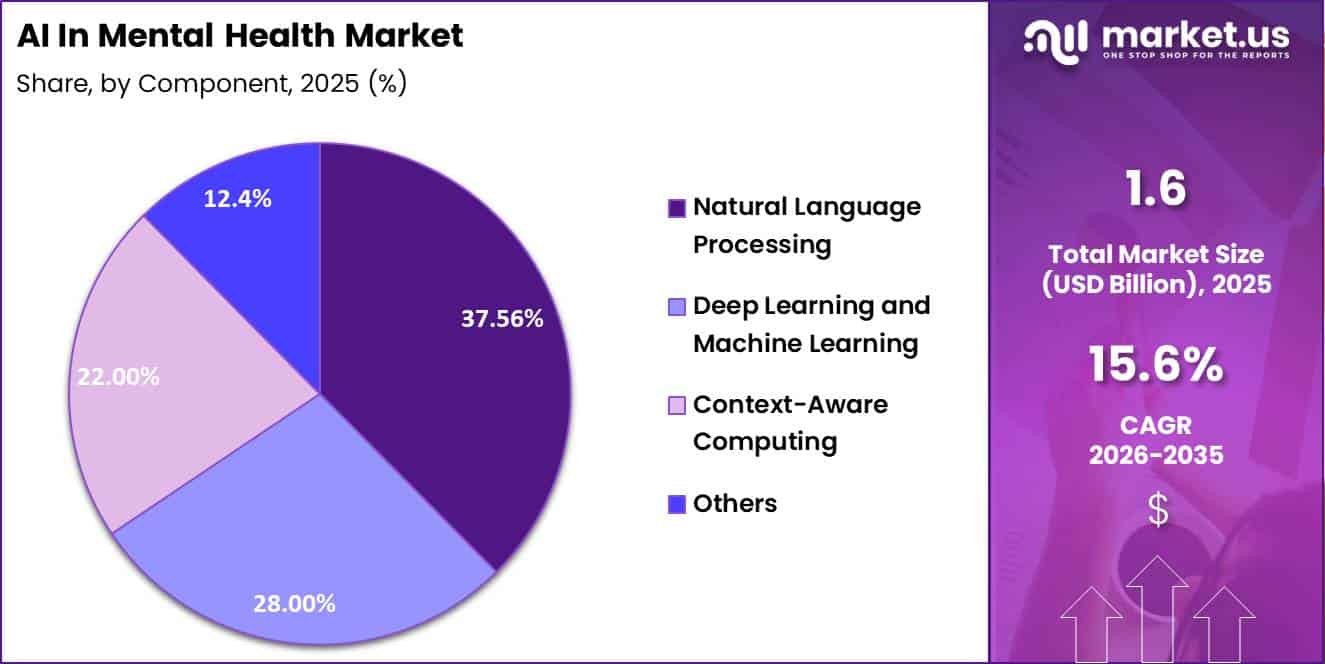
- Technology: Natural Language Processing dominates the segment, accounting for 37.56% of total revenue.
- End User: Hospitals and Clinics dominate the segment, accounting for 42.8% of total revenue.
- Regional: North America is the dominant regional market, accounting for 37.89% of global sales.
Component Analysis
The Software segment dominates the Global AI in Mental Health Market, accounting for 65.40% market share in 2025, driven by the increasing adoption of AI-powered mental health platforms, digital therapeutics, virtual assistants, and clinical decision-support solutions.
Software-based AI applications enable automated patient assessments, behavioral analysis, conversational therapy support, remote monitoring, and personalized mental healthcare recommendations.
The growing integration of machine learning algorithms, natural language processing (NLP), and predictive analytics into mental health platforms is strengthening demand for advanced software solutions among healthcare providers and digital health companies.
The Hardware segment represents 34.6% of the market in 2025, supported by rising deployment of AI-enabled wearable devices, monitoring sensors, and connected healthcare technologies.
Hardware components assist in collecting physiological and behavioral data, including sleep patterns, activity levels, heart rate variations, and emotional indicators, which can be analyzed through AI systems to support mental health assessments.
Increasing focus on remote patient monitoring and decentralized healthcare delivery is contributing to hardware adoption. Together, software and hardware components are enabling more accessible, continuous, and data-driven mental healthcare solutions worldwide.
Technology Analysis
The Natural Language Processing (NLP) segment dominates the Global AI in Mental Health Market with a 37.56% market share in 2025, owing to its widespread application in AI chatbots, virtual mental health assistants, sentiment analysis tools, and automated patient communication systems.
NLP enables AI platforms to understand human language, identify emotional patterns, analyze speech and text responses, and provide personalized support for individuals experiencing mental health challenges.
The Deep Learning and Machine Learning segment holds 28.00% market share in 2025, driven by its ability to analyze complex healthcare datasets, identify behavioral trends, and support predictive mental health assessments. These technologies improve diagnosis assistance, risk prediction, and treatment personalization by learning from large volumes of patient information.
The Context-Aware Computing segment accounts for 22.00% share, supported by AI systems that consider environmental, behavioral, and user-specific factors to deliver adaptive interventions.
The Others segment contributes 12.4%, including technologies such as computer vision, speech recognition, and emotion recognition systems. The combined advancement of these technologies is enhancing AI-driven mental healthcare accessibility and clinical effectiveness.
End User Analysis
The Hospitals and Clinics segment dominates the Global AI in Mental Health Market with a 42.8% market share in 2025, driven by increasing adoption of AI-based diagnostic assistance, patient monitoring platforms, electronic health record integration, and digital mental health management solutions. Hospitals and clinical facilities are implementing AI technologies to improve mental health screening, optimize workflows, support psychiatrists, and expand access to behavioral healthcare services.
The Mental Health Centers segment represents a significant portion of market adoption, as specialized facilities increasingly utilize AI-powered tools for patient assessment, therapy support, progress tracking, and personalized treatment planning. AI solutions help mental health professionals manage increasing patient volumes while improving continuity of care.
The Research Institutions segment is contributing to market expansion through increased AI research initiatives focused on psychiatric disorders, behavioral analysis, and development of advanced mental health algorithms. Universities and healthcare research organizations are leveraging AI models to improve understanding of neurological and psychological conditions.
The Others segment, including digital health providers, community healthcare organizations, and corporate wellness programs, is also gaining traction due to growing demand for accessible and remote mental health support solutions. Increasing global awareness of mental health needs is encouraging adoption across diverse healthcare settings.
Key Market Segments
By Component
- Hardware
- Software
By Technology
- Natural Language Processing
- Deep Learning and Machine Learning
- Context-Aware Computing
- Others
By End User
- Hospitals and Clinics
- Mental Health Centers
- Research Institutions
- Others
Drivers
Medicare Reimbursement Unlock for Digital Mental Health AI Tools
The most immediate commercial catalyst is that Medicare began paying for qualifying digital mental health treatment from January 1, 2025, through HCPCS codes G0552, G0553, and G0554, converting AI-enabled mental health tools from discretionary tech purchases into billable adjuncts to clinician-led care. CMS linked reimbursement matters because it changes unit economics at the provider level.
Vendors can package onboarding, device supply, adherence monitoring, and monthly data review into recurring revenue aligned with behavioral care plans rather than one-time app subscriptions, while eligibility is limited to FDA-cleared or authorized products under 21 CFR 882.5801, which raises the value of regulated clinical workflows over general wellness chatbots.
Structure pulls the market toward hybrid models in which AI handles symptom capture, reminders, CBT task reinforcement, and between-visit monitoring, while licensed professionals retain diagnosis, prescribing authority, and monthly interaction requirements; the effect is strongest in the U.S. first because reimbursement creates a hard budget line, but it also gives EU and APAC buyers a reference architecture for future payment design.
| Driver | (~) % Impact on CAGR Forecast | Geographic Relevance | Impact Timeline |
|---|---|---|---|
| Medicare-backed AI mental health treatment reimbursement | +2.4% | North America core, EU follow-on, APAC pilot markets | Short term |
| Behavioral health access gap and workforce shortage automation pull | +2.1% | North America core, EU, ANZ, urban APAC corridors | Short term |
| Rising treated-population volume expands AI triage and monitoring demand | +1.8% | North America core, EU, South America spill-over | Medium term |
| Privacy, breach notification, and clinical-grade oversight reshape buyer trust | +1.3% | U.S. core, EU, UK, regulated APAC markets | Medium term |
| Clinical validation of conversational and digital therapeutics improves adoption | +1.7% | U.S. core, EU academic hubs, high-income APAC | Medium term |
| WHO-led digital health normalization supports cross-system procurement | +1.1% | EU, MENA, ASEAN, Africa urban systems, LatAm public programs | Long term |
Challenges
Clinical validation variability and deployment friction in AI mental health
Clinical validation in AI-based mental health tools remains highly inconsistent, with reported performance ranging from approximately 65 % to 90 % depending on dataset size, population, and outcome definition. Most studies are limited by small cohorts, often under 500 participants, short follow-up periods, and weak external replication, which makes generalization to real-world care settings difficult.
Because of this uncertainty, healthcare providers typically require their own real-world pilot deployments before scaling adoption. These pilots often involve thousands of patients and extend evaluation timelines to 3 to 4 years, compared with 2 to 3 years for conventional digital health tools.
Hospitals also demand granular proof of impact, including diagnostic accuracy across demographic groups, false positive rates, and measurable clinical outcomes like changes in PHQ-9 or GAD-7 scores. This extended validation process increases pre-commercial costs and slows adoption, creating a measurable drag on market growth.
Vendors are therefore pushed to invest in larger pragmatic trials and standardized evidence frameworks to shorten procurement cycles over time and improve scalability.
| Challenge | (~) % CAGR Friction Drag | Geographic Relevance | Mitigation Horizon |
|---|---|---|---|
| Fragmented clinical evidence | -1.4% | North America, EU, APAC | Medium term (2-4 years) |
| Regulated data access & consent | -1.2% | North America, EU hubs | Long-term (≥ 4 years) |
| Human-in-the-loop workload | -1.0% | US, EU care systems | Medium term (2-4 years) |
| Bias, equity & liability exposure | -0.9% | US, EU, urban APAC | Long-term (≥ 4 years) |
| Integration into legacy workflows | -1.1% | US hospital networks, EU public systems | Medium term (2-4 years) |
| Algorithm lifecycle & drift control | -1.0% | Global SaMD vendors | Long-term (≥ 4 years) |
Restraints
Fragmented SaMD regulation and risk-based compliance burden
Regulatory fragmentation across Software as a Medical Device SaMD frameworks significantly slows commercialization of AI mental health tools. These systems are often classified differently across jurisdictions, requiring companies to navigate overlapping FDA, EU MDR, and other regional risk based regulations, each with distinct evidence and labeling requirements.
In the U.S., FDA guidance places many AI-driven mental health applications into higher risk categories when they deliver therapeutic or diagnostic functions, triggering requirements such as clinical trials, human factors validation, lifecycle monitoring, and post-market surveillance. Similar but non-aligned rules in the EU and other OECD regions force developers to prepare separate compliance packages, increasing duplication of effort.
Regulatory complexity extends development timelines by 18 to 36 months and raises operational costs by 20 to 30 % due to sustained regulatory, quality, and documentation requirements. As a result, many companies prioritize lower risk engagement or wellness features instead of fully therapeutic AI functions.
Overall, fragmented SaMD oversight delays global scaling, compresses margins, and limits product depth, reducing the pace of revenue expansion in AI mental health markets.
| Restraint | (~) % Impact on CAGR Forecast | Geographic Relevance | Impact Timeline |
|---|---|---|---|
| Fragmented risk-based regulation & SaMD oversight | -3.0% | U.S., EU, select OECD | Medium term (2-4 years) |
| State-level bans & limits on AI therapy delivery | -2.7% | U.S. (select states) | Short–Medium term (≤ 4 years) |
| Data privacy, consent & health-data misuse risk | -2.3% | North America core, EU, APAC urban | Long-term (≥ 4 years) |
| Clinical evidence burden & trial design complexity | -2.0% | U.S., EU, Japan, high-income APAC | Medium–Long term (≥ 3 years) |
| Bias, safety, and explainability constraints | -1.8% | Global, with higher impact in diverse markets | Long-term (≥ 4 years) |
| Limited reimbursement & payer acceptance | -2.2% | U.S., EU, high-income APAC | Medium term (2-4 years) |
Opportunity
Value-based reimbursement models for AI mental health care
This opportunity addresses the gap between the high burden of mental illness and the limited reimbursement for digital and AI-enabled care. While current adoption is driven largely by direct-to-consumer subscriptions, most payer systems still reimburse mental health services on a fee-for-service basis, which does not fully capture the value of continuous monitoring or AI-supported interventions.
A shift toward value-based reimbursement, where payment is linked to outcomes such as improvements in PHQ-9 or GAD-7 scores, reduced hospitalizations, or improved adherence, could unlock substantial payer-side spending. In the U.S. alone, this could translate into a multi-billion-dollar incremental opportunity by 2030, especially as millions of individuals remain untreated or inadequately managed under existing systems.
If even a modest share of patients transition into AI-augmented, reimbursed care pathways with annual per-patient payments in the 300 to 500 dollar range, it would significantly expand total addressable revenue and support double-digit growth in affected segments. It would also improve unit economics by shifting customer acquisition toward payer-driven enrollment rather than consumer marketing.
Strategically, value-based models allow vendors to monetize measurable clinical improvements, potentially enabling profit sharing with payers and improving margins through scale and reduced churn.
| Opportunity | (~) % Potential CAGR Upside | Geographic Relevance | Execution Window |
|---|---|---|---|
| Value-based AI reimbursement models | +1.8% | North America, EU, select APAC | Medium term (2–4 years) |
| Employer-integrated AI mental health platforms | +1.5% | North America core, EU, urban APAC | Short–medium term (≤ 3 years) |
| Youth-focused AI therapeutics & prevention | +1.6% | Global, skew to APAC & LATAM | Medium–long term (3–6 years) |
| AI-augmented severe mental illness care | +2.0% | North America, EU, high-income APAC | Medium–long term (3–6 years) |
| Cross-condition AI for mental–metabolic comorbidities | +1.2% | North America, EU, GCC, urban APAC | Medium term (2–4 years) |
| Regulated AI clinical infrastructure & audit layer | +1.4% | North America, EU, global health systems | Long-term (≥ 4 years) |
Regional Analysis
In 2025, North America led the market, achieving over 37.89% market share with revenue of US$ 0.61 billion. The region’s leading position is attributed to the rapid adoption of artificial intelligence technologies across healthcare systems, strong digital health infrastructure, and increasing demand for accessible mental healthcare solutions.
The presence of advanced healthcare facilities, technology innovators, and research institutions has accelerated the deployment of AI-powered mental health platforms for screening, diagnosis support, virtual counseling, patient monitoring, and personalized treatment planning.
The United States remains the key contributor within North America, supported by growing investments in healthcare, artificial intelligence, expansion of telehealth services, and increasing integration of AI tools into hospitals and behavioral health centers.
Government initiatives promoting responsible AI development and digital healthcare transformation are encouraging healthcare providers to implement AI-based solutions to improve mental health service delivery. Europe represents a significant regional market, driven by increasing awareness of mental health disorders, supportive digital healthcare policies, and rising adoption of AI-assisted clinical solutions.
Countries across the region are focusing on improving access to psychiatric care through technology-enabled healthcare models. The Asia Pacific region is expected to witness strong growth during the forecast period, supported by increasing mental health awareness, rising healthcare digitization, and expanding use of mobile-based AI mental health applications.
Latin America and the Middle East & Africa are gradually adopting AI solutions as healthcare systems modernise and demand for remote mental health services increases. Overall, regional growth is being fueled by the need for scalable, affordable, and efficient mental healthcare delivery worldwide.
Key Regions and Countries
North America
- The US
- Canada
Europe
- Germany
- France
- The U.K.
- Italy
- Spain
- Russia & CIS
- Rest of Europe
Asia Pacific
- China
- India
- Japan
- South Korea
- ASEAN
- Australia & New Zealand
- Rest of Asia Pacific
Middle East & Africa
- GCC
- South Africa
- Rest of Middle East & Africa
Latin America
- Brazil
- Mexico
- Rest of Latin America
Key Player Analysis
Competitive advantage in the global AI in mental health market is driven by advanced natural language processing (NLP) capabilities that support conversational AI therapy and mental health screening tools, established relationships with hospitals, clinics, and mental health centers, and continued investment in deep learning and machine learning platforms.
These capabilities are improving the accuracy of mental health condition detection and strengthening personalized intervention and treatment recommendations.
Major strategic priorities among leading providers include expanding AI-powered conversational therapy and cognitive behavioral therapy chatbot platforms, which support the dominant software component segment; developing context-aware computing solutions for real-time emotional state detection and crisis intervention; and increasing investments in hospital and clinic relationships to strengthen clinical validation and support formulary adoption of AI-enabled mental health solutions.
Strong procurement relationships with hospitals and clinics, together with expanding partnerships with mental health centers, are emerging as key competitive differentiators for providers operating within the globally dominant NLP-powered mental health applications segment.
Top Key Players
- Spring Care, Inc.
- Wysa Ltd.
- Lyra Health, Inc.
- Woebot Health
- Quartet
- Meru
- Syra Health
- New Life Solution, Inc. (meQ)
- Aiberry
- Limbic
- Ellipsis Health
- Kintsugi Mindful Wellness, Inc.
- NextGen Healthcare
- Other Key Players
Recent Developments
- In January 2026, Lyra Health, Inc. expanded its AI-powered mental health platform with new NLP-driven clinical documentation and therapist support tools, targeting hospital and clinic institutional buyers seeking improved mental health care workflow efficiency and patient outcome tracking.
- In February 2026, Woebot Health introduced an enhanced AI conversational therapy platform with expanded depression and anxiety screening capabilities, targeting mental health center and employer wellness program buyers seeking scalable digital mental health intervention solutions.
- In March 2026, Wysa Ltd. secured a partnership with a leading European hospital network to deploy its AI mental health chatbot across inpatient and outpatient psychiatric care settings, targeting clinical staff support and patient between-session mental health engagement.
- In April 2026, Kintsugi Mindful Wellness, Inc. launched a new voice biomarker AI depression detection tool for integration into telehealth platforms, targeting mental health center and research institution buyers seeking passive, non-invasive mental health screening capabilities.
Report Scope
| Report Features | Description |
|---|---|
| Market Value (2025) | US$ 1.6 Billion |
| Forecast Revenue (2035) | US$ 8.0 Billion |
| CAGR (2026-2035) | 15.6% |
| Base Year for Estimation | 2025 |
| Historic Period | 2020-2024 |
| Forecast Period | 2026-2035 |
| Report Coverage | Revenue Forecast, Market Dynamics, Competitive Landscape, Recent Developments |
| Segments Covered | By Component (Hardware, Software), By Technology (Natural Language Processing, Deep Learning and Machine Learning, Context-Aware Computing, Others), By End User (Hospitals and Clinics, Mental Health Centers, Research Institutions, Others) |
| Regional Analysis | North America – The US, Canada; Europe – Germany, France, U.K., Italy, Spain, Russia & CIS, Rest of Europe; Asia Pacific – China, India, Japan, South Korea, ASEAN, Australia & New Zealand, Rest of Asia Pacific; Middle East & Africa – GCC, South Africa, Rest of Middle East & Africa; Latin America – Brazil, Mexico, Rest of Latin America |
| Competitive Landscape | Spring Care, Inc., Wysa Ltd., Lyra Health, Inc., Woebot Health, Quartet, Meru, Syra Health, New Life Solution, Inc. (meQ), Aiberry, Limbic, Ellipsis Health, Kintsugi Mindful Wellness, Inc., NextGen Healthcare, Other Key Players |
| Customization Scope | Customization for segments, region/country-level will be provided. Moreover, additional customization can be done based on the requirements. |
| Purchase Options | We have three licenses to opt for: Single User License, Multi-User License (Up to 5 Users), Corporate Use License (Unlimited User and Printable PDF) |





































