


Global AI in Medical Scribing Market By Application (Target Identification, Lead Discovery & Lead Optimization, De Novo Molecular Design, Drug Repurposing, Preclinical Testing and Others), By Offering (Software (Platforms-as-a-Service) and Services (Consulting & Managed R&D)), By Therapeutic Area (Oncology, Neurology, Infectious Diseases, Cardiovascular Diseases, Rare Diseases and Others), By End User (Pharmaceutical Companies, Biotechnology Companies, Academic & Research Institutes and Contract Research Organizations (CROs)), Region and Companies – Industry Segment Outlook, Market Assessment, Competition Scenario, Trends and Forecast 2026-2035
- Published date: March 2026
- Report ID: 181702
- Number of Pages: 246
- Format:
-
keyboard_arrow_up
Quick Navigation
Report Overview
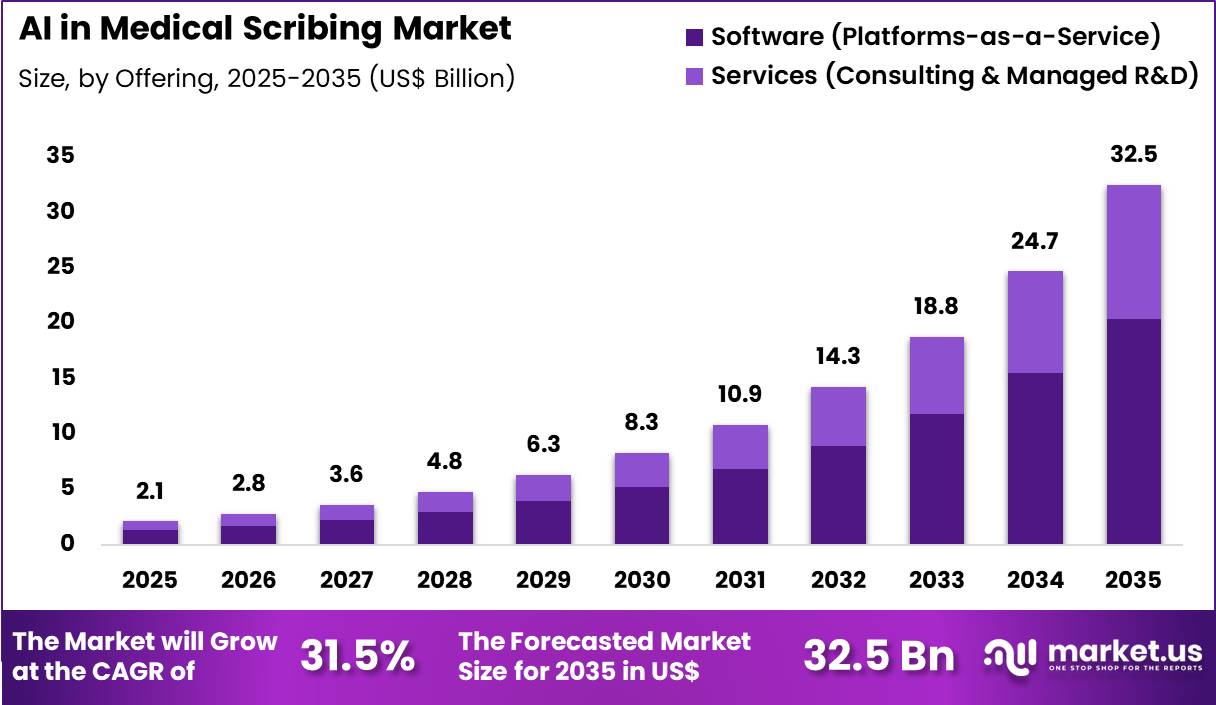
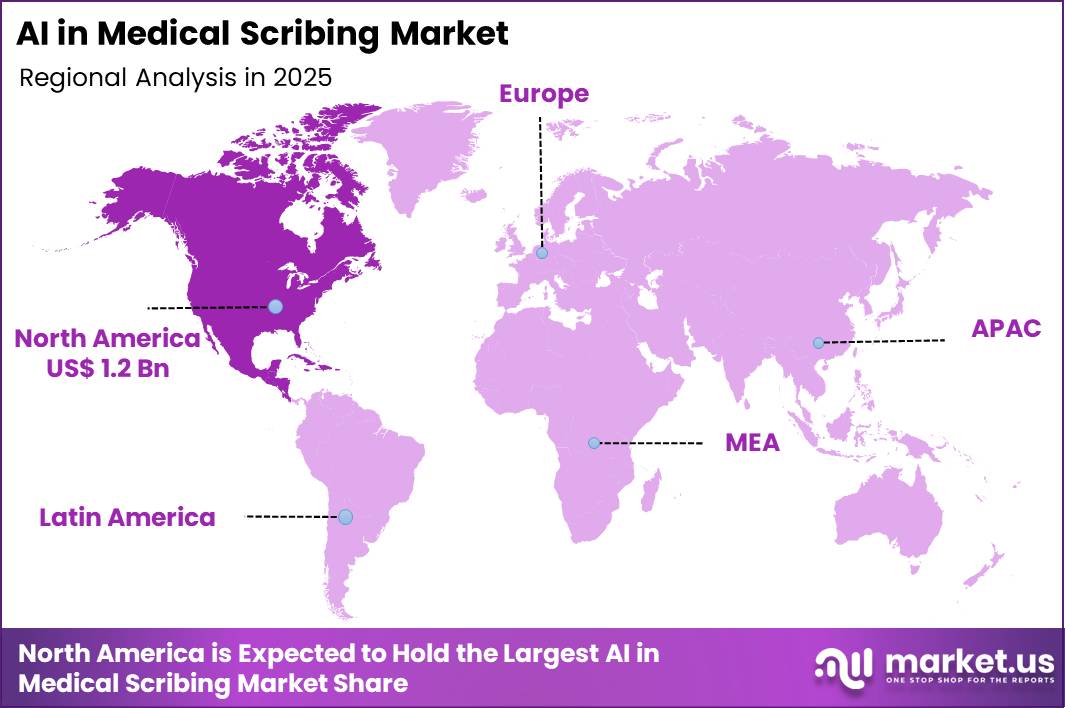
The Global AI in Medical Scribing Market size is expected to be worth around US$ 32.5 Billion by 2035 from US$ 2.1 Billion in 2025, growing at a CAGR of 31.5% during the forecast period 2026-2035. In 2025, North America led the market, achieving over 56.2% share with a revenue of US$ 1.2 Billion.
Increasing administrative burdens and physician burnout drive the AI in Medical Scribing market as healthcare organizations seek intelligent solutions that automate documentation and restore focus to patient care. Physicians increasingly rely on ambient AI scribing tools during patient encounters to capture multi-party conversations in real time, converting spoken dialogue into structured clinical notes without manual entry or dictation.
These systems support primary care and specialty clinics by generating accurate problem lists, histories of present illness, and assessment/plan sections for electronic health records, reducing after-hours charting time. Emergency department providers utilize AI scribing to document rapid assessments and treatment plans during high-acuity cases, ensuring comprehensive records for continuity of care and billing accuracy.
Specialists in oncology and cardiology apply the technology to summarize complex discussions involving treatment options, side effects, and prognosis, maintaining precise documentation for multidisciplinary coordination.
In October 2025, Microsoft (Nuance) achieved full-scale deployment of its Dragon Ambient eXperience (DAX) Copilot integrated natively within the Epic mobile application. This rollout allows physicians to initiate automated scribing directly from their mobile devices without needing separate hardware, using advanced generative AI to transform multi-party conversations into structured clinical summaries in real-time.
According to recent organizational data, health systems utilizing this integrated workflow have reported a 70% reduction in physician burnout scores related to administrative tasks. Technology providers pursue opportunities to embed generative AI with contextual understanding that adapts to diverse specialties and documentation styles, expanding applications in surgical and procedural specialties where detailed operative notes and post-procedure summaries require high accuracy.
Developers advance mobile-first and cloud-based scribing platforms that enable seamless integration with major electronic health record systems, broadening utility in ambulatory and telehealth settings. These advancements facilitate real-time editing and customization, allowing clinicians to refine AI-generated notes during or immediately after encounters.
Opportunities emerge in multilingual scribing capabilities that support diverse patient populations and international care teams. Companies invest in privacy-preserving models and compliance frameworks that meet HIPAA standards while enabling secure data processing.
Recent trends emphasize ambient listening with minimal clinician interaction, proactive summarization, and integration with clinical decision support tools, positioning AI in medical scribing as a transformative solution for reducing documentation burden, improving physician well-being, and enhancing care delivery efficiency.
Key Takeaways
- In 2025, the market generated a revenue of US$ 2.1 billion, with a CAGR of 31.5%, and is expected to reach US$ 32.5 billion by the year 2035.
- The application segment is divided into target identification, lead discovery & lead optimization, de novo molecular design, drug repurposing, preclinical testing and others, with target identification & lead discovery taking the lead with a market share of 41.8%.
- Considering offering, the market is divided into software (platforms-as-a-service) and services (consulting & managed R&D). Among these, Software held a significant share of 62.7%.
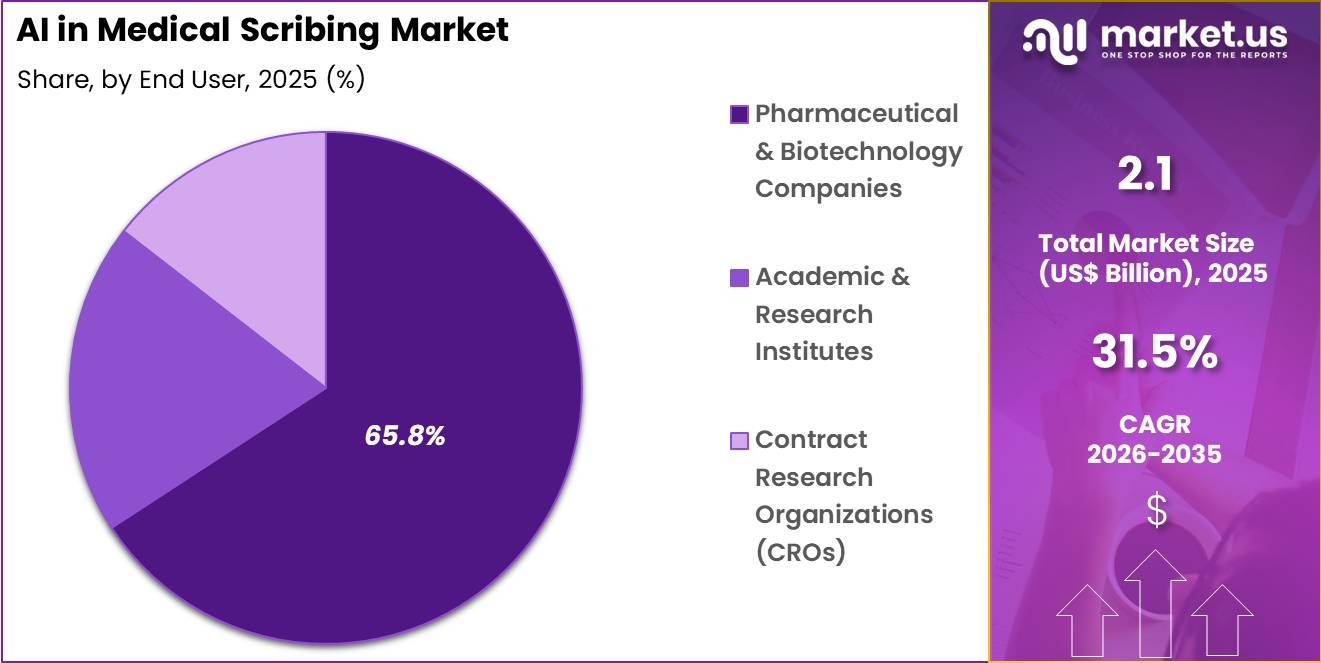
- Furthermore, concerning the therapeutic area segment, the market is segregated into oncology, neurology, infectious diseases, cardiovascular diseases, rare diseases and others. The pharmaceutical & biotechnology companies sector stands out as the dominant player, holding the largest revenue share of 65.8% in the market.
- The end user segment is segregated into pharmaceutical companies, biotechnology companies, academic & research institutes and contract research organizations (CROs), with the deep learning (dl) segment leading the market, holding a revenue share of 48.0%.
- North America led the market by securing a market share of 56.2%.
Application Analysis
Target identification and lead discovery accounted for 41.8% of growth within application and dominate the AI in medical scribing market due to the increasing need to accelerate early-stage drug discovery workflows. Pharmaceutical research teams analyze massive biomedical datasets including genomic data, protein structures, and clinical evidence to identify potential therapeutic targets.
Artificial intelligence platforms significantly improve the speed and efficiency of this process by identifying molecular patterns and biological relationships within large datasets. The National Institutes of Health reports that drug discovery typically requires more than ten years of research before approval, which encourages companies to adopt AI tools that shorten discovery timelines.
Researchers increasingly deploy AI models to screen millions of chemical compounds and predict potential drug candidates. This segment is expected to expand as pharmaceutical companies invest heavily in AI-driven drug discovery technologies that improve success rates and reduce development costs.
Offering Analysis
Software platforms accounted for 62.7% of growth within offering and dominate the AI in medical scribing market due to the increasing adoption of AI-enabled drug discovery platforms delivered through cloud-based and platform-as-a-service models.
Pharmaceutical companies prefer scalable software platforms because they integrate computational chemistry tools, biological databases, and predictive analytics within a unified research environment. These platforms allow researchers to perform complex modeling, compound screening, and biological data analysis more efficiently.
Pharmaceutical and biotechnology companies increasingly invest in digital drug discovery infrastructure that integrates machine learning and advanced analytics tools. Software-based research platforms are projected to expand as organizations seek scalable AI solutions that support collaborative research and faster experimental design. Continuous improvements in computational power and cloud computing infrastructure are expected to further strengthen adoption of AI-driven research platforms.
Therapeutic Area Analysis
Oncology accounted for 28.6% of growth within therapeutic area and dominate the AI in medical scribing market due to the increasing complexity of cancer research and the large amount of biological data generated in oncology studies. Cancer research programs analyze genomic mutations, tumor biomarkers, and molecular pathways to identify targeted treatment approaches.
Artificial intelligence technologies assist researchers in analyzing these complex datasets and identifying new therapeutic opportunities. The World Health Organization reports that cancer remains one of the leading causes of death globally, which increases the urgency of developing new treatments.
Pharmaceutical companies increasingly deploy AI-driven computational models to accelerate oncology drug discovery and evaluate potential therapeutic targets. The segment is expected to strengthen as precision oncology and genomic medicine continue expanding across pharmaceutical research programs.
End User Analysis
Pharmaceutical and biotechnology companies accounted for 65.8% of growth within end users and dominate the AI in medical scribing market due to their extensive investment in artificial intelligence technologies for drug discovery and biomedical research. These organizations generate large volumes of scientific data from laboratory experiments, clinical trials, and genomic sequencing platforms.
AI-driven systems help researchers process this information faster and identify promising therapeutic candidates more efficiently. Pharmaceutical companies increasingly integrate AI tools into research pipelines to improve discovery productivity and reduce experimental costs.
Global pharmaceutical R&D spending continues to grow each year, reflecting the strong commitment to innovative drug development. The segment is anticipated to expand as pharmaceutical and biotechnology companies continue integrating advanced computational technologies into research and development workflows.
Key Market Segments
By Application
- Target Identification
- Lead Discovery & Lead Optimization
- De Novo Molecular Design
- Drug Repurposing
- Preclinical Testing
- Others
By Offering
- Software (Platforms-as-a-Service)
- Services (Consulting & Managed R&D)
By Therapeutic Area
- Oncology
- Neurology
- Infectious Diseases
- Cardiovascular Diseases
- Rare Diseases
- Others
By End User
- Pharmaceutical Companies
- Biotechnology Companies
- Academic & Research Institutes
- Contract Research Organizations (CROs)
Drivers
Rising integration of AI scribes in ambulatory care settings is driving the market.
Healthcare providers have accelerated adoption of AI-powered medical scribing solutions to address persistent documentation burdens in outpatient clinics. These systems transcribe physician-patient conversations in real time and generate structured clinical notes compatible with electronic health record systems.
The driver aligns with ongoing workforce shortages among medical assistants and scribes in primary care and specialty practices. Physicians report measurable reductions in after-hours documentation time through automated note generation. The technology supports compliance with evaluation and management coding guidelines by capturing required elements consistently.
Facilities achieve improved throughput by minimizing administrative interruptions during patient encounters. The trend corresponds with increased acceptance of ambient listening capabilities that require no manual activation.
Enhanced natural language processing models improve accuracy in recognizing medical terminology and contextual nuances. The momentum reflects broader efforts to restore physician well-being through reduced clerical workload. This factor sustains steady demand for AI scribing platforms across various practice sizes.
Restraints
Concerns regarding data privacy and HIPAA compliance are restraining the market.
AI medical scribing solutions process highly sensitive protected health information during live patient encounters, necessitating robust safeguards against unauthorized access or breaches. Implementation requires comprehensive business associate agreements and continuous monitoring of data transmission pathways.
The restraint arises from lingering uncertainty among risk-averse organizations regarding vendor security postures. Smaller practices often lack dedicated compliance personnel to evaluate AI platforms thoroughly. The factor contributes to prolonged procurement cycles as legal and IT teams conduct extensive due diligence.
Providers remain cautious about solutions that retain audio recordings beyond immediate transcription needs. The dynamic moderates adoption velocity in privacy-sensitive specialties such as psychiatry and genetics. Vendors face pressure to demonstrate zero-retention architectures and audit-ready logging. This constraint limits rapid scaling in certain market segments. The limitation persists in influencing purchasing decisions amid evolving regulatory expectations.
Opportunities
Expansion of ambient AI documentation into hospital inpatient workflows is creating growth opportunities.
Vendors have begun adapting ambient listening technologies for use in hospital wards, intensive care units, and procedural areas beyond traditional ambulatory settings. These adaptations enable automated capture of multidisciplinary rounds, bedside discussions, and operative dictations. Opportunities arise for integration with hospital information systems to populate progress notes and discharge summaries.
The framework supports value-based care models by improving documentation timeliness and completeness. Developers gain capacity to address complex inpatient narratives involving multiple speakers and background noise. The development facilitates reduced reliance on traditional dictation services in academic medical centers.
Such capabilities attract health systems seeking enterprise-wide documentation standardization. The opportunity fosters differentiation through specialty-specific language models for hospital medicine. Stakeholders anticipate measurable improvements in coding accuracy and revenue capture. This advancement positions participants for expansion into higher-acuity care environments.
Impact of Macroeconomic / Geopolitical Factors
Macroeconomic pressure reshapes the AI in medical scribing market as healthcare providers search for ways to control administrative costs while maintaining documentation quality. Hospitals and physician groups face rising labor expenses, which pushes them to evaluate automation tools that reduce manual charting time.
At the same time, tighter financing conditions slow large-scale IT upgrades in smaller healthcare networks. Global geopolitical tensions also influence cloud infrastructure supply, data hosting regulations, and cross-border technology partnerships that support AI documentation platforms.
US tariffs on imported servers, networking hardware, and computing equipment raise deployment costs for technology vendors that rely on advanced processing infrastructure. These factors create short-term budget constraints and cautious adoption cycles in some healthcare systems.
However, providers continue to prioritize workflow efficiency and physician productivity as clinical workloads expand. Strong demand for accurate documentation and reduced clinician burnout keeps long-term adoption of AI-driven scribing solutions on a stable upward trajectory.
Latest Trends
Increased CMS recognition of AI-assisted documentation in E/M coding is driving the market.
The Centers for Medicare & Medicaid Services issued updated guidance in 2025 clarifying the permissibility of AI-generated documentation when accompanied by physician attestation and review. This clarification confirms that physicians may use AI scribes to draft notes provided final content reflects their clinical judgment.
The 2025 policy adjustment addresses prior ambiguity surrounding artificial intelligence in medical record creation. Providers benefit from explicit support for ambient documentation tools in Evaluation and Management services. The development aligns with ongoing efforts to reduce administrative burden under the Patients over Paperwork initiative.
Facilities report improved confidence in submitting claims supported by AI-assisted notes. The guidance stimulates broader deployment across Medicare-participating practices. The trend supports educational initiatives on appropriate attestation language and oversight responsibilities.
Early implementations demonstrate maintained coding compliance levels. Overall, this regulatory endorsement strengthens the strategic rationale for AI scribing adoption in U.S. medical practices.
Regional Analysis
North America is leading the AI in Medical Scribing Market
North America accounted for 56.2% of the AI in medical scribing market in 2025 as healthcare providers increasingly adopted artificial intelligence to automate clinical documentation and reduce physician administrative burden. Hospitals and physician practices across the United States are integrating AI-powered speech recognition and natural language processing tools that convert doctor–patient conversations into structured clinical notes.
According to the American Medical Association, physicians spend nearly two hours on administrative and electronic health record tasks for every hour spent with patients, highlighting the strong need for technologies that streamline documentation workflows.
Growing burnout among clinicians has therefore encouraged healthcare systems to deploy automated scribing solutions that allow physicians to focus more on patient care. Technology companies are developing advanced AI models capable of understanding complex medical terminology and generating accurate documentation directly within electronic health record systems.
Health systems are also expanding telehealth and virtual care programs that rely on automated transcription and documentation tools. Venture capital investment in healthcare AI startups has accelerated innovation in real-time clinical documentation platforms. These developments collectively supported strong expansion of intelligent medical documentation solutions across North America in 2025.
The Asia Pacific region is expected to experience the highest CAGR during the forecast period
Asia Pacific is expected to experience strong growth during the forecast period as digital health adoption and artificial intelligence integration expand across healthcare systems. Countries such as China, India, Japan, and South Korea are investing heavily in AI-driven healthcare technologies to improve clinical efficiency and reduce physician workload.
The World Health Organization reported in 2023 that the Western Pacific region accounts for nearly 1.9 billion people, creating enormous healthcare demand and increasing the need for technologies that improve clinical productivity. Hospitals and digital health companies across the region are introducing AI-based voice recognition platforms that assist clinicians in documenting patient encounters more efficiently.
Governments are supporting national digital health initiatives that encourage integration of artificial intelligence with hospital information systems and electronic medical records. Technology firms are collaborating with healthcare providers to develop multilingual clinical documentation tools suitable for diverse patient populations.
Medical universities and research institutions are expanding programs focused on healthcare AI and data science. Growing telemedicine adoption and increasing smartphone usage among healthcare professionals are also supporting the use of voice-enabled documentation platforms. These developments are expected to accelerate the adoption of automated clinical documentation technologies across Asia Pacific in the coming years.
Key Regions and Countries
North America
- The US
- Canada
Europe
- Germany
- France
- The U.K.
- Italy
- Spain
- Russia & CIS
- Rest of Europe
Asia Pacific
- China
- India
- Japan
- South Korea
- ASEAN
- Australia & New Zealand
- Rest of Asia Pacific
Middle East & Africa
- GCC
- South Africa
- Rest of Middle East & Africa
Latin America
- Brazil
- Mexico
- Rest of Latin America
Key Players Analysis
Key participants in the AI in Medical Scribing Market accelerate expansion by developing advanced speech recognition engines, natural language processing tools, and automated clinical documentation systems that assist physicians during patient consultations. Companies collaborate with hospitals and telehealth platforms to integrate AI-powered transcription software directly into electronic health record systems.
They also invest in cloud-based platforms and machine learning models that convert physician–patient conversations into structured medical notes with improved accuracy and efficiency. Nuance Communications, a Microsoft company, represents a major participant in the AI in Medical Scribing Market and operates as a healthcare technology provider that develops conversational AI and clinical documentation solutions for healthcare professionals.
The company offers digital assistant platforms designed to streamline clinical documentation and reduce physician administrative workload. Industry competitors continue to introduce real-time voice recognition tools, strengthen healthcare partnerships, and expand AI-driven documentation capabilities to improve clinical workflow productivity.
Top Key Players
- Insilico Medicine
- Exscientia
- Atomwise
- BenevolentAI
- Absci
- Recursion Pharmaceuticals
- XtalPi
- Valo Health
- Deep Genomics
- Healx
- Schrödinger, Inc.
- Verge Genomics
Recent Developments
- In February 2026, Abridge announced a major expansion of its “linked evidence” technology, which allows clinicians to click on any part of a generated note to hear the exact moment in the patient conversation that informed that detail. This development follows a successful US$150 million Series C funding round in late 2025, which the company is using to deepen its integration with Epic’s electronic health record (EHR) system. The technology is now being deployed across massive networks like University of Kansas Health System to reduce the “pajama time” doctors spend on documentation after hours.
- In January 2026, Nabla introduced a new suite of “Specialty-Specific Intelligence” for its Copot platform, tailored for high-complexity fields like oncology and rheumatology. Unlike general-purpose models, these specialized versions are trained to recognize and structure intricate clinical data points, such as chemotherapy cycles and multi-joint assessments. Recent performance reports indicate that this update has helped clinicians reduce their total documentation time by over 50%, with the platform now supporting more than 20,000 providers globally.
Report Scope
Report Features Description Market Value (2025) US$ 2.1 Billion Forecast Revenue (2035) US$ 32.5 Billion CAGR (2026-2035) 31.5% Base Year for Estimation 2025 Historic Period 2020-2024 Forecast Period 2026-2035 Report Coverage Revenue Forecast, Market Dynamics, COVID-19 Impact, Competitive Landscape, Recent Developments Segments Covered By Application (Target Identification, Lead Discovery & Lead Optimization, De Novo Molecular Design, Drug Repurposing, Preclinical Testing and Others), By Offering (Software (Platforms-as-a-Service) and Services (Consulting & Managed R&D)), By Therapeutic Area (Oncology, Neurology, Infectious Diseases, Cardiovascular Diseases, Rare Diseases and Others), By End User (Pharmaceutical Companies, Biotechnology Companies, Academic & Research Institutes and Contract Research Organizations (CROs)) Regional Analysis North America – The US, Canada; Europe – Germany, France, The U.K., Italy, Spain, Russia & CIS, Rest of Europe; Asia Pacific – China, India, Japan, South Korea, ASEAN, Australia & New Zealand, Rest of Asia Pacific; Middle East & Africa – GCC, South Africa, Rest of Middle East & Africa; Latin America – Brazil, Mexico, Rest of Latin America Competitive Landscape Insilico Medicine, Exscientia, Atomwise, BenevolentAI, Absci, Recursion Pharmaceuticals, XtalPi, Valo Health, Deep Genomics, Healx, Schrödinger, Inc., Verge Genomics. Customization Scope Customization for segments, region/country-level will be provided. Moreover, additional customization can be done based on the requirements. Purchase Options We have three licenses to opt for: Single User License, Multi-User License (Up to 5 Users), Corporate Use License (Unlimited User and Printable PDF)  AI in Medical Scribing MarketPublished date: March 2026add_shopping_cartBuy Now get_appDownload Sample
 -
-
Our Clients

- 181702
- March 2026






