


Report Overview
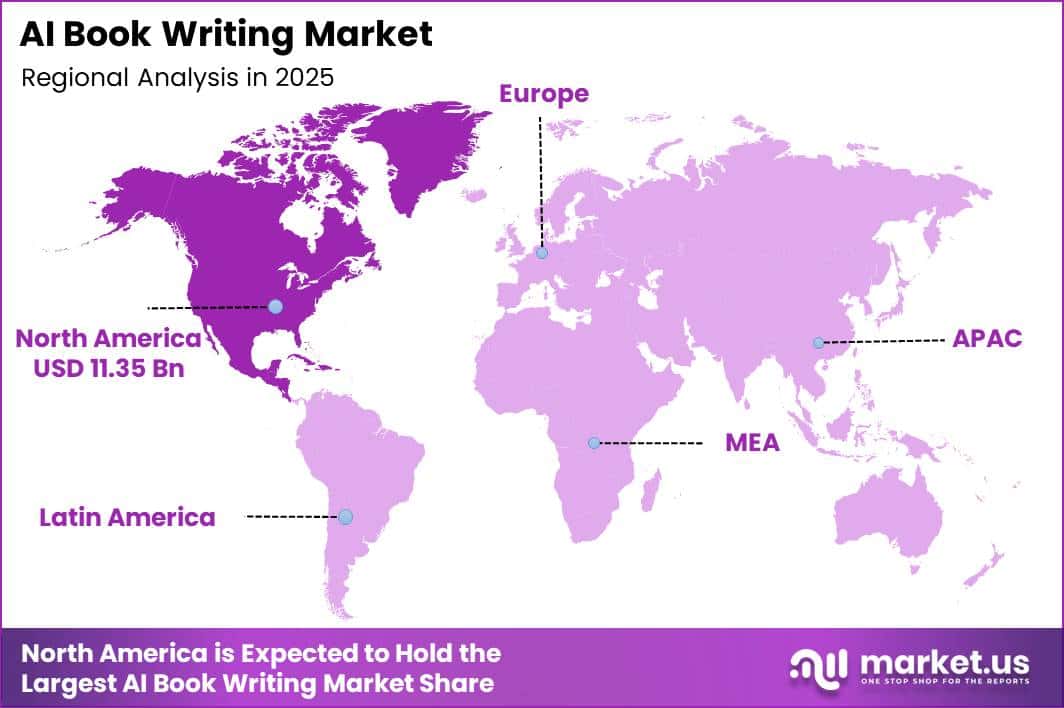
In 2025, the Global AI Book Writing Market was valued at USD 27.0 billion. The market is projected to grow at a CAGR of 11.4% during 2026–2035, reaching approximately USD 77.7 billion by 2035. North America dominated the global market in 2025, accounting for more than 42.1% of the total market share and generating approximately USD 11.3 billion in revenue.
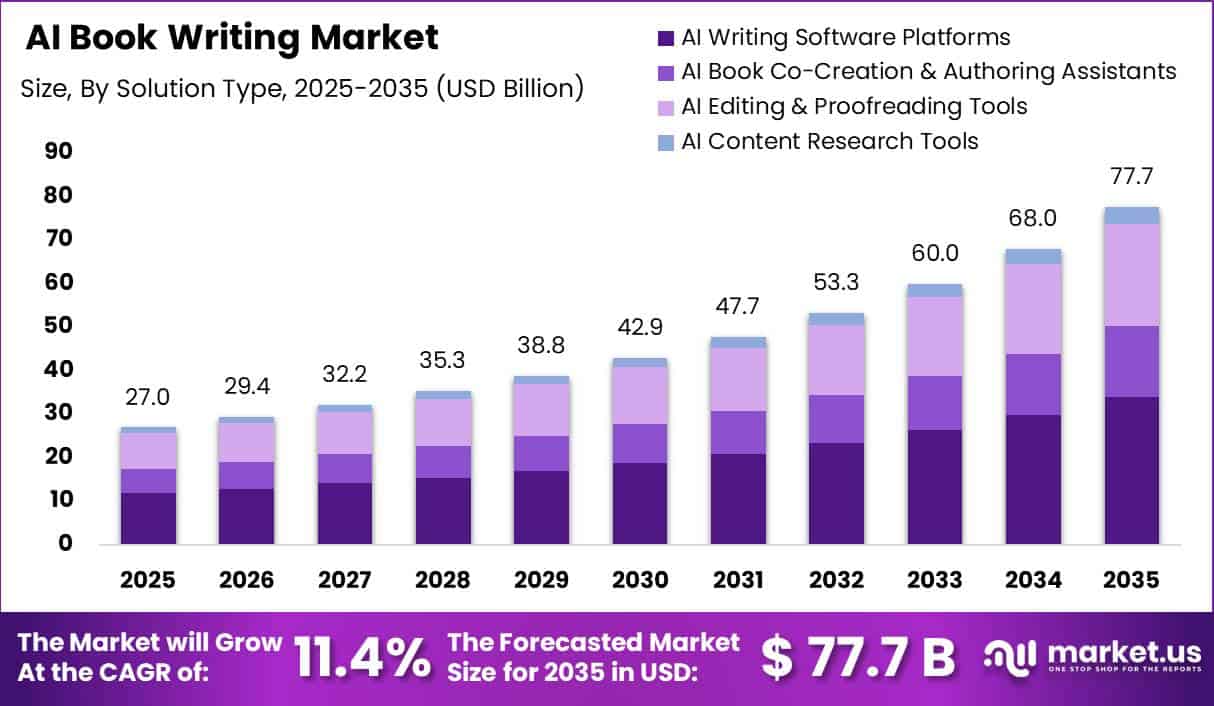
This growth is supported by the increasing digitalization of writing, editing, publishing, translation, and audiobook production. According to the World Bank’s 2025 Digital Progress and Trends Report, high-income economies lead global AI adoption because they have stronger computing infrastructure, skilled AI professionals, and greater investment capacity. AI writing platforms help meet these needs by automating repetitive tasks and reducing dependence on external services.
The U.S. Bureau of Labor Statistics reports that media and communication professionals, including writers and authors, earn median annual wages ranging from USD 70,300 to USD 72,270. The broader occupational group also generates more than 100,000 job openings each year. This large creator base faces continuous pressure to produce content faster, reduce operating costs, and publish across multiple formats.
Key Takeaway
- The AI Book Writing Market was valued at USD 27.0 billion in 2025 and is projected to reach USD 77.7 billion by 2035.
- The market is projected to grow at a CAGR of 11.4% between 2026 and 2035.
- AI Writing Software Platforms dominated the solution type segment with a 43.8% share in 2025.
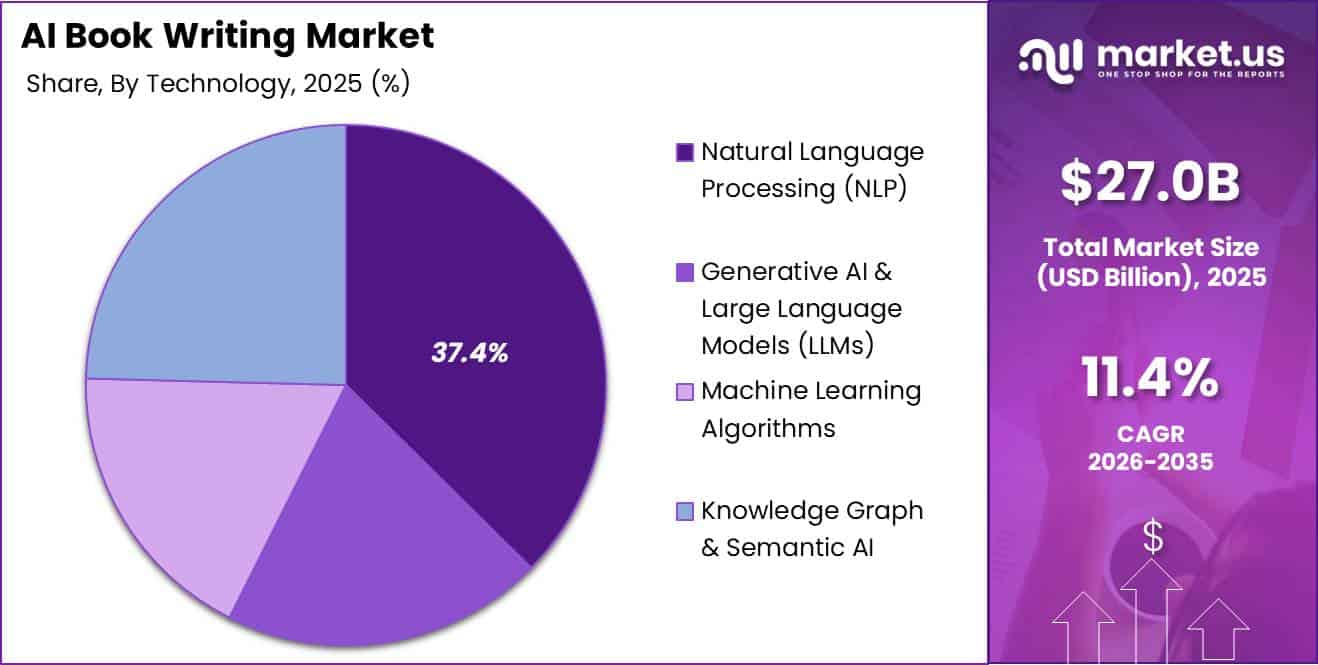
- Natural Language Processing led the technology segment with a 37.4% share in 2025.
- Fiction Books held the largest book type share at 35.9% in 2025.
- Cloud-based platforms accounted for approximately 76.2% of total revenue in 2025.
- Content Generation and Drafting led the application segment with approximately 41.7% of revenue in 2025.
- Independent Authors and Writers were the leading end-user segment at approximately 47.6% of revenue in 2025.
- Subscription-Based AI Writing Platforms led the business model segment with approximately 61.5% of revenue in 2025.
- North America led the market in 2025 with a 42.1% share, worth approximately USD 11.3 billion.
By Solution Type
In 2025, AI Writing Software Platforms held a dominant position in the AI Book Writing Market by solution type, capturing a 43.8% share. Their leadership is supported by the growing scale of digital publishing and self-publishing activities. UNESCO estimates that nearly 2.2 million new book titles are published worldwide each year, while annual book production exceeds 5 billion copies.
AI writing platforms combine language models, layout systems, collaboration tools, rights management, and multi-format publishing within one environment. They can produce e-books, print-ready files, and audiobooks while reducing the time and cost required for manual editing and localization.
By Technology
In 2025, Natural Language Processing held a dominant position in the AI Book Writing Market by technology, accounting for a 37.4% share. NLP forms the technical foundation of digital writing systems because it supports grammar correction, style improvement, readability analysis, named-entity recognition, translation, and multilingual content processing.
Publishers, writing platforms, and independent authors commonly use NLP tools to identify errors, improve sentence structure, maintain a consistent writing style, and prepare books for release in different languages. NLP is also integrated into spellcheckers, editing software, content moderation systems, accessibility tools, and text-to-speech applications.
By Book Type
In 2025, Fiction Books held a dominant position in the AI Book Writing Market by book type, accounting for a 35.9% share. This leadership is supported by the large scale of global trade publishing and the strong demand for novels, short stories, children’s books, and other general-interest titles.
Nielsen BookScan data also shows that fiction, children’s books, and other trade categories represented more than two-thirds of book unit sales in developed markets such as the United Kingdom and Italy. The United Kingdom alone recorded sales of 208.8 million copies and point-of-sale revenue of USD 2.2 billion in 2022. This high publishing volume encourages authors and publishers to use AI for plot development, character creation, drafting, rewriting, language improvement, and multi-format publishing.
By Deployment Mode
In 2025, Cloud-based platforms held a dominant position in the AI Book Writing Market by deployment mode, accounting for approximately 76.2% of total revenue. Their leadership is supported by the high computing power and constant connectivity required for large language models, collaborative writing, and automated publishing workflows.
World Bank guidance indicates that wider cloud adoption could contribute between 0.6% and 2.2% to GDP in advanced Asian economies as businesses shift workloads from on-premises systems to hyperscale cloud infrastructure. According to the ITU’s Facts and Figures 2024, more than two-thirds of the global population, or around 5.4 billion people, were connected to the internet.
By Application
In 2025, Content Generation and Drafting held a dominant position in the AI Book Writing Market by application, accounting for approximately 41.7% of total revenue. The segment leads because it supports the most time-consuming stage of book production: creating original, long-form content. UNESCO reports that the global publishing industry produces millions of titles and billions of book copies each year, with every title requiring a new manuscript or major content revision.
According to WIPO’s Global Publishing Industry in 2022 report, trade and educational publishing generated more than USD 76.3 billion across 28 reporting countries. This large publishing base creates continuous demand for new titles, revised editions, localized content, and expanded book series. AI drafting tools help authors and publishers generate first drafts, chapter outlines, character profiles, storylines, and educational explanations more quickly.
By End User
In 2025, Independent Authors and Writers held a dominant position in the AI Book Writing Market by end user, accounting for approximately 47.6% of total revenue. The segment leads because independent creators represent a large user base and often manage the complete book production process without extensive editorial support. According to the U.S. Bureau of Labor Statistics, the United States had nearly 135,400 writer and author jobs in 2024. Employment in this occupation is projected to increase by 4% between 2024 and 2034, with approximately 13,400 openings expected each year.
Many writers work as freelancers or self-employed professionals and personally cover the time and cost required for drafting, editing, formatting, and publishing. Author association surveys also indicate that more than 1 million people have self-published at least 1 book in recent years. AI writing tools help these creators generate drafts, improve structure and writing style, correct errors, and prepare books for digital, print, and audio formats.
By Business Model
In 2025, Subscription-Based AI Writing Platforms held a dominant position in the AI Book Writing Market by business model, accounting for approximately 61.5% of total revenue. The segment leads because subscriptions have become the standard payment model for cloud-based software and AI services. OECD analysis shows that recurring subscription access is widely used for software and cloud products, although some providers also include usage-based charges.
Subscription platforms give independent authors, editors, and publishing companies continuous access to drafting, editing, translation, formatting, and content analysis tools. Users can apply these capabilities across several books and projects without purchasing separate software for each manuscript. This model also provides predictable monthly or annual costs for customers and stable recurring revenue for platform providers.
Key Market Segments
By Solution Type
- AI Writing Software Platforms
- AI Book Co-Creation & Authoring Assistants
- AI Editing & Proofreading Tools
- AI Content Research Tools
By Technology
- Natural Language Processing (NLP)
- Generative AI & Large Language Models (LLMs)
- Machine Learning Algorithms
- Knowledge Graph & Semantic AI
By Book Type
- Fiction Books
- Educational & Academic Books
- Non-Fiction Books
- Children’s Books
- Business & Self-Help Books
By Deployment Mode
- Cloud-Based Platforms
- On-Premises Solutions
By Application
- Content Generation & Drafting
- Editing & Content Enhancement
- Plot & Story Development
- Research & Citation Assistance
- Translation & Localization
By End User
- Independent Authors & Writers
- Publishing Houses
- Educational Institutions
- Corporate Content Creators
By Business Model
- Subscription-Based AI Writing Platforms
- Usage-Based AI Writing Services
- Enterprise Licensing
Geopolitical Impact Analysis
Geopolitical tensions are increasing operating costs and delivery risks across the AI Book Writing Market by affecting cloud infrastructure, energy prices, semiconductor supply, and global logistics. The WTO estimates that global merchandise trade could shift from a baseline growth rate of 3.0% in 2025 to a contraction of 1.5% if reciprocal tariffs and trade policy uncertainty increase.
This represents a possible 4.5-percentage-point change in global trade flows. Higher tariffs on servers, networking systems, semiconductors, and other data-centre equipment could raise infrastructure investment costs for AI writing platform providers and reduce profit margins.
Logistics disruptions in the Red Sea and the Middle East have also extended Asia–Europe shipping times by around 10–15 days. Spot container freight rates on major trade routes have increased by more than 200%, creating longer delivery periods and higher costs for GPUs, memory modules, storage systems, and other hardware required to operate AI models.
Energy costs represent another major concern. According to the International Energy Agency, data centres consumed approximately 415 TWh of electricity in 2024, equal to around 1.5% of global electricity demand. This consumption is projected to more than double to 945 TWh by 2030 as AI workloads expand.
Volatile electricity and gas prices could therefore increase the operating cost of every AI-generated response and user session. AI book writing providers may respond by raising subscription fees, introducing usage limits, increasing pay-per-use charges, or focusing on higher-value publishing clients. These pressures could also create regional differences in the affordability and availability of AI-based drafting, editing, translation, and content-generation services.
Regional Analysis
North America held the leading position in the global AI Book Writing Market, accounting for 42.1% of total revenue, valued at approximately USD 11.3 billion. The region benefits from advanced AI infrastructure, strong cloud computing networks, high internet access, and a well-established digital publishing industry. It also has a large base of professional writers, independent authors, publishing companies, and self-publishing platforms.
These users are adopting AI tools for drafting, editing, translation, formatting, and audiobook production. Subscription-based writing platforms and AI co-creation tools are increasingly being integrated into both new and existing book catalogues, supporting North America’s dominant market position.
Asia-Pacific is expected to be the fastest-growing regional market during the forecast period. Growth is supported by improving digital literacy, rising smartphone use, expanding cloud infrastructure, and increasing online content creation across China, South Korea, Japan, and Southeast Asian countries.
Demand for local-language books, e-books, educational content, web novels, and serialized fiction is also increasing. Publishers and digital platforms are using AI to generate multilingual content, manage high-volume writing projects, and reduce production time.
Key Regions and Countries
North America
- US
- Canada
Europe
- Germany
- France
- The UK
- Spain
- Italy
- Rest of Europe
Asia Pacific
- China
- Japan
- South Korea
- India
- Australia
- Rest of APAC
Latin America
- Brazil
- Mexico
- Rest of Latin America
Middle East & Africa
- GCC
- South Africa
- Rest of MEA
Market Dynamics
Drivers
| Driver | (~) % CAGR | Geographic Relevance | Impact Timeline |
|---|---|---|---|
| Enterprise adoption of AI authoring stacks | +2.3% | North America, Europe, East Asia | Short term (≤ 2 years) |
| Proliferation of AI-native publishing platforms | +1.8% | Global | Short term (≤ 2 years) |
| Falling inference costs for large language models | +1.5% | Global | Medium term (2–4 years) |
| Expanding base of AI-assisted authors | +1.2% | Global (concentrated in U.S., U.K., India) | Short term (≤ 2 years) |
| Integration of AI tools into existing editorial workflows | +1.0% | North America, Europe | Medium term (2–4 years) |
| Growth in overall AI-powered content creation budgets | +0.9% | Global | Medium term (2–4 years) |
Enterprise adoption of AI authoring stacks
Large publishers and educational content providers are actively formalizing AI authoring stacks that combine proprietary datasets with fine-tuned language models, following proofs of concept deployed since around 2023 in marketing and documentation workflows.
These stacks typically reduce first-draft cycle times by 40–60% and cut per-manuscript development costs by roughly 15–25%, allowing enterprises to expand annual title output by 20–30% without proportional staff increases and to reallocate 5–10% of editorial budgets into AI licensing and orchestration layers.
At a market level, this shift is reshaping business models from project-based ghostwriting to recurring SaaS and usage-based contracts, lifting attach rates of AI book-writing modules into existing content suites by an estimated 10–15 percentage points and adding roughly +2.3% to the underlying AI book writing market CAGR as enterprises lock in multi-year platform deals and bundle AI co-authoring into wider digital publishing transformations.
Restraints
| Restraint | (~) % CAGR | Geographic Relevance | Impact Timeline |
|---|---|---|---|
| Emerging AI content transparency and copyright compliance mandates | -2.0% | European Union, U.K., selected U.S. states | Short term (≤ 2 years) |
| High dependency on proprietary foundation models | -1.5% | Global | Medium term (2–4 years) |
| Limited trust from traditional publishers | -1.3% | North America, Europe | Short term (≤ 2 years) |
| Data privacy constraints for author training corpora | -1.1% | Europe, North America | Medium term (2–4 years) |
| Payment and platform risk concentration | -0.9% | Global | Medium term (2–4 years) |
| Litigation risk around training data provenance | -0.8% | U.S., Europe | Short term (≤ 2 years) |
Emerging AI content transparency and copyright compliance mandates
New transparency requirements for AI-generated content, including obligations to label synthetic text and publish summaries of training data, are forcing AI book-writing vendors serving the European Union and similar jurisdictions to redesign workflows and compliance tooling on accelerated timelines.
To align with forthcoming AI governance regimes, publishers must add detection, watermarking, and disclosure layers that can increase compliance and legal review costs per title by roughly 5–10% and extend time-to-market by 2–4 weeks for AI-heavy manuscripts, directly depressing near-term throughput of AI-authored books.
In response, some houses are capping the proportion of AI-generated content to below 30–40% of any single work and freezing experiments in higher-risk genres, which effectively removes an estimated -2.0% from potential CAGR as budget is diverted into risk management, contract renegotiations, and legal reserves rather than aggressive scaling of AI book-writing pipelines.
Challenges
| Challenge | (~) % CAGR | Geographic Relevance | Mitigation Horizon |
|---|---|---|---|
| Quality consistency at scale | -1.9% | Global | Medium term (2–4 years) |
| Talent gap in AI-native editing | -1.6% | Global (more acute in developing markets) | Medium term (2–4 years) |
| Model hallucinations in long-form narrative | -1.4% | Global | Short term (≤ 2 years) |
| Fragmented toolchain interoperability | -1.2% | Global | Medium term (2–4 years) |
| Rapid model upgrade cycles | -1.0% | Global | Long term (≥ 4 years) |
| Localization and multilingual complexity | -0.9% | Europe, Asia-Pacific, Latin America | Medium term (2–4 years) |
Quality consistency at scale
As AI book-writing outputs move from experimental novellas to multi-hundred-page catalogs, publishers are encountering structural issues in maintaining narrative coherence, factual accuracy, and brand voice across 50–500 page manuscripts generated or heavily assisted by large language models.
Internal audits at content-heavy enterprises often find that 20–35% of AI-generated chapters require substantial human rewriting to meet house style and factual standards, which can erode the anticipated cost savings by 30–50% and add 15–20 hours of human editing per title, diluting the economic advantage that underpins more aggressive deployment scenarios.
Over the medium term, this friction removes roughly -1.9% from potential CAGR as operators prioritize fewer, higher-quality AI-assisted titles, invest in custom guardrails and fine-tuning stacks that can add mid-six-figure annual operating expenses for larger houses, and slow the pace at which AI book-writing is rolled out across backlists, imprints, and non-English segments.
Opportunities
| Opportunity | (~) % CAGR | Geographic Relevance | Execution Window |
|---|---|---|---|
| AI-first backlist revitalization and versioning | +2.1% | North America, Europe, Japan | Medium term (2–4 years) |
| Personalized and interactive AI co-authored books | +1.9% | Global (digital-first markets) | Long term (≥ 4 years) |
| Verticalized AI book-writing for education and training | +1.7% | Global | Medium term (2–4 years) |
| Licensing of AI-generated IP portfolios | +1.4% | Global | Long term (≥ 4 years) |
| Emerging market language expansion | +1.2% | Asia-Pacific, Africa, Latin America | Long term (≥ 4 years) |
| Tooling for regulatory-grade AI provenance tracking | +1.0% | Europe, North America | Medium term (2–4 years) |
AI-first backlist revitalization and versioning
Unlike the current driver of enterprise AI stack adoption, the systematic use of AI to revitalize and version deep backlists remains largely untapped, with most publishers having activated AI on less than 10–15% of their legacy titles despite sizable digital catalogs.
Applying AI book-writing systems to produce updated editions, condensed summaries, audio-first adaptations, and region-specific variants can reduce marginal content refresh costs by roughly 40–60% per title and raise effective lifetime revenue per work by an estimated 20–30% through incremental SKUs and improved discovery, without requiring proportional marketing or author advances.
For AI book-writing vendors, offering managed backlist programs with revenue-sharing or per-title pricing can expand recurring revenues by an estimated +2.1% CAGR upside over baseline, as even a modest activation of a few thousand titles at mid-single-digit royalty rates per unit sold would materially shift unit economics toward higher-margin, at-scale catalog monetization rather than purely net-new title creation.
Key Players Analysis
The AI Book Writing Market has developed a two-tier competitive structure. Tier-1 companies mainly include foundation-model and cloud infrastructure providers that support most downstream AI writing tools. OpenAI generated approximately USD 13 billion in revenue during 2025, representing an increase of 236% from USD 3.7 billion in 2024. Its annualized revenue exceeded USD 20 billion by January 2026, supported by ChatGPT subscriptions and more than 1 million business customers.
Anthropic’s annualized revenue reportedly increased from USD 9 billion to USD 47 billion by May 2026, while its valuation rose from USD 61.5 billion in March 2025 to USD 183 billion. Google Cloud recorded USD 58.7 billion in FY2025 revenue, growing 36% year over year, with more than 70% of customers using its AI products. Microsoft also strengthened its position through an estimated 27% stake in OpenAI, valued at around USD 135 billion.
Tier-2 competitors include specialized AI writing and authoring software providers. Grammarly, now operating under Superhuman, reported nearly USD 700 million in annual recurring revenue and more than 40 million daily active users. The company also secured a USD 1 billion financing arrangement from General Catalyst.
Jasper, Copy.ai, Writesonic, Sudowrite, QuillBot, and ProWritingAid compete through focused services such as fiction drafting, grammar correction, and marketing content. Notion, Atticus, Scrivener, and Amazon Kindle Direct Publishing provide supporting authoring, formatting, and distribution tools.
Top Key Players in the Market
- OpenAI
- Anthropic
- Microsoft
- Jasper
- Sudowrite
- Writesonic
- Copy.ai
- Grammarly
- ProWritingAid
- QuillBot
- Notion
- Atticus
- Kindle Direct Publishing
- Scrivener
Recent Developments
- In March 2026, OpenAI secured USD 122 billion in committed funding at a post-money valuation of USD 852 billion. The investment strengthened its capacity to expand computing infrastructure, develop advanced foundation models, and improve enterprise AI products used for long-form drafting, editing, translation, and content enhancement.
- In May 2025, Grammarly secured USD 1 billion in non-dilutive financing from General Catalyst. The funding was allocated toward product development, marketing, customer expansion, and strategic acquisitions. Grammarly served more than 40 million daily users and generated over USD 700 million in annual revenue, strengthening its position in AI-assisted writing and productivity software.
Report Scope
| Report Features | Description |
|---|---|
| Market Value (2025) | USD 27.0 Billion |
| Forecast Revenue (2035) | USD 77.7 Billion |
| CAGR (2026-2035) | 11.4% |
| Base Year for Estimation | 2025 |
| Historic Period | 2020-2024 |
| Forecast Period | 2026-2035 |
| Report Coverage | Revenue Forecast, Market Dynamics, Competitive Landscape, Recent Developments |
| Segments Covered | By Solution Type (AI Writing Software Platforms, AI Book Co-Creation & Authoring Assistants, AI Editing & Proofreading Tools, AI Content Research Tools); By Technology (Natural Language Processing (NLP), Generative AI & Large Language Models (LLMs), Machine Learning Algorithms, Knowledge Graph & Semantic AI); By Book Type (Fiction Books, Educational & Academic Books, Non-Fiction Books, Children’s Books, Business & Self-Help Books); By Deployment Mode (Cloud-Based Platforms, On-Premises Solutions); By Application (Content Generation & Drafting, Editing & Content Enhancement, Plot & Story Development, Research & Citation Assistance, Translation & Localization); By End User (Independent Authors & Writers, Publishing Houses, Educational Institutions, Corporate Content Creators); By Business Model (Subscription-Based AI Writing Platforms, Usage-Based AI Writing Services, Enterprise Licensing) |
| Regional Analysis | North America – US, Canada; Europe – Germany, France, The UK, Spain, Italy, Rest of Europe; Asia Pacific – China, Japan, South Korea, India, Australia, Singapore, Rest of APAC; Latin America – Brazil, Mexico, Rest of Latin America; Middle East & Africa – GCC, South Africa, Rest of MEA |
| Competitive Landscape | OpenAI, Anthropic, Google, Microsoft, Jasper, Sudowrite, Writesonic, Copy.ai, Grammarly, ProWritingAid, QuillBot, Notion, Atticus, Kindle Direct Publishing, Scrivener |
| Customization Scope | Customization for segments, region/country-level will be provided. Moreover, additional customization can be done based on the requirements. |
| Purchase Options | We have three licenses to opt for: Single User License, Multi-User License (Up to 5 Users), Corporate Use License (Unlimited Users and Printable PDF) |





























