Report Overview
In 2025, the Global Agentic AI in Telecom Market was valued at USD 5.5 billion. The market is projected to grow at a CAGR of 39.3% during 2026–2035, reaching approximately USD 143.3 billion by 2035. North America dominated the global market in 2025, accounting for more than 40.5% of the total market share and generating approximately USD 2.2 billion in revenue.
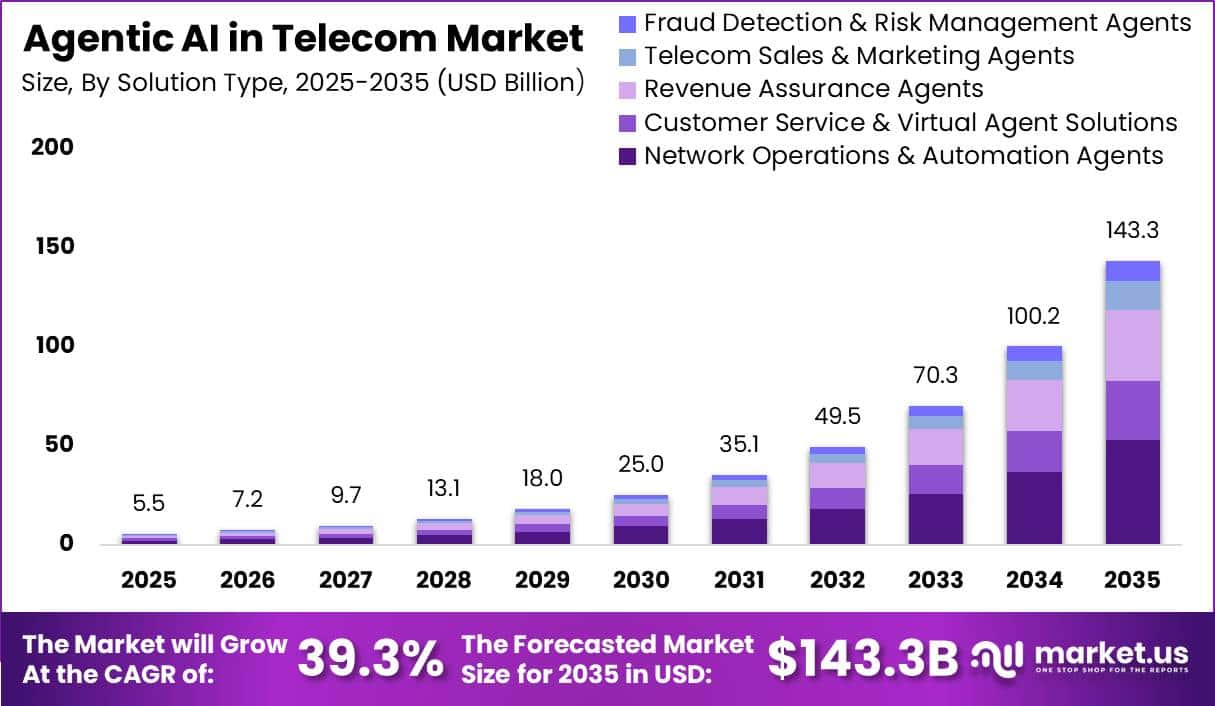
The sharp rise in internet traffic, connected devices, and complex telecom networks supports this expansion. According to the International Telecommunication Union, global end-user internet traffic exceeded 1 zettabyte in 2023. Mobile broadband traffic is estimated to reach 1.5 ZB in 2025, while fixed broadband traffic is expected to reach 7.3 ZB, growing annually by around 19% and 16%, respectively.
Ericsson also forecasts that global mobile network data traffic will more than double to 328 exabytes per month by 2031. These rising data volumes are encouraging telecom operators to use agentic AI for network planning, traffic management, anomaly detection, fraud prevention, customer support, and service personalization.
North American region’s leadership is supported by high 5G adoption and growing smartphone data use, which Ericsson expects to rise from 25 GB per month in 2025 to 52 GB by 2031, at a CAGR of nearly 13%. In addition, 65% of telecom operators have an AI strategy, 70% have fully or partly implemented generative AI, and 89% plan further generative AI investments in the next financial year.
Key Takeaway
- Market valued at USD 5.5 billion in 2025, forecast to reach USD 143.3 billion by 2035 at a 39.3% CAGR.
- Network Operations & Automation Agents led the solution segment with a 36.8% share.
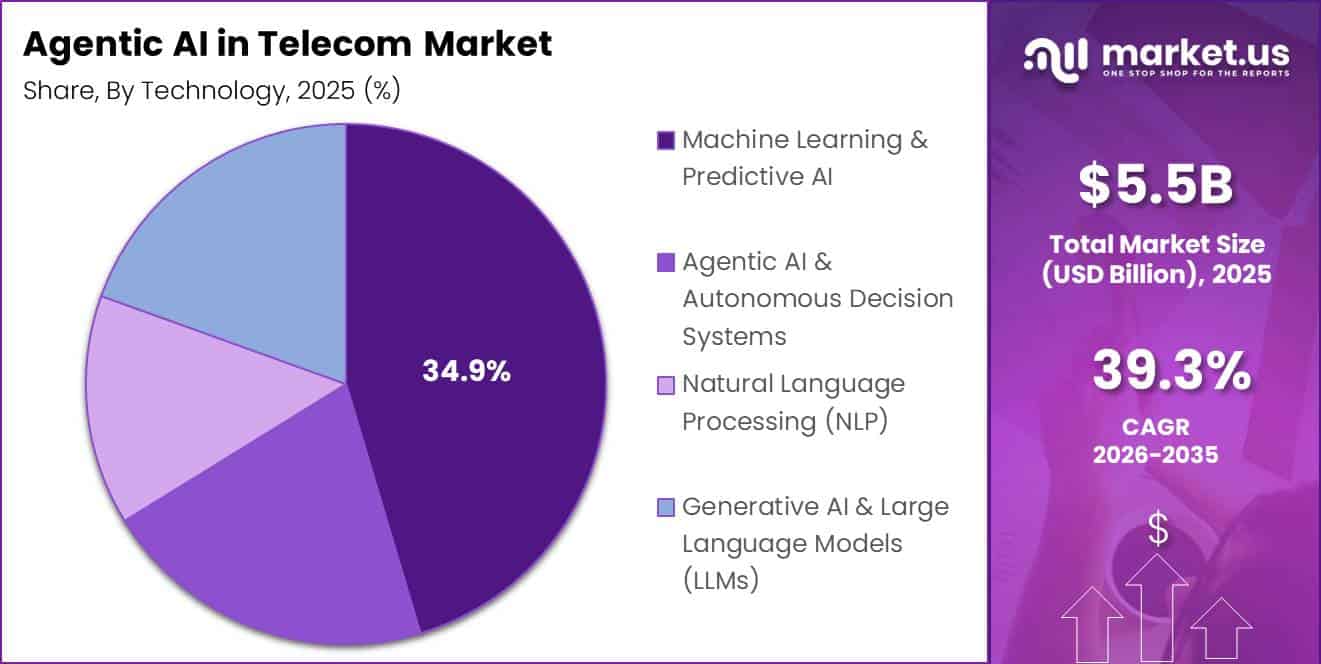
- Machine Learning & Predictive AI held a 34.9% technology share, with Agentic AI & Autonomous Decision Systems as the fastest-growing.
- Cloud-based deployment dominated with a 64.7% share, while Hybrid deployment is the fastest-growing mode.
- Network Performance Management led applications with a 32.4% share.
- Mobile Networks (4G/5G) held a 48.3% share by network type, with Private Enterprise Networks growing fastest.
- Large Telecom Operators accounted for 72.6% of enterprise spending.
- Telecom Service Providers (TSPs) represented 69.1% of end-user spending.
- Operational Efficiency & Cost Optimization led functions with a 38.2% share.
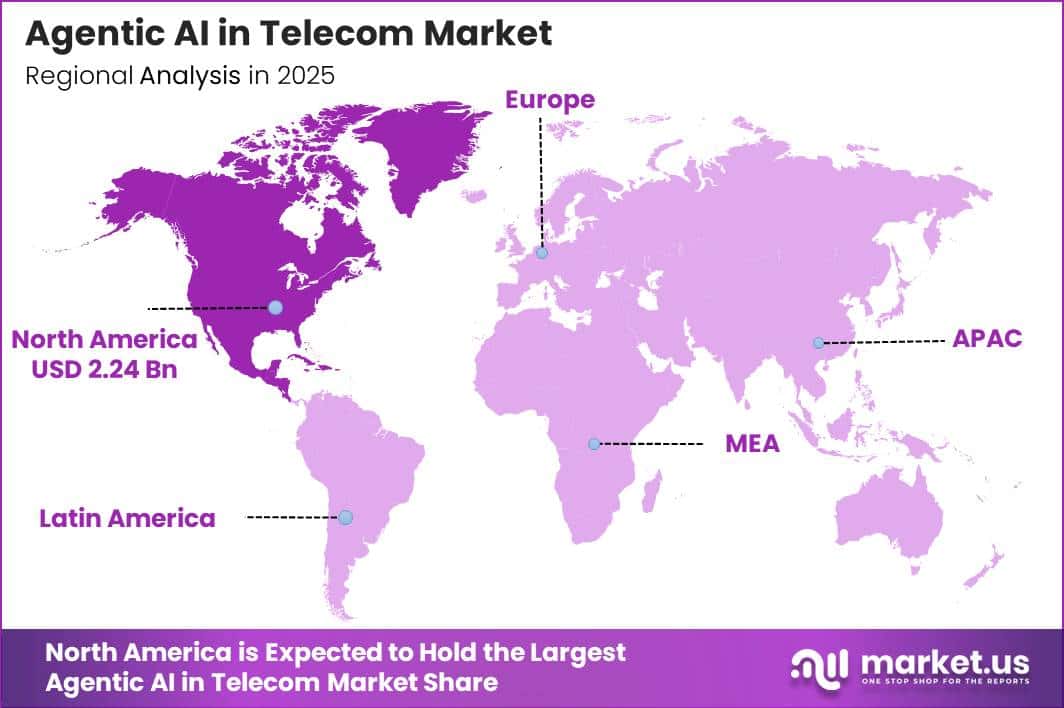
- North America led with a 40.5% share, worth approximately USD 2.2 billion in 2025.
By Solution Type
Network Operations and Automation Agents held a leading 36.8% share of the Agentic AI in the Telecom Market, as they help operators manage the high cost and complexity of large, multi-vendor networks. Global telecom operating expenditure was estimated at nearly USD 1.6 trillion in 2024, of which network-related expenses represented approximately USD 440 billion.
Network operating costs increased by only 0.2% year over year despite rising data traffic and service complexity, showing the growing importance of AI-based automation. These agents can identify faults, balance network traffic, optimize energy consumption, coordinate upgrades, reduce field visits, and limit unplanned downtime.
Customer Service & Virtual Agent Solutions are expected to be the fastest-growing segment, as telecom operators manage millions of customer calls, chats, and service tickets each day. Around 47–50% of tracked telecom AI projects are focused on customer care. Virtual agents can manage billing questions, plan changes, account requests, and basic technical support without requiring proportional growth in employee numbers.
By Technology
Machine Learning & Predictive AI held a leading 34.9% share of the Agentic AI in Telecom Market because it supports intelligent network monitoring, forecasting, and optimization. Standards developed by 3GPP and ETSI for Self-Organising Networks include self-configuration, self-optimization, and self-healing functions. These systems continuously collect data from radio networks, core infrastructure, and connected devices to predict congestion, equipment failures, and coverage gaps.
Machine learning models can analyse millions of network events and performance indicators, helping operators identify problems before they affect customers. This reduces outages, unnecessary field visits, customer churn, and network operating costs. The expansion of 5G and cloud-native core networks is also generating larger volumes of telemetry data, increasing demand for predictive AI solutions that convert network information into useful operational decisions.
By Deployment Mode
Cloud-based deployment held a dominant 64.7% share of the Agentic AI in Telecom Market, supported by the growing use of cloud-native 5G cores, open RAN systems, and digital service platforms. Global enterprises allocate around 10% of their revenue to digital transformation technologies, including AI, IoT, and cloud solutions.
This investment encourages telecom operators to deliver AI-based services through flexible cloud infrastructure instead of relying only on fixed on-premises systems. Cloud deployment allows AI models to be trained, managed, and updated centrally across thousands of cell sites and connected devices.
It also provides scalable computing and storage capacity, reduces upfront capital expenditure, supports faster implementation, and simplifies integration with third-party platforms through APIs and microservices. As more 5G network functions, customer service channels, and B2B applications move to the cloud, operators increasingly deploy AI agents within the same environment for network optimization, security, and customer engagement.
By Application
Network Performance Management held a leading 32.4% share of the Agentic AI in Telecom Market, supported by the growing scale and complexity of telecom networks. In 2024, the world recorded nearly 9.1 billion mobile-cellular subscriptions and around 9 billion mobile broadband subscriptions. Regulators also require operators to meet strict service standards.
For example, performance benchmarks for 4G and 5G networks include latency below 75 milliseconds and packet drop rates under 3%. Agentic AI platforms continuously analyse network data related to latency, throughput, congestion, outages, and service quality across millions of cells and backhaul connections.
Customer Experience Management is expected to be the fastest-growing application segment as telecom companies focus more on retaining customers and increasing revenue per subscriber. Global mobile industry revenue exceeded USD 1 trillion in 2024, while AI-based churn models have shown accuracy levels of more than 95% when analysing customer usage, billing history, and service interactions.
Agentic AI can use these insights to deliver personalized offers, proactive support, and real-time assistance across smartphones, home gateways, applications, and enterprise devices. For large operators, even a 1–2% reduction in annual customer churn can protect hundreds of millions of dollars in revenue, supporting faster adoption of AI-based customer experience solutions.
By Network Type
Mobile Networks (4G/5G) held a dominant 48.3% share of the Agentic AI in Telecom Market because they support the largest volume of global users, devices, and data traffic. In 2025, the world recorded around 9.2 billion mobile-cellular subscriptions, while mobile broadband represented 89% of all mobile subscriptions and 5G/IMT-2020 accounted for 36%.
More than 51% of the global population was covered by 5G, while 92% had access to 4G or better. This large network footprint creates strong demand for agentic AI systems that can manage radio resources, handovers, interference, traffic congestion, and energy use across millions of cells and billions of active SIM connections. Improved 4G and 5G performance also helps operators protect revenue from mobile data, video streaming, and enterprise connectivity services.
Private Enterprise Networks are expected to be the fastest-growing network type as factories, ports, mines, utilities, and business campuses adopt dedicated 4G and 5G systems. These networks support Industry 4.0 applications such as robot control, automated guided vehicles, logistics tracking, and real-time quality inspection.
By Enterprise Size
Large Telecom Operators held a dominant 72.6% share of spending in the Agentic AI in Telecom Market because a limited number of national and multinational carriers control a major portion of global telecom revenue and connections. Mobile operator revenue exceeds USD 1 trillion annually, while leading telecom groups in China, India, the US, and Europe each manage hundreds of millions of connections.
These companies operate nationwide 4G, 5G, and fiber networks across thousands of sites and millions of devices. Their large scale creates strong demand for agentic AI in network automation, customer support, fault management, churn reduction, and digital service delivery.
Small & Regional Telecom Providers are expected to be the fastest-growing segment as they adopt AI to compete with larger operators while serving local and underserved markets. Around 75–80% of telecom AI deployments in emerging regions focus on improving operating cost efficiency.
By End User
Telecom Service Providers (TSPs) held a dominant 69.1% share of spending in the Agentic AI in Telecom Market because they own and operate mobile and fixed telecom networks. Global mobile operator revenue exceeds USD 1 trillion annually, while operator revenues in individual countries can range from hundreds of millions to tens of billions of dollars per year.
This creates strong demand for agentic AI solutions that can automate fault resolution, optimize energy consumption, improve service quality, and simplify customer interactions. Even a 1–2% improvement in operating efficiency or customer retention can generate substantial savings for large operators.
By Function
Operational Efficiency and Cost Optimization held a leading 38.2% share of the Agentic AI in the Telecom Market because telecom operations require high and continuous spending. Global telecom operating expenditure reached approximately USD 1.6 trillion in 2024, compared with industry revenue of nearly USD 2.01 trillion. Network-related operating costs accounted for around USD 441 billion, while labor expenses reached about USD 300 billion.
At this scale, even a 0.5% improvement in operating efficiency could generate annual savings of nearly USD 8–10 billion. Agentic AI supports these savings by optimizing energy consumption, automating network fault management, improving field operations, and simplifying back-office activities.
Autonomous Customer Engagement is expected to be the fastest-growing function segment. Around 47–50% of tracked telecom AI projects focus on customer care, while approximately 75–80% of AI initiatives target cost reduction. Autonomous AI agents can manage billing questions, plan changes, service requests, and basic technical problems across calls, chats, mobile applications, smartphones, home gateways, and enterprise devices.
Key Market Segments
By Solution Type
- Network Operations & Automation Agents
- Customer Service & Virtual Agent Solutions
- Revenue Assurance Agents
- Telecom Sales & Marketing Agents
- Fraud Detection & Risk Management Agents
By Technology
- Machine Learning & Predictive AI
- Agentic AI & Autonomous Decision Systems
- Natural Language Processing (NLP)
- Generative AI & Large Language Models (LLMs)
By Deployment Mode
- Cloud-Based
- On-Premises
- Hybrid Deployment
By Application
- Network Performance Management
- Customer Experience Management
- Service Provisioning & Orchestration
- Predictive Maintenance
- Billing & Revenue Optimization
By Network Type
- Mobile Networks (4G/5G)
- Fixed Broadband Networks
- Private Enterprise Networks
By Enterprise Size
- Large Telecom Operators
- Small & Regional Telecom Providers
By End User
- Telecom Service Providers (TSPs)
- Managed Service Providers (MSPs)
- Enterprise Telecom Network Operators
By Function
- Operational Efficiency & Cost Optimization
- Autonomous Customer Engagement
- Security & Threat Intelligence
- Business Process Automation
Geopolitical Impact Analysis
The Agentic AI in Telecom Market remains highly exposed to the US-China technology rivalry because AI platforms depend on advanced GPUs, accelerators, and specialized semiconductors supplied through a concentrated global network. US restrictions on advanced AI chips have changed rapidly, shifting from bans on products such as the H20 and H200 to conditional approval, combined with a 25% tariff on chips sold into China. Wider US-China tariffs reached 145% in April 2025 before easing to nearly 30% by mid-2025.
These policy changes create uncertainty in equipment pricing, sourcing, and investment planning for telecom operators. Regulatory enforcement has also increased. The US Bureau of Industry and Security imposed a US$252 million penalty on Applied Materials for illegal equipment exports to China, showing that semiconductor companies face higher compliance and supply-chain risks.
Energy costs create an additional challenge for the market. Data-center electricity demand increased by 17% in 2025, nearly 6 times the 3% growth in global electricity demand. This rise was supported by more than US$400 billion in AI infrastructure investment, which is expected to increase by another 75% in 2026.
AI-related electricity consumption is also projected to triple by 2030. Higher electricity demand may increase the cost of operating telecom core networks, edge infrastructure, and agentic AI platforms. Together, semiconductor tariffs, export controls, compliance expenses, and power-price pressure could slow deployment and raise the total cost of agentic AI solutions.
Regional Analysis
North America held the leading position in the Agentic AI in Telecom Market, accounting for 40.5% of global revenue, equal to approximately USD 2.2 billion in 2025. The region’s dominance is supported by early 5G deployment, high mobile data consumption, and strong cloud and AI infrastructure across the US and Canada.
Major telecom operators are already using AI for network management, customer service, fraud detection, and cybersecurity. The presence of hyperscale data centers, cloud providers, and AI chip companies also supports faster testing and large-scale deployment of agentic AI solutions.
Asia-Pacific is expected to be the fastest-growing region due to rapid mobile broadband expansion and large-scale 4G and 5G deployment in China, South Korea, Japan, and India. Operators are adding hundreds of millions of mobile users, creating strong demand for AI-based network optimization, spectrum management, and automated customer engagement.
Europe represents a steadily developing market, supported by strong demand for network reliability, energy efficiency, and regulatory compliance. Telecom operators are deploying agentic AI to manage multi-country networks, improve service quality in densely populated areas, and reduce energy use.
Key Regions and Countries
North America
- US
- Canada
Europe
- Germany
- France
- The UK
- Spain
- Italy
- Rest of Europe
Asia Pacific
- China
- Japan
- South Korea
- India
- Australia
- Rest of APAC
Latin America
- Brazil
- Mexico
- Rest of Latin America
Middle East & Africa
- GCC
- South Africa
- Rest of MEA
Market Dynamics
Drivers
| Driver | (~) % CAGR | Geographic Relevance | Impact Timeline |
|---|---|---|---|
| Autonomous network operations adoption | +4.2% | North America, Europe, East Asia | Short term (≤ 2 years) |
| Agentic AI for customer experience | +3.6% | Global Tier‑1/Tier‑2 operators | Short term (≤ 2 years) |
| API‑first, agent‑consumable networks | +3.1% | Global, led by advanced 5G markets | Medium term (2–4 years) |
| Cloud‑native OSS/BSS modernization | +2.8% | Global, especially developed markets | Medium term (2–4 years) |
| Security and fraud mitigation agents | +2.4% | Global | Short term (≤ 2 years) |
| Multi‑domain operational cost pressure | +2.0% | Global | Short term (≤ 2 years) |
Autonomous network operations adoption
Between 2024 and 2026, early deployments of agentic AI in telecom have shifted from reactive alarm handling to closed‑loop, self‑healing network operations, with autonomous agents now executing multi‑step workflows across OSS/BSS, RAN, and core domains in live environments.
This transition is rooted in the convergence of GenAI, advanced NLP, and real‑time telemetry collection across tens of thousands of network elements, enabling agents to plan and execute actions such as dynamic RAN parameter tuning, slice reconfiguration, and traffic re‑routing with minimal human intervention, which can cut unplanned downtime by up to 30–40% and reduce Level‑1/Level‑2 NOC ticket volumes by roughly 25–35% for early adopters.
Commercially, this alters the telco operating model from manual, ticket‑driven workflows to agent‑supervised autonomy, shifting opex structure as field‑engineer truck rolls per 10,000 subscribers fall by an estimated 15–25% and allowing operators to reallocate 10–15% of network operations spend towards new digital services, which supports an incremental uplift of about 4.2 percentage points on the baseline agentic AI in telecom CAGR as process savings are recycled into broader AI footprint expansion.
Restraints
| Restraint | (~) % CAGR | Geographic Relevance | Impact Timeline |
|---|---|---|---|
| High initial capex for AI-native stacks | –3.8% | Global, sharper in emerging markets | Short term (≤ 2 years) |
| EU AI Act compliance burden | –2.9% | European Union, extraterritorial impact | Medium term (2–4 years) |
| Data privacy and consent constraints | –2.6% | Europe, India, select APAC and LATAM | Short term (≤ 2 years) |
| Legacy OSS/BSS lock‑in | –2.3% | Global | Medium term (2–4 years) |
| Model risk and liability exposure | –2.0% | Global, stronger in regulated markets | Short term (≤ 2 years) |
| Spectrum and critical‑infrastructure scrutiny | –1.7% | US, EU, key Asian markets | Long term (≥ 4 years) |
High initial capex for AI-native stacks
To operationalize agentic AI at scale, operators must fund GPU‑dense compute clusters, low‑latency storage, and observability pipelines capable of ingesting and acting on millions of network events per second, pushing initial AI‑native stack investments for large telcos into the high eight‑ to low nine‑figure range in local currency terms and raising technology capex by roughly 8–12% over pre‑agentic baselines in the 2024–2026 window.
This capital intensity is exacerbated by the need to duplicate environments across production and sandbox domains for safety validation and to support multi‑vendor integrations, leaving some operators with parallel cost structures where less than 30% of network workflows are fully migrated to agentic orchestration yet 60–70% of the target infrastructure cost is already incurred, which can compress EBITDA margins by an estimated 150–250 basis points during transition years.
Boards in cost‑constrained markets delay or phase in deployments, deferring 12–24 months of potential agentic AI rollouts and pulling down the realizable CAGR by roughly 3.8 percentage points relative to the unconstrained baseline, particularly for mid‑tier operators with higher leverage and limited access to low‑cost funding.
Challenges
| Challenge | (~) % CAGR | Geographic Relevance | Mitigation Horizon |
|---|---|---|---|
| Telecom AI talent scarcity | –3.3% | Global, acute in emerging markets | Medium term (2–4 years) |
| Complex multi‑agent orchestration | –3.0% | Global | Medium term (2–4 years) |
| Operational change management | –2.7% | Global | Short term (≤ 2 years) |
| Data quality and lineage | –2.5% | Global | Medium term (2–4 years) |
| Interoperability across vendors | –2.2% | Global, multi‑vendor networks | Long term (≥ 4 years) |
| Real‑time governance and oversight | –2.0% | US, EU, advanced APAC | Medium term (2–4 years) |
Telecom AI talent scarcity
Agentic AI in telecom requires a scarce blend of skills—network engineering, distributed systems, ML ops, and safety‑critical automation—while the number of professionals with deep exposure to both large‑scale telecom stacks and contemporary agentic architectures likely numbers in only the low thousands globally as of 2026, far below the needs of hundreds of operators and their vendor ecosystems.
This shortage pushes total compensation for senior AI‑network architects and lead ML engineers 20–40% above traditional network roles and leaves many operators with project teams that are 30–50% understaffed versus planned blueprints, extending pilot‑to‑production timelines from an intended 6–9 months to closer to 12–18 months for complex multi‑domain agents.
Strategically, telcos must redesign workforce plans toward centralized AI centers of excellence, expand vendor‑managed services, and prioritize automation blueprints that maximize impact per scarce expert—yet this gradual adjustment means a friction drag of roughly 3.3 percentage points on the addressable CAGR, as many networks operate with partial agentic capabilities instead of fully autonomous, value‑maximizing deployments.
Opportunities
| Opportunity | (~) % CAGR | Geographic Relevance | Execution Window |
|---|---|---|---|
| Agentic AI marketplaces and XaaS | +3.9% | Global, platform‑oriented operators | Medium term (2–4 years) |
| Verticalized B2B network co‑pilots | +3.4% | Global enterprise markets | Short term (≤ 2 years) |
| Security and fraud AI services | +3.0% | Global | Medium term (2–4 years) |
| Agent‑centric API monetization | +2.7% | Global digital ecosystems | Long term (≥ 4 years) |
| Low‑touch SME automation bundles | +2.5% | Global, especially emerging markets | Medium term (2–4 years) |
| Green AI and energy optimization | +2.1% | Global | Long term (≥ 4 years) |
Agentic AI marketplaces and XaaS
Emerging concepts of agentic AI marketplaces—where autonomous agents become primary consumers of programmable network capabilities via standardized, machine‑readable APIs—are still largely in blueprint or pilot phases as of 2026, meaning most operators have not yet productized catalogues where third‑party agents can discover, negotiate, and pay for quality‑of‑service, slicing, or security services on demand.
This white space allows early‑mover telcos to evolve from selling fixed connectivity to operating multi‑sided platforms, with realistic unit‑economic shifts such as raising effective ARPU on agent‑driven traffic by roughly 10–20% via premium latency/jitter tiers, while also improving gross margins on incremental workloads by 5–8 percentage points through higher resource utilization and automated provisioning.
If operators couple these marketplaces with XaaS models—usage‑based pricing for AI‑enhanced observability, policy, and assurance offered to enterprises and digital platforms—the resulting expansion into adjacent digital service fees and revenue‑share constructs could add an estimated 3.9 percentage points of upside to the baseline CAGR for agentic AI in telecom, provided they execute within the next 2–4 years before platform positions consolidate around a small set of ecosystems.
Key Players Analysis
Tier-1 companies in the Agentic AI in Telecom Market are supported by their strong positions in AI chips, cloud computing, and telecom network software. NVIDIA, Microsoft, Alphabet, Huawei, Cisco, Ericsson, and Nokia are estimated to capture around 55–65% of agentic AI-related revenue. Alphabet recorded USD 400 billion in total revenue in 2025, while Google Cloud generated USD 58.7 billion, increasing 36% year over year and reaching an annual run rate of more than USD 70 billion.
Microsoft’s Intelligent Cloud business generates tens of billions of dollars annually, while its research and development spending has historically represented around 10–12% of revenue. Ericsson also reported multi-billion-euro revenue from its Networks and Cloud & Software Services businesses in 2025, with Network Infrastructure revenue rising 7%and Mobile Networks increasing 6% in Q4.
Tier-2 companies, including IBM, Amdocs, Tech Mahindra, Accenture, Infosys, ServiceNow, Cognizant, and Rakuten Symphony, are estimated to represent 25–35% of market value. These firms mainly compete through system integration, OSS/BSS modernization, managed services, and AI-based workflow automation.
ServiceNow generated USD 12.8 billion in subscription revenue in 2025, up 21%, with remaining performance obligations of USD 28.2 billion. Accenture serves multi-billion-dollar Communications, Media & Technology operations and invests around USD 1.2–1.3 billion annually in research and intellectual property.
Top Key Players in the Market
- NVIDIA
- Microsoft
- IBM
- Cisco Systems
- Ericsson
- Nokia
- Huawei
- Amdocs
- Tech Mahindra
- Accenture
- Infosys
- ServiceNow
- Cognizant
- Rakuten Symphony
Recent Developments
- In March 2026, Ericsson and T-Mobile successfully tested Ericsson Cloud RAN software on NVIDIA AI infrastructure. The solution allows the same RAN software to operate on Ericsson Silicon, NVIDIA infrastructure, and other commercial hardware platforms. The companies presented the technology at Mobile World Congress 2026, held from March 2 to March 5, supporting more flexible deployment of AI-native and future 6G networks.
- In January 2026, ServiceNow reported full-year 2025 subscription revenue of USD 12.8 billion, representing growth of 21%. Its remaining performance obligations reached USD 28.2 billion, increasing 26.5%, while new annual contract value from Now Assist more than doubled in Q4 2025. ServiceNow had also introduced NVIDIA-powered AI agents for telecom customer service and network operations in March 2025.
Report Scope
| Report Features | Description |
|---|---|
| Market Value (2025) | USD 5.5 Billion |
| Forecast Revenue (2035) | USD 143.3 Billion |
| CAGR (2026-2035) | 39.3% |
| Base Year for Estimation | 2025 |
| Historic Period | 2020-2024 |
| Forecast Period | 2026-2035 |
| Report Coverage | Revenue Forecast, Market Dynamics, Competitive Landscape, Recent Developments |
| Segments Covered | By Solution Type (Network Operations & Automation Agents, Customer Service & Virtual Agent Solutions, Revenue Assurance Agents, Telecom Sales & Marketing Agents, Fraud Detection & Risk Management Agents); By Technology (Machine Learning & Predictive AI, Agentic AI & Autonomous Decision Systems, Natural Language Processing (NLP), Generative AI & Large Language Models (LLMs)); By Deployment Mode (Cloud-Based, On-Premises, Hybrid Deployment); By Application (Network Performance Management, Customer Experience Management, Service Provisioning & Orchestration, Predictive Maintenance, Billing & Revenue Optimization); By Network Type (Mobile Networks (4G/5G), Fixed Broadband Networks, Private Enterprise Networks); By Enterprise Size (Large Telecom Operators, Small & Regional Telecom Providers); By End User (Telecom Service Providers (TSPs), Managed Service Providers (MSPs), Enterprise Telecom Network Operators); By Function (Operational Efficiency & Cost Optimization, Autonomous Customer Engagement, Security & Threat Intelligence, Business Process Automation) |
| Regional Analysis | North America – US, Canada; Europe – Germany, France, The UK, Spain, Italy, Rest of Europe; Asia Pacific – China, Japan, South Korea, India, Australia, Singapore, Rest of APAC; Latin America – Brazil, Mexico, Rest of Latin America; Middle East & Africa – GCC, South Africa, Rest of MEA |
| Competitive Landscape | NVIDIA, Microsoft, Google, IBM, Cisco Systems, Ericsson, Nokia, Huawei, Amdocs, Tech Mahindra, Accenture, Infosys, ServiceNow, Cognizant, Rakuten Symphony |
| Customization Scope | Customization for segments, region/country-level will be provided. Moreover, additional customization can be done based on the requirements. |
| Purchase Options | We have three licenses to opt for: Single User License, Multi-User License (Up to 5 Users), Corporate Use License (Unlimited Users and Printable PDF) |