Report Overview
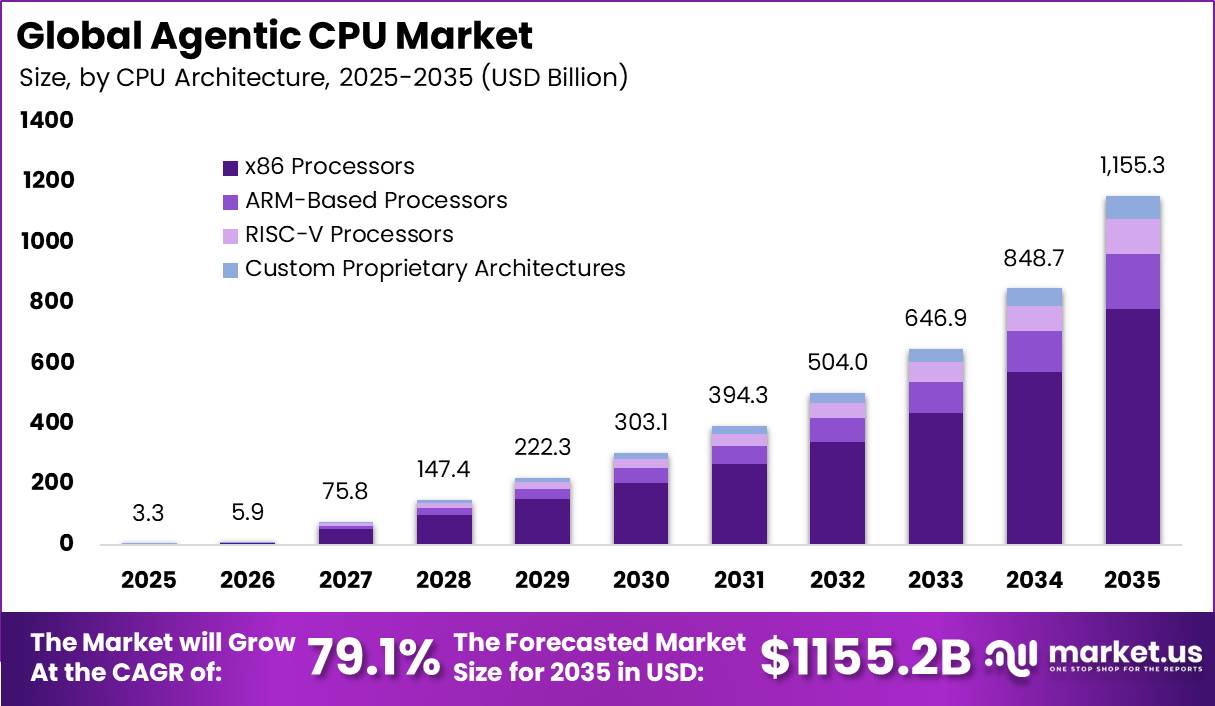
In 2025, the Global Agentic CPU Market was valued at USD 3.3 billion. The market is projected to grow at a CAGR of 79.1% during 2026–2035, reaching approximately USD 1,155.2 billion by 2035. North America dominated the global market in 2025, accounting for more than 46.5% of the total market share and generating approximately USD 1.5 billion in revenue.
Growth is being supported by rapid data centre construction and rising demand for AI computing. Global data centre electricity consumption reached 415 TWh in 2024 and is expected to more than double to around 945-950 TWh by 2030, while electricity demand from accelerated servers is projected to grow by nearly 30% annually. Semiconductor demand is rising alongside this expansion.
Global semiconductor sales increased from USD 630.5 billion in 2024 to a record USD 791.7 billion in 2025, representing 25.6% growth. Logic semiconductor sales, which include CPUs, increased 39.9% to USD 301.9 billion, while global chip sales are expected to exceed USD 1 trillion in 2026. U.S. data centre electricity consumption increased 17% in 2025, compared with overall electricity demand growth of just 3%, and data centres could contribute nearly 50% of U.S. electricity demand growth through 2030.
AI-related investment contributed around 1.16-1.3 percentage points to U.S. real GDP growth in 2025 and represented nearly 30% of GDP growth in Q2 2025. Investment in information-processing equipment and software also increased at an annualized 28.3% in H1 2025, compared with average GDP growth of 2.4% between 2013 and 2024.
Key Takeaway
- The Agentic CPU Market is valued at USD 3.3 billion in 2025, projected to reach USD 1155.2 billion by 2035 at a CAGR of 79.1%.
- x86 Processors dominated the CPU Architecture segment with a 67.5% share, while ARM-Based Processors is the fastest-growing segment.
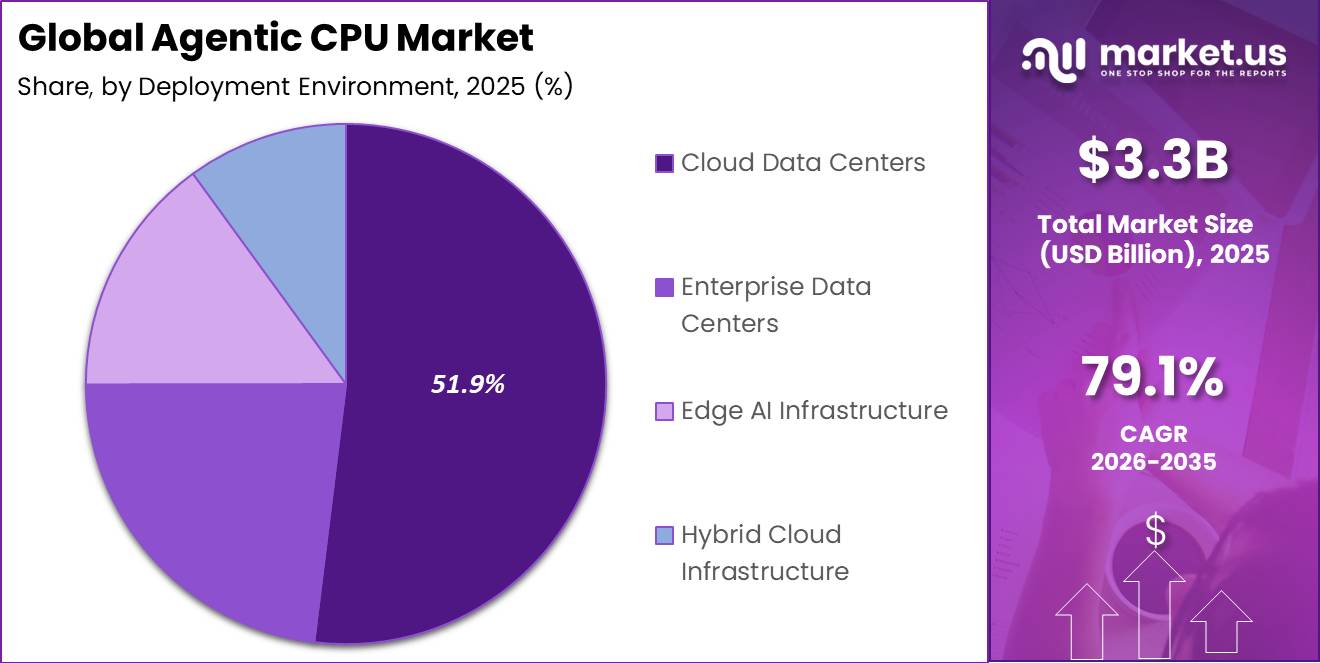
- Cloud Data Centers held a 51.9% share of the Deployment Environment segment, while Enterprise Data Centers is the fastest-growing segment.
- AI Copilots & Digital Agents led the Application segment with a 27.4% share, while AI Agent Orchestration is the fastest-growing segment.
- Hyperscale Cloud Providers held a 39.6% share among End Users, while AI Model Developers is the fastest-growing segment.
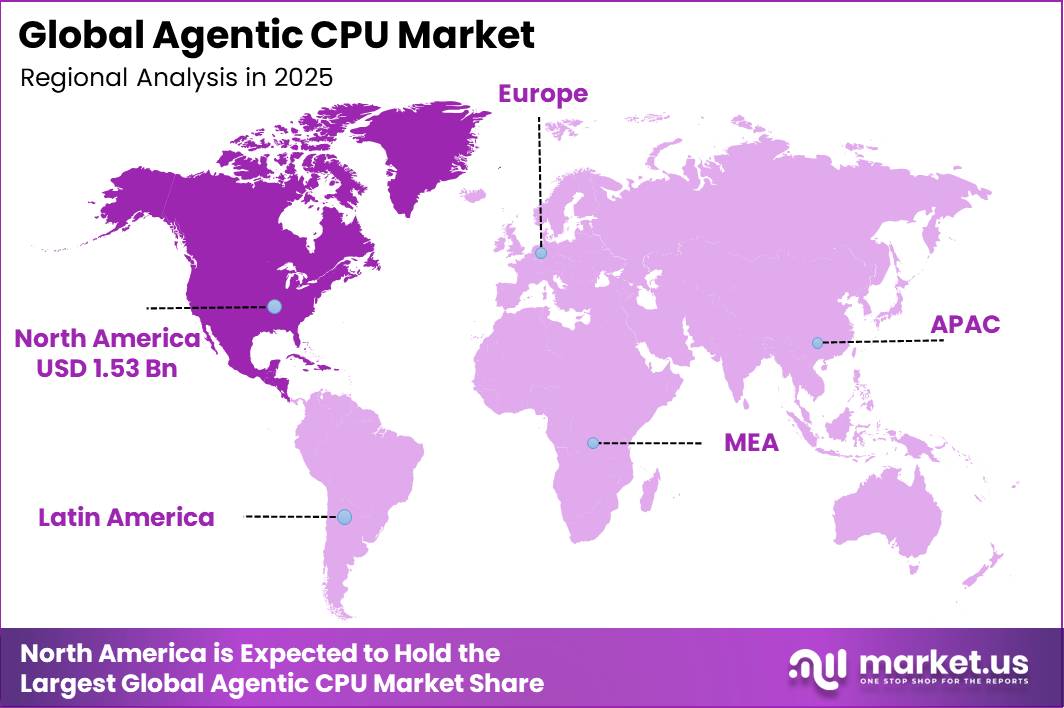
- North America led the market with a 46.5% share and USD 1.5 billion in revenue in 2025.
Market Statistics and Data Insights
- Global data-centre electricity consumption increased by 17% in 2025, while electricity use at AI-focused data centres surged by 50%. This is one of the clearest real-world indicators of rapidly expanding AI computing infrastructure and processor workloads.
- Semiconductor sales reached USD 236.6 billion in Q4 2025, up 37.1% year over year and 13.6% from Q3 2025. December 2025 alone generated USD 78.9 billion in global chip sales.
- NVIDIA generated USD 215.9 billion in total FY2026 revenue, up 65%, while its Data Center business generated USD 193.7 billion, up 68%. Q4 Data Center revenue alone reached USD 62.3 billion, increasing 75% year over year.
- About 18% of U.S. firms had adopted AI by the end of 2025. Work-related generative AI usage reached approximately 41% of the U.S. workforce by November 2025.
- Around 78% of the U.S. workforce was employed by firms that had adopted some form of AI in November 2025, while approximately 54% worked for firms using large language models.
- Canadian business AI adoption increased to 19.2% in Q2 2026 from 12.2% in Q2 2025 and 6.1% in Q2 2024, meaning adoption more than tripled within two years.
- AWS Graviton processors now power more than 350 EC2 instance types serving over 120,000 customers. This provides strong evidence that Arm-based CPUs are already scaling across mainstream cloud computing.
- AI adoption reached about 55% among large EU businesses in 2025 compared with 19% among SMEs. Around 12% of EU companies used AI to analyze written language, 10% to generate images/video/audio, and 9% to generate written or spoken language.
- The OECD’s 2026 D4SME Survey found that 61% of surveyed SMEs used at least one AI-enabled application. However, 75% relied on off-the-shelf AI, only 5% used customized AI, and just 3.6% deployed agentic AI.
- Microsoft’s 2025 Work Trend Index found that 46% of surveyed leaders said their companies were already using AI agents to fully automate workflows or business processes. Another 82% expected digital labor to expand workforce capacity within the following 12–18 months.
By CPU Architecture
The x86 Processors segment held a dominant 67.5% market share, supported by its strong presence across data centres, enterprise servers, and existing software systems. The architecture remains widely used for agentic AI workloads because most enterprise applications and data-centre infrastructure are already built around x86 platforms.
ARM-Based Processors are emerging as the fastest-growing segment due to their strong focus on energy efficiency and flexible computing designs. Arm-based chip shipments reached 30.6 billion units in fiscal 2025, taking cumulative shipments to more than 310 billion units worldwide. ARM’s royalty revenue also increased 18% year over year, supported by growing adoption of its architecture in AI-enabled devices.
By Deployment Environment
Cloud Data Centers held a dominant 51.9% market share, supported by the large-scale infrastructure expansion of major hyperscalers. Amazon spent about USD 131 billion on data centre capital expenditure in 2025 and is expected to invest around USD 200-220 billion in 2026, while Google increased its 2026 capital spending guidance to approximately USD 195-205 billion.
Meanwhile, Enterprise Data Centers are emerging as the fastest-growing segment as companies expand their own AI infrastructure. Private data centre construction spending in the United States reached USD 41 billion in 2025, increasing 32% year over year.
In December 2025, data centre construction spending reached USD 37.1 billion, exceeding general office construction spending of USD 35.8 billion for the first time. Growing demand for lower latency, stronger data control, and regulatory compliance is encouraging enterprises to run more AI workloads on-premises, which is increasing the need for dedicated CPU capacity.
By Application
AI Copilots & Digital Agents held a dominant 27.4% market share, supported by the rapid adoption of generative AI across everyday business activities. This growing usage is increasing demand for reliable and continuous CPU processing, as copilots and digital agents must respond to user requests, analyze data, and run inference tasks throughout the day.
Meanwhile, AI Agent Orchestration is emerging as the fastest-growing segment as businesses move from individual AI tools toward connected systems that can manage several agents at the same time. According to the OECD’s 2026 D4SME Survey, enterprise-wide agentic AI adoption currently stands at only 3.6%, but these deployments generate transformational impact rates around 11 times higher than isolated AI use, at 23% compared with 2%.
By End User
Hyperscale Cloud Providers held a dominant 39.6% market share, supported by their control over the large computing infrastructure used to run AI applications. Four major hyperscalers are expected to spend more than USD 700 billion combined on AI infrastructure, including advanced processors and data centres. This high level of investment directly increases demand for agentic CPUs, as every additional gigawatt of data centre capacity requires a corresponding expansion in server and processor deployment.
Meanwhile, AI Model Developers are emerging as the fastest-growing segment as they increase spending on model training and inference. OpenAI’s total expenditure reached around USD 34 billion in 2025, including approximately USD 7.5 billion in inference computing costs, compared with USD 2.6 billion in 2024, representing an increase of nearly 3 times.
Anthropic has also committed about USD 200 billion to Google Cloud infrastructure over 5 years, highlighting the growing computing requirements of advanced AI developers. As model developers handle larger training workloads and rising inference volumes, their demand for cloud computing capacity continues to increase.
Key Market Segments
By CPU Architecture
- x86 Processors
- ARM-Based Processors
- RISC-V Processors
- Custom Proprietary Architectures
By Deployment Environment
- Cloud Data Centers
- Enterprise Data Centers
- Edge AI Infrastructure
- Hybrid Cloud Infrastructure
By Application
- AI Agent Orchestration
- Multi-Agent Systems
- Retrieval-Augmented Generation (RAG)
- AI Copilots & Digital Agents
- Autonomous Software Development
- Robotics & Physical AI
- Research & Scientific Computing
- Other Agentic Workflows
By End User
- Hyperscale Cloud Providers
- AI Model Developers
- Enterprises
- Government & Defense Organizations
- Research Institutions
- Telecommunications Providers
Geopolitical Impact Analysis
Geopolitical tensions are creating direct cost and supply-chain pressure for the Agentic CPU Market. Effective January 15, 2026, the U.S. Section 232 proclamation introduced a 25% tariff on advanced computing chips such as Nvidia H200 and AMD MI325X when routed through security testing before conditional export to China, replacing an earlier proposed 100% tariff on semiconductors.
U.S.-China trade tensions also increased sharply after tariffs reached a peak of 145% in April 2025, before settling at around 30% by mid-2026. An additional 12.5% Section 301 duty introduced in July 2026 pushed effective tariffs on selected China-origin products toward 36.5%, while the existing Section 301 tariff on semiconductors had already reached 50%. These duties can increase the landed cost of logic chips, components, and materials used in agentic CPU production.
China’s late-2025 licensing controls on gallium, germanium, and graphite added further supply risk because these materials are important for semiconductor manufacturing and packaging. Energy and material costs are also becoming important concerns. The U.S. announced a 15% tariff on polysilicon, scheduled to take effect within 120 days of the August 2026 proclamation.
The IMF’s January 2026 World Economic Outlook noted that temporary U.S.-China arrangements paused certain reciprocal export controls until November 2026, although these measures remain reversible. This creates the possibility of renewed supply-chain pressure as early as Q4 2026 and encourages chipmakers to expand domestic U.S. production and data-centre routing to reduce exposure to the 25% chip tariff.
Regional Analysis
North America held a dominant 46.5% share of the Agentic CPU Market and generated approximately USD 1.5 billion in revenue in 2025, supported by strong hyperscale data centre infrastructure and an advanced semiconductor R&D ecosystem. U.S. data centre electricity consumption increased 17% in 2025, nearly 6 times faster than the country’s overall electricity demand growth of 3%.
Data centres are also expected to contribute close to 50% of total U.S. electricity demand growth through 2030. This expanding computing infrastructure, combined with strong processor design capabilities and widespread use of AMD and Arm-based technologies, continues to strengthen North America’s position as a major production and consumption hub for agentic CPUs.
Asia Pacific is emerging as the fastest-growing region, supported by rapid data centre construction and semiconductor investment. The regional data centre development pipeline reached a record 26.5 GW in H1 2026, after adding 7.1 GW within 6 months. Southeast Asia, led by Malaysia and Thailand, represented nearly 50% of capacity under construction.
Regional data centre investment reached USD 11.6 billion in 2025. Japan is increasing its semiconductor and AI budget to around ¥1.2 trillion, or approximately USD 7.9 billion, for fiscal 2026, including support for 2-nanometer logic chips. Mumbai’s data centre pipeline expanded 31% to 1.73 GW, while national capacity is projected to exceed 2 GW by 2028, further supporting agentic CPU demand.
Key Regions and Countries
North America
- US
- Canada
Europe
- Germany
- France
- The UK
- Spain
- Italy
- Rest of Europe
Asia Pacific
- China
- Japan
- South Korea
- India
- Australia
- Rest of APAC
Latin America
- Brazil
- Mexico
- Rest of Latin America
Middle East & Africa
- GCC
- South Africa
- Rest of MEA
Market Dynamics
Drivers
| Driver | (~) % CAGR | Geographic Relevance | Impact Timeline |
|---|---|---|---|
| AI Data-Centre Buildout | +6.0% | Global | Short term (2 years or less) |
| Enterprise Agent Adoption | +4.5% | North America, Europe, Asia Pacific | Short term (2 years or less) |
| Custom Cloud Silicon | +3.5% | North America, Asia Pacific | Medium term (2 to 4 years) |
| Edge AI Integration | +2.8% | Global | Medium term (2 to 4 years) |
| Public AI Infrastructure | +2.2% | North America, Europe, Asia Pacific | Medium term (2 to 4 years) |
AI Data-Centre Buildout
AI data-centre expansion is the largest active demand driver because agentic systems require persistent inference, memory management, and orchestration workloads rather than one-time model training. The International Energy Agency estimates that global data-centre electricity demand rose 17% in 2025, while AI-focused facilities increased consumption by 50%.
Its central outlook projects total data-centre demand to rise from 485 TWh in 2025 to 950 TWh by 2030. These trends are shifting purchasing from periodic server upgrades toward continuously expanding AI clusters, increasing processor volumes, platform-validation demand, and recurring infrastructure capital expenditure.
Restraints
| Restraint | (~) % CAGR | Geographic Relevance | Impact Timeline |
|---|---|---|---|
| Advanced-Chip Trade Restrictions | -4.2% | United States, China, East Asia | Short term (2 years or less) |
| Grid-Connection Constraints | -3.6% | North America, Europe, Asia Pacific | Medium term (2 to 4 years) |
| High Server Acquisition Cost | -2.9% | Global | Short term (2 years or less) |
| Export-Licence Uncertainty | -2.5% | United States, China | Short term (2 years or less) |
| Restricted Capital Availability | -1.8% | Emerging Markets | Medium term (2 to 4 years) |
Advanced-Chip Trade Restrictions
Advanced-chip trade restrictions are a major short-term restraint for the Agentic CPU Market because they limit where high-performance processors and related server systems can be sold. From January 15, 2026, the U.S. imposed a 25% Section 232 tariff on selected advanced computing chips and derivative products, while export coverage also depends on defined processing-performance and DRAM-bandwidth thresholds.
The policy includes exemptions for qualifying U.S. data centres, research activities, startups, and public-sector applications, creating different cost conditions across markets. These trade restrictions can increase compliance expenses, change sourcing routes, delay inventory movement, reduce distributor margins, and postpone customer investment decisions in affected export regions.
Challenges
| Challenge | (~) % CAGR | Geographic Relevance | Mitigation Horizon |
|---|---|---|---|
| Power Supply Bottlenecks | -3.8% | Global | Long term (4 years or more) |
| Advanced Packaging Concentration | -3.1% | East Asia, North America | Medium term (2 to 4 years) |
| Cooling System Complexity | -2.6% | Global | Medium term (2 to 4 years) |
| AI Engineering Skills Gap | -2.2% | Global | Medium term (2 to 4 years) |
| Software Porting Friction | -1.9% | Global | Short term (2 years or less) |
Power Supply Bottlenecks
Power availability is a structural ceiling on agentic CPU deployment because processor orders convert into revenue only after data-centre sites obtain generation, transmission and interconnection capacity. The International Energy Agency estimates data centres used about 415 TWh of electricity in 2024, equivalent to roughly 1.5% of global electricity consumption, and projects consumption near 945 TWh by 2030, or just under 3% of the global total.
The IEA further projects electricity generation serving data centres to exceed 1,000 TWh by 2030 and reach about 1,300 TWh by 2035. This forces cloud operators and enterprises to sequence CPU purchases around grid availability, invest in liquid cooling and on-site power, and accept longer asset commissioning cycles despite strong end-user demand.
Opportunities
| Opportunity | (~) % CAGR | Geographic Relevance | Execution Window |
|---|---|---|---|
| Agentic Edge Appliances | +5.2% | Global | Medium term (2 to 4 years) |
| Sovereign AI Platforms | +4.4% | Europe, Middle East, Asia Pacific | Medium term (2 to 4 years) |
| CPU Lifecycle Services | +3.1% | Global | Short term (2 years or less) |
| Industry Agent Platforms | +2.7% | Global | Long term (4 years or more) |
| Chiplet Design Licensing | +2.3% | North America, Asia Pacific | Long term (4 years or more) |
Agentic Edge Appliances
Agentic edge appliances represent a strong untapped opportunity as most AI investment remains focused on centralized data centres. Factories, hospitals, retail sites, and telecom facilities increasingly need local, low-latency computing. Global data-centre electricity demand is projected to reach around 945 TWh by 2030, supporting greater interest in edge systems that reduce cloud dependence and long-distance data transfers.
Distributed connectivity also creates room for expansion. Around 5.5 billion people were online in 2024, while about 2.6 billion remained offline. Vendors offering integrated CPUs, security, orchestration software, and maintenance could improve gross-margin capture by an estimated 5% to 10% compared with component-only sales, while standardized appliances can also lower deployment effort at individual sites.
Key Players Analysis
Tier-1 companies lead the Agentic CPU Market through large-scale operations, advanced chip design, and strong control over hardware ecosystems. NVIDIA reported USD 193.7 billion in FY2026 revenue, increasing 68% year over year, supported by record Q4 Data Center revenue of USD 62.3 billion, up 75% YoY, as Blackwell-based systems expanded for agentic AI workloads.
AMD also strengthened its position, with Data Center revenue reaching USD 16.6 billion in 2025, an increase of 32% YoY. Intel invested USD 13.8 billion in R&D in 2025, compared with USD 16.5 billion in 2024, while advancing its Intel 18A and 14A manufacturing technologies. Arm Holdings remains important in low-power processor design.
Tier-2 competitors are increasingly focused on custom silicon and energy-efficient computing. AWS, Google, and Microsoft are collectively committing nearly USD 600 billion toward AI infrastructure, supporting proprietary processors such as Graviton and Trainium while reducing dependence on third-party chips.
Qualcomm and Ampere Computing compete in ARM-based server processors, while IBM and Oracle use enterprise cloud relationships to expand agentic computing across existing IT environments. Apple and Alibaba are also developing vertically integrated processor strategies through Apple Silicon and Alibaba’s T-Head platforms, targeting device-level and regional cloud AI workloads, although standalone Agentic CPU revenue is not separately disclosed.
Top Key Players in the Market
- NVIDIA Corporation
- Intel Corporation
- Advanced Micro Devices, Inc.
- Qualcomm Incorporated
- Arm Holdings plc
- Apple Inc.
- Amazon Web Services, Inc.
- Google LLC
- Microsoft Corporation
- Oracle Corporation
- Ampere Computing
- International Business Machines Corporation (IBM)
- Alibaba Group
Recent Developments
- In July 2026, NAVER, NVIDIA, and Brookfield announced plans to expand Korea’s AI factory infrastructure, increasing the initial deployment from 55 MW to 200 MW by 2028. NVIDIA plans to invest USD 1 billion in NAVER, while Brookfield entered a non-binding agreement to provide up to USD 9 billion in financing. NAVER also intends to expand its NVIDIA AI infrastructure deployment toward 1 GW, creating additional demand for large-scale computing and processor capacity.
- In September 2025, NVIDIA and Intel announced a strategic partnership to develop new AI infrastructure and personal computing products. Intel will develop custom x86 data-centre CPUs that NVIDIA plans to integrate with its AI platforms through NVLink technology. NVIDIA also agreed to invest USD 5 billion in Intel common stock at USD 23.2 per share, subject to regulatory approvals and other closing conditions. The partnership strengthens the role of x86 CPUs in next-generation AI infrastructure and agentic computing systems.
Report Scope
| Report Features | Description |
|---|---|
| Market Value (2025) | USD 3.3 Billion |
| Forecast Revenue (2035) | USD 1155.2 Billion |
| CAGR (2026-2035) | 79.1% |
| Base Year for Estimation | 2025 |
| Historic Period | 2020-2024 |
| Forecast Period | 2026-2035 |
| Report Coverage | Revenue Forecast, Market Dynamics, Competitive Landscape, Recent Developments |
| Segments Covered | By CPU Architecture (x86 Processors, ARM-Based Processors, RISC-V Processors, Custom Proprietary Architectures); By Deployment Environment (Cloud Data Centers, Enterprise Data Centers, Edge AI Infrastructure, Hybrid Cloud Infrastructure); By Application (AI Agent Orchestration, Multi-Agent Systems, Retrieval-Augmented Generation (RAG), AI Copilots & Digital Agents, Autonomous Software Development, Robotics & Physical AI, Research & Scientific Computing, Other Agentic Workflows); By End User (Hyperscale Cloud Providers, AI Model Developers, Enterprises, Government & Defense Organizations, Research Institutions, Telecommunications Providers) |
| Regional Analysis | North America – US, Canada; Europe – Germany, France, The UK, Spain, Italy, Rest of Europe; Asia Pacific – China, Japan, South Korea, India, Australia, Singapore, Rest of APAC; Latin America – Brazil, Mexico, Rest of Latin America; Middle East & Africa – GCC, South Africa, Rest of MEA |
| Competitive Landscape | NVIDIA Corporation, Intel Corporation, Advanced Micro Devices, Inc., Qualcomm Incorporated, Arm Holdings plc, Apple Inc., Amazon Web Services, Inc., Google LLC, Microsoft Corporation, Oracle Corporation, Ampere Computing, International Business Machines Corporation (IBM), Alibaba Group |
| Customization Scope | Customization for segments and region/country levels will be provided. Moreover, customization can be tailored to the requirements. |
| Purchase Options | We have three licenses to opt for: Single User License, Multi-User License (Up to 5 Users), Corporate Use License (Unlimited Users and Printable PDF) |