


Global 3D Neuroscience Market By Component (Instruments & Consumables and Software & Services), By Technology (Brain Imaging, Neuro-Microscopy, Electrophysiology and Neuroproteomic Analysis), By Application (Drug Discovery and Lead Screening, Neurotoxicity and Safety Assessment, Disease Modelling and Others), By End-User (Hospitals, Diagnostic Laboratories and Research and Academic Institutes), Region and Companies – Industry Segment Outlook, Market Assessment, Competition Scenario, Trends and Forecast 2026-2035
- Published date: March 2026
- Report ID: 180788
- Number of Pages: 322
- Format:
-
keyboard_arrow_up
Quick Navigation
Report Overview
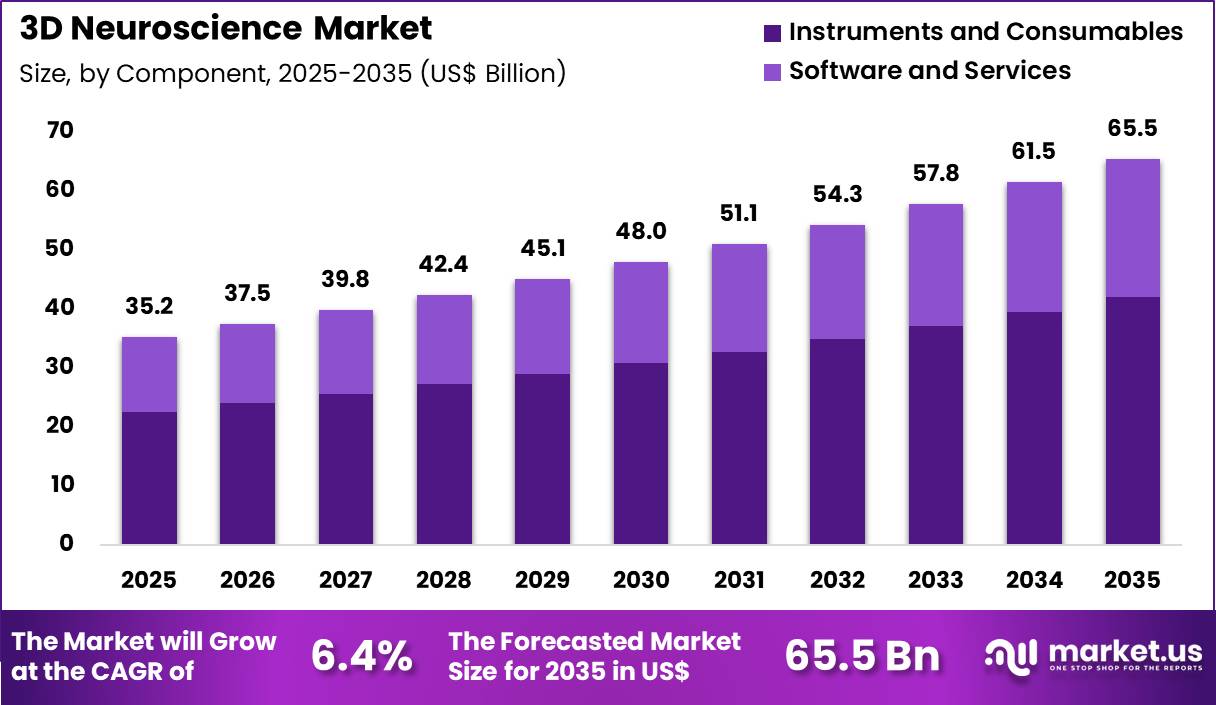
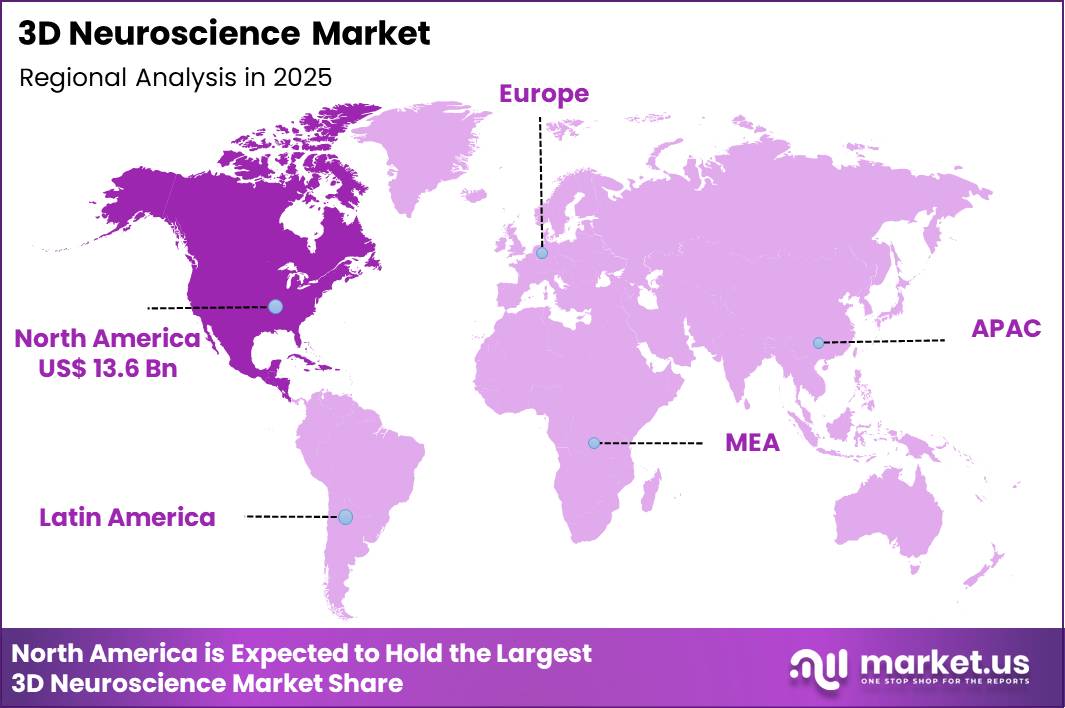
The Global 3D Neuroscience Market size is expected to be worth around US$ 65.5 Billion by 2035 from US$ 35.2 Billion in 2025, growing at a CAGR of 6.4% during the forecast period 2026-2035. In 2025, North America led the market, achieving over 38.5% share with a revenue of US$ 13.6 Billion.
Increasing demand for advanced tools that replicate complex neural architecture propels the 3D neuroscience market as researchers and clinicians require spatially accurate models to study brain function, disease mechanisms, and therapeutic interventions.
Neuroscientists increasingly employ 3D brain organoids derived from human pluripotent stem cells to model neurodevelopmental disorders, enabling detailed investigation of cortical layering and neuronal connectivity in conditions such as autism spectrum disorder and microcephaly.
These constructs support drug screening platforms where researchers test neuroprotective compounds on patient-specific organoids, identifying candidates that modulate aberrant signaling pathways in Alzheimer’s and Parkinson’s disease models. Pharmaceutical developers utilize 3D neural tissues in high-content screening assays to evaluate compound effects on synaptic plasticity and neurodegeneration, accelerating identification of disease-modifying therapies.
Clinicians apply 3D-printed brain phantoms for surgical planning and training, replicating patient-specific tumor locations and vascular anatomy to optimize resection strategies in glioma and epilepsy surgeries. In February 2025, Medtronic secured US FDA approval for BrainSense Adaptive, an advancement integrated into its Percept deep brain stimulation systems used in Parkinson’s therapy.
The technology automatically adjusts stimulation based on brain signal feedback, allowing more personalized neuromodulation and improved symptom management without manual recalibration. Manufacturers pursue opportunities to integrate biofabrication techniques with stem cell-derived neural tissues, expanding applications in spinal cord injury repair where 3D bioprinted scaffolds promote axonal regrowth and functional recovery.
Developers advance multi-cellular 3D models that incorporate microglia, astrocytes, and vascular components to mimic neuroinflammatory environments, broadening utility in multiple sclerosis and traumatic brain injury research.
These innovations facilitate high-throughput platforms for compound testing in neurodegenerative disease models, improving predictive accuracy for clinical translation. Opportunities emerge in hybrid systems combining 3D neural tissues with optogenetics and calcium imaging, enabling real-time functional studies of circuit dynamics.
Companies invest in scalable, reproducible organoid production methods that support large-scale drug discovery efforts. Recent trends emphasize patient-derived 3D models for precision neurology and AI-assisted analysis of complex tissue interactions, positioning the market for growth in transformative approaches to brain disease modeling, therapeutic validation, and neurosurgical innovation.
Key Takeaways
- In 2025, the market generated a revenue of US$ 35.2 Billion, with a CAGR of 6.4%, and is expected to reach US$ 65.5 Billion by the year 2035.
- The component segment is divided into instruments & consumables and software & services, with instruments and consumables taking the lead with a market share of 64.2%.
- Considering technology, the market is divided into brain imaging, neuro-microscopy, electrophysiology and neuroproteomic analysis. Among these, brain imaging held a significant share of 42.0%.
- Furthermore, concerning the application segment, the market is segregated into drug discovery and lead screening, neurotoxicity and safety assessment, disease modelling and others. The drug discovery and lead screening sector stands out as the dominant player, holding the largest revenue share of 47.6% in the market.
- The end-user segment is segregated into hospitals, diagnostic laboratories and research and academic institutes, with the diagnostic laboratories segment leading the market, holding a revenue share of 39.9%.
- North America led the market by securing a market share of 38.5%.
Component Analysis
Instruments and consumables accounted for 64.2% of growth within component and dominate the 3D neuroscience market due to the strong demand for advanced laboratory tools used in brain research and neurological studies. Neuroscience laboratories rely heavily on imaging systems, electrophysiology platforms, and specialized reagents to analyze complex neural structures in three-dimensional models.
Researchers increasingly use organoids and 3D neural cultures to understand neurological disorders such as Alzheimer’s disease and Parkinson’s disease. The World Health Organization reports that neurological conditions affect more than one billion people globally, which intensifies the need for advanced research tools.
The segment is expected to strengthen as pharmaceutical companies and academic institutions invest in laboratory equipment that supports high-resolution neural analysis. Continuous development of specialized reagents, culture systems, and imaging consumables further expands demand. Growing research funding for brain science initiatives is projected to sustain adoption across neuroscience laboratories worldwide.
Technology Analysis
Brain imaging accounted for 42.0% of growth within technology and dominate the market because imaging techniques remain essential for studying neural activity, brain connectivity, and disease progression in three-dimensional models. Technologies such as advanced microscopy, magnetic resonance imaging, and optical imaging enable researchers to visualize neural networks in unprecedented detail.
Global neuroscience programs continue to expand imaging capabilities to better understand brain disorders. According to the World Health Organization, neurological diseases represent a major global health burden and contribute significantly to disability worldwide.
The segment is anticipated to expand as imaging technologies integrate with artificial intelligence and advanced computational analysis. Researchers increasingly adopt 3D imaging tools to study neurodegenerative diseases, developmental disorders, and traumatic brain injury. Continuous improvements in spatial resolution and imaging speed are projected to accelerate adoption across research laboratories and clinical neuroscience programs.
Application Analysis
Drug discovery and lead screening accounted for 47.6% of growth within application and dominate the 3D neuroscience market because pharmaceutical developers require advanced brain models to evaluate potential neurological therapies. Traditional two-dimensional cell cultures fail to replicate the complex architecture of neural tissues, which drives the adoption of three-dimensional neuroscience platforms.
Pharmaceutical companies increasingly rely on organoid models and neural tissue cultures to screen compounds targeting neurological diseases. The global burden of neurological disorders continues to increase, with Alzheimer’s disease and related dementias affecting millions of patients worldwide.
This growing disease burden encourages companies to invest heavily in neuroscience research and early-stage drug screening technologies. The segment is expected to grow as biotechnology firms adopt 3D neural systems that improve predictive accuracy during preclinical testing. Expanding collaboration between academic neuroscience laboratories and pharmaceutical developers further strengthens demand for advanced screening platforms.
End-User Analysis
Diagnostic laboratories accounted for 39.9% of growth within end users and dominate the 3D neuroscience market because these facilities increasingly perform advanced neurological testing and biomarker analysis. Diagnostic centers adopt sophisticated imaging platforms, molecular testing systems, and neural tissue models to support neurological disease diagnosis and research.
Rising incidence of conditions such as Alzheimer’s disease, Parkinson’s disease, and epilepsy drives demand for improved diagnostic technologies. Healthcare providers increasingly rely on specialized laboratories to conduct complex neurological investigations that support accurate diagnosis and treatment planning.
The segment is projected to expand as diagnostic laboratories integrate advanced neuroscience technologies into clinical testing workflows. Growing investments in neurological biomarker discovery and molecular diagnostics further strengthen the role of these facilities. Expansion of neurodiagnostic services across hospitals and private laboratories is anticipated to sustain strong growth in this segment.

Key Market Segments
By Component
- Instruments & Consumables
- Software & Services
By Technology
- Brain Imaging
- Neuro-Microscopy
- Electrophysiology
- Neuroproteomic Analysis
By Application
- Drug Discovery & Lead Screening
- Neurotoxicity & Safety Assessment
- Disease Modelling
- Others
By End-User
- Hospitals
- Diagnostic Laboratories
- Research & Academic Institutes
Drivers
Escalating NIH BRAIN Initiative funding is driving the market.
The NIH BRAIN Initiative allocated $620 million in fiscal year 2022 to advance neuroscience technologies, including 3D mapping and imaging tools. This funding supported diverse projects aimed at developing high-resolution 3D models of neural circuits. The appropriation increased to $680 million in fiscal year 2023, enabling expanded investments in computational and systems neuroscience.
Such resources facilitated the integration of 3D visualization platforms into research workflows. Institutions leveraged these funds to acquire advanced imaging hardware for volumetric brain reconstruction. The growth in appropriations underscored federal commitment to accelerating 3D neuroscience innovations.
Collaborators across academia and industry benefited from grant-supported prototypes for neural tissue analysis. The initiative’s emphasis on scalable 3D datasets promoted interoperability among research tools. Enhanced funding streams encouraged interdisciplinary teams to tackle complex brain connectivity challenges. This trajectory solidified the foundation for sustained progress in 3D neuroscience applications.
Restraints
Significant reduction in BRAIN Initiative allocations for fiscal year 2024 is restraining the market.
The NIH BRAIN Initiative experienced a substantial budget cut to $402 million in fiscal year 2024, down $278 million from the $680 million in fiscal year 2023. This decline stemmed from the expiration of supplemental appropriations under the 21st Century Cures Act.
Researchers faced constraints in pursuing long-term 3D imaging projects due to diminished grant availability. Institutions postponed upgrades to 3D reconstruction software and hardware amid fiscal uncertainties. The reduction moderated collaborative efforts in developing comprehensive neural atlases.
Supply chains for specialized 3D neuroscience equipment encountered slower procurement cycles. Academic labs prioritized core operations over exploratory 3D modeling initiatives. The funding shortfall highlighted dependencies on stable federal support for high-cost technologies. Stakeholders expressed concerns over delayed milestones in volumetric data analysis. This restraint tempered overall innovation velocity in the sector during the transitional period.
Opportunities
New NIH funding opportunities for engineering next-generation nervous system models is creating growth opportunities.
The National Institutes of Health issued PAR-25-198 on November 6, 2024, to support engineering of advanced human nervous system models, including 3D constructs. This program announcement encourages proposals integrating data from the BRAIN Initiative and PsychENCODE for realistic 3D simulations. Opportunities arise for scalable platforms that recapitulate neural dynamics in disease contexts.
Researchers can access tools for 3D bioprinting of brain organoids with vascular integration. The initiative fosters partnerships between bioengineers and neuroscientists to refine tissue-mimicking scaffolds. Enhanced models enable precise testing of therapeutic interventions on 3D neural networks.
Funding prioritizes open-source datasets to accelerate community-wide adoption. Such efforts position 3D neuroscience for breakthroughs in personalized medicine applications. Collaborators gain avenues to validate computational predictions against physical 3D prototypes. This framework promotes diversification and long-term resilience in neural technology development.
Impact of Macroeconomic / Geopolitical Factors
Macroeconomic conditions shape the 3D neuroscience market through research grants, pharmaceutical R&D budgets, and capital spending by advanced laboratories. Inflation increases expenses for 3D cell culture materials, imaging systems, and laboratory instrumentation, which raises operational costs for research centers.
Higher interest rates limit venture funding for neuroscience startups and slow investment in emerging brain research platforms. Geopolitical tensions affect international collaboration and disrupt the supply of specialized biomaterials, chips, and high-precision equipment used in neural modeling.
Current US tariffs on imported laboratory hardware and advanced computing components increase acquisition costs for institutions working on complex brain studies. These pressures can delay equipment upgrades and restrict experimentation budgets in smaller research programs.
At the same time, organizations expand domestic research partnerships and strengthen local supply channels to improve stability. Growing interest in neurological disease research and advanced brain modeling technologies continues to support steady long-term market growth.
Latest Trends
Creation of the first precise 3D map of a mammalian brain is driving the market.
Scientists unveiled the inaugural high-resolution 3D reconstruction of a mouse brain on April 15, 2025, encompassing 84,000 neurons and over 500 million synapses. This achievement employed advanced electron microscopy and AI-driven segmentation techniques. The map provides unprecedented insights into synaptic connectivity across cortical layers.
Researchers utilized serial sectioning to capture volumetric data at nanoscale precision. The development aligns with goals of the NIH BRAIN Initiative for comprehensive neural wiring diagrams. Institutions now integrate this atlas into training datasets for machine learning models.
The 2025 milestone facilitates comparative studies between species for human brain extrapolation. Clinicians anticipate applications in modeling neurodegenerative pathways. Collaborative platforms disseminate the dataset for global validation and extension. Overall, this advancement catalyzes a new era of data-driven 3D neuroscience exploration.
Regional Analysis
North America is leading the 3D Neuroscience Market
North America accounted for 38.5% of the 3D neuroscience market in 2025 as research institutions and biotechnology firms expanded advanced brain research platforms that replicate complex neural environments. Universities and medical research centers increasingly adopted three dimensional neural culture systems and brain organoid models to study neurodegenerative diseases and neurological disorders.
The National Institutes of Health reported that it invested more than USD 3.8 billion in neuroscience research through the BRAIN Initiative between 2014 and 2023, supporting development of innovative technologies for understanding brain structure and function.
Pharmaceutical companies across the United States and Canada are also integrating advanced neural tissue models into drug discovery pipelines to improve the accuracy of neurological disease testing. Growing prevalence of neurological disorders such as Alzheimer’s disease and Parkinson’s disease has increased demand for advanced research tools capable of replicating real brain tissue environments.
Academic laboratories are strengthening collaborations with biotechnology startups to develop improved neural organoid platforms and microfluidic brain models. Government grants and venture capital funding are accelerating innovation in neurotechnology and regenerative brain research. These factors collectively supported strong expansion of advanced neural modeling technologies across North America in 2025.
The Asia Pacific region is expected to experience the highest CAGR during the forecast period
Asia Pacific is expected to experience significant growth during the forecast period as governments and research institutions expand investments in neuroscience innovation and biomedical technology. Countries such as China, Japan, South Korea, and Singapore are strengthening national research programs focused on neurological disease and brain science.
China’s Ministry of Science and Technology launched the China Brain Project with funding estimated at about USD 1 billion to support large scale neuroscience research and brain simulation technologies. Universities and biotechnology companies across the region are increasing research activity in neural tissue engineering, brain organoids, and advanced cell culture technologies.
Pharmaceutical firms are also adopting advanced neural models to improve drug discovery for neurodegenerative and psychiatric disorders. Expanding biotechnology clusters and innovation parks are supporting collaboration between academic researchers and private life science companies.
Governments are encouraging research commercialization and startup development in neurotechnology sectors. Rising awareness of neurological disorders and aging populations are also increasing demand for improved research tools that support disease understanding. These developments are expected to accelerate adoption of advanced neural research platforms throughout Asia Pacific in the coming years.
Key Regions and Countries
North America
- US
- Canada
Europe
- Germany
- France
- The UK
- Spain
- Italy
- Russia
- Netherland
- Rest of Europe
Asia Pacific
- China
- Japan
- South Korea
- India
- Australia
- New Zealand
- Singapore
- Thailand
- Vietnam
- Rest of APAC
Latin America
- Brazil
- Mexico
- Rest of Latin America
Middle East & Africa
- South Africa
- Saudi Arabia
- UAE
- Rest of MEA
Key Players Analysis
Key participants in the 3D Neuroscience market expand their capabilities by developing advanced neural organoid platforms, high-content imaging systems, and scalable 3D cell culture technologies that enable more accurate modeling of brain biology.
Companies strengthen growth through partnerships with pharmaceutical developers and academic research institutes to accelerate drug discovery for neurological disorders such as Alzheimer’s and Parkinson’s disease.
They also invest in stem-cell-derived neuronal models and organ-on-chip technologies that replicate complex neural networks and improve preclinical testing outcomes. Three-dimensional neural culture platforms allow cells to interact in a structure that closely mimics the human brain environment, which improves disease modeling and therapeutic research.
Axol Bioscience represents a notable participant in the 3D Neuroscience market and operates as a biotechnology company that develops induced pluripotent stem cell-derived neuronal models used for neuroscience research and drug discovery. The company supplies disease-specific neural cell lines and laboratory tools that help researchers investigate neurological conditions including Alzheimer’s, Parkinson’s, and ALS.
Industry competitors including Thermo Fisher Scientific, Corning, and Stemcell Technologies expand their offerings through advanced culture media, reagents, and research platforms designed for complex neural modeling. These initiatives strengthen innovation pipelines and support broader adoption of three-dimensional neuroscience technologies across pharmaceutical and academic research environments.
Top Key Players
- Siemens Healthineers AG
- GE HealthCare
- Thermo Fisher Scientific Inc.
- Merck KGaA
- Corning Incorporated
- Doric Lenses Inc.
- Mightex Systems
- Neuronnexus Technologies Inc.
- Axion BioSystems Inc.
- STEMCELL Technologies Inc.
Recent Developments
- In May 2025, Sanofi completed the acquisition of Vigil Neuroscience to strengthen its portfolio in neurological therapeutics. The transaction brings VG-3927, an oral TREM2 agonist under development for Alzheimer’s disease, into Sanofi’s pipeline. The program focuses on enhancing the protective activity of microglial cells in the brain, supporting new approaches to address neurodegenerative conditions.
- In June 2025, Royal Philips obtained CE Mark certification for its SmartCT image reconstruction technology, developed to support clinical decision-making in stroke and other neurovascular interventions. The system works with the Philips Azurion neuro biplane platform to generate real-time three-dimensional imaging, helping clinicians improve procedural efficiency and treatment planning.
Report Scope
Report Features Description Market Value (2025) US$ 35.2 Billion Forecast Revenue (2035) US$ 65.5 Billion CAGR (2026-2035) 6.4% Base Year for Estimation 2025 Historic Period 2020-2024 Forecast Period 2026-2035 Report Coverage Revenue Forecast, Market Dynamics, COVID-19 Impact, Competitive Landscape, Recent Developments Segments Covered By Component (Instruments & Consumables and Software & Services), By Technology (Brain Imaging, Neuro-Microscopy, Electrophysiology and Neuroproteomic Analysis), By Application (Drug Discovery and Lead Screening, Neurotoxicity and Safety Assessment, Disease Modelling and Others), By End-User (Hospitals, Diagnostic Laboratories and Research and Academic Institutes) Regional Analysis North America – US, Canada; Europe – Germany, France, The UK, Spain, Italy, Russia, Netherlands, Rest of Europe; Asia Pacific – China, Japan, South Korea, India, Australia, New Zealand, Singapore, Thailand, Vietnam, Rest of APAC; Latin America – Brazil, Mexico, Rest of Latin America; Middle East & Africa – South Africa, Saudi Arabia, UAE, Rest of MEA Competitive Landscape Siemens Healthineers AG, GE HealthCare, Thermo Fisher Scientific Inc., Merck KGaA, Corning Incorporated, Doric Lenses Inc., Mightex Systems, Neuronnexus Technologies Inc., Axion BioSystems Inc., STEMCELL Technologies Inc. Customization Scope Customization for segments, region/country-level will be provided. Moreover, additional customization can be done based on the requirements. Purchase Options We have three licenses to opt for: Single User License, Multi-User License (Up to 5 Users), Corporate Use License (Unlimited User and Printable PDF) 
-
-
- Siemens Healthineers AG
- GE HealthCare
- Thermo Fisher Scientific Inc.
- Merck KGaA
- Corning Incorporated
- Doric Lenses Inc.
- Mightex Systems
- Neuronnexus Technologies Inc.
- Axion BioSystems Inc.
- STEMCELL Technologies Inc.
Our Clients

- 180788
- March 2026






