


Market Overview
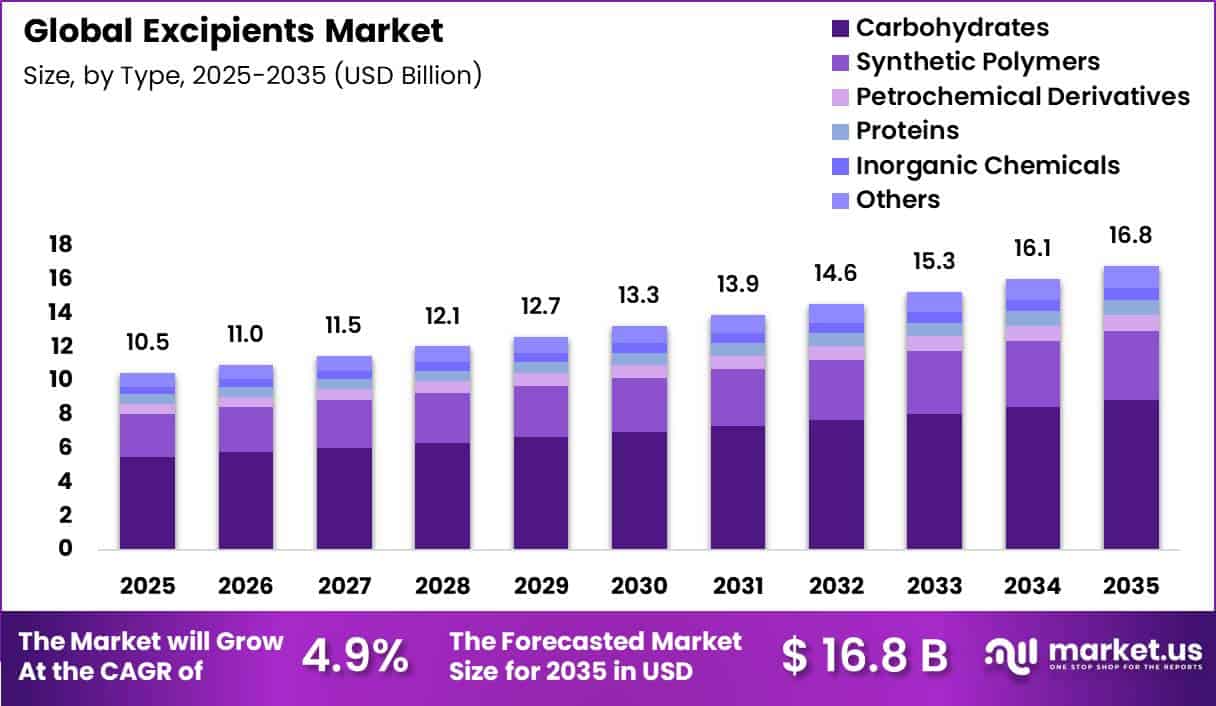
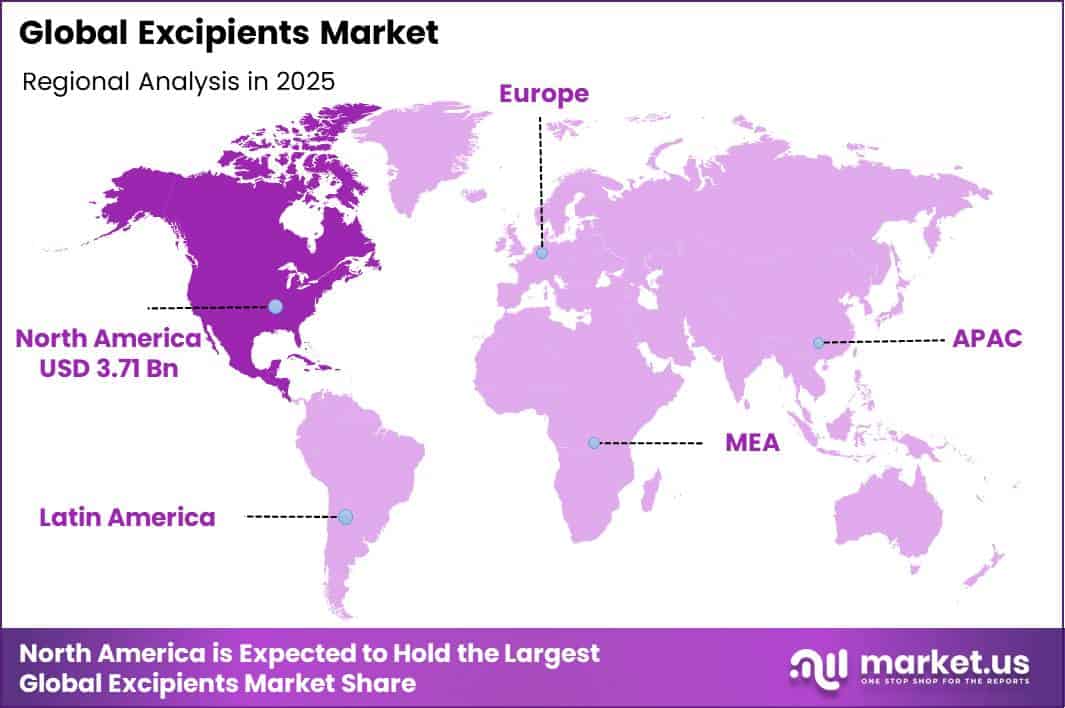
The Global Excipients Market size is expected to be worth around US$ 16.8 Billion by 2035 from US$ 10.5 Billion in 2025, growing at a CAGR of 4.9% during the forecast period from 2026 to 2035. In 2025, North America led the market, achieving over 35.4% share with a revenue of US$ 3.71 Billion.
Excipients are inactive substances used in pharmaceutical formulations to improve the stability, safety, effectiveness, taste, appearance, and delivery of medicines. They play an essential role in tablets, capsules, injectables, biologics, vaccines, and topical formulations by acting as binders, fillers, coatings, preservatives, disintegrants, and stabilisers.
As pharmaceutical innovation expands globally, the demand for high-quality excipients continues to rise alongside increasing drug production and stricter regulatory standards. The growing burden of chronic diseases is a major factor supporting excipient demand.
According to the World Health Organisation (WHO), noncommunicable diseases account for approximately 43 million deaths annually, representing about 74% of all global deaths, driving continuous demand for pharmaceutical products.
In addition, the U.S. Food and Drug Administration (FDA) maintains its Inactive Ingredients Database (IID), which is updated quarterly and contains information on excipients used in approved drug products, helping manufacturers develop safe and effective formulations.
Technological advancements are also transforming the excipients market. Functional excipients designed for controlled-release formulations, orally disintegrating tablets, pediatric medicines, and biologics are gaining wider adoption.
Pharmaceutical manufacturers are increasingly investing in multifunctional excipients that simplify production while improving product performance and patient compliance. Regulatory agencies continue to emphasise excipient quality, traceability, and manufacturing standards to ensure medicine safety.
With expanding pharmaceutical manufacturing, increasing generic drug approvals, and continued innovation in drug delivery systems, the global excipients market is expected to witness steady long-term growth, supported by healthcare investments and rising demand for advanced pharmaceutical formulations worldwide.
Key Takeaways
- Market Size: The Global Excipients Market size was US$ 10.5 billion in 2025. The market is estimated to grow to US$ 16.8 billion by 2035.
- Market Share: The Compound Annual Growth Rate (CAGR) of the market from 2026 to 2035 will be 4.9%.
- Type: Carbohydrates have the largest market share, accounting for 52.8% of the total type segment revenue.
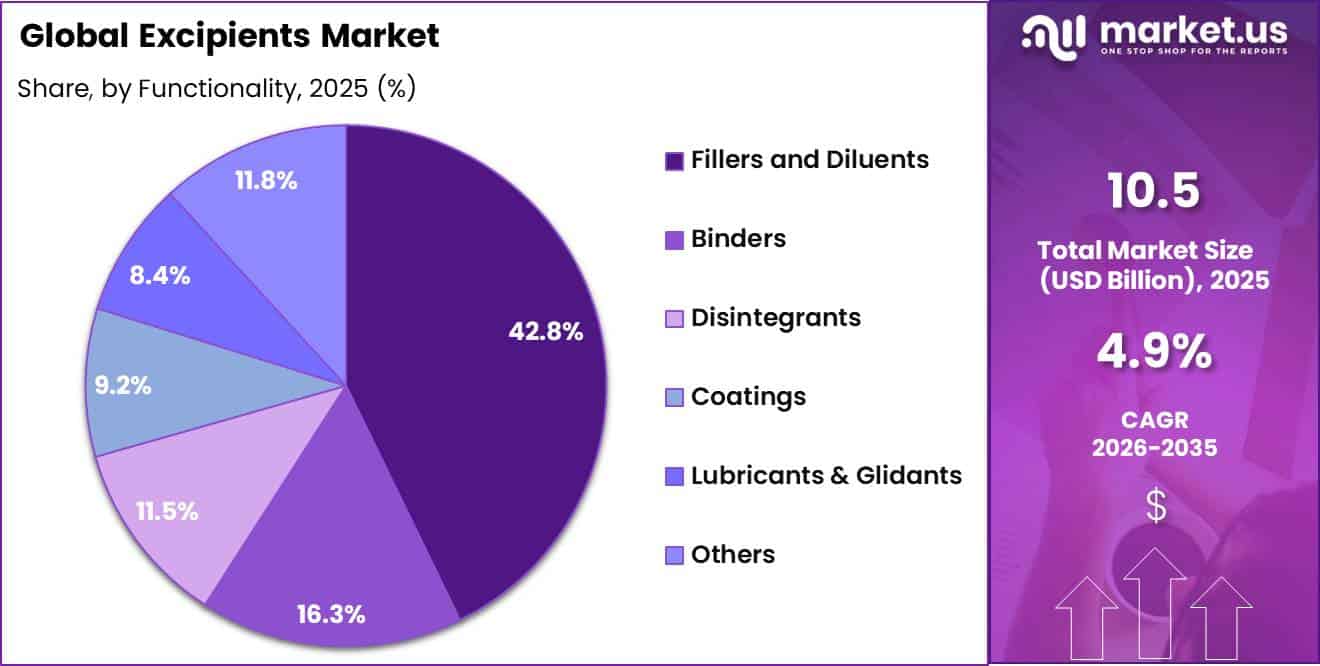
- Functionality: Fillers and Diluents lead the segment, accounting for 42.8% of total functionality segment revenue.
- Formulation Type: Oral Formulations lead the segment, accounting for 74.5% of total formulation type revenue.
- Regional: North America is the dominant regional market, accounting for 35.4% of global revenue, holding US$ 3.71 billion in revenue in 2025.
Type Analysis
The Carbohydrates segment dominated the global Excipients Market in 2025, accounting for 52.8% of the total market share. Carbohydrate-based excipients, including lactose, starch, cellulose derivatives, and sucrose, remain the preferred choice for pharmaceutical manufacturers due to their excellent compressibility, stability, affordability, and compatibility with a wide range of active pharmaceutical ingredients (APIs).
These excipients are extensively used in tablets, capsules, powders, and oral liquid formulations, making them indispensable in both branded and generic drug production. Their established regulatory acceptance and broad availability further strengthen their market leadership.
The Synthetic Polymers segment captured 24.3% of the market, supported by increasing demand for controlled-release formulations, advanced drug delivery systems, and high-performance pharmaceutical products.
Petrochemical Derivatives represented 5.8%, finding applications in specialised formulations requiring enhanced stability and solubility. Proteins accounted for 5.2%, driven by growing biologics and vaccine manufacturing, where protein-based stabilisers and carriers play a crucial role.
Inorganic Chemicals held 4.2%, primarily used as buffering agents, preservatives, and mineral-based excipients. The Others category, including Oleochemicals and Excipient Blends, contributed 7.7%, reflecting rising interest in multifunctional excipients that improve manufacturing efficiency, formulation performance, and product quality while supporting innovative pharmaceutical development.
Functionality Analysis
The Fillers and Diluents segment led the Excipients Market in 2025, accounting for 42.8% of the global market share. These excipients are widely used to increase tablet and capsule bulk, improve dosage accuracy, and enhance manufacturing consistency.
Common materials such as lactose, microcrystalline cellulose, and calcium phosphate provide excellent flowability and compressibility, making them essential for high-volume pharmaceutical production. Their broad application across generic and branded medicines continues to support their dominant market position.
The Binders segment held 16.3% of the market, driven by its role in improving tablet cohesion and mechanical strength during manufacturing. Disintegrants accounted for 11.5%, supported by increasing demand for fast-dissolving tablets and formulations that improve drug absorption and patient convenience.
Coatings represented 9.2%, as pharmaceutical companies increasingly adopt protective and functional coatings to improve stability, appearance, taste masking, and controlled drug release.
Lubricants & Glidants captured 8.4%, helping optimise powder flow and reduce friction during tablet compression and capsule filling processes. The Others segment, with 11.8%, includes preservatives, sweeteners, flavouring agents, colourants, and stabilisers that enhance product quality, shelf life, and patient acceptance across a broad range of pharmaceutical formulations.
Formulation Type Analysis
The Oral Formulations segment dominated the global Excipients Market in 2025, capturing 74.5% of the total market share. Oral dosage forms, including tablets, capsules, powders, and syrups, remain the most widely prescribed and patient-preferred method of drug administration due to their convenience, cost-effectiveness, ease of manufacturing, and high patient compliance.
The extensive production of generic medicines, over-the-counter drugs, and chronic disease therapies continues to drive strong demand for excipients specifically designed for oral pharmaceutical formulations.
The Topical Formulations segment maintained a significant market presence, supported by increasing use of creams, gels, ointments, and transdermal products for dermatology, pain management, and cosmetic applications. Excipients in topical formulations help improve texture, stability, drug penetration, and product consistency.
The Parenteral Formulations segment also contributed notably to the market, driven by expanding biologics, vaccines, injectable therapies, and hospital-based treatments that require highly purified and sterile excipients.
The Other Formulations category, including inhalation, ophthalmic, nasal, and rectal dosage forms, continues to gain importance with advances in targeted drug delivery technologies and specialised therapeutic applications, creating additional opportunities for innovative excipient development across the pharmaceutical industry.
Key Market Segments
By Type
- Carbohydrates
- Synthetic Polymers
- Petrochemical Derivatives
- Proteins
- Inorganic Chemicals
- Others (Oleochemicals, Excipient Blends)
By Functionality
- Fillers and Diluents
- Binders
- Disintegrants
- Coatings
- Lubricants & Glidants
- Others
By Formulation Type
- Oral Formulations
- Topical Formulations
- Parenteral Formulations
- Other Formulations
Drivers
Essential Medicines Access and Chronic Disease Volume Expansion
The WHO 2025 Essential Medicines List now includes over 520 medicines, covering areas such as oncology, diabetes, cystic fibrosis, tobacco cessation, and pediatric care. Since more than 150 countries base national formularies on the WHO model list, each expansion directly influences procurement, reimbursement, and manufacturing priorities.
This not only increases API demand but also significantly broadens excipient usage, as higher volumes of tablets, capsules, injectables, and pediatric formulations require binders, coatings, stabilisers, and preservatives.
In chronic diseases like diabetes and cancer, expanded treatment lines increase dosage form complexity, widening excipient diversity rather than just scaling volume. The strongest effect is seen in public procurement-driven markets across Asia, Africa, Latin America, and the Middle East, where cost constraints exist but quality requirements are strict.
WHO aligned procurement and tender systems to gradually translate list changes into manufacturing scale-up. Overall, this supports about a +1.4 % point CAGR uplift over the medium term through broader essential medicine access and higher chronic care volumes.
| Driver | (~) % Impact on CAGR Forecast | Geographic Relevance | Impact Timeline |
|---|---|---|---|
| Biologics stabilisation demand in buffers, surfactants, and lyoprotectants | +1.9% | North America core, EU, Japan, South Korea, China biologics hubs | Medium term (2-4 years) |
| Generic complexity and formulation equivalence need | +1.5% | North America core, EU, India, China, LATAM spill-over | Short term (≤ 2 years) |
| Essential medicines access and chronic-disease volume expansion | +1.4% | APAC, Africa, South America, Middle East, public procurement markets | Medium term (2-4 years) |
| Resilient supply chains and quality-management upgrading | +1.2% | US, EU, India, China, global export corridors | Short term (≤ 2 years) |
| Co-processed excipients for direct compression and ODT efficiency | +1.0% | India, China, EU, North America, ASEAN manufacturing bases | Medium term (2-4 years) |
| Pediatric and sensitive-population reformulation toward safer excipient systems | +0.8% | US, EU, Japan, pediatric speciality markets globally | Long-term (≥ 4 years) |
Challenge
Multi-Site Quality Variance in Excipient Supply Chains
Excipient markets face ongoing quality normalisation challenges due to globally distributed production across multiple plants, tolling sites, and repackaging networks. Finished dose manufacturers must maintain strict consistency in particle size, moisture content, microbial limits, impurities, and functional performance, but variability across sites often disrupts this uniformity.
WHO GMP frameworks emphasise prevention of contamination, mix-ups, and labelling errors, while FDA continues to cite manufacturing quality issues as a leading cause of drug shortages, reinforcing how sensitive the system is to even small deviations.
As a result, minor batch-to-batch variability can trigger requalification, additional testing, or supplier delisting rather than full replacement. This creates operational friction, extending supplier approval cycles to 6 to 12 months, increasing audit frequency by 2 to 4 additional checks for critical grades, and forcing 15 to 30 days of higher safety stock.
Collectively, this quality variability acts as a structural drag of roughly 1.2 % points on category CAGR. Mitigation requires harmonised specifications, tighter change control, and stronger process capability across sites.
| Challenge | (~) % CAGR Friction Drag | Geographic Relevance | Mitigation Horizon |
|---|---|---|---|
| Multi-site quality variance | -1.2% | North America core, EU regulatory hubs, India-China supply base | Medium term (2-4 years) |
| Sterile-grade capacity bottlenecks | -1.0% | U.S. injectables market, EU hospital supply chains, Japan | Long-term (≥ 4 years) |
| Raw material traceability gaps | -0.8% | APAC logistics corridors, EU import channels, North America | Medium term (2-4 years) |
| Novel excipient validation lag | -0.9% | U.S. formulation pipeline, EU innovation clusters, Japan | Long-term (≥ 4 years) |
| Audit and documentation overload | -0.7% | EU GMP markets, U.S. compliance-heavy segments, global exporters | Short term (≤ 2 years) |
| Demand-shock inventory mismatch | -1.1% | U.S. hospital channels, EU essential medicines, LATAM import markets | Medium term (2-4 years) |
Restraints
High-Risk Excipient and Impurity Control Costs
The formalisation of high-risk excipient frameworks under WHO guidance and related regulatory norms is increasing analytical rigour and quality control intensity across materials such as polysorbates, PEGs, complex polymers, and multifunctional speciality excipients.
These changes are driven by heightened focus on impurity control, contamination prevention, and patient safety, particularly in sterile, injectable, pediatric, and biologic drug applications where excipient performance directly affects stability and immunogenic risk.
Manufacturers are now required to implement stricter impurity specifications aligned with or exceeding pharmacopoeial standards, expand analytical testing panels including residual solvents and nitrosamine surveillance, and maintain full batch traceability with validated certificates of analysis.
Repackers must also operate under full GMP compliance with documented controls and change management systems. As a result, routine testing intensity increases by about 1.5 to 2 times versus pre 2023 norms.
Operationally, chromatographic and validation runs per batch rise by 30 to 50 %, lab utilisation shifts toward 90 % plus capacity, and per batch testing costs increase by 15 to 25 %. Additional investments of 0.5 to 1.0 % of revenue are required for instrumentation, data integrity systems, and LIMS upgrades.
Batch release timelines extend by 3 to 7 days, while rejection rates rise by 2 to 4 % points in high-risk applications. Overall, the cost of goods increases by 8 to 12 %, compressing margins and creating an estimated 1.2 % point drag on CAGR while limiting the scalability of smaller suppliers.
| Restraint | (~) % Impact on CAGR Forecast | Geographic Relevance | Impact Timeline |
|---|---|---|---|
| Stricter excipient safety & GMP enforcement | -1.8% | North America, EU, India core | Medium term (2–4 years) |
| High-risk excipient & impurity control costs | -1.2% | EU, North America, APAC hubs | Medium term (2–4 years) |
| Trade tariffs & logistics cost inflation | -1.0% | North America core, APAC export, EU import | Short–Medium term (≤ 4 years) |
| Regulatory data & labelling transparency burden | -0.8% | India, EU, North America | Medium–Long term (≥ 3 years) |
| Supply-chain concentration in limited geographies | -0.9% | APAC corridors, global pharma clusters | Short–Medium term (≤ 4 years) |
| Slow qualification of novel / pediatric excipients | -0.7% | North America, EU, global innovators | Long-term (≥ 4 years) |
Opportunity
Pediatric and Geriatric Safety Optimised Excipients
Despite increasing regulatory attention to vulnerable populations, most excipient portfolios remain optimised for standard adult use, leaving clear gaps in paediatric and geriatric-specific formulation design. Children require tighter control over preservatives, sweeteners, solvents, and colourants, while elderly patients face heightened sensitivity to excipient-driven effects on absorption, metabolism, and tolerability due to comorbidities and polypharmacy.
Regulators such as the FDA and EMA are increasingly scrutinising excipient safety in these groups, especially for long-term therapies in diabetes, cardiovascular disease, and neurodegenerative conditions. This is driving demand for excipients specifically engineered for low toxicity, improved palatability, and predictable pharmacokinetics, including safer solubilisers, taste masking agents, and fillers validated for age-specific use.
Commercially, these specialised excipients can command 15 to 25 % price premiums over commodity equivalents and reduce regulatory friction for drug sponsors. If adoption reaches 15 to 20 % of relevant formulations by 2035, the segment could generate a multi-billion-dollar incremental total addressable market and add about 2 % points of CAGR in regions with strong pediatric and geriatric regulatory focus.
| Opportunity | (~) % Potential CAGR Upside | Geographic Relevance | Execution Window |
|---|---|---|---|
| Biologics-tailored excipient platforms | +3.0% | North America, EU, APAC developed | Medium term (2–4 years) |
| Pediatric and geriatric safety-optimised excipients | +2.2% | North America, EU, Asia urban | Medium term (2–4 years) |
| High-potency & continuous manufacturing excipient kits | +2.8% | North America core, EU, APAC emerging | Short term (≤ 2 years) |
| Digital formulation & regulatory data services | +1.8% | Global top-50 pharma hubs | Short term (≤ 2 years) |
| Novel solubility & bioavailability enhancers for oral and long-acting injectables | +2.5% | North America, EU, LatAm, APAC | Long-term (≥ 4 years) |
| Low-carbon and biobased excipient portfolios | +1.5% | EU, North America, APAC multinationals | Long-term (≥ 4 years) |
Regional Analysis
In 2025, North America led the market, achieving over 35.4% share with a revenue of US$ 3.71 billion. The region’s leadership is supported by its well-established pharmaceutical manufacturing industry, advanced drug development capabilities, and strict regulatory framework governing pharmaceutical ingredients.
The United States remains the largest contributor due to the presence of leading pharmaceutical companies, increasing production of generic medicines, biologics, and speciality drugs, and continuous investment in innovative drug delivery technologies.
Strong regulatory oversight from the U.S. Food and Drug Administration (FDA) has also encouraged the adoption of high-quality, multifunctional excipients that meet stringent safety and performance standards.
Europe represents the second-largest regional market, driven by a mature pharmaceutical sector, expanding biologics production, and increasing demand for high-performance excipients in innovative therapies. Countries such as Germany, France, Switzerland, and Ireland continue to invest in pharmaceutical manufacturing and research activities.
The Asia-Pacific region is expected to register the fastest growth during the forecast period. Rapid expansion of pharmaceutical manufacturing, increasing exports of generic drugs, growing healthcare expenditure, and supportive government initiatives in countries including China, India, Japan, and South Korea are accelerating demand for pharmaceutical excipients.
Meanwhile, Latin America and the Middle East & Africa are experiencing steady market growth due to improving healthcare infrastructure, rising local pharmaceutical production, expanding access to essential medicines, and increasing investments in healthcare manufacturing capabilities. These developments are expected to strengthen regional demand for high-quality excipients over the coming years.
Key Regions and Countries
North America
- The US
- Canada
Europe
- Germany
- France
- The U.K.
- Italy
- Spain
- Russia & CIS
- Rest of Europe
Asia Pacific
- China
- India
- Japan
- South Korea
- ASEAN
- Australia & New Zealand
- Rest of Asia Pacific
Middle East & Africa
- GCC
- South Africa
- Rest of the Middle East & Africa
Latin America
- Brazil
- Mexico
- Rest of Latin America
Key Player Analysis
Suppliers in the global excipients market seek competitive advantage through multifunctional excipient platform development, enabling single excipient ingredients to deliver combined filler, binder, and disintegrant functionality within tablet and capsule formulations.
Alongside novel excipient innovation supporting advanced drug delivery system development, including controlled-release matrices, lipid nanoparticle delivery systems for mRNA and gene therapy applications, and orally disintegrating tablet formulations addressing patient swallowing compliance challenges.
Key strategic focus areas include pharmaceutical-grade carbohydrate excipient portfolio expansion covering lactose, microcrystalline cellulose, and starch-derived alternatives, synthetic polymer development for controlled-release coating and matrix applications, and regulatory Drug Master File filing across FDA, EMA, and Asian regulatory authority jurisdictions, enabling pharmaceutical manufacturers’ qualification of excipient supply sources within their drug product regulatory submissions.
Companies continue investing in cGMP manufacturing compliance infrastructure, pharmacopoeial grade certification across USP, EP, and JP monograph standards, and pharmaceutical customer technical service capability supporting excipient selection, compatibility testing, and formulation development programs.
The rapid expansion of biologic drug formulation, including monoclonal antibodies, mRNA vaccines, and cell and gene therapy applications requiring specialised excipient systems, including trehalose cryoprotectants, lipid excipients, and novel stabilisation agents, is creating structurally new high-value excipient demand streams beyond conventional small-molecule oral solid dosage form applications through the forecast period to 2035.
Top Key Players
- Evonik Industries AG
- Dow Inc.
- International Flavours & Fragrances Inc. (IFF)
- BASF SE
- Roquette Frères
- Ashland Global Holdings Inc.
- Associated British Foods plc (ABF)
- Kerry Group plc
- Croda International Plc
- Archer-Daniels-Midland Company (ADM)
- Merck KGaA
- Signet Excipients Pvt. Ltd.
- Colorcon Inc.
- DFE Pharma GmbH & Co. KG
- JRS Pharma GmbH & Co. KG
- Other Key Players
Recent Developments
- In February 2026, Roquette Frères expanded its pharmaceutical-grade microcrystalline cellulose and co-processed excipient production capacity at its European manufacturing facilities, targeting growing institutional procurement demand from oral solid dosage form pharmaceutical manufacturers across global distribution networks.
- In March 2026, BASF SE secured a multi-year excipient supply agreement with a leading North American generic pharmaceutical manufacturer covering Kollidon and Kollicoat polymer excipient procurement for controlled-release tablet and film coating formulation programs across its institutional manufacturing network.
- In May 2026, Colorcon Inc. launched its next-generation aqueous film coating system for modified-release oral tablet applications, securing formulation qualification approvals from multiple European and Asian pharmaceutical manufacturer institutional buyers targeting improved coating process efficiency and film performance consistency.
Report Scope
| Report Features | Description |
|---|---|
| Market Value (2025) | US$ 10.5 Billion |
| Forecast Revenue (2035) | US$ 16.8 Billion |
| CAGR (2026-2035) | 4.9% |
| Base Year for Estimation | 2025 |
| Historic Period | 2020-2024 |
| Forecast Period | 2026-2035 |
| Report Coverage | Revenue Forecast, Market Dynamics, Competitive Landscape, Recent Developments |
| Segments Covered | By Type (Carbohydrates, Synthetic Polymers, Petrochemical Derivatives, Proteins, Inorganic Chemicals, Others ), By Functionality (Fillers and Diluents, Binders, Disintegrants, Coatings, Lubricants & Glidants, Others), By Formulation Type (Oral Formulations, Topical Formulations, Parenteral Formulations, Other Formulations) |
| Regional Analysis | North America – The US, Canada; Europe – Germany, France, U.K., Italy, Spain, Russia & CIS, Rest of Europe; Asia Pacific – China, India, Japan, South Korea, ASEAN, Australia & New Zealand, Rest of Asia Pacific; Middle East & Africa – GCC, South Africa, Rest of Middle East & Africa; Latin America – Brazil, Mexico, Rest of Latin America |
| Competitive Landscape | Evonik Industries AG, Dow Inc., International Flavors & Fragrances Inc. (IFF), BASF SE, Roquette Frères, Ashland Global Holdings Inc., Associated British Foods plc (ABF), Kerry Group plc, Croda International Plc, Archer-Daniels-Midland Company (ADM), Merck KGaA, Signet Excipients Pvt. Ltd., Colorcon Inc., DFE Pharma GmbH & Co. KG, JRS Pharma GmbH & Co. KG, Other Key Players |
| Customization Scope | Customization for segments, region/country-level will be provided. Moreover, additional customization can be done based on the requirements. |
| Purchase Options | We have three licenses to opt for: Single User License, Multi-User License (Up to 5 Users), Corporate Use License (Unlimited User and Printable PDF) |





































